


ASTM E246-10(2015)
(Test Method)Standard Test Methods for Determination of Iron in Iron Ores and Related Materials by Dichromate Titrimetry
Standard Test Methods for Determination of Iron in Iron Ores and Related Materials by Dichromate Titrimetry
SIGNIFICANCE AND USE
3.1 The determination of the total iron content is the primary means for establishing the commercial value of iron ores used in international trade.
3.2 These test methods are intended as referee methods for the determination of iron in iron ores. It is assumed that all who use these test methods will be trained analysts capable of performing common laboratory procedures skillfully and safely. It is expected that work will be performed in a properly equipped laboratory and that proper waste disposal procedures will be followed. Appropriate quality control practices must be followed, such as those described in Guide E882.
SCOPE
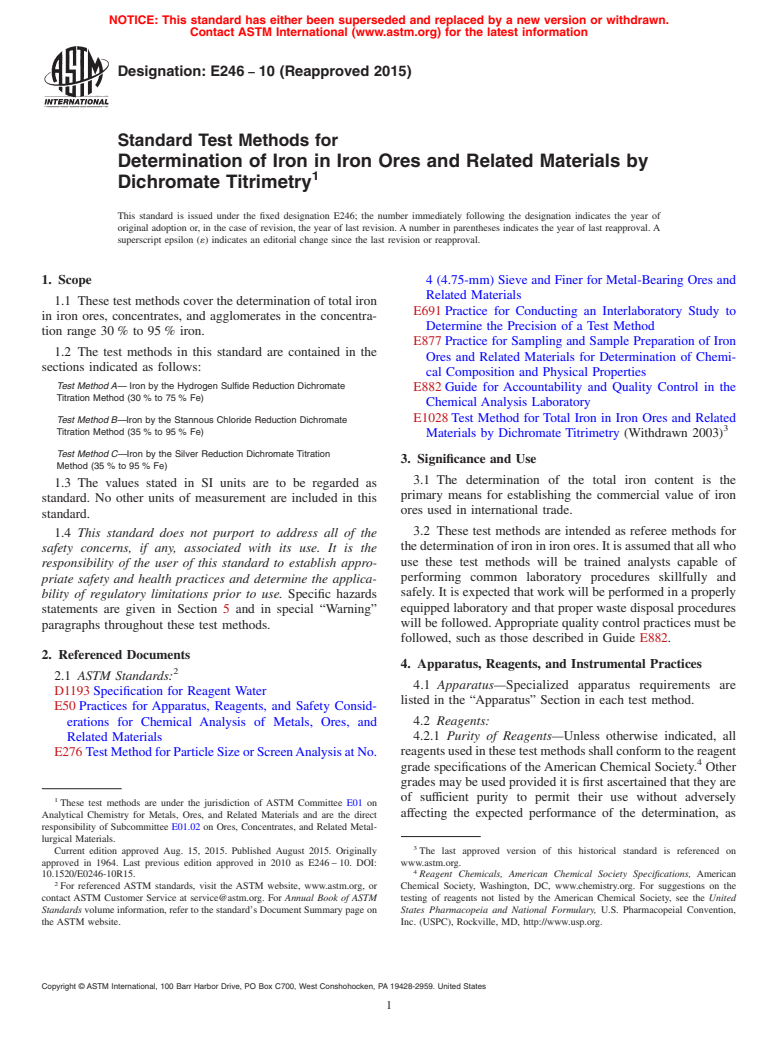
1.1 These test methods cover the determination of total iron in iron ores, concentrates, and agglomerates in the concentration range 30 % to 95 % iron.
1.2 The test methods in this standard are contained in the sections indicated as follows:
Test Method A— Iron by the Hydrogen Sulfide Reduction Dichromate Titration Method (30 % to 75 % Fe)
Test Method B—Iron by the Stannous Chloride Reduction Dichromate Titration Method (35 % to 95 % Fe)
Test Method C—Iron by the Silver Reduction Dichromate Titration Method (35 % to 95 % Fe)
1.3 The values stated in SI units are to be regarded as standard. No other units of measurement are included in this standard.
1.4 This standard does not purport to address all of the safety concerns, if any, associated with its use. It is the responsibility of the user of this standard to establish appropriate safety and health practices and determine the applicability of regulatory limitations prior to use. Specific hazards statements are given in Section 5 and in special “Warning” paragraphs throughout these test methods.
General Information
Buy Standard
Standards Content (Sample)
NOTICE: This standard has either been superseded and replaced by a new version or withdrawn.
Contact ASTM International (www.astm.org) for the latest information
Designation: E246 − 10 (Reapproved 2015)
Standard Test Methods for
Determination of Iron in Iron Ores and Related Materials by
Dichromate Titrimetry
This standard is issued under the fixed designation E246; the number immediately following the designation indicates the year of
original adoption or, in the case of revision, the year of last revision.Anumber in parentheses indicates the year of last reapproval.A
superscript epsilon (´) indicates an editorial change since the last revision or reapproval.
1. Scope 4 (4.75-mm) Sieve and Finer for Metal-Bearing Ores and
Related Materials
1.1 These test methods cover the determination of total iron
E691Practice for Conducting an Interlaboratory Study to
in iron ores, concentrates, and agglomerates in the concentra-
Determine the Precision of a Test Method
tion range 30% to 95% iron.
E877Practice for Sampling and Sample Preparation of Iron
1.2 The test methods in this standard are contained in the
Ores and Related Materials for Determination of Chemi-
sections indicated as follows:
cal Composition and Physical Properties
Test Method A— Iron by the Hydrogen Sulfide Reduction Dichromate
E882Guide for Accountability and Quality Control in the
Titration Method (30% to 75% Fe)
Chemical Analysis Laboratory
E1028Test Method for Total Iron in Iron Ores and Related
Test Method B—Iron by the Stannous Chloride Reduction Dichromate
Titration Method (35% to 95% Fe)
Materials by Dichromate Titrimetry (Withdrawn 2003)
Test Method C—Iron by the Silver Reduction Dichromate Titration
3. Significance and Use
Method (35% to 95% Fe)
3.1 The determination of the total iron content is the
1.3 The values stated in SI units are to be regarded as
primary means for establishing the commercial value of iron
standard. No other units of measurement are included in this
ores used in international trade.
standard.
3.2 These test methods are intended as referee methods for
1.4 This standard does not purport to address all of the
thedeterminationofironinironores.Itisassumedthatallwho
safety concerns, if any, associated with its use. It is the
use these test methods will be trained analysts capable of
responsibility of the user of this standard to establish appro-
performing common laboratory procedures skillfully and
priate safety and health practices and determine the applica-
safely. It is expected that work will be performed in a properly
bility of regulatory limitations prior to use. Specific hazards
equipped laboratory and that proper waste disposal procedures
statements are given in Section 5 and in special “Warning”
will be followed.Appropriate quality control practices must be
paragraphs throughout these test methods.
followed, such as those described in Guide E882.
2. Referenced Documents
4. Apparatus, Reagents, and Instrumental Practices
2.1 ASTM Standards:
4.1 Apparatus—Specialized apparatus requirements are
D1193Specification for Reagent Water
listed in the “Apparatus” Section in each test method.
E50Practices for Apparatus, Reagents, and Safety Consid-
erations for Chemical Analysis of Metals, Ores, and 4.2 Reagents:
4.2.1 Purity of Reagents—Unless otherwise indicated, all
Related Materials
E276TestMethodforParticleSizeorScreenAnalysisatNo. reagentsusedinthesetestmethodsshallconformtothereagent
grade specifications of theAmerican Chemical Society. Other
grades may be used provided it is first ascertained that they are
of sufficient purity to permit their use without adversely
These test methods are under the jurisdiction of ASTM Committee E01 on
Analytical Chemistry for Metals, Ores, and Related Materials and are the direct affecting the expected performance of the determination, as
responsibility of Subcommittee E01.02 on Ores, Concentrates, and Related Metal-
lurgical Materials.
Current edition approved Aug. 15, 2015. Published August 2015. Originally The last approved version of this historical standard is referenced on
approved in 1964. Last previous edition approved in 2010 as E246–10. DOI: www.astm.org.
10.1520/E0246-10R15. Reagent Chemicals, American Chemical Society Specifications, American
For referenced ASTM standards, visit the ASTM website, www.astm.org, or Chemical Society, Washington, DC, www.chemistry.org. For suggestions on the
contact ASTM Customer Service at service@astm.org. For Annual Book of ASTM testing of reagents not listed by the American Chemical Society, see the United
Standards volume information, refer to the standard’s Document Summary page on States Pharmacopeia and National Formulary, U.S. Pharmacopeial Convention,
the ASTM website. Inc. (USPC), Rockville, MD, http://www.usp.org.
Copyright ©ASTM International, 100 Barr Harbor Drive, PO Box C700, West Conshohocken, PA19428-2959. United States
E246 − 10 (2015)
indicated in the “Precision and Bias” Section. Reagent water 1-L flask and dilute to volume with the same acid. When the
shall conform to Type II as described in Specification D1193. sample solution is ready for titration, standardize the
FeSO ·(NH ) SO ·6H O solution against the standard
4 4 2 4 2
5. Hazards
K Cr O (0.1000 N), as described in 12.5. Calculate the
2 2 7
millilitres of standard K Cr O equivalent to 1mL of the
5.1 For precautions to be observed in the use of certain
2 2 7
reagents and equipment in this test method refer to Practices FeSO ·(NH ) SO ·6H O solution.
4 4 2 4 2
E50.
11.2 Potassium Dichromate, Standard Solution (0.1000
N)—Transfer 4.9031g of primary standard grade potassium
6. Sampling and Sample Preparation
dichromate (K Cr O ); previously ground in an agate mortar,
2 2 7
6.1 Collect and prepare the test sample in accordance with
and dried at 105°C to 110°C, to a 1-L volumetric flask.
Practice E877.
Dissolve in water and dilute to 1L. If preferred, this solution
maybepreparedfromreagentgradeK Cr O ,bypurifyingthe
6.2 The test sample shall be pulverized to pass a No.100
2 2 7
(150-µm) sieve in accordance with Test Method E276.To salt twice by recrystallizing from water, drying at 110°C,
pulverizinginanagatemortar,anddryingat180°Ctoconstant
facilitate decomposition some ores, such as specular hematite,
weight. The titer of this solution shall be confirmed by means
require grinding to pass a No.200 (75-µm) sieve.
of standard sample similar in type and composition to the test
TEST METHOD A—IRON BY THE HYDROGEN
sample.
SULFIDE REDUCTION DICHROMATE TITRATION
11.3 Potassium Permanganate Solution (25g⁄L)—Dissolve
METHOD
25g of potassium permanganate (KMnO ) in water and dilute
to 1L.
7. Scope
11.4 Sodium Diphenylamine Sulfonate Indicator Solution—
7.1 This test method covers the determination of total iron
in iron ores, concentrates, and agglomerates in the concentra- Dissolve 0.3g of sodium diphenylamine sulfonate in 100mL
of water. Store in a dark-colored bottle.
tion range from 30% to 75%.
11.5 Sodium Pyrosulfate (Na S O ).
2 2 7
8. Summary of Test Method
11.6 Sulfuric Acid-Hydrogen Sulfide Wash Solution—Add
8.1 ThesampleisdissolvedinHCl.Theinsolubleresidueis
20mLof concentrated H SO (H SO , sp gr 1.84) to 900mL
2 4 2 4
removed by filtration, ignited, treated for the recovery of iron,
water, cool, dilute to 1L, and pass a rapid stream of H S
and added to the main solution. To this solution containing all
through it for at least 10min.
of the iron, H SO is added and the solution evaporated to
2 4
fumes to expel chlorides. The salts are dissolved in water, the
12. Procedure
solution heated to boiling, and the iron reduced by a rapid
stream of hydrogen sulfide (H S).The precipitated sulfides are
12.1 Transferapproximately0.50gofthetestspecimentoa
filtered and washed with an acid-sulfide wash solution until
small weighing bottle previously dried at about 105°C. Dry
freeofiron.ThefiltrateisthenboiledtoexpeltheH S,cooled,
the bottle and contents for 1h at 105°C to 110°C (Note 1).
and titrated with K Cr O solution, using sodium diphenylam-
Cap the bottle and cool to room temperature in a desiccator.
2 2 7
ine sulfonate as the indicator.
Momentarilyreleasethecaptoequalizethepressureandweigh
the capped bottle and sample to the nearest 0.1mg. Repeat the
9. Interferences
drying and weighing until there is no further weight loss.
9.1 None of the elements normally found in iron ores Transferthetestspecimentoa250-mLbeakerandreweighthe
interfere with this test method. These include vanadium,
cappedbottletothenearest0.1mg.Thedifferencebetweenthe
copper, and small amounts of molybdenum, which occasion- two weights is the weight of the sample taken for analysis.
ally occur in iron ores.
NOTE 1—Most ores yield their hygroscopic moisture at this tempera-
ture.Ifadryingtemperatureotherthanthatspecifiedisrequired,thisshall
10. Apparatus
be determined by mutual agreement between manufacturer and purchaser.
10.1 Hydrogen Sulfide Generator—H S shall be obtained
12.2 Decomposition of the Sample—Moisten the sample
from a cylinder of the compressed gas or from a Kipp
with a few millilitres of water and add 25mL of HCl. Cover
generator. A consistent flow of 1L⁄min shall be maintained
the beaker and heat, maintaining a temperature below boiling
and the gas passed through a water trap to remove any salts.
until most of the dark particles are dissolved and no further
10.1.1 Warning—H S is extremely toxic. All procedures
attack is apparent. Add 5mL of HNO and digest for another
involving its use must be performed in an efficient fume hood.
15min. Remove from the source of heat, wash the sides and
Refer to Hazards section in Practices E50.
cover of the beaker, and dilute to 50mL with warm water.
10.2 Crucibles, platinum, 25-mL capacity.
Filter the insoluble residue on a fine-texture paper. Wash the
residuewithwarmHCl(1+50)untiltheyellowcolorofferric
11. Reagents and Materials
chloride is no longer observed and then with warm water six
11.1 Ferrous Ammonium Sulfate Solution (approximately times to eight times. Collect the filtrate and washings in a
0.10 N) —Dissolve 40 g of ferrous ammonium sulfate 600-mLbeakerandreserveasthemainsolution(Note2).Place
(FeSO ·(NH ) SO ·6H O) in H SO (1+19). Transfer to a the paper and residue in a platinum crucible. Char the paper at
4 4 2 4 2 2 4
E246 − 10 (2015)
TABLE 1 Precision Data
Repeatability Reproducibility
Number of Iron Found
Sample
R R
I 2
Laboratories %
s s
r R
(2.8 s) (2.8 s )
r R
Seine River Ore 9 57.52 0.125 0.35 0.126 0.35
Knob Lake Ore 9 58.45 0.097 0.27 0.136 0.38
NBS 27d (64.96% Fe) 6 65.01 0.057 0.16 0.085 0.24
Chilean Iron Ore 9 66.11 0.102 0.29 0.172 0.48
A
Pooled standard deviations 0.101 0.137
A
Weighted by degrees of freedom, n for s and (n−1)for s where n = number of laboratories.
r R
a low temperature, then ignite at 950°C.Allow the crucible to 12.5 Determination of Blank—Determinetheblankvalueof
cool,moistentheresiduewithH SO (1+1),addabout5mL thereagentsconcurrentlywiththetestdetermination,usingthe
2 4
of HF, and heat gently to remove silica and H SO (Note 3).
same amount of all reagents and following all the steps of the
2 4
Cool the crucible, add 3g of Na S O , and heat until a clear procedure. Immediately before titrating with the K Cr O
2 2 7
2 2 7
melt is obtained. Cool, place the crucible in a 250-mL beaker,
solution, add 1.0 mL, accurately measured, of the
add about 25mL of water and 5mL of HCl, and warm to
FeSO ·(NH ) SO ·6H O solution. In another beaker place
4 4 2 4 2
dissolve the melt. Rinse and remove the crucible. Add the
350mLofcoldH SO (1+9)andaddanaccuratelymeasured
2 4
solution and washings to the main solution.
1mL of the FeSO ·(NH ) SO ·6H O solution. Add 5mL of
4 4 2 4 2
H PO and five drops of the sodium diphenylamine sulfonate
3 4
NOTE 2—If the residue is small in amount and perfectly white, the
indicator solution and titrate with the K Cr O solution.
filtration, and treatment of the residue may be omitted without causing
2 2 7
significant error.
Recordthistitrationandsubtractfromthetitrationoftheblank
NOTE 3—The treatment of the residue depends upon the nature of the
solution to obtain the corrected blank.
minerals present. Many ores require only an H SO −HF treatment to
2 4
decompose the residue.
NOTE 6—In the absence of iron, the diphenylamine sulfonate indicator
does not react with the K Cr O solution. The addition of the
12.3 Reduction—To the combined solution add 10mL of 2 2 7
FeSO ·(NH ) SO ·6H O is, therefore, necessary to promote indicator
4 4 2 4 2
H SO (1+1) and evaporate to copious fumes of sulfur
2 4
response in the blank solution.Acorrection must be made in terms of its
trioxide (SO)(Note 4). Cool, dilute to approximately 100mL
equivalent in millilitres of K Cr O solution.
2 2 7
withwater,andheattoboiling.AdddropwiseKMnO solution
until the permanganate color persists. Dilute the solution to
13. Calculation
250mLand again heat to boiling for several minutes. Remove
13.1 Calculate the percentage of iron as follows:
fromthesourceofheatandpassarapidstreamofH Sthrough
the solution for 15 min. (Warning—Hydrogen sulfide is
iron, % 5 @~A 2 B! 3 C/D# 3100 (1)
extremely toxic. All procedures involving its use must be
where:
performed in an efficient fume hood. Refer to Hazards section
A = millilitres of K Cr O required for titration of the
in Practices E50.) Digest at 60°C for 15min and filter through 2 2 7
sample,
a medium-texture paper, collecting the filtrate in a 500-mL
B = millilitres of K Cr O required for titration of the
Erlenmeyer flask. Wash the precipitated sulfides thoroughly 2 2 7
blank,
with the H SO −H S wash solution. Add 10mL of H SO
2 4 2 2 4
C = iron equivalent of the K Cr O , g/mL, and
2 2 7
(1+1) to the solution in the flask and add glass beads to
D = grams of sample used.
prevent bumping. Boil for 10min to expel H S (lead acetate
test paper) and continue boiling for an additional 10min (Note
14. Precision and Bias
5). Remove from the source of heat, cover the flask with a
small watch glass, and cool in running water to 20°C.
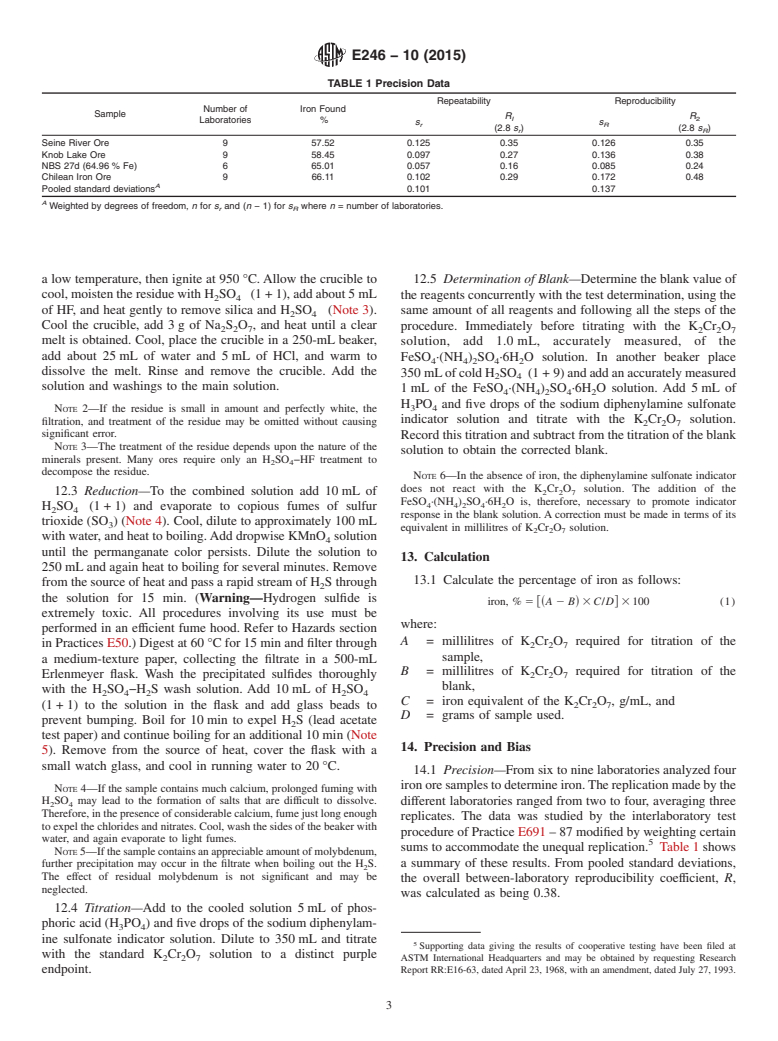
14.1 Precision—From six to nine laboratories analyzed four
ironoresamplestodetermineiron.Thereplicationmadebythe
NOTE 4—If the sample contains much calcium, prolonged fuming with
H SO may lead to the formation of salts that are difficult to dissolve.
different laboratories ranged from two to four, averaging three
2 4
Therefore,inthepresenceofconsiderablecalcium,fumejustlongenough
replicates. The data was studied by the interlaboratory test
toexpelthechloridesandnitrates.Cool,washthesidesofthebeakerwith
procedureofPracticeE691–87modifiedbyweightingcertain
water, and again evaporate to light fumes.
sums to accommodate the unequal replication. Table 1 shows
NOTE5—Ifthesamplecontainsanappreciableamountofmolybdenum,
a summary of these results. From pooled standard deviations,
further precipitation may occur in the filtrate when boiling out the H S.
The effect of
...
This document is not an ASTM standard and is intended only to provide the user of an ASTM standard an indication of what changes have been made to the previous version. Because
it may not be technically possible to adequately depict all changes accurately, ASTM recommends that users consult prior editions as appropriate. In all cases only the current version
of the standard as published by ASTM is to be considered the official document.
Designation: E246 − 10 E246 − 10 (Reapproved 2015)
Standard Test Methods for
Determination of Iron in Iron Ores and Related Materials by
Dichromate Titrimetry
This standard is issued under the fixed designation E246; the number immediately following the designation indicates the year of
original adoption or, in the case of revision, the year of last revision. A number in parentheses indicates the year of last reapproval. A
superscript epsilon (´) indicates an editorial change since the last revision or reapproval.
1. Scope
1.1 These test methods cover the determination of total iron in iron ores, concentrates, and agglomerates in the concentration
range 30 % to 95 % iron.
1.2 The test methods in this standard are contained in the sections indicated as follows:
Test Method A— Iron by the Hydrogen Sulfide Reduction Dichromate
Titration Method (30 % to 75 % Fe)
Test Method B—Iron by the Stannous Chloride Reduction Dichromate
Titration Method (35 % to 95 % Fe)
Test Method C—Iron by the Silver Reduction Dichromate Titration
Method (35 % to 95 % Fe)
1.3 The values stated in SI units are to be regarded as standard. No other units of measurement are included in this standard.
1.4 This standard does not purport to address all of the safety concerns, if any, associated with its use. It is the responsibility
of the user of this standard to establish appropriate safety and health practices and determine the applicability of regulatory
limitations prior to use. Specific hazards statements are given in Section 5 and in special “Warning” paragraphs throughout these
test methods.
2. Referenced Documents
2.1 ASTM Standards:
D1193 Specification for Reagent Water
E50 Practices for Apparatus, Reagents, and Safety Considerations for Chemical Analysis of Metals, Ores, and Related Materials
E276 Test Method for Particle Size or Screen Analysis at No. 4 (4.75-mm) Sieve and Finer for Metal-Bearing Ores and Related
Materials
E691 Practice for Conducting an Interlaboratory Study to Determine the Precision of a Test Method
E877 Practice for Sampling and Sample Preparation of Iron Ores and Related Materials for Determination of Chemical
Composition and Physical Properties
E882 Guide for Accountability and Quality Control in the Chemical Analysis Laboratory
E1028 Test Method for Total Iron in Iron Ores and Related Materials by Dichromate Titrimetry (Withdrawn 2003)
3. Significance and Use
3.1 The determination of the total iron content is the primary means for establishing the commercial value of iron ores used in
international trade.
3.2 These test methods are intended as referee methods for the determination of iron in iron ores. It is assumed that all who use
these test methods will be trained analysts capable of performing common laboratory procedures skillfully and safely. It is expected
These test methods are under the jurisdiction of ASTM Committee E01 on Analytical Chemistry for Metals, Ores, and Related Materials and are the direct responsibility
of Subcommittee E01.02 on Ores, Concentrates, and Related Metallurgical Materials.
Current edition approved June 15, 2010Aug. 15, 2015. Published August 2010August 2015. Originally approved in 1964. Last previous edition approved in 20052010
as E246 – 01 (2005).E246 – 10. DOI: 10.1520/E0246-10.10.1520/E0246-10R15.
For referenced ASTM standards, visit the ASTM website, www.astm.org, or contact ASTM Customer Service at service@astm.org. For Annual Book of ASTM Standards
volume information, refer to the standard’s Document Summary page on the ASTM website.
The last approved version of this historical standard is referenced on www.astm.org.
Copyright © ASTM International, 100 Barr Harbor Drive, PO Box C700, West Conshohocken, PA 19428-2959. United States
E246 − 10 (2015)
that work will be performed in a properly equipped laboratory and that proper waste disposal procedures will be followed.
Appropriate quality control practices must be followed, such as those described in Guide E882.
4. Apparatus, Reagents, and Instrumental Practices
4.1 Apparatus—Specialized apparatus requirements are listed in the “Apparatus” Section in each test method.
4.2 Reagents:
4.2.1 Purity of Reagents—Unless otherwise indicated, all reagents used in these test methods shall conform to the reagent grade
specifications of the American Chemical Society. Other grades may be used provided it is first ascertained that they are of
sufficient purity to permit their use without adversely affecting the expected performance of the determination, as indicated in the
“Precision and Bias” Section. Reagent water shall conform to Type II as described in Specification D1193.
5. Hazards
5.1 For precautions to be observed in the use of certain reagents and equipment in this test method refer to Practices E50.
6. Sampling and Sample Preparation
6.1 Collect and prepare the test sample in accordance with Practice E877.
6.2 The test sample shall be pulverized to pass a No. 100 (150-μm) sieve in accordance with Test Method E276. To facilitate
decomposition some ores, such as specular hematite, require grinding to pass a No. 200 (75-μm) sieve.
TEST METHOD A—IRON BY THE HYDROGEN SULFIDE REDUCTION DICHROMATE TITRATION METHOD
7. Scope
7.1 This test method covers the determination of total iron in iron ores, concentrates, and agglomerates in the concentration
range from 30 % to 75 %.
8. Summary of Test Method
8.1 The sample is dissolved in HCl. The insoluble residue is removed by filtration, ignited, treated for the recovery of iron, and
added to the main solution. To this solution containing all of the iron, H SO is added and the solution evaporated to fumes to expel
2 4
chlorides. The salts are dissolved in water, the solution heated to boiling, and the iron reduced by a rapid stream of hydrogen sulfide
(H S). The precipitated sulfides are filtered and washed with an acid-sulfide wash solution until free of iron. The filtrate is then
boiled to expel the H S, cooled, and titrated with K Cr O solution, using sodium diphenylamine sulfonate as the indicator.
2 2 2 7
9. Interferences
9.1 None of the elements normally found in iron ores interfere with this test method. These include vanadium, copper, and small
amounts of molybdenum, which occasionally occur in iron ores.
10. Apparatus
10.1 Hydrogen Sulfide Generator—H S shall be obtained from a cylinder of the compressed gas or from a Kipp generator. A
consistent flow of 1 L ⁄min shall be maintained and the gas passed through a water trap to remove any salts.
10.1.1 Warning—H S is extremely toxic. All procedures involving its use must be performed in an efficient fume hood. Refer
to Hazards section in Practices E50.
10.2 Crucibles, platinum, 25-mL capacity.
11. Reagents and Materials
11.1 Ferrous Ammonium Sulfate Solution (approximately 0.10 N) —Dissolve 40 g of ferrous ammonium sulfate
(FeSO ·(NH ) SO ·6H O) in H SO (1 + 19). Transfer to a 1-L flask and dilute to volume with the same acid. When the sample
4 4 2 4 2 2 4
solution is ready for titration, standardize the FeSO ·(NH ) SO ·6H O solution against the standard K Cr O (0.1000 N), as
4 4 2 4 2 2 2 7
described in 12.5. Calculate the millilitres of standard K Cr O equivalent to 1 mL of the FeSO ·(NH ) SO ·6H O solution.
2 2 7 4 4 2 4 2
11.2 Potassium Dichromate, Standard Solution (0.1000 N)—Transfer 4.9031 g of primary standard grade potassium dichromate
(K Cr O ); previously ground in an agate mortar, and dried at 105 °C to 110 °C, to a 1-L volumetric flask. Dissolve in water and
2 2 7
dilute to 1 L. If preferred, this solution may be prepared from reagent grade K Cr O , by purifying the salt twice by recrystallizing
2 2 7
from water, drying at 110 °C, pulverizing in an agate mortar, and drying at 180 °C to constant weight. The titer of this solution
shall be confirmed by means of standard sample similar in type and composition to the test sample.
Reagent Chemicals, American Chemical Society Specifications, American Chemical Society, Washington, DC, www.chemistry.org. For suggestions on the testing of
reagents not listed by the American Chemical Society, see the United States Pharmacopeia and National Formulary, U.S. Pharmacopeial Convention, Inc. (USPC), Rockville,
MD, http://www.usp.org.
E246 − 10 (2015)
11.3 Potassium Permanganate Solution (25 g ⁄L)—Dissolve 25 g of potassium permanganate (KMnO ) in water and dilute to
1 L.
11.4 Sodium Diphenylamine Sulfonate Indicator Solution—Dissolve 0.3 g of sodium diphenylamine sulfonate in 100 mL of
water. Store in a dark-colored bottle.
11.5 Sodium Pyrosulfate (Na S O ).
2 2 7
11.6 Sulfuric Acid-Hydrogen Sulfide Wash Solution—Add 20 mL of concentrated H SO (H SO , sp gr 1.84) to 900 mL water,
2 4 2 4
cool, dilute to 1 L, and pass a rapid stream of H S through it for at least 10 min.
12. Procedure
12.1 Transfer approximately 0.50 g of the test specimen to a small weighing bottle previously dried at about 105 °C. Dry the
bottle and contents for 1 h at 105 °C to 110 °C (Note 1). Cap the bottle and cool to room temperature in a desiccator. Momentarily
release the cap to equalize the pressure and weigh the capped bottle and sample to the nearest 0.1 mg. Repeat the drying and
weighing until there is no further weight loss. Transfer the test specimen to a 250-mL beaker and reweigh the capped bottle to the
nearest 0.1 mg. The difference between the two weights is the weight of the sample taken for analysis.
NOTE 1—Most ores yield their hygroscopic moisture at this temperature. If a drying temperature other than that specified is required, this shall be
determined by mutual agreement between manufacturer and purchaser.
12.2 Decomposition of the Sample—Moisten the sample with a few millilitres of water and add 25 mL of HCl. Cover the beaker
and heat, maintaining a temperature below boiling until most of the dark particles are dissolved and no further attack is apparent.
Add 5 mL of HNO and digest for another 15 min. Remove from the source of heat, wash the sides and cover of the beaker, and
dilute to 50 mL with warm water. Filter the insoluble residue on a fine-texture paper. Wash the residue with warm HCl (1 + 50)
until the yellow color of ferric chloride is no longer observed and then with warm water six times to eight times. Collect the filtrate
and washings in a 600-mL beaker and reserve as the main solution (Note 2). Place the paper and residue in a platinum crucible.
Char the paper at a low temperature, then ignite at 950 °C. Allow the crucible to cool, moisten the residue with H SO (1 + 1),
2 4
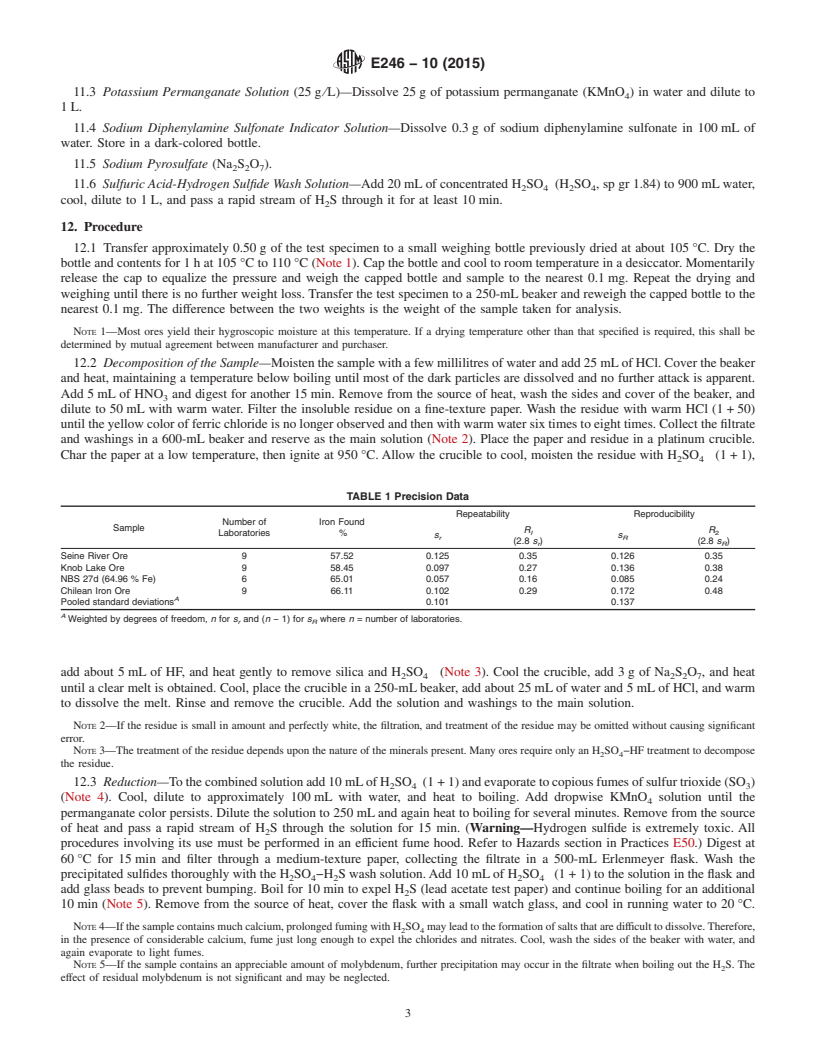
TABLE 1 Precision Data
Repeatability Reproducibility
Number of Iron Found
Sample
R R
I 2
Laboratories %
s s
r R
(2.8 s ) (2.8 s )
r R
Seine River Ore 9 57.52 0.125 0.35 0.126 0.35
Knob Lake Ore 9 58.45 0.097 0.27 0.136 0.38
NBS 27d (64.96 % Fe) 6 65.01 0.057 0.16 0.085 0.24
Chilean Iron Ore 9 66.11 0.102 0.29 0.172 0.48
A
Pooled standard deviations 0.101 0.137
A
Weighted by degrees of freedom, n for s and (n − 1) for s where n = number of laboratories.
r R
add about 5 mL of HF, and heat gently to remove silica and H SO (Note 3). Cool the crucible, add 3 g of Na S O , and heat
2 4 2 2 7
until a clear melt is obtained. Cool, place the crucible in a 250-mL beaker, add about 25 mL of water and 5 mL of HCl, and warm
to dissolve the melt. Rinse and remove the crucible. Add the solution and washings to the main solution.
NOTE 2—If the residue is small in amount and perfectly white, the filtration, and treatment of the residue may be omitted without causing significant
error.
NOTE 3—The treatment of the residue depends upon the nature of the minerals present. Many ores require only an H SO −HF treatment to decompose
2 4
the residue.
12.3 Reduction—To the combined solution add 10 mL of H SO (1 + 1) and evaporate to copious fumes of sulfur trioxide (SO )
2 4 3
(Note 4). Cool, dilute to approximately 100 mL with water, and heat to boiling. Add dropwise KMnO solution until the
permanganate color persists. Dilute the solution to 250 mL and again heat to boiling for several minutes. Remove from the source
of heat and pass a rapid stream of H S through the solution for 15 min. (Warning—Hydrogen sulfide is extremely toxic. All
procedures involving its use must be performed in an efficient fume hood. Refer to Hazards section in Practices E50.) Digest at
60 °C for 15 min and filter through a medium-texture paper, collecting the filtrate in a 500-mL Erlenmeyer flask. Wash the
precipitated sulfides thoroughly with the H SO −H S wash solution. Add 10 mL of H SO (1 + 1) to the solution in the flask and
2 4 2 2 4
add glass beads to prevent bumping. Boil for 10 min to expel H S (lead acetate test paper) and continue boiling for an additional
10 min (Note 5). Remove from the source of heat, cover the flask with a small watch glass, and cool in running water to 20 °C.
NOTE 4—If the sample contains much calcium, prolonged fuming with H SO may lead to the formation of salts that are difficult to dissolve. Therefore,
2 4
in the presence of considerable calcium, fume just long enough to expel the chlorides and nitrates. Cool, wash the sides of the beaker with water, and
again evaporate to light fumes.
NOTE 5—If the sample contains an appreciable amount of molybdenum, further precipitation may occur in the filtrate when boiling out the H S. The
effect of residual molybdenum is not significant and may be neglected.
E246 − 10 (2015)
12.4 Titration—Add to the cooled solution 5 mL of phosphoric acid (H PO ) and five drops of the sodium diphenylamine
3 4
sulfonate indicator solution. Dilute to 350 mL and titrate with the standard K Cr O solution to a distinct purple endpoint.
2 2 7
12.5 Determination of Blank—Determine the blank value of the reagents concurrently with the test determination, using the
same amount of all reagents and following all the steps of the procedure. Immediately before titrating with the K Cr O solution,
2 2 7
add 1.0 mL, accurately measured, of the FeSO ·(NH ) SO ·6H O solution. In another beaker place 350 mL of cold H SO (1 + 9)
4 4 2 4 2 2 4
and add an accurately measured 1 mL of the FeSO ·(NH ) SO ·6H O solution. Add 5 mL of H PO and five drops of the sodium
4 4 2 4 2 3 4
diphenylamine sulfonate indicator solution and titrate with the K Cr O solution. Record this titration and subtract from the
2 2 7
titration of the blank solution to obtain the corrected blank.
NOTE 6—In the absence of iron, the diphenylamine su
...
Questions, Comments and Discussion
Ask us and Technical Secretary will try to provide an answer. You can facilitate discussion about the standard in here.