

ASTM C1422/C1422M-20a
(Specification)Standard Specification for Chemically Strengthened Flat Glass
General Information
- Abstract
SCOPE
1.1 This specification covers the requirements for chemically strengthened glass products that are used in general building construction, transportation, solar, and other electronic applications, such as PC screens, notebooks, tablets, smart phones, and E-readers, as well as copy machine scanners, computer disks, and flat glass screens for television monitors. The technique covered in this specification usually involves conducting ion exchange of constituent alkali ions in a glass product by immersing it in a bath of molten salt containing larger alkali ions. Penetration of the larger ions into smaller host sites produces a layer of compression on the surface which strengthens the glass. Techniques such as ion implantation, dealkalization, etch-strengthening, and glaze coatings are specifically excluded from this specification.
1.2 Classification of chemically strengthened glass products is based on the laboratory measurements of surface compression and case depth (depth of compression) and not on the modulus of rupture (MOR). This specification does not purport to address end-use performance.
1.3 A test method for the measurement of case depth and surface compression is included in Section 8. Another test method for similar measurement using optically guided-wave equipment is included in Section 9.
1.4 The values stated in either SI units or inch-pound units are to be regarded separately as standard. The values stated in each system are not necessarily exact equivalents; therefore, to ensure conformance with the standard, each system shall be used independently of the other, and values from the two systems shall not be combined.
1.5 This standard does not purport to address all of the safety concerns, if any, associated with its use. It is the responsibility of the user of this standard to establish appropriate safety, health, and environmental practices and determine the applicability of regulatory limitations prior to use.
1.6 This international standard was developed in accordance with internationally recognized principles on standardization established in the Decision on Principles for the Development of International Standards, Guides and Recommendations issued by the World Trade Organization Technical Barriers to Trade (TBT) Committee.
- Status
- Published
- Publication Date
- 31-Jul-2020
- Technical Committee
- C14 - Glass and Glass Products
- Drafting Committee
- C14.08 - Flat Glass
Buy Documents
ASTM C1422/C1422M-20a - Standard Specification for Chemically Strengthened Flat Glass
REDLINE ASTM C1422/C1422M-20a - Standard Specification for Chemically Strengthened Flat Glass
Overview
ASTM C1422/C1422M-20a: Standard Specification for Chemically Strengthened Flat Glass establishes requirements and classification criteria for chemically strengthened flat glass used in building, transportation, solar, and various electronic applications. This standard, developed by ASTM International, provides guidance for manufacturers, specifiers, and users regarding the quality and characteristics of glass strengthened primarily by ion exchange processes. The document details methods for measuring critical properties such as surface compression and case depth to ensure the durability and mechanical strength of glass products.
Key Topics
Definition and Scope
The standard covers chemically strengthened glass produced by ion exchange, specifically excluding other surface treatment methods such as ion implantation, dealkalization, or coatings.Classification
Products are classified based on:- Surface Compression: Categorized in levels (Level 1 to Level 7), with increasing compressive stress values indicating greater potential flexural strength.
- Case Depth: Ranges from Level A1 to Level F, indicating the depth of compressive strengthening below the glass surface.
Test Methods
- Section 8 details laboratory testing for surface compression and case depth using polarizing microscopes and other apparatus.
- Section 9 provides an alternative test method for thin glasses using optically guided-wave equipment, especially relevant for electronic display cover applications.
Fabrication and Postprocessing
The standard addresses the importance of not altering the compressive surface after strengthening. Cutting or modifying the glass after treatment may impact its strength. Special marking is required if the glass is cut post-strengthening.Measurement Units
Both SI and inch-pound units are provided, but they are not to be interchanged for compliance purposes.Safety Note
Chemically strengthened glass is not automatically considered a safety glazing product; separate compliance with applicable safety standards may be required.
Applications
Chemically strengthened flat glass is essential in the following areas:
- Building Construction: For use where enhanced strength and resistance to breakage are needed, such as facades, windows, and interior partitions.
- Transportation: Used in vehicles, trains, and other transportation modes where lightweight, strong glass is essential.
- Solar Panels: Protects photovoltaic cells and enhances durability against environmental stressors.
- Consumer Electronics: Used in PC screens, notebooks, tablets, smartphones, e-readers, and flat panel displays for TVs and monitors.
- Office Equipment: Applied in copiers, scanners, and optical storage disks.
The standard’s classification and testing protocols help manufacturers and end-users ensure that the selected glass type meets the performance and durability requirements for its intended application.
Related Standards
To ensure proper application and specification of chemically strengthened flat glass, ASTM C1422/C1422M-20a references several related standards:
- ASTM C162: Terminology of Glass and Glass Products
- ASTM C770: Test Method for Measurement of Glass Stress-Optical Coefficient
- ASTM C1036: Specification for Flat Glass
- ASTM C1279: Measurement of Edge and Surface Stresses in Flat Glass
- ASTM C1648: Guide for Determining Glass Refraction and Dispersion
- ANSI Z97.1: Safety Glazing Materials Used in Buildings
- CPSC 16 CFR 1201: Architectural Glazing Materials Safety Standard
These references help in ensuring compatibility, safety, and optimal performance of chemically strengthened glass in various applications.
Keywords: chemically strengthened flat glass, ASTM C1422/C1422M, ion exchange glass, case depth, surface compression, glass strength specification, building glass, electronic device glass, solar glass, ASTM glass standards
Relations
- Effective Date
- 01-Nov-2023
- Effective Date
- 01-Oct-2023
- Refers
ASTM C770-16(2020) - Standard Test Method for Measurement of Glass Stress—Optical Coefficient - Effective Date
- 01-Aug-2020
- Effective Date
- 01-Aug-2019
- Effective Date
- 01-Feb-2019
- Effective Date
- 01-May-2016
- Effective Date
- 01-Nov-2015
- Effective Date
- 01-May-2014
- Effective Date
- 01-Oct-2013
- Effective Date
- 01-Oct-2013
- Effective Date
- 01-Oct-2012
- Refers
ASTM F218-12 - Standard Test Method for Measuring Optical Retardation and Analyzing Stress in Glass - Effective Date
- 01-Mar-2012
- Effective Date
- 01-Dec-2011
- Effective Date
- 01-Oct-2011
- Effective Date
- 01-Oct-2011
Buy Documents
ASTM C1422/C1422M-20a - Standard Specification for Chemically Strengthened Flat Glass
REDLINE ASTM C1422/C1422M-20a - Standard Specification for Chemically Strengthened Flat Glass
Frequently Asked Questions
ASTM C1422/C1422M-20a is a technical specification published by ASTM International. Its full title is "Standard Specification for Chemically Strengthened Flat Glass". This standard covers: SCOPE 1.1 This specification covers the requirements for chemically strengthened glass products that are used in general building construction, transportation, solar, and other electronic applications, such as PC screens, notebooks, tablets, smart phones, and E-readers, as well as copy machine scanners, computer disks, and flat glass screens for television monitors. The technique covered in this specification usually involves conducting ion exchange of constituent alkali ions in a glass product by immersing it in a bath of molten salt containing larger alkali ions. Penetration of the larger ions into smaller host sites produces a layer of compression on the surface which strengthens the glass. Techniques such as ion implantation, dealkalization, etch-strengthening, and glaze coatings are specifically excluded from this specification. 1.2 Classification of chemically strengthened glass products is based on the laboratory measurements of surface compression and case depth (depth of compression) and not on the modulus of rupture (MOR). This specification does not purport to address end-use performance. 1.3 A test method for the measurement of case depth and surface compression is included in Section 8. Another test method for similar measurement using optically guided-wave equipment is included in Section 9. 1.4 The values stated in either SI units or inch-pound units are to be regarded separately as standard. The values stated in each system are not necessarily exact equivalents; therefore, to ensure conformance with the standard, each system shall be used independently of the other, and values from the two systems shall not be combined. 1.5 This standard does not purport to address all of the safety concerns, if any, associated with its use. It is the responsibility of the user of this standard to establish appropriate safety, health, and environmental practices and determine the applicability of regulatory limitations prior to use. 1.6 This international standard was developed in accordance with internationally recognized principles on standardization established in the Decision on Principles for the Development of International Standards, Guides and Recommendations issued by the World Trade Organization Technical Barriers to Trade (TBT) Committee.
SCOPE 1.1 This specification covers the requirements for chemically strengthened glass products that are used in general building construction, transportation, solar, and other electronic applications, such as PC screens, notebooks, tablets, smart phones, and E-readers, as well as copy machine scanners, computer disks, and flat glass screens for television monitors. The technique covered in this specification usually involves conducting ion exchange of constituent alkali ions in a glass product by immersing it in a bath of molten salt containing larger alkali ions. Penetration of the larger ions into smaller host sites produces a layer of compression on the surface which strengthens the glass. Techniques such as ion implantation, dealkalization, etch-strengthening, and glaze coatings are specifically excluded from this specification. 1.2 Classification of chemically strengthened glass products is based on the laboratory measurements of surface compression and case depth (depth of compression) and not on the modulus of rupture (MOR). This specification does not purport to address end-use performance. 1.3 A test method for the measurement of case depth and surface compression is included in Section 8. Another test method for similar measurement using optically guided-wave equipment is included in Section 9. 1.4 The values stated in either SI units or inch-pound units are to be regarded separately as standard. The values stated in each system are not necessarily exact equivalents; therefore, to ensure conformance with the standard, each system shall be used independently of the other, and values from the two systems shall not be combined. 1.5 This standard does not purport to address all of the safety concerns, if any, associated with its use. It is the responsibility of the user of this standard to establish appropriate safety, health, and environmental practices and determine the applicability of regulatory limitations prior to use. 1.6 This international standard was developed in accordance with internationally recognized principles on standardization established in the Decision on Principles for the Development of International Standards, Guides and Recommendations issued by the World Trade Organization Technical Barriers to Trade (TBT) Committee.
ASTM C1422/C1422M-20a is classified under the following ICS (International Classification for Standards) categories: 81.040.20 - Glass in building. The ICS classification helps identify the subject area and facilitates finding related standards.
ASTM C1422/C1422M-20a has the following relationships with other standards: It is inter standard links to ASTM C1279-23, ASTM C162-23, ASTM C770-16(2020), ASTM C1279-13(2019), ASTM C978-04(2019), ASTM C770-16, ASTM C162-05(2015), ASTM C978-04(2014), ASTM C1279-13, ASTM C770-98(2013), ASTM C1648-12, ASTM F218-12, ASTM E1967-11a, ASTM C1036-11e1, ASTM C1036-11. Understanding these relationships helps ensure you are using the most current and applicable version of the standard.
ASTM C1422/C1422M-20a is available in PDF format for immediate download after purchase. The document can be added to your cart and obtained through the secure checkout process. Digital delivery ensures instant access to the complete standard document.
Standards Content (Sample)
This international standard was developed in accordance with internationally recognized principles on standardization established in the Decision on Principles for the
Development of International Standards, Guides and Recommendations issued by the World Trade Organization Technical Barriers to Trade (TBT) Committee.
Designation: C1422/C1422M −20a
Standard Specification for
Chemically Strengthened Flat Glass
This standard is issued under the fixed designation C1422/C1422M; the number immediately following the designation indicates the
year of original adoption or, in the case of revision, the year of last revision. A number in parentheses indicates the year of last
reapproval. A superscript epsilon (´) indicates an editorial change since the last revision or reapproval.
1. Scope priate safety, health, and environmental practices and deter-
mine the applicability of regulatory limitations prior to use.
1.1 This specification covers the requirements for chemi-
1.6 This international standard was developed in accor-
cally strengthened glass products that are used in general
dance with internationally recognized principles on standard-
building construction, transportation, solar, and other elec-
ization established in the Decision on Principles for the
tronic applications, such as PC screens, notebooks, tablets,
Development of International Standards, Guides and Recom-
smart phones, and E-readers, as well as copy machine
mendations issued by the World Trade Organization Technical
scanners, computer disks, and flat glass screens for television
Barriers to Trade (TBT) Committee.
monitors. The technique covered in this specification usually
involves conducting ion exchange of constituent alkali ions in
2. Referenced Documents
a glass product by immersing it in a bath of molten salt 2
2.1 ASTM Standards:
containing larger alkali ions. Penetration of the larger ions into
C162Terminology of Glass and Glass Products
smaller host sites produces a layer of compression on the
C770Test Method for Measurement of Glass Stress—
surface which strengthens the glass. Techniques such as ion
Optical Coefficient
implantation, dealkalization, etch-strengthening, and glaze
C978Test Method for Photoelastic Determination of Re-
coatings are specifically excluded from this specification.
sidual Stress in a Transparent Glass Matrix Using a
1.2 Classificationofchemicallystrengthenedglassproducts Polarizing Microscope and Optical Retardation Compen-
is based on the laboratory measurements of surface compres- sation Procedures
sion and case depth (depth of compression) and not on the C1036Specification for Flat Glass
modulusofrupture(MOR).Thisspecificationdoesnotpurport C1279Test Method for Non-Destructive Photoelastic Mea-
to address end-use performance. surement of Edge and Surface Stresses in Annealed,
Heat-Strengthened, and Fully Tempered Flat Glass
1.3 A test method for the measurement of case depth and
C1648Guide for Choosing a Method for Determining the
surface compression is included in Section 8. Another test
Index of Refraction and Dispersion of Glass
method for similar measurement using optically guided-wave
E1967Test Method for the Automated Determination of
equipment is included in Section 9.
Refractive Index of Glass Samples Using the Oil Immer-
1.4 The values stated in either SI units or inch-pound units
sion Method and a Phase Contrast Microscope
are to be regarded separately as standard. The values stated in
F218Test Method for Measuring Optical Retardation and
eachsystemarenotnecessarilyexactequivalents;therefore,to
Analyzing Stress in Glass
ensure conformance with the standard, each system shall be
2.2 ANSI Standard:
used independently of the other, and values from the two
Z97.1-2015Safety Glazing Materials Used In Buildings -
systems shall not be combined.
Safety Performance Specifications And Methods Of Test
2.3 Federal Standard:
1.5 This standard does not purport to address all of the
16 CFR 1201Consumer Product Safety Commission Safety
safety concerns, if any, associated with its use. It is the
Standard for Architectural Glazing Materials
responsibility of the user of this standard to establish appro-
For referenced ASTM standards, visit the ASTM website, www.astm.org, or
contact ASTM Customer Service at service@astm.org. For Annual Book of ASTM
This specification is under the jurisdiction ofASTM Committee C14 on Glass Standards volume information, refer to the standard’s Document Summary page on
and Glass Products and is the direct responsibility of Subcommittee C14.08 on Flat the ASTM website.
Glass. Available fromAmerican National Standards Institute (ANSI), 25 W. 43rd St.,
Current edition approved Aug. 1, 2020. Published September 2020. Originally 4th Floor, New York, NY 10036, http://www.ansi.org.
approved in 1999. Last previous edition approved in 2020 as C1422/C1422M–20. AvailablefromU.S.ConsumerProductSafetyCommission(CPSC),4330East
DOI: 10.1520/C1422_C1422M-20A. West Hwy., Bethesda, MD 20814, http://www.cpsc.gov.
Copyright © ASTM International, 100 Barr Harbor Drive, PO Box C700, West Conshohocken, PA 19428-2959. United States
C1422/C1422M − 20a
3. Terminology 4.4 The very nature of the chemical strengthening process
alterstheglasssurfacechemistry.Therefore,theproceduresfor
3.1 Definitions:
and the performance of postprocessing steps, such as laminat-
3.1.1 For definitions of general terms used in this
ing and coating, can be different from that of nonchemically
specification, refer to Terminology C162. For definitions of
strengthened glass.
terms concerning flat glass blemishes, refer to Specification
C1036. 4.5 Modulus of rupture (MOR), weight gain measurement,
3.2 Definitions of Terms Specific to This Standard: and optical methods are examples of procedures used for
process control in chemical strengthening. In addition to those
3.2.1 case depth, n—depth of compression below the sur-
described in Sections 8 and 9, optical methods utilizing
facetothenearestzerostressplane;thismeasurementdoesnot
differential surface refractometer (DSR) and scattered light
depend upon the wavelength of the light beam employed.
photoelasticity stress meter (SLP) have been proven to be
3.2.2 center tension (CT) , n—the magnitude of the maxi-
reliableforsomespecificglasstypesandthicknessesandsome
mum in-plane tensile stress in the interior of the glass away
specific ion-exchange couples (potassium for sodium in the
from the ion-exchanged region.
glass or sodium for lithium in the glass).
3.2.3 chemically strengthened glass, n—glass which has
been strengthened by ion exchange to produce a compressive
5. Classification
stress layer at the treated surface.
5.1 Kinds—Chemically strengthened glass furnished in ac-
3.2.4 depth of compression (DOC), n—see case depth.
cordance with this specification shall be classified on the basis
3.2.5 depth of layer (DOL), n—in optically guided-wave of the surface compression levels (Level 1-7) and case depth
type equipment, the DOL is the depth of location where the (Levels A-F). Surface compression and case depth are inde-
differential refractive index profile reverses sign; this depth is pendentofeachother.Increasinglevelsofsurfacecompression
shorter than the depth of ion penetration when measured using permit an increasing amount of flexure. Greater case depths
instruments such as the spectroscopic microprobe, and is offer more protection from strength reduction caused by abuse
longer than the case depth. and abrasion. Case depth values may vary on different thick-
nesses of the same glass type which have been manufactured
3.2.6 ion exchange process (IOX or IX), n—theexchangeof
under similar chemical exchange conditions. For classification
constituent ions in the glass with externally supplied ions
purposes, all surface compression and case depth values are to
(generally at temperatures near the strain point of the glass),
be reported, along with the sheet thickness of the witness
which when of a larger ionic radius, build strengthening
specimen in accordance with 8.1.3. See Fig. 1.
compressive stress in the exchange region; this may be
5.1.1 Surface Compression:
accomplished by immersing glass in a molten salt bath or
5.1.1.1 Level 1—Surfacecompression,>7MPa[1000psi]≤
solution with or without electric field, ultrasonic or other
172 MPa [25 000 psi].
assistance, exposing glass to plasma, applying a paste on the
5.1.1.2 Level 2—Surface compression, >172 MPa
glasssurface,orcontactingglasswithmoltensaltsinafurnace;
[25 000 psi] ≤ 345 MPa [50000 psi].
in some cases, ion exchange can be conducted sequentially
5.1.1.3 Level 3—Surface compression, >345 MPa
using multiple baths.
[50 000 psi] ≤ 517 MPa [75000 psi].
3.2.7 surfacecompressionorcompressivestress(CS),n—an
5.1.1.4 Level 4—Surface compression, >517 MPa
in-plane (biaxial) stress generated by constraining the expan-
[75 000 psi] ≤ 690 MPa [100 000 psi].
sion of the surface relative to its equilibrium length along both
5.1.1.5 Level 5—Surface compression, >690 MPa
planar axes.
[100 000 psi] ≤ 862 MPa [125 000 psi].
5.1.1.6 Level 6—Surface compression, >862 MPa
4. Significance and Use
[125 000 psi] ≤ 1034 MPa [150 000 psi].
4.1 Chemically strengthened glass is significantly stronger
5.1.1.7 Level 7—Surface compression, > 1034 MPa
than annealed glass, depending upon the glass composition,
[150 000 psi].
strengthening process, level of abrasion, and the application
5.1.2 Case Depth:
environment. The strengthening process does not contribute
5.1.2.1 Level A1—Case depth, ≤25 µm [0.001 in.].
significantly to optical distortion.
5.1.2.2 Level A2—Case depth, >25 µm and ≤50 µm
4.2 The chemical strengthening process can effectively
[0.002in.]
strengthen glass of all sizes and shapes and can be useful in
5.1.2.3 Level B—Case depth, >50 µm [0.002 in.] and
cases in which glass is too thin, small, or complex-shaped for
≤150µm [0.006 in.].
thermal tempering.
5.1.2.4 Level C—Case depth, >150 µm [0.006 in.] and
≤250µm [0.010 in.].
4.3 Monolithicchemicallystrengthenedglassisnotasafety
5.1.2.5 Level D—Case depth, >250 µm [0.010 in.] and
glazing product because its break pattern is similar to that of
≤350µm [0.014 in.].
annealed glass. When safety glazing is required, chemically
5.1.2.6 Level E—Case depth, >350 µm [0.014 in.] and
strengthened glass shall pass the requirements ofANSI Z97.1-
≤500µm [0.020 in.].
2015, or shall be laminated in accordance with CPSC 16CFR
1201 Cat. I or Cat. II or ANSI Z97.1-2015. 5.1.2.7 Level F—Case depth, >500µm [0.020 in.].
C1422/C1422M − 20a
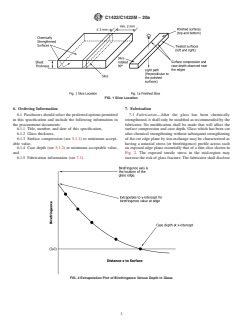
FIG. 1 Slice Location
6. Ordering Information 7. Fabrication
6.1 Purchasersshould select the preferred optionspermitted 7.1 Fabrication—After the glass has been chemically
in this specification and include the following information in strengthened, it shall only be modified as recommended by the
the procurement documents: fabricator. No modification shall be made that will affect the
6.1.1 Title, number, and date of this specification, surface compression and case depth. Glass which has been cut
6.1.2 Glass thickness, after chemical strengthening without subsequent strengthening
6.1.3 Surface compression (see 5.1.1) or minimum accept- of the cut edge plane by ion-exchange may be characterized as
able value, having a uniaxial stress (or birefringence) profile across such
6.1.4 Case depth (see 5.1.2) or minimum acceptable value, an exposed edge plane essentially that of a thin slice shown in
and Fig. 2. The exposed tensile stress in the mid-region may
6.1.5 Fabrication information (see 7.1). increase the risk of glass fracture.The fabricator shall disclose
FIG. 2 Extrapolation Plot of Birefringence Versus Depth in Glass
C1422/C1422M − 20a
to the end user instances where glass has been cut after a microscope defined in 8.2, either in conjunction with a
chemical strengthening without subsequent strengthening of suitable compensator in accordance withTest Method C978 or
the cut edge by ion exchange and any permanent logo applied by photoelastic color pattern observation (in accordance with
to such a glass article shall include the words “CUT AFTER Test Method F218). The retardation can be converted to stress
STRENGTHENING.” using the stress optic coefficient obtained from Test Method
7.1.1 Thickness—Substrates for chemically strengthened C770 or Eq 1.
glass shall be in accordance with the thicknes
...
This document is not an ASTM standard and is intended only to provide the user of an ASTM standard an indication of what changes have been made to the previous version. Because
it may not be technically possible to adequately depict all changes accurately, ASTM recommends that users consult prior editions as appropriate. In all cases only the current version
of the standard as published by ASTM is to be considered the official document.
Designation: C1422/C1422M − 20 C1422/C1422M − 20a
Standard Specification for
Chemically Strengthened Flat Glass
This standard is issued under the fixed designation C1422/C1422M; the number immediately following the designation indicates the
year of original adoption or, in the case of revision, the year of last revision. A number in parentheses indicates the year of last
reapproval. A superscript epsilon (´) indicates an editorial change since the last revision or reapproval.
1. Scope
1.1 This specification covers the requirements for chemically strengthened glass products that are used in general building
construction, transportation, solar, and other electronic applications, such as PC screens, notebooks, tablets, smart phones, and
E-readers, as well as copy machine scanners, computer disks, and flat glass screens for television monitors. The technique covered
in this specification usually involves conducting ion exchange of constituent alkali ions in a glass product by immersing it in a bath
of molten salt containing larger alkali ions. Penetration of the larger ions into smaller host sites produces a layer of compression
on the surface which strengthens the glass. Techniques such as ion implantation, dealkalization, etch-strengthening, and glaze
coatings are specifically excluded from this specification.
1.2 Classification of chemically strengthened glass products is based on the laboratory measurements of surface compression and
case depth (depth of compression) and not on the modulus of rupture (MOR). This specification does not purport to address end-use
performance.
1.3 A test method for the measurement of case depth and surface compression is included in Section 8. Another test method for
similar measurement using optically guided-wave equipment is included in Section 9.
1.4 The values stated in either SI units or inch-pound units are to be regarded separately as standard. The values stated in each
system mayare not benecessarily exact equivalents; therefore, to ensure conformance with the standard, each system shall be used
independently of the other. Combiningother, and values from the two systems may result in non-conformance with the
standard.shall not be combined.
1.5 This standard does not purport to address all of the safety concerns, if any, associated with its use. It is the responsibility
of the user of this standard to establish appropriate safety, health, and environmental practices and determine the applicability of
regulatory limitations prior to use.
1.6 This international standard was developed in accordance with internationally recognized principles on standardization
established in the Decision on Principles for the Development of International Standards, Guides and Recommendations issued
by the World Trade Organization Technical Barriers to Trade (TBT) Committee.
2. Referenced Documents
2.1 ASTM Standards:
C162 Terminology of Glass and Glass Products
C770 Test Method for Measurement of Glass Stress—Optical Coefficient
This specification is under the jurisdiction of ASTM Committee C14 on Glass and Glass Products and is the direct responsibility of Subcommittee C14.08 on Flat Glass.
Current edition approved April 15, 2020Aug. 1, 2020. Published April 2020September 2020. Originally approved in 1999. Last previous edition approved in 20152020
as C1422/C1422M – 15.C1422/C1422M – 20. DOI: 10.1520/C1422_C1422M-20.10.1520/C1422_C1422M-20A.
For referenced ASTM standards, visit the ASTM website, www.astm.org, or contact ASTM Customer Service at service@astm.org. For Annual Book of ASTM Standards
volume information, refer to the standard’s Document Summary page on the ASTM website.
Copyright © ASTM International, 100 Barr Harbor Drive, PO Box C700, West Conshohocken, PA 19428-2959. United States
C1422/C1422M − 20a
C978 Test Method for Photoelastic Determination of Residual Stress in a Transparent Glass Matrix Using a Polarizing
Microscope and Optical Retardation Compensation Procedures
C1036 Specification for Flat Glass
C1279 Test Method for Non-Destructive Photoelastic Measurement of Edge and Surface Stresses in Annealed, Heat-
Strengthened, and Fully Tempered Flat Glass
C1648 Guide for Choosing a Method for Determining the Index of Refraction and Dispersion of Glass
E1967 Test Method for the Automated Determination of Refractive Index of Glass Samples Using the Oil Immersion Method
and a Phase Contrast Microscope
F218 Test Method for Measuring Optical Retardation and Analyzing Stress in Glass
2.2 ANSI Standard:
Z97.1-2015 Z97.1-2015. Safety Glazing Materials Used In Buildings - Safety Performance Specifications And Methods Of Test
2.3 Federal Document:Standard:
CPSC 16CFR16 CFR 1201 Consumer Product Safety Commission Safety Standard for Architectural Glazing Materials
Available from American National Standards Institute (ANSI), 25 W. 43rd St., 4th Floor, New York, NY 10036, http://www.ansi.org.
Available from U.S. Consumer Product Safety Commission (CPSC), 4330 East West Hwy., Bethesda, MD 20814, http://www.cpsc.gov.
C1422/C1422M − 20a
3. Terminology
3.1 Definitions:
3.1.1 Refer For definitions of general terms used in this specification, refer to Terminology C162, as appropriate. For definitions
of terms concerning flat glass blemishes, refer to Specification C1036.
3.1.2 blemishes, n—refer to Specification C1036 for flat glass.
3.2 Definitions of Terms Specific to This Standard:
3.2.1 case depth, n—depth of compression below the surface to the nearest zero stress plane. Thisplane; this measurement does
not depend upon the wavelength of the light beam employed.
3.2.2 center tension (CT) , n—the magnitude of the maximum in-plane tensile stress in the interior of the glass away from the
ion-exchanged region.
3.2.3 chemically strengthened glass, n—glass which has been strengthened by ion exchange to produce a compressive stress layer
at the treated surface.
3.2.4 depth of compression (DOC), n—see case depth.
3.2.5 depth of layer (DOL), n—in optically guided-wave type equipment, the DOL is the depth of location where the differential
refractive index profile reverses sign; this depth is shorter than the depth of ion penetration when measured using instruments such
as the spectroscopic microprobe, and is longer than the case depth.
3.2.6 ion exchange process (IOX or IX), n—the exchange of constituent ions in the glass with externally supplied ions (generally
at temperatures near the strain point of the glass), which when of a larger ionic radius, build strengthening compressive stress in
the exchange region; this may be accomplished by immersing glass in a molten salt bath or solution with or without electric field,
ultrasonic or other assistance, exposing glass to plasma, applying a paste on the glass surface, or contacting glass with molten salts
in a furnace; in some cases, ion exchange can be conducted sequentially using multiple baths.
3.2.7 surface compression or compressive stress (CS), n—an in-plane (biaxial) stress which causes the lengthgenerated by
constraining the expansion of the surface along both planar axes to be reduced with respect to its equilibrium value.” relative to
its equilibrium length along both planar axes.
4. Significance and Use
4.1 Chemically strengthened glass is significantly stronger than annealed glass, depending upon the glass composition,
strengthening process, level of abrasion, and the application environment. The strengthening process does not contribute
significantly to optical distortion.
4.2 The chemical strengthening process can effectively strengthen glass of all sizes and shapes and can be useful in cases in which
glass is too thin, small, or complex-shaped for thermal tempering.
4.3 Monolithic chemically strengthened glass is not a safety glazing product because its break pattern is similar to that of annealed
glass. When safety glazing is required, chemically strengthened glass shall pass the requirements of ANSI Z97.1-2015, or shall be
laminated in accordance with CPSC 16CFR 1201 Cat. I or Cat. II or ANSI Z97.1-2015.
4.4 The very nature of the chemical strengthening process alters the glass surface chemistry. Therefore, the procedures for and the
performance of postprocessing steps, such as laminating and coating, can be different from that of nonchemically strengthened
glass.
4.5 Modulus of rupture (MOR), weight gain measurement, and optical methods are examples of procedures used for process
control in chemical strengthening. In addition to those described in Sections 8 and 9, optical methods utilizing differential surface
C1422/C1422M − 20a
refractometer (DSR) and scattered light photoelasticity stress meter (SLP) have been proven to be reliable for some specific glass
types and thicknesses and some specific ion-exchange couples (potassium for sodium in the glass or sodium for lithium in the
glass).
5. Classification
5.1 Kinds—Chemically strengthened glass furnished in accordance with this specification shall be classified on the basis of the
surface compression levels (Level 1-7) and case depth (Levels A-F). Surface compression and case depth are independent of each
other. Increasing levels of surface compression permit an increasing amount of flexure. Greater case depths offer more protection
from strength reduction caused by abuse and abrasion. Case depth values may vary on different thicknesses of the same glass type
which have been manufactured under similar chemical exchange conditions. For classification purposes, all surface compression
and case depth values are to be reported, along with the sheet thickness of the witness specimen in accordance with 8.1.3. See Fig.
1 and . Fig. 1a.
5.1.1 Surface Compression:
5.1.1.1 Level 1—Surface compression, >7 MPa [1000 psi] ≤172 MPa [25 000 psi].[1000 psi] ≤ 172 MPa [25 000 psi].
5.1.1.2 Level 2—Surface compression, >172 MPa [25 000 psi] ≤345 MPa [50 000 psi].[25 000 psi] ≤ 345 MPa [50 000 psi].
5.1.1.3 Level 3—Surface compression, >345 MPa [50 000 psi] ≤517 MPa [75 000 psi].[50 000 psi] ≤ 517 MPa [75 000 psi].
5.1.1.4 Level 4—Surface compression, >517 MPa [75 000 psi] ≤690 MPa [100 000 psi].[75 000 psi] ≤ 690 MPa [100 000 psi].
5.1.1.5 Level 5—Surface compression, >690 MPa [100 000 psi] ≤862 MPa [125 000 psi].[100 000 psi] ≤ 862 MPa [125 000 psi].
5.1.1.6 Level 6—Surface compression, >862 MPa [125 000 psi] ≤1034 MPa [150 000 psi].[125 000 psi] ≤ 1034 MPa
[150 000 psi].
5.1.1.7 Level 7—Surface compression, >1034 MPa [150 000 psi].> 1034 MPa [150 000 psi].
5.1.2 Case Depth:
5.1.2.1 Level A1—Case depth, ≤25 μm [0.001 in.].
5.1.2.2 Level A2—Case depth, >25 μm and ≤ 50 μm ≤50 μm [0.002 in.]
5.1.2.3 Level B—Case depth, >50 μm [0.002 in.] and ≤150 μm [0.006 in.].
5.1.2.4 Level C—Case depth, >150 μm [0.006 in.] and ≤250 μm [0.010 in.].
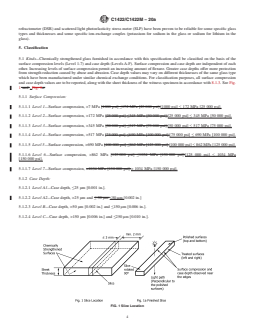
FIG. 1 Slice Location
C1422/C1422M − 20a
5.1.2.5 Level D—Case depth, >250 μm [0.010 in.] and ≤350 μm [0.014 in.].
5.1.2.6 Level E—Case depth, >350 μm [0.014 in.] and ≤500 μm [0.020 in.].
5.1.2.7 Level F—Case depth, >500 μm [0.020 in.].
6. Ordering Information
6.1 Purchasers should select the preferred options permitted in this specification and include the following information in the
procurement documents:
6.1.1 Title, number, and date of this specification.specification,
6.1.2 Glass thickness.thickness,
6.1.3 Surface compression (see 5.1.1) or minimum acceptable value.value,
6.1.4 Case depth (see 5.1.2) or minimum acceptable value.value, and
6.1.5 Fabrication information (see 7.1).
7. Fabrication
7.1 Fabrication—After the glass has been chemically strengthened, it shall only be modified as recommended by the fabricator.
No modification shall be made that will affect the surface compression and case depth. Glass which has been cut after chemical
strengthening without subsequent strengthening of the cut edge plane by ion-exchange may be characterized as having a uniaxial
stress (or birefringence) profile across such an edge which comprises at least one of an absence of compressive stress,exposed edge
plane essentially that of a thin slice shown in Fig. 2an otherwise reduced compressive stress, and exposed tensile stress. . The
exposed tensile stress in the mid-region may increase the risk of glass fracture. The fabricator shall disclose to the end user
instances where glass has been cut after chemical strengthening without subsequent strengthening of the cut edge by ion exchange
and any permanent logo applied to such a glass article shall include the words “CUT AFTER STRENGTHENING.”
FIG. 32 Extrapolation Plot of Birefringence Versus Depth in Glass
C1422/C1422M − 20a
7.1.1 Thickness—Substrates for chemically strengthened glass shall be in accordance with the thicknesses in Specification C1036
or as specified therein (see Section 6). All thicknesses may not be available. Consult the manufacturer or the fabricator.
8. Test Method
8.1 Preparation of Test Specimen:
8.1.1 Prepare the test specimens from the same material as the test batch and anneal before chemically strengthening.
8.1.2 Protect the edges of the test specimens during the preparation process (slicing, grinding, smoothing).
8.1.3 A witness specimen plate having length and width at a minimum of six times the sheet thickness shall be processed. Both
the large flat faces of the specimen shall have the as-fabricated condition. After the chemical strengthening process, slice a section
from this specimen perpendicularly at least 2 mm [0.08 in.] away from the ends (see Fig. 1). The slice thickness shall not exceed
3 mm, which allows for grinding and polishing loss. Lightly polish the slice on its non-chemically strengthened surfaces using
conventional ceramographic techniques and examine it for classification by viewing the optical retardation through the slice
thickness.
NOTE 1—The recommended range is from 0.15 to 3.00 mm [0.005 to 0.12 in.]. Specimen thicknesses at the lower end of this range yield better results.
8.2 Apparatus for Measuring of Surface Stress and Case Depth in Section (Slice) Using Polarizing Microscope:
8.2.1 Microscope, used with a minimum objective times eyepiece magnification of 25×. Case depths < 50 microns <50 μm shall
use a minimum magnification of 50×. The optimum magnification shall be selected based on the case depth.
8.2.2 Polarizers, installed in mutually crossed orientation, aligned at +45° to the symmetry plane of the microscope.
8.2.3 Means of Measuring Distances Between Black Fringe and Edge, including a fine-graduated reticle, an eyepiece reticle, or
stage micrometer of appropriate resolution. The measuring system must resolve 1 μm or 2 % of the case depth, whichever is
greater.
8.3 Measurement of Case Depth:
8.3.1 Using white light, identify the black fringe representing the transition from mid-plane tension to surface compression. Make
the measurement of case depth from the center of that black fringe to the nearest fabrication surface using the reticle or micrometer.
Compute the separation between the center of the dark fringe and the nearest surface using the known calibration and report as
the case depth (see Fig. 23(a) and Fig. 23(b)).(b)).
8.4 Measurement of Surface Stress:
8.4.1 The retardation at the edge of the slice removed from the witness specimen, in other words, the surface stress of the sheet,
can be measured and conver
...