

ASTM D6520-18
(Practice)Standard Practice for the Solid Phase Micro Extraction (SPME) of Water and its Headspace for the Analysis of Volatile and Semi-Volatile Organic Compounds
General Information
- Abstract
SIGNIFICANCE AND USE
5.1 This practice provides a general procedure for the solid phase micro extraction of volatile and semi-volatile organic compounds from an aqueous matrix or its headspace. Solid sorbent extraction is used as the initial step in the extraction of organic constituents for the purpose of quantifying or screening for extractable organic compounds.
5.2 Typical detection limits that can be achieved using SPME techniques with gas chromatography with flame ionization detector (FID), electron capture detector (ECD), or with a mass spectrometer (MS) range from mg/L to μg/L. The detection limit, linear concentration range, and sensitivity of the test method for a specific organic compound will depend upon the aqueous matrix, the fiber phase, the sample temperature, sample volume, sample mixing, and the determinative technique employed.
5.3 SPME has the advantages of speed, no desorption solvent, simple extraction device, and the use of small amounts of sample.
5.3.1 Extraction devices vary from a manual SPME fiber holder to automated commercial device specifically designed for SPME.
5.3.2 Listed below are examples of organic compounds that can be determined by this practice. This list includes both high and low boiling compounds.
Volatile Organic Compounds (1-3)3
Pesticides, General (4, 5)
Organochlorine Pesticides (6)
Organophosphorous Pesticides (7, 8)
Polyaromatic Hydrocarbons (9, 10)
Polychlorinated Biphenyls (10)
Phenols (11)
Nitrophenols (12)
Amines (13)
5.3.3 SPME may be used to screen water samples prior to purge and trap extraction to determine if dilution is necessary, thereby eliminating the possibility of trap overload.
SCOPE
1.1 This practice covers procedures for the extraction of volatile and semi-volatile organic compounds from water and its headspace using solid phase micro extraction (SPME).
1.2 The compounds of interest must have a greater affinity for the SPME-absorbent polymer or adsorbent or combinations of these than the water or headspace phase in which they reside.
1.3 Not all of the analytes that can be determined by SPME are addressed in this practice. The applicability of the absorbent polymer, adsorbent, or combination thereof, to extract the compound(s) of interest must be demonstrated before use.
1.4 This practice provides sample extracts suitable for quantitative or qualitative analysis by gas chromatography (GC) or gas chromatography-mass spectrometry (GC-MS).
1.5 Where used, it is the responsibility of the user to validate the application of SPME to the analysis of interest.
1.6 The values stated in SI units are to be regarded as standard. No other units of measurement are included in this standard.
1.7 This standard does not purport to address all of the safety concerns, if any, associated with its use. It is the responsibility of the user of this standard to establish appropriate safety, health, and environmental practices and determine the applicability of regulatory limitations prior to use. For specific hazard statements, see Section 12.
1.8 This international standard was developed in accordance with internationally recognized principles on standardization established in the Decision on Principles for the Development of International Standards, Guides and Recommendations issued by the World Trade Organization Technical Barriers to Trade (TBT) Committee.
- Status
- Published
- Publication Date
- 14-Dec-2018
- Technical Committee
- D19 - Water
- Drafting Committee
- D19.06 - Methods for Analysis for Organic Substances in Water
Buy Documents
ASTM D6520-18 - Standard Practice for the Solid Phase Micro Extraction (SPME) of Water and its Headspace for the Analysis of Volatile and Semi-Volatile Organic Compounds
REDLINE ASTM D6520-18 - Standard Practice for the Solid Phase Micro Extraction (SPME) of Water and its Headspace for the Analysis of Volatile and Semi-Volatile Organic Compounds
Overview
The ASTM D6520-18 standard practice provides a comprehensive approach for the solid phase micro extraction (SPME) of water and its headspace for the analysis of volatile and semi-volatile organic compounds (VOCs and SVOCs). Developed by ASTM, this standard outlines procedures to efficiently extract and prepare water samples for quantitative and qualitative analysis of organic contaminants. The method harnesses the selectivity and efficiency of SPME, offering significant benefits for environmental monitoring, drinking water analysis, and industrial wastewater assessment.
SPME is recognized for its solvent-free extraction, speed, simplicity, and the ability to operate with small sample volumes. It enables laboratories to achieve sensitive detection limits when coupled with analytical techniques such as gas chromatography (GC) and gas chromatography-mass spectrometry (GC-MS), making it a valuable tool for laboratory professionals in identifying and quantifying organic pollutants in aqueous environments.
Key Topics
Scope and Applicability
- Procedures for extracting volatile and semi-volatile organic compounds from water and headspace samples.
- Compounds must exhibit a greater affinity to the SPME sorbent than the water or headspace phase.
- Suitable for both qualitative and quantitative analysis by GC or GC-MS.
Advantages of SPME
- No need for desorption solvents, reducing sample handling and contamination risk.
- Simple and rapid extraction process adaptable to manual or automated systems.
- Minimal sample requirement, reducing waste and cost.
Target Analytes
- Broad range of high and low boiling point compounds, including:
- Volatile organic compounds (VOCs)
- General and organochlorine/organophosphorus pesticides
- Polyaromatic hydrocarbons (PAHs)
- Polychlorinated biphenyls (PCBs)
- Phenols, nitrophenols, and amines
- Broad range of high and low boiling point compounds, including:
Practical Guidance
- Recommendations on sampler and vial selection, fiber phase optimization, and sample preservation.
- Emphasis on laboratory quality control, calibration, and validation to ensure reliable results.
- Safety and environmental considerations for sample handling and extraction processes.
Applications
ASTM D6520-18 is widely used in:
- Environmental Monitoring: Analysis of contaminated groundwater, surface waters, and effluent streams for regulatory compliance.
- Drinking Water Testing: Screening for trace levels of hazardous organic chemicals to ensure potable water safety.
- Industrial and Municipal Wastewater Analysis: Detection and quantification of process-related VOCs and SVOCs.
- Screening Prior to Purge and Trap Extraction: Determining the need for sample dilution to prevent instrument overload.
- Research and Development: Development of new methods for organic contaminant analysis in varied aqueous matrices.
The method allows for flexible adaptation based on the properties of the target analytes and the complexity of the matrix, making it suitable across sectors where volatile and semi-volatile organic compounds in water are of concern.
Related Standards
For effective implementation, ASTM D6520-18 references and aligns with several related ASTM standards, including:
- ASTM D1129: Terminology Relating to Water
- ASTM D1193: Specification for Reagent Water
- ASTM D3370: Practices for Sampling Water from Closed Conduits
- ASTM D3694: Practices for Preparation of Sample Containers and for Preservation of Organic Constituents
- ASTM D3856: Guide for Management Systems in Laboratories Engaged in Analysis of Water
- ASTM D4448: Guide for Sampling Ground-Water Monitoring Wells
These standards collectively support best practices for sample collection, preservation, analytical quality control, and laboratory management, ensuring high-integrity results from SPME-based water analysis.
Keywords: solid phase micro extraction, SPME, volatile organic compounds, semi-volatile organics, water analysis, ASTM D6520-18, environmental testing, headspace sampling, GC-MS, laboratory standards
Relations
- Effective Date
- 15-Dec-2018
- Effective Date
- 01-Apr-2024
- Effective Date
- 01-May-2020
- Effective Date
- 01-Feb-2019
- Effective Date
- 01-Apr-2013
- Refers
ASTM D3856-11 - Standard Guide for Management Systems in Laboratories Engaged in Analysis of Water - Effective Date
- 15-Nov-2011
- Effective Date
- 01-May-2011
- Effective Date
- 01-Dec-2010
- Effective Date
- 01-Mar-2010
- Effective Date
- 01-Oct-2008
- Effective Date
- 01-Dec-2007
- Effective Date
- 15-Oct-2007
- Effective Date
- 01-Sep-2006
- Effective Date
- 01-Sep-2006
- Effective Date
- 01-Mar-2006
Buy Documents
ASTM D6520-18 - Standard Practice for the Solid Phase Micro Extraction (SPME) of Water and its Headspace for the Analysis of Volatile and Semi-Volatile Organic Compounds
REDLINE ASTM D6520-18 - Standard Practice for the Solid Phase Micro Extraction (SPME) of Water and its Headspace for the Analysis of Volatile and Semi-Volatile Organic Compounds
Get Certified
Connect with accredited certification bodies for this standard

CIS Institut d.o.o.
Personal Protective Equipment (PPE) certification body. Notified Body NB-2890 for EU Regulation 2016/425 PPE.

Kiwa BDA Testing
Building and construction product certification.
Kmetijski inštitut Slovenije
Agricultural Institute of Slovenia. Soil testing, plant health, agricultural product analysis.
Sponsored listings
Frequently Asked Questions
ASTM D6520-18 is a standard published by ASTM International. Its full title is "Standard Practice for the Solid Phase Micro Extraction (SPME) of Water and its Headspace for the Analysis of Volatile and Semi-Volatile Organic Compounds". This standard covers: SIGNIFICANCE AND USE 5.1 This practice provides a general procedure for the solid phase micro extraction of volatile and semi-volatile organic compounds from an aqueous matrix or its headspace. Solid sorbent extraction is used as the initial step in the extraction of organic constituents for the purpose of quantifying or screening for extractable organic compounds. 5.2 Typical detection limits that can be achieved using SPME techniques with gas chromatography with flame ionization detector (FID), electron capture detector (ECD), or with a mass spectrometer (MS) range from mg/L to μg/L. The detection limit, linear concentration range, and sensitivity of the test method for a specific organic compound will depend upon the aqueous matrix, the fiber phase, the sample temperature, sample volume, sample mixing, and the determinative technique employed. 5.3 SPME has the advantages of speed, no desorption solvent, simple extraction device, and the use of small amounts of sample. 5.3.1 Extraction devices vary from a manual SPME fiber holder to automated commercial device specifically designed for SPME. 5.3.2 Listed below are examples of organic compounds that can be determined by this practice. This list includes both high and low boiling compounds. Volatile Organic Compounds (1-3)3 Pesticides, General (4, 5) Organochlorine Pesticides (6) Organophosphorous Pesticides (7, 8) Polyaromatic Hydrocarbons (9, 10) Polychlorinated Biphenyls (10) Phenols (11) Nitrophenols (12) Amines (13) 5.3.3 SPME may be used to screen water samples prior to purge and trap extraction to determine if dilution is necessary, thereby eliminating the possibility of trap overload. SCOPE 1.1 This practice covers procedures for the extraction of volatile and semi-volatile organic compounds from water and its headspace using solid phase micro extraction (SPME). 1.2 The compounds of interest must have a greater affinity for the SPME-absorbent polymer or adsorbent or combinations of these than the water or headspace phase in which they reside. 1.3 Not all of the analytes that can be determined by SPME are addressed in this practice. The applicability of the absorbent polymer, adsorbent, or combination thereof, to extract the compound(s) of interest must be demonstrated before use. 1.4 This practice provides sample extracts suitable for quantitative or qualitative analysis by gas chromatography (GC) or gas chromatography-mass spectrometry (GC-MS). 1.5 Where used, it is the responsibility of the user to validate the application of SPME to the analysis of interest. 1.6 The values stated in SI units are to be regarded as standard. No other units of measurement are included in this standard. 1.7 This standard does not purport to address all of the safety concerns, if any, associated with its use. It is the responsibility of the user of this standard to establish appropriate safety, health, and environmental practices and determine the applicability of regulatory limitations prior to use. For specific hazard statements, see Section 12. 1.8 This international standard was developed in accordance with internationally recognized principles on standardization established in the Decision on Principles for the Development of International Standards, Guides and Recommendations issued by the World Trade Organization Technical Barriers to Trade (TBT) Committee.
SIGNIFICANCE AND USE 5.1 This practice provides a general procedure for the solid phase micro extraction of volatile and semi-volatile organic compounds from an aqueous matrix or its headspace. Solid sorbent extraction is used as the initial step in the extraction of organic constituents for the purpose of quantifying or screening for extractable organic compounds. 5.2 Typical detection limits that can be achieved using SPME techniques with gas chromatography with flame ionization detector (FID), electron capture detector (ECD), or with a mass spectrometer (MS) range from mg/L to μg/L. The detection limit, linear concentration range, and sensitivity of the test method for a specific organic compound will depend upon the aqueous matrix, the fiber phase, the sample temperature, sample volume, sample mixing, and the determinative technique employed. 5.3 SPME has the advantages of speed, no desorption solvent, simple extraction device, and the use of small amounts of sample. 5.3.1 Extraction devices vary from a manual SPME fiber holder to automated commercial device specifically designed for SPME. 5.3.2 Listed below are examples of organic compounds that can be determined by this practice. This list includes both high and low boiling compounds. Volatile Organic Compounds (1-3)3 Pesticides, General (4, 5) Organochlorine Pesticides (6) Organophosphorous Pesticides (7, 8) Polyaromatic Hydrocarbons (9, 10) Polychlorinated Biphenyls (10) Phenols (11) Nitrophenols (12) Amines (13) 5.3.3 SPME may be used to screen water samples prior to purge and trap extraction to determine if dilution is necessary, thereby eliminating the possibility of trap overload. SCOPE 1.1 This practice covers procedures for the extraction of volatile and semi-volatile organic compounds from water and its headspace using solid phase micro extraction (SPME). 1.2 The compounds of interest must have a greater affinity for the SPME-absorbent polymer or adsorbent or combinations of these than the water or headspace phase in which they reside. 1.3 Not all of the analytes that can be determined by SPME are addressed in this practice. The applicability of the absorbent polymer, adsorbent, or combination thereof, to extract the compound(s) of interest must be demonstrated before use. 1.4 This practice provides sample extracts suitable for quantitative or qualitative analysis by gas chromatography (GC) or gas chromatography-mass spectrometry (GC-MS). 1.5 Where used, it is the responsibility of the user to validate the application of SPME to the analysis of interest. 1.6 The values stated in SI units are to be regarded as standard. No other units of measurement are included in this standard. 1.7 This standard does not purport to address all of the safety concerns, if any, associated with its use. It is the responsibility of the user of this standard to establish appropriate safety, health, and environmental practices and determine the applicability of regulatory limitations prior to use. For specific hazard statements, see Section 12. 1.8 This international standard was developed in accordance with internationally recognized principles on standardization established in the Decision on Principles for the Development of International Standards, Guides and Recommendations issued by the World Trade Organization Technical Barriers to Trade (TBT) Committee.
ASTM D6520-18 is classified under the following ICS (International Classification for Standards) categories: 13.060.50 - Examination of water for chemical substances. The ICS classification helps identify the subject area and facilitates finding related standards.
ASTM D6520-18 has the following relationships with other standards: It is inter standard links to ASTM D6520-06(2012), ASTM D3694-96(2024), ASTM D1129-13(2020)e2, ASTM D4448-01(2019), ASTM D4448-01(2013), ASTM D3856-11, ASTM D3694-96(2011), ASTM D3370-10, ASTM D1129-10, ASTM D3370-08, ASTM D3370-07, ASTM D4448-01(2007), ASTM D1129-06a, ASTM D1129-06ae1, ASTM D1193-06. Understanding these relationships helps ensure you are using the most current and applicable version of the standard.
ASTM D6520-18 is available in PDF format for immediate download after purchase. The document can be added to your cart and obtained through the secure checkout process. Digital delivery ensures instant access to the complete standard document.
Standards Content (Sample)
This international standard was developed in accordance with internationally recognized principles on standardization established in the Decision on Principles for the
Development of International Standards, Guides and Recommendations issued by the World Trade Organization Technical Barriers to Trade (TBT) Committee.
Designation: D6520 − 18
Standard Practice for
the Solid Phase Micro Extraction (SPME) of Water and its
Headspace for the Analysis of Volatile and Semi-Volatile
Organic Compounds
This standard is issued under the fixed designation D6520; the number immediately following the designation indicates the year of
original adoption or, in the case of revision, the year of last revision. A number in parentheses indicates the year of last reapproval. A
superscript epsilon (´) indicates an editorial change since the last revision or reapproval.
1. Scope 2. Referenced Documents
1.1 This practice covers procedures for the extraction of 2.1 ASTM Standards:
volatile and semi-volatile organic compounds from water and D1129 Terminology Relating to Water
its headspace using solid phase micro extraction (SPME). D1193 Specification for Reagent Water
D3370 Practices for Sampling Water from Closed Conduits
1.2 The compounds of interest must have a greater affinity
D3694 Practices for Preparation of Sample Containers and
for the SPME-absorbent polymer or adsorbent or combinations
for Preservation of Organic Constituents
of these than the water or headspace phase in which they
D3856 Guide for Management Systems in Laboratories
reside.
Engaged in Analysis of Water
1.3 Not all of the analytes that can be determined by SPME
D4448 Guide for Sampling Ground-Water MonitoringWells
are addressed in this practice. The applicability of the absor-
bent polymer, adsorbent, or combination thereof, to extract the 3. Terminology
compound(s) of interest must be demonstrated before use.
3.1 Definitions:
1.4 This practice provides sample extracts suitable for 3.1.1 For definitions of terms used in this standard, refer to
quantitative or qualitative analysis by gas chromatography Terminology D1129.
(GC) or gas chromatography-mass spectrometry (GC-MS).
4. Summary of Practice
1.5 Whereused,itistheresponsibilityoftheusertovalidate
4.1 This practice employs adsorbent/liquid or adsorbent/gas
the application of SPME to the analysis of interest.
extractiontoisolatecompoundsofinterest.Anaqueoussample
1.6 The values stated in SI units are to be regarded as
is added to a septum-sealed vial. The aqueous phase or its
standard. No other units of measurement are included in this
headspace is then exposed to an adsorbent coated on a fused
standard.
silica fiber. The fiber is desorbed in the heated injection port of
1.7 This standard does not purport to address all of the
a GC or GC-MS or the injector of an high-performance liquid
safety concerns, if any, associated with its use. It is the
chromatography (HPLC).
responsibility of the user of this standard to establish appro-
4.2 The desorbed organic analytes may be analyzed using
priate safety, health, and environmental practices and deter-
instrumental methods for specific volatile or semi-volatile
mine the applicability of regulatory limitations prior to use.
organic compounds. This practice does not include sample
For specific hazard statements, see Section 12.
extract clean-up procedures.
1.8 This international standard was developed in accor-
dance with internationally recognized principles on standard-
5. Significance and Use
ization established in the Decision on Principles for the
5.1 This practice provides a general procedure for the solid
Development of International Standards, Guides and Recom-
phase micro extraction of volatile and semi-volatile organic
mendations issued by the World Trade Organization Technical
compounds from an aqueous matrix or its headspace. Solid
Barriers to Trade (TBT) Committee.
sorbent extraction is used as the initial step in the extraction of
organicconstituentsforthepurposeofquantifyingorscreening
for extractable organic compounds.
This practice is under the jurisdiction ofASTM Committee D19 on Water and
is the direct responsibility of Subcommittee D19.06 on Methods for Analysis for
Organic Substances in Water. For referenced ASTM standards, visit the ASTM website, www.astm.org, or
Current edition approved Dec. 15, 2018. Published January 2019. Originally contact ASTM Customer Service at service@astm.org. For Annual Book of ASTM
approved in 2000. Last previous edition approved in 2012 as D6520 – 06 (2012). Standards volume information, refer to the standard’s Document Summary page on
DOI: 10.1520/D6520-18. the ASTM website.
Copyright © ASTM International, 100 Barr Harbor Drive, PO Box C700, West Conshohocken, PA 19428-2959. United States
D6520 − 18
5.2 Typical detection limits that can be achieved using 7. Interferences
SPME techniques with gas chromatography with flame ioniza-
7.1 Reagents, glassware, septa, fiber coatings, and other
tion detector (FID), electron capture detector (ECD), or with a
sample processing hardware may yield discrete artifacts or
mass spectrometer (MS) range from mg/L to µg/L. The
elevated baselines that can cause poor precision and accuracy.
detection limit, linear concentration range, and sensitivity of
7.1.1 Glassware should be washed with detergent, rinsed
the test method for a specific organic compound will depend
with water, and finally rinsed with distilled-in-glass acetone.
upon the aqueous matrix, the fiber phase, the sample
Air dry or in 103°C oven. Additional cleaning steps may be
temperature, sample volume, sample mixing, and the determi-
required when the analysis requires levels of µg/L or below.
native technique employed.
Once the glassware has been cleaned, it should be used
immediately or stored wrapped in aluminum foil (shiny side
5.3 SPME has the advantages of speed, no desorption
out) or under a stretched sheet of PTFE-fluorocarbon.
solvent,simpleextractiondevice,andtheuseofsmallamounts
7.1.2 Plastics other than PTFE-fluorocarbon should be
of sample.
avoided. They are a significant source of interference and can
5.3.1 Extraction devices vary from a manual SPME fiber
adsorb some organics.
holder to automated commercial device specifically designed
7.1.3 Afield blank prepared from water and carried through
for SPME.
sampling, subsequent storage, and handling can serve as a
5.3.2 Listed below are examples of organic compounds that
check on sources of interferences from the containers.
can be determined by this practice. This list includes both high
7.2 When performing analyses for specific organic
and low boiling compounds.
compounds, matrix interferences may be caused by materials
Volatile Organic Compounds (1-3)
and constituents that are coextracted from the sample. The
Pesticides, General (4, 5)
extent of such matrix interferences will vary considerably
Organochlorine Pesticides (6)
depending on the sample and the specific instrumental analysis
Organophosphorous Pesticides (7, 8)
methodused.Matrixinterferencesmaybereducedbychoosing
Polyaromatic Hydrocarbons (9, 10)
an appropriate SPME adsorbing fiber.
Polychlorinated Biphenyls (10)
Phenols (11)
8. The Technique of SPME
Nitrophenols (12)
Amines (13)
8.1 The technique of SPME uses a short, thin solid rod of
fused silica (typically 1-cm long and 0.11-µm outer diameter),
5.3.3 SPME may be used to screen water samples prior to
coated with a film (30 to 100 µM) of a polymer, copolymer,
purge and trap extraction to determine if dilution is necessary,
carbonaceousadsorbent,oracombinationofthese.Thecoated,
thereby eliminating the possibility of trap overload.
fused silica (SMPE fiber) is attached to a metal rod and the
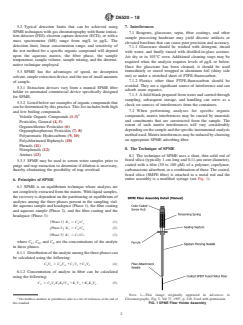
entire assembly is a modified syringe (see Fig. 1).
6. Principles of SPME
6.1 SPME is an equilibrium technique where analytes are
not completely extracted from the matrix.With liquid samples,
the recovery is dependent on the partitioning or equilibrium of
analytes among the three phases present in the sampling vial:
the aqueous sample and headspace (Phase 1), the fiber coating
and aqueous sample (Phase 2), and the fiber coating and the
headspace (Phase 3):
Phase 1 K 5 C /C (1)
~ !
1 L g
Phase 2 K 5 C /C (2)
~ !
2 F L
Phase 3 K 5 C /C (3)
~ !
3 F G
where C , C , and C are the concentrations of the analyte
L G F
in these phases.
6.1.1 Distribution of the analyte among the three phases can
be calculated using the following:
C V 5 C V 1C V 1C V (4)
0 L G G L L F F
6.1.2 Concentration of analyte in fiber can be calculated
using the following:
C 5 C V K K /V 1K V 1K K V (5)
F 0 L 1 2 G 1 L 1 2 F
NOTE 1—This image originally appeared in Advances in
Chromatography, Fig. 5, Vol 37, 1997, p. 218. Used with permission.
The boldface numbers in parentheses refer to a list of references at the end of
this standard. FIG. 1 SPME Fiber Holder Assembly
D6520 − 18
8.2 In the standby position, withdraw the fiber into a
protective sheath. Place an aqueous sample containing organic
analytes or a solid containing organic volatiles into a vial, and
seal the vial with a septum cap.
8.3 Push the sheath with fiber retracted through the vial
septum and lower into the body of the vial. Inject the fiber into
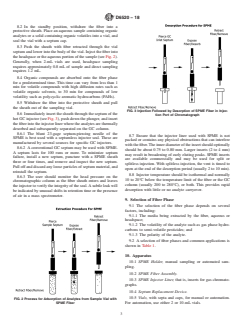
theheadspaceortheaqueousportionofthesample(seeFig.2).
Generally, when 2-mL vials are used, headspace sampling
requires approximately 0.8 mL of sample and direct sampling
requires 1.2 mL.
8.4 Organic compounds are absorbed onto the fiber phase
for a predetermined time. This time can vary from less than 1
min for volatile compounds with high diffusion rates such as
volatile organic solvents, to 30 min for compounds of low
volatility such as polycyclic aromatic hydrocarbons (PAHs).
8.5 Withdraw the fiber into the protective sheath and pull
the sheath out of the sampling vial.
FIG. 3 Injection Followed by Desorption of SPME Fiber in Injec-
8.6 Immediately insert the sheath through the septum of the
tion Port of Chromatograph
hot GC injector (see Fig. 3), push down the plunger, and insert
the fiber into the injector liner where the analytes are thermally
desorbed and subsequently separated on the GC column.
8.6.1 The blunt 23-gage septum-piercing needle of the
8.7 Ensure that the injector liner used with SPME is not
SPME is best used with a septumless injector seal. These are
packed or contains any physical obstructions that can interfere
manufactured by several sources for specific GC injectors.
withthefiber.Theinnerdiameteroftheinsertshouldoptimally
8.6.2 A conventional GC septum may be used with SPME.
should be about 0.75 to 0.80 mm. Larger inserts (2 to 4 mm)
A septum lasts for 100 runs or more. To minimize septum
may result in broadening of early eluting peaks. SPME inserts
failure, install a new septum, puncture with a SPME sheath
are available commercially and may be used for split or
three or four times, and remove and inspect the new septum.
splitless injection. With splitless injection, the vent is timed to
Pull off and discard any loose particles of septum material, and
open at the end of the desorption period (usually 2 to 10 min).
reinstall the septum.
8.8 Injector temperature should be isothermal and normally
8.6.3 The user should monitor the head pressure on the
10 to 20°C below the temperature limit of the fiber or the GC
chromatographic column as the fiber sheath enters and leaves
column (usually 200 to 280°C), or both. This provides rapid
the injector to verify the integrity of the seal.Asubtle leak will
desorption with little or no analyte carryover.
be indicated by unusual shifts in retention time or the presence
of air in a mass spectrometer.
9. Selection of Fiber Phase
9.1 The selection of the fiber phase depends on several
factors, including:
9.1.1 The media being extracted by the fiber, aqueous or
headspace;
9.1.2 The volatility of the analyte such as gas phase hydro-
carbons to semi-volatile pesticides; and
9.1.3 The polarity of the analyte.
9.2 A selection of fiber phases and common applications is
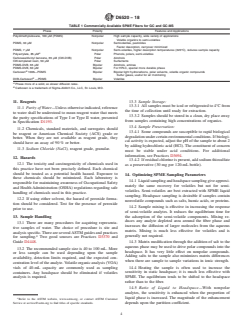
shown in Table 1.
10. Apparatus
10.1 SPME Holder, manual sampling or automated sam-
pling.
10.2 SPME Fiber Assembly.
10.3 SPME Injector Liner, that is, inserts for gas chromato-
graphs.
10.4 Septum Replacement Device.
10.5 Vials, with septa and caps, for manual or automation.
FIG. 2 Process for Adsorption of Analytes from Sample Vial with
SPME Fiber For automation, use either 2 or 10-mL vials.
D6520 − 18
TABLE 1 Commercially Available SPME Fibers for GC and GC-MS
Phase Polarity Features and Applications
Polydimethylsiloxane, 100 µM (PDMS) Nonpolar High sample capacity, wide variety of applications
Volatile organics to semi-volatiles
PDMS, 30 µM Nonpolar Semivolatiles, pesticides
Faster desorption, carryover minimized
PDMS, 7 µM Nonpolar Semi-volatiles, higher desorption temperatures (320°C), reduces sample capacity
A
Polyacrylate, 85 µM Polar Phenols, polars, semi-volatiles
Carbowax/divinyl benzene, 65 µM (CW-DVB) Polar Alcohols
CW-templated resin, 50 µM Polar Surfactants
PDMS-DVB, 65 µM Bipolar Alcohols, amines
PDMS-DVB, 60 µM Bipolar For HPLC, special more durable phase
B
Carboxen 1006—PDMS Bipolar Bipolar light hydrocarbons, polar solvents, volatile organic compounds
Sulfur gases, useful for air monitoring
B
DVB-Carboxen —PDMS Bipolar Volatiles
A
Phase more of a solid, so slower diffusion rates.
B
Carboxen is a trademark of Sigma-Aldrich Co., LLC, St. Louis, MO.
11. Reagents 13.3 Sample Storage:
13.3.1 All samples must be iced or refrigerated to 4°C from
11.1 Purity of Water—Unless otherwise indicated, reference
the time of collection until ready for extraction.
to water shall be understood to mean reagent water that meets
13.3.2 Samples should be stored in a clean, dry place away
the purity specifications of Type I or Type II water, presented
from samples containing high concentrations of organics.
in Specification D1193.
13.4 Sample Preservation:
11.2 Chemicals, standard materials, and surrogates should
13.4.1 Some compounds are susceptible to rapid biological
be reagent or American Chemical Society (ACS) grade or
degradation under certain environmental conditions. If biologi-
better. When they are not available as reagent grade, they
cal activity is expected, adjust the pH of the sample to about 2
should have an assay of 90 % or better.
by adding hydrochloric acid (HCl). The constituent of concern
11.3 Sodium Chloride (NaCl), reagent grade, granular.
must be stable under acid conditions. For additional
information, see Practices D3694.
12. Hazards
13.4.2 If residual chlorine is present, add sodium thiosulfate
12.1 The tox
...
This document is not an ASTM standard and is intended only to provide the user of an ASTM standard an indication of what changes have been made to the previous version. Because
it may not be technically possible to adequately depict all changes accurately, ASTM recommends that users consult prior editions as appropriate. In all cases only the current version
of the standard as published by ASTM is to be considered the official document.
Designation: D6520 − 06 (Reapproved 2012) D6520 − 18
Standard Practice for
the Solid Phase Micro Extraction (SPME) of Water and its
Headspace for the Analysis of Volatile and Semi-Volatile
Organic Compounds
This standard is issued under the fixed designation D6520; the number immediately following the designation indicates the year of
original adoption or, in the case of revision, the year of last revision. A number in parentheses indicates the year of last reapproval. A
superscript epsilon (´) indicates an editorial change since the last revision or reapproval.
1. Scope
1.1 This practice covers procedures for the extraction of volatile and semi-volatile organic compounds from water and its
headspace using solid-phase microextraction solid phase micro extraction (SPME).
1.2 The compounds of interest must have a greater affinity for the SPME-absorbent polymer or adsorbent or combinations of
these than the water or headspace phase in which they reside.
1.3 Not all of the analytes that can be determined by SPME are addressed in this practice. The applicability of the absorbent
polymer, adsorbent, or combination thereof, to extract the compound(s) of interest must be demonstrated before use.
1.4 This practice provides sample extracts suitable for quantitative or qualitative analysis by gas chromatography (GC) or gas
chromatography-mass spectrometry (GC-MS).
1.5 Where used, it is the responsibility of the user to validate the application of SPME to the analysis of interest.
1.6 The values stated in SI units are to be regarded as the standard. No other units of measurement are included in this standard.
1.7 This standard does not purport to address all of the safety concerns, if any, associated with its use. It is the responsibility
of the user of this standard to establish appropriate safety safety, health, and healthenvironmental practices and determine the
applicability of regulatory limitations prior to use. For specific hazard statements, see Section 1012.
1.8 This international standard was developed in accordance with internationally recognized principles on standardization
established in the Decision on Principles for the Development of International Standards, Guides and Recommendations issued
by the World Trade Organization Technical Barriers to Trade (TBT) Committee.
2. Referenced Documents
2.1 ASTM Standards:
D1129 Terminology Relating to Water
D1193 Specification for Reagent Water
D3370 Practices for Sampling Water from Closed Conduits
D3694 Practices for Preparation of Sample Containers and for Preservation of Organic Constituents
D3856 Guide for Management Systems in Laboratories Engaged in Analysis of Water
D4210 Practice for Intralaboratory Quality Control Procedures and a Discussion on Reporting Low-Level Data (Withdrawn
2002)
D4448 Guide for Sampling Ground-Water Monitoring Wells
3. Terminology
3.1 Definitions—For definitions of terms used in this practice, refer to Terminology D1129.
3.1 Definitions:
3.1.1 For definitions of terms used in this standard, refer to Terminology D1129.
This practice is under the jurisdiction of ASTM Committee D19 on Water and is the direct responsibility of Subcommittee D19.06 on Methods for Analysis for Organic
Substances in Water.
Current edition approved June 15, 2012Dec. 15, 2018. Published June 2012January 2019. Originally approved in 2000. Last previous edition approved in 2012 as
D6520 – 06.D6520 – 06 (2012). DOI: 10.1520/D6520-06R12.10.1520/D6520-18.
For referenced ASTM standards, visit the ASTM website, www.astm.org, or contact ASTM Customer Service at service@astm.org. For Annual Book of ASTM Standards
volume information, refer to the standard’s Document Summary page on the ASTM website.
Copyright © ASTM International, 100 Barr Harbor Drive, PO Box C700, West Conshohocken, PA 19428-2959. United States
D6520 − 18
4. Summary of Practice
4.1 This practice employs adsorbent/liquid or adsorbent/gas extraction to isolate compounds of interest. An aqueous sample is
added to a septum-sealed vial. The aqueous phase or its headspace is then exposed to an adsorbent coated on a fused silica fiber.
The fiber is desorbed in the heated injection port of a GC or GC-MS or the injector of an HPLC.high-performance liquid
chromatography (HPLC).
4.2 The desorbed organic analytes may be analyzed using instrumental methods for specific volatile or semi-volatile organic
compounds. This practice does not include sample extract clean-up procedures.
5. Significance and Use
5.1 This practice provides a general procedure for the solid-phase microextraction solid phase micro extraction of volatile and
semi-volatile organic compounds from an aqueous matrix or its headspace. Solid sorbent extraction is used as the initial step in
the extraction of organic constituents for the purpose of quantifying or screening for extractable organic compounds.
5.2 Typical detection limits that can be achieved using SPME techniques with gas chromatography with flame ionization
detector (FID), electron capture detector (ECD), or with a mass spectrometer (MS) range from mg/L to μg/L. The detection limit,
linear concentration range, and sensitivity of the test method for a specific organic compound will depend upon the aqueous matrix,
the fiber phase, the sample temperature, sample volume, sample mixing, and the determinative technique employed.
5.3 SPME has the advantages of speed, no desorption solvent, simple extraction device, and the use of small amounts of sample.
5.3.1 Extraction devices vary from a manual SPME fiber holder to automated commercial device specifically designed for
SPME.
5.3.2 Listed below are examples of organic compounds that can be determined by this practice. This list includes both high and
low boiling compounds. The numbers in parentheses refer to references at the end of this standard.
Volatile Organic Compounds (1,2,3)
Pesticides, General (4,5)
Organochlorine Pesticides (6)
Organophosphorous Pesticides (7,8)
Polyaromatic Hydrocarbons (9,10)
Polychlorinated biphenyls (10)
Phenols (11)
Nitrophenols (12)
Amines (13)
Volatile Organic Compounds (1-3)
Pesticides, General (4, 5)
Organochlorine Pesticides (6)
Organophosphorous Pesticides (7, 8)
Polyaromatic Hydrocarbons (9, 10)
Polychlorinated Biphenyls (10)
Phenols (11)
Nitrophenols (12)
Amines (13)
5.3.3 SPME may be used to screen water samples prior to purge and trap extraction to determine if dilution is necessary, thereby
eliminating the possibility of trap overload.
6. Principles of SPME
6.1 SPME is an equilibrium technique where analytes are not completely extracted from the matrix. With liquid samples, the
recovery is dependent on the partitioning or equilibrium of analytes among the three phases present in the sampling vial: the
aqueous sample and headspace (Phase 1), the fiber coating and aqueous sample (Phase 2), and the fiber coating and the headspace
(Phase 3):
~Phase 1! K 5 C /C (1)
1 L g
Phase 2 K 5 C /C (2)
~ !
2 F L
Phase 3 K 5 C /C (3)
~ !
3 F G
Phase 1 K 5 C /C (1)
~ !
1 L g
~Phase 2! K 5 C /C (2)
2 F L
Phase 3 K 5 C /C (3)
~ !
3 F G
The last approved version of this historical standard is referenced on www.astm.org.boldface numbers in parentheses refer to a list of references at the end of this standard.
D6520 − 18
where C , C , and C are the concentrations of the analyte in these phases.
L G G F F
6.1.1 Distribution of the analyte among the three phases can be calculated using the following:
Distribution of the analyte among the three phases can be calculated using the following:
C V 5 C V 1C V 1C V (4)
0 L G G L L F F
6.1.2 Concentration of analyte in fiber can be calculated using the following:
Concentration of analyte in fiber can be calculated using the following:
C 5 C V K K /V 1K V 1K K V (5)
F 0 L 1 2 G 1 L 1 2 F
7. Interferences
7.1 Reagents, glassware, septa, fiber coatings, and other sample processing hardware may yield discrete artifacts or elevated
baselines that can cause poor precision and accuracy.
7.1.1 Glassware should be washed with detergent, rinsed with water, and finally rinsed with distilled-in-glass acetone. Air dry
or in 103°C oven. Additional cleaning steps may be required when the analysis requires levels of μg/L or below. Once the glassware
has been cleaned, it should be used immediately or stored wrapped in aluminum foil (shiny side out) or under a stretched sheet
of PTFE-fluorocarbon.
7.1.2 Plastics other than PTFE-fluorocarbon should be avoided. They are a significant source of interference and can adsorb
some organics.
7.1.3 A field blank prepared from water and carried through sampling, subsequent storage, and handling can serve as a check
on sources of interferences from the containers.
7.2 When performing analyses for specific organic compounds, matrix interferences may be caused by materials and
constituents that are coextracted from the sample. The extent of such matrix interferences will vary considerably depending on the
sample and the specific instrumental analysis method used. Matrix interferences may be reduced by choosing an appropriate SPME
adsorbing fiber.
8. The Technique of SPME
8.1 The technique of SPME uses a short, thin solid rod of fused silica (typically 1-cm long and 0.11-μm outer diameter), coated
with a film (30 to 100 μM) of a polymer, copolymer, carbonaceous adsorbent, or a combination of these. The coated, fused silica
(SMPE fiber) is attached to a metal rod and the entire assembly is a modified syringe (see Fig. 1).
8.2 In the standby position, withdraw the fiber into a protective sheath. Place an aqueous sample containing organic analytes
or a solid containing organic volatiles into a vial, and seal the vial with a septum cap.
NOTE 1—This figure is Fig. 5, p.image originally appeared in 218, Vol 37, Advances in Chromatography, 1997. Fig. 5, Vol 37, 1997, p. 218. Used with
permission.
FIG. 1 SPME Fiber Holder Assembly
D6520 − 18
8.3 Push the sheath with fiber retracted through the vial septum and lower into the body of the vial. Inject the fiber into the
headspace or the aqueous portion of the sample (see Fig. 2). Generally, when 2-mL vials are used, headspace sampling requires
approximately 0.8 mL of sample and direct sampling requires 1.2 mL.
8.4 Organic compounds are absorbed onto the fiber phase for a predetermined time. This time can vary from less than 1 min
for volatile compounds with high diffusion rates such as volatile organic solvents, to 30 min for compounds of low volatility such
as PAHs.polycyclic aromatic hydrocarbons (PAHs).
8.5 Withdraw the fiber into the protective sheath and pull the sheath out of the sampling vial.
8.6 Immediately insert the sheath through the septum of the hot GC injector (see Fig. 3), push down the plunger, and insert the
fiber into the injector liner where the analytes are thermally desorbed and subsequently separated on the GC column.
8.6.1 The blunt 23-gage septum-piercing needle of the SPME is best used with a septumless injector seal. These are
manufactured by several sources for specific GC injectors.
8.6.2 A conventional GC septum may be used with SPME. A septum lasts for 100 runs or more. To minimize septum failure,
install a new septum, puncture with a SPME sheath three or four times, and remove and inspect the new septum. Pull off and
discard any loose particles of septum material, and reinstall the septum.
8.6.3 The user should monitor the head pressure on the chromatographic column as the fiber sheath enters and leaves the injector
to verify the integrity of the seal. A subtle leak will be indicated by unusual shifts in retention time or the presence of air in a mass
spectrometer.
8.7 Ensure that the injector liner used with SPME is not packed or contains any physical obstructions that can interfere with
the fiber. The inner diameter of the insert should optimally should be about 0.75 to 0.80 mm. Larger inserts (2 to 4 mm) may result
in broadening of early eluting peaks. SPME inserts are available commercially and may be used for split or splitless injection. With
splitless injection, the vent is timed to open at the end of the desorption period (usually 2 to 10 min).
8.8 Injector temperature should be isothermal and normally 10 to 20°C below the temperature limit of the fiber or the GC
column (usually 200 to 280°C), or both. This provides rapid desorption with little or no analyte carryover.
9. Selection of Fiber Phase
9.1 The selection of the fiber phase depends on several factors, including:
9.1.1 The media being extracted by the fiber, aqueous or headspace,headspace;
9.1.2 The volatility of the analyte such as gas phase hydrocarbons to semivolatile pesticides,semi-volatile pesticides; and
9.1.3 The polarity of the analyte.
9.2 A selection of fiber phases and common applications is shown in Table 1.
10. Apparatus
10.1 SPME Holder, manual sampling or automated sampling.
10.2 SPME Fiber Assembly.
FIG. 2 Process for Adsorption of Analytes from Sample Vial with SPME Fiber
D6520 − 18
FIG. 3 Injection Followed by Desorption of SPME Fiber in Injection Port of Chromatograph
10.3 SPME Injector Liner, that is, inserts for gas chromatographs.
10.4 Septum Replacement Device,Device. Merlin or Jade.
10.5 Vials, with septa and caps, for manual or automation. For automation, use either 2-2 or 10–mL10-mL vials.
11. Reagents
11.1 Purity of Water—Unless otherwise indicated, reference to water shall be understood to mean reagent water that meets the
purity specifications of Type I or Type II water, presented in Specification D1193.
11.2 Chemicals, standard materials, and surrogates should be reagent or ACS American Chemical Society (ACS) grade or better.
When they are not available as reagent grade, they should have an assay of 90 % or better.
11.3 Sodium Chloride (NaCl), reagent grade, granular.
12. Hazards
12.1 The toxicity and carcinogenicity of chemicals used in this practice have not been precisely defined. Each chemical should
be treated as a potential health hazard. Exposure to these chemicals should be minimized. Each laboratory is responsible for
maintaining awareness of OSHA Occupational Safety and Health Administration (OSHA) regulations regarding safe handling of
chemicals used in this practice.
12.2 If using either solvent, the hazard of peroxide formation should be considered. Test for the presence of peroxide prior to
use.
13. Sample Handling
13.1 There are many procedures for acquiring representative samples of water. The choice of procedure is site and analysis
specific. There are several ASTM guides and practices for sampling. Two good sources are Practices D3370 and Guide D4448.
13.2 The recommended sample size is 40 to 100 mL. More or less sample can be used depending upon the sample availability,
detection limits required, and the expected concentration level of the analyte. VOA Volatile organic analysis (VOA) vials of 40-mL
capacity are commonly used as sampling containers. Any headspace should be eliminated if volatiles analysis is required.
Refer to the Annual Book of ASTM Standards,ASTM website, Vol 00.01, www.astm.org, or the ASTM Homepage on the internet at www.astm.orgcontact ASTM
Customer Service at service@astm.org to find titles of specific standards.
D6520 − 18
TABLE 1 Commercially Available SPME Fibers for GC and GC/MSGC-MS
Phase Polarity Features and Applications
Phase Polarity Features and Applications
Polydimethylsiloxane, 100 μM (PDMS) Non-polar High sample capacity, wide variety of applications;
volatile organics to semivolatiles
Polydimethylsiloxane, 100 μM (PDMS) Nonpolar High sample capacity, wide variety of applications
Volatile organics to semi-volatiles
PDMS, 30 μM Non-polar Semivolatiles, pesticides.
Faster desorption, carryover minimized
PDMS, 30 μM Nonpolar Semivolatiles, pesticides
Faster desorption, carryover mi
...