

ASTM C846-16(2021)
(Practice)Standard Practice for Application of Cellulosic Fiber Insulating Board for Wall Sheathing
General Information
- Abstract
SIGNIFICANCE AND USE
4.1 This standard provides recommendations for the installation in a safe and effective manner. Actual conditions may vary greatly, and additional care should be taken to ensure a safe and effective installation.
4.2 This standard presents requirements that are general in nature and considered practical. They are not intended as specific recommendations. The user should consult the manufacturer for recommended application methods and procedures.
4.3 This standard does not address the applicability of regulatory limitations. This is the responsibility of the user.
SCOPE
1.1 This practice covers the requirements for storing, handling, and application of cellulosic fiber insulating board products.
1.2 The values stated in inch-pound units are to be regarded as standard. The values given in parentheses are mathematical conversions to SI units that are provided for information only and are not considered standard.
1.3 This standard does not purport to address all of the safety concerns, if any, associated with its use. It is the responsibility of the user of this standard to establish appropriate safety, health, and environmental practices and determine the applicability of regulatory limitations prior to use.
1.4 This international standard was developed in accordance with internationally recognized principles on standardization established in the Decision on Principles for the Development of International Standards, Guides and Recommendations issued by the World Trade Organization Technical Barriers to Trade (TBT) Committee.
- Status
- Published
- Publication Date
- 28-Feb-2021
- Technical Committee
- C16 - Thermal Insulation
- Drafting Committee
- C16.40 - Insulation Systems

Overview
ASTM C846-16(2021), Standard Practice for Application of Cellulosic Fiber Insulating Board for Wall Sheathing, is a recognized international standard developed by ASTM International. This document provides practical recommendations for the storage, handling, and installation of cellulosic fiber insulating board specifically used as wall sheathing in building construction. The guidelines aim to promote safe, effective, and efficient application practices, but do not substitute for manufacturer-specific instructions or regulatory requirements.
Key Topics
- Scope of Application: The standard outlines general requirements for storing, handling, and applying cellulosic fiber insulating boards as wall sheathing. Both regular and structural sheathing types are addressed.
- Material Specifications: Insulating boards used must comply with ASTM C208. Suitable fasteners such as nails, staples, and screws are referenced, as well as acceptable building paper and weather barrier requirements for certain exterior finishes.
- Fastener and Framing Guidance: Recommendations for fastener types and spacings relative to both wood and metal framing are established to ensure secure installation. Standard stud spacings (16 in. or 24 in. on center) are identified based on code requirements.
- Application Methods: The standard covers vertical and horizontal sheathing applications, fastener placements around perimeters and by field, and special instructions for joints at doors, windows, and horizontal intersections.
- Exterior Finishes: Guidance is offered for installing common exterior finishes over cellulosic fiberboard, such as horizontal lap siding, vertical wood siding, mineral fiber shingles, panels, wood shingles, stucco, and masonry veneer.
- Storage and Handling: Sheathing boards must be stored flat, supported, protected from direct ground contact and precipitation, and allowed to reach equilibrium with job site conditions before use.
Applications
The cellulosic fiber insulating board wall sheathing as covered by ASTM C846 is primarily used in:
- Residential and Light Commercial Construction: Applied as an exterior wall sheathing beneath siding, stucco, or veneer, improving thermal performance and contributing to the wall system's racking resistance when required.
- Renovation Projects: Frequently chosen for retrofit wall insulation.
- Weather Barrier Backing: Used in combination with weather-resistant barriers or building paper beneath finishes to protect wall assemblies from moisture ingress.
Key practical benefits:
- Versatility: Supports a variety of exterior finishes, including siding, stucco, and masonry veneer.
- Insulation Enhancement: Adds thermal value as part of the building envelope.
- Regulatory Recognition: Aligns with codes and referenced in project specifications internationally.
Related Standards
Professionals applying ASTM C846-16(2021) should also be familiar with these related standards and specifications:
- ASTM C208: Specification for Cellulosic Fiber Insulating Board - establishes product requirements.
- ASTM D1554: Terminology relating to wood-base fiber and particle panel materials.
- Federal Specification FF-N-105-B: Nails, brads, staples, and spikes used in fastening sheathing.
- Federal Specification UU-B-790-A: Building paper, vegetable fiber for use as a water- and fire-resistant barrier.
Summary
Adherence to ASTM C846-16(2021) ensures that cellulosic fiber insulating board wall sheathing is stored, handled, and installed professionally in line with industry practices. This increases the durability and effectiveness of the building envelope, enhances energy efficiency, and provides a versatile substrate for numerous exterior wall systems. Always consult both this standard and manufacturer instructions for optimal results, and verify compliance with local codes and regulations before installation.
Keywords: cellulosic fiberboard, insulating board, wall sheathing, ASTM C846, installation standard, structural wall sheathing, thermal insulation, building envelope, exterior wall systems.
Relations
- Effective Date
- 01-Sep-2017
- Effective Date
- 01-Sep-2012
- Effective Date
- 01-May-2010
- Effective Date
- 01-Dec-2008
- Effective Date
- 01-Aug-2008
- Effective Date
- 01-Aug-2008
- Refers
ASTM D1554-01(2005) - Standard Terminology Relating to Wood-Base Fiber and Particle Panel Materials - Effective Date
- 01-Oct-2005
- Refers
ASTM D1554-01e1 - Standard Terminology Relating to Wood-Base Fiber and Particle Panel Materials - Effective Date
- 10-Feb-2001
- Effective Date
- 10-Feb-2001
- Effective Date
- 10-Feb-2001
- Effective Date
- 01-Jan-2001
- Effective Date
- 01-Jan-2001
Get Certified
Connect with accredited certification bodies for this standard

DIBt (Deutsches Institut für Bautechnik)
German Institute for Building Technology.
DIN CERTCO
DIN Group product certification.

Aboma Certification B.V.
Specialized in construction, metal, and transport sectors.
Sponsored listings
Frequently Asked Questions
ASTM C846-16(2021) is a standard published by ASTM International. Its full title is "Standard Practice for Application of Cellulosic Fiber Insulating Board for Wall Sheathing". This standard covers: SIGNIFICANCE AND USE 4.1 This standard provides recommendations for the installation in a safe and effective manner. Actual conditions may vary greatly, and additional care should be taken to ensure a safe and effective installation. 4.2 This standard presents requirements that are general in nature and considered practical. They are not intended as specific recommendations. The user should consult the manufacturer for recommended application methods and procedures. 4.3 This standard does not address the applicability of regulatory limitations. This is the responsibility of the user. SCOPE 1.1 This practice covers the requirements for storing, handling, and application of cellulosic fiber insulating board products. 1.2 The values stated in inch-pound units are to be regarded as standard. The values given in parentheses are mathematical conversions to SI units that are provided for information only and are not considered standard. 1.3 This standard does not purport to address all of the safety concerns, if any, associated with its use. It is the responsibility of the user of this standard to establish appropriate safety, health, and environmental practices and determine the applicability of regulatory limitations prior to use. 1.4 This international standard was developed in accordance with internationally recognized principles on standardization established in the Decision on Principles for the Development of International Standards, Guides and Recommendations issued by the World Trade Organization Technical Barriers to Trade (TBT) Committee.
SIGNIFICANCE AND USE 4.1 This standard provides recommendations for the installation in a safe and effective manner. Actual conditions may vary greatly, and additional care should be taken to ensure a safe and effective installation. 4.2 This standard presents requirements that are general in nature and considered practical. They are not intended as specific recommendations. The user should consult the manufacturer for recommended application methods and procedures. 4.3 This standard does not address the applicability of regulatory limitations. This is the responsibility of the user. SCOPE 1.1 This practice covers the requirements for storing, handling, and application of cellulosic fiber insulating board products. 1.2 The values stated in inch-pound units are to be regarded as standard. The values given in parentheses are mathematical conversions to SI units that are provided for information only and are not considered standard. 1.3 This standard does not purport to address all of the safety concerns, if any, associated with its use. It is the responsibility of the user of this standard to establish appropriate safety, health, and environmental practices and determine the applicability of regulatory limitations prior to use. 1.4 This international standard was developed in accordance with internationally recognized principles on standardization established in the Decision on Principles for the Development of International Standards, Guides and Recommendations issued by the World Trade Organization Technical Barriers to Trade (TBT) Committee.
ASTM C846-16(2021) is classified under the following ICS (International Classification for Standards) categories: 91.100.60 - Thermal and sound insulating materials. The ICS classification helps identify the subject area and facilitates finding related standards.
ASTM C846-16(2021) has the following relationships with other standards: It is inter standard links to ASTM C208-12(2017)e1, ASTM C208-12, ASTM D1554-10, ASTM C208-08a, ASTM C208-08, ASTM C208-08e1, ASTM D1554-01(2005), ASTM D1554-01e1, ASTM D1554-00, ASTM D1554-01, ASTM C208-95, ASTM C208-95(2001). Understanding these relationships helps ensure you are using the most current and applicable version of the standard.
ASTM C846-16(2021) is available in PDF format for immediate download after purchase. The document can be added to your cart and obtained through the secure checkout process. Digital delivery ensures instant access to the complete standard document.
Standards Content (Sample)
This international standard was developed in accordance with internationally recognized principles on standardization established in the Decision on Principles for the
Development of International Standards, Guides and Recommendations issued by the World Trade Organization Technical Barriers to Trade (TBT) Committee.
Designation: C846 − 16 (Reapproved 2021)
Standard Practice for
Application of Cellulosic Fiber Insulating Board for Wall
Sheathing
This standard is issued under the fixed designation C846; the number immediately following the designation indicates the year of
original adoption or, in the case of revision, the year of last revision. A number in parentheses indicates the year of last reapproval. A
superscript epsilon (´) indicates an editorial change since the last revision or reapproval.
1. Scope 3. Terminology
1.1 This practice covers the requirements for storing, 3.1 Definitions of Terms Specific to This Standard:
handling, and application of cellulosic fiber insulating board 3.1.1 exterior finish—the shingle, lap, or panel siding
products.
material, masonry veneer, or stucco applied over the sheathing
as a protective, decorative exterior finish of the building.
1.2 The values stated in inch-pound units are to be regarded
as standard. The values given in parentheses are mathematical 3.1.2 fasteners—nails, staples, or screws used for applica-
conversions to SI units that are provided for information only tion of the sheathing.
and are not considered standard.
3.1.3 framing members—those portions of the studs,
1.3 This standard does not purport to address all of the headers, bracing, and blocking which serve to receive the
safety concerns, if any, associated with its use. It is the
sheathing. Framing members can be wood or metal.
responsibility of the user of this standard to establish appro-
3.1.4 regular wall sheathing—described in Definitions
priate safety, health, and environmental practices and deter-
D1554 and Specification C208. It is 4 ft (1.22 m) wide with
mine the applicability of regulatory limitations prior to use.
square-cut edges on all sides and ⁄2 in. (12.7 mm) in thickness.
1.4 This international standard was developed in accor-
3.1.5 structural wall sheathing—described in Definitions
dance with internationally recognized principles on standard-
D1554 and Specification C208. When installed in accordance
ization established in the Decision on Principles for the
with Section 7, it is considered a structural sheathing providing
Development of International Standards, Guides and Recom-
adequate racking resistance. It is 4 ft (1.22 m) wide and ⁄2 in.
mendations issued by the World Trade Organization Technical
(12.7 mm) or ⁄32 in. (19.8 mm) in thickness with square-cut
Barriers to Trade (TBT) Committee.
edges on all sides.
2. Referenced Documents
3.1.6 vertical application—sheathing applied with the long
edges parallel to the studs.
2.1 ASTM Standards:
C208 Specification for Cellulosic Fiber Insulating Board
4. Significance and Use
D1554 Terminology Relating to Wood-Base Fiber and Par-
ticle Panel Materials
4.1 This standard provides recommendations for the instal-
2.2 Federal Specifications:
lation in a safe and effective manner. Actual conditions may
FF-N-105-B with Interim Amendment 4 Nails, Brads,
vary greatly, and additional care should be taken to ensure a
Staples and Spikes: Wire Cut and Wrought
safe and effective installation.
UU-B-790-A Building Paper, Vegetable Fiber: (Kraft,
3 4.2 This standard presents requirements that are general in
Waterproofed, Water Repellent and Fire Resistant)
nature and considered practical. They are not intended as
specific recommendations. The user should consult the manu-
This practice is under the jurisdiction of ASTM Committee C16 on Thermal
facturerforrecommendedapplicationmethodsandprocedures.
Insulation and is the direct responsibility of Subcommittee C16.40 on Insulation
Systems. 4.3 This standard does not address the applicability of
Current edition approved March 1, 2021. Published April 2021. Originally
regulatory limitations. This is the responsibility of the user.
approved in 1976. Last previous edition approved in 2016 as C846 – 16. DOI:
10.1520/C0846-16R21.
5. Materials
For referenced ASTM standards, visit the ASTM website, www.astm.org, or
contact ASTM Customer Service at service@astm.org. For Annual Book of ASTM
5.1 Sheathing shall conform to Specification C208.
Standards volume information, refer to the standard’s Document Summary page on
the ASTM website.
5.2 Nails for application of sheathing to wood framing shall
Available from Standardization Documents Order Desk, DODSSP, Bldg. 4,
conform to Federal Specification FF-N-105-B, including In-
Section D, 700 Robbins Ave., Philadelphia, PA 19111-5098, http://
www.dodssp.daps.mil. terim Amendment 4, and shall be in accordance with Table 1.
Copyright © ASTM International, 100 Barr Harbor Drive, PO Box C700, West Conshohocken, PA 19428-2959. United States
C846 − 16 (2021)
TABLE 1 Nail Dimensions
Sheathing Thickness, Galvanized Steel Common
in. (mm) Roofing Nails Nails
Gage 11 11 ⁄2 (6d)
Length, min, in. (mm) 1 ⁄2 (38.1) 2 (50.8)
1 7 17
⁄2 (12.7) Head diameter, min, in. (mm) ⁄16 (11.1) ⁄64 (6.75)
A
Wire diameter, min, in. (mm) 0.120 (3.06) 0.1130 (2.87)
Gage 11 10 ⁄4 (8d)
3 1
Length, min, in. (mm) 1 ⁄4 (44.5) 2 ⁄2 (63.5)
25 7 9
⁄32 (19.8) Head diameter, min, in. (mm) ⁄16 (11.1) ⁄32 (7.14)
A
Wire diameter, min, in. (mm) 0.120 (3.06) 0.131 (3.33)
A
Prior to galvanizing.
1 25
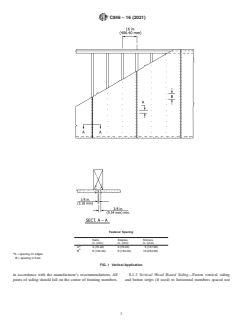
5.3 Staples for application of ⁄2-in. and ⁄32-in. sheathing to 7.1 Vertical Application (see Fig. 1)—Apply 4-ft (1.22-m)
1 25
wood framing shall meet the following requirements: wide by ⁄2-in. (12.7-mm) or by ⁄32-in. (19.8-mm) sheathing
vertically with long edges parallel to the vertical studs. Center
Gage 16
Thickness, min, in. (mm) 0.057 (1.45)
all joints over the framing members with a ⁄8-in. (3.18-mm)
Width, min, in. (mm) 0.063 (1.59)
gap between edges. Leave a ⁄8-in. gap at doors, windows, and
Length, min, in. (mm) 1 ⁄2 (38.1)
7 horizontal joints. Sheathing should extend from sill to plate. If
Crown, min, in. (mm) ⁄16 (11.1)
Points chisel point
not, headers for adequate nailing should be provided at all
divergent point
1 25
horizontal joints.Apply fasteners for ⁄2-in. or ⁄32-in. material
divergent chisel point
using roofing nails, common nails (5.2) or staples (5.3) for
1 25
5.4 Screwsforapplicationof ⁄2-in.and ⁄32-in.sheathingon
wood framing and screws (5.4) for metal framing. Apply
14-gage (0.075-in.) (1.90-mm) to 20-gage (0.036-in.)
fasteners to intermediate framing members first. For wood
(0.91mm) steel studs shall meet the following requirements:
framing, space fasteners 6 in. (152 mm) (Note 1) on center.
...