

ASTM E3105-17(2023)
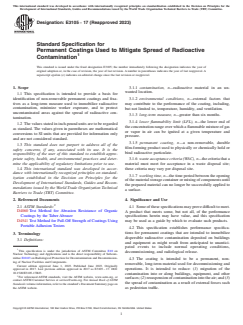
(Specification)Standard Specification for Permanent Coatings Used to Mitigate Spread of Radioactive Contamination
General Information
- Abstract
ABSTRACT
This specification prescribes the performance criteria for non-removable permanent coatings and fixatives as a long-term measure used to immobilize radioactive contamination, minimize worker exposure, and protect uncontaminated areas against the spread of radioactive contamination. It covers the minimum performance requirements (shelf life, adhesion, abrasion resistance, dry/cure time, decontamination factor, airborne release fraction, respirable fraction, radiation resistance) as well as the mechanical and chemical properties for permanent coatings that are intended to immobilize dispersible radioactive contamination deposited on buildings and equipment as might result from anticipated to unanticipated events to include normal operating conditions, decommissioning, and radiological release. The coating is intended to reduce: migration of the contamination into or along buildings, equipment, and other surfaces; resuspension of contamination into the air; and the spread of contamination as a result of external forces such as pedestrian traffic. It shall: be applicable to both vertical and horizontal surfaces; work within a range of environmental and radiological conditions; and be applicable to both porous and nonporous materials such as concrete, wood, metal, ceramics, and plastics. Furthermore, the coating may include constituents that will physically or chemically bind and hold radioactive contamination.
SCOPE
1.1 This specification is intended to provide a basis for identification of non-removable permanent coatings and fixatives as a long-term measure used to immobilize radioactive contamination, minimize worker exposure, and to protect uncontaminated areas against the spread of radioactive contamination.
1.2 The values stated in inch-pound units are to be regarded as standard. The values given in parentheses are mathematical conversions to SI units that are provided for information only and are not considered standard.
1.3 This standard does not purport to address all of the safety concerns, if any, associated with its use. It is the responsibility of the user of this standard to establish appropriate safety, health, and environmental practices and determine the applicability of regulatory limitations prior to use.
1.4 This international standard was developed in accordance with internationally recognized principles on standardization established in the Decision on Principles for the Development of International Standards, Guides and Recommendations issued by the World Trade Organization Technical Barriers to Trade (TBT) Committee.
- Status
- Published
- Publication Date
- 31-May-2023
- Technical Committee
- E10 - Nuclear Technology and Applications


Overview
ASTM E3105-17(2023) is the internationally recognized standard specification for permanent coatings designed to mitigate the spread of radioactive contamination. Developed under the jurisdiction of ASTM Committee E10 on Nuclear Technology and Applications, this standard prescribes the performance criteria for non-removable and durable coatings and fixatives. These specialized coatings play a critical role in immobilizing radioactive particles, minimizing worker exposure, and protecting uncontaminated areas against both anticipated and unanticipated contamination events such as normal operations, decommissioning, and radiological releases.
Key Topics
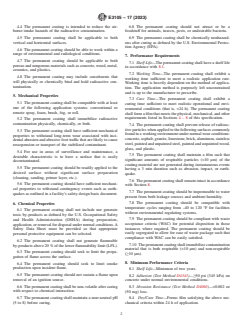
- Performance Requirements: The standard outlines essential properties such as shelf life, adhesion, abrasion resistance, cure time, decontamination factor, airborne and respirable release fractions, and radiation resistance. It mandates a minimum shelf life of two years and a film that cures in under 24 hours, with performance expectations over at least five years.
- Mechanical and Chemical Properties: Permanent coatings must endure environmental stresses (e.g., temperature fluctuations, humidity) and remain effective on a variety of surfaces, including both porous and nonporous materials like concrete, metal, wood, ceramics, and plastics.
- Worker and Environmental Protection: By ensuring minimal resuspension of radioactive particles and reducing airborne intake hazards, the standard supports safety in nuclear facilities and contaminated environments.
- Application Flexibility: The specification allows for diverse application methods (spray, foam, brush, roll, fog) and emphasizes ease of application with minimal surface preparation.
- Compatibility and Safety: Coatings must not introduce new hazards, complying with OSHA and EPA guidance for chemical safety, and must not generate toxic, flammable, or biologically attractive by-products.
Applications
- Nuclear Facility Decommissioning: Used as a long-term contamination control measure during facility shutdown and dismantling, preventing radioactive particle migration and simplifying final cleanup.
- Operational Safety in Nuclear Sites: Applied to buildings, equipment, and infrastructure to immobilize contamination from operations, maintenance, or accidental releases.
- Emergency Response: Serves as a rapid, durable fixative to limit the spread of contamination following incidents involving radiological dispersion.
- Surface Protection: Suitable for both vertical and horizontal surfaces, supporting protection across diverse assets within controlled and potentially contaminated environments.
By meeting the stringent requirements of ASTM E3105, coatings help ensure regulatory compliance, efficient decontamination efforts, and long-term environmental stewardship at sites dealing with radioactive materials.
Related Standards
- ASTM D4060: Test Method for Abrasion Resistance of Organic Coatings by the Taber Abraser - referenced for evaluating wear resistance.
- ASTM D4541: Test Method for Pull-Off Strength of Coatings - used to assess adhesion properties.
- DOE-HDBK-3010: U.S. Department of Energy, Airborne Release Fractions and Respirable Fractions for Nonreactor Nuclear Facilities.
- Waste Acceptance Criteria (WAC): Criteria that materials must meet for acceptance at nuclear waste disposal sites.
Adherence to ASTM E3105-17(2023) enhances worker safety, reduces environmental risks, and ensures the effective long-term immobilization of radioactive contamination-a critical process for the nuclear industry and remediation specialists worldwide.
Relations
- Effective Date
- 01-Feb-2010
- Effective Date
- 01-Feb-2009
- Effective Date
- 01-Jun-2007
- Effective Date
- 10-Feb-2002
- Effective Date
- 10-Feb-2002
- Effective Date
- 10-Dec-2001
- Effective Date
- 10-Dec-2001
Get Certified
Connect with accredited certification bodies for this standard

DNV
DNV is an independent assurance and risk management provider.

Lloyd's Register
Lloyd's Register is a global professional services organisation specialising in engineering and technology.
DNV Energy Systems
Energy and renewable energy certification.
Sponsored listings
Frequently Asked Questions
ASTM E3105-17(2023) is a technical specification published by ASTM International. Its full title is "Standard Specification for Permanent Coatings Used to Mitigate Spread of Radioactive Contamination". This standard covers: ABSTRACT This specification prescribes the performance criteria for non-removable permanent coatings and fixatives as a long-term measure used to immobilize radioactive contamination, minimize worker exposure, and protect uncontaminated areas against the spread of radioactive contamination. It covers the minimum performance requirements (shelf life, adhesion, abrasion resistance, dry/cure time, decontamination factor, airborne release fraction, respirable fraction, radiation resistance) as well as the mechanical and chemical properties for permanent coatings that are intended to immobilize dispersible radioactive contamination deposited on buildings and equipment as might result from anticipated to unanticipated events to include normal operating conditions, decommissioning, and radiological release. The coating is intended to reduce: migration of the contamination into or along buildings, equipment, and other surfaces; resuspension of contamination into the air; and the spread of contamination as a result of external forces such as pedestrian traffic. It shall: be applicable to both vertical and horizontal surfaces; work within a range of environmental and radiological conditions; and be applicable to both porous and nonporous materials such as concrete, wood, metal, ceramics, and plastics. Furthermore, the coating may include constituents that will physically or chemically bind and hold radioactive contamination. SCOPE 1.1 This specification is intended to provide a basis for identification of non-removable permanent coatings and fixatives as a long-term measure used to immobilize radioactive contamination, minimize worker exposure, and to protect uncontaminated areas against the spread of radioactive contamination. 1.2 The values stated in inch-pound units are to be regarded as standard. The values given in parentheses are mathematical conversions to SI units that are provided for information only and are not considered standard. 1.3 This standard does not purport to address all of the safety concerns, if any, associated with its use. It is the responsibility of the user of this standard to establish appropriate safety, health, and environmental practices and determine the applicability of regulatory limitations prior to use. 1.4 This international standard was developed in accordance with internationally recognized principles on standardization established in the Decision on Principles for the Development of International Standards, Guides and Recommendations issued by the World Trade Organization Technical Barriers to Trade (TBT) Committee.
ABSTRACT This specification prescribes the performance criteria for non-removable permanent coatings and fixatives as a long-term measure used to immobilize radioactive contamination, minimize worker exposure, and protect uncontaminated areas against the spread of radioactive contamination. It covers the minimum performance requirements (shelf life, adhesion, abrasion resistance, dry/cure time, decontamination factor, airborne release fraction, respirable fraction, radiation resistance) as well as the mechanical and chemical properties for permanent coatings that are intended to immobilize dispersible radioactive contamination deposited on buildings and equipment as might result from anticipated to unanticipated events to include normal operating conditions, decommissioning, and radiological release. The coating is intended to reduce: migration of the contamination into or along buildings, equipment, and other surfaces; resuspension of contamination into the air; and the spread of contamination as a result of external forces such as pedestrian traffic. It shall: be applicable to both vertical and horizontal surfaces; work within a range of environmental and radiological conditions; and be applicable to both porous and nonporous materials such as concrete, wood, metal, ceramics, and plastics. Furthermore, the coating may include constituents that will physically or chemically bind and hold radioactive contamination. SCOPE 1.1 This specification is intended to provide a basis for identification of non-removable permanent coatings and fixatives as a long-term measure used to immobilize radioactive contamination, minimize worker exposure, and to protect uncontaminated areas against the spread of radioactive contamination. 1.2 The values stated in inch-pound units are to be regarded as standard. The values given in parentheses are mathematical conversions to SI units that are provided for information only and are not considered standard. 1.3 This standard does not purport to address all of the safety concerns, if any, associated with its use. It is the responsibility of the user of this standard to establish appropriate safety, health, and environmental practices and determine the applicability of regulatory limitations prior to use. 1.4 This international standard was developed in accordance with internationally recognized principles on standardization established in the Decision on Principles for the Development of International Standards, Guides and Recommendations issued by the World Trade Organization Technical Barriers to Trade (TBT) Committee.
ASTM E3105-17(2023) is classified under the following ICS (International Classification for Standards) categories: 27.120.20 - Nuclear power plants. Safety. The ICS classification helps identify the subject area and facilitates finding related standards.
ASTM E3105-17(2023) has the following relationships with other standards: It is inter standard links to ASTM D4060-10, ASTM D4541-09, ASTM D4060-07, ASTM D4541-95e1, ASTM D4541-02, ASTM D4060-95, ASTM D4060-01. Understanding these relationships helps ensure you are using the most current and applicable version of the standard.
ASTM E3105-17(2023) is available in PDF format for immediate download after purchase. The document can be added to your cart and obtained through the secure checkout process. Digital delivery ensures instant access to the complete standard document.
Standards Content (Sample)
This international standard was developed in accordance with internationally recognized principles on standardization established in the Decision on Principles for the
Development of International Standards, Guides and Recommendations issued by the World Trade Organization Technical Barriers to Trade (TBT) Committee.
Designation: E3105 − 17 (Reapproved 2023)
Standard Specification for
Permanent Coatings Used to Mitigate Spread of Radioactive
Contamination
This standard is issued under the fixed designation E3105; the number immediately following the designation indicates the year of
original adoption or, in the case of revision, the year of last revision. A number in parentheses indicates the year of last reapproval. A
superscript epsilon (´) indicates an editorial change since the last revision or reapproval.
1. Scope 3.1.1 contamination, n—radioactive material in an un-
wanted location.
1.1 This specification is intended to provide a basis for
identification of non-removable permanent coatings and fixa-
3.1.2 environmental conditions, n—external factors that
tives as a long-term measure used to immobilize radioactive
may contribute to the performance of the coating, including,
contamination, minimize worker exposure, and to protect but not limited to, temperature, humidity, and ventilation.
uncontaminated areas against the spread of radioactive con-
3.1.3 long-term measure, n—greater than six months.
tamination.
3.1.4 lower flammability limit (LFL), n—the lower end of
1.2 The values stated in inch-pound units are to be regarded
the concentration range over which a flammable mixture of gas
as standard. The values given in parentheses are mathematical
or vapor in air can be ignited at a given temperature and
conversions to SI units that are provided for information only
pressure.
and are not considered standard.
3.1.5 permanent coating, n—a non-removable, durable
1.3 This standard does not purport to address all of the
film-forming product used to physically or chemically hold or
safety concerns, if any, associated with its use. It is the
bind radioactive particulate.
responsibility of the user of this standard to establish appro-
priate safety, health, and environmental practices and deter- 3.1.6 waste acceptance criteria (WAC), n—the criteria that a
mine the applicability of regulatory limitations prior to use.
material must meet for acceptance in a waste disposal site;
1.4 This international standard was developed in accor- these criteria may vary per disposal site.
dance with internationally recognized principles on standard-
3.1.7 working time, n—the time period between the opening
ization established in the Decision on Principles for the
of the material storage container or mixing of components until
Development of International Standards, Guides and Recom-
the prepared material can no longer be successfully applied to
mendations issued by the World Trade Organization Technical
a surface.
Barriers to Trade (TBT) Committee.
4. Significance and Use
2. Referenced Documents
2.1 ASTM Standards: 4.1 Some of these specifications may prove difficult to meet.
D4060 Test Method for Abrasion Resistance of Organic A product that meets some, but not all, of the performance
Coatings by the Taber Abraser specifications herein may have value, and this specification
D4541 Test Method for Pull-Off Strength of Coatings Using may be used as a guide by which to evaluate such products.
Portable Adhesion Testers
4.2 This specification establishes performance specifica-
tions for permanent coatings that are intended to immobilize
3. Terminology
dispersible radioactive contamination deposited on buildings
3.1 Definitions:
and equipment as might result from anticipated to unantici-
pated events to include normal operating conditions,
This specification is under the jurisdiction of ASTM Committee E10 on
decommissioning, and radiological release.
Nuclear Technology and Applications and is the direct responsibility of Subcom-
mittee E10.03 on Radiological Protection for Decontamination and Decommission-
4.3 The coating is intended to be a permanent, non-
ing of Nuclear Facilities and Components.
removable, long-term material used for decommissioning and
Current edition approved June 1, 2023. Published June 2023. Originally
operations. It is intended to reduce: (1) migration of the
approved in 2017. Last previous edition approved in 2017 as E3105 – 17. DOI:
10.1520/E3105-17R23.
contamination into or along buildings, equipment, and other
For referenced ASTM standards, visit the ASTM website, www.astm.org, or
surfaces; (2) resuspension of contamination into the air; and (3)
contact ASTM Customer Service at service@astm.org. For Annual Book of ASTM
the spread of contamination as a result of external forces such
Standards volume information, refer to the standard’s Document Summary page on
the ASTM website. as pedestrian traffic.
Copyright © ASTM International, 100 Barr Harbor Drive, PO Box C700, West Conshohocken, PA 19428-2959. United States
E3105 − 17 (2023)
4.4 The permanent coating is intended to reduce the air- 6.8 The permanent coating should not attract or be a
borne intake hazards of the radioactive contamination. foodstuff for animals, insects, pests, or undesirable bacteria.
6.9 The permanent coating shall be chemically nonhazard-
4.5 The permanent coating shall be applicable to both
vertical and horizontal surfaces. ous after curing as defined by the U.S. Environmental Protec-
tion Agency (EPA).
4.6 The permanent coating should be able to work within a
range of environmental and radiological conditions.
7. Performance Requirements
4.7 The permanent coating should be applicable to both
7.1 Shelf Life—The permanent coating shall have a shelf life
porous and nonporous materials such as concrete, wood, metal,
in accordance with 8.1.
ceramics, and plastics.
7.2 Working Time—The permanent coating shall exhibit a
4.8 The permanent coating may include constituents that
working time sufficient to meet a realistic application rate.
will physically or chemically bind and hold radioactive con-
Working time is heavily dependent on the method of applica-
tamination.
tion. The application method is purposely left unconstrained
and is up to the manufacturer to prescribe.
5. Mechanical Properties
7.3 Cure Time—The permanent coating shall exhibit a
5.1 The permanent coating shall be compatible with at least
curing time sufficient to meet realistic operational and envi-
one of the following application systems: conventional or
ronmental conditions (that is, <24 h). The permanent coating
remote spray, foam, brush, fog, or roll.
shall form a film that meets the physical, mechanical, and other
requirements listed in Sections 4 – 8 of this specification.
5.2 The
...