

ASTM C1074-19e1
(Practice)Standard Practice for Estimating Concrete Strength by the Maturity Method
General Information
- Abstract
SIGNIFICANCE AND USE
5.1 This practice can be used to estimate the in-place strength of concrete to allow the start of critical construction activities such as: (1) removal of formwork and reshoring; (2) post-tensioning of tendons; (3) termination of cold weather protection; and (4) opening of roadways to traffic.
5.2 This practice can be used to estimate strength of laboratory specimens cured under non-standard temperature conditions.
5.3 The major limitations of the maturity method are: (1) the concrete must be maintained in a condition that permits cement hydration; (2) the method does not take into account the effects of early-age concrete temperature on the long-term strength (see Note 6) (3, 4); and (3) the method needs to be supplemented by other indications of the potential strength of the field concrete.
5.4 The accuracy of the estimated strength depends, in part, on using the appropriate parameters (datum temperature or value of Q) for the maturity functions described in Section 6.
Note 1: Approximate values of the datum temperature, To, and the Q-value for use in Eq 1 or Eq 2, respectively, are given in Appendix X2. If maximum accuracy of strength estimation is desired, the appropriate values of To or Q for a specific concrete mixture may be determined using the procedures given in Appendix X1.
SCOPE
1.1 This practice provides a procedure for estimating concrete strength by means of the maturity method. The maturity index is expressed either in terms of the temperature-time factor or in terms of the equivalent age at a specified temperature.
1.2 This practice requires establishing the strength-maturity relationship of the concrete mixture in the laboratory and recording the temperature history of the concrete for which strength is to be estimated.
1.3 The values stated in SI units are to be regarded as standard for determining the maturity index. No other units of measurement are included for this purpose. There is, however, no restriction on the system of units for expressing strength in developing the strength-maturity relationship.
1.4 This standard does not purport to address all of the safety concerns, if any, associated with its use. It is the responsibility of the user of this standard to establish appropriate safety, health, and environmental practices and determine the applicability of regulatory limitations prior to use. (Warning—Fresh hydraulic cementitious mixtures are caustic and may cause chemical burns to skin and tissue upon prolonged exposure.2)
1.5 This international standard was developed in accordance with internationally recognized principles on standardization established in the Decision on Principles for the Development of International Standards, Guides and Recommendations issued by the World Trade Organization Technical Barriers to Trade (TBT) Committee.
- Status
- Published
- Publication Date
- 31-May-2019
- Technical Committee
- C09 - Concrete and Concrete Aggregates
- Drafting Committee
- C09.64 - Nondestructive and In-Place Testing
Overview
ASTM C1074-19e1, titled "Standard Practice for Estimating Concrete Strength by the Maturity Method," is an international ASTM standard that provides a systematic procedure for estimating the strength of concrete using the maturity method. This standard is widely recognized in the concrete construction industry for its practical approach to monitoring in-place concrete strength, enabling more precise control over critical construction operations. The maturity method relates the development of concrete strength to its temperature history, providing an estimate of in-place properties based on site conditions rather than relying solely on laboratory-cured samples.
The standard supports safer and more efficient construction by allowing earlier decisions on formwork removal, post-tensioning, and opening concrete structures to service, all based on scientifically-supported strength estimates.
Key Topics
- Maturity Index: The cornerstone of the standard is the calculation of the maturity index, either as a temperature-time factor or as the equivalent age at a given temperature. This index collectively represents the effects of thermal history and time on cement hydration and consequent strength development.
- Strength-Maturity Relationship: The standard requires the empirical establishment of a relationship between strength and maturity for each concrete mixture, based on laboratory tests and temperature monitoring.
- Field Application: By recording the temperature history of in-place concrete, users can determine the maturity index and estimate concrete strength using the previously developed relationship.
- Limitations: The method’s accuracy relies on proper hydration conditions, does not fully account for the effects of high early-age temperatures on long-term strength, and should be supplemented by additional testing for critical operations.
- Safety & Compliance: The standard includes guidance on health, safety, and environmental practice, highlighting the potential hazards of handling fresh concrete materials.
Applications
The maturity method outlined in ASTM C1074-19e1 is valuable for a range of construction scenarios, notably where timely strength assessment is crucial. Its key applications include:
- Formwork Removal & Reshoring: Estimating when concrete has achieved enough strength to safely remove forms or adjust shoring.
- Post-Tensioning of Tendons: Timing post-tensioning operations based on actual in-place concrete strength for structural safety.
- Cold Weather Protection: Determining when thermal protection measures can be safely removed during cold weather concreting.
- Opening to Traffic: Deciding when roadways, airport runways, or similar concrete pavements can be opened to traffic.
- Non-Standard Curing: Estimating the strength of specimens cured under conditions different from laboratory standards, supporting a more realistic assessment of field-cured concrete.
- Quality Control & Fast-Track Construction: Providing real-time data for project managers and engineers to optimize construction speed while maintaining quality and safety.
Related Standards
Several other ASTM standards are referenced and often used in conjunction with ASTM C1074-19e1 to ensure comprehensive quality and compliance in concrete testing and construction:
- ASTM C31/C31M – Standard Practice for Making and Curing Concrete Test Specimens in the Field
- ASTM C39/C39M – Standard Test Method for Compressive Strength of Cylindrical Concrete Specimens
- ASTM C78/C78M – Standard Test Method for Flexural Strength of Concrete (Using Simple Beam with Third-Point Loading)
- ASTM C109/C109M – Standard Test Method for Compressive Strength of Hydraulic Cement Mortars
- ASTM C511 – Specification for Moist Cabinets, Rooms, and Water Storage Tanks Used in Concrete Testing
- ASTM C803/C803M, C873/C873M, C900, C918/C918M, and C1768/C1768M – Non-destructive and accelerated curing test methods for concrete
These related standards collectively support accurate testing, in-place evaluation, and safe, efficient project execution within the concrete construction industry.
Keywords: concrete maturity method, ASTM C1074, estimating concrete strength, in-place concrete strength, temperature-time factor, equivalent age, construction safety, quality control, concrete testing standards.
Relations
- Refers
ASTM C31/C31M-24a - Standard Practice for Making and Curing Concrete Test Specimens in the Field - Effective Date
- 01-Apr-2024
- Refers
ASTM C31/C31M-24 - Standard Practice for Making and Curing Concrete Test Specimens in the Field - Effective Date
- 01-Jan-2024
- Effective Date
- 15-Dec-2023
- Effective Date
- 15-Dec-2023
- Refers
ASTM C39/C39M-23 - Standard Test Method for Compressive Strength of Cylindrical Concrete Specimens - Effective Date
- 01-Dec-2023
- Effective Date
- 01-Dec-2023
- Effective Date
- 01-Oct-2023
- Effective Date
- 01-Apr-2020
- Effective Date
- 15-Dec-2019
- Effective Date
- 15-Dec-2019
- Effective Date
- 01-Jan-2019
- Effective Date
- 15-Dec-2018
- Effective Date
- 01-Oct-2018
- Effective Date
- 01-Jul-2018
- Effective Date
- 01-Jan-2018
Get Certified
Connect with accredited certification bodies for this standard

DIBt (Deutsches Institut für Bautechnik)
German Institute for Building Technology.
DIN CERTCO
DIN Group product certification.

Aboma Certification B.V.
Specialized in construction, metal, and transport sectors.
Sponsored listings
Frequently Asked Questions
ASTM C1074-19e1 is a standard published by ASTM International. Its full title is "Standard Practice for Estimating Concrete Strength by the Maturity Method". This standard covers: SIGNIFICANCE AND USE 5.1 This practice can be used to estimate the in-place strength of concrete to allow the start of critical construction activities such as: (1) removal of formwork and reshoring; (2) post-tensioning of tendons; (3) termination of cold weather protection; and (4) opening of roadways to traffic. 5.2 This practice can be used to estimate strength of laboratory specimens cured under non-standard temperature conditions. 5.3 The major limitations of the maturity method are: (1) the concrete must be maintained in a condition that permits cement hydration; (2) the method does not take into account the effects of early-age concrete temperature on the long-term strength (see Note 6) (3, 4); and (3) the method needs to be supplemented by other indications of the potential strength of the field concrete. 5.4 The accuracy of the estimated strength depends, in part, on using the appropriate parameters (datum temperature or value of Q) for the maturity functions described in Section 6. Note 1: Approximate values of the datum temperature, To, and the Q-value for use in Eq 1 or Eq 2, respectively, are given in Appendix X2. If maximum accuracy of strength estimation is desired, the appropriate values of To or Q for a specific concrete mixture may be determined using the procedures given in Appendix X1. SCOPE 1.1 This practice provides a procedure for estimating concrete strength by means of the maturity method. The maturity index is expressed either in terms of the temperature-time factor or in terms of the equivalent age at a specified temperature. 1.2 This practice requires establishing the strength-maturity relationship of the concrete mixture in the laboratory and recording the temperature history of the concrete for which strength is to be estimated. 1.3 The values stated in SI units are to be regarded as standard for determining the maturity index. No other units of measurement are included for this purpose. There is, however, no restriction on the system of units for expressing strength in developing the strength-maturity relationship. 1.4 This standard does not purport to address all of the safety concerns, if any, associated with its use. It is the responsibility of the user of this standard to establish appropriate safety, health, and environmental practices and determine the applicability of regulatory limitations prior to use. (Warning—Fresh hydraulic cementitious mixtures are caustic and may cause chemical burns to skin and tissue upon prolonged exposure.2) 1.5 This international standard was developed in accordance with internationally recognized principles on standardization established in the Decision on Principles for the Development of International Standards, Guides and Recommendations issued by the World Trade Organization Technical Barriers to Trade (TBT) Committee.
SIGNIFICANCE AND USE 5.1 This practice can be used to estimate the in-place strength of concrete to allow the start of critical construction activities such as: (1) removal of formwork and reshoring; (2) post-tensioning of tendons; (3) termination of cold weather protection; and (4) opening of roadways to traffic. 5.2 This practice can be used to estimate strength of laboratory specimens cured under non-standard temperature conditions. 5.3 The major limitations of the maturity method are: (1) the concrete must be maintained in a condition that permits cement hydration; (2) the method does not take into account the effects of early-age concrete temperature on the long-term strength (see Note 6) (3, 4); and (3) the method needs to be supplemented by other indications of the potential strength of the field concrete. 5.4 The accuracy of the estimated strength depends, in part, on using the appropriate parameters (datum temperature or value of Q) for the maturity functions described in Section 6. Note 1: Approximate values of the datum temperature, To, and the Q-value for use in Eq 1 or Eq 2, respectively, are given in Appendix X2. If maximum accuracy of strength estimation is desired, the appropriate values of To or Q for a specific concrete mixture may be determined using the procedures given in Appendix X1. SCOPE 1.1 This practice provides a procedure for estimating concrete strength by means of the maturity method. The maturity index is expressed either in terms of the temperature-time factor or in terms of the equivalent age at a specified temperature. 1.2 This practice requires establishing the strength-maturity relationship of the concrete mixture in the laboratory and recording the temperature history of the concrete for which strength is to be estimated. 1.3 The values stated in SI units are to be regarded as standard for determining the maturity index. No other units of measurement are included for this purpose. There is, however, no restriction on the system of units for expressing strength in developing the strength-maturity relationship. 1.4 This standard does not purport to address all of the safety concerns, if any, associated with its use. It is the responsibility of the user of this standard to establish appropriate safety, health, and environmental practices and determine the applicability of regulatory limitations prior to use. (Warning—Fresh hydraulic cementitious mixtures are caustic and may cause chemical burns to skin and tissue upon prolonged exposure.2) 1.5 This international standard was developed in accordance with internationally recognized principles on standardization established in the Decision on Principles for the Development of International Standards, Guides and Recommendations issued by the World Trade Organization Technical Barriers to Trade (TBT) Committee.
ASTM C1074-19e1 is classified under the following ICS (International Classification for Standards) categories: 91.100.30 - Concrete and concrete products. The ICS classification helps identify the subject area and facilitates finding related standards.
ASTM C1074-19e1 has the following relationships with other standards: It is inter standard links to ASTM C31/C31M-24a, ASTM C31/C31M-24, ASTM C109/C109M-23, ASTM C900-23, ASTM C39/C39M-23, ASTM C803/C803M-23, ASTM C873/C873M-23, ASTM C918/C918M-20, ASTM C125-19a, ASTM C900-19, ASTM C125-19, ASTM C803/C803M-18, ASTM C125-18b, ASTM C125-18a, ASTM C125-18. Understanding these relationships helps ensure you are using the most current and applicable version of the standard.
ASTM C1074-19e1 is available in PDF format for immediate download after purchase. The document can be added to your cart and obtained through the secure checkout process. Digital delivery ensures instant access to the complete standard document.
Standards Content (Sample)
This international standard was developed in accordance with internationally recognized principles on standardization established in the Decision on Principles for the
Development of International Standards, Guides and Recommendations issued by the World Trade Organization Technical Barriers to Trade (TBT) Committee.
´1
Designation: C1074 − 19
Standard Practice for
Estimating Concrete Strength by the Maturity Method
This standard is issued under the fixed designation C1074; the number immediately following the designation indicates the year of
original adoption or, in the case of revision, the year of last revision. A number in parentheses indicates the year of last reapproval. A
superscript epsilon (´) indicates an editorial change since the last revision or reapproval.
ε NOTE—Placement of Fig. X1.2 and Fig. X1.3 was editorially corrected in January 2021.
1. Scope* 2. Referenced Documents
1.1 This practice provides a procedure for estimating con- 2.1 ASTM Standards:
crete strength by means of the maturity method. The maturity C31/C31M Practice for Making and Curing Concrete Test
index is expressed either in terms of the temperature-time Specimens in the Field
factor or in terms of the equivalent age at a specified tempera- C39/C39M Test Method for Compressive Strength of Cylin-
ture. drical Concrete Specimens
C78/C78M Test Method for Flexural Strength of Concrete
1.2 This practice requires establishing the strength-maturity
(Using Simple Beam with Third-Point Loading)
relationship of the concrete mixture in the laboratory and
C109/C109M Test Method for Compressive Strength of
recording the temperature history of the concrete for which
Hydraulic Cement Mortars (Using 2-in. or [50 mm] Cube
strength is to be estimated.
Specimens)
1.3 The values stated in SI units are to be regarded as
C125 Terminology Relating to Concrete and Concrete Ag-
standard for determining the maturity index. No other units of
gregates
measurement are included for this purpose. There is, however,
C192/C192M Practice for Making and Curing Concrete Test
no restriction on the system of units for expressing strength in
Specimens in the Laboratory
developing the strength-maturity relationship.
C511 Specification for Mixing Rooms, Moist Cabinets,
1.4 This standard does not purport to address all of the
Moist Rooms, and Water Storage Tanks Used in the
safety concerns, if any, associated with its use. It is the Testing of Hydraulic Cements and Concretes
responsibility of the user of this standard to establish appro- C803/C803M Test Method for Penetration Resistance of
priate safety, health, and environmental practices and deter-
Hardened Concrete
mine the applicability of regulatory limitations prior to use. C873/C873M Test Method for Compressive Strength of
(Warning—Fresh hydraulic cementitious mixtures are caustic
Concrete Cylinders Cast in Place in Cylindrical Molds
and may cause chemical burns to skin and tissue upon C900 Test Method for Pullout Strength of Hardened Con-
prolonged exposure. )
crete
1.5 This international standard was developed in accor- C918/C918M Test Method for Measuring Early-Age Com-
dance with internationally recognized principles on standard-
pressive Strength and Projecting Later-Age Strength
ization established in the Decision on Principles for the C1768/C1768M PracticeforAcceleratedCuringofConcrete
Development of International Standards, Guides and Recom-
Cylinders
mendations issued by the World Trade Organization Technical
3. Terminology
Barriers to Trade (TBT) Committee.
3.1 Definitions:
1 3.1.1 For definitions of terms used in this practice, refer to
This practice is under the jurisdiction of ASTM Committee C09 on Concrete
andConcreteAggregatesandisthedirectresponsibilityofSubcommitteeC09.64on Terminology C125.
Nondestructive and In-Place Testing.
CurrenteditionapprovedJune1,2019.PublishedJuly2019.Originallyapproved
in 1987. Last previous edition approved in 2017 as C1074 – 17. DOI: 10.1520/ For referenced ASTM standards, visit the ASTM website, www.astm.org, or
C1074-19E01. contact ASTM Customer Service at service@astm.org. For Annual Book of ASTM
Section on Safety Precautions, Manual of Aggregate and Concrete Testing, Standards volume information, refer to the standard’s Document Summary page on
Annual Book of ASTM Standards, Vol 04.02. the ASTM website.
*A Summary of Changes section appears at the end of this standard
Copyright © ASTM International, 100 Barr Harbor Drive, PO Box C700, West Conshohocken, PA 19428-2959. United States
´1
C1074 − 19
3.2 Definitions of Terms Specific to This Standard:
M~t! 5 ~T 2 T ! ∆t (1)
( a o
3.2.1 maturity method—a technique for estimating concrete
where:
strengththatisbasedontheassumptionthatsamplesofagiven
M(t) = the temperature-time factor at age t, degree-days or
concrete mixture attain equal strengths if they attain equal
degree-hours,
values of the maturity index (1, 2, 3).
∆t = a time interval, days or hours,
3.2.2 strength-maturity relationship—an empirical relation-
T = average concrete temperature during time interval,
a
ship between concrete strength and maturity index that is
∆t, °C, and
obtained by testing specimens whose temperature history up to
T = datum temperature, °C.
o
the time of test has been recorded.
If during a time interval∆t the value of T is less than T , the
a 0
4. Summary of Practice value (T – T ) shall be taken equal to zero for that time
a 0
interval.
4.1 A strength-maturity relationship is developed by labo-
ratory tests on the concrete mixture to be used.
6.3 The other maturity function is used to compute equiva-
lent age at a specified temperature as follows (5):
4.2 The temperature history of the field concrete, for which
1 1
strength is to be estimated, is recorded from the time of 2Q 2
S D
t 5 e T T ∆ t (2)
e ( a s
concrete placement to the time when the strength estimation is
where:
desired.
t = equivalent age at a specified temperature T , days or h,
e s
4.3 Therecordedtemperaturehistoryisusedtocalculatethe
Q = activation energy divided by the gas constant, K,
maturity index of the field concrete.
T = average temperature of concrete during time interval
a
4.4 Using the calculated maturity index and the strength-
∆t,K,
maturity relationship, the strength of the field concrete is T = specified temperature, K, and
s
estimated. ∆t = time interval, days or h.
NOTE 2—Temperature used in Eq 2 is expressed using the absolute
5. Significance and Use
temperature scale. Temperature in kelvin (K) equals approximately
temperature °C + 273 °C.
5.1 This practice can be used to estimate the in-place
strength of concrete to allow the start of critical construction
7. Apparatus
activities such as: (1) removal of formwork and reshoring; (2)
post-tensioning of tendons; (3) termination of cold weather 7.1 A device is required to monitor and record the concrete
temperature as a function of time and compute the maturity
protection; and (4) opening of roadways to traffic.
index in accordance with Eq 1 or Eq 2.
5.2 This practice can be used to estimate strength of
NOTE 3—Acceptable devices include commercial maturity instruments
laboratory specimens cured under non-standard temperature
thatmonitortemperatureandcomputeanddisplayeithertemperature-time
conditions.
factor or equivalent age. Some commercial maturity instruments use fixed
values of datum temperature or activation energy in evaluating the
5.3 Themajorlimitationsofthematuritymethodare:(1)the
maturity index; thus the displayed maturity index may not be indicative of
concretemustbemaintainedinaconditionthatpermitscement
the true value for the concrete mixture being used. Refer to Appendix X2
hydration; (2) the method does not take into account the effects
for information on correcting displayed time-temperature values for
of early-age concrete temperature on the long-term strength another value of datum temperature. Equivalent-age values displayed by a
maturity instrument cannot be adjusted for another activation energy
(see Note 6) (3, 4); and (3) the method needs to be supple-
value.
mentedbyotherindicationsofthepotentialstrengthofthefield
concrete. 7.2 Alternative devices include temperature sensors con-
nected to data-loggers, or embedded digital devices that
5.4 The accuracy of the estimated strength depends, in part,
measure, record, and store temperature data as a function of
on using the appropriate parameters (datum temperature or
time. The temperature data are used to calculate the maturity
value of Q) for the maturity functions described in Section 6.
index according to Eq 1 or Eq 2.
NOTE 1—Approximate values of the datum temperature, T , and the
o
Q-value for use in Eq 1 or Eq 2, respectively, are given in Appendix X2.
7.3 The time interval between temperature measurements
If maximum accuracy of strength estimation is desired, the appropriate
shall be ⁄2 h or less for the first 48 h and1hor less thereafter.
values of T or Q for a specific concrete mixture may be determined using
o
The temperature recording device shall be accurate to within
the procedures given in Appendix X1.
61 °C.
6. Maturity Functions
8. Procedure to Develop Strength-Maturity Relationship
6.1 There are two alternative functions for computing the
maturity index from the measured temperature history of the
8.1 Prepare at least 15 cylindrical specimens according to
concrete. Refer to Note 1.
Practice C192/C192M. The mixture proportions and constitu-
6.2 One maturity function is used to compute the ents of the concrete shall be similar to those of the concrete
temperature-time factor as follows:
whose strength will be estimated using this practice. If two
batchesareneededtopreparetherequirednumberofcylinders,
castanequalnumberofcylindersfromeachbatch,andtestone
The boldface numbers in parentheses refer to the list of references at the end of
this standard. cylinder from each batch at the test ages given in 8.4.
´1
C1074 − 19
8.2 After the specimens are molded, embed temperature
sensors to within 615 mm of the centers of at least two
specimens (Note 4). After inserting the sensor, tap the side of
the cylinder mold with a rubber mallet or the tamping rod so
thatthefreshconcretecomesintocontactwiththesensor.After
tapping is completed, connect the sensors to a maturity
instrument or to a temperature-recording device.
NOTE 4—Amethod to assist in the proper positioning of the sensor is to
insert a small diameter rigid rod into the center of the freshly made
cylinder. The rod will push aside any interfering aggregate particles. The
rod is removed and the sensor is inserted into the cylinder.
8.3 Unless specified otherwise, moist cure the specimens in
a water storage tank or in a moist room meeting the require-
ments of Specification C511.
NOTE 5—Curing under water will aid in reducing temperature differ-
ences among test specimens.
NOTE 6—To account for the reduction in long-term concrete strength
due to high early-age curing temperatures, the test specifier could require
FIG. 1 Example of a Relationship Between Compressive
that specimens be moist-cured at an elevated temperature close to the
Strength and Temperature-Time Factor
expected average in-place temperature during the first 24 h after place-
ment.
8.4 Unless specified otherwise, perform compression tests
at ages of 1, 3, 7, 14, and 28 days in accordance with Test
Method C39/C39M. Test two specimens at each age and
compute the average strength. If the range of compressive
strength of the two specimens exceeds 10 % of their average
strength, test another cylinder and compute the average of the
three tests. If a low test result is due to an obviously defective
specimen, discard the low test result.
NOTE 7—If the concrete mixture has rapid strength development, if
strength estimates are to be made at low maturity index values, or if as
mentioned in Note 6 specimens are cured at temperatures higher than the
standard curing temperature, the first test age should be as soon as
practicable after final setting. Subsequent tests should be scheduled to
result in approximately equal increments of strength gain between test
ages. At least five test ages should be used.
8.5 At each test age, record the average maturity index for
the instrumented specimens.
FIG. 2 Example of a Relationship Between Compressive
8.5.1 If maturity instruments are used, record the average of
Strength and Equivalent Age at 20 °C
the displayed values.
8.5.2 If temperature recorders are used, evaluate the matu-
NOTE9—Thestrength-maturityrelationshipcanbeestablishedbyusing
rity index according to Eq 1 or Eq 2. Unless specified
regression analysis to determine a best-fit equation to the data. Possible
otherwise, use a time interval (∆t)of ⁄2 h or less for the first 48
equations that have been found to be suitable for this purpose may be
h of the temperature record. Longer time intervals are permit-
found in Ref. (3). A popular equation is to express strength as a linear
function of the logarithm of the maturity index (see Fig. 3).
ted for the relatively constant portion of the subsequent
temperature record.
8.7 If specified, a flexural strength versus maturity index
relationshipispermitted.Prepareatleast15beamspecimensin
NOTE 8—Judgement should be used in selecting the initial time
accordance with Practice C192/C192M. If two batches are
intervals to record temperature in mixtures that result in rapid changes in
early-age temperature due to rapid hydration. Appendix X3 gives an needed to prepare the required number of specimens, cast an
example of how to evaluate the temperature-time factor or equivalent age
equal number of beams from each batch, and test one beam
from the recorded temperature history of the concrete.
from each batch at the test ages given in 8.4. Embed tempera-
8.6 Plot the average compressive strength as a function of ture sensors in two specimens, one from each batch if two
the average value of the maturity index. Draw or calculate a batches are made. Connect the sensors to maturity instruments
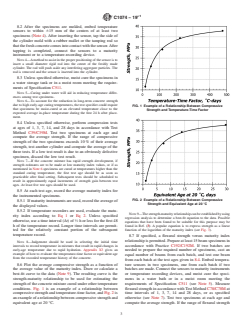
best-fit curve to the data (Note 9). The resulting curve is the or temperature recording devices, and moist cure the speci-
strength-maturity relationship to be used for estimating the mens in a water bath or in a moist room meeting the
strength of the concrete mixture cured under other temperature requirements of Specification C511 (see Note 5). Measure
conditions. Fig. 1 is an example of a relationship between flexural strength in accordance withTest Method C78/C78M at
compressive strength and temperature-time factor, and Fig. 2 is time intervals of 1, 3, 7, 14 and 28 days, or as specified
anexampleofarelationshipbetweencompressivestrengthand otherwise (see Note 7). Test two specimens at each age and
equivalent age at 20 °C. compute the average strength. If the range of flexural strength
´1
C1074 − 19
in computing the maturity index during development of the
strength-maturity relationship (see Section 8).
9.3 When the strength at the location of a sensor is to be
estimated, read the value of the maturity index from the
maturity instrument or evaluate the maturity index from the
temperature record.
9.4 Using the strength-maturity relationship developed in
Section 8, determine the value of compressive (or flexural)
strength corresponding to the measured maturity index.
9.5 Before performing critical operations, such as formwork
removal or post-tensioning, that are based on estimated
strength from the concrete maturity, perform other tests to
ensure that the concrete in the structure has a potential strength
FIG. 3 Example of Compressive Strength as a Function of Loga-
that is similar to that of the concrete used to develop the
rithm of Equivalent Age
strength-maturity relationship.Appropriate techniques include:
9.5.1 In-place tests that give indications of strength, such as
Test Method C873/C873M,Test Method C803/C803M, orTest
of the two specimens exceeds 15 % of their average strength,
Method C900.
test another beam and compute the average of the three tests. If
a low test result is due to an obviously defective specimen,
NOTE 13—The latter two test methods require mixture-specific strength
discard the low test result. Use the same procedures as in 8.5 relationships to estimate in-place strength.
and 8.6 to develop the flexural strength-maturity relationship.
9.5.2 Early-age compressive strength tests in accordance
8.8 It is also permitted to develop a relationship between
with Test Method C918/C918M of standard-cured specimens
cube strength of concrete and the maturity index. Follow the
molded from samples of the concrete as-delivered.
procedure as given for cylinders except that the cubes are to be
9.5.3 Compressive strength tests on specimens molded from
prepared and tested in accordance with the applicable test
samples of the concrete as-delivered and subjected to acceler-
method.Inserttemperaturesensorsatthecentersofatleasttwo
ated curing in accordance with Practice C1768/C1768M.
cubes. Test two cubes at each test age. In deciding whether to
9.5.4 Early-age tests of field-molded cylinders instrumented
discard a low cube strength result, use the precision statement
with maturity instruments. These cylinders shall be subjected
of the standard test method for cube strength as guidance.
to standard curing in accordance with Practice C31/C31M.The
early-age strengths are measured after the in-place maturity of
9. Procedure to Estimate In-Place Strength
the structure indicates that the concrete has attained the target
9.1 Secure temperature sensors within the section to be cast
strength on the basis of the strength-maturity relationship. The
before concrete placement, or embed temperature sensors into
measured strengths are compared with the strengths estimated
the fresh concrete as soon as is practicable after concrete
from the established strength-maturity relationship and the
placement (see Note 10). Place temperature sensing elements
maturity index of the test cylinders. If the difference consis-
so that they will be surrounded by concrete and not be in direct
tently exceeds 10 %, a new strength-maturity relationship is to
contact with metallic embedments or other features that will be
be developed in accordance with Section 8.
partially exposed to the environment (see Note 11). If this
practice is used to decide whether critical construction opera-
10. Interpretation
tionsmaybegin,installsensorsatlocationsinthestructurethat
are critical in terms of exposure conditions and structural 10.1 This practice is used to estimate the in-place strength
of concrete based on the measured thermal history at a point in
requirements (see Note 12).
the structure and a previously established strength-maturity
NOTE 10—The appropriate method will depend on the type of sensor
relationship. The accuracy of the estimated strength depends
that is used and the conditions at the construction site. Manufacturer’s
on several factors, such as the appropriateness of the maturity
recommendations provide additional guidance.
NOTE 11—The intent is to avoid placing temperature sensing elements function for the specific concrete mixture, the in-place early-
in contact with embedments that are partially exposed to the ambient
age temperature history, and the actual mixture proportions of
environment and that could potentially be at a different temperature than
the field concrete. High early-age temperature of the field
the concrete.
concrete may reduce the long-term potential strength (3, 4) and
NOTE 12—In building construction, exposed portions of slabs and
thereby result in lower in-place strength than would be
slab-column connections are typically critical locations. The advice of the
Engineer should be sought for critical locations in t
...