

ASTM C873/C873M-23
(Test Method)Standard Test Method for Compressive Strength of Concrete Cylinders Cast in Place in Cylindrical Molds
General Information
- Abstract
ABSTRACT
This test method covers the determination of strength of cylindrical concrete specimens that have been molded in place using special molds attached to formwork. A concrete cylinder mold assembly consisting of a mold and a tubular support member is fastened within the concrete formwork prior to placement of the concrete. The elevation of the mold upper edge is adjusted to correspond to the plane of the finished slab surface. The mold support prevents direct contact of the slab concrete with the outside of the mold and permits its easy removal from the hardened concrete. Strength of cast-in-place cylinders may be used for various purposes, such as estimating the load-bearing capacity of slabs, determining the time of form and shore removal, and determining the effectiveness of curing and protection. Consolidation of concrete in the mold may be varied to simulate the conditions of placement. Internal vibration of concrete in the mold is prohibited except under special circumstances.
SIGNIFICANCE AND USE
4.1 Cast-in-place cylinder strength relates to the strength of concrete in the structure due to the similarity of curing conditions because the cylinder is cured within the slab. However, due to differences in moisture condition, degree of consolidation, specimen size, and length-diameter ratio, there is not a unique relationship between the strength of cast-in-place cylinders and cores of the same age. When cores can be drilled undamaged and tested in the same moisture condition as the cast-in-place cylinders, the strength of the cylinders can be expected to be on average 10 % higher than the cores at ages up to 91 days for specimens of the same size and length-diameter ratio.4
4.2 Strength of cast-in-place cylinders may be used for various purposes, such as estimating the load-bearing capacity of slabs, determining the time of form and shore removal, and determining the effectiveness of curing and protection.
SCOPE
1.1 This test method covers the determination of strength of cylindrical concrete specimens that have been molded in place using special molds attached to formwork. This test method is limited to use in slabs where the depth of concrete is from 125 mm to 300 mm [5 in. to 12 in.].
1.2 The text of this standard refers to notes and footnotes that provide explanatory material. These notes and footnotes (excluding those in tables and figures) shall not be considered as requirements of the standard.
1.3 Units—The values stated in either SI units or inch-pound units are to be regarded separately as standard. The values stated in each system are not necessarily exact equivalents; therefore, to ensure conformance with the standard, each system shall be used independently of the other, and values from the two systems shall not be combined. Combining values from the two systems may result in non-conformance with the standard.
1.4 This standard does not purport to address all of the safety concerns, if any, associated with its use. It is the responsibility of the user of this standard to establish appropriate safety, health, and environmental practices and determine the applicability of regulatory limitations prior to use. (Warning—Fresh hydraulic cementitious mixtures are caustic and may cause chemical burns to skin and tissue upon prolonged exposure.2)
1.5 This international standard was developed in accordance with internationally recognized principles on standardization established in the Decision on Principles for the Development of International Standards, Guides and Recommendations issued by the World Trade Organization Technical Barriers to Trade (TBT) Committee.
- Status
- Published
- Publication Date
- 30-Sep-2023
- Technical Committee
- C09 - Concrete and Concrete Aggregates
- Drafting Committee
- C09.61 - Testing for Strength
Buy Documents

ASTM C873/C873M-23 - Standard Test Method for Compressive Strength of Concrete Cylinders Cast in Place in Cylindrical Molds
REDLINE ASTM C873/C873M-23 - Standard Test Method for Compressive Strength of Concrete Cylinders Cast in Place in Cylindrical Molds
Overview
ASTM C873/C873M-23: Standard Test Method for Compressive Strength of Concrete Cylinders Cast in Place in Cylindrical Molds provides guidance for determining the compressive strength of concrete specimens molded in place within slabs using special cylindrical molds. This method ensures specimens undergo curing conditions similar to those of the surrounding structural concrete by embedding molds directly in the slab prior to concrete placement.
This standard is particularly applicable to concrete slabs with depths ranging from 125 mm to 300 mm [5 to 12 in.], enabling more representative in-place strength assessments compared to traditional lab-cured samples. Such in-place tests have significant practical use in quality control, structural performance evaluation, and construction timing decisions.
Key Topics
- Compressive Strength Testing: Procedures for measuring the compressive strength of cylindrical specimens molded and cured within concrete slabs.
- Mold Assembly and Installation: Requirements for mold construction, installation practices, and placement within the formwork to ensure accurate results.
- Curing Conditions: Emphasis on exposing test specimens to the same curing environment as the slab, closely simulating actual in-situ behavior.
- Measurement and Testing Procedures: Step-by-step guidance on specimen handling, removal, and testing, including diameter and length measurement, capping, and compressive loading.
- Reporting Requirements: Detailed documentation of test conditions, results, locations, and variables affecting specimen performance.
- Limitations and Safety: Scope limitations, safety warnings, and notes on ensuring compliance with health and environmental practices.
Applications
This ASTM standard offers practical value for a variety of stakeholders in the construction and concrete industries:
- Quality Control: On-site compressive strength testing provides a direct assessment of in-place concrete performance, reducing variability caused by transporting and curing separate specimens.
- Structural Capacity Estimation: The method helps evaluate the actual load-bearing capacity of concrete slabs, which is vital for safe and effective structural design and assessment.
- Formwork and Shore Removal Timing: By measuring the compressive strength on-site, contractors can determine the optimal timing for removing forms and shores, improving construction efficiency and safety.
- Curing Effectiveness: Monitoring specimen performance under true slab curing conditions allows assessment of curing methods and protection measures, ensuring long-term concrete durability.
- Compliance and Specification Verification: Useful for verifying compliance with project specifications requiring in-place strength documentation for slabs within the specified depth range.
Related Standards
For enhanced accuracy, reproducibility, and broader context, ASTM C873/C873M-23 is often used in conjunction with the following standards:
- ASTM C39/C39M - Test Method for Compressive Strength of Cylindrical Concrete Specimens
- ASTM C42/C42M - Test Method for Obtaining and Testing Drilled Cores and Sawed Beams of Concrete
- ASTM C470/C470M - Specification for Molds for Forming Concrete Test Cylinders Vertically
- ASTM C617/C617M - Practice for Capping Cylindrical Concrete Specimens
- ASTM C1231/C1231M - Practice for Use of Unbonded Caps in Determination of Compressive Strength of Hardened Cylindrical Concrete Specimens
Adhering to these related standards ensures methodological consistency and high-quality, reliable results in compressive strength testing of in-place concrete.
Keywords: ASTM C873/C873M-23, compressive strength, cast-in-place cylinder, concrete slab testing, in-place concrete strength, cylinder molds, onsite concrete performance, curing conditions, structural concrete, ASTM standards
Relations
- Effective Date
- 01-Oct-2023
- Effective Date
- 01-Feb-2024
- Effective Date
- 01-Jan-2024
- Refers
ASTM C39/C39M-23 - Standard Test Method for Compressive Strength of Cylindrical Concrete Specimens - Effective Date
- 01-Dec-2023
- Effective Date
- 01-Oct-2023
- Effective Date
- 01-Oct-2023
- Effective Date
- 01-Dec-2015
- Effective Date
- 15-Jun-2015
- Effective Date
- 01-Apr-2015
- Referred By
ASTM C39/C39M-21 - Standard Test Method for Compressive Strength of Cylindrical Concrete Specimens - Effective Date
- 01-Oct-2023
- Referred By
ASTM C1074-19e1 - Standard Practice for Estimating Concrete Strength by the Maturity Method - Effective Date
- 01-Oct-2023
Buy Documents
ASTM C873/C873M-23 - Standard Test Method for Compressive Strength of Concrete Cylinders Cast in Place in Cylindrical Molds
REDLINE ASTM C873/C873M-23 - Standard Test Method for Compressive Strength of Concrete Cylinders Cast in Place in Cylindrical Molds
Get Certified
Connect with accredited certification bodies for this standard

DIBt (Deutsches Institut für Bautechnik)
German Institute for Building Technology.
DIN CERTCO
DIN Group product certification.

Aboma Certification B.V.
Specialized in construction, metal, and transport sectors.
Sponsored listings
Frequently Asked Questions
ASTM C873/C873M-23 is a standard published by ASTM International. Its full title is "Standard Test Method for Compressive Strength of Concrete Cylinders Cast in Place in Cylindrical Molds". This standard covers: ABSTRACT This test method covers the determination of strength of cylindrical concrete specimens that have been molded in place using special molds attached to formwork. A concrete cylinder mold assembly consisting of a mold and a tubular support member is fastened within the concrete formwork prior to placement of the concrete. The elevation of the mold upper edge is adjusted to correspond to the plane of the finished slab surface. The mold support prevents direct contact of the slab concrete with the outside of the mold and permits its easy removal from the hardened concrete. Strength of cast-in-place cylinders may be used for various purposes, such as estimating the load-bearing capacity of slabs, determining the time of form and shore removal, and determining the effectiveness of curing and protection. Consolidation of concrete in the mold may be varied to simulate the conditions of placement. Internal vibration of concrete in the mold is prohibited except under special circumstances. SIGNIFICANCE AND USE 4.1 Cast-in-place cylinder strength relates to the strength of concrete in the structure due to the similarity of curing conditions because the cylinder is cured within the slab. However, due to differences in moisture condition, degree of consolidation, specimen size, and length-diameter ratio, there is not a unique relationship between the strength of cast-in-place cylinders and cores of the same age. When cores can be drilled undamaged and tested in the same moisture condition as the cast-in-place cylinders, the strength of the cylinders can be expected to be on average 10 % higher than the cores at ages up to 91 days for specimens of the same size and length-diameter ratio.4 4.2 Strength of cast-in-place cylinders may be used for various purposes, such as estimating the load-bearing capacity of slabs, determining the time of form and shore removal, and determining the effectiveness of curing and protection. SCOPE 1.1 This test method covers the determination of strength of cylindrical concrete specimens that have been molded in place using special molds attached to formwork. This test method is limited to use in slabs where the depth of concrete is from 125 mm to 300 mm [5 in. to 12 in.]. 1.2 The text of this standard refers to notes and footnotes that provide explanatory material. These notes and footnotes (excluding those in tables and figures) shall not be considered as requirements of the standard. 1.3 Units—The values stated in either SI units or inch-pound units are to be regarded separately as standard. The values stated in each system are not necessarily exact equivalents; therefore, to ensure conformance with the standard, each system shall be used independently of the other, and values from the two systems shall not be combined. Combining values from the two systems may result in non-conformance with the standard. 1.4 This standard does not purport to address all of the safety concerns, if any, associated with its use. It is the responsibility of the user of this standard to establish appropriate safety, health, and environmental practices and determine the applicability of regulatory limitations prior to use. (Warning—Fresh hydraulic cementitious mixtures are caustic and may cause chemical burns to skin and tissue upon prolonged exposure.2) 1.5 This international standard was developed in accordance with internationally recognized principles on standardization established in the Decision on Principles for the Development of International Standards, Guides and Recommendations issued by the World Trade Organization Technical Barriers to Trade (TBT) Committee.
ABSTRACT This test method covers the determination of strength of cylindrical concrete specimens that have been molded in place using special molds attached to formwork. A concrete cylinder mold assembly consisting of a mold and a tubular support member is fastened within the concrete formwork prior to placement of the concrete. The elevation of the mold upper edge is adjusted to correspond to the plane of the finished slab surface. The mold support prevents direct contact of the slab concrete with the outside of the mold and permits its easy removal from the hardened concrete. Strength of cast-in-place cylinders may be used for various purposes, such as estimating the load-bearing capacity of slabs, determining the time of form and shore removal, and determining the effectiveness of curing and protection. Consolidation of concrete in the mold may be varied to simulate the conditions of placement. Internal vibration of concrete in the mold is prohibited except under special circumstances. SIGNIFICANCE AND USE 4.1 Cast-in-place cylinder strength relates to the strength of concrete in the structure due to the similarity of curing conditions because the cylinder is cured within the slab. However, due to differences in moisture condition, degree of consolidation, specimen size, and length-diameter ratio, there is not a unique relationship between the strength of cast-in-place cylinders and cores of the same age. When cores can be drilled undamaged and tested in the same moisture condition as the cast-in-place cylinders, the strength of the cylinders can be expected to be on average 10 % higher than the cores at ages up to 91 days for specimens of the same size and length-diameter ratio.4 4.2 Strength of cast-in-place cylinders may be used for various purposes, such as estimating the load-bearing capacity of slabs, determining the time of form and shore removal, and determining the effectiveness of curing and protection. SCOPE 1.1 This test method covers the determination of strength of cylindrical concrete specimens that have been molded in place using special molds attached to formwork. This test method is limited to use in slabs where the depth of concrete is from 125 mm to 300 mm [5 in. to 12 in.]. 1.2 The text of this standard refers to notes and footnotes that provide explanatory material. These notes and footnotes (excluding those in tables and figures) shall not be considered as requirements of the standard. 1.3 Units—The values stated in either SI units or inch-pound units are to be regarded separately as standard. The values stated in each system are not necessarily exact equivalents; therefore, to ensure conformance with the standard, each system shall be used independently of the other, and values from the two systems shall not be combined. Combining values from the two systems may result in non-conformance with the standard. 1.4 This standard does not purport to address all of the safety concerns, if any, associated with its use. It is the responsibility of the user of this standard to establish appropriate safety, health, and environmental practices and determine the applicability of regulatory limitations prior to use. (Warning—Fresh hydraulic cementitious mixtures are caustic and may cause chemical burns to skin and tissue upon prolonged exposure.2) 1.5 This international standard was developed in accordance with internationally recognized principles on standardization established in the Decision on Principles for the Development of International Standards, Guides and Recommendations issued by the World Trade Organization Technical Barriers to Trade (TBT) Committee.
ASTM C873/C873M-23 is classified under the following ICS (International Classification for Standards) categories: 91.100.30 - Concrete and concrete products. The ICS classification helps identify the subject area and facilitates finding related standards.
ASTM C873/C873M-23 has the following relationships with other standards: It is inter standard links to ASTM C873/C873M-15, ASTM C670-24a, ASTM C670-24, ASTM C39/C39M-23, ASTM C617/C617M-23, ASTM C1231/C1231M-23, ASTM C1231/C1231M-15, ASTM C670-15, ASTM C617/C617M-15, ASTM C39/C39M-21, ASTM C1074-19e1. Understanding these relationships helps ensure you are using the most current and applicable version of the standard.
ASTM C873/C873M-23 is available in PDF format for immediate download after purchase. The document can be added to your cart and obtained through the secure checkout process. Digital delivery ensures instant access to the complete standard document.
Standards Content (Sample)
This international standard was developed in accordance with internationally recognized principles on standardization established in the Decision on Principles for the
Development of International Standards, Guides and Recommendations issued by the World Trade Organization Technical Barriers to Trade (TBT) Committee.
Designation: C873/C873M − 23
Standard Test Method for
Compressive Strength of Concrete Cylinders Cast in Place
in Cylindrical Molds
This standard is issued under the fixed designation C873/C873M; the number immediately following the designation indicates the year
of original adoption or, in the case of revision, the year of last revision. A number in parentheses indicates the year of last reapproval.
A superscript epsilon (´) indicates an editorial change since the last revision or reapproval.
1. Scope* 2. Referenced Documents
2.1 ASTM Standards:
1.1 This test method covers the determination of strength of
C39/C39M Test Method for Compressive Strength of Cylin-
cylindrical concrete specimens that have been molded in place
drical Concrete Specimens
using special molds attached to formwork. This test method is
C42/C42M Test Method for Obtaining and Testing Drilled
limited to use in slabs where the depth of concrete is from
Cores and Sawed Beams of Concrete
125 mm to 300 mm [5 in. to 12 in.].
C470/C470M Specification for Molds for Forming Concrete
1.2 The text of this standard refers to notes and footnotes
Test Cylinders Vertically
that provide explanatory material. These notes and footnotes
C617/C617M Practice for Capping Cylindrical Concrete
(excluding those in tables and figures) shall not be considered
Specimens
as requirements of the standard.
C670 Practice for Preparing Precision and Bias Statements
for Test Methods for Construction Materials
1.3 Units—The values stated in either SI units or inch-
C1231/C1231M Practice for Use of Unbonded Caps in
pound units are to be regarded separately as standard. The
Determination of Compressive Strength of Hardened Cy-
values stated in each system are not necessarily exact equiva-
lindrical Concrete Specimens
lents; therefore, to ensure conformance with the standard, each
system shall be used independently of the other, and values
3. Summary of Test Method
from the two systems shall not be combined. Combining values
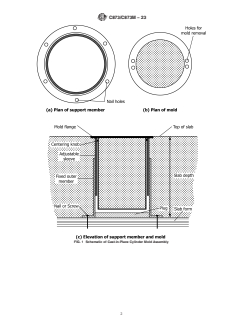
from the two systems may result in non-conformance with the 3.1 A concrete cylinder mold assembly consisting of a mold
standard.
and a tubular support member is fastened within the concrete
formwork prior to placement of the concrete as shown in Fig.
1.4 This standard does not purport to address all of the
1. The elevation of the mold upper edge is adjusted to
safety concerns, if any, associated with its use. It is the
correspond to the level of the finished slab surface. The mold
responsibility of the user of this standard to establish appro-
support prevents direct contact of the slab concrete with the
priate safety, health, and environmental practices and deter-
outside of the mold and permits easy removal of the mold from
mine the applicability of regulatory limitations prior to use.
the slab. The mold is filled at the time its location is reached in
(Warning—Fresh hydraulic cementitious mixtures are caustic
the normal course of concrete placement. The specimen in the
and may cause chemical burns to skin and tissue upon
2 “cured-in-place” condition is removed from its in-place loca-
prolonged exposure. )
tion immediately prior to de-molding, capping, and testing.
1.5 This international standard was developed in accor-
The reported compressive strength is corrected on the basis of
dance with internationally recognized principles on standard-
specimen length-diameter ratio using correction factors pro-
ization established in the Decision on Principles for the
vided in the section on calculation of Test Method C42/C42M.
Development of International Standards, Guides and Recom-
mendations issued by the World Trade Organization Technical
4. Significance and Use
Barriers to Trade (TBT) Committee.
4.1 Cast-in-place cylinder strength relates to the strength of
concrete in the structure due to the similarity of curing
conditions because the cylinder is cured within the slab.
This test method is under the jurisdiction of ASTM Committee C09 on
However, due to differences in moisture condition, degree of
Concrete and Concrete Aggregates and is the direct responsibility of Subcommittee
C09.61 on Testing for Strength.
Current edition approved Oct. 1, 2023. Published October 2023. Originally
approved in 1977. Last previous edition approved in 2015 as C873/C873M–15. For referenced ASTM standards, visit the ASTM website, www.astm.org, or
DOI: 10.1520/C0873_C0873M-23. contact ASTM Customer Service at service@astm.org. For Annual Book of ASTM
Section on Safety Precautions, Manual of Aggregate and Concrete Testing, Standards volume information, refer to the standard’s Document Summary page on
Annual Book of ASTM Standards, Vol 04.02. the ASTM website.
*A Summary of Changes section appears at the end of this standard
Copyright © ASTM International, 100 Barr Harbor Drive, PO Box C700, West Conshohocken, PA 19428-2959. United States
C873/C873M − 23
FIG. 1 Schematic of Cast-in-Place Cylinder Mold Assembly
C873/C873M − 23
consolidation, specimen size, and length-diameter ratio, there concrete or mortar into the annular ring space between the
is not a unique relationship between the strength of cast-in- support member and the mold.
place cylinders and cores of the same age. When cores can be
6. Installation of Apparatus
drilled undamaged and tested in the same moisture condition as
the cast-in-place cylinders, the strength of the cylinders can be 6.1 After completion of reinforcing steel placement and
other formwork preparation, fasten the support member to slab
expected to be on average 10 % higher than the cores at ages
up to 91 days for specimens of the same size and length- forms using nails or screws. Adjust the support member so that
the top of the mold is aligned with the elevation of screed
diameter ratio.
guides used in striking off the concrete.
4.2 Strength of cast-in-place cylinders may be used for
various purposes, such as estimating the load-bearing capacity NOTE 2—The location of mold assemblies should be noted on project
drawings for easy location after concrete placement and for identification.
of slabs, determining the time of form and shore removal, and
determining the effectiveness of curing and protection.
6.2 Place the mold in the support member so that the flange
of the mold is uniformly supported by the sleeve to prevent
5. Apparatus
concrete or mortar from penetrating into the space between the
5.1 Cast-in-place molds shall have a diameter at least three
mold and support member.
times the nominal maximum aggregate size. The length-
NOTE 3—Insertion of compressible material between the support
diameter ratio (L/D) of the specimen after capping shall not be
member and the mold is permitted to prevent mortar seepage into the
less than 1.0 (see Note 1). Molds (inner member) shall be
annular space.
constructed in one piece in the form of right circular cylinders
7. Procedure
at least 100 mm [4 in.] in inside diameter with the average
diameter not differing from the nominal diameter by more than 7.1 Inspect the molds to ensure they are clean and free of
1 % and no individual diameter differing from any other any debris or foreign matter. Fill the molds when the concrete
diameter by more than 2 %. The plane of the rim of the mold placement progresses to the vicinity of mold location.
and the bottom shall be perpendicular to the axis of the mold
7.2 Consolidation—Consolidate concrete in the mold to
within 0.5° (approximately equivalent to 1 mm in 300 mm [ ⁄8
simulate the conditions of placement. In normal field construc-
in. in 12 in.]).
tion practice, if the surrounding concrete is co
...
This document is not an ASTM standard and is intended only to provide the user of an ASTM standard an indication of what changes have been made to the previous version. Because
it may not be technically possible to adequately depict all changes accurately, ASTM recommends that users consult prior editions as appropriate. In all cases only the current version
of the standard as published by ASTM is to be considered the official document.
Designation: C873/C873M − 15 C873/C873M − 23
Standard Test Method for
Compressive Strength of Concrete Cylinders Cast in Place
in Cylindrical Molds
This standard is issued under the fixed designation C873/C873M; the number immediately following the designation indicates the year
of original adoption or, in the case of revision, the year of last revision. A number in parentheses indicates the year of last reapproval.
A superscript epsilon (´) indicates an editorial change since the last revision or reapproval.
1. Scope*
1.1 This test method covers the determination of strength of cylindrical concrete specimens that have been molded in place using
special molds attached to formwork. This test method is limited to use in slabs where the depth of concrete is from 125125 mm
to 300 mm [5[5 in. to 12 in.].
1.2 The text of this standard refers to notes and footnotes that provide explanatory material. These notes and footnotes (excluding
those in tables and figures) shall not be considered as requirements of the standard.
1.3 Units—The values stated in either SI units or inch-pound units are to be regarded separately as standard. The values stated in
each system may not beare not necessarily exact equivalents; therefore, to ensure conformance with the standard, each system shall
be used independently of the other. other, and values from the two systems shall not be combined. Combining values from the two
systems may result in non-conformance with the standard.
1.4 This standard does not purport to address all of the safety concerns, if any, associated with its use. It is the responsibility
of the user of this standard to consult and establish appropriate safety and healthsafety, health, and environmental practices and
determine the applicability of regulatory limitations prior to use. (Warning—Fresh hydraulic cementitious mixtures are caustic
and may cause chemical burns to skin and tissue upon prolonged exposure. )
1.5 This international standard was developed in accordance with internationally recognized principles on standardization
established in the Decision on Principles for the Development of International Standards, Guides and Recommendations issued
by the World Trade Organization Technical Barriers to Trade (TBT) Committee.
2. Referenced Documents
2.1 ASTM Standards:
C39/C39M Test Method for Compressive Strength of Cylindrical Concrete Specimens
C42/C42M Test Method for Obtaining and Testing Drilled Cores and Sawed Beams of Concrete
C470/C470M Specification for Molds for Forming Concrete Test Cylinders Vertically
C617C617/C617M Practice for Capping Cylindrical Concrete Specimens
C670 Practice for Preparing Precision and Bias Statements for Test Methods for Construction Materials
This test method is under the jurisdiction of ASTM Committee C09 on Concrete and Concrete Aggregates and is the direct responsibility of Subcommittee C09.61 on
Testing for Strength.
Current edition approved Dec. 1, 2015Oct. 1, 2023. Published February 2016October 2023. Originally approved in 1977. Last previous edition approved in 20102015 as
C873/C873M–10a. DOI: 10.1520/C0873_C0873M-15.–15. DOI: 10.1520/C0873_C0873M-23.
Section on Safety Precautions, Manual of Aggregate and Concrete Testing, Annual Book of ASTM Standards, Vol 04.02.
For referenced ASTM standards, visit the ASTM website, www.astm.org, or contact ASTM Customer Service at service@astm.org. For Annual Book of ASTM Standards
volume information, refer to the standard’s Document Summary page on the ASTM website.
*A Summary of Changes section appears at the end of this standard
Copyright © ASTM International, 100 Barr Harbor Drive, PO Box C700, West Conshohocken, PA 19428-2959. United States
C873/C873M − 23
C1231/C1231M Practice for Use of Unbonded Caps in Determination of Compressive Strength of Hardened Cylindrical
Concrete Specimens
3. Summary of Test Method
3.1 A concrete cylinder mold assembly consisting of a mold and a tubular support member is fastened within the concrete
formwork prior to placement of the concrete as shown in Fig. 1. The elevation of the mold upper edge is adjusted to correspond
to the level of the finished slab surface. The mold support prevents direct contact of the slab concrete with the outside of the mold
and permits easy removal of the mold from the slab. The mold is filled at the time its location is reached in the normal course of
concrete placement. The specimen in the “cured-in-place” condition is removed from its in-place location immediately prior to
de-molding, capping, and testing. The reported compressive strength is corrected on the basis of specimen length-diameter ratio
using correction factors provided in the section on calculation of Test Method C42/C42M.
4. Significance and Use
4.1 Cast-in-place cylinder strength relates to the strength of concrete in the structure due to the similarity of curing conditions
because the cylinder is cured within the slab. However, due to differences in moisture condition, degree of consolidation, specimen
size, and length-diameter ratio, there is not a unique relationship between the strength of cast-in-place cylinders and cores of the
same age. When cores can be drilled undamaged and tested in the same moisture condition as the cast-in-place cylinders, the
strength of the cylinders can be expected to be on average 10 % higher than the cores at ages up to 91 days for specimens of the
same size and length-diameter ratio.
4.2 Strength of cast-in-place cylinders may be used for various purposes, such as estimating the load-bearing capacity of slabs,
determining the time of form and shore removal, and determining the effectiveness of curing and protection.
5. Apparatus
5.1 Cast-in-place molds shall have a diameter at least three times the nominal maximum aggregate size. The length-diameter ratio
(L/D) of the specimen after capping shall not be less than 1.0 (see Note 1). Molds (inner member) shall be constructed in one piece
in the form of right circular cylinders at least 100 mm [4 in.] in inside diameter with the average diameter not differing from the
nominal diameter by more than 1 % and no individual diameter differing from any other diameter by more than 2 %. The plane
of the rim of the mold and the bottom shall be perpendicular to the axis of the mold within 0.5° (approximately equivalent to 1
mm in 300 mm [ ⁄8 in. in 12 in.]).
NOTE 1—The length-diameter ratio should preferably be between 1.5 and 2.0.
5.2 Molds shall be watertight and meet the criteria of the section on water leakage of Specification C470/C470M. Molds and
auxiliary apparatus shall be made of nonabsorbent material that does not react with concrete containing portland or other hydraulic
cements. Molds shall be sufficiently strong and tough to permit use under normal construction conditions without tearing, crushing,
or otherwise deforming permanently when filled with fresh concrete. Molds shall resist permanent deformation to the extent that
they produce hardened concrete cylinders such that two diameters measured at right angles to each other in any horizontal plane
do not differ by more than 2.0 mm [ ⁄16 in.].
5.3 The exterior top of the mold shall have outwardly extending centering knobs and an annular flange to rest on top of the support
member (5.4) and to seal the annular ring space between the mold and that support member. Means for twisting and vertical
withdrawal of molds from the support member shall be provided in the annular flange (see Fig. 1).
5.4 Support members shall be right circular cylinders and shall be rigid tubes of diameter required to accommodate molds
stipulated in 5.1 and to concentrically contact and support the annular flange of the mold. Support members shall
...