


ASTM C703-72(2016)
(Test Method)Standard Test Methods for Spalling Resistance of Porcelain Enameled Aluminum
Standard Test Methods for Spalling Resistance of Porcelain Enameled Aluminum
SIGNIFICANCE AND USE
3.1 It is difficult to overemphasize the importance of the spall test. Porcelain enameled aluminum that fails this test will probably spall in service if subjected to moisture or weathering.
SCOPE
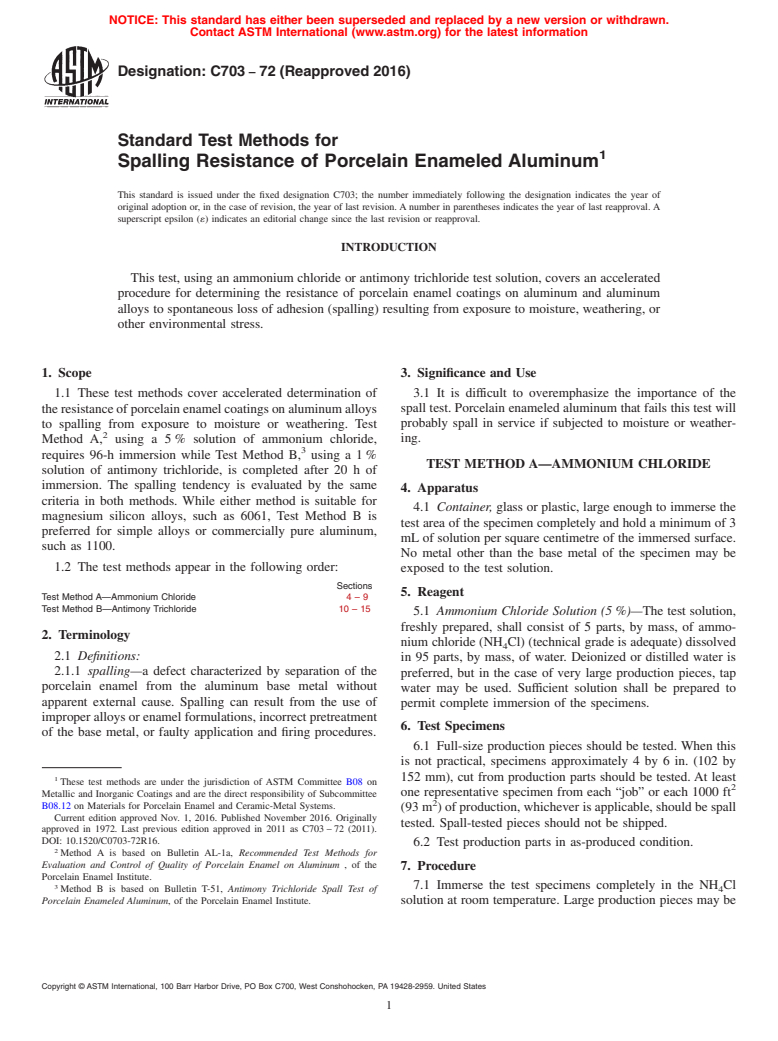
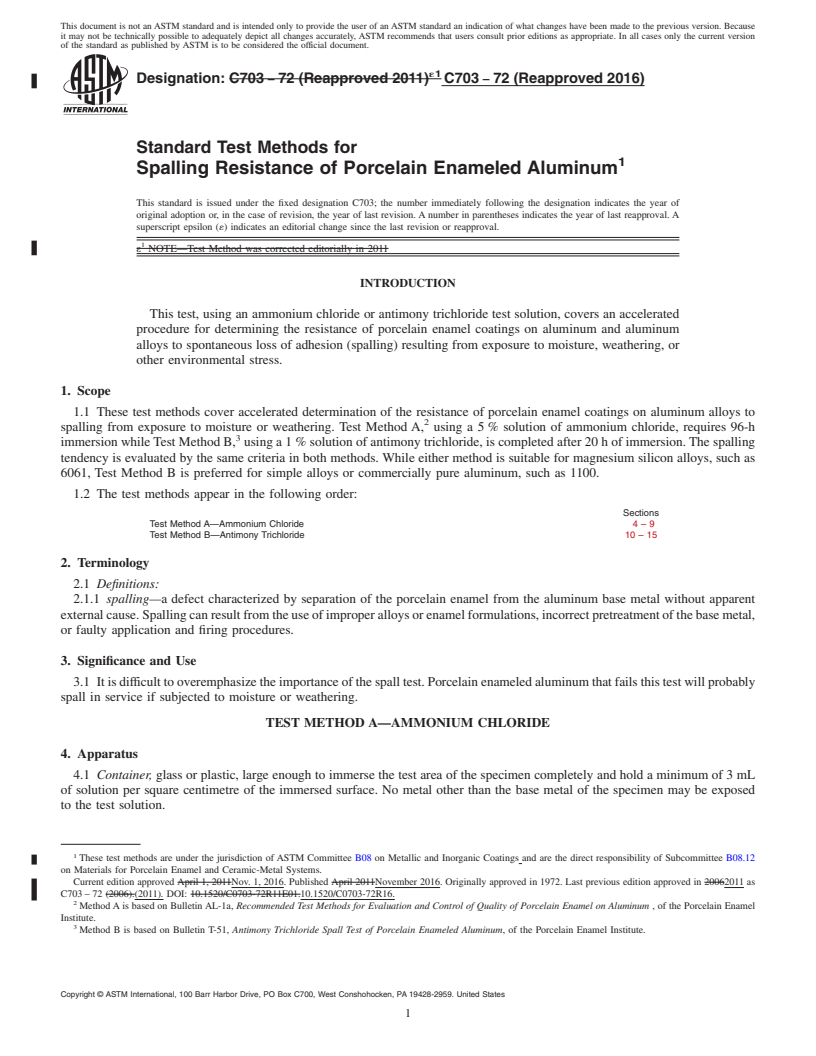
1.1 These test methods cover accelerated determination of the resistance of porcelain enamel coatings on aluminum alloys to spalling from exposure to moisture or weathering. Test Method A,2 using a 5 % solution of ammonium chloride, requires 96-h immersion while Test Method B,3 using a 1 % solution of antimony trichloride, is completed after 20 h of immersion. The spalling tendency is evaluated by the same criteria in both methods. While either method is suitable for magnesium silicon alloys, such as 6061, Test Method B is preferred for simple alloys or commercially pure aluminum, such as 1100.
1.2 The test methods appear in the following order:
Sections
Test Method A—Ammonium Chloride
4 – 9
Test Method B—Antimony Trichloride
10 – 15
General Information
Buy Standard
Standards Content (Sample)
NOTICE: This standard has either been superseded and replaced by a new version or withdrawn.
Contact ASTM International (www.astm.org) for the latest information
Designation: C703 − 72 (Reapproved 2016)
Standard Test Methods for
Spalling Resistance of Porcelain Enameled Aluminum
This standard is issued under the fixed designation C703; the number immediately following the designation indicates the year of
original adoption or, in the case of revision, the year of last revision. A number in parentheses indicates the year of last reapproval. A
superscript epsilon (´) indicates an editorial change since the last revision or reapproval.
INTRODUCTION
This test, using an ammonium chloride or antimony trichloride test solution, covers an accelerated
procedure for determining the resistance of porcelain enamel coatings on aluminum and aluminum
alloys to spontaneous loss of adhesion (spalling) resulting from exposure to moisture, weathering, or
other environmental stress.
1. Scope 3. Significance and Use
3.1 It is difficult to overemphasize the importance of the
1.1 These test methods cover accelerated determination of
spall test. Porcelain enameled aluminum that fails this test will
theresistanceofporcelainenamelcoatingsonaluminumalloys
probably spall in service if subjected to moisture or weather-
to spalling from exposure to moisture or weathering. Test
Method A, using a 5 % solution of ammonium chloride, ing.
requires 96-h immersion while Test Method B, using a 1 %
TEST METHOD A—AMMONIUM CHLORIDE
solution of antimony trichloride, is completed after 20 h of
immersion. The spalling tendency is evaluated by the same
4. Apparatus
criteria in both methods. While either method is suitable for
4.1 Container, glass or plastic, large enough to immerse the
magnesium silicon alloys, such as 6061, Test Method B is
test area of the specimen completely and hold a minimum of 3
preferred for simple alloys or commercially pure aluminum,
mL of solution per square centimetre of the immersed surface.
such as 1100.
No metal other than the base metal of the specimen may be
1.2 The test methods appear in the following order:
exposed to the test solution.
Sections
5. Reagent
Test MethodA—Ammonium Chloride 4–9
Test Method B—Antimony Trichloride 10–15
5.1 Ammonium Chloride Solution (5 %)—The test solution,
freshly prepared, shall consist of 5 parts, by mass, of ammo-
2. Terminology
nium chloride (NH Cl) (technical grade is adequate) dissolved
2.1 Definitions:
in 95 parts, by mass, of water. Deionized or distilled water is
2.1.1 spalling—a defect characterized by separation of the
preferred, but in the case of very large production pieces, tap
porcelain enamel from the aluminum base metal without
water may be used. Sufficient solution shall be prepared to
apparent external cause. Spalling can result from the use of
permit complete immersion of the specimens.
improper alloys or enamel formulations, incorrect pretreatment
6. Test Specimens
of the base metal, or faulty application and firing procedures.
6.1 Full-size production pieces should be tested. When this
is not practical, specimens approximately 4 by 6 in. (102 by
1 152 mm), cut from production parts should be tested. At least
These test methods are under the jurisdiction of ASTM Committee B08 on
one representative specimen from each “job” or each 1000 ft
Metallic and Inorganic Coatings and are the direct responsibility of Subcommittee
B08.12 on Materials for Porcelain Enamel and Ceramic-Metal Systems.
(93 m ) of production, whichever is applicable, should be spall
Current edition approved Nov. 1, 2016. Published November 2016. Originally
tested. Spall-tested pieces should not be shipped.
approved in 1972. Last previous edition approved in 2011 as C703 – 72 (2011).
DOI: 10.1520/C0703-72R16.
6.2 Test production parts in as-produced condition.
Method A is based on Bulletin AL-1a, Recommended Test Methods for
Evaluation and Control of Quality of Porcelain Enamel on Aluminum ,ofthe
7. Procedure
Porcelain Enamel Institute.
3 7.1 Immerse the test specimens completely in the NH Cl
Method B is based on Bulletin T-51, Antimony Trichloride Spall Test of 4
Porcelain Enameled Aluminum, of the Porcelain Enamel Institute. solution at room temperature. Large production pieces may be
Copyright ©ASTM International, 100 Barr Harbor Drive, PO Box C700, West Conshohocken, PA19428-2959. United States
C703 − 72 (Reapproved 2016)
immersed in a container made by lining a packing box with this. If not, the interface should be exposed by scoring the
polyethylene plastic sheeting. enamel. At least one representative specimen from each “job”
2 2
or each 1000 ft (93 m ) of production, whichever is
7.2 Make a visual inspection after 96 h of immersion.
applicable, should be spall tested.
NOTE 1—Variations of this test may be used for studies of processing
12.2 Test production parts in as-produced condition.
variables.These include scored or deformed samples, 24 h inspection, and
multiple cycles of 96 h each.
12.3 Wherever practical (such as porcelain enameled sheet
material) specimens cut from production pieces should be bent
8. Evaluation
toa45°angleovera ⁄2-in.(12.7-mm)diameterrodormandrel.
8.1 Any of the following types of spall that develop within
13. Procedure
96 h shall constitute failure:
8.1.1 Any spall area (revealing bare metal) extending ⁄8 in.
13.1 Immerse as much of the test specimen as practical in
(3 mm), or more, in from an edge and more than 1 in. (25 mm)
the SbCl solution at room temperature. If a sample has been
in length,
bent over a mandrel, the bent
...
This document is not an ASTM standard and is intended only to provide the user of an ASTM standard an indication of what changes have been made to the previous version. Because
it may not be technically possible to adequately depict all changes accurately, ASTM recommends that users consult prior editions as appropriate. In all cases only the current version
of the standard as published by ASTM is to be considered the official document.
´1
Designation: C703 − 72 (Reapproved 2011) C703 − 72 (Reapproved 2016)
Standard Test Methods for
Spalling Resistance of Porcelain Enameled Aluminum
This standard is issued under the fixed designation C703; the number immediately following the designation indicates the year of
original adoption or, in the case of revision, the year of last revision. A number in parentheses indicates the year of last reapproval. A
superscript epsilon (´) indicates an editorial change since the last revision or reapproval.
ε NOTE—Test Method was corrected editorially in 2011
INTRODUCTION
This test, using an ammonium chloride or antimony trichloride test solution, covers an accelerated
procedure for determining the resistance of porcelain enamel coatings on aluminum and aluminum
alloys to spontaneous loss of adhesion (spalling) resulting from exposure to moisture, weathering, or
other environmental stress.
1. Scope
1.1 These test methods cover accelerated determination of the resistance of porcelain enamel coatings on aluminum alloys to
spalling from exposure to moisture or weathering. Test Method A, using a 5 % solution of ammonium chloride, requires 96-h
immersion while Test Method B, using a 1 % solution of antimony trichloride, is completed after 20 h of immersion. The spalling
tendency is evaluated by the same criteria in both methods. While either method is suitable for magnesium silicon alloys, such as
6061, Test Method B is preferred for simple alloys or commercially pure aluminum, such as 1100.
1.2 The test methods appear in the following order:
Sections
Test Method A—Ammonium Chloride 4 – 9
Test Method B—Antimony Trichloride 10 – 15
2. Terminology
2.1 Definitions:
2.1.1 spalling—a defect characterized by separation of the porcelain enamel from the aluminum base metal without apparent
external cause. Spalling can result from the use of improper alloys or enamel formulations, incorrect pretreatment of the base metal,
or faulty application and firing procedures.
3. Significance and Use
3.1 It is difficult to overemphasize the importance of the spall test. Porcelain enameled aluminum that fails this test will probably
spall in service if subjected to moisture or weathering.
TEST METHOD A—AMMONIUM CHLORIDE
4. Apparatus
4.1 Container, glass or plastic, large enough to immerse the test area of the specimen completely and hold a minimum of 3 mL
of solution per square centimetre of the immersed surface. No metal other than the base metal of the specimen may be exposed
to the test solution.
These test methods are under the jurisdiction of ASTM Committee B08 on Metallic and Inorganic Coatings and are the direct responsibility of Subcommittee B08.12
on Materials for Porcelain Enamel and Ceramic-Metal Systems.
Current edition approved April 1, 2011Nov. 1, 2016. Published April 2011November 2016. Originally approved in 1972. Last previous edition approved in 20062011 as
C703 – 72 (2006).(2011). DOI: 10.1520/C0703-72R11E01.10.1520/C0703-72R16.
Method A is based on Bulletin AL-1a, Recommended Test Methods for Evaluation and Control of Quality of Porcelain Enamel on Aluminum , of the Porcelain Enamel
Institute.
Method B is based on Bulletin T-51, Antimony Trichloride Spall Test of Porcelain Enameled Aluminum, of the Porcelain Enamel Institute.
Copyright © ASTM International, 100 Barr Harbor Drive, PO Box C700, West Conshohocken, PA 19428-2959. United States
C703 − 72 (Reapproved 2016)
5. Reagent
5.1 Ammonium Chloride Solution (5 %)—The test solution, freshly prepared, shall consist of 5 parts, by mass, of ammonium
chloride (NH Cl) (technical grade is adequate) dissolved in 95 parts, by mass, of water. Deionized or distilled water is preferred,
but in the case of very large production pieces, tap water may be used. Sufficient solution shall be prepared to permit complete
immersion of the specimens.
6. Test Specimens
6.1 Full-size production pieces should be tested. When this is not practical, specimens approximately 4 by 6 in. (102 by 152
2 2
mm), cut from production parts should be tested. At least one representative specimen from each “job” or each 1000 ft (93 m )
of production, whichever is applicable, should be spall tested. Spall-tested pieces should not be shipped.
6.2 Test production parts in as-produced condition.
7. Procedure
7.1 Immerse the test specimens completely in the NH Cl solution at room temperature. Large production pieces may be
immersed in a container made by lining a packing box with polyethylene plastic sheeting.
7.2 Make a visual inspection after 96 h of immersion.
NOTE 1—Variations of this test may be used for studies of processing variables. These include scored or deformed samples, 24 h inspection, and
multiple cycles of 96 h each.
8. Evaluation
8.1 Any of the following types of spall that develop within 96 h shall constitute failure:
8.1.1 Any spall area (revealing bare metal) extending ⁄8 in. (3 mm), or more, in from an edge and more than 1 in. (25 mm) in
length,
8.1.2 Any spall area on the interior surface (not touching an edge) that is more than ⁄8 in. (3 mm) to its maximum dimension,
or
2 2
8.1.3 More than six visible spall spots per 1 ft (929 cm ) on the interior surface.
9. Report
9.1 The report shall include the following:
9.1.1 Evaluation of the specimen as passing or failing the immersion test in 96 h,
9.1.2 Complete identification of the specimen, includ
...
Questions, Comments and Discussion
Ask us and Technical Secretary will try to provide an answer. You can facilitate discussion about the standard in here.