

ASTM D7639-22
(Test Method)Standard Test Method for Determination of Zirconium Treatment Weight or Thickness on Metal Substrates by X-Ray Fluorescence
General Information
- Abstract
SIGNIFICANCE AND USE
4.1 The procedure described in this test method is designed to provide a method by which the coating weight of zirconium treatments on metal substrates may be determined.
4.2 This test method is applicable for determination of the total coating weight and the zirconium coating weight of a zirconium-containing treatment.
SCOPE
1.1 This test method covers the use of X-ray fluorescence (XRF) spectrometry for the determination of the mass of zirconium (Zr) coating weight per unit area of metal substrates.
1.2 Coating treatments can also be expressed in units of linear thickness provided that the density of the coating is known, or provided that a calibration curve has been established for thickness determination using standards with treatment matching this of test specimens to be analyzed. For simplicity, the method will subsequently refer to the determination expressed as coating weight.
1.3 XRF is applicable for the determination of the coating weight as zirconium or total coating weight of a zirconium containing treatment, or both, on a variety of metal substrates.
1.4 The maximum measurable coating weight for a given coating is that weight beyond which the intensity of the characteristic X-ray radiation from the coating or the substrate is no longer sensitive to small changes in weight.
1.5 The values stated in SI units are to be regarded as standard. No other units of measurement are included in this standard.
1.6 This standard does not purport to address all of the safety concerns, if any, associated with its use. It is the responsibility of the user of this standard to establish appropriate safety, health, and environmental practices and determine the applicability of regulatory limitations prior to use.
1.7 This international standard was developed in accordance with internationally recognized principles on standardization established in the Decision on Principles for the Development of International Standards, Guides and Recommendations issued by the World Trade Organization Technical Barriers to Trade (TBT) Committee.
- Status
- Published
- Publication Date
- 30-Nov-2022
- Technical Committee
- D01 - Paint and Related Coatings, Materials, and Applications
- Drafting Committee
- D01.53 - Coil Coated Metal
Buy Documents
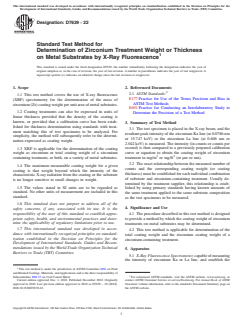
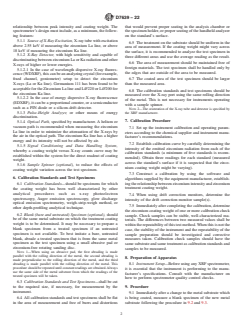
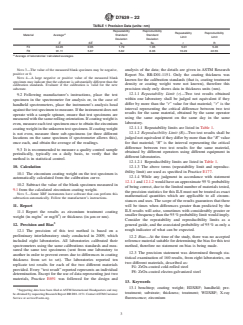

ASTM D7639-22 - Standard Test Method for Determination of Zirconium Treatment Weight or Thickness on Metal Substrates by X-Ray Fluorescence
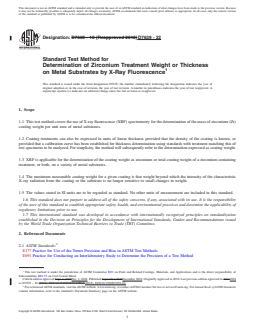
REDLINE ASTM D7639-22 - Standard Test Method for Determination of Zirconium Treatment Weight or Thickness on Metal Substrates by X-Ray Fluorescence
Overview
ASTM D7639-22: Standard Test Method for Determination of Zirconium Treatment Weight or Thickness on Metal Substrates by X-Ray Fluorescence provides a reliable and efficient methodology for measuring the coating weight or thickness of zirconium-based treatments on metal substrates using X-ray fluorescence (XRF) spectrometry. This international standard, published by ASTM International, is widely recognized for ensuring accurate and repeatable measurements crucial for quality control in metal finishing and coating processes.
Accurate determination of zirconium coating weights enables manufacturers and quality assurance professionals to verify compliance with product specifications, maintain process consistency, and optimize performance by controlling surface treatments. The method is designed to be adaptable to a variety of metal substrates and zirconium-based coatings, supporting industries where precise surface engineering is critical.
Key Topics
- X-Ray Fluorescence Spectrometry Application: This standard establishes procedures for using XRF equipment to measure the mass of zirconium per unit area on metal substrates.
- Coating Weight and Thickness Determination: The primary focus is the determination of total zirconium coating weight, with the option to report linear thickness if coating density or suitable calibration standards are available.
- Calibration and Instrumentation: Detailed guidelines are provided for instrument calibration, including the preparation and use of calibration standards, blank specimens, and process checks to ensure measurement reliability.
- Precision and Repeatability: Recommendations on sample handling, measurement orientation, and quality control sampling help optimize consistency and reproducibility across different operators and laboratories.
- Practical Considerations: The standard covers applicable safety, health, and environmental practices, with emphasis on following manufacturer guidelines and regulatory requirements.
Applications
The testing method in ASTM D7639-22 is essential for industries utilizing zirconium-containing surface treatments, especially where protective, adhesive, or functional properties depend on controlled coating thickness:
- Coil-Coated and Electro-Galvanized Steel: Used to verify zirconium pre-treatments that improve corrosion resistance and paint adhesion on steel products.
- Aluminum and Other Metals: Applied to various substrate types where zirconium-based conversion coatings are specified.
- Production Quality Control: Supports process monitoring and end-of-line inspection for consistent surface treatment application.
- Materials R&D: Facilitates development and optimization of new zirconium coatings and treatments through accurate measurement and comparison.
- Compliance and Specification Verification: Ensures products meet industry standards or customer requirements for coating mass or thickness.
By applying ASTM D7639-22, organizations benefit from standardized data collection, supporting both internal process improvements and communication with suppliers and customers regarding surface treatment quality.
Related Standards
ASTM D7639-22 references and is complemented by several other important ASTM International test methods and practices, including:
- ASTM E177: Practice for Use of the Terms Precision and Bias in ASTM Test Methods - establishes guidance for reporting and interpreting measurement uncertainty.
- ASTM E691: Practice for Conducting an Interlaboratory Study to Determine the Precision of a Test Method.
Additional standards for zirconium and XRF applications or surface coatings may further supplement the use of ASTM D7639-22, particularly when documenting compliance or participating in inter-laboratory studies.
Keywords: zirconium coating weight, X-ray fluorescence, XRF, metal substrates, treatment thickness, coating analysis, ASTM D7639-22, surface treatments, calibration standards, quality control, WDXRF, EDXRF, coil-coated metal, electro-galvanized steel, surface finish measurement.
Relations
- Effective Date
- 01-May-2014
- Effective Date
- 01-May-2013
- Effective Date
- 01-May-2013
- Effective Date
- 01-Nov-2011
- Effective Date
- 01-Oct-2010
- Effective Date
- 01-Oct-2008
- Effective Date
- 01-Oct-2008
- Refers
ASTM E177-06b - Standard Practice for Use of the Terms Precision and Bias in ASTM Test Methods - Effective Date
- 15-Nov-2006
- Refers
ASTM E177-06a - Standard Practice for Use of the Terms Precision and Bias in ASTM Test Methods - Effective Date
- 01-Nov-2006
- Effective Date
- 01-Nov-2005
- Refers
ASTM E177-04e1 - Standard Practice for Use of the Terms Precision and Bias in ASTM Test Methods - Effective Date
- 01-Nov-2004
- Effective Date
- 01-Nov-2004
- Effective Date
- 01-Nov-2004
- Refers
ASTM E177-90a(2002) - Standard Practice for Use of the Terms Precision and Bias in ASTM Test Methods - Effective Date
- 10-Jan-2002
- Effective Date
- 10-May-1999
Buy Documents
ASTM D7639-22 - Standard Test Method for Determination of Zirconium Treatment Weight or Thickness on Metal Substrates by X-Ray Fluorescence
REDLINE ASTM D7639-22 - Standard Test Method for Determination of Zirconium Treatment Weight or Thickness on Metal Substrates by X-Ray Fluorescence
Get Certified
Connect with accredited certification bodies for this standard

DVS-ZERT GmbH
German welding certification society.
CARES (UK Certification Authority for Reinforcing Steels)
UK certification for reinforcing steels and construction.
EWF/IIW (European/International Welding Federation)
International welding personnel certification.
Sponsored listings
Frequently Asked Questions
ASTM D7639-22 is a standard published by ASTM International. Its full title is "Standard Test Method for Determination of Zirconium Treatment Weight or Thickness on Metal Substrates by X-Ray Fluorescence". This standard covers: SIGNIFICANCE AND USE 4.1 The procedure described in this test method is designed to provide a method by which the coating weight of zirconium treatments on metal substrates may be determined. 4.2 This test method is applicable for determination of the total coating weight and the zirconium coating weight of a zirconium-containing treatment. SCOPE 1.1 This test method covers the use of X-ray fluorescence (XRF) spectrometry for the determination of the mass of zirconium (Zr) coating weight per unit area of metal substrates. 1.2 Coating treatments can also be expressed in units of linear thickness provided that the density of the coating is known, or provided that a calibration curve has been established for thickness determination using standards with treatment matching this of test specimens to be analyzed. For simplicity, the method will subsequently refer to the determination expressed as coating weight. 1.3 XRF is applicable for the determination of the coating weight as zirconium or total coating weight of a zirconium containing treatment, or both, on a variety of metal substrates. 1.4 The maximum measurable coating weight for a given coating is that weight beyond which the intensity of the characteristic X-ray radiation from the coating or the substrate is no longer sensitive to small changes in weight. 1.5 The values stated in SI units are to be regarded as standard. No other units of measurement are included in this standard. 1.6 This standard does not purport to address all of the safety concerns, if any, associated with its use. It is the responsibility of the user of this standard to establish appropriate safety, health, and environmental practices and determine the applicability of regulatory limitations prior to use. 1.7 This international standard was developed in accordance with internationally recognized principles on standardization established in the Decision on Principles for the Development of International Standards, Guides and Recommendations issued by the World Trade Organization Technical Barriers to Trade (TBT) Committee.
SIGNIFICANCE AND USE 4.1 The procedure described in this test method is designed to provide a method by which the coating weight of zirconium treatments on metal substrates may be determined. 4.2 This test method is applicable for determination of the total coating weight and the zirconium coating weight of a zirconium-containing treatment. SCOPE 1.1 This test method covers the use of X-ray fluorescence (XRF) spectrometry for the determination of the mass of zirconium (Zr) coating weight per unit area of metal substrates. 1.2 Coating treatments can also be expressed in units of linear thickness provided that the density of the coating is known, or provided that a calibration curve has been established for thickness determination using standards with treatment matching this of test specimens to be analyzed. For simplicity, the method will subsequently refer to the determination expressed as coating weight. 1.3 XRF is applicable for the determination of the coating weight as zirconium or total coating weight of a zirconium containing treatment, or both, on a variety of metal substrates. 1.4 The maximum measurable coating weight for a given coating is that weight beyond which the intensity of the characteristic X-ray radiation from the coating or the substrate is no longer sensitive to small changes in weight. 1.5 The values stated in SI units are to be regarded as standard. No other units of measurement are included in this standard. 1.6 This standard does not purport to address all of the safety concerns, if any, associated with its use. It is the responsibility of the user of this standard to establish appropriate safety, health, and environmental practices and determine the applicability of regulatory limitations prior to use. 1.7 This international standard was developed in accordance with internationally recognized principles on standardization established in the Decision on Principles for the Development of International Standards, Guides and Recommendations issued by the World Trade Organization Technical Barriers to Trade (TBT) Committee.
ASTM D7639-22 is classified under the following ICS (International Classification for Standards) categories: 25.220.40 - Metallic coatings. The ICS classification helps identify the subject area and facilitates finding related standards.
ASTM D7639-22 has the following relationships with other standards: It is inter standard links to ASTM E177-14, ASTM E691-13, ASTM E177-13, ASTM E691-11, ASTM E177-10, ASTM E691-08, ASTM E177-08, ASTM E177-06b, ASTM E177-06a, ASTM E691-05, ASTM E177-04e1, ASTM E177-04, ASTM E177-06, ASTM E177-90a(2002), ASTM E691-99. Understanding these relationships helps ensure you are using the most current and applicable version of the standard.
ASTM D7639-22 is available in PDF format for immediate download after purchase. The document can be added to your cart and obtained through the secure checkout process. Digital delivery ensures instant access to the complete standard document.
Standards Content (Sample)
This international standard was developed in accordance with internationally recognized principles on standardization established in the Decision on Principles for the
Development of International Standards, Guides and Recommendations issued by the World Trade Organization Technical Barriers to Trade (TBT) Committee.
Designation: D7639 − 22
Standard Test Method for
Determination of Zirconium Treatment Weight or Thickness
on Metal Substrates by X-Ray Fluorescence
This standard is issued under the fixed designation D7639; the number immediately following the designation indicates the year of
original adoption or, in the case of revision, the year of last revision. A number in parentheses indicates the year of last reapproval. A
superscript epsilon (´) indicates an editorial change since the last revision or reapproval.
1. Scope 2. Referenced Documents
2.1 ASTM Standards:
1.1 This test method covers the use of X-ray fluorescence
E177 Practice for Use of the Terms Precision and Bias in
(XRF) spectrometry for the determination of the mass of
ASTM Test Methods
zirconium(Zr)coatingweightperunitareaofmetalsubstrates.
E691 Practice for Conducting an Interlaboratory Study to
1.2 Coating treatments can also be expressed in units of
Determine the Precision of a Test Method
linear thickness provided that the density of the coating is
known, or provided that a calibration curve has been estab-
3. Summary of Test Method
lished for thickness determination using standards with treat-
3.1 The test specimen is placed in the X-ray beam, and the
ment matching this of test specimens to be analyzed. For
resultant peak intensity of the zirconium Ka line (at 0.0786 nm
simplicity, the method will subsequently refer to the determi-
or 15.747 keV) or the zirconium La line (at 0.606 nm or
nation expressed as coating weight.
2.042 keV) is measured. The intensity (in counts or counts per
1.3 XRF is applicable for the determination of the coating second) is then compared to a previously prepared calibration
weight as zirconium or total coating weight of a zirconium curve or equation to obtain the coating weight of zirconium
2 2
treatment in mg/m or mg/ft (or µm or nm).
containing treatment, or both, on a variety of metal substrates.
3.2 The exact relationship between the measured number of
1.4 The maximum measurable coating weight for a given
counts and the corresponding coating weight (or coating
coating is that weight beyond which the intensity of the
thickness) must be established for each individual combination
characteristic X-ray radiation from the coating or the substrate
of substrate and zirconium-containing treatment. Usually de-
is no longer sensitive to small changes in weight.
termined by the treatment supplier, this relationship is estab-
1.5 The values stated in SI units are to be regarded as
lished by using primary standards having known amounts of
standard. No other units of measurement are included in this
the same treatment applied to the same substrate composition
standard.
as the test specimens to be measured.
1.6 This standard does not purport to address all of the
4. Significance and Use
safety concerns, if any, associated with its use. It is the
responsibility of the user of this standard to establish appro-
4.1 The procedure described in this test method is designed
priate safety, health, and environmental practices and deter-
to provide a method by which the coating weight of zirconium
mine the applicability of regulatory limitations prior to use.
treatments on metal substrates may be determined.
1.7 This international standard was developed in accor-
4.2 This test method is applicable for determination of the
dance with internationally recognized principles on standard-
total coating weight and the zirconium coating weight of a
ization established in the Decision on Principles for the
zirconium-containing treatment.
Development of International Standards, Guides and Recom-
mendations issued by the World Trade Organization Technical
5. Apparatus
Barriers to Trade (TBT) Committee.
5.1 X-RayFluorescenceSpectrometer,capableofmeasuring
the intensity of zirconium Ka or La line, and establish the
This test method is under the jurisdiction of ASTM Committee D01 on Paint
and Related Coatings, Materials, andApplications and is the direct responsibility of
Subcommittee D01.53 on Coil Coated Metal. For referenced ASTM standards, visit the ASTM website, www.astm.org, or
Current edition approved Dec. 1, 2022. Published December 2022. Originally contact ASTM Customer Service at service@astm.org. For Annual Book of ASTM
approved in 2010. Last previous edition approved in 2018 as D7639 – 10 (2018). Standards volume information, refer to the standard’s Document Summary page on
DOI:10.1520/D7639-22. the ASTM website.
Copyright © ASTM International, 100 Barr Harbor Drive, PO Box C700, West Conshohocken, PA 19428-2959. United States
D7639 − 22
relationship between peak intensity and coating weight. The that would prevent proper seating in the analysis chamber or
spectrometer’s design must include, as a minimum, the follow- thespecimenholder,orproperseatingofthehandheldanalyzer
ing features: on the standard’s surface.
5.1.1 SourceofX-RayExcitation,X-raytubewithexcitation
6.5 The treatment on the substrate should be uniform in the
above 2.55 keV if measuring the zirconium La line, or above
area of measurement. If the coating weight might vary across
18 keV if measuring the zirconium Ka line.
the surface, it is recommended to analyze the test specimen in
5.1.2 X-Ray Detector, with high sensitivity and capable of
three different areas and use the average reading as the result.
discriminating between zirconium La or Ka radiation and other
6.6 The area of measurement should be maintained free of
X-rays of higher or lower energies.
foreign materials. The test specimen shall be handled only by
5.1.2.1 In the case of wavelength dispersive X-ray fluores-
the edges that are outside of the area to be measured.
cence(WDXRF),thiscanbeananalyzingcrystal(forexample,
fixed channel, goniometer) setup to detect the zirconium 6.7 The coated area of the test specimen should be larger
X-rays (La or Ka line). Germanium 111 has been found to be
than the measured area.
acceptable for the Zirconium La line and LiF220 or LiF200 for
6.8 The calibration standards and test specimens should be
the zirconium Ka line.
measured over the X-ray port using the same rolling direction
5.1.2.2 In the case of energy dispersive X-ray fluorescence
of the metal. This is not necessary for instruments operating
(EDXRF), it can be a proportional counter, or a semiconductor
with a sample spinner.
such as a PIN diode or a silicon-drift detector.
NOTE 2—The orientation of the X-ray tube and detector is specified by
5.1.3 Pulse-Height Analyzer, or other means of energy
the XRF manufacturer.
discrimination.
7. Calibration Procedure
5.1.4 Optical Path, specified by manufacturer. A helium or
vacuum path is recommended when measuring the zirconium
7.1 Set up the instrument calibration and operating param-
La line in order to minimize the attenuation of the X-rays by
eters according to the chemical supplier and instrument manu-
the air in the optical path. The zirconium Ka line has a higher
facturer’s recommendations.
energy and its intensity will not be affected by air.
7.2 Establish calibration curve by carefully determining the
5.1.5 Signal Conditioning and Data Handling System,
intensity of the emitted zirconium radiation from each of the
whereby a coating weight versus X-ray counts curve may be
calibration standards (a minimum of five standards is recom-
established within the system for the direct readout of coating
mended). Obtain three readings for each standard (measured
weight.
across the standard’s surface if it is suspected that the zirco-
5.1.6 Sample Spinner (optional), to reduce the effects of
nium coating weight might be varying).
coating weight variation across the test specimen.
7.3 Construct a calibration by using the software and
6. Calibration Standards and Test Specimens
algorithms supplied by the equipment manufacturer, establish-
ingtherelationshipbetweenzirconiumintensityandzirconium
6.1 Calibration Standards—should be specimens for which
treatment coating weight.
the coating weight has been well characterized by other
analytical procedures such as x-ray photoelectron
7.4 When using drift correction monitors, determine the
spectroscopy, Auger emission spectroscopy, glow discharge
intensity of the drift correction monitor sample(s).
optical emission spectrometry, weigh-strip-weigh method, or
7.5 Immediately after completing the calibration, determine
other depth-profiling analytical technique.
the zirconium coating weight of one or more calibration check
6.2 Blank (bare and untreated) Specimen (optional), should
sample. Check samples can be stable, well-c
...
This document is not an ASTM standard and is intended only to provide the user of an ASTM standard an indication of what changes have been made to the previous version. Because
it may not be technically possible to adequately depict all changes accurately, ASTM recommends that users consult prior editions as appropriate. In all cases only the current version
of the standard as published by ASTM is to be considered the official document.
Designation: D7639 − 10 (Reapproved 2018) D7639 − 22
Standard Test Method for
Determination of Zirconium Treatment Weight or Thickness
on Metal Substrates by X-Ray Fluorescence
This standard is issued under the fixed designation D7639; the number immediately following the designation indicates the year of
original adoption or, in the case of revision, the year of last revision. A number in parentheses indicates the year of last reapproval. A
superscript epsilon (´) indicates an editorial change since the last revision or reapproval.
1. Scope
1.1 This test method covers the use of X-ray fluorescence (XRF) spectrometry for the determination of the mass of zirconium (Zr)
coating weight per unit area of metal substrates.
1.2 Coating treatments can also be expressed in units of linear thickness provided that the density of the coating is known, or
provided that a calibration curve has been established for thickness determination using standards with treatment matching this of
test specimens to be analyzed. For simplicity, the method will subsequently refer to the determination expressed as coating weight.
1.3 XRF is applicable for the determination of the coating weight as zirconium or total coating weight of a zirconium containing
treatment, or both, on a variety of metal substrates.
1.4 The maximum measurable coating weight for a given coating is that weight beyond which the intensity of the characteristic
X-ray radiation from the coating or the substrate is no longer sensitive to small changes in weight.
1.5 The values stated in SI units are to be regarded as standard. No other units of measurement are included in this standard.
1.6 This standard does not purport to address all of the safety concerns, if any, associated with its use. It is the responsibility
of the user of this standard to establish appropriate safety, health, and environmental practices and determine the applicability of
regulatory limitations prior to use.
1.7 This international standard was developed in accordance with internationally recognized principles on standardization
established in the Decision on Principles for the Development of International Standards, Guides and Recommendations issued
by the World Trade Organization Technical Barriers to Trade (TBT) Committee.
2. Referenced Documents
2.1 ASTM Standards:
E177 Practice for Use of the Terms Precision and Bias in ASTM Test Methods
E691 Practice for Conducting an Interlaboratory Study to Determine the Precision of a Test Method
This test method is under the jurisdiction of ASTM Committee D01 on Paint and Related Coatings, Materials, and Applications and is the direct responsibility of
Subcommittee D01.53 on Coil Coated Metal.
Current edition approved Sept. 1, 2018Dec. 1, 2022. Published September 2018December 2022. Originally approved in 2010. Last previous edition approved in 20142018
as D7639 – 10 (2014). DOI:10.1520/D7639-10R18.(2018). DOI:10.1520/D7639-22.
For referenced ASTM standards, visit the ASTM website, www.astm.org, or contact ASTM Customer Service at service@astm.org. For Annual Book of ASTM Standards
volume information, refer to the standard’s Document Summary page on the ASTM website.
Copyright © ASTM International, 100 Barr Harbor Drive, PO Box C700, West Conshohocken, PA 19428-2959. United States
D7639 − 22
3. Summary of Test Method
3.1 The test specimen is placed in the X-ray beam, and the resultant peak intensity of the zirconium Ka line (at 0.0786 nm or
15.747 keV) or the zirconium La line (at 0.606 nm or 2.042 keV) 2.042 keV) is measured. The intensity (in counts or counts per
second) is then compared to a previously prepared calibration curve or equation to obtain the coating weight of zirconium treatment
2 2
in mg/m or mg/ft (or μm or nm).
3.2 The exact relationship between the measured number of counts and the corresponding coating weight (or coating thickness)
must be established for each individual combination of substrate and zirconium-containing treatment. Usually determined by the
treatment supplier, this relationship is established by using primary standards having known amounts of the same treatment applied
to the same substrate composition as the test specimens to be measured.
4. Significance and Use
4.1 The procedure described in this test method is designed to provide a method by which the coating weight of zirconium
treatments on metal substrates may be determined.
4.2 This test method is applicable for determination of the total coating weight and the zirconium coating weight of a
zirconium-containing treatment.
5. Apparatus
5.1 X-Ray Fluorescence Spectrometer, capable of measuring the intensity of zirconium Ka or La line, and establish the relationship
between peak intensity and coating weight. The spectrometer’s design must include, as a minimum, the following features:
5.1.1 Source of X-Ray Excitation, X-ray tube with excitation above 2.55 keV if measuring the zirconium La line, or above 18 keV
if measuring the zirconium Ka line.
5.1.2 X-Ray Detector, with high sensitivity and capable of discriminating between zirconium La or Ka radiation and other X-rays
of higher or lower energies.
5.1.2.1 In the case of wavelength dispersive X-ray fluorescence (WDXRF), this can be an analyzing crystal (for example, fixed
channel, goniometer) setup to detect the zirconium X-rays (La or Ka line). Germanium 111 has been found to be acceptable for
the Zirconium La line and LiF220 or LiF200 for the zirconium Ka line.
5.1.2.2 In the case of energy dispersive X-ray fluorescence (EDXRF), it can be a proportional counter, or a semiconductor such
as a PIN diode or a silicon-drift detector.
5.1.3 Pulse-Height Analyzer, or other means of energy discrimination.
5.1.4 Optical Path, specified by manufacturer. A helium or vacuum path is recommended when measuring the zirconium La line
in order to minimize the attenuation of the X-rays by the air in the optical path. The zirconium Ka line has a higher energy and
its intensity will not be affected by air.
5.1.5 Signal Conditioning and Data Handling System, whereby a coating weight versus X-ray counts curve may be established
within the system for the direct readout of coating weight.
5.1.6 Sample Spinner (optional), to reduce the effects of coating weight variation across the test specimen.
6. Calibration Standards and Test Specimens
6.1 Calibration Standards—should be specimens for which the coating weight has been well characterized by other analytical
procedures such as x-ray photoelectron spectroscopy, Auger emission spectroscopy, glow discharge optical emission spectrometry,
weigh-strip-weigh method, or other depth-profiling analytical technique.
6.2 Blank (bare and untreated) Specimen (optional), should be of the same metal substrate on which the treatment coating weight
is to be determined. It may be necessary to prepare a blank specimen from a treated specimen if an untreated specimen is not
D7639 − 22
available. To best imitate a bare, untreated blank, abrade a treated specimen that is from the same metal specimen as the test
specimen using a small abrasive pad.pad or zirconium-free rotating sanding disc.
NOTE 1—The When using an abrasive pad, the first abrading is made parallel with the rolling direction of the metal, the second abrading is made
perpendicular to the rolling direction of the metal, and the third abrading is made parallel with the rolling direction of the metal. This procedure should
be repeated until constant readings are obtained. Always use the same side of the metal substrate from which the readings of the treated specimen will
be taken.
6.3 Calibration Standards and Test Specimens—shall be cut to the required size, if necessary, for measurement by the instrument.
6.4 All calibration standards and test specimens shall be flat in the area of measurement and free of burrs and distortions that would
prevent proper seating in the analysis chamber or the specimen holder, or proper seating of the handheld analyzer on the standard’s
surface.
6.5 The treatment on the substrate should be uniform in the area of measurement. If the coating weight might vary across the
surface, it is recommended to analyze the test specimen in three different areas and use the average reading as the result.
6.6 The area of measurement should be maintained free of foreign materials. The test specimen shall be handled only by the edges
that are outside of the area to be measured.
6.7 The coated area of the test specimen should be larger than the measured area.
6.8 The calibration standards and test speci
...