

ASTM D4370-01(2023)
(Test Method)Standard Test Methods for Acid and Base Milliequivalent Content of Electrocoat Bath
General Information
- Abstract
SIGNIFICANCE AND USE
4.1 The acid and base concentrations are a measurement of the titratable acidic and alkaline components in the electrocoat baths. These measurements are used for research, production or electrocoat bath process control.
SCOPE
1.1 These test methods cover the determination of acid and base milliequivalent contents of anodic and cathodic electrocoat baths and their ultrafiltrates.
1.2 The values stated in SI units are to be regarded as standard. No other units of measurement are included in this standard.
1.3 This standard does not purport to address all of the safety concerns, if any, associated with its use. It is the responsibility of the user of this standard to establish appropriate safety, health, and environmental practices and determine the applicability of regulatory limitations prior to use.
1.4 This international standard was developed in accordance with internationally recognized principles on standardization established in the Decision on Principles for the Development of International Standards, Guides and Recommendations issued by the World Trade Organization Technical Barriers to Trade (TBT) Committee.
- Status
- Published
- Publication Date
- 31-May-2023
- Technical Committee
- D01 - Paint and Related Coatings, Materials, and Applications
- Drafting Committee
- D01.21 - Chemical Analysis of Paints and Paint Materials


Overview
ASTM D4370-01(2023), titled Standard Test Methods for Acid and Base Milliequivalent Content of Electrocoat Bath, provides standardized procedures for determining the acid and base milliequivalent content in both anodic and cathodic electrocoat (e-coat) baths and their ultrafiltrates. These test methods ensure reliable measurement of titratable acidic and alkaline components, which is essential for research, production, and process control in electrocoating applications. The standard emphasizes the use of SI units and is developed in accordance with international standardization principles.
Key Topics
- Acid and Base Content Determination: This standard specifies titration-based methods to quantify the milliequivalents of acids and bases in electrocoat baths.
- Sample Preparation: Ensures sampling from well-circulated and homogeneous baths or ultrafiltrates to achieve accurate and repeatable results.
- Instrumentation and Reagents:
- Use of automatic potentiometric titrators, analytical balances, pH meters, specific electrodes, high-purity reagents, and reference pH solutions.
- Standard solutions include potassium hydroxide and hydrochloric acid prepared to precise concentrations.
- Test Procedures:
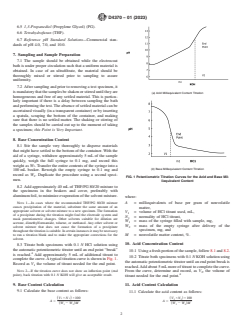
- Potentiometric titration and pH meter-based titrations are outlined for both acid and base content.
- Detailed methods for weight calculations and titrant volume measurements are provided for accurate content determination.
- Precision and Bias:
- The standard includes criteria for repeatability and reproducibility, based on interlaboratory studies.
- Safety and Compliance: Emphasizes the responsibility of users to adopt proper safety, health, and environmental practices and to comply with applicable regulations.
Applications
ASTM D4370-01(2023) is widely utilized in industries employing electrocoating processes, including automotive, electronics, heavy machinery, and appliance manufacturing. Practical applications include:
- Research and Development: Accurate monitoring of acid and base levels enables formulation optimization for new electrocoat products.
- Production Quality Control: Routine testing ensures electrocoat bath chemistry is maintained within required parameters, leading to consistent coating thickness, appearance, and corrosion resistance.
- Process Troubleshooting: Detecting deviations in acid/base content allows operators to adjust bath compositions promptly, preventing defects and minimizing downtime.
- Regulatory Compliance: Standardized test methods help facilities adhere to both internal specifications and external regulatory requirements for process control and environmental management.
Related Standards
The following ASTM standards are referenced or relevant for users of ASTM D4370-01(2023):
- ASTM D1193 - Specification for Reagent Water: Defines water purity requirements crucial for chemical testing.
- ASTM Paint and Coating Standards - Various standards under ASTM Committee D01 address the analysis, performance, and safety of coatings and related materials.
- Other International Guidelines: Developed according to WTO TBT principles, making this standard compatible with global trade and regulatory expectations.
Keywords: electrocoat bath, acid content, base content, milliequivalent, titration, process control, ASTM D4370-01(2023), coating analysis, quality control, electrocoating industry
Relations
- Effective Date
- 01-Mar-2006
- Effective Date
- 10-Feb-1999
- Effective Date
- 10-Feb-1999
Get Certified
Connect with accredited certification bodies for this standard

DVS-ZERT GmbH
German welding certification society.
CARES (UK Certification Authority for Reinforcing Steels)
UK certification for reinforcing steels and construction.
EWF/IIW (European/International Welding Federation)
International welding personnel certification.
Sponsored listings
Frequently Asked Questions
ASTM D4370-01(2023) is a standard published by ASTM International. Its full title is "Standard Test Methods for Acid and Base Milliequivalent Content of Electrocoat Bath". This standard covers: SIGNIFICANCE AND USE 4.1 The acid and base concentrations are a measurement of the titratable acidic and alkaline components in the electrocoat baths. These measurements are used for research, production or electrocoat bath process control. SCOPE 1.1 These test methods cover the determination of acid and base milliequivalent contents of anodic and cathodic electrocoat baths and their ultrafiltrates. 1.2 The values stated in SI units are to be regarded as standard. No other units of measurement are included in this standard. 1.3 This standard does not purport to address all of the safety concerns, if any, associated with its use. It is the responsibility of the user of this standard to establish appropriate safety, health, and environmental practices and determine the applicability of regulatory limitations prior to use. 1.4 This international standard was developed in accordance with internationally recognized principles on standardization established in the Decision on Principles for the Development of International Standards, Guides and Recommendations issued by the World Trade Organization Technical Barriers to Trade (TBT) Committee.
SIGNIFICANCE AND USE 4.1 The acid and base concentrations are a measurement of the titratable acidic and alkaline components in the electrocoat baths. These measurements are used for research, production or electrocoat bath process control. SCOPE 1.1 These test methods cover the determination of acid and base milliequivalent contents of anodic and cathodic electrocoat baths and their ultrafiltrates. 1.2 The values stated in SI units are to be regarded as standard. No other units of measurement are included in this standard. 1.3 This standard does not purport to address all of the safety concerns, if any, associated with its use. It is the responsibility of the user of this standard to establish appropriate safety, health, and environmental practices and determine the applicability of regulatory limitations prior to use. 1.4 This international standard was developed in accordance with internationally recognized principles on standardization established in the Decision on Principles for the Development of International Standards, Guides and Recommendations issued by the World Trade Organization Technical Barriers to Trade (TBT) Committee.
ASTM D4370-01(2023) is classified under the following ICS (International Classification for Standards) categories: 25.220.40 - Metallic coatings. The ICS classification helps identify the subject area and facilitates finding related standards.
ASTM D4370-01(2023) has the following relationships with other standards: It is inter standard links to ASTM D1193-06, ASTM D1193-99e1, ASTM D1193-99. Understanding these relationships helps ensure you are using the most current and applicable version of the standard.
ASTM D4370-01(2023) is available in PDF format for immediate download after purchase. The document can be added to your cart and obtained through the secure checkout process. Digital delivery ensures instant access to the complete standard document.
Standards Content (Sample)
This international standard was developed in accordance with internationally recognized principles on standardization established in the Decision on Principles for the
Development of International Standards, Guides and Recommendations issued by the World Trade Organization Technical Barriers to Trade (TBT) Committee.
Designation: D4370 − 01 (Reapproved 2023)
Standard Test Methods for
Acid and Base Milliequivalent Content of Electrocoat Bath
This standard is issued under the fixed designation D4370; the number immediately following the designation indicates the year of
original adoption or, in the case of revision, the year of last revision. A number in parentheses indicates the year of last reapproval. A
superscript epsilon (´) indicates an editorial change since the last revision or reapproval.
1. Scope baths. These measurements are used for research, production or
electrocoat bath process control.
1.1 These test methods cover the determination of acid and
base milliequivalent contents of anodic and cathodic electro-
5. Apparatus
coat baths and their ultrafiltrates.
5.1 Automatic Potentiometric Titrator with Stirrer and
1.2 The values stated in SI units are to be regarded as
Recorder, any model.
standard. No other units of measurement are included in this
5.2 Analytical Balance, with sensitivity of 0.1 mg.
standard.
1.3 This standard does not purport to address all of the 5.3 pH Meter, any model.
safety concerns, if any, associated with its use. It is the
5.4 Glass and Saturated Calomel Electrodes.
responsibility of the user of this standard to establish appro-
5.5 Syringes, 5 mL disposable.
priate safety, health, and environmental practices and deter-
mine the applicability of regulatory limitations prior to use.
6. Reagents
1.4 This international standard was developed in accor-
6.1 Purity of Reagents—Reagent grade chemicals shall be
dance with internationally recognized principles on standard-
used in all tests. Unless otherwise indicated, it is intended that
ization established in the Decision on Principles for the
all reagents shall conform to the specifications of the Commit-
Development of International Standards, Guides and Recom-
tee on Analytical Reagents of the American Chemical Society,
mendations issued by the World Trade Organization Technical
where such specifications are available.
Barriers to Trade (TBT) Committee.
Other grades may be used, provided it is ascertained that the
reagent is of sufficiently high purity to permit its use without
2. Referenced Documents
lessening the accuracy of the determination.
2.1 ASTM Standards:
D1193 Specification for Reagent Water 6.2 Purity of Water—References to water shall be under-
stood to mean water conforming to Type II of Specification
3. Summary of Test Methods
D1193.
3.1 Specimens are titrated with standard acid and alkali
6.3 Potassium Hydroxide Solution in Methanol, 0.1
solutions respectively. Alternative procedures are given for
N—Prepare by dissolving 5.6 g of potassium hydroxide (KOH)
determining acid and base concentrations potentiometrically or
pellets in 1 L of methanol. Standardize against NIST standard
using a pH meter.
reference material of acid potassium phthalate No. 84 using an
automatic potentiometric titrator to a given end point or,
4. Significance and Use
alternatively, to a phenolphthalein end point.
4.1 The acid and base concentrations are a measurement of
6.4 Hydrochloric Acid Solution , 0.1 N—Prepare by mixing
the titratable acidic and alkaline components in the electrocoat
about 8.50 mL of concentrated hydrochloric acid (HCl) (1.19
sp gr) into a mixture of 600 mL water and 400 mL methanol.
Standardize against 0.1 N potassium hydroxide solution (see
These test methods are under the jurisdiction of ASTM Committee D01 on
6.3).
Paint and Related Coatings, Materials, and Applications and are the direct
responsibility of Subcommittee D01.21 on Chemical Analysis of Paints and Paint
Materials.
Current edition approved June 1, 2023. Published June 2023. Originally ACS Reagent Chemicals, Specifications and Procedures for Reagents and
approved in 1984. Last previous edition approved in 2017 as D4370 – 01 (2017). Standard-Grade Reference Materials, American Chemical Society, Washington,
DOI: 10.1520/D4370-01R23. DC. For suggestions on the testing of reagents not listed by the American Chemical
For referenced ASTM standards, visit the ASTM website, www.astm.org, or Society, see Analar Standards for Laboratory Chemicals, BDH Ltd., Poole, Dorset,
contact ASTM Customer Service at service@astm.org. For Annual Book of ASTM U.K., and the United States Pharmacopeia and National Formulary, U.S. Pharma-
Standards volume information, refer to the standard’s Document Summary page on copeial Convention, Inc. (USPC), Rockville, MD.
the ASTM website. Svehla, G., Automatic Potentiometric Titration, Pergamon Press, 1978, p. 187.
Copyright © ASTM International, 100 Barr Harbor Drive, PO Box C700, West Conshohocken, PA 19428-2959. United States
D4370 − 01 (2023)
6.5 1,3-Propanediol (Propylene Glycol) (PG).
6.6 Tetrahydrofuran (THF).
6.7 Reference pH Standard Solutions—Commercial stan-
dards of pH 4.0, 7.0, and 10.0.
7. Sampling and Sample Preparation
7.1 The sample should be obtained while the electrocoat
bath is under proper circulation such that a uniform material is
obtained. In case of an ultrafiltrate, the material should be
thoroughly mixed or stirred prior to sampling to assure
uniformity.
7.2 After sampling and prior to removing a test specimen, it
is mandatory that the samples be shaken or stirred until they are
(a) Acid Milliequivalent Content Titration
homogeneous and free of any settled material. This is particu-
larly important if there is a delay between sampling the bath
and performing the test. The absence of settled material can be
ascertained visually (in a transparent container) or by inserting
a spatula, scraping the bottom of the container, and making
sure that there is no settled matter. The shaking or stirring of
the samples should be carried out up to the moment of taking
a specimen; this Point is Very Important.
8. Base Concentration Content
8.1 Stir the sample very thoroughly to disperse materials
that might have settled to the bottom of the container. With the
aid of a syringe, withdraw approximately 5 mL of the sample
quickly, weigh the full syringe to 0.1 mg, and record this
weight as W . Transfer the entire contents of the syringe into a
(b) Base Milliequivalent Conten
...