

ASTM B107/B107M-13(2021)
(Specification)Standard Specification for Magnesium-Alloy Extruded Bars, Rods, Profiles, Tubes, and Wire
General Information
- Abstract
ABSTRACT
This specification covers magnesium-alloy extruded bars, rods, profiles, tubes, and wire. The bars, rods, profiles, tubes, or wire shall conform to the chemical requirements specified. Tensile properties such as tensile strength, yield strength, and elongation of magnesium alloys shall be determined. All material shall be of uniform quality, free from injurious surface defects, and shall have a workmanlike finish.
SCOPE
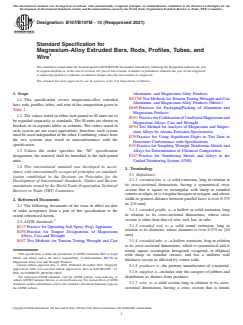
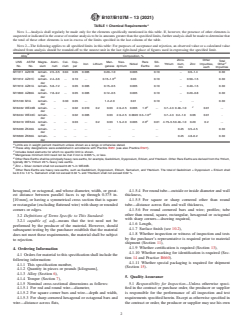
1.1 This specification covers magnesium-alloy extruded bars, rods, profiles, tubes, and wire of the composition given in Table 1.
1.2 The values stated in either inch-pound or SI units are to be regarded separately as standards. The SI units are shown in brackets or in separate tables or columns. The values stated in each system are not exact equivalents; therefore, each system must be used independent of the other. Combining values from the two systems may result in nonconformance with the specification.
1.3 Unless the order specifies the “M” specification designation, the material shall be furnished to the inch-pound units.
1.4 This international standard was developed in accordance with internationally recognized principles on standardization established in the Decision on Principles for the Development of International Standards, Guides and Recommendations issued by the World Trade Organization Technical Barriers to Trade (TBT) Committee.
- Status
- Published
- Publication Date
- 30-Nov-2021
- Technical Committee
- B07 - Light Metals and Alloys
- Drafting Committee
- B07.04 - Magnesium Alloy Cast and Wrought Products
Overview
ASTM B107/B107M-13(2021) is the international standard specification for magnesium-alloy extruded bars, rods, profiles, tubes, and wire. Developed by ASTM International, this standard outlines the requirements for chemical composition, mechanical properties, dimensions, tolerances, and quality assurance of magnesium alloy extruded products. Widely recognized in both inch-pound and SI metric units, ASTM B107/B107M provides essential guidelines to ensure reliable quality and performance of magnesium extrusions across multiple industries.
Key Topics
- Scope and Applicability: Covers solid and hollow extruded forms, including bars, rods, profiles (custom cross sections), tubes, and wire manufactured from magnesium alloys.
- Chemical Composition: Specifies acceptable ranges and limits of alloying elements to ensure material integrity. Chemical analysis and sampling guidelines are included.
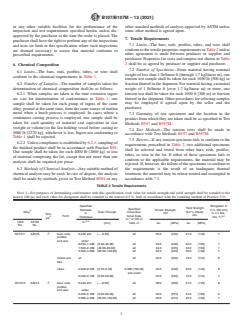
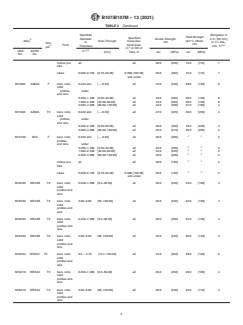
- Mechanical Properties: Stipulates minimum requirements for tensile strength, yield strength, and elongation in various product forms and sizes.
- Dimensional Tolerances: Establishes cross-sectional tolerances for different product geometries, including round, square, hexagonal, and octagonal shapes, as well as straightness and flatness criteria.
- Workmanship: Requires extruded products to be uniform in quality, free from injurious surface defects, and to exhibit a workmanlike finish.
- Corrosion Resistance: Includes procedures and periodic tests (such as salt spray exposure) to verify adequate resistance to corrosion, especially in specific alloys.
- Certification and Marking: Details requirements for product marking and, when specified, certification of compliance.
- Packaging: Offers guidance for packaging and package marking to protect materials during transportation and delivery.
Applications
Magnesium-alloy extruded products governed by ASTM B107/B107M are widely used for their favorable strength-to-weight ratio, corrosion resistance, and ease of fabrication. Key practical applications include:
- Aerospace Industry: Lightweight structural components, brackets, and support frames where weight reduction is critical.
- Automotive Sector: Drive shafts, frames, steering wheel cores, seat frames, and other lightweight parts improving fuel efficiency and vehicle performance.
- Electronics: Housings, chassis, and internal supports in mobile devices or computing equipment, benefiting from electromagnetic shielding and low weight.
- Sporting Goods and Consumer Products: Bicycle frames, sporting equipment, luggage frames, tool handles, and similar products where weight and strength are important.
- Military and Defense: Lightweight structures and support systems, benefiting from compliance with U.S. Department of Defense adoption of this standard.
Consistent implementation of ASTM B107/B107M enhances process quality, promotes uniformity, and provides confidence in the supply chain for manufacturers, suppliers, and end users.
Related Standards
- ASTM B117: Standard Practice for Operating Salt Spray (Fog) Apparatus - referenced for corrosion resistance testing.
- ASTM B296: Practice for Temper Designations of Magnesium Alloys, Cast and Wrought.
- ASTM B557/B557M: Test Methods for Tension Testing Wrought and Cast Aluminum- and Magnesium-Alloy Products.
- ASTM B660: Practices for Packaging/Packing of Aluminum and Magnesium Products.
- ASTM B951: Practice for Codification of Unalloyed Magnesium and Magnesium-Alloys, Cast and Wrought.
- ASTM E29: Practice for Using Significant Digits in Test Data to Determine Conformance with Specifications.
- ASTM E55: Practice for Sampling Wrought Nonferrous Metals and Alloys for Determination of Chemical Composition.
- ASTM E527: Practice for Numbering Metals and Alloys in the Unified Numbering System (UNS).
Standardizing magnesium alloy extrusions according to ASTM B107/B107M-13(2021) ensures that critical material requirements are met, supporting reliability and safety in advanced engineering applications.
Relations
- Effective Date
- 01-Nov-2023
- Refers
ASTM B296-20 - Standard Practice for Temper Designations of Magnesium Alloys, Cast and Wrought - Effective Date
- 01-May-2020
- Effective Date
- 01-May-2018
- Effective Date
- 15-May-2014
- Effective Date
- 15-May-2014
- Refers
ASTM B296-03(2014) - Standard Practice for Temper Designations of Magnesium Alloys, Cast and Wrought - Effective Date
- 01-May-2014
- Effective Date
- 01-Nov-2011
- Effective Date
- 01-Oct-2011
- Effective Date
- 01-Jul-2010
- Effective Date
- 01-Jul-2010
- Effective Date
- 01-Feb-2010
- Effective Date
- 01-Jul-2009
- Effective Date
- 01-Jun-2009
- Effective Date
- 15-Oct-2008
- Effective Date
- 01-Oct-2008
Get Certified
Connect with accredited certification bodies for this standard

Element Materials Technology
Materials testing and product certification.

Inštitut za kovinske materiale in tehnologije
Institute of Metals and Technology. Materials testing, metallurgical analysis, NDT.
Sponsored listings
Frequently Asked Questions
ASTM B107/B107M-13(2021) is a technical specification published by ASTM International. Its full title is "Standard Specification for Magnesium-Alloy Extruded Bars, Rods, Profiles, Tubes, and Wire". This standard covers: ABSTRACT This specification covers magnesium-alloy extruded bars, rods, profiles, tubes, and wire. The bars, rods, profiles, tubes, or wire shall conform to the chemical requirements specified. Tensile properties such as tensile strength, yield strength, and elongation of magnesium alloys shall be determined. All material shall be of uniform quality, free from injurious surface defects, and shall have a workmanlike finish. SCOPE 1.1 This specification covers magnesium-alloy extruded bars, rods, profiles, tubes, and wire of the composition given in Table 1. 1.2 The values stated in either inch-pound or SI units are to be regarded separately as standards. The SI units are shown in brackets or in separate tables or columns. The values stated in each system are not exact equivalents; therefore, each system must be used independent of the other. Combining values from the two systems may result in nonconformance with the specification. 1.3 Unless the order specifies the “M” specification designation, the material shall be furnished to the inch-pound units. 1.4 This international standard was developed in accordance with internationally recognized principles on standardization established in the Decision on Principles for the Development of International Standards, Guides and Recommendations issued by the World Trade Organization Technical Barriers to Trade (TBT) Committee.
ABSTRACT This specification covers magnesium-alloy extruded bars, rods, profiles, tubes, and wire. The bars, rods, profiles, tubes, or wire shall conform to the chemical requirements specified. Tensile properties such as tensile strength, yield strength, and elongation of magnesium alloys shall be determined. All material shall be of uniform quality, free from injurious surface defects, and shall have a workmanlike finish. SCOPE 1.1 This specification covers magnesium-alloy extruded bars, rods, profiles, tubes, and wire of the composition given in Table 1. 1.2 The values stated in either inch-pound or SI units are to be regarded separately as standards. The SI units are shown in brackets or in separate tables or columns. The values stated in each system are not exact equivalents; therefore, each system must be used independent of the other. Combining values from the two systems may result in nonconformance with the specification. 1.3 Unless the order specifies the “M” specification designation, the material shall be furnished to the inch-pound units. 1.4 This international standard was developed in accordance with internationally recognized principles on standardization established in the Decision on Principles for the Development of International Standards, Guides and Recommendations issued by the World Trade Organization Technical Barriers to Trade (TBT) Committee.
ASTM B107/B107M-13(2021) is classified under the following ICS (International Classification for Standards) categories: 77.150.20 - Magnesium products. The ICS classification helps identify the subject area and facilitates finding related standards.
ASTM B107/B107M-13(2021) has the following relationships with other standards: It is inter standard links to ASTM B660-23, ASTM B296-20, ASTM B951-11(2018), ASTM B557-14, ASTM B557M-14, ASTM B296-03(2014), ASTM B951-11, ASTM B117-11, ASTM B557M-10, ASTM B557-10, ASTM B951-10, ASTM B117-09, ASTM B951-09, ASTM B660-08, ASTM E29-08. Understanding these relationships helps ensure you are using the most current and applicable version of the standard.
ASTM B107/B107M-13(2021) is available in PDF format for immediate download after purchase. The document can be added to your cart and obtained through the secure checkout process. Digital delivery ensures instant access to the complete standard document.
Standards Content (Sample)
This international standard was developed in accordance with internationally recognized principles on standardization established in the Decision on Principles for the
Development of International Standards, Guides and Recommendations issued by the World Trade Organization Technical Barriers to Trade (TBT) Committee.
Designation:B107/B107M −13 (Reapproved 2021)
Standard Specification for
Magnesium-Alloy Extruded Bars, Rods, Profiles, Tubes, and
Wire
This standard is issued under the fixed designation B107/B107M; the number immediately following the designation indicates the year
of original adoption or, in the case of revision, the year of last revision. A number in parentheses indicates the year of last reapproval.
A superscript epsilon (´) indicates an editorial change since the last revision or reapproval.
This standard has been approved for use by agencies of the U.S. Department of Defense.
1. Scope Aluminum- and Magnesium-Alloy Products
B557M Test Methods for Tension Testing Wrought and Cast
1.1 This specification covers magnesium-alloy extruded
Aluminum- and Magnesium-Alloy Products (Metric)
bars, rods, profiles, tubes, and wire of the composition given in
B660 Practices for Packaging/Packing of Aluminum and
Table 1.
Magnesium Products
1.2 The values stated in either inch-pound or SI units are to
B951 PracticeforCodificationofUnalloyedMagnesiumand
be regarded separately as standards. The SI units are shown in
Magnesium-Alloys, Cast and Wrought
brackets or in separate tables or columns. The values stated in
B954 Test Method for Analysis of Magnesium and Magne-
each system are not exact equivalents; therefore, each system
sium Alloys by Atomic Emission Spectrometry
must be used independent of the other. Combining values from
E29 Practice for Using Significant Digits in Test Data to
the two systems may result in nonconformance with the
Determine Conformance with Specifications
specification.
E55 Practice for Sampling Wrought Nonferrous Metals and
1.3 Unless the order specifies the “M” specification Alloys for Determination of Chemical Composition
E527 Practice for Numbering Metals and Alloys in the
designation, the material shall be furnished to the inch-pound
units. Unified Numbering System (UNS)
1.4 This international standard was developed in accor-
3. Terminology
dance with internationally recognized principles on standard-
3.1 Definitions:
ization established in the Decision on Principles for the
3.1.1 extruded bar, n—a solid extrusion, long in relation to
Development of International Standards, Guides and Recom-
its cross-sectional dimensions, having a symmetrical cross
mendations issued by the World Trade Organization Technical
section that is square or rectangular with sharp or rounded
Barriers to Trade (TBT) Committee.
cornersoredges,orisaregularhexagonoroctagon,andwhose
width or greatest distance between parallel faces is over 0.375
2. Referenced Documents
in. [10 mm].
2.1 The following documents of the issue in effect on date
3.1.2 extruded profile, n—a hollow or solid extrusion, long
of order acceptance form a part of this specification to the
in relation to its cross-sectional dimensions, whose cross
extent referenced herein.
section is other than that of wire, rod, bar, or tube.
2.2 ASTM Standards:
3.1.3 extruded rod, n—a solid round extrusion, long in
B117 Practice for Operating Salt Spray (Fog) Apparatus
relation to its diameter, whose diameter is over 0.375 in. [10
B296 Practice for Temper Designations of Magnesium
mm].
Alloys, Cast and Wrought
B557 Test Methods for Tension Testing Wrought and Cast 3.1.4 extruded tube, n—a hollow extrusion, long in relation
to its cross-sectional dimensions, which is symmetrical and is
round, square, rectangular, hexagonal, octagonal, or elliptical
This specification is under the jurisdiction of ASTM Committee B07 on Light
with sharp or rounded corners, and has a uniform wall
Metals and Alloys and is the direct responsibility of Subcommittee B07.04 on
thickness except as affected by corner radii.
Magnesium Alloy Cast and Wrought Products.
Current edition approved Dec. 1, 2021. Published December 2021. Originally
3.1.5 producer, n—the primary manufacturer of a material.
approved in 1936. Last previous edition approved in 2013 as B107/B107M – 13.
3.1.6 supplier, n—includes only the category of jobbers and
DOI: 10.1520/B0107_B0107M-13R21.
For referenced ASTM standards, visit the ASTM website, www.astm.org, or
distributors as distinct from producer.
contact ASTM Customer Service at service@astm.org. For Annual Book of ASTM
3.1.7 wire, n—a solid section long in relation to its cross-
Standards volume information, refer to the standard’s Document Summary page on
the ASTM website. sectional dimensions, having a cross section that is round,
Copyright © ASTM International, 100 Barr Harbor Drive, PO Box C700, West Conshohocken, PA 19428-2959. United States
B107/B107M−13 (2021)
A
TABLE 1 Chemical Requirements
NOTE 1—Analysis shall regularly be made only for the elements specifically mentioned in this table. If, however, the presence of other elements is
suspected or indicated in the course of routine analysis to be in amounts greater than the specified limits, further analysis shall be made to determine that
the total of these other elements is not in excess of the limits specified in the last column of the table.
NOTE 2—The following applies to all specified limits in this table: For purposes of acceptance and rejection, an observed value or a calculated value
obtained from analysis should be rounded-off to the nearest unit in the last right-hand place of figures used in expressing the specified limit.
B
Alloy Composition, %
Zirco- Other
Total
UNS ASTM Magne- Alumi- Cal- Cop- Man- Neo- Rare Sili-
C
Iron Lithium Nickel Yttrium nium, Zinc Impurities, Other
No. No. sium num cium per ganese dymium Earths con
Impurities
min each
M11311 AZ31B remain- 2.5–3.5 0.04 0.05 0.005 0.20–1.0 0.005 0.10 . 0.6–1.4 0.30
der
D
M11312 AZ31C remain- 2.4–3.6 . 0.10 . 0.15–1.0 0.03 0.10 . 0.50–1.5 0.30
der
M11610 AZ61A remain- 5.8–7.2 . 0.05 0.005 0.15–0.5 0.005 0.10 . 0.40–1.5 0.30
der
M11800 AZ80A remain- 7.8–9.2 . 0.05 0.005 0.12–0.5 0.005 0.10 . 0.20–0.8 0.30
der
M15100 M1A remain- . 0.30 0.05 . 1.2–2.0 0.01 0.10 . . 0.30
der
E F
M18432 WE43B remain- . . 0.02 0.010 0.2 0.03 2.0–2.5 0.005 1.9 . 3.7–4.3 0.40–1.0 0.01 .
der
G
M18434 WE43C remain- {{ 0.02 0.005 0.03 2.0–2.5 0.0020 0.3–1.0 3.7–4.3 0.2–1.0 0.06 0.01 {
der
E
M18410 WE54A remain- . . 0.03 . 0.2 0.03 1.5–2.0 0.005 2.0 0.01 4.75–5.5 0.40–1.0 0.20 0.2 .
der
M16400 ZK40A remain- . . . . . . . 0.45 3.5–4.5 0.30
der
M16600 ZK60A remain- . . . . . . . 0.45 4.8–6.2 0.30
der
A
Limits are in weight percent maximum unless shown as a range or otherwise stated.
B
These alloy designations were established in accordance with Practice B951 (see also Practice E527).
C
Includes listed elements for which no specific limit is shown.
D
Manganese minimum limit need not be met if iron is 0.005 %, or less.
E
Other Rare Earths shall be principally heavy rare earths, for example, Gadolinium, Dysprosium, Erbium, and Ytterbium. Other Rare Earths are derived from the Yttrium,
typically 80 % Yttrium 20 % heavy rare earths.
F
Zinc + Silver content shall not exceed 0.20 % in WE43B.
G
Other Rare Earths are heavy rare earths, such as Gadolinium, Dysprosium, Erbium, Samarium, and Ytterbium. The total of Gadolinium + Dysprosium + Erbium shall
be 0.3 to 1.0 %. Samarium shall not exceed 0.04 % and Ytterbium shall not exceed 0.02 %
hexagonal, or octagonal, and whose diameter, width, or great- 4.1.5.4 For round tube—outside or inside diameter and wall
est distance between parallel faces is up through 0.375 in. thickness,
[10 mm], or having a symmetrical cross section that is square 4.1.5.5 For square or sharp cornered other than round
or rectangular (excluding flattened wire) with sharp or rounded tube—distance across flats and wall thickness,
corners or edges. 4.1.5.6 For round cornered bars and wire; profiles; tube
other than round, square, rectangular, hexagonal or octagonal
3.2 Definitions of Terms Specific to This Standard:
with sharp corners—drawing required,
3.2.1 capable of, adj—means that the test need not be
4.1.6 Length,
performed by the producer of the material. However, should
4.1.7 Surface finish (see 10.2),
subsequent testing by the purchaser establish that the material
4.1.8 Whether inspection or witness of inspection and tests
does not meet these requirements, the material shall be subject
by the purchaser’s representative is required prior to material
to rejection.
shipment (Section 11),
4.1.9 Whether certification is required (Section 13),
4. Ordering Information
4.1.10 Whether marking for identification is required (Sec-
4.1 Orders for material to this specification shall include the
tion 14 and Practice B660).
following information:
4.1.11 Whether special packaging is required for shipment
4.1.1 This specification number,
(Section 15).
4.1.2 Quantity in pieces or pounds [kilograms],
4.1.3 Alloy (Section 6),
5. Quality Assurance
4.1.4 Temper (Section 7),
4.1.5 Nominal cross-sectional dimensions as follows: 5.1 Responsibility for Inspection—Unless otherwise speci-
4.1.5.1 For rod and round wire—diameter, fied in the contract or purchase order, the producer or supplier
4.1.5.2 For square corner bars and wire—depth and width, is responsible for the performance of all inspection and test
4.1.5.3 For sharp cornered hexagonal or octagonal bars and requirements specified herein. Except as otherwise specified in
wire—distance across flats, the contract or order, the producer or supplier may use his own
B107/B107M−13 (2021)
or any other suitable facilities for the performance of the other standard methods of analysis approved by ASTM unless
inspection and test requirements specified herein, unless dis- some other method is agreed upon.
approved by the purchaser at the time the order is placed. The
7. Tensile Requirements
purchaser shall have the right to perform any of the inspections
7.1 Limits—The bars, rods, profiles, tubes, and wire shall
and tests set forth in this specification where such inspections
conformtothetensilepropertiesrequirementsinTable2unless
are deemed necessary to assure that material conforms to
other agreement is made between producer or supplier and
prescribed requirements.
purchaser. Properties for sizes and tempers not shown in Table
2 shall be as agreed by producer or supplier and purchaser.
6. Chemical Composition
7.2 Number of Specimens—From material having nominal
6.1 Limits—The bars, rods, profiles, tubes, or wire shall
weight of less than 1 lb/linear ft [through 1.7 kg/linear m], one
conform to the chemical requirements in Table 1.
tension test sample shall be taken for each 1000 lb [500 kg] or
6.2 Number of Samples—The number of samples taken for
fraction thereof in the shipment. For material having a nominal
determination of chemical composition shall be as follows: weight of 1 lb/linear ft [over 1.7 kg/linear m] or more, one
tension test shall be taken for each 1000 ft [300 m] or fraction
6.2.1 When samples are taken at the time extrusion ingots
thereofintheshipment.Otherproceduresforselectingsamples
are cast for determination of conformance to Table 1, one
may be employed if agreed upon by the seller and the
sample shall be taken for each group of ingots of the same
purchaser.
alloy, poured at the same time, from the same source of molten
metal when a batch process is employed. In cases where a
7.3 Geometry of test specimens and the location in the
continuous casting process is employed, one sample shall be
product from which they are taken shall be as specified in Test
taken for each quantity of material cast equivalent in size
Methods B557 and B557M.
(weight or volume) to the last holding vessel before casting or
7.4 Test Methods—The tension tests shall be made in
5000 lb [2270 kg], whichever is less. Ingots not conforming to
accordance with Test Methods B557 and B557M.
Table 1 shall be rejected.
7.5 Retests—If any tension specimen fails to conform to the
6.2.2 Unlesscomplianceisestablishedby6.2.1,samplingof
requirements prescribed in Table 2, two additional specimens
the finished product shall be in accordance with Practice E55.
shall be selected and tested from other bars, rods, profiles,
One sample shall be taken for each 4000 lb (2000 kg) or less
tubes, or wire in the lot. If either of these specimens fails to
of material comprising the lot, except that not more than one
conform to the applicable requirements, the material may be
analysis shall be required per piece.
rejected.If,however,thefailureofthespecimenstoconformto
6.3 Methods of Chemical Analysis—Any suitable method of the requirements is the result of an inadequate thermal
chemical analysis may be used. In case of dispute, the analysis treatment, the material may be reheat treated and resampled in
shall be made by methods given in Test Method B954 or any accordance with 7.2.
TABLE 2 Tensile Requirements
NOTE 1—For purposes of determining conformance with this specification, each value for tensile strength and yield strength shall be rounded to the
nearest 100 psi and each value for elongation shall be rounded to the nearest 0.5 %, both in accordance with the rounding method of Practice E29.
Specified Elongation in
Yield Strength
Specified
Diameter Tensile Strength, 2 in. [50 mm]
A
Alloy Over-Through (0.2 % offset),
Cross-Sec-
or min or 4 × Dia.,
Tem-
min
Form tional Area, B,C
A
Thickness min, %
per
in. or OD of
D,E
UNS ASTM in.
Tube, in.
[mm] ksi [MPa] ksi [MPa]
No. No.
M11311 AZ31B F bars, rods, 0.249 and [.–6.30] all 35.0 [240] 21.0 [145] 7
profiles,
and wire under
0.250–1.499 [6.30–40.00] all 35.0 [240] 22.0 [150] 7
1.500–2.499 [40.00–60.00] all 34.0 [235] 22.0 [150] 7
2.500–4.999 [60.00–130.00] all 32.0 [220] 20.0 [140] 7
hollow pro- all all 32.0 [220] 16.0 [110] 8
files
tubes 0.028–0.250 [0.70–6.30] 6.000 [150.00] 32.0 [220] 20.0 [140] 8
and under
0.250–0.750 [6.30–20.00] 32.0 [220] 16.0 [110] 4
M11610 AZ61A F bars, rods, 0.249 and [.–6.30] all 38.0 [260] 21.0 [145] 8
profiles,
and wire under
0.250–2.499 [6.30–60.00] all 40.0 [275] 24.0 [165] 9
2.500–4.999 [60.00–130.00] all 40.0 [275] 22.0 [150] 7
B107/B107M−13 (2021)
TABLE2 Continued
Specified Elongation in
Yield Strength
Specified
Diameter Tensile Strength, 2 in. [50 mm]
A
Alloy Over-Through (0.2 % offset),
Cross-Sec-
or min or 4 × Dia.,
Tem-
min
Form tional Area, B,C
A
Thickness min, %
per
in. or OD of
D,E
UNS ASTM in.
Tube, in.
[mm] ksi [MPa] ksi [MPa]
No. No.
hollow pro- all all 36.0 [250] 16.0 [110] 7
files
tubes 0.028–0.750 [0.70–20.00] 6.000 [150.00] 36.0 [250] 16.0 [110] 7
and under
M11800 AZ80A F bars, rods, 0.249 and [.–6.30] all 43.0 [295] 28.0 [195] 9
solid
profiles, under
and wire
0.250–1.499 [6.30–40.00] all 43.0 [295] 28.0 [195] 8
1.500–2.499 [40.00–60.00] all 43.0 [295] 28.0 [195] 6
2.500–4.999 [60.00–130.00] all 42.0 [290] 27.0 [185] 4
M11800 AZ80A T5 bars, rods, 0.249 and [.–6.30] all 47.0 [325] 30.0 [205] 4
solid
profiles, under
and wire
0.250–2.499 [6.30–60.00] all 48.0 [330] 33.0 [230] 4
2.500–4.999 [60.00–130.00] all 45.0 [310] 30.0 [205] 2
FF
M15100 M1A F bars, rods, 0.249 and [.–6.30] all 30.0 [205] 2
profiles,
and wire under
FF
0.250–1.499 [6.30–40.00] all 32.0 [220] 3
FF
1.500–2.499 [40.00–60.00] all 32.0 [220] 2
FF
2.500–4.999 [60.00–130.00] all 29.0 [200] 2
FF
hollow pro- all all 28.0 [195] 2
files
FF
tubes 0.028–0.750 [0.70–20.00] 6.000 [150.00] 28.0 [195] 2
and under
M18430 WE43B T5 bars, rods, 0.250–1.999 [6.3–50.00] all 36.0 [250] 23.0 [160] 4
solid
profiles and
wire
M18430 WE43B T5 bars, rods, 2.00–5.00 [50–130.00] all 35.0 [240] 22.0 [150] 4
solid
profiles and
wire
M18430 WE43B T6 bars, rods, 0.250–1.999 [6.3–50.00] all 36.0 [250] 22.0 [150] 4
solid
profiles and
wire
M18430 WE43B T6 bars, rods, 2.00–5.00 [50–130.00] all 35.0 [240] 20.0 [140] 4
solid
profiles and
wire
M18434 WE43C T5 bars, rods, 0.5 – 4.75 [12.7–120.00] all 44.0 [303] 28.0 [195] 6
solid
profiles and
wire
M18410 WE54A T5 bars, rods, 0.250–1.999 [6.3–50.00] all 36.0 [250] 26.0 [180] 4
solid
profiles and
wire
M18410 WE54A T5 bars, rods, 2.00–5.00 [50–130.00] all 36.0 [250] 25.0 [170] 4
solid
profiles and
wire
B107/B107M−13 (2021)
TABLE2 Continued
Specified Elongation in
Yield Strength
Specified
Diameter Tensile Strength, 2 in. [50 mm]
A
Alloy Over-Through (0.2 % offset),
Cross-Sec-
or min or 4 × Dia.,
Tem-
min
Form tional Area, B,C
A
Thickness min, %
per
in. or OD of
D,E
UNS ASTM in.
Tube, in.
[mm] ksi [MPa] ksi [MPa]
No. No.
M18410 WE54A T6 bars, rods, 0.250–1.999 [6.3–50.00] all 38.0 [260] 26.0 [180] 4
solid
profiles and
wire
M18410 WE54A T6 bars, rods, 2.00–5.00 [50–130.00] all 36.0 [250] 25.0 [175] 4
solid
profiles and
wire
M16400 ZK40A T5 bars, rods, all 3.000 [1900] 37.0 [255] 34.0 [235] 4.0
profiles, and under
and wire
hollow pro- all all 40.0 [275] 37.0 [255] 4.0
files
tubes 0.062–0.500 [1.60–12.50] 3.000 [80.00] 40.0 [275] 36.0 [255] 4.0
and under
M16600 ZK60A F bars, rods, all 4.999 [3200] 43.0 [295] 31.0 [215] 5
profiles and under
and wire
5.000–39.999 43.0 [295] 31.0 [215] 6
[3201–26 000]
hollow pro- all all 40.0 [275] 28.0 [195] 5
files
tubes 0.028–0.750 [0.70–20.00] 3.000 [80.00] 40.0 [275] 28.0 [195] 5
and under
M16600 ZK60A T5 bars, rods, all 4.999 [3200] 45.0 [310] 36.0 [250] 4
profiles,and and under
wire
5.000–24.999 45.0 [310] 34.0 [235] 6
[3201–16 000]
25.000–39.999 43.0 [295] 31.0 [215] 6
[16 001–26 000]
hollow pro- all all 46.0 [315] 38.0 [260] 4
files
tubes 0.028–0.250 [0.70–6.30] 3.000 [80.00] 46.0 [315] 38.0 [260] 4
and under
0.094–1.188 [2.50–30.00] 3.001 [80.00]– 44.0 [305] 33.0 [230] 4
8.500 [215]
A
See Practice B296.
B
Elongation of full-section and machined sheet-type specimens is measured in 2 in. [50 mm] of machined round specimens, in 4 × specimen dia. [5 × dia. in metric].
C
For material of such dimensions that a standard test specimen cannot be obtained, for wire less than 0.125 in. diameter [3.2 mm diameter], or for material thinner than
0.062 in. [1.60 mm] the test for elongation is not required.
D
Intermediate dimensions shall be rounded off to the third decimal place in accordance with Practice E29.
E
Wall thickness of tubes.
F
Not required.
B107/B107M−13 (2021)
A
TABLE 3 Cross-Sectional Tolerances for Bars, Rods, Profiles, and Wire
B,C
Tolerance in. ±
Metal Dimensions Space Dimensions
Allowable Deviation from Specified
Allowable Deviation from Specified Dimension Where More
Dimension Where 75% or More
E,F
than 25% of the Dimension is Space
D
of the Dimension is Metal
Specified
Dimension, in.
At At
G,H, I
Wall Thickness At Dimensioned At Dimensioned At Dimensioned At Dimensioned
All Except Dimensioned Dimensioned
Completely Enclosing Points Points Points Points
Those Covered Points Points
Space 0.250–0.624 0.625–1.249 1.250–2.499 2.500–3.999
By Column 4.000–5.999 6.000–8.000
0.11 in. and Over in. from Base in. from Base in. from Base in. from Base
3 in. from Base in. from Base
(Eccentricity) of Leg of Leg of Leg of Leg
of Leg of Leg
Col. 1 Col. 2 Col. 3 Col. 4 Col. 5 Col. 6 Col. 7 Col. 8 Col. 9
Circumscribing Circle Sizes Less than 10 in. in Dia
0.124 and under 0.006 ±10 % of specified 0.010 0.012 . . . .
0.125–0.249 0.007 dimension: 0.012 0.014 0.016 . . .
0.250–0.499 0.008 ±0.060 max 0.014 0.016 0.018 0.020 . .
0.500–0.749 0.009 ±0.010 min 0.016 0.018 0.020 0.022 . .
0.750–0.999 0.010 0.018 0.020 0.022 0.025 0.30 .
1.000–1.499 0.012 0.021 0.023 0.026 0.030 0.035 .
1.500–1.999 0.014 0.024 0.026 0.031 0.036 0.042 0.050
2.000–3.999 0.024 0.034 0.038 0.048 0.057 0.068 0.080
4.000–5.999 0.034 0.044 0.050 0.064 0.078 0.094 0.110
6.000–7.999 0.044 0.054 0.062 0.082 0.099 0.120 0.140
8.000–9.999 0.054 0.064 0.074 0.100 0.120 0.145 0.170
Circumscribing Circle Sizes 10 in. in Dia and Over
0.124 and under 0.014 ±15 % of specified 0.018 0.020 . . . .
0.125–0.249 0.015 dimension: 0.019 0.022 0.028 . . .
0.250–0.499 0.016 ±0.090 max 0.020 0.024 0.030 0.050 . .
0.500–0.749 0.017 ±0.015 min 0.022 0.027 0.040 0.060 . .
0.750–0.999 0.018 0.023 0.030 0.050 0.070 0.090 .
1.000–1.499 0.019 0.024 0.034 0.060 0.080 0.100 .
1.500–1.999 0.024 0.034 0.044 0.070 0.090 0.110 0.170
2.000–3.999 0.034 0.044 0.054 0.080 0.100 0.120 0.180
4.000–5.999 0.044 0.054 0.064 0.090 0.110 0.130 0.190
6.000–7.999 0.054 0.064 0.074 0.100 0.120 0.140 0.200
8.000–9.999 0.064 0.074 0.084 0.110 0.130 0.150 0.210
10.000–11.999 0.074 0.084 0.094 0.120 0.140 0.160 0.220
12.000–13.999 0.084 0.094 0.104 0.130 0.150 0.170 0.230
14.000–15.999 0.094 0.104 0.114 0.140 0.160 0.180 0.240
16.000–17.999 0.104 0.114 0.124 0.150 0.170 0.190 0.250
18.000–19.999 0.114 0.124 0.134 0.160 0.180 0.200 0.260
20.000–21.999 0.124 0.134 0.144 0.170 0.190 0.210 0.270
22.000–23.999 0.134 0.144 0.154 0.180 0.200 0.220 0.280
A
These tolerances are applicable to the average profile. Wider tolerances may be required for some profiles and closer tolerances may be possible for others.
B
The tolerances applicable to a dimension composed of two or more component dimensions is the sum of the tolerances of the component dimensions if all of the
component dimensions are indicated.
C
When a tolerance is specified other than as an equal bilateral tolerance, the value of the standard tolerance is that which would apply to the mean of the maximum
dimensions permissible under the tolerance.
D
These tolerances do not apply to space dimensions such as dimensions X and Z of the example even when Y is 75 % or more of X. For the tolerance applicable to
dimensions X, use Col. 4, 5, 6, 7, 8 or 9, dependent on distance A and the circumscribing circle diameter.
E
At points less than 0.250 in. from base of leg the tolerances in Column 2 are applicable.
B107/B107M−13 (2021)
F
The following tolerances apply where the space is completely enclosed (hollow profiles): For the width (A) the tolerance is the value shown in Column 4 for the depth
(D), the tolerance is the value shown in Column 4 for the width (A). In no case is the tolerance for either width or depth less than at the corners (Column 2, metal
dimensions).
Example—Hollow profile having 1 by 3 in. rectangular outside dimensions and having a circumscribing circle diameter less than 10 in.: width tolerance is± 0.024 in. and
depth tolerance ±0.034 in. (Tolerances at corners, Column 2, metal dimensions, are ±0.024 in. for the width and ±0.012 in. for the depth.)
G
Where dimensions specified are outside and inside, rather than wall thickness itself, the allowable deviation (eccentricity) given in Column 3 applies to mean wall
thickness (mean wall thickness is the average of two wall thickness measurements taken at opposite sides of the void).
H
In the case of Class 1 Hollow Profiles the standard wall thickness tolerance for extruded round tube is applicable. (A Class 1 Hollow Profile is one whose void is round
and 1 in. or more in diameter and whose weight is equally distributed on opposite sides of two or more equally spaced axes.)
I
Tolerance applicable to the wall thickness enclosing the void of hollow and semihollow profiles is subject to negotiation when the nominal thickness of one wall is three
times or greater than that of the opposite wall.
B107/B107M−13 (2021)
A
TABLE 4 Cross Section Tolerances for Bars, Rods, Profiles, and Wire [Metric]
B,C
Tolerance mm ±
Metal Dimensions Space Dimensions
Allowable Deviation from Specified
Allowable Deviation from Specified Dimension Where More than 25 % of the Dimension is
Dimension Where 75 % or More of
E,F
Space
D
the Dimension is Metal
Specified
At Dimen-
At Dimen- At Dimen- At Dimen- At Dimen- At Dimen-
Dimensions
All Except Wall Thickness sioned
sioned Points sioned Points sioned Points sioned Points sioned Points
(mm)
Those Completely Enclos- Points
Over 5 Over 30 Over 60 Over 100 Over 150
Covered ing Space 7.0 mm Over 15
through through through through through
by Column and Over through
15 mm from 60 mm from 100 mm from 150 mm from 200 mm from
G,H,I
3 (Eccentricity) 30 mm from
Base of Leg Base of Leg Base of Leg Base of Leg Base of Leg
Base of Leg
Col. 1 Col. 2 Col. 3 Col. 4 Col. 5 Col. 6 Col. 7 Col. 8 Col. 9
Over Through Circumscribing Circle Sizes Thru 250 mm in Diameter
0 3.20 0.15 ±10 % of specified 0.25 0.30 . . . .
3.20 6.30 0.18 dimensions: 0.30 0.36 0.41 . . .
6.30 12.50 0.20 ±1.50 max 0.36 0.41 0.46 0.50 . .
12.50 20.00 0.23 ±0.25 min 0.41 0.46 0.50 0.56 . .
20.00 25.00 0.25 0.46 0.50 0.56 0.64 0.76 .
25.00 40.00 0.30 0.54 0.58 0.66 0.76 0.88 .
40.00 50.00 0.36 0.60 0.66 0.78 0.92 1.05 1.25
50.00 100.00 0.60 0.86 0.96 1.20 1.45 1.70 2.05
100.00 150.00 0.86 1.10 1.25 1.65 2.00 2.40 2.80
150.00 200.00 1.10 1.35 1.55 2.10 2.50 3.05 3.55
200.00 250.00 1.35 1.65 1.90 2.50 3.05 3.70 4.30
Circumscribing Circle Sizes Over 250 mm in Diameter
0 3.20 0.36 ±15 % of specified 0.46 0.50 . . . .
3.20 6.30 0.38 dimensions: 0.48 0.56 0.72 . . .
6.30 12.50 0.41 ±2.30 max 0.50 0.60 0.76 1.25 . .
12.50 20.00 0.43 ±0.38 min 0.56 0.68 1.00 1.50 . .
20.00 25.00 0.46 0.58 0.76 1.25 1.80 2.30 .
25.00 40.00 0.48 0.60 0.86 1.50 2.05 2.55 .
40.00 50.00 0.60 0.86 1.10 1.80 2.30 2.80 4.30
50.00 100.00 0.86 1.10 1.35 2.05 2.55 3.05 4.55
100.00 150.00 1.10 1.35 1.65 2.30 2.80 3.30 4.85
150.00 200.00 1.35 1.65 1.90 2.55 3.05 3.55 5.10
200.00 250.00 1.65 1.90 2.15 2.80 3.20 3.80 5.35
250.00 300.00 1.90 2.15 2.40 3.05 3.55 4.05 5.60
300.00 350.00 2.15 2.40 2.65 3.30 3.80 4.30 5.85
350.00 400.00 2.40 2.65 2.90 3.55 4.05 4.55 6.10
400.00 450.00 2.65 2.90 3.15 3.80 4.30 4.85 6.35
450.00 500.00 2.90 3.15 3.40 4.05 4.55 5.10 6.60
500.00 550.00 3.15 3.40 3.65 4.30 4.85 5.25 6.85
550.00 600.00 3.40 3.65 3.90 4.55 5.10 5.60 7.10
A
These tolerances are applicable to the average profile. Wider tolerances may be required for some profiles and closer tolerances may be possible for others.
B
The tolerances applicable to a dimension composed of two or more component dimensions is the sum of the tolerances of the component dimensions if all of the
component dimensions are indicated.
C
When a tolerance is specified other than as an equal bilateral tolerance, the value of the standard tolerance is that which would apply to the mean of the maximum
dimensions permissible under the tolerance.
D
These tolerances do not apply to space dimensions such as dimensions X and Z of the example even when Y is 75 % or more of X. For the tolerance applicable to
dimensions X, use columns 4, 5, 6, 7, 8 or 9, dependent on distance A and the circumscribing circle diameter.
E
At points less than 6.30 mm in from base of leg the tolerances in Column 2 are applicable.
B107/B107M−13 (2021)
F
The following tolerances apply where the space is completely enclosed (hollow profiles): For the width (A) the tolerance is the value shown in Column 4 for the depth
(D). For the depth (D), the tolerance is the value shown in Column 4 for the width (A). In no case is the tolerance for either width or depth less than at the corners (Column
2, metal dimensions).
Example—Hollow profile having 25 mm by 75 mm rectangular outside dimensions and having a circumscribing circle diameter less than 250 mm: width tolerance is ±0.60
mm and depth tolerance ±1 mm. Tolerances at corners, Column 2, metal dimensions, are ±0.60 mm for the width and ±0.25 mm for the depth.)
G
Where dimensions specified are outside and inside, rather than wall thickness itself, the allowable deviation (eccentricity) given in Column 3 applies to mean wall
thickness (mean wall thickness is the average of two wall thickness measurements taken at opposite sides of the void).
H
In the case of Class 1 Hollow Profiles the standard wall thickness tolerance for extruded round tube is applicable. (A Class 1 Hollow Profile is one whose void is round
and 25 mm or more in diameter and whose weight is equally distributed on opposite sides of two or more equally spaced axes.)
I
Tolerance applicable to the wall thickness enclosing the void of hollow and semihollow profiles is subject to negotiation when the nominal thickness of one wall is three
times or greater than that of the opposite wall.
8. Corrosion Resistance
EP = exposure time in days,
D = density, 1.82 g/cm , and
8.1 CorrosionrateofWE43C,testedina
...