

ASTM B403-20
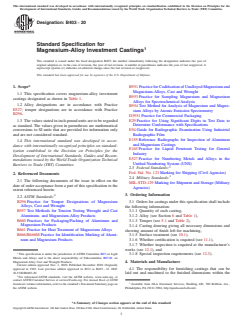
(Specification)Standard Specification for Magnesium-Alloy Investment Castings
General Information
- Abstract
ABSTRACT
This specification covers magnesium-alloy investment castings designated as AM100A, AZ81A, AZ91C, AZ91E, AZ92A, EQ21A, EZ33A, K1A, QE22A, ZE41A, and ZK61A. Sufficient stock shall be allowed for shrinkage and, where required, for finishing; but castings of excessive weight shall not be furnished. The castings shall conform to the chemical composition requirements prescribed for magnesium, aluminum, manganese, zinc, zirconium, rare earth elements, copper, nickel, silicon, iron, and other impurities, as determined by chemical analysis, and shall meet the specified requirements for the tensile properties such as tensile strength, yield strength, and elongation. Requirements for heat treatment and tensile test are detailed. The castings shall be of uniform quality and condition, free from cracks and other injurious defects, shall be cleaned before inspection by blasting or other approved process, and shall not be repaired by welding, impregnation, peening, or other method unless it is required.
SCOPE
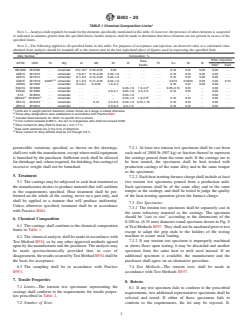
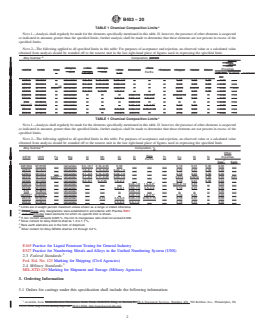
1.1 This specification covers magnesium-alloy investment castings designated as shown in Table 1.
1.2 Alloy designations are in accordance with Practice E527; temper designations are in accordance with Practice B296.
1.3 The values stated in inch-pound units are to be regarded as standard. The values given in parentheses are mathematical conversions to SI units that are provided for information only and are not considered standard.
1.4 This international standard was developed in accordance with internationally recognized principles on standardization established in the Decision on Principles for the Development of International Standards, Guides and Recommendations issued by the World Trade Organization Technical Barriers to Trade (TBT) Committee.
- Status
- Published
- Publication Date
- 31-Oct-2020
- Technical Committee
- B07 - Light Metals and Alloys
- Drafting Committee
- B07.04 - Magnesium Alloy Cast and Wrought Products

Overview
ASTM B403-20: Standard Specification for Magnesium-Alloy Investment Castings outlines the requirements for the chemical composition, mechanical properties, manufacture, testing, and quality assurance of magnesium alloy investment castings. Developed by ASTM International, this standard is crucial for industries that rely on lightweight, high-performance cast components, such as aerospace, automotive, and defense sectors. The specification covers a range of magnesium alloys, including AM100A, AZ81A, AZ91C, AZ91E, AZ92A, EQ21A, EZ33A, K1A, QE22A, ZE41A, and ZK61A.
Key Topics
- Alloy Designations: Specifies the magnesium alloy grades according to established practices (ASTM E527 and B296).
- Chemical Composition: Sets precise limits for elements such as magnesium, aluminum, manganese, zinc, zirconium, rare earths, copper, nickel, silicon, iron, and impurities-ensuring high-quality material performance.
- Mechanical Properties: Requires tensile testing to verify minimum values for tensile strength, yield strength, and elongation as per alloy and temper, aligning with methods like ASTM B557.
- Heat Treatment: Covers heat treatment processes to achieve specified properties, as outlined in ASTM B661, ensuring uniformity and strength.
- Manufacture and Finish: Details requirements concerning casting stock for shrinkage and finishing, cleanliness (e.g., blasting, chrome pickling, or corrosion-inhibitive oiling), and prohibits unauthorized repairs.
- Testing and Inspection: Mandates the use of certified methods for chemical analysis (e.g., ASTM B954) and sampling (ASTM B953), with retest procedures and inspection provisions (including radiography per ASTM E94 and penetrant inspection per ASTM E165).
- Packaging and Marking: Stipulates proper packaging to prevent damage, as well as identification and compliance with civil and military packaging standards.
- Certification: Suppliers must provide certificates of compliance with the specification upon request.
Applications
Magnesium-alloy investment castings manufactured to ASTM B403-20 are widely used across sectors that demand components with an optimal balance of light weight and mechanical strength. Key applications include:
- Aerospace: Aircraft structural components, brackets, housings, and other load-bearing parts where weight reduction is critical for performance and fuel efficiency.
- Automotive: Transmission casings, gearbox components, and other chassis parts where reduced mass improves efficiency and handling.
- Defense and Military: Lightweight structures for military vehicles and equipment benefit from the high strength-to-weight ratio and corrosion-resistant options defined by the standard.
- General Engineering: Complex geometries and precision parts in machinery where investment casting offers manufacturing flexibility and tight tolerances.
Related Standards
Users implementing ASTM B403-20 may also reference or require compliance with associated standards to ensure full specification and quality:
- ASTM E527: Numbering Metals and Alloys in the Unified Numbering System (UNS)
- ASTM B296: Temper Designations of Magnesium Alloys
- ASTM B557: Tension Testing Wrought and Cast Aluminum- and Magnesium-Alloy Products
- ASTM B661: Heat Treatment of Magnesium Alloys
- ASTM B953, B954: Sampling and Chemical Analysis Methods for Magnesium Alloys
- ASTM E94, ASTM E155: Radiographic Examination and Reference Radiographs for Castings
- ASTM E165: Liquid Penetrant Testing for General Industry
- ASTM B666/B666M, ASTM D3951, Fed. Std. No. 123, MIL-STD-129: Packaging and Marking Specifications
Practical Value
Compliance with ASTM B403-20 assures manufacturers and end users that magnesium alloy investment castings possess the targeted chemical and mechanical properties, consistent quality, and suitability for high-performance applications. The standard provides a recognized framework for procurement, verification, and quality assurance-facilitating reliable production, streamlined inspection, and confidence in the durability and performance of magnesium cast components.
Relations
- Effective Date
- 01-Nov-2023
- Effective Date
- 01-Oct-2023
- Refers
ASTM B296-20 - Standard Practice for Temper Designations of Magnesium Alloys, Cast and Wrought - Effective Date
- 01-May-2020
- Effective Date
- 01-May-2018
- Effective Date
- 01-May-2018
- Effective Date
- 01-Dec-2015
- Effective Date
- 15-May-2014
- Refers
ASTM B296-03(2014) - Standard Practice for Temper Designations of Magnesium Alloys, Cast and Wrought - Effective Date
- 01-May-2014
- Effective Date
- 01-Nov-2011
- Refers
ASTM E155-10 - Standard Reference Radiographs for Inspection of Aluminum and Magnesium Castings - Effective Date
- 01-Sep-2010
- Effective Date
- 15-Aug-2010
- Effective Date
- 01-Jul-2010
- Effective Date
- 01-Feb-2010
- Effective Date
- 01-Jul-2009
- Effective Date
- 01-Jun-2009
Get Certified
Connect with accredited certification bodies for this standard

Element Materials Technology
Materials testing and product certification.

Inštitut za kovinske materiale in tehnologije
Institute of Metals and Technology. Materials testing, metallurgical analysis, NDT.
Sponsored listings
Frequently Asked Questions
ASTM B403-20 is a technical specification published by ASTM International. Its full title is "Standard Specification for Magnesium-Alloy Investment Castings". This standard covers: ABSTRACT This specification covers magnesium-alloy investment castings designated as AM100A, AZ81A, AZ91C, AZ91E, AZ92A, EQ21A, EZ33A, K1A, QE22A, ZE41A, and ZK61A. Sufficient stock shall be allowed for shrinkage and, where required, for finishing; but castings of excessive weight shall not be furnished. The castings shall conform to the chemical composition requirements prescribed for magnesium, aluminum, manganese, zinc, zirconium, rare earth elements, copper, nickel, silicon, iron, and other impurities, as determined by chemical analysis, and shall meet the specified requirements for the tensile properties such as tensile strength, yield strength, and elongation. Requirements for heat treatment and tensile test are detailed. The castings shall be of uniform quality and condition, free from cracks and other injurious defects, shall be cleaned before inspection by blasting or other approved process, and shall not be repaired by welding, impregnation, peening, or other method unless it is required. SCOPE 1.1 This specification covers magnesium-alloy investment castings designated as shown in Table 1. 1.2 Alloy designations are in accordance with Practice E527; temper designations are in accordance with Practice B296. 1.3 The values stated in inch-pound units are to be regarded as standard. The values given in parentheses are mathematical conversions to SI units that are provided for information only and are not considered standard. 1.4 This international standard was developed in accordance with internationally recognized principles on standardization established in the Decision on Principles for the Development of International Standards, Guides and Recommendations issued by the World Trade Organization Technical Barriers to Trade (TBT) Committee.
ABSTRACT This specification covers magnesium-alloy investment castings designated as AM100A, AZ81A, AZ91C, AZ91E, AZ92A, EQ21A, EZ33A, K1A, QE22A, ZE41A, and ZK61A. Sufficient stock shall be allowed for shrinkage and, where required, for finishing; but castings of excessive weight shall not be furnished. The castings shall conform to the chemical composition requirements prescribed for magnesium, aluminum, manganese, zinc, zirconium, rare earth elements, copper, nickel, silicon, iron, and other impurities, as determined by chemical analysis, and shall meet the specified requirements for the tensile properties such as tensile strength, yield strength, and elongation. Requirements for heat treatment and tensile test are detailed. The castings shall be of uniform quality and condition, free from cracks and other injurious defects, shall be cleaned before inspection by blasting or other approved process, and shall not be repaired by welding, impregnation, peening, or other method unless it is required. SCOPE 1.1 This specification covers magnesium-alloy investment castings designated as shown in Table 1. 1.2 Alloy designations are in accordance with Practice E527; temper designations are in accordance with Practice B296. 1.3 The values stated in inch-pound units are to be regarded as standard. The values given in parentheses are mathematical conversions to SI units that are provided for information only and are not considered standard. 1.4 This international standard was developed in accordance with internationally recognized principles on standardization established in the Decision on Principles for the Development of International Standards, Guides and Recommendations issued by the World Trade Organization Technical Barriers to Trade (TBT) Committee.
ASTM B403-20 is classified under the following ICS (International Classification for Standards) categories: 77.150.20 - Magnesium products. The ICS classification helps identify the subject area and facilitates finding related standards.
ASTM B403-20 has the following relationships with other standards: It is inter standard links to ASTM B660-23, ASTM D3951-18(2023), ASTM B296-20, ASTM B951-11(2018), ASTM D3951-18, ASTM D3951-15, ASTM B557-14, ASTM B296-03(2014), ASTM B951-11, ASTM E155-10, ASTM D3951-10, ASTM B557-10, ASTM B951-10, ASTM E165-09, ASTM B951-09. Understanding these relationships helps ensure you are using the most current and applicable version of the standard.
ASTM B403-20 is available in PDF format for immediate download after purchase. The document can be added to your cart and obtained through the secure checkout process. Digital delivery ensures instant access to the complete standard document.
Standards Content (Sample)
This international standard was developed in accordance with internationally recognized principles on standardization established in the Decision on Principles for the
Development of International Standards, Guides and Recommendations issued by the World Trade Organization Technical Barriers to Trade (TBT) Committee.
Designation:B403 −20
Standard Specification for
Magnesium-Alloy Investment Castings
This standard is issued under the fixed designation B403; the number immediately following the designation indicates the year of
original adoption or, in the case of revision, the year of last revision. A number in parentheses indicates the year of last reapproval. A
superscript epsilon (´) indicates an editorial change since the last revision or reapproval.
This standard has been approved for use by agencies of the U.S. Department of Defense.
1. Scope* B951 PracticeforCodificationofUnalloyedMagnesiumand
Magnesium-Alloys, Cast and Wrought
1.1 This specification covers magnesium-alloy investment
B953 Practice for Sampling Magnesium and Magnesium
castings designated as shown in Table 1.
Alloys for Spectrochemical Analysis
1.2 Alloy designations are in accordance with Practice
B954 Test Method for Analysis of Magnesium and Magne-
E527; temper designations are in accordance with Practice
sium Alloys by Atomic Emission Spectrometry
B296.
D3951 Practice for Commercial Packaging
E29 Practice for Using Significant Digits in Test Data to
1.3 The values stated in inch-pound units are to be regarded
as standard. The values given in parentheses are mathematical Determine Conformance with Specifications
E94 Guide for Radiographic Examination Using Industrial
conversions to SI units that are provided for information only
and are not considered standard. Radiographic Film
E155 Reference Radiographs for Inspection of Aluminum
1.4 This international standard was developed in accor-
and Magnesium Castings
dance with internationally recognized principles on standard-
E165 Practice for Liquid Penetrant Testing for General
ization established in the Decision on Principles for the
Industry
Development of International Standards, Guides and Recom-
E527 Practice for Numbering Metals and Alloys in the
mendations issued by the World Trade Organization Technical
Unified Numbering System (UNS)
Barriers to Trade (TBT) Committee.
2.3 Federal Standards:
Fed. Std. No. 123 Marking for Shipping (Civil Agencies)
2. Referenced Documents
2.4 Military Standards:
2.1 The following documents of the issue in effect on the
MIL-STD-129 Marking for Shipment and Storage (Military
date of order acceptance form a part of this specification to the
Agencies)
extent referenced herein:
3. Ordering Information
2.2 ASTM Standards:
B296 Practice for Temper Designations of Magnesium 3.1 Orders for castings under this specification shall include
Alloys, Cast and Wrought
the following information:
B557 Test Methods for Tension Testing Wrought and Cast 3.1.1 Quantity of each casting,
Aluminum- and Magnesium-Alloy Products
3.1.2 Alloy (see Section 6 and Table 1),
B660 Practices for Packaging/Packing of Aluminum and
3.1.3 Temper (see 5.1 and Table 2),
Magnesium Products
3.1.4 Casting drawing giving all necessary dimensions and
B661 Practice for Heat Treatment of Magnesium Alloys
showing amount of finish left for machining,
B666/B666M Practice for Identification Marking of Alumi-
3.1.5 Surface treatment (see 10.1),
num and Magnesium Products
3.1.6 Whether certification is required (see 11.1),
3.1.7 Whether inspection is required at the manufacturer’s
works (see 12.1), and
This specification is under the jurisdiction of ASTM Committee B07 on Light
3.1.8 Special inspection requirements (see 12.3).
Metals and Alloys and is the direct responsibility of Subcommittee B07.04 on
Magnesium Alloy Cast and Wrought Products.
4. Materials and Manufacture
Current edition approved Nov. 1, 2020. Published December 2020. Originally
4.1 The responsibility for furnishing castings that can be
approved in 1963. Last previous edition approved in 2012 as B403 – 12. DOI:
10.1520/B0403-20.
laid out and machined to the finished dimensions within the
For referenced ASTM standards, visit the ASTM website, www.astm.org, or
contact ASTM Customer Service at service@astm.org. For Annual Book of ASTM
Standards volume information, refer to the standard’s Document Summary page on Available from DLA Document Services, Building 4/D, 700 Robbins Ave.,
the ASTM website. Philadelphia, PA 19111-5094, http://quicksearch.dla.mil.
*A Summary of Changes section appears at the end of this standard
Copyright © ASTM International, 100 Barr Harbor Drive, PO Box C700, West Conshohocken, PA 19428-2959. United States
B403−20
A
TABLE 1 Chemical Composition Limits
NOTE1—Analysisshallregularlybemadefortheelementsspecificallymentionedinthistable.If,however,thepresenceofotherelementsissuspected
or indicated in amounts greater than the specified limits, further analysis shall be made to determine that these elements are not present in excess of the
specified limits.
NOTE 2—The following applied to all specified limits in this table: For purposes of acceptance and rejection, an observed value or a calculated value
obtained from analysis should be rounded off to the nearest unit in the last right-hand place of figures used in expressing the specified limit.
B
Alloy Number Composition, %
Other Impurities
Rare
ASTM UNS Fe Mg Al Mn Zn Zr Th Cu Ni Si
C
Earths
Total Each
AM100A M10100 . . . remainder 9.3–10.7 0.10–0.35 0.30 . . . . . . . . . 0.10 0.01 0.30 0.30 . . .
AZ81A M11810 . . . remainder 7.0–8.1 0.13–0.35 0.40–1.0 . . . . . . . . . 0.10 0.01 0.30 0.30 . . .
AZ91C M11914 . . . remainder 8.1–9.3 0.13–0.35 0.40–1.0 . . . . . . . . . 0.10 0.01 0.30 0.30 . . .
D,E
AZ91E M11919 0.005 remainder 8.1–9.3 0.17–0.35 0.40–1.0 . . . . . . . . . 0.015 0.0010 0.20 0.30 0.01
AZ92A M11920 . . . remainder 8.3–9.7 0–0.35 1.6–2.4 . . . . . . . . . 0.10 0.01 0.30 0.30 . . .
F
EQ21A M18330 . . . remainder . . . . . . . . . 0.40–1.0 1.5–3.0 . . . 0.05–0.10 0.01 . 0.30 . . .
EZ33A M12330 . . . remainder . . . . . . 2.0–3.1 0.50–1.0 2.5–4.0 . . . 0.10 0.01 . 0.30 . . .
K1A M18010 . . . remainder . . . . . . . 0.40–1.0 . . . . . . . . . 0.30 . . .
G G F
QE22A M18220 . . . remainder . . . . . . . 0.40–1.0 1.8–2.5 . . . 0.10 0.01 . 0.30 . . .
ZE41A M16410 . . . remainder . . . 0.15 3.5–5.0 0.40–1.0 0.75–1.75 . . . 0.10 0.01 . 0.30 . . .
ZK61A M16610 . . . remainder . . . . . . 5.5–6.5 0.6–1.0 . . . . . . 0.10 0.01 . 0.30 . . .
A
Limits are in weight percent maximum unless shown as a range or stated otherwise.
B
These alloy designations were established in accordance with Practice B951.
C
Includes listed elements for which no specific limit is shown.
D
If iron content exceeds 0.005 %, the iron to manganese ratio shall not exceed 0.032.
E
Silver content for Alloy EQ21A shall be 1.3 to 1.7 %.
F
Rare earth elements are in the form of didymium.
G
Silver content for Alloy QE22A shall be 2.0 through 3.0 %.
permissible variations specified, as shown on the drawings, 7.2.1 At least two tension test specimens shall be cast from
shall rest with the manufacturer, except where mold equipment each melt of 2000 lb (907 kg) or fraction thereof to represent
is furnished by the purchaser. Sufficient stock shall be allowed the castings poured from the same melt. If the castings are to
forshrinkageand,whererequired,forfinishing;butcastingsof be heat treated, the specimens shall be heat treated with
excessive weight shall not be furnished. production castings of the same alloy and in the same temper
as the specimens.
5. Treatment
7.2.2 Eachheat-treatingfurnacechargeshallincludeatleast
two tension test specimens poured from a production melt.
5.1 The castings may be subjected to such heat treatment as
the manufacturer desires to produce material that will conform Such specimens shall be of the same alloy and in the same
temper as the castings, and shall be tested to judge the quality
to the requirements specified. Heat treatment shall be per-
formed on the whole of the casting, never on a part only, and of the heat-treating operation given the furnace charge.
shall be applied in a manner that will produce uniformity.
7.3 Test Specimens:
Unless otherwise spec
...
This document is not an ASTM standard and is intended only to provide the user of an ASTM standard an indication of what changes have been made to the previous version. Because
it may not be technically possible to adequately depict all changes accurately, ASTM recommends that users consult prior editions as appropriate. In all cases only the current version
of the standard as published by ASTM is to be considered the official document.
Designation: B403 − 12 B403 − 20
Standard Specification for
Magnesium-Alloy Investment Castings
This standard is issued under the fixed designation B403; the number immediately following the designation indicates the year of
original adoption or, in the case of revision, the year of last revision. A number in parentheses indicates the year of last reapproval. A
superscript epsilon (´) indicates an editorial change since the last revision or reapproval.
This standard has been approved for use by agencies of the U.S. Department of Defense.
1. Scope*
1.1 This specification covers magnesium-alloy investment castings designated as shown in Table 1.
1.2 Alloy designations are in accordance with Practice E527; temper designations are in accordance with Practice B296.
1.3 The values stated in inch-pound units are to be regarded as the standard. The SI values given in parentheses are for information
only. mathematical conversions to SI units that are provided for information only and are not considered standard.
1.4 This international standard was developed in accordance with internationally recognized principles on standardization
established in the Decision on Principles for the Development of International Standards, Guides and Recommendations issued
by the World Trade Organization Technical Barriers to Trade (TBT) Committee.
2. Referenced Documents
2.1 The following documents of the issue in effect on the date of order acceptance form a part of this specification to the extent
referenced herein:
2.2 ASTM Standards:
B296 Practice for Temper Designations of Magnesium Alloys, Cast and Wrought
B557 Test Methods for Tension Testing Wrought and Cast Aluminum- and Magnesium-Alloy Products
B660 Practices for Packaging/Packing of Aluminum and Magnesium Products
B661 Practice for Heat Treatment of Magnesium Alloys
B666/B666M Practice for Identification Marking of Aluminum and Magnesium Products
B951 Practice for Codification of Unalloyed Magnesium and Magnesium-Alloys, Cast and Wrought
B953 Practice for Sampling Magnesium and Magnesium Alloys for Spectrochemical Analysis
B954 Test Method for Analysis of Magnesium and Magnesium Alloys by Atomic Emission Spectrometry
D3951 Practice for Commercial Packaging
E29 Practice for Using Significant Digits in Test Data to Determine Conformance with Specifications
E88 Practice for Sampling Nonferrous Metals and Alloys in Cast Form for Determination of Chemical Composition
E94 Guide for Radiographic Examination Using Industrial Radiographic Film
E155 Reference Radiographs for Inspection of Aluminum and Magnesium Castings
This specification is under the jurisdiction of ASTM Committee B07 on Light Metals and Alloys and is the direct responsibility of Subcommittee B07.04 on Magnesium
Alloy Cast and Wrought Products.
Current edition approved Nov. 1, 2012Nov. 1, 2020. Published November 2012December 2020. Originally approved in 1963. Last previous edition approved in 20072012
as B403 – 07.B403 – 12. DOI: 10.1520/B0403-12.10.1520/B0403-20.
For referenced ASTM standards, visit the ASTM website, www.astm.org, or contact ASTM Customer Service at service@astm.org. For Annual Book of ASTM Standards
volume information, refer to the standard’s Document Summary page on the ASTM website.
*A Summary of Changes section appears at the end of this standard
Copyright © ASTM International, 100 Barr Harbor Drive, PO Box C700, West Conshohocken, PA 19428-2959. United States
B403 − 20
A
TABLE 1 Chemical Composition Limits
NOTE 1—Analysis shall regularly be made for the elements specifically mentioned in this table. If, however, the presence of other elements is suspected
or indicated in amounts greater than the specified limits, further analysis shall be made to determine that these elements are not present in excess of the
specified limits.
NOTE 2—The following applied to all specified limits in this table: For purposes of acceptance and rejection, an observed value or a calculated value
obtained from analysis should be rounded off to the nearest unit in the last right-hand place of figures used in expressing the specified limit.
B
Alloy Number Composition, percent
Others
C
Total
Each
Other
Magne- Alu- Manga- Rare
Impurities
ASTM UNS Iron Zinc Zirconium Thorium Copper Nickel Silicon
sium minum nese Earths
... 9.3–10.7 0.30 0.10–0.35AM100Aremain-... M10100... ...0.100.010.30
der
AZ81A M11810 . remainder 7.0–8.1 0.13–0.35 0.40–1.0 . . . 0.10 0.01 0.30 0.30 .
AZ91C M11914 . remainder 8.1–9.3 0.13–0.35 0.40–1.0 . . . 0.10 0.01 0.30 0.30 .
DE
AZ91E M11919 0.005 remainder 8.1–9.3 0.17–0.35 0.40–1.0 . . . 0.015 0.0010 0.20 0.30 0.01
AZ92A M11920 . remainder 8.3–9.7 0–0.35 1.6–2.4 . . . 0.10 0.01 0.30 0.30 .
F
EQ21A M18330 . remainder . . . 0.40–1.0 1.5–3.0 . 0.05–0.10 0.01 . 0.30 .
EZ33A M12330 . remainder . . 2.0–3.1 0.50–1.0 2.5–4.0 . 0.10 0.01 . 0.30 .
K1A M18010 . remainder . . . 0.40–1.0 . . . . . 0.30 .
G G F
QE22A M18220 . remainder . . . 0.40–1.0 1.8–2.5 . 0.10 0.01 . 0.30 .
ZE41A M16410 . remainder . 0.15 3.5–5.0 0.40–1.0 0.75–1.75 . 0.10 0.01 . 0.30 .
ZK61A M16610 . remainder . . 5.5–6.5 0.6–1.0 . . 0.10 0.01 . 0.30 .
A
TABLE 1 Chemical Composition Limits
NOTE 1—Analysis shall regularly be made for the elements specifically mentioned in this table. If, however, the presence of other elements is suspected
or indicated in amounts greater than the specified limits, further analysis shall be made to determine that these elements are not present in excess of the
specified limits.
NOTE 2—The following applied to all specified limits in this table: For purposes of acceptance and rejection, an observed value or a calculated value
obtained from analysis should be rounded off to the nearest unit in the last right-hand place of figures used in expressing the specified limit.
B
Alloy Number Composition, %
Other
Rare
Impurities
ASTM UNS Fe Mg Al Mn Zn Zr Th Cu Ni Si
Earths
C
Total Each
AM100A M10100 . . . remainder 9.3–10.7 0.10–0.35 0.30 . . . . . . . . . 0.10 0.01 0.30 0.30 . . .
AZ81A M11810 . . . remainder 7.0–8.1 0.13–0.35 0.40–1.0 . . . . . . . . . 0.10 0.01 0.30 0.30 . . .
AZ91C M11914 . . . remainder 8.1–9.3 0.13–0.35 0.40–1.0 . . . . . . . . . 0.10 0.01 0.30 0.30 . . .
D,E
AZ91E M11919 0.005 remainder 8.1–9.3 0.17–0.35 0.40–1.0 . . . . . . . . . 0.015 0.0010 0.20 0.30 0.01
AZ92A M11920 . . . remainder 8.3–9.7 0–0.35 1.6–2.4 . . . . . . . . . 0.10 0.01 0.30 0.30 . . .
F
EQ21A M18330 . . . remainder . . . . . . . . . 0.40–1.0 1.5–3.0 . . . 0.05–0.10 0.01 . 0.30 . . .
EZ33A M12330 . . . remainder . . . . . . 2.0–3.1 0.50–1.0 2.5–4.0 . . . 0.10 0.01 . 0.30 . . .
K1A M18010 . . . remainder . . . . . . . 0.40–1.0 . . . . . . . . . 0.30 . . .
G G F
QE22A M18220 . . . remainder . . . . . . . 0.40–1.0 1.8–2.5 . . . 0.10 0.01 . 0.30 . . .
ZE41A M16410 . . . remainder . . . 0.15 3.5–5.0 0.40–1.0 0.75–1.75 . . . 0.10 0.01 . 0.30 . . .
ZK61A M16610 . . . remainder . . . . . . 5.5–6.5 0.6–1.0 . . . . . . 0.10 0.01 . 0.30 . . .
A
Limits are in weight percent maximum unless shown as a range or stated otherwise.
B
TheseThese alloy designations were established in accordance with Practice B951.
C
IncludesIncludes listed elements for which no specific limit is shown.
D
If iron content exceeds 0.005 %, the iron to manganese ratio shall not exceed 0.032.
E
Silver content for Alloy EQ21A shall be 1.3 to 1.7 %.
F
Rare earth elements are in the form of didymium.
G
Silver content for Alloy QE22A shall be 2.0 through 3.0 %.
E165 Practice for Liquid Penetrant Testing for General Industry
E527 Practice for Numbering Metals and Alloys in the Unified Numbering System (UNS)
2.3 Federal Standards:
Fed. Std. No. 123 Marking for Shipping (Civil Agencies)
2.4 Military Standards:
MIL-STD-129 Marking for Shipment and Storage (Military Agencies)
3. Ordering Information
3.1 Orders for castings under this specification shall include the following information:
Available from Standardization Documents Order Desk, DODSSP, Bldg. 4, Section D, DLA Document Services, Building 4/D, 700 Robbins Ave., Philadelphia, PA
19111-5098, http://www.dodssp.daps.mil. 19111-5094, http://quicksearch.dla.mil.
B403 − 20
3.1.1 Quantity of each casting,
3.1.2 Alloy (Section (see Section 6 and Table 1),
3.1.3 Temper (see 5.1 and Table 2),
3.1.4 Casting drawing giving all necessary dimensions and showing amount of finish left for machining,
3.1.5 Surface treatment (see 10.1),
3.1.6 Whether certification is required (see 11.1),
3.1.7 Whether inspection is required at the manufacturer’s works (see 12.1), and
3.1.8 Special inspection requirements (see 12.3).
4. Materials and Manufacture
4.1 The responsibility for furnishing castings that can be laid out and machined to the finished dimensions within the permissible
variations specified, as shown on the drawings, shall rest with the manufacturer, except where mold equipment is furnished by the
purchaser. Sufficient stock shall be allowed for shrinkage and, where required, for finishing; but castings of excessive weight shall
not be furnished.
5. Treatment
5.1 The castings may be subjected to such heat treatment as the manufacturer desires to produce material that will conform to the
requirements specified. Heat treatment shall be performed on the whole of the casting, never on a part
...