

ASTM B93/B93M-21
(Specification)Standard Specification for Magnesium Alloys in Ingot Form for Sand Castings, Permanent Mold Castings, and Die Castings
General Information
- Abstract
ABSTRACT
This specification covers magnesium alloys in ingot form for remelting for the manufacture of sand castings, permanent mold castings, investment castings, and die castings. The chemical composition shall conform to the requirements and limits prescribed in the specification. Samples for the chemical analysis may be taken from the molten metal when the ingot is poured or from the ingots.
SCOPE
1.1 This specification covers magnesium alloys in ingot form for remelting for the manufacture of sand castings, permanent mold castings, investment castings, and die castings.
Note 1: Supplementary information pertaining to the alloys covered by this specification when used in the form of castings is given in Specifications B80, B94, B199, and B403.
1.2 The values stated in either inch-pound units or SI units are to be regarded separately as standard. The values stated in each system are not exact equivalents; therefore, each system shall be used independently of the other.
1.3 This standard does not purport to address all of the safety concerns, if any, associated with its use. It is the responsibility of the user of this standard to establish appropriate safety, health, and environmental practices and determine the applicability of regulatory limitations prior to use.
1.4 This international standard was developed in accordance with internationally recognized principles on standardization established in the Decision on Principles for the Development of International Standards, Guides and Recommendations issued by the World Trade Organization Technical Barriers to Trade (TBT) Committee.
- Status
- Published
- Publication Date
- 30-Apr-2021
- Technical Committee
- B07 - Light Metals and Alloys
- Drafting Committee
- B07.04 - Magnesium Alloy Cast and Wrought Products
Buy Documents
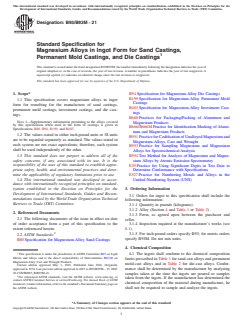
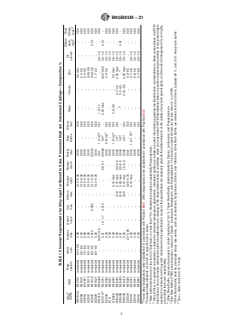
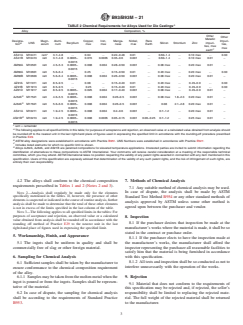

ASTM B93/B93M-21 - Standard Specification for Magnesium Alloys in Ingot Form for Sand Castings, Permanent Mold Castings, and Die Castings
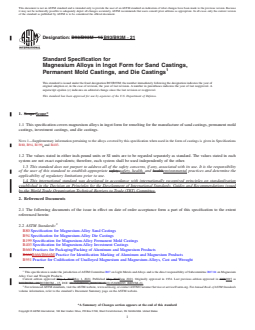
REDLINE ASTM B93/B93M-21 - Standard Specification for Magnesium Alloys in Ingot Form for Sand Castings, Permanent Mold Castings, and Die Castings
Overview
ASTM B93/B93M-21 is the internationally recognized standard specification for magnesium alloys in ingot form used for remelting to manufacture sand castings, permanent mold castings, investment castings, and die castings. Developed by ASTM International, this standard outlines requirements for chemical composition, marking, sampling, analysis, packaging, and inspection of magnesium alloy ingots prior to their use in various casting processes.
Magnesium alloys are valued for their lightweight properties and are commonly used in industries such as automotive, aerospace, electronics, and other applications demanding strength-to-weight efficiency. Employing ingots conforming to ASTM B93/B93M ensures consistent performance, safety, and quality throughout the supply chain.
Key Topics
Scope and Purpose: Covers magnesium alloys in ingot form for producing castings via sand, permanent mold, investment, and die casting methods. Both inch-pound and SI units are included, but they must be used independently.
Chemical Composition: Strict requirements for alloy composition are specified, ensuring that the magnesium alloys meet exact standards for R&D and industrial manufacturing. Conformance is verified through chemical analysis of samples taken from the molten metal or finished ingots.
Sampling and Analysis: Provides guidelines for representative sampling and approved analysis methods. In case of dispute, specific ASTM practices and test methods are referenced for resolution.
Workmanship and Quality: Requires ingots to be uniform in quality and virtually free of slag or foreign material. Specifications for appearance and finish support high-quality downstream casting production.
Inspection and Rejection: Purchasers may request inspection at the manufacturer’s works. Material not meeting requirements may be rejected and replaced, ensuring reliability in procurement.
Identification, Marking, and Packaging: Detailed procedures for product marking, color coding per alloy designation, packaging for shipment, and traceability are provided for quality assurance and logistics.
Applications
Sand Castings: Magnesium ingots conforming to ASTM B93/B93M are remelted and poured into sand molds, ideal for producing complex, moderate-volume parts with superior machining properties.
Permanent Mold Castings: Suitable for repeated-use molds, magnesium alloys from qualified ingots are used to create durable parts with improved mechanical properties and surface finish.
Investment Castings: Magnesium ingots are also utilized in the precision investment casting process, essential for parts requiring intricate detail and high dimensional accuracy.
Die Castings: This standard supports high-pressure die casting applications in the automotive, aerospace, and electronics industries, leveraging magnesium alloys’ lightweight and mechanical advantages.
Quality Assurance in Manufacturing: By adhering to B93/B93M, manufacturers and buyers ensure material integrity, uniformity, and traceable compliance, which is critical for safety and regulatory acceptance.
Related Standards
For further guidance and compatibility across magnesium alloy casting applications, the following related ASTM standards are referenced:
- ASTM B80 - Specification for Magnesium-Alloy Sand Castings
- ASTM B94 - Specification for Magnesium-Alloy Die Castings
- ASTM B199 - Specification for Magnesium-Alloy Permanent Mold Castings
- ASTM B403 - Specification for Magnesium-Alloy Investment Castings
- ASTM B660 - Practices for Packaging/Packing of Aluminum and Magnesium Products
- ASTM B666/B666M - Practice for Identification Marking of Aluminum and Magnesium Products
- ASTM B951 - Practice for Codification of Unalloyed Magnesium and Magnesium-Alloys, Cast and Wrought
- ASTM B953 - Practice for Sampling Magnesium and Magnesium Alloys for Spectrochemical Analysis
- ASTM B954 - Test Method for Analysis of Magnesium and Magnesium Alloys by Atomic Emission Spectrometry
- ASTM E29 - Practice for Using Significant Digits in Test Data to Determine Conformance with Specifications
Practical Value
Implementing ASTM B93/B93M-21 in procurement and production ensures that magnesium alloy ingots will perform reliably in critical casting applications. This standard supports global competitiveness, regulatory compliance, and operational efficiency by providing clear sourcing, quality, and documentation requirements for magnesium casting alloys.
Relations
- Effective Date
- 01-Nov-2023
- Effective Date
- 01-May-2018
- Effective Date
- 01-May-2018
- Effective Date
- 01-May-2013
- Effective Date
- 01-Nov-2012
- Effective Date
- 01-Nov-2011
- Effective Date
- 01-Feb-2010
- Effective Date
- 07-Dec-2009
- Effective Date
- 01-Jun-2009
- Effective Date
- 15-Oct-2008
- Effective Date
- 01-Oct-2008
- Effective Date
- 01-Mar-2008
- Effective Date
- 01-Jun-2007
- Effective Date
- 01-Jun-2007
- Effective Date
- 01-Jun-2007
Buy Documents
ASTM B93/B93M-21 - Standard Specification for Magnesium Alloys in Ingot Form for Sand Castings, Permanent Mold Castings, and Die Castings
REDLINE ASTM B93/B93M-21 - Standard Specification for Magnesium Alloys in Ingot Form for Sand Castings, Permanent Mold Castings, and Die Castings
Get Certified
Connect with accredited certification bodies for this standard

Element Materials Technology
Materials testing and product certification.

Inštitut za kovinske materiale in tehnologije
Institute of Metals and Technology. Materials testing, metallurgical analysis, NDT.
Sponsored listings
Frequently Asked Questions
ASTM B93/B93M-21 is a technical specification published by ASTM International. Its full title is "Standard Specification for Magnesium Alloys in Ingot Form for Sand Castings, Permanent Mold Castings, and Die Castings". This standard covers: ABSTRACT This specification covers magnesium alloys in ingot form for remelting for the manufacture of sand castings, permanent mold castings, investment castings, and die castings. The chemical composition shall conform to the requirements and limits prescribed in the specification. Samples for the chemical analysis may be taken from the molten metal when the ingot is poured or from the ingots. SCOPE 1.1 This specification covers magnesium alloys in ingot form for remelting for the manufacture of sand castings, permanent mold castings, investment castings, and die castings. Note 1: Supplementary information pertaining to the alloys covered by this specification when used in the form of castings is given in Specifications B80, B94, B199, and B403. 1.2 The values stated in either inch-pound units or SI units are to be regarded separately as standard. The values stated in each system are not exact equivalents; therefore, each system shall be used independently of the other. 1.3 This standard does not purport to address all of the safety concerns, if any, associated with its use. It is the responsibility of the user of this standard to establish appropriate safety, health, and environmental practices and determine the applicability of regulatory limitations prior to use. 1.4 This international standard was developed in accordance with internationally recognized principles on standardization established in the Decision on Principles for the Development of International Standards, Guides and Recommendations issued by the World Trade Organization Technical Barriers to Trade (TBT) Committee.
ABSTRACT This specification covers magnesium alloys in ingot form for remelting for the manufacture of sand castings, permanent mold castings, investment castings, and die castings. The chemical composition shall conform to the requirements and limits prescribed in the specification. Samples for the chemical analysis may be taken from the molten metal when the ingot is poured or from the ingots. SCOPE 1.1 This specification covers magnesium alloys in ingot form for remelting for the manufacture of sand castings, permanent mold castings, investment castings, and die castings. Note 1: Supplementary information pertaining to the alloys covered by this specification when used in the form of castings is given in Specifications B80, B94, B199, and B403. 1.2 The values stated in either inch-pound units or SI units are to be regarded separately as standard. The values stated in each system are not exact equivalents; therefore, each system shall be used independently of the other. 1.3 This standard does not purport to address all of the safety concerns, if any, associated with its use. It is the responsibility of the user of this standard to establish appropriate safety, health, and environmental practices and determine the applicability of regulatory limitations prior to use. 1.4 This international standard was developed in accordance with internationally recognized principles on standardization established in the Decision on Principles for the Development of International Standards, Guides and Recommendations issued by the World Trade Organization Technical Barriers to Trade (TBT) Committee.
ASTM B93/B93M-21 is classified under the following ICS (International Classification for Standards) categories: 77.150.20 - Magnesium products. The ICS classification helps identify the subject area and facilitates finding related standards.
ASTM B93/B93M-21 has the following relationships with other standards: It is inter standard links to ASTM B660-23, ASTM B951-11(2018), ASTM B94-18, ASTM B94-13, ASTM B199-12, ASTM B951-11, ASTM B951-10, ASTM B80-09, ASTM B951-09, ASTM B660-08, ASTM E29-08, ASTM B951-08, ASTM B80-07, ASTM B403-07, ASTM B954-07. Understanding these relationships helps ensure you are using the most current and applicable version of the standard.
ASTM B93/B93M-21 is available in PDF format for immediate download after purchase. The document can be added to your cart and obtained through the secure checkout process. Digital delivery ensures instant access to the complete standard document.
Standards Content (Sample)
This international standard was developed in accordance with internationally recognized principles on standardization established in the Decision on Principles for the
Development of International Standards, Guides and Recommendations issued by the World Trade Organization Technical Barriers to Trade (TBT) Committee.
Designation:B93/B93M −21
Standard Specification for
Magnesium Alloys in Ingot Form for Sand Castings,
Permanent Mold Castings, and Die Castings
This standard is issued under the fixed designation B93/B93M; the number immediately following the designation indicates the year of
original adoption or, in the case of revision, the year of last revision. A number in parentheses indicates the year of last reapproval. A
superscript epsilon (´) indicates an editorial change since the last revision or reapproval.
This standard has been approved for use by agencies of the U.S. Department of Defense.
1. Scope* B94 Specification for Magnesium-Alloy Die Castings
B199 Specification for Magnesium-Alloy Permanent Mold
1.1 This specification covers magnesium alloys in ingot
Castings
form for remelting for the manufacture of sand castings,
B403 Specification for Magnesium-Alloy Investment Cast-
permanent mold castings, investment castings, and die cast-
ings
ings.
B660 Practices for Packaging/Packing of Aluminum and
NOTE 1—Supplementary information pertaining to the alloys covered
Magnesium Products
by this specification when used in the form of castings is given in
B666/B666M Practice for Identification Marking of Alumi-
Specifications B80, B94, B199, and B403.
num and Magnesium Products
1.2 The values stated in either inch-pound units or SI units
B951 PracticeforCodificationofUnalloyedMagnesiumand
are to be regarded separately as standard. The values stated in
Magnesium-Alloys, Cast and Wrought
each system are not exact equivalents; therefore, each system
B953 Practice for Sampling Magnesium and Magnesium
shall be used independently of the other.
Alloys for Spectrochemical Analysis
1.3 This standard does not purport to address all of the B954 Test Method for Analysis of Magnesium and Magne-
safety concerns, if any, associated with its use. It is the
sium Alloys by Atomic Emission Spectrometry
responsibility of the user of this standard to establish appro- E29 Practice for Using Significant Digits in Test Data to
priate safety, health, and environmental practices and deter-
Determine Conformance with Specifications
mine the applicability of regulatory limitations prior to use. E527 Practice for Numbering Metals and Alloys in the
1.4 This international standard was developed in accor-
Unified Numbering System (UNS)
dance with internationally recognized principles on standard-
ization established in the Decision on Principles for the 3. Ordering Information
Development of International Standards, Guides and Recom-
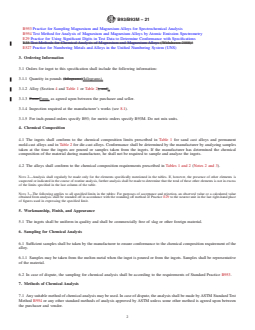
3.1 Orders for ingot to this specification shall include the
mendations issued by the World Trade Organization Technical
following information:
Barriers to Trade (TBT) Committee.
3.1.1 Quantity in pounds (kilograms).
3.1.2 Alloy (Section 4 and Table 1 or Table 2).
2. Referenced Documents
3.1.3 Form, as agreed upon between the purchaser and
2.1 The following documents of the issue in effect on date
seller.
of order acceptance form a part of this specification to the
3.1.4 Inspection required at the manufacturer’s works (see
extent referenced herein:
8.1).
3.1.5 For inch-pound orders specify B93; for metric orders
2.2 ASTM Standards:
specify B93M. Do not mix units.
B80 Specification for Magnesium-Alloy Sand Castings
4. Chemical Composition
This specification is under the jurisdiction of ASTM Committee B07 on Light
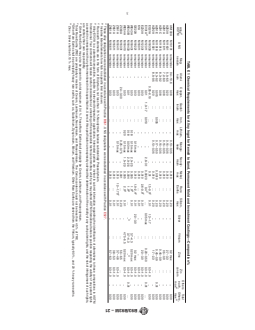
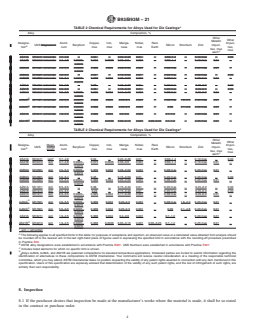
4.1 The ingots shall conform to the chemical composition
Metals and Alloys and is the direct responsibility of Subcommittee B07.04 on
limits prescribed in Table 1 for sand cast alloys and permanent
Magnesium Alloy Cast and Wrought Products.
mold-cast alloys and in Table 2 for die-cast alloys. Confor-
Current edition approved May 1, 2021. Published June 2021. Originally
mance shall be determined by the manufacturer by analyzing
approved in 1934. Last previous edition approved in 2015 as B93/B93M – 15. DOI:
10.1520/B0093_B0093M-21.
samples taken at the time the ingots are poured or samples
For referenced ASTM standards, visit the ASTM website, www.astm.org, or
taken from the ingots. If the manufacturer has determined the
contact ASTM Customer Service at service@astm.org. For Annual Book of ASTM
chemical composition of the material during manufacture, he
Standards volume information, refer to the standard’s Document Summary page on
the ASTM website. shall not be required to sample and analyze the ingots.
*A Summary of Changes section appears at the end of this standard
Copyright © ASTM International, 100 Barr Harbor Drive, PO Box C700, West Conshohocken, PA 19428-2959. United States
B93/B93M−21
TABLE 1 Chemical Requirements for Alloy Ingot for Remelt to Sand, Permanent Mold and Investment Castings—Composition%
Others Total
A
Mag- Alumi- Copper, Gadol- Iron, Lithium, Manga- Neody- Nickel, Rare Silicon, Zir-
Alloy
UNS Silver Yttrium Zinc each, Others,
ASTM
nesium num max inium max max nese mium max Earths max conium
B B
max max
AM100A M10101 remainder 9.4–10.6 0.08 . . . 0.13–0.35 . 0.010 . 0.20 . . 0.2 max . . 0.30
AZ63A M11631 remainder 5.5–6.5 0.20 . . . 0.15–0.35 . 0.010 . 0.20 . . 2.7–3.3 . . 0.30
AZ81A M11811 remainder 7.2–8.0 0.08 . . . 0.15–0.35 . 0.010 . 0.20 . . 0.5–0.9 . . 0.30
AZ91C M11915 remainder 8.3–9.2 0.08 . . . 0.15–0.35 . 0.010 . 0.20 . . 0.45–0.9 . . 0.30
AZ91E M11918 remainder 8.3–9.2 0.015 . 0.005 . 0.17–0.50 . 0.0010 . 0.20 . . 0.45–0.9 . 0.01 0.30
AZ92A M11921 remainder 8.5–9.5 0.20 . . . 0.13–0.35 . 0.010 . 0.20 . . 1.7–2.3 . . 0.30
C
EQ21A M18330 remainder . 0.05–0.10 . . . . . 0.01 1.5–3.0 0.01 1.3–1.7 . . 0.3–1.0 . 0.30
D E
EV31A M12311 remainder . 0.01 1.0–1.7 0.010 . . 2.6–3.1 0.0020 0.4 . 0.05 max . 0.20–0.50 0.3–1.0 0.01 .
F
EZ33A M12331 remainder . 0.03 . . . . . 0.010 2.6–3.9 0.01 . . 2.0–3.0 0.3–1.0 . 0.30
K1A M18011 remainder . 0.03 . . . . . 0.010 . 0.01 . . . 0.3–1.0 . 0.30
C
QE22A M18221 remainder . 0.03 . . . 0.15 max . 0.010 1.9–2.4 0.01 2.0–3.0 . 0.2 max 0.3–1.0 . 0.30
G
WE43A M18431 remainder . 0.03 . . 0.18 0.15 max 2.0–2.5 0.005 1.9 0.01 . 3.7–4.3 0.20 max 0.3–1.0 . 0.30
G H H
WE43B M18433 remainder . 0.01 . . 0.18 0.03 max 2.0–2.5 0.004 1.9 . . 3.7–4.3 . 0.3–1.0 0.01 .
G
WE54A M18410 remainder . 0.03 . . 0.20 0.15 max 1.5–2.0 0.005 2.0 0.01 . 4.75–5.5 0.20 max 0.3–1.0 . 0.30
ZC63A M16331 remainder . 2.4–3.00 . . . 0.25–0.75 . 0.001 . 0.20 . . 5.5–6.5 . . 0.30
F
ZE41A M16411 remainder . 0.03 . . . 0.15 max . 0.010 1.0–1.75 0.01 . . 3.7–4.8 0.3–1.0 . 0.30
ZK51A M16511 remainder . 0.03 . . . . . 0.010 . 0.01 . . 3.8–5.3 0.3–1.0 . 0.30
ZK61A M16611 remainder . 0.03 . . . . . 0.010 . 0.01 . . 5.7–6.3 0.3–1.0 . 0.30
A
These alloy designations were established in accordance with Practice B951. UNS designations were established in accordance with Practice E527.
B
Includes listed elements for which no specific limit is shown.
C
Rare earth elements are in the form of Didymium, not less than 70 % Neodymium balance substantially Praseodymium.
D
Alloy EV31A is a patented composition, suitable for elevated temperature applications. Interested parties are invited to submit information regarding the identification of alternatives to these compositions to ASTM
International. Your comments will receive careful consideration at a meeting of the responsible technical committee, which you may attend. ASTM International takes no position respecting the validity of any patent rights
asserted in connection with any item mentioned in this specification. Users of this specification are expressly advised that determination of the validity of any such patent rights, and the risk of infringement of such rights,
are entirely their own responsibility.
E
Other Rare Earths may also be present to a total maximum of 0.4 %. These Rare Earths shall principally be Cerium, Lanthanum, and Praseodymium.
F
Total Rare Earths (TRE) are principally a mixture of Cerium, Lanthanum, Neodymium, and Praseodymium. The Cerium content should not be less than 45 % of TRE.
G
Other Rare Earths shall be principally heavy rare earths, such as, Gadolinium, Dysprosium, Erbium, and Ytterbium. Other Rare Earths are derived from the Yttrium, typically 80 %, and 20 % heavy rare earths.
H
Zinc + Silver shall be 0.15 % max.
B93/B93M−21
A
TABLE 2 Chemical Requirements for Alloys Used for Die Castings
Alloy Composition, %
Other
Other
Metallic
Designa- Magn- Alumi- Copper, Iron, Manga- Nickel, Rare Impuri-
UNS Beryllium Silicon Strontium Zinc impuri-
B
tion esium num max max nese max Earth ties,
ties, max
max
C
each
AS41A M10411 rem* 3.7–4.8 . 0.04 . 0.22–0.48 0.01 . 0.60–1.4 . 0.10 max . 0.30
AS41B M1041
...
This document is not an ASTM standard and is intended only to provide the user of an ASTM standard an indication of what changes have been made to the previous version. Because
it may not be technically possible to adequately depict all changes accurately, ASTM recommends that users consult prior editions as appropriate. In all cases only the current version
of the standard as published by ASTM is to be considered the official document.
Designation: B93/B93M − 15 B93/B93M − 21
Standard Specification for
Magnesium Alloys in Ingot Form for Sand Castings,
Permanent Mold Castings, and Die Castings
This standard is issued under the fixed designation B93/B93M; the number immediately following the designation indicates the year of
original adoption or, in the case of revision, the year of last revision. A number in parentheses indicates the year of last reapproval. A
superscript epsilon (´) indicates an editorial change since the last revision or reapproval.
This standard has been approved for use by agencies of the U.S. Department of Defense.
1. Scope Scope*
1.1 This specification covers magnesium alloys in ingot form for remelting for the manufacture of sand castings, permanent mold
castings, investment castings, and die castings.
NOTE 1—Supplementary information pertaining to the alloys covered by this specification when used in the form of castings is given in Specifications
B80, B94, B199, and B403.
1.2 The values stated in either inch-pound units or SI units are to be regarded separately as standard. The values stated in each
system are not exact equivalents; therefore, each system shall be used independently of the other.
1.3 This standard does not purport to address all of the safety concerns, if any, associated with its use. It is the responsibility
of the user of this standard to establish appropriate safety safety, health, and healthenvironmental practices and determine the
applicability of regulatory limitations prior to use.
1.4 This international standard was developed in accordance with internationally recognized principles on standardization
established in the Decision on Principles for the Development of International Standards, Guides and Recommendations issued
by the World Trade Organization Technical Barriers to Trade (TBT) Committee.
2. Referenced Documents
2.1 The following documents of the issue in effect on date of order acceptance form a part of this specification to the extent
referenced herein:
2.2 ASTM Standards:
B80 Specification for Magnesium-Alloy Sand Castings
B94 Specification for Magnesium-Alloy Die Castings
B199 Specification for Magnesium-Alloy Permanent Mold Castings
B403 Specification for Magnesium-Alloy Investment Castings
B660 Practices for Packaging/Packing of Aluminum and Magnesium Products
B666B666/B666M Practice for Identification Marking of Aluminum and Magnesium Products
B951 Practice for Codification of Unalloyed Magnesium and Magnesium-Alloys, Cast and Wrought
This specification is under the jurisdiction of ASTM Committee B07 on Light Metals and Alloys and is the direct responsibility of Subcommittee B07.04 on Magnesium
Alloy Cast and Wrought Products.
Current edition approved May 1, 2015May 1, 2021. Published May 2015June 2021. Originally approved in 1934. Last previous edition approved in 20092015 as
B93/B93M – 09.B93/B93M – 15. DOI: 10.1520/B0093_B0093M-15.10.1520/B0093_B0093M-21.
For referenced ASTM standards, visit the ASTM website, www.astm.org, or contact ASTM Customer Service at service@astm.org. For Annual Book of ASTM Standards
volume information, refer to the standard’s Document Summary page on the ASTM website.
*A Summary of Changes section appears at the end of this standard
Copyright © ASTM International, 100 Barr Harbor Drive, PO Box C700, West Conshohocken, PA 19428-2959. United States
B93/B93M − 21
B953 Practice for Sampling Magnesium and Magnesium Alloys for Spectrochemical Analysis
B954 Test Method for Analysis of Magnesium and Magnesium Alloys by Atomic Emission Spectrometry
E29 Practice for Using Significant Digits in Test Data to Determine Conformance with Specifications
E35 Test Methods for Chemical Analysis of Magnesium and Magnesium Alloys (Withdrawn 2008)
E527 Practice for Numbering Metals and Alloys in the Unified Numbering System (UNS)
3. Ordering Information
3.1 Orders for ingot to this specification shall include the following information:
3.1.1 Quantity in pounds (kilograms)(kilograms).
3.1.2 Alloy (Section 4 and Table 1 or Table 2), and).
3.1.3 Form:Form, as agreed upon between the purchaser and seller.
3.1.4 Inspection required at the manufacturer’s works (see 8.1).
3.1.5 For inch-pound orders specify B93; for metric orders specify B93M. Do not mix units.
4. Chemical Composition
4.1 The ingots shall conform to the chemical composition limits prescribed in Table 1 for sand cast alloys and permanent
mold-cast alloys and in Table 2 for die-cast alloys. Conformance shall be determined by the manufacturer by analyzing samples
taken at the time the ingots are poured or samples taken from the ingots. If the manufacturer has determined the chemical
composition of the material during manufacture, he shall not be required to sample and analyze the ingots.
4.2 The alloys shall conform to the chemical composition requirements prescribed in Tables 1 and 2 (Notes 2 and 3).
NOTE 2—Analysis shall regularly be made only for the elements specifically mentioned in the tables. If, however, the presence of other elements is
suspected or indicated in the course of routine analysis, further analysis shall be made to determine that the total of these other elements is not in excess
of the limits specified in the last column of the table.
NOTE 3—The following applies to all specified limits in the tables: For purposes of acceptance and rejection, an observed value or a calculated value
obtained from analysis shall be rounded off in accordance with the rounding off method of Practice E29 to the nearest unit in the last right-hand place
of figures used in expressing the specified limit.
5. Workmanship, Finish, and Appearance
5.1 The ingots shall be uniform in quality and shall be commercially free of slag or other foreign material.
6. Sampling for Chemical Analysis
6.1 Sufficient samples shall be taken by the manufacturer to ensure conformance to the chemical composition requirement of the
alloy.
6.1.1 Samples may be taken from the molten metal when the ingot is poured or from the ingots. Samples shall be representative
of the material.
6.2 In case of dispute, the sampling for chemical analysis shall be according to the requirements of Standard Practice B953.
7. Methods of Chemical Analysis
7.1 Any suitable method of chemical analysis may be used. In case of dispute, the analysis shall be made by ASTM Standard Test
Method B954 or any other standard methods of analysis approved by ASTM unless some other method is agreed upon between
the purchaser and vendor.
B93/B93M − 21
TABLE 1 Chemical Requirements for Alloy Ingot for Remelt to Sand, Permanent Mold and Investment Castings—Composition %
Others Total
A
Mag- Alumi- Copper, Gadol- Iron, Lithium, Manga- Neody- Nickel, Rare Silicon, Zir-
Alloy
UNS Silver Yttrium Zinc each, Others,
ASTM nesium num max inium max max nese mium max Earths max conium
B B
max max
AM100A M10101 remainder 9.4–10.6 0.08 . . . 0.13–0.35 . 0.010 . 0.20 . . 0.2 max . . 0.30
AZ63A M11631 remainder 5.5–6.5 0.20 . . . 0.15–0.35 . 0.010 . 0.20 . . 2.7–3.3 . . 0.30
AZ81A M11811 remainder 7.2–8.0 0.08 . . . 0.15–0.35 . 0.010 . 0.20 . . 0.5–0.9 . . 0.30
AZ91C M11915 remainder 8.3–9.2 0.08 . . . 0.15–0.35 . 0.010 . 0.20 . . 0.45–0.9 . . 0.30
AZ91E M11918 remainder 8.3–9.2 0.015 . 0.005 . 0.17–0.50 . 0.0010 . 0.20 . . 0.45–0.9 . 0.01 0.30
AZ92A M11921 remainder 8.5–9.5 0.20 . . . 0.13–0.35 . 0.010 . 0.20 . . 1.7–2.3 . . 0.30
C
EQ21A M18330 remainder . 0.05–0.10 . . . . . 0.01 1.5–3.0 0.01 1.3–1.7 . . 0.3–1.0 . 0.30
D E
EV31A M12311 remainder . 0.01 1.0–1.7 0.010 . . 2.6–3.1 0.0020 0.4 . 0.05 max . 0.20–0.50 0.3–1.0 0.01 .
F
EZ33A M12331 remainder . 0.03 . . . . . 0.010 2.6–3.9 0.01 . . 2.0–3.0 0.3–1.0 . 0.30
K1A M18011 remainder . 0.03 . . . . . 0.010 . 0.01 . . . 0.3–1.0 . 0.30
C
QE22A M18221 remainder . 0.03 . . . 0.15 max . 0.010 1.9–2.4 0.01 2.0–3.0 . 0.2 max 0.3–1.0 . 0.30
G
WE43A M18431 remainder . 0.03 . . 0.18 0.15 max 2.0–2.5 0.005 1.9 0.01 . 3.7–4.3 0.20 max 0.3–1.0 . 0.30
G H H
WE43B M18433 remainder . 0.01 . . 0.18 0.03 max 2.0–2.5 0.004 1.9 . . 3.7–4.3 . 0.3–1.0 0.01 .
G
WE54A M18410 remainder . 0.03 . . 0.20 0.15 max 1.5–2.0 0.005 2.0 0.01 . 4.75–5.5 0.20 max 0.3–1.0 . 0.30
ZC63A M16331 remainder . 2.4–3.00 . . . 0.25–0.75 . 0.001 . 0.20 . . 5.5–6.5 . . 0.30
F
ZE41A M16411 remainder . 0.03 . . . 0.15 max . 0.010 1.0–1.75 0.01 . . 3.7–4.8 0.3–1.0 . 0.30
ZK51A M16511 remainder . 0.03 . . . . . 0.010 . 0.01 . . 3.8–5.3 0.3–1.0 . 0.30
ZK61A M16611 remainder . 0.03 . . . . . 0.010 . 0.01 . . 5.7–6.3 0.3–1.0 . 0.30
A
These alloy designations were established in accordance with Practice B951. UNS designations were established in accordance with Practice E527.
B
Includes listed elements for which no specific limit is shown.
C
Rare earth elements are in the form of Didymium, not less than 70 % Neodymium balance substantially Praseodymium.
D
Alloy EV31A is a patented composition, suitable for elevated temperature applications. Interested parties are invited to submit information regarding the identification of alternatives to these compositions to ASTM
International. Your comments will receive careful consideration at a meeting of the responsible technical committee, which you may attend. ASTM International takes no position respecting the validity of any patent rights
asserted in connection with any item mentioned in this specification. Users of this specification are expressly advised that determination of the validity of any such patent rights, and the risk of infringement of such rig
...