

ASTM D5252-24
(Practice)Standard Practice for the Operation of the Hexapod Tumble Drum Tester
General Information
- Abstract
SIGNIFICANCE AND USE
5.1 This equipment may be used to bring about the changes in appearance and texture on the surface of pile floor covering caused by mechanical action.
SCOPE
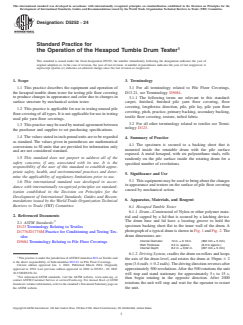
1.1 This practice describes the equipment and operation of the hexapod tumble drum tester for testing pile floor covering to produce changes in appearance and color due to changes in surface structure by mechanical action tester.
1.2 This practice is applicable for use in testing unused pile floor covering of all types. It is not applicable for use in testing used pile yarn floor coverings.
1.3 This practice may be used by mutual agreement between the purchaser and supplier to set purchasing specifications.
1.4 The values stated in inch-pound units are to be regarded as standard. The values given in parentheses are mathematical conversions to SI units that are provided for information only and are not considered standard.
1.5 This standard does not purport to address all of the safety concerns, if any, associated with its use. It is the responsibility of the user of this standard to establish appropriate safety, health, and environmental practices and determine the applicability of regulatory limitations prior to use.
1.6 This international standard was developed in accordance with internationally recognized principles on standardization established in the Decision on Principles for the Development of International Standards, Guides and Recommendations issued by the World Trade Organization Technical Barriers to Trade (TBT) Committee.
- Status
- Published
- Publication Date
- 31-Dec-2023
- Technical Committee
- D13 - Textiles
- Drafting Committee
- D13.21 - Pile Floor Coverings
Overview
ASTM D5252-24: Standard Practice for the Operation of the Hexapod Tumble Drum Tester provides detailed procedures and equipment requirements for testing pile floor coverings, such as carpets, using the hexapod tumble drum tester. This practice is widely recognized in the flooring and textile industries as a method for assessing changes in appearance, texture, and color of unused pile floor coverings due to simulated mechanical action.
The standard guides users through equipment setup, specimen preparation, testing protocols, and quality control measures to ensure repeatable and reliable test results. This practice helps manufacturers, suppliers, and purchasers objectively evaluate the wear performance and durability of floor coverings under controlled laboratory simulation.
Key Topics
Purpose and Scope
- Evaluates changes in surface appearance and texture of unused pile floor covering caused by mechanical action.
- Applicable to all types of unused pile floor coverings, including residential and commercial carpets.
- Useful for setting purchasing specifications through mutual agreement between buyers and suppliers.
Equipment Description
- Details the hexapod tumble drum tester, including the rotatable drum and hexapod tumblers with six polyurethane feet.
- Specifies apparatus such as specimen backing sheets, vacuum cleaners, and optional cleaning frames.
Testing Procedure
- Outlines specimen preparation, backing application, and placement in the drum.
- Describes standard test cycles involving specified drum rotations, use of residential or commercial hexapod tumblers, and vacuuming protocol.
- Ensures consistency in environmental conditions during testing.
Quality Assurance
- Provides requirements for unit calibration, maintenance, and periodic verification to maintain test repeatability.
- Includes guidelines for checking the condition and hardness of tumbler feet, with instructions on required break-in periods for new parts.
Reporting
- Mandates documentation of test details including the number of drum rotations, type of vacuum cleaner, tumbler selection, and any deviations from the standard procedure.
Applications
ASTM D5252-24 is used internationally to:
- Product Development: Carpet and pile floor covering manufacturers utilize this standard to gauge product durability, wear resistance, and aesthetic retention under simulated foot traffic.
- Quality Control: Facilities implement this practice to ensure batch consistency and adherence to customer requirements for both residential and commercial floor coverings.
- Purchasing Specifications: Buyers and suppliers rely on this standard to define measurable criteria for floor covering performance, reducing subjectivity in product evaluation.
- Research and Comparative Analysis: Technical researchers apply the test to compare various construction methods, materials, and finishes in textile floor coverings.
This standard helps improve product life cycle assessments, supports informed material selection, and enhances customer satisfaction by providing reproducible, objective data on carpet and rug performance.
Related Standards
ASTM D5252-24 references and aligns with other important standards, including:
- ASTM D123 - Terminology Relating to Textiles
- ASTM D1776/D1776M - Practice for Conditioning and Testing Textiles
- ASTM D5684 - Terminology Relating to Pile Floor Coverings
These documents provide terminology, specimen conditioning procedures, and additional context for textile and carpet testing, ensuring a harmonized approach across industry practices.
By utilizing ASTM D5252-24, flooring professionals and laboratories ensure standardized, accurate, and reliable assessment of pile floor covering durability using the hexapod tumble drum test method. This fosters transparency, consistency, and trust in flooring performance claims across the global marketplace.
Relations
- Effective Date
- 01-Jan-2024
- Effective Date
- 01-Jan-2024
- Effective Date
- 01-Jan-2024
- Effective Date
- 01-Jan-2024
Frequently Asked Questions
ASTM D5252-24 is a standard published by ASTM International. Its full title is "Standard Practice for the Operation of the Hexapod Tumble Drum Tester". This standard covers: SIGNIFICANCE AND USE 5.1 This equipment may be used to bring about the changes in appearance and texture on the surface of pile floor covering caused by mechanical action. SCOPE 1.1 This practice describes the equipment and operation of the hexapod tumble drum tester for testing pile floor covering to produce changes in appearance and color due to changes in surface structure by mechanical action tester. 1.2 This practice is applicable for use in testing unused pile floor covering of all types. It is not applicable for use in testing used pile yarn floor coverings. 1.3 This practice may be used by mutual agreement between the purchaser and supplier to set purchasing specifications. 1.4 The values stated in inch-pound units are to be regarded as standard. The values given in parentheses are mathematical conversions to SI units that are provided for information only and are not considered standard. 1.5 This standard does not purport to address all of the safety concerns, if any, associated with its use. It is the responsibility of the user of this standard to establish appropriate safety, health, and environmental practices and determine the applicability of regulatory limitations prior to use. 1.6 This international standard was developed in accordance with internationally recognized principles on standardization established in the Decision on Principles for the Development of International Standards, Guides and Recommendations issued by the World Trade Organization Technical Barriers to Trade (TBT) Committee.
SIGNIFICANCE AND USE 5.1 This equipment may be used to bring about the changes in appearance and texture on the surface of pile floor covering caused by mechanical action. SCOPE 1.1 This practice describes the equipment and operation of the hexapod tumble drum tester for testing pile floor covering to produce changes in appearance and color due to changes in surface structure by mechanical action tester. 1.2 This practice is applicable for use in testing unused pile floor covering of all types. It is not applicable for use in testing used pile yarn floor coverings. 1.3 This practice may be used by mutual agreement between the purchaser and supplier to set purchasing specifications. 1.4 The values stated in inch-pound units are to be regarded as standard. The values given in parentheses are mathematical conversions to SI units that are provided for information only and are not considered standard. 1.5 This standard does not purport to address all of the safety concerns, if any, associated with its use. It is the responsibility of the user of this standard to establish appropriate safety, health, and environmental practices and determine the applicability of regulatory limitations prior to use. 1.6 This international standard was developed in accordance with internationally recognized principles on standardization established in the Decision on Principles for the Development of International Standards, Guides and Recommendations issued by the World Trade Organization Technical Barriers to Trade (TBT) Committee.
ASTM D5252-24 is classified under the following ICS (International Classification for Standards) categories: 97.150 - Floor coverings. The ICS classification helps identify the subject area and facilitates finding related standards.
ASTM D5252-24 has the following relationships with other standards: It is inter standard links to ASTM D5252-20, ASTM D5684-19a, ASTM D7330-22, ASTM D6719-22e1. Understanding these relationships helps ensure you are using the most current and applicable version of the standard.
ASTM D5252-24 is available in PDF format for immediate download after purchase. The document can be added to your cart and obtained through the secure checkout process. Digital delivery ensures instant access to the complete standard document.
Standards Content (Sample)
This international standard was developed in accordance with internationally recognized principles on standardization established in the Decision on Principles for the
Development of International Standards, Guides and Recommendations issued by the World Trade Organization Technical Barriers to Trade (TBT) Committee.
Designation: D5252 − 24
Standard Practice for
the Operation of the Hexapod Tumble Drum Tester
This standard is issued under the fixed designation D5252; the number immediately following the designation indicates the year of
original adoption or, in the case of revision, the year of last revision. A number in parentheses indicates the year of last reapproval. A
superscript epsilon (´) indicates an editorial change since the last revision or reapproval.
1. Scope 3. Terminology
3.1 For all terminology related to Pile Floor Coverings,
1.1 This practice describes the equipment and operation of
the hexapod tumble drum tester for testing pile floor covering D13.21, see Terminology D5684.
to produce changes in appearance and color due to changes in
3.1.1 The following terms are relevant to this standard:
surface structure by mechanical action tester.
carpet, finished, finished pile yarn floor covering, floor
covering, lengthwise direction, pile, pile lay, pile yarn floor
1.2 This practice is applicable for use in testing unused pile
covering, pitch, practice, primary backing, secondary backing,
floor covering of all types. It is not applicable for use in testing
textile floor covering, texture, tufted fabric.
used pile yarn floor coverings.
3.2 For all other terminology related to textiles see Termi-
1.3 This practice may be used by mutual agreement between
nology D123.
the purchaser and supplier to set purchasing specifications.
1.4 The values stated in inch-pound units are to be regarded
4. Summary of Practice
as standard. The values given in parentheses are mathematical
4.1 The specimen is secured to a backing sheet that is
conversions to SI units that are provided for information only
mounted inside the rotatable drum with the pile surface
and are not considered standard.
exposed. A metal hexapod, with six polyurethane studs, rolls
1.5 This standard does not purport to address all of the
randomly on the pile surface inside the rotating drum for a
safety concerns, if any, associated with its use. It is the
specified number of revolutions.
responsibility of the user of this standard to establish appro-
priate safety, health, and environmental practices and deter-
5. Significance and Use
mine the applicability of regulatory limitations prior to use.
5.1 This equipment may be used to bring about the changes
1.6 This international standard was developed in accor-
in appearance and texture on the surface of pile floor covering
dance with internationally recognized principles on standard-
caused by mechanical action.
ization established in the Decision on Principles for the
Development of International Standards, Guides and Recom-
6. Apparatus, Materials, and Reagent
mendations issued by the World Trade Organization Technical
Barriers to Trade (TBT) Committee.
6.1 Hexapod Tumble Tester
6.1.1 Drum—Constructed of Nylon or other polymer mate-
2. Referenced Documents
rial and capped by a lid that is secured by a latching device.
The drum base and lid have a locating groove to hold the
2.1 ASTM Standards:
specimen backing sheet flat to the inner wall of the drum. A
D123 Terminology Relating to Textiles
photograph of a typical drum is shown in Fig. 1 and Fig. 2. The
D1776/D1776M Practice for Conditioning and Testing Tex-
drum dimensions are:
tiles
Internal Diameter 12 in. ± 0.18 in. (302 mm ± 5 mm)
D5684 Terminology Relating to Pile Floor Coverings
Wall Thickness 0.3 in. approx. (8 mm approx.)
Internal Depth 8.2 in. ± 0.02 in. (207 mm ± 5 mm)
6.1.2 Driving System, cradles the drum on rollers and keeps
This practice is under the jurisdiction of ASTM Committee D13 on Textiles and
the axis of the drum level, and rotates the drum at 35rpm 6 2
is the direct responsibility of Subcommittee D13.21 on Pile Floor Coverings.
rpm (3.6 rad/s 6 0.2 rad/s). The driving direction reverses after
Current edition approved Jan. 1, 2024. Published March 2024. Originally
approximately 500 revolutions. After the 500 rotations the unit
approved in 1992. Last previous edition approved in 2020 as D5252 – 20. DOI:
10.1520/D5252-24.
will stop and stand stationary for approximately 5 s to 15 s,
For referenced ASTM standards, visit the ASTM website, www.astm.org, or
then begin rotating in the opposite direction. After 2000
contact ASTM Customer Service at service@astm.org. For Annual Book of ASTM
rotations the unit will stop and wait for the operator to restart
Standards volume information, refer to the standard’s Document Summary page on
the ASTM website. the unit.
Copyright © ASTM International, 100 Barr Harbor Drive, PO Box C700, West Conshohocken, PA 19428-2959. United States
D5252 − 24
FIG. 1 Typical Front View of Drum Cover FIG. 3 8.4 lb Commercial Hexapod Tumbler
6.1.3.2 2.8 lb Light Residential Hexapod Tumbler—
Comprised of aluminum (or other suitable material) 2.00 in. 6
0.04 in. (50 mm 6 1 mm) cube with 25 mm (1 in.) thick plates
welded to each side. The outside corners are welded such that
when the studs are fitted and the hexapod placed on a flat
surface, no metal touches the flat surface. Alternatively, the ball
may be milled from a solid block if the construction meets the
specification. The total length of any axis, not including
hexapod studs, should be 3.8 6 0.08 in. (96 6 2 mm).
Replaceable tumbler feet are screwed centrally in each face.
The specified total mass of the Residential Hexapod Tumbler
with six feet installed is 2.8 lb 6 0.13 lb (1270 g 6 60 g). A
photograph of a typical 2.8 lb Residential Hexapod Tumbler is
shown in Fig. 4.
FIG. 2 Typical Inside of Drum without Cover
6.1.3.3 Hexapod Tumbler Feet Specifications (see Fig. 5)—
Tumbler Feet parameters are:
6.1.3 Hexapod Tumbler—There are two types of Hexapod
Tumblers: the 2.8 lb (1270 g) or the 8.4 lb (3810 g) as specified
below. The selection of which depends on the end use of the
pile floor covering.
NOTE 1—The 2.8 lb Residential Hexapod Tumbler is recommended for
residential pile floor covering test applications and the 8.4 lb Commercial
Hexapod Tumbler is recommended for commercial pile floor covering
applications.
6.1.3.1 8.4 lb Commercial Hexapod Tumber—Comprised of
a steel (or other suitable material) 2.0 in. 6 0.04 in. (50 mm 6
1 mm) cube with 1 in. (25 mm) thick plates welded to each
side. The outside corners are welded such that when the studs
are fitted and the hexapod placed on a flat surface, no metal
touches the flat surface. The total length of any axis, not
including hexapod feet, should be 3.8 in. 6 0.08 in. (96 mm 6
2 mm). Replaceable tumbler feet (see 6.1.3.3) are screwed
centrally into each face. The specified total mass of Commer-
cial Hexapod Tumbler with six feet installed is 8.4 lb 6 0.2 lb
(3810 g 6 90 g). A photograph of a typical 8.4 lb Commercial
Hexapod Tumbler is shown in Fig. 3. FIG. 4 2.8 lb Residential Hexapod Tumbler
D5252 − 24
7.2 Size of Specimen—Cut the specimen approximately
37 in. by 8 in. (940 mm by 200 mm) with the long dimension
parallel to the lengthwise direction of the pile yarn floor
covering. Take no specimen within 4.0 in. (100 mm) of the
trimmed selvedge. Alternatively, up to four smaller specimens
of similar thickness may be tested together, although if this is
done, the effect of fiber or finish must be considered. If this is
the case, cut the specimen to allow for a 0.2 in. (5 mm) gap
between each specimen, and ensure that the pile lay is in the
same direction.
NOTE 2—Texture change results can be noticeably different when
testing a specimen in the machine direction versus across the machine
direction.
7.3 Cleaning of Specimen—Prior to testing, vacuum the
specimen to remove any loose tufts or fibers.
7.4 Specimen Attachment—Attach the double-sided adhe-
sive tape along each side and across the end of the specimen
FIG. 5 Typical Hexapod Tumbler Foot
backing sheet leaving approximately 0.2 in. (5 mm) clear at
each edge, pressing down firmly to ensure adhesion. If testing
Diameter of Foot 1.60 in. ± 0.04 (40 mm ± 1 mm)
multiple specimens, attach an additional strip tape at each cross
in.
Height of Foot 0.60 in. ± 0.04 (15 mm ± 1 mm)
junction. Mount the specimen pile surface uppermost, allowing
in.
a 0.2 in. (5 mm) gap at the end and between 0.2 to 0.4 in. (5 to
Edge of Radius Stud 0.60 in. ± 0.04 (15 mm ± 1 mm)
10 mm) between specimens to allow space for the pile when
in.
Steel Backing for Polyurethane
the backing sheet is curved to fit the drum.
Foot Hardness 8.3 ± 6 Type A Durometer
Foot Thickness 0.12 in. ± 0.01 (3.00 mm ± 0.25 mm)
8. Conditioning
in.
...
This document is not an ASTM standard and is intended only to provide the user of an ASTM standard an indication of what changes have been made to the previous version. Because
it may not be technically possible to adequately depict all changes accurately, ASTM recommends that users consult prior editions as appropriate. In all cases only the current version
of the standard as published by ASTM is to be considered the official document.
Designation: D5252 − 20 D5252 − 24
Standard Practice for
the Operation of the Hexapod Tumble Drum Tester
This standard is issued under the fixed designation D5252; the number immediately following the designation indicates the year of
original adoption or, in the case of revision, the year of last revision. A number in parentheses indicates the year of last reapproval. A
superscript epsilon (´) indicates an editorial change since the last revision or reapproval.
1. Scope
1.1 This practice describes the equipment and operation of the hexapod tumble drum tester for testing pile floor covering to
produce changes in appearance and color due to changes in surface structure by mechanical action tester.
1.2 This practice is applicable for use in testing unused pile floor covering of all types. It is not applicable for use in testing used
pile yarn floor coverings.
1.3 This practice may be used by mutual agreement between the purchaser and supplier to set purchasing specifications.
1.4 The values stated in inch-pound units are to be regarded as standard. The values given in parentheses are mathematical
conversions to SI units that are provided for information only and are not considered standard.
1.5 This standard does not purport to address all of the safety concerns, if any, associated with its use. It is the responsibility
of the user of this standard to establish appropriate safety, health, and environmental practices and determine the applicability of
regulatory limitations prior to use.
1.6 This international standard was developed in accordance with internationally recognized principles on standardization
established in the Decision on Principles for the Development of International Standards, Guides and Recommendations issued
by the World Trade Organization Technical Barriers to Trade (TBT) Committee.
2. Referenced Documents
2.1 ASTM Standards:
D123 Terminology Relating to Textiles
D1776D1776/D1776M Practice for Conditioning and Testing Textiles
D5684 Terminology Relating to Pile Floor Coverings
3. Terminology
3.1 For all terminology related to Pile Floor Coverings, D13.21, see Terminology D5684.
3.1.1 The following terms are relevant to this standard: carpet, finished, finished pile yarn floor covering, floor covering,
lengthwise direction, pile, pile lay, pile yarn floor covering, pitch, practice, primary backing, secondary backing, textile floor
covering, texture, tufted fabric.
This practice is under the jurisdiction of ASTM Committee D13 on Textiles and is the direct responsibility of Subcommittee D13.21 on Pile Floor Coverings.
Current edition approved Feb. 1, 2020Jan. 1, 2024. Published February 2020March 2024. Originally approved in 1992. Last previous edition approved in 20152020 as
D5252 – 15.D5252 – 20. DOI: 10.1520/D5252-20.10.1520/D5252-24.
For referenced ASTM standards, visit the ASTM website, www.astm.org, or contact ASTM Customer Service at service@astm.org. For Annual Book of ASTM Standards
volume information, refer to the standard’s Document Summary page on the ASTM website.
Copyright © ASTM International, 100 Barr Harbor Drive, PO Box C700, West Conshohocken, PA 19428-2959. United States
D5252 − 24
3.2 For all other terminology related to textiles see Terminology D123.
4. Summary of Practice
4.1 The specimen is secured to a backing sheet that is mounted inside the rotatable drum with the pile surface exposed. A metal
hexapod, with six polyurethane studs, rolls randomly on the pile surface inside the rotating drum for a specified number of
revolutions.
5. Significance and Use
5.1 This equipment may be used to bring about the changes in appearance and texture on the surface of pile floor covering caused
by mechanical action.
6. Apparatus, Materials, and Reagent
6.1 Hexapod Tumble Tester
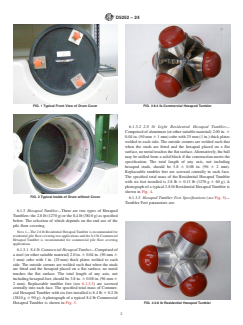
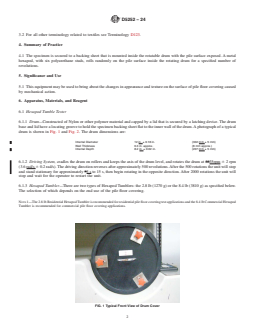
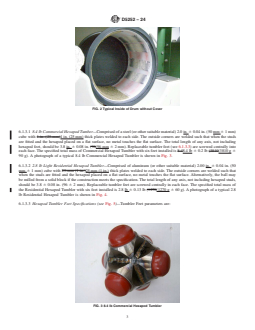
6.1.1 Drum—Constructed of Nylon or other polymer material and capped by a lid that is secured by a latching device. The drum
base and lid have a locating groove to hold the specimen backing sheet flat to the inner wall of the drum. A photograph of a typical
drum is shown in Fig. 1 and Fig. 2. The drum dimensions are:
Internal Diameter 12 in. ± 0.18 in. (302 mm ± 5 mm)
Wall Thickness 0.3 in. approx. (8 mm approx.)
Internal Depth 8.2 in. ± 0.02 in. (207 mm ± 5 mm)
6.1.2 Driving System, cradles the drum on rollers and keeps the axis of the drum level, and rotates the drum at 3535rpm 6 2 rpm
(3.6 rad/s 6 0.2 rad/s). The driving direction reverses after approximately 500 revolutions. After the 500 rotations the unit will stop
and stand stationary for approximately 55 s to 15 s, then begin rotating in the opposite direction. After 2000 rotations the unit will
stop and wait for the operator to restart the unit.
6.1.3 Hexapod Tumbler—There are two types of Hexapod Tumblers: the 2.8 lb (1270 g) or the 8.4 lb (3810 g) as specified below.
The selection of which depends on the end use of the pile floor covering.
NOTE 1—The 2.8 lb Residential Hexapod Tumbler is recommended for residential pile floor covering test applications and the 8.4 lb Commercial Hexapod
Tumbler is recommended for commercial pile floor covering applications.
FIG. 1 Typical Front View of Drum Cover
D5252 − 24
FIG. 2 Typical Inside of Drum without Cover
6.1.3.1 8.4 lb Commercial Hexapod Tumber—Comprised of a steel (or other suitable material) 2.0 in. 6 0.04 in. (50 mm 6 1 mm)
cube with 1-in. (25-mm)1 in. (25 mm) thick plates welded to each side. The outside corners are welded such that when the studs
are fitted and the hexapod placed on a flat surface, no metal touches the flat surface. The total length of any axis, not including
hexapod feet, should be 3.8 in. 6 0.08 in. (96(96 mm 6 2 mm). Replaceable tumbler feet (see 6.1.3.3) are screwed centrally into
each face. The specified total mass of Commercial Hexapod Tumbler with six feet installed is 8.48.4 lb 6 0.2 lb (3810(3810 g 6
90 g). A photograph of a typical 8.4 lb Commercial Hexapod Tumbler is shown in Fig. 3.
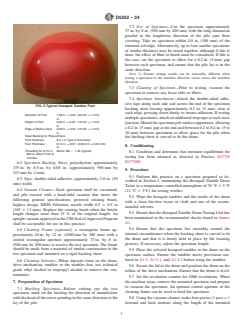
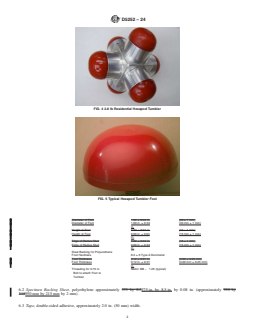
6.1.3.2 2.8 lb Light Residential Hexapod Tumbler—Comprised of aluminum (or other suitable material) 2.00 in. 6 0.04 in. (50
mm 6 1 mm) cube with 25-mm (1-in.)25 mm (1 in.) thick plates welded to each side. The outside corners are welded such that
when the studs are fitted and the hexapod placed on a flat surface, no metal touches the flat surface. Alternatively, the ball may
be milled from a solid block if the construction meets the specification. The total length of any axis, not including hexapod studs,
should be 3.8 6 0.08 in. (96 6 2 mm). Replaceable tumbler feet are screwed centrally in each face. The specified total mass of
the Residential Hexapod Tumbler with six feet installed is 2.8 lb 6 0.13 lb (1270(1270 g 6 60 g). A photograph of a typical 2.8
lb Residential Hexapod Tumbler is shown in Fig. 4.
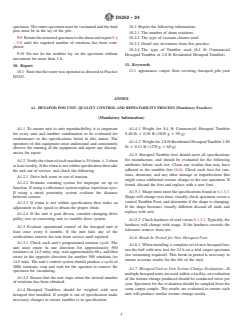
6.1.3.3 Hexapod Tumbler Feet Specifications (see Fig. 5)—Tumbler Feet parameters are:
FIG. 3 8.4 lb Commercial Hexapod Tumbler
D5252 − 24
FIG. 4 2.8 lb Residential Hexapod Tumbler
FIG. 5 Typical Hexapod Tumbler Foot
Diameter of Foot 1.60 ± 0.04 in. (40 ± 1 mm)
Diameter of Foot 1.60 in. ± 0.04 (40 mm ± 1 mm)
in.
Height of Foot 0.60 ± 0.04 in. (15 ± 1 mm)
Height of Foot 0.60 in. ± 0.04 (15 mm ± 1 mm)
in.
Edge of Radius Stud 0.60 ± 0.04 in. (15 ± 1 mm)
Edge of Radius Stud 0.60 in. ± 0.04 (15 mm ± 1 mm)
in.
Steel Backing for Polyurethane
Foot Hardness 8.3 ± 6 Type A Durometer
Foot Thickness 0.12 ± 0.01 in. (3.00 ± 0.25 mm)
Foot Thickness 0.12 in. ± 0.01 (3.00 mm ± 0.25 mm)
in.
Threading for 0.75 in. Metric M8 – 1.25 (typical)
Bolt to attach Foot to
Tumbler
6.2 Specimen Backing Sheet, polyethylene approximately 375 by 8.5375 in. by 8.5 in. by 0.08 in. (approximately 950 by
215950 mm by 215 mm by 2 mm).
6.3 Tape, double-sided adhesive, approximately 2.0 in. (50 mm) width.
D5252 − 24
6.4 Vacuum Cleaner—Each specimen shall be vacuumed, and pile erected with a hand-held vacuum that meets the following
general specifications: powered rotating brush, bag less design, HEPA filtration, 7 A motor, bagless design, HEPA Filtration, nozzle
width 6.5 6 0.3 in. (165 6 7 m), and overall weight 6.5 6 0.5 lb (3.0 6 0.2 kg). 0.5 in (165 6 13 mm). Replace the rotating brush
when the bristle length changes more than 15 % of the original length. An upright vacuum approved in the CRI Seal of Approval
Program shall be acceptable for use in this practice.
6.5 Cleaning Frame (optional), a rectangular frame approximately 4040 in. by 12 in. (1000(1000 mm by 300 mm) with a central
rectangular aperture approximately 3737 in. by 8 in. (940(940 mm by 200 mm) to receive the test specimen. The frame should be
made from a material of similar construction to the test specimen and mounted on a rigid
...