

ASTM F1952-22
(Specification)Standard Specification for Helmets Used for Downhill Mountain Bicycle Racing
General Information
- Abstract
ABSTRACT
This specification covers performance requirements for helmets used by downhill mountain bicycle riders. Studies have shown higher risk to the head and face for this sport as compared to recreational street riding; hence, this specification requires greater impact protection and provides performance criteria for chin bars on full-face helmets, but does not require full-face helmets. Retention system tests shall be performed before impact testing. The helmet can be impacted anywhere on or above the test line with the curbstone anvil in any horizontal orientation. The ambient test helmet shall be subjected to the chin bar impact test.
SCOPE
1.1 This specification covers performance requirements for helmets used by downhill mountain bicycle riders. Studies have shown higher risk to the head and face for this sport as compared to recreational street riding; hence, this specification requires greater impact protection and provides performance criteria for chin bars on full-face helmets, but does not require full-face helmets. This specification recognizes the desirability of lightweight construction and ventilation; however, it is a performance specification and is not intended to restrict design.
1.2 All testing and requirements of this specification shall be in accordance with Test Methods F1446, except where noted herein.
1.3 Partial utilization of this standard is prohibited. Any statement of compliance with this specification must be a certification that the product meets all of the requirements of this specification in its entirety. A product that fails to meet any one of the requirements of this specification is considered to have failed this standard, and should not be sold with any indication that it meets parts of this standard.
1.4 Headgear designed to comply with this and other standards may proclaim uses as certified by the manufacturer.
1.5 This standard is subject to revision at any time by ASTM. It must be reviewed every five years and if not revised either reapproved or withdrawn. References to the standard must include the version date. No references to a version that has been replaced or withdrawn shall be placed on any product or its packaging manufactured more than 24 months after the effective revision or withdrawal date. Go to astm.org to verify the latest version of this standard.
1.6 The values stated in SI units are to be regarded as standard. No other units of measurement are included in this standard.
1.7 The following safety caveat applies to the chemical, mechanical, or physical, or a combination thereof, test methods described herein and is meant specifically for those performing the tests (in an effort to provide them with notice to take the appropriate precautions when conducting the tests): This standard does not purport to address all of the safety concerns, if any, associated with its use. It is the responsibility of the user of this standard to establish appropriate safety, health, and environmental practices and determine the applicability of regulatory limitations prior to use.
1.8 This international standard was developed in accordance with internationally recognized principles on standardization established in the Decision on Principles for the Development of International Standards, Guides and Recommendations issued by the World Trade Organization Technical Barriers to Trade (TBT) Committee.
- Status
- Published
- Publication Date
- 14-Jun-2022
- Technical Committee
- F08 - Sports Equipment, Playing Surfaces, and Facilities
- Drafting Committee
- F08.53 - Headgear and Helmets
Buy Documents


ASTM F1952-22 - Standard Specification for Helmets Used for Downhill Mountain Bicycle Racing

REDLINE ASTM F1952-22 - Standard Specification for Helmets Used for Downhill Mountain Bicycle Racing
Overview
ASTM F1952-22: Standard Specification for Helmets Used for Downhill Mountain Bicycle Racing provides comprehensive performance and testing requirements for helmets specifically designed for downhill mountain bicycling. Recognizing the higher risk of head and facial injuries associated with this sport compared to recreational cycling, this standard specifies enhanced impact protection and criteria for chin bars on full-face helmets, while not mandating their use. ASTM F1952-22 aims to improve rider safety without limiting innovation or comfort features such as lightweight materials and ventilation.
Key Topics
Enhanced Impact Protection:
Helmets certified to ASTM F1952-22 must provide greater impact protection compared to those intended for street or recreational riding. Impact testing is conducted using various anvil types and orientations to simulate realistic crash scenarios.Chin Bar Performance:
For full-face helmets, the chin bar must meet specific rigidity criteria to protect the lower face. The standard details test methods and limits for chin bar deflection, ensuring meaningful protection in downhill environments.Retention System Testing:
Before impact evaluation, helmet retention systems (often chin straps and fasteners) undergo rigorous strength and stability tests under varied environmental conditions (ambient, hot, cold, wet). Retention systems must remain intact and prevent excessive elongation to keep the helmet in place during an incident.Sound Marking and Labels:
Helmets must be clearly marked as “For downhill mountain bicycle racing” and follow defined label and warning requirements to inform users of their intended application.Testing Procedures:
The standard references ASTM F1446 for test methods, ensuring helmets are evaluated consistently and rigorously. This includes controlled impacts, assessing multiple helmet samples per size, and marking precise test lines on the helmet shell.Design Flexibility:
While specifying minimum performance benchmarks, ASTM F1952-22 is not a design-restrictive standard. It encourages lightweight construction and enhanced ventilation as long as safety criteria are met.
Applications
Downhill Mountain Biking:
The primary application of ASTM F1952-22 is to certify helmets for use in downhill mountain bike racing, which involves high speeds and technical terrain, increasing the risk for significant impacts.Competitive Bicycle Racing Events:
Event organizers, federations, and clubs reference this standard to define helmet requirements for sanctioned downhill competitions, ensuring participant safety.Helmet Manufacturers and Suppliers:
Manufacturers use ASTM F1952-22 to design, test, and certify products specifically for downhill mountain biking, enabling market differentiation and regulatory compliance.Consumer Assurance:
Riders benefit from ASTM F1952-22 certified helmets, knowing the equipment meets stringent criteria tailored to the demands of downhill racing.
Related Standards
ASTM F1446:
Test Methods for Equipment and Procedures Used in Evaluating the Performance Characteristics of Protective Headgear. This standard is directly referenced throughout ASTM F1952-22 for test protocols.Other Helmet Standards:
- Standards for recreational cycling helmets (such as CPSC 16 CFR Part 1203) do not address the higher impact tolerances required for downhill applications.
- ASTM F2032 covers helmets for BMX cycling, which have different performance requirements.
World Trade Organization TBT Principles:
This standard aligns with international standardization principles, supporting global recognition.
Conclusion
ASTM F1952-22 establishes a robust framework to ensure helmets used in downhill mountain bike racing provide advanced protection where it is most needed. By addressing impact attenuation, chin bar strength, retention system performance, and comprehensive labeling, it gives manufacturers, event organizers, and riders confidence in the safety capabilities of certified helmets. For anyone involved in downhill mountain biking-from competitive racers to manufacturers-adhering to ASTM F1952-22 is a critical step toward minimizing head injuries and promoting safer riding experiences.
Buy Documents
ASTM F1952-22 - Standard Specification for Helmets Used for Downhill Mountain Bicycle Racing
REDLINE ASTM F1952-22 - Standard Specification for Helmets Used for Downhill Mountain Bicycle Racing
Get Certified
Connect with accredited certification bodies for this standard

CIS Institut d.o.o.
Personal Protective Equipment (PPE) certification body. Notified Body NB-2890 for EU Regulation 2016/425 PPE.

Kiwa BDA Testing
Building and construction product certification.
Kmetijski inštitut Slovenije
Agricultural Institute of Slovenia. Soil testing, plant health, agricultural product analysis.
Sponsored listings
Frequently Asked Questions
ASTM F1952-22 is a technical specification published by ASTM International. Its full title is "Standard Specification for Helmets Used for Downhill Mountain Bicycle Racing". This standard covers: ABSTRACT This specification covers performance requirements for helmets used by downhill mountain bicycle riders. Studies have shown higher risk to the head and face for this sport as compared to recreational street riding; hence, this specification requires greater impact protection and provides performance criteria for chin bars on full-face helmets, but does not require full-face helmets. Retention system tests shall be performed before impact testing. The helmet can be impacted anywhere on or above the test line with the curbstone anvil in any horizontal orientation. The ambient test helmet shall be subjected to the chin bar impact test. SCOPE 1.1 This specification covers performance requirements for helmets used by downhill mountain bicycle riders. Studies have shown higher risk to the head and face for this sport as compared to recreational street riding; hence, this specification requires greater impact protection and provides performance criteria for chin bars on full-face helmets, but does not require full-face helmets. This specification recognizes the desirability of lightweight construction and ventilation; however, it is a performance specification and is not intended to restrict design. 1.2 All testing and requirements of this specification shall be in accordance with Test Methods F1446, except where noted herein. 1.3 Partial utilization of this standard is prohibited. Any statement of compliance with this specification must be a certification that the product meets all of the requirements of this specification in its entirety. A product that fails to meet any one of the requirements of this specification is considered to have failed this standard, and should not be sold with any indication that it meets parts of this standard. 1.4 Headgear designed to comply with this and other standards may proclaim uses as certified by the manufacturer. 1.5 This standard is subject to revision at any time by ASTM. It must be reviewed every five years and if not revised either reapproved or withdrawn. References to the standard must include the version date. No references to a version that has been replaced or withdrawn shall be placed on any product or its packaging manufactured more than 24 months after the effective revision or withdrawal date. Go to astm.org to verify the latest version of this standard. 1.6 The values stated in SI units are to be regarded as standard. No other units of measurement are included in this standard. 1.7 The following safety caveat applies to the chemical, mechanical, or physical, or a combination thereof, test methods described herein and is meant specifically for those performing the tests (in an effort to provide them with notice to take the appropriate precautions when conducting the tests): This standard does not purport to address all of the safety concerns, if any, associated with its use. It is the responsibility of the user of this standard to establish appropriate safety, health, and environmental practices and determine the applicability of regulatory limitations prior to use. 1.8 This international standard was developed in accordance with internationally recognized principles on standardization established in the Decision on Principles for the Development of International Standards, Guides and Recommendations issued by the World Trade Organization Technical Barriers to Trade (TBT) Committee.
ABSTRACT This specification covers performance requirements for helmets used by downhill mountain bicycle riders. Studies have shown higher risk to the head and face for this sport as compared to recreational street riding; hence, this specification requires greater impact protection and provides performance criteria for chin bars on full-face helmets, but does not require full-face helmets. Retention system tests shall be performed before impact testing. The helmet can be impacted anywhere on or above the test line with the curbstone anvil in any horizontal orientation. The ambient test helmet shall be subjected to the chin bar impact test. SCOPE 1.1 This specification covers performance requirements for helmets used by downhill mountain bicycle riders. Studies have shown higher risk to the head and face for this sport as compared to recreational street riding; hence, this specification requires greater impact protection and provides performance criteria for chin bars on full-face helmets, but does not require full-face helmets. This specification recognizes the desirability of lightweight construction and ventilation; however, it is a performance specification and is not intended to restrict design. 1.2 All testing and requirements of this specification shall be in accordance with Test Methods F1446, except where noted herein. 1.3 Partial utilization of this standard is prohibited. Any statement of compliance with this specification must be a certification that the product meets all of the requirements of this specification in its entirety. A product that fails to meet any one of the requirements of this specification is considered to have failed this standard, and should not be sold with any indication that it meets parts of this standard. 1.4 Headgear designed to comply with this and other standards may proclaim uses as certified by the manufacturer. 1.5 This standard is subject to revision at any time by ASTM. It must be reviewed every five years and if not revised either reapproved or withdrawn. References to the standard must include the version date. No references to a version that has been replaced or withdrawn shall be placed on any product or its packaging manufactured more than 24 months after the effective revision or withdrawal date. Go to astm.org to verify the latest version of this standard. 1.6 The values stated in SI units are to be regarded as standard. No other units of measurement are included in this standard. 1.7 The following safety caveat applies to the chemical, mechanical, or physical, or a combination thereof, test methods described herein and is meant specifically for those performing the tests (in an effort to provide them with notice to take the appropriate precautions when conducting the tests): This standard does not purport to address all of the safety concerns, if any, associated with its use. It is the responsibility of the user of this standard to establish appropriate safety, health, and environmental practices and determine the applicability of regulatory limitations prior to use. 1.8 This international standard was developed in accordance with internationally recognized principles on standardization established in the Decision on Principles for the Development of International Standards, Guides and Recommendations issued by the World Trade Organization Technical Barriers to Trade (TBT) Committee.
ASTM F1952-22 is classified under the following ICS (International Classification for Standards) categories: 13.340.20 - Head protective equipment. The ICS classification helps identify the subject area and facilitates finding related standards.
ASTM F1952-22 is available in PDF format for immediate download after purchase. The document can be added to your cart and obtained through the secure checkout process. Digital delivery ensures instant access to the complete standard document.
Standards Content (Sample)
This international standard was developed in accordance with internationally recognized principles on standardization established in the Decision on Principles for the
Development of International Standards, Guides and Recommendations issued by the World Trade Organization Technical Barriers to Trade (TBT) Committee.
Designation:F1952 −22 An American National Standard
Standard Specification for
Helmets Used for Downhill Mountain Bicycle Racing
This standard is issued under the fixed designation F1952; the number immediately following the designation indicates the year of
original adoption or, in the case of revision, the year of last revision. A number in parentheses indicates the year of last reapproval. A
superscript epsilon (´) indicates an editorial change since the last revision or reapproval.
1. Scope described herein and is meant specifically for those performing
the tests (in an effort to provide them with notice to take the
1.1 This specification covers performance requirements for
appropriate precautions when conducting the tests): This stan-
helmets used by downhill mountain bicycle riders. Studies
dard does not purport to address all of the safety concerns, if
have shown higher risk to the head and face for this sport as
any, associated with its use. It is the responsibility of the user
compared to recreational street riding; hence, this specification
of this standard to establish appropriate safety, health, and
requires greater impact protection and provides performance
environmental practices and determine the applicability of
criteria for chin bars on full-face helmets, but does not require
regulatory limitations prior to use.
full-face helmets. This specification recognizes the desirability
1.8 This international standard was developed in accor-
of lightweight construction and ventilation; however, it is a
dance with internationally recognized principles on standard-
performance specification and is not intended to restrict design.
ization established in the Decision on Principles for the
1.2 All testing and requirements of this specification shall
Development of International Standards, Guides and Recom-
beinaccordancewithTestMethodsF1446,exceptwherenoted
mendations issued by the World Trade Organization Technical
herein.
Barriers to Trade (TBT) Committee.
1.3 Partial utilization of this standard is prohibited. Any
2. Referenced Documents
statement of compliance with this specification must be a
certification that the product meets all of the requirements of
2.1 ASTM Standards:
this specification in its entirety. A product that fails to meet any F1446 Test Methods for Equipment and Procedures Used in
one of the requirements of this specification is considered to
Evaluating the Performance Characteristics of Protective
have failed this standard, and should not be sold with any Headgear
indication that it meets parts of this standard.
3. Labels and Warnings
1.4 Headgear designed to comply with this and other
3.1 Shall meet the requirements of Test Methods F1446.
standards may proclaim uses as certified by the manufacturer.
3.2 Shall have the words “For downhill mountain bicycle
1.5 This standard is subject to revision at any time by
racing.”
ASTM. It must be reviewed every five years and if not revised
either reapproved or withdrawn. References to the standard
4. Marking the Test Line
must include the version date. No references to a version that
has been replaced or withdrawn shall be placed on any product 4.1 The test line is shown in Fig. 1 and shall be marked in
accordance with Test Methods F1446.
or its packaging manufactured more than 24 months after the
effective revision or withdrawal date. Go to astm.org to verify
5. Conditioning and Number of Samples
the latest version of this standard.
5.1 Conditioning of the samples to be tested shall be in
1.6 The values stated in SI units are to be regarded as
accordance with the section entitled “Conditioning Environ-
standard. No other units of measurement are included in this
ments” in Test Methods F1446.
standard.
5.2 For helmets with a chin bar, five sample helmets are
1.7 The following safety caveat applies to the chemical,
required for each shell-liner size combination.
mechanical, or physical, or a combination thereof, test methods
5.3 For helmets without a chin bar, four sample helmets are
required for each shell-liner size combination.
This specification is under the jurisdiction ofASTM Committee F08 on Sports
Equipment, Playing Surfaces, and Facilities and is the direct responsibility of
Subcommittee F08.53 on Headgear and Helmets. For referenced ASTM standards, visit the ASTM website, www.astm.org, or
Current edition approved June 15, 2022. Published July 2022. Originally contact ASTM Customer Service at service@astm.org. For Annual Book of ASTM
approved in 1999. Last previous edition approved in 2015 as F1952 – 15. DOI: Standards volume information, refer to the standard’s Document Summary page on
10.1520/F1952-22. the ASTM website.
Copyright © ASTM International, 100 Barr Harbor Drive, PO Box C700, West Co
...
This document is not an ASTM standard and is intended only to provide the user of an ASTM standard an indication of what changes have been made to the previous version. Because
it may not be technically possible to adequately depict all changes accurately, ASTM recommends that users consult prior editions as appropriate. In all cases only the current version
of the standard as published by ASTM is to be considered the official document.
Designation: F1952 − 15 F1952 − 22 An American National Standard
Standard Specification for
Helmets Used for Downhill Mountain Bicycle Racing
This standard is issued under the fixed designation F1952; the number immediately following the designation indicates the year of
original adoption or, in the case of revision, the year of last revision. A number in parentheses indicates the year of last reapproval. A
superscript epsilon (´) indicates an editorial change since the last revision or reapproval.
1. Scope
1.1 This specification covers performance requirements for helmets used by downhill mountain bicycle riders. Studies have shown
higher risk to the head and face for this sport as compared to recreational street riding; hence, this specification requires greater
impact protection and provides performance criteria for chin bars on full-face helmets, but does not require full-face helmets. This
specification recognizes the desirability of lightweight construction and ventilation; however, it is a performance specification and
is not intended to restrict design.
1.2 All testing and requirements of this specification shall be in accordance with Test Methods F1446, except where noted herein.
1.3 Partial utilization of this standard is prohibited. Any statement of compliance with this specification must be a certification
that the product meets all of the requirements of this specification in its entirety. A product that fails to meet any one of the
requirements of this specification is considered to have failed this standard, and should not be sold with any indication that it meets
parts of this standard.
1.4 Headgear designed to comply with this and other standards may proclaim uses as certified by the manufacturer.
1.5 This standard is subject to revision at any time by ASTM. It must be reviewed every five years and if not revised either
reapproved or withdrawn. References to the standard must include the version date. No references to a version that has been
replaced or withdrawn shall be placed on any product or its packaging manufactured more than 24 months after the effective
revision or withdrawal date. Go to astm.org to verify the latest version of this standard.
1.6 The values stated in SI units are to be regarded as standard. No other units of measurement are included in this standard.
1.7 The following safety caveat applies to the chemical, mechanical, or physical, or a combination thereof, test methods
described herein and is meant specifically for those performing the tests (in an effort to provide them with notice to take the
appropriate precautions when conducting the tests): This standard does not purport to address all of the safety concerns, if any,
associated with its use. It is the responsibility of the user of this standard to establish appropriate safety safety, health, and
healthenvironmental practices and determine the applicability of regulatory limitations prior to use.
1.8 This international standard was developed in accordance with internationally recognized principles on standardization
established in the Decision on Principles for the Development of International Standards, Guides and Recommendations issued
by the World Trade Organization Technical Barriers to Trade (TBT) Committee.
This specification is under the jurisdiction of ASTM Committee F08 on Sports Equipment, Playing Surfaces, and Facilities and is the direct responsibility of
Subcommittee F08.53 on Headgear and Helmets.
Current edition approved May 15, 2015June 15, 2022. Published June 2015July 2022. Originally approved in 1999. Last previous edition approved in 20102015 as
F1952 – 10.F1952 – 15. DOI: 10.1520/F1952-15.10.1520/F1952-22.
Copyright © ASTM International, 100 Barr Harbor Drive, PO Box C700, West Conshohocken, PA 19428-2959. United States
F1952 − 22
2. Referenced Documents
2.1 ASTM Standards:
F1446 Test Methods for Equipment and Procedures Used in Evaluating the Performance Characteristics of Protective Headgear
3. Labels and Warnings
3.1 Shall meet the requirements of Test Methods F1446.
3.2 Shall have the words “For downhill mountain bicycle racing.”
4. Marking the Test Line
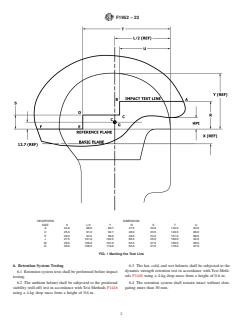
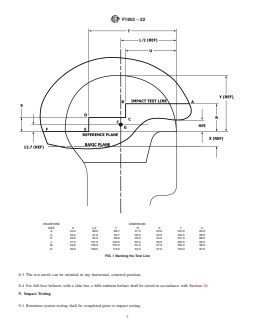
4.1 The test line is shown in Fig. 1 and shall be marked in accordance with Test Methods F1446.
5. Conditioning and Number of Samples
5.1 Conditioning of the samples to be tested shall be in accordance with the section entitled “Conditioning Environments” in Test
Methods F1446.
5.2 For helmets with a chin bar, five sample helmets are required for each shell-liner size combination.
5.3 For helmets without a chin bar, four sample helmets are required for each shell-liner size combination.
6. Retention System Testing
6.1 Retention system tests shall be performed before imp
...