

ASTM F1045-22
(Specification)Standard Performance Specification for Ice Hockey Helmets
General Information
- Abstract
SCOPE
1.1 This performance specification2 covers performance requirements for ice hockey helmets.
1.2 The intent of this performance specification is to reduce the risk of injury to the head without compromising the form and appeal of the game.
1.3 This performance specification covers: (1) performance tests for shock absorption properties of the complete helmet and strength and elongation of the chin strap and its attachment; and (2) requirements for area of coverage and penetration.
1.4 The values stated in SI units are to be regarded as standard. The values given in parentheses are for information only.
1.5 The following precautionary caveat pertains only to the test methods portion, Section 12, of this performance specification: This standard does not purport to address all of the safety concerns, if any, associated with its use. It is the responsibility of the user of this standard to establish appropriate safety, health, and environmental practices and determine the applicability of regulatory limitations prior to use.
1.6 This international standard was developed in accordance with internationally recognized principles on standardization established in the Decision on Principles for the Development of International Standards, Guides and Recommendations issued by the World Trade Organization Technical Barriers to Trade (TBT) Committee.
- Status
- Published
- Publication Date
- 14-Jun-2022
- Technical Committee
- F08 - Sports Equipment, Playing Surfaces, and Facilities
- Drafting Committee
- F08.15 - Ice Hockey
Overview
ASTM F1045-22: Standard Performance Specification for Ice Hockey Helmets is an internationally recognized standard developed by ASTM International. Designed to enhance the safety of ice hockey players, this standard specifies the minimum performance requirements for protective helmets used in the sport of ice hockey. The primary objective is to reduce the risk of head injuries without altering the form or spirit of the game. The standard addresses essential characteristics of helmet construction, impact mitigation, and ergonomic fit, ensuring both safety and functionality.
Key Topics
- Performance Requirements:
The standard defines the fundamental performance benchmarks for shock absorption, penetration resistance, and strength of the helmet's retention system (e.g., chin and neck straps). - Material Specifications:
Helmets must be constructed from materials that maintain integrity and performance across a wide range of temperatures and environmental conditions, and avoid causing skin irritation or health issues. - Area of Coverage:
Clear requirements are set for the area of the head that must be protected, with specific measurements to ensure appropriate protection across different head sizes. - Testing Procedures:
Procedures cover impact testing at designated areas (front, side, rear, etc.), including both prescribed and non-prescribed locations, conditioning at various temperatures, and tests for chin/neck strap strength and extensibility. - Product Marking & Instruction:
Helmets must display permanent labels with critical safety information, manufacturer details, and proper fitting instructions to maximize safety for end-users.
Applications
The practical application of ASTM F1045-22 lies in certifying ice hockey helmets for use in organized play, from youth leagues to professional hockey. Compliance with this standard ensures:
- Enhanced Player Safety:
Helmets meeting ASTM F1045-22 provide proven protection against high-mass, low-velocity impacts, minimizing the risk and severity of head injuries. - Quality Assurance for Manufacturers:
Adhering to standardized tests and requirements enables manufacturers to bring helmets to market that are universally recognized for safety and reliability. - Regulatory and Procurement Compliance:
Many sports organizations, leagues, and educational institutions require that helmets meet ASTM F1045-22, making it an essential certification for suppliers and distributors in the sports equipment industry. - Consumer Confidence:
Clearly labeled, standardized helmets give players, parents, coaches, and league administrators confidence in the product’s safety.
Related Standards
ASTM F513 - Specification for Eye and Face Protective Equipment for Hockey Players
Defines requirements for face protectors often used in conjunction with helmets.EN 960:2006 - Headforms for Use in the Testing of Protective Helmets
Specifies test headforms that match defined sizes for consistent and reliable helmet testing.Other ASTM Sports Equipment Standards
Various standards developed by ASTM Committee F08 address other protective gear for sports and recreational activities.
By adhering to ASTM F1045-22, stakeholders in the ice hockey community can trust that helmet protective equipment is held to rigorous, internationally benchmarked standards for athlete safety, performance, and durability. This standard is crucial for manufacturers, sports organizations, and players seeking effective and reliable head protection on the ice.
Relations
- Refers
ASTM F513-12 - Standard Specification for Eye and Face Protective Equipment for Hockey Players - Effective Date
- 01-Jan-2012
- Effective Date
- 01-May-2007
- Effective Date
- 10-Jun-2000
Get Certified
Connect with accredited certification bodies for this standard

CIS Institut d.o.o.
Personal Protective Equipment (PPE) certification body. Notified Body NB-2890 for EU Regulation 2016/425 PPE.

Kiwa BDA Testing
Building and construction product certification.
Kmetijski inštitut Slovenije
Agricultural Institute of Slovenia. Soil testing, plant health, agricultural product analysis.
Sponsored listings
Frequently Asked Questions
ASTM F1045-22 is a technical specification published by ASTM International. Its full title is "Standard Performance Specification for Ice Hockey Helmets". This standard covers: SCOPE 1.1 This performance specification2 covers performance requirements for ice hockey helmets. 1.2 The intent of this performance specification is to reduce the risk of injury to the head without compromising the form and appeal of the game. 1.3 This performance specification covers: (1) performance tests for shock absorption properties of the complete helmet and strength and elongation of the chin strap and its attachment; and (2) requirements for area of coverage and penetration. 1.4 The values stated in SI units are to be regarded as standard. The values given in parentheses are for information only. 1.5 The following precautionary caveat pertains only to the test methods portion, Section 12, of this performance specification: This standard does not purport to address all of the safety concerns, if any, associated with its use. It is the responsibility of the user of this standard to establish appropriate safety, health, and environmental practices and determine the applicability of regulatory limitations prior to use. 1.6 This international standard was developed in accordance with internationally recognized principles on standardization established in the Decision on Principles for the Development of International Standards, Guides and Recommendations issued by the World Trade Organization Technical Barriers to Trade (TBT) Committee.
SCOPE 1.1 This performance specification2 covers performance requirements for ice hockey helmets. 1.2 The intent of this performance specification is to reduce the risk of injury to the head without compromising the form and appeal of the game. 1.3 This performance specification covers: (1) performance tests for shock absorption properties of the complete helmet and strength and elongation of the chin strap and its attachment; and (2) requirements for area of coverage and penetration. 1.4 The values stated in SI units are to be regarded as standard. The values given in parentheses are for information only. 1.5 The following precautionary caveat pertains only to the test methods portion, Section 12, of this performance specification: This standard does not purport to address all of the safety concerns, if any, associated with its use. It is the responsibility of the user of this standard to establish appropriate safety, health, and environmental practices and determine the applicability of regulatory limitations prior to use. 1.6 This international standard was developed in accordance with internationally recognized principles on standardization established in the Decision on Principles for the Development of International Standards, Guides and Recommendations issued by the World Trade Organization Technical Barriers to Trade (TBT) Committee.
ASTM F1045-22 is classified under the following ICS (International Classification for Standards) categories: 13.340.20 - Head protective equipment; 97.220.30 - Indoor sports equipment. The ICS classification helps identify the subject area and facilitates finding related standards.
ASTM F1045-22 has the following relationships with other standards: It is inter standard links to ASTM F513-12, ASTM F513-00(2007), ASTM F513-00. Understanding these relationships helps ensure you are using the most current and applicable version of the standard.
ASTM F1045-22 is available in PDF format for immediate download after purchase. The document can be added to your cart and obtained through the secure checkout process. Digital delivery ensures instant access to the complete standard document.
Standards Content (Sample)
This international standard was developed in accordance with internationally recognized principles on standardization established in the Decision on Principles for the
Development of International Standards, Guides and Recommendations issued by the World Trade Organization Technical Barriers to Trade (TBT) Committee.
Designation:F1045 −22 An American National Standard
Standard Performance Specification for
Ice Hockey Helmets
This standard is issued under the fixed designation F1045; the number immediately following the designation indicates the year of
original adoption or, in the case of revision, the year of last revision.Anumber in parentheses indicates the year of last reapproval.A
superscript epsilon (´) indicates an editorial change since the last revision or reapproval.
INTRODUCTION
Ice hockey is a contact sport with intrinsic hazards. The use of protective equipment will not
eliminateallinjuriesbutshouldsubstantiallyreducetheseverityandfrequencyofinjury.Participation
in the sport of ice hockey by a player implies acceptance of some risk of injury. The goal is to
minimize this risk.
Thisperformancespecificationforheadprotectiveequipmenthasbeenpreparedafterconsideration
of head protection relative to the following principle risks: high-mass, low-velocity impact (various
playing situations), and fit. This performance specification may be modified as other risks are
identified.
Performance requirements were determined after consideration of state-of-the-art of helmet design
and manufacture and the demands of the sport.
1. Scope 1.6 This international standard was developed in accor-
2 dance with internationally recognized principles on standard-
1.1 This performance specification covers performance
ization established in the Decision on Principles for the
requirements for ice hockey helmets.
Development of International Standards, Guides and Recom-
1.2 The intent of this performance specification is to reduce
mendations issued by the World Trade Organization Technical
the risk of injury to the head without compromising the form
Barriers to Trade (TBT) Committee.
and appeal of the game.
2. Referenced Documents
1.3 This performance specification covers: (1) performance
tests for shock absorption properties of the complete helmet 2.1 ASTM Standards:
and strength and elongation of the chin strap and its attach- F513Specification for Eye and Face Protective Equipment
ment; and (2) requirements for area of coverage and penetra- for Hockey Players
tion.
2.2 CEN Standard:
EN 960:2006Headforms for use in the testing of protective
1.4 The values stated in SI units are to be regarded as
helmets
standard. The values given in parentheses are for information
only.
3. Terminology
1.5 The following precautionary caveat pertains only to the
3.1 Definitions of Terms Specific to This Standard:
test methods portion, Section 12, of this performance specifi-
3.1.1 retention system:
cation: This standard does not purport to address all of the
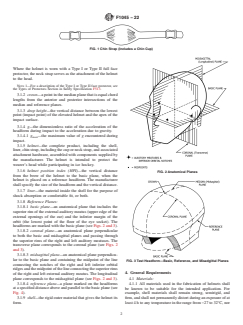
3.1.1.1 chin strap—the chin strap, including a cup that
safety concerns, if any, associated with its use. It is the
covers the chin (see Fig. 1), is affixed to both sides of the
responsibility of the user of this standard to establish appro-
helmet and secures the helmet to the head when a Type I or
priate safety, health, and environmental practices and deter-
Type II full face protector is not worn with the helmet.
mine the applicability of regulatory limitations prior to use.
3.1.1.2 neck strap—theneckstrapthatsecuresthehelmetto
theheadisaffixedonbothsidesofthehelmetandpassesunder
the lower jaw in close proximity to the jaw and the neck.
This performance specification is under the jurisdiction of ASTM Committee
F08 on Sports Equipment, Playing Surfaces, and Facilities and is the direct
responsibility of Subcommittee F08.15 on Ice Hockey. For referenced ASTM standards, visit the ASTM website, www.astm.org, or
Current edition approved June 15, 2022. Published August 2022. Originally contact ASTM Customer Service at service@astm.org. For Annual Book of ASTM
ε1
approved in 1988. Last previous edition approved in 2016 as F1045–16 . DOI: Standards volume information, refer to the standard’s Document Summary page on
10.1520/F1045-22. the ASTM website.
2 4
Thisperformancespecificationissubjecttorevisionasindicatedbysubsequent Available from European Committee for Standardization (CEN), Avenue
injury statistics and subject to review at least every five years. Marnix 17, B-1000, Brussels, Belgium, http://www.cen.eu.
Copyright © ASTM International, 100 Barr Harbor Drive, PO Box C700, West Conshohocken, PA 19428-2959. United States
F1045−22
FIG. 1Chin Strap (Includes a Chin Cup)
Where the helmet is worn with a Type I or Type II full face
protector,theneckstrapservesastheattachmentofthehelmet
to the head.
NOTE 1—For a description of the Type I or Type II face protector, see
the Types of Protectors Section in Safety Specification F513.
3.1.2 crown—apointinthemedianplanethatisequalchord
lengths from the anterior and posterior intersections of the
median and reference planes.
3.1.3 drop height—the vertical distance between the lowest
point (impact point) of the elevated helmet and the apex of the
impact surface.
3.1.4 g—the dimensionless ratio of the acceleration of the
headform during impact to the acceleration due to gravity.
3.1.4.1 g —the maximum value of g encountered during
max
impact.
3.1.5 helmet—the complete product, including the shell,
liner,chinstrap,includingthecuporneckstrap,andassociated
attachment hardware, assembled with components supplied by
the manufacturer. The helmet is intended to protect the
wearer’s head while participating in ice hockey.
3.1.6 helmet position index (HPI)—the vertical distance
FIG. 2Anatomical Planes
from the brow of the helmet to the basic plane, when the
helmet is placed on a reference headform. The manufacturer
shallspecifythesizeoftheheadformandtheverticaldistance.
3.1.7 liner—the material inside the shell for the purpose of
shock absorption or comfortable fit, or both.
3.1.8 Reference Planes:
3.1.8.1 basic plane—an anatomical plane that includes the
superiorrimoftheexternalauditorymeatus(upperedgeofthe
external openings of the ear) and the inferior margin of the
orbit (the lowest point of the floor of the eye socket). The
headforms are marked with the basic plane (see Figs. 2 and 3).
3.1.8.2 coronal plane—an anatomical plane perpendicular
to both the basic and midsagittal planes and passing through
the superior rims of the right and left auditory meatuses. The
transverse plane corresponds to the coronal plane (see Figs. 2
and 3).
3.1.8.3 midsagittal plane—an anatomical plane perpendicu-
lar to the basic plane and containing the midpoint of the line
FIG. 3Test Headform—Basic, Reference, and Misadgittal Planes
connecting the notches of the right and left inferior orbital
ridgesandthemidpointofthelineconnectingthesuperiorrims
4. General Requirements
of the right and left external auditory meatus.The longitudinal
plane corresponds to the midsagittal plane (see Figs. 2 and 3). 4.1 Materials:
3.1.8.4 reference plane—a plane marked on the headforms 4.1.1 All materials used in the fabrication of helmets shall
ataspecifieddistanceaboveandparalleltothebasicplane(see be known to be suitable for the intended application. For
Fig. 4). example, shell materials shall remain strong, semirigid, and
3.1.9 shell—therigidoutermaterialthatgivesthehelmetits firm,andshallnotpermanentlydistortduringanexposureofat
form. least4htoanytemperatureintherangefrom−27to32°C,nor
F1045−22
4.5 Area of Coverage—Area of coverage measurements
shall be made with the protector mounted in accordance with
theprotectormanufacturer’sinstructionsontheheadformsthat
correspondtothephysicaldimensionsdefinedinEN960:2006
as headform circumferences 495, 535, 575, or 605 mm. If a
helmet size range, as identified by the manufacturer’s
instructions, is capable of fitting two different headforms, the
larger headform shall be used.
4.5.1 Type 1—The extent of coverage shall include at least
alloftheareaabovelineBCDEFasshowninFig.5.Thisarea
shall correspond with the headform size with which the
protector is to be tested. No ear aperture shall have any
dimensionexceeding38mm(1.5in.).Theearapertureshallbe
completely surrounded by the helmet. The distance from any
edge of an ear aperture to any edge of the helmet shall not be
Headform
less than 20 mm (0.8 in.).
circumference X, mm Y, mm
(mm)
4.5.2 Type 2—The extent of coverage shall include at least
495 23.5 89.7
all of the area above line BCDGHEF as shown in Fig. 6. This
535 25.5 96
575 27.5 102.4 area shall correspond with the headform size with which the
605 29 107.2
protector is to be tested.
FIG. 4Location of Reference Lines 4.6 Attachments—The components of the fasteners for se-
curing attachments to the shell shall be so attached that the
degree of protection afforded the wearer by the protective
padding or cushioning material of the helmet is not thereby
shall the material be significantly affected by exposure to
reduced.
ultraviolet radiation, water, dirt, or vibration. All materials
4.7 Size of Helmets—Helmets shall be sized in accordance
shall be rot-resistant. In addition, paints, glues, and finishes
with Table 1.
used in manufacture shall be compatible with the helmet shell
and shock absorption system materials.
4.8 Chin Strap or Neck Strap:
4.1.2 Materials coming into contact with the wearer’s head
4.8.1 The chin strap, including the cup, or the neck strap,
shall not be the type known to cause skin irritation or disease,
shallbeattachedtothehelmetsothatthehelmetremainsinits
and shall not undergo significant loss of strength, flexibility, or
normal position on the player’s head during play and impact
other physical change as a result of contact with perspiration,
conditions.
oil, or grease from the wearer’s hair.
4.8.2 The chin strap or the neck strap used in combination
4.1.3 Any material used in the construction of helmets shall
with the face protector shall satisfy the requirements in 3.1.1.
not be adversely affected by ordinary household soap and
4.8.3 The minimum width of the chin strap exclusive of the
water, mild household detergent, or cleaners recommended by
cup shall be 13 mm.
the manufacturer.
5. Performance Requirements
4.2 Helmet Assembly:
4.2.1 Any optional devices fitted to the helmet shall be so
5.1 General—Helmets shall be capable of meeting the
designed that they are unlikely to cause any injury to the
requirementsinthisperformancespecificationthroughouttheir
wearer or other participants during contact.
full range of adjustment. They shall be capable of meeting the
4.2.2 All edges shall be smooth and rounded and there shall
requirementsinSections11and12atanytemperaturebetween
be no rigid projections on the inside of the helmet that could
−27 to 32°C.
come in contact with the wearer’s head.
5.2 Shock Absorption—The helmet is mounted on a head-
4.2.3 All external projections shall be smooth and ad-
form that is oriented in different positions and dropped at a
equatelyfairedtoothersurfaces.Splitorbifurcatedrivetsshall
specificvelocityontoanimpactsurface.Alinearaccelerometer
not be used.
mounted at the center of gravity of the headform monitors the
4.3 Types of Protectors:
acceleration and the time history of impact that are recorded
4.3.1 Type 1—Head protectors that meet requirements for
with appropriate instrumentation. Maximum acceleration data
the area of coverage mentioned in 4.5.1.
obtained by the specified procedures are intended to determine
4.3.2 Type 2—Head protectors that meet requirements for
the shock absorption characteristics of the helmet.
the area of coverage mentioned in 4.5.2.
5.3 Chin Strap—When tested in accordance with 12.7.2.1,
4.4 ImpactTestProtectedArea—Theareaabovethetestline
the force to separate the strap shall not be less than 50 N (11.2
(see 12.2.7) shall be considered the impact test protected area.
lbf) nor more than 500 N (112.4 lbf), and the maximum
All parts of the wearer’s head covered by the area of the shell
shallbeprotectedatleasttotheminimumimpactrequirements
of 13.1 and 13.2. Table should be used for information only.
F1045−22
Headform Distance (mm)
circumference
tu v
(mm)
495 24 123 132
535 26 128 140
575 27 129.9 144.9
605 28 132.2 151.2
NOTE 1—A-Reference plane, B-Coronal plane
FIG. 5Type 1–Area of Coverage
Headform Distance (mm)
circumference
tu v x y z
(mm)
495 24 123 132 – – –
535 26 128 140 18 30 50
575 27 129.9 144.9 20 40 55
605 28 132.2 151.2 20 45 55
NOTE 1—A-Reference plane, B-Coronal plane
NOTE 2—Dimension Y and Z are taken and must cover between the reference and the basic plane.
NOTE 3—495 mm Headform does not have Type 2 coverage.
FIG. 6Type 2–Area of Coverage
displacement of the strap shall not exceed 25.4 mm (1 in.) at a
F1045−22
TABLE 1 Hat Sizes and Head Fittings
5.4 Penetration Resistance Test Requirements—It shall not
be possible to touch the test headform with the curved end of
NOTE 1—These are U.S. and Canadian hat sizes.
the test stick blade within the required area of coverage,
Circumference of Head
Hat Size
excluding the ear opening.
in. mm
6 19 483
6. Apparatus
1 3
6 ⁄8 19 ⁄8 492
1 3
6 ⁄4 19 ⁄4 502
6.1 Shock Absorption Test—The apparatus for the shock
3 1
6 ⁄8 20 ⁄8 511
absorption test shall consist of the following:
1 1
6 ⁄2 20 ⁄2 521
5 7
6 ⁄8 20 ⁄8 530 6.1.1 Guide Assembly—The headform shall be attached to
3 1
6 ⁄4 21 ⁄4 540
the free fall drop assembly carriage by an adjustable mounting
7 5
6 ⁄8 21 ⁄8 550
that will allow impacts to be delivered to any prescribed point
7 22 559
1 3
7 ⁄8 22 ⁄8 568 onthehelmet(seeFig.7).Thecarriageshallbefreetoslideon
1 3
7 ⁄4 22 ⁄4 578
vertical guides. If wires are used, they must be placed under at
3 1
7 ⁄8 23 ⁄8 587
least 845.2 N (190 lbf) tension (see 12.4 for guide assembly
1 1
7 ⁄2 23 ⁄2 597
5 7
specifications and allowable weight of drop assembly).
7 ⁄8 23 ⁄8 606
3 1
7 ⁄4 24 ⁄4 616
6.1.2 RecordingEquipment—Therecordingequipmentshall
7 5
7 ⁄8 24 ⁄8 625
meet the following criteria:
8 25 635
6.1.2.1 Acceleration Transducer—The linear accelerometer
is mounted at the center of gravity of the combined test
headformandcarriageassemblywiththesensitiveaxisaligned
load of 109 N (24.5 lbf).The requirements of 12.7.2.1 shall be to within 5° of the vertical when the helmet and headform are
met at ambient conditions. in the impact position. This transducer shall be capable of
NOTE 1—Rail-guided drop assemblies are also permissible.
FIG. 7Schematic of Typical Drop Assembly
F1045−22
withstandingashockof1000 gwithoutdamageandshallhave 10. Calibration and Standardization
afrequencyresponse(variation 61.5%)overtherangefrom5
10.1 Calibration—Instrumentation used in the testing shall
to 900 Hz.
be calibrated to manufacturer’s specifications on a periodic
6.1.2.2 System Accuracy—The impact recording system
basis. The duration of the calibration cycle shall be no more
shall be capable of measuring shocks of up to 500 g peak
than one year.
acceleration with an accuracy of 65%.
10.2 Impact Attenuation Instrument System Check—The
6.1.2.3 Impact Recording—The impact shall be recorded on
system instrumentation shall be checked before and after each
single- or dual-trace storage oscilloscope with 0.1-mVto 20-V
seriesoftestsbydroppingthesphericalimpactorontotheMEP
deflectionfactor,1to5-mssweepspeed-division,and500-kHz
6 pad at an impact velocity of 5.2 m/s 6 2 %. Impact velocity
bandwidth.
shallbemeasuredduringthelast40mm(1.575in.)offreefall
6.1.2.4 Test Headforms—Test headforms that correspond to
for each test. The weight of the drop assembly (which is the
the physical dimensions defined in EN 960:2006 as headform
combined weight of the instrumented spherical impactor and
circumferences 495, 535, 575, or 605 mm. The weight of the
supporting assembly) for the drop test shall be 5 6 0.1 kg
drop assembly, including the headform, shall be in accordance
(11.00 6 0.2 lb). Six impacts, at intervals of 75 6 15 s, shall
with 12.4 unless otherwise specified in the individual perfor-
be performed before and after the testing program. The first
mance specifications. The test headforms shall include surface
three impacts shall be used to warm up the pad; the peak
markings corresponding to the basic, coronal, midsagittal, and
accelerationoftheremainingthreeshallberecorded.Themean
reference planes (see Figs. 2 and 3).
of the three post-test results shall not differ by more than 5 %
6.1.2.5 Reference Headforms—Measuring headforms con-
fromthemeanofthe
...
This document is not an ASTM standard and is intended only to provide the user of an ASTM standard an indication of what changes have been made to the previous version. Because
it may not be technically possible to adequately depict all changes accurately, ASTM recommends that users consult prior editions as appropriate. In all cases only the current version
of the standard as published by ASTM is to be considered the official document.
´1
Designation: F1045 − 16 F1045 − 22 An American National Standard
Standard Performance Specification for
Ice Hockey Helmets
This standard is issued under the fixed designation F1045; the number immediately following the designation indicates the year of
original adoption or, in the case of revision, the year of last revision. A number in parentheses indicates the year of last reapproval. A
superscript epsilon (´) indicates an editorial change since the last revision or reapproval.
ε NOTE—Editorially corrected 11.1.1 in February 2022.
INTRODUCTION
Ice hockey is a contact sport with intrinsic hazards. The use of protective equipment will not
eliminate all injuries but should substantially reduce the severity and frequency of injury. Participation
in the sport of ice hockey by a player implies acceptance of some risk of injury. The goal is to
minimize this risk.
This performance specification for head protective equipment has been prepared after consideration
of head protection relative to the following principle risks: high-mass, low-velocity impact (various
playing situations), and fit. This performance specification may be modified as other risks are
identified.
Performance requirements were determined after consideration of state-of-the-art of helmet design
and manufacture and the demands of the sport.
1. Scope
1.1 This performance specification covers performance requirements for ice hockey helmets.
1.2 The intent of this performance specification is to reduce the risk of injury to the head without compromising the form and
appeal of the game.
1.3 This performance specification covers: (1) performance tests for shock absorption properties of the complete helmet and
strength and elongation of the chin strap and its attachment; and (2) requirements for area of coverage and penetration.
1.4 The values stated in SI units are to be regarded as standard. The values given in parentheses are for information only.
1.5 The following precautionary caveat pertains only to the test methods portion, Section 12, of this performance specification:
This standard does not purport to address all of the safety concerns, if any, associated with its use. It is the responsibility of the
user of this standard to establish appropriate safety, health, and environmental practices and determine the applicability of
regulatory limitations prior to use.
1.6 This international standard was developed in accordance with internationally recognized principles on standardization
established in the Decision on Principles for the Development of International Standards, Guides and Recommendations issued
by the World Trade Organization Technical Barriers to Trade (TBT) Committee.
This performance specification is under the jurisdiction of ASTM Committee F08 on Sports Equipment, Playing Surfaces, and Facilities and is the direct responsibility
of Subcommittee F08.15 on Ice Hockey.
Current edition approved Oct. 1, 2016June 15, 2022. Published November 2016August 2022. Originally approved in 1988. Last previous edition approved in 20152016
ε1
as F1045 – 15.F1045 – 16 . DOI: 10.1520/F1045-16E01.10.1520/F1045-22.
This performance specification is subject to revision as indicated by subsequent injury statistics and subject to review at least every five years.
Copyright © ASTM International, 100 Barr Harbor Drive, PO Box C700, West Conshohocken, PA 19428-2959. United States
F1045 − 22
2. Referenced Documents
2.1 ASTM Standards:
F513 Specification for Eye and Face Protective Equipment for Hockey Players
2.2 CEN Standard:
EN 960:2006 Headforms for use in the testing of protective helmets
3. Terminology
3.1 Definitions of Terms Specific to This Standard:
3.1.1 retention system:
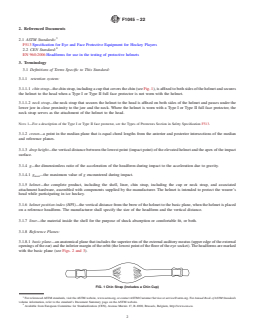
3.1.1.1 chin strap—the chin strap, including a cup that covers the chin (see Fig. 1), is affixed to both sides of the helmet and secures
the helmet to the head when a Type I or Type II full face protector is not worn with the helmet.
3.1.1.2 neck strap—the neck strap that secures the helmet to the head is affixed on both sides of the helmet and passes under the
lower jaw in close proximity to the jaw and the neck. Where the helmet is worn with a Type I or Type II full face protector, the
neck strap serves as the attachment of the helmet to the head.
NOTE 1—For a description of the Type I or Type II face protector, see the Types of Protectors Section in Safety Specification F513.
3.1.2 crown—a point in the median plane that is equal chord lengths from the anterior and posterior intersections of the median
and reference planes.
3.1.3 drop height—the vertical distance between the lowest point (impact point) of the elevated helmet and the apex of the impact
surface.
3.1.4 g—the dimensionless ratio of the acceleration of the headform during impact to the acceleration due to gravity.
3.1.4.1 g —the maximum value of g encountered during impact.
max
3.1.5 helmet—the complete product, including the shell, liner, chin strap, including the cup or neck strap, and associated
attachment hardware, assembled with components supplied by the manufacturer. The helmet is intended to protect the wearer’s
head while participating in ice hockey.
3.1.6 helmet position index (HPI)—the vertical distance from the brow of the helmet to the basic plane, when the helmet is placed
on a reference headform. The manufacturer shall specify the size of the headform and the vertical distance.
3.1.7 liner—the material inside the shell for the purpose of shock absorption or comfortable fit, or both.
3.1.8 Reference Planes:
3.1.8.1 basic plane—an anatomical plane that includes the superior rim of the external auditory meatus (upper edge of the external
openings of the ear) and the inferior margin of the orbit (the lowest point of the floor of the eye socket). The headforms are marked
with the basic plane (see Figs. 2 and 3).
FIG. 1 Chin Strap (Includes a Chin Cup)
For referenced ASTM standards, visit the ASTM website, www.astm.org, or contact ASTM Customer Service at service@astm.org. For Annual Book of ASTM Standards
volume information, refer to the standard’s Document Summary page on the ASTM website.
Available from European Committee for Standardization (CEN), Avenue Marnix 17, B-1000, Brussels, Belgium, http://www.cen.eu.
F1045 − 22
FIG. 2 Anatomical Planes
FIG. 3 Test Headform—Basic, Reference, and Misadgittal Planes
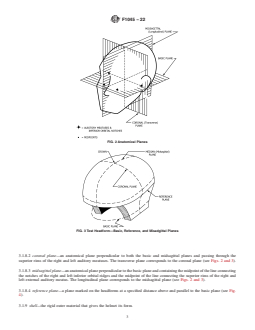
3.1.8.2 coronal plane—an anatomical plane perpendicular to both the basic and midsagittal planes and passing through the
superior rims of the right and left auditory meatuses. The transverse plane corresponds to the coronal plane (see Figs. 2 and 3).
3.1.8.3 midsagittal plane—an anatomical plane perpendicular to the basic plane and containing the midpoint of the line connecting
the notches of the right and left inferior orbital ridges and the midpoint of the line connecting the superior rims of the right and
left external auditory meatus. The longitudinal plane corresponds to the midsagittal plane (see Figs. 2 and 3).
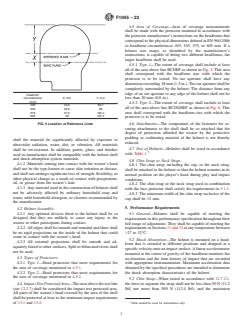
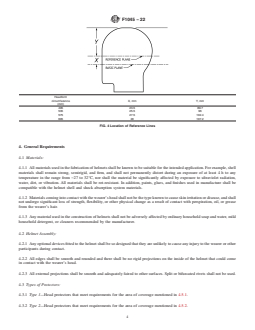
3.1.8.4 reference plane—a plane marked on the headforms at a specified distance above and parallel to the basic plane (see Fig.
4).
3.1.9 shell—the rigid outer material that gives the helmet its form.
F1045 − 22
Headform
circumference X, mm Y, mm
(mm)
495 23.5 89.7
535 25.5 96
575 27.5 102.4
605 29 107.2
FIG. 4 Location of Reference Lines
4. General Requirements
4.1 Materials:
4.1.1 All materials used in the fabrication of helmets shall be known to be suitable for the intended application. For example, shell
materials shall remain strong, semirigid, and firm, and shall not permanently distort during an exposure of at least 4 h to any
temperature in the range from −27 to 32°C, nor shall the material be significantly affected by exposure to ultraviolet radiation,
water, dirt, or vibration. All materials shall be rot-resistant. In addition, paints, glues, and finishes used in manufacture shall be
compatible with the helmet shell and shock absorption system materials.
4.1.2 Materials coming into contact with the wearer’s head shall not be the type known to cause skin irritation or disease, and shall
not undergo significant loss of strength, flexibility, or other physical change as a result of contact with perspiration, oil, or grease
from the wearer’s hair.
4.1.3 Any material used in the construction of helmets shall not be adversely affected by ordinary household soap and water, mild
household detergent, or cleaners recommended by the manufacturer.
4.2 Helmet Assembly:
4.2.1 Any optional devices fitted to the helmet shall be so designed that they are unlikely to cause any injury to the wearer or other
participants during contact.
4.2.2 All edges shall be smooth and rounded and there shall be no rigid projections on the inside of the helmet that could come
in contact with the wearer’s head.
4.2.3 All external projections shall be smooth and adequately faired to other surfaces. Split or bifurcated rivets shall not be used.
4.3 Types of Protectors:
4.3.1 Type 1—Head protectors that meet requirements for the area of coverage mentioned in 4.5.1.
4.3.2 Type 2—Head protectors that meet requirements for the area of coverage mentioned in 4.5.2.
F1045 − 22
4.4 Impact Test Protected Area—The area above the test line (see 12.2.7) shall be considered the impact test protected area. All
parts of the wearer’s head covered by the area of the shell shall be protected at least to the minimum impact requirements of 13.1
and 13.2.
4.5 Area of Coverage—Area of coverage measurements shall be made with the protector mounted in accordance with the protector
manufacturer’s instructions on the headforms that correspond to the physical dimensions defined in EN 960:2006 as headform
circumferences 495, 535, 575, or 605 mm. If a helmet size range, as identified by the manufacturer’s instructions, is capable of
fitting two different headforms, the larger headform shall be used.
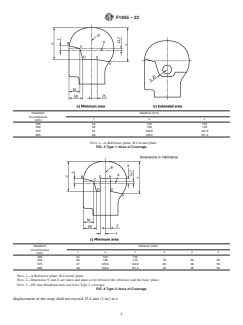
4.5.1 Type 1—The extent of coverage shall include at least all of the area above line BCDEF as shown in Fig. 5. This area shall
correspond with the headform size with which the protector is to be tested. No ear aperture shall have any dimension exceeding
38 mm (1.5 in.). The ear aperture shall be completely surrounded by the helmet. The distance from any edge of an ear aperture
to any edge of the helmet shall not be less than 20 mm (0.8 in.).
4.5.2 Type 2—The extent of coverage shall include at least all of the area above line BCDGHEF as shown in Fig. 6. This area shall
correspond with the headform size with which the protector is to be tested.
4.6 Attachments—The components of the fasteners for securing attachments to the shell shall be so attached that the degree of
protection afforded the wearer by the protective padding or cushioning material of the helmet is not thereby reduced.
4.7 Size of Helmets—Helmets shall be sized in accordance with Table 1.
4.8 Chin Strap or Neck Strap:
4.8.1 The chin strap, including the cup, or the neck strap, shall be attached to the helmet so that the helmet remains in its normal
position on the player’s head during play and impact conditions.
Headform Distance (mm)
circumference
t u v
(mm)
495 24 123 132
535 26 128 140
575 27 129.9 144.9
605 28 132.2 151.2
NOTE 1—A-Reference plane, B-Coronal plane
FIG. 5 Type 1–Area of Coverage
Table should be used for information only.
F1045 − 22
Headform Distance (mm)
circumference
t u v x y z
(mm)
495 24 123 132 – – –
535 26 128 140 18 30 50
575 27 129.9 144.9 20 40 55
605 28 132.2 151.2 20 45 55
NOTE 1—A-Reference plane, B-Coronal plane
NOTE 2—Dimension Y and Z are taken and must cover between the reference and the basic plane.
NOTE 3—495 mm Headform does not have Type 2 coverage.
FIG. 6 Type 2–Area of Coverage
TABLE 1 Hat Sizes and Head Fittings
NOTE 1—These are U.S. and Canadian hat sizes.
Circumference of Head
Hat Size
in. mm
6 19 483
1 3
6 ⁄8 19 ⁄8 492
1 3
6 ⁄4 19 ⁄4 502
3 1
6 ⁄8 20 ⁄8 511
1 1
6 ⁄2 20 ⁄2 521
5 7
6 ⁄8 20 ⁄8 530
3 1
6 ⁄4 21 ⁄4 540
7 5
6 ⁄8 21 ⁄8 550
7 22 559
1 3
7 ⁄8 22 ⁄8 568
1 3
7 ⁄4 22 ⁄4 578
3 1
7 ⁄8 23 ⁄8 587
1 1
7 ⁄2 23 ⁄2 597
5 7
7 ⁄8 23 ⁄8 606
3 1
7 ⁄4 24 ⁄4 616
7 5
7 ⁄8 24 ⁄8 625
8 25 635
4.8.2 The chin strap or the neck strap used in combination with the face protector shall satisfy the requirements in 3.1.1.
4.8.3 The minimum width of the chin strap exclusive of the cup shall be 12.7 mm (0.5 in.).13 mm.
5. Performance Requirements
5.1 General—Helmets shall be capable of meeting the requirements in this performance specification throughout their full range
of adjustment. They shall be capable of meeting the requirements in Sections 11 and 12 at any temperature between −27 to 32°C.
F1045 − 22
5.2 Shock Absorption—The helmet is mounted on a headform that is oriented in different positions and dropped at a specific
velocity onto an impact surface. A linear accelerometer mounted at the center of gravity of the headform monitors the acceleration
and the time history of impact that are recorded with appropriate instrumentation. Maximum acceleration and time duration data
obtained by the specified procedures are intended to determine the shock absorption characteristics of the helmet.
5.3 Chin Strap—When tested in accordance with 12.812.7.2.1, the force to separate the strap shall not be less than 50 N (11.2 lbf)
nor more than 500 N (112.4 lbf), and the maximum displacement of the strap shall not exceed 25.4 mm (1 in.) at a load of 109
N (24.5 lbf). The requirements of 12.812.7.2.1 shall be met at ambient conditions.
5.4 Penetration Resistance Test Requirements—It shall not be possible to touch the test headform with the curved end of the test
stick blade within the required area of coverage, excluding the ear opening.
6. Apparatus
6.1 Shock Absorption Test—The apparatus for the shock absorption test shall consist of the following:
6.1.1 Guide Assembly—The headform shall be attached to the free fall drop assembly carriage by an adjustable mounting that will
allow impacts to be delivered to any prescribed point on the helmet (see Fig. 7). The carriage shall be free to slide on vertical
guides. If wires are used, they must be placed under at least 845.2 N (190 lbf) tension (see 12.4 for guide assembly specifications
and allowable weight of drop assembly).
6.1.2 Recording Equipment—The recording equipment shall meet the following criteria:
6.1.2.1 Acceleration Transducer—The linear accelerometer is mounted at the center of gravity of the combined test headform and
carriage assembly with the sensitive axis aligned to within 5° of the vertical when the helmet and headform are in the impact
NOTE 1—Rail-guided drop assemblies are also permissible.
FIG. 7 Schematic of Typical Drop Assembly
F1045 − 22
position. This transducer shall be capable of withstanding a shock of 1000 g without damage and shall have a frequency response
(variation 61.5 %) over the range from 5 to 900 Hz.
6.1.2.2 System Accuracy—The impact recording system shall be capable of measuring shocks of up to 500 g peak acceleration
with an accuracy of 65 %.
6.1.2.3 Impact Recording—The impact shall be recorded on single- or dual-trace storage oscilloscope with 0.1-mV to 20-V
deflection factor, 1 to 5-ms sweep speed-division, and 500-kHz bandwidth.
6.1.2.4 Test Headforms—Test headforms that correspond to the physical dimensions defined in EN 960:2006 as headform
circumferences 495, 535, 575, or 605 mm. The weight of the drop assembly, including the headform, shall be in accordance with
12.4 unless otherwise specified in the individual performance specifications. The test headforms shall include surface markings
corresponding to the basic, coronal, midsagittal, and reference planes (see Figs. 2 and 3).
6.1.2.5 Reference Headforms—Measuring headforms contoured in the same configuration as the test headforms with circumfer-
ences of 495, 535, 575, or 605 mm, as defined in EN 960:2006. The reference headforms shall include surface markings
corresponding to the basic, coronal, midsagittal, and reference planes (see Figs. 2-4).
6.1.2.6 Impact Surface—The impact surface shall be a flat modular elastomer programmer (MEP) 152.4 mm (6 in.) in diameter
and 25.4 mm (1 in.) in thickness which is firmly fixed to the top surface of a flat anvil. The MEP required is a 60 6 5 Durometer
Shore A Hardness impact surface. The base shall consist of a rigid slab weighing at least 136.1 kg (300 lb). The top surface of this
base may be used as the flat metal anvil if it is faced with a steel plate with minimum thickness of 25.4 mm (1 in.) and minimum
2 2 2
top surface area of 0.09 m (1 ft ). If a detachable flat metal anvil is used it must have a top surface area of at least 290.3 cm (45
in. ). The MEP is mounted on an aluminum plate with a minimum thickness of 5.6 mm (0.220 in.) after grinding.
7. Sampling
7.1 Submit at least four specimen helmets for each size to be tested under the various conditions as described in Section 11. One
ambient conditioned sample shall be used for both impact testing and the penetration and retention test.
8. Test Specimen
8.1 Test helmets without accessories.
9. Preparation of Apparatus
9.1 Turn on all electronic equipment and allow to warm-up for at least 30 min or as recommended by the manufacturer, whichever
time is greater, prior to any testing.
10. Calibration and Standardization
10.1 Calibration—Instrumentation used in the testing shall be calibrated to manufacturer’s specifications on a periodic basis. The
duration of the calibration cycle shall be no more than one year.
10.2 Impact Attenuation Instrument System Check—The system instrumentation shall be checked before and after each series of
tests by dropping the spherical impactor onto the MEP pad at an impact velocity of 5.44 6 0.11 m/s (17.85 6 0.36 ft/s).5.2 m/s
6 2 %. Impact velocity shall be measured during the last 40 mm (1.575 in.) of free fall for each test. The weight of the drop
assembly (which is the combined weight of the instrumented spherical impactor and supporting assembly) for the drop test shall
be 5 6 0.1 kg (11.00 6 0.2 lb). Three such Six impacts, at intervals of 75 +6 15 s, shall be performed before and after each series
of tests. The peak acceleration obtained during impact shall be 389 6 8 g. If the average pea
...