

ASTM C1363-24
(Test Method)Standard Test Method for Thermal Performance of Building Materials and Envelope Assemblies by Means of a Hot Box Apparatus
General Information
- Abstract
SIGNIFICANCE AND USE
5.1 A need exists for accurate data on heat transfer through insulated structures at representative test conditions. The data are needed to judge compliance with specifications and regulations, for design guidance, for research evaluations of the effect of changes in materials or constructions, and for verification of, or use in, simulation models. Other ASTM standards such as Test Methods C177 and C518 provide data on homogeneous specimens bounded by temperature controlled flat impervious plates. The hot box test method is more suitable for providing such data for large building elements, usually of a built-up or composite nature, which are exposed to temperature-controlled air on both sides.
5.2 For the results to be representative of a building construction, only representative sections shall be tested. The test specimen shall duplicate the framing geometry, material composition and installation practice, and orientation of construction (see Section 7).
5.3 This test method does not establish test conditions, specimen configuration, or data acquisition details but leaves these choices to be made in a manner consistent with the specific application being considered. Data obtained by the use of this test method is representative of the specimen performance only for the conditions of the test. It is unlikely that the test conditions will exactly duplicate in-use conditions and the user of the test results must be cautioned of possible significant differences. For example, in some specimens, especially those containing empty cavities or cavities open to one surface, the overall resistance or transmittance will depend upon the temperature difference across the test specimen due to internal convection.
5.4 Detailed heat flow analysis shall precede the use of the hot box apparatus for large, complex structures. A structure that contains cavity spaces between adjacent surfaces, for example, an attic section including a ceiling with sloping roof, may be difficult...
SCOPE
1.1 This test method establishes the principles for the design of a hot box apparatus and the minimum requirements for the determination of the steady state thermal performance of building assemblies when exposed to controlled laboratory conditions. This method is also used to measure the thermal performance of a building material at standardized test conditions such as those required in material Specifications C739, C764, C1224 and Practice C1373.
1.2 This test method is used for large homogeneous or non-homogeneous specimens. This test method applies to building structures or composite assemblies of building materials for which it is possible to build a representative specimen that fits the test apparatus. The dimensions of specimen projections or recesses are controlled by the design of the hot box apparatus. Some hot boxes are limited to planar or nearly planar specimens. However, larger hot boxes have been used to characterize projecting skylights and attic sections. See 3.2 for a definition of the test specimen and other terms specific to this method.
Note 1: This test method replaces Test Methods C236, the Guarded Hot Box, and C976, the Calibrated Hot Box which have been withdrawn. Test apparatus designed and operated previously under Test Methods C236 and C976 will require slight modifications to the calibration and operational procedures to meet the requirements of Test Method C1363.2
1.3 A properly designed and operated hot box apparatus is directly analogous to the Test Method C177 guarded hot plate for testing large specimens exposed to air induced temperature differences. The operation of a hot box apparatus requires a significant number of fundamental measurements of temperatures, areas and power. The equipment performing these measurements requires calibration to ensure that the data are accurate. During initial setup and periodic verification testing, each measurement system and sensor is calibrat...
- Status
- Published
- Publication Date
- 29-Feb-2024
- Technical Committee
- C16 - Thermal Insulation
- Drafting Committee
- C16.30 - Thermal Measurement
Buy Documents
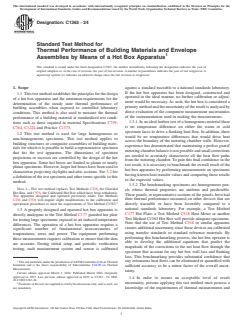
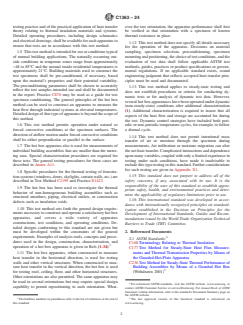
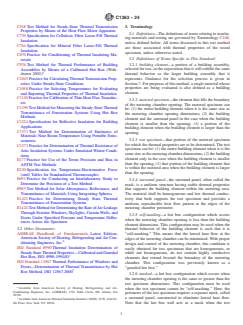
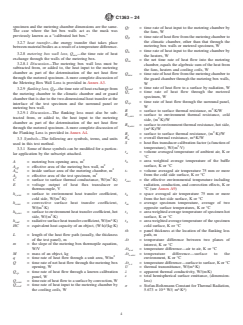
ASTM C1363-24 - Standard Test Method for Thermal Performance of Building Materials and Envelope Assemblies by Means of a Hot Box Apparatus
REDLINE ASTM C1363-24 - Standard Test Method for Thermal Performance of Building Materials and Envelope Assemblies by Means of a Hot Box Apparatus
Overview
ASTM C1363-24 is the internationally recognized standard test method for determining the steady-state thermal performance of building materials and envelope assemblies using a hot box apparatus. Developed under the jurisdiction of ASTM Committee C16 on Thermal Insulation, this method provides essential guidance for evaluating heat transfer through building components under controlled laboratory conditions. Accurate data obtained from hot box testing is critical for compliance verification, research, design optimization, and the validation of simulation models in the construction industry.
Key Topics
Test Scope and Applicability
- Measures the thermal resistance and transmittance of both homogeneous and non-homogeneous building elements, including walls, roofs, floors, doors, skylights, and other envelope assemblies.
- Suitable for specimens large enough to represent in-use constructions, with configurations adaptable to planar and certain non-planar assemblies.
- Replaces earlier withdrawn standards (ASTM C236 and C976), with apparatus modifications to meet updated calibration and operational requirements.
Methodology
- Utilizes a hot box apparatus that exposes test specimens to controlled air temperatures on both sides, closely mimicking actual building conditions.
- Parameters such as specimen selection, geometry, orientation, and installation practice must reflect real-world assemblies to ensure result representativeness.
- Detailed heat flow analyses and benchmarking with known reference panels are necessary to correct for wall and flanking losses in the measurement process.
Limitations
- Does not dictate specific test conditions or specimen configurations; these are determined based on the target application.
- Only evaluates the specimen's performance under the laboratory conditions set during the test – real-world results may vary, especially for assemblies with air cavities or non-uniform features.
- Excludes dynamic testing and intentional air or moisture transfer through specimens.
Applications
Building Design and Compliance
- Essential for architects, engineers, and builders seeking to verify that walls, roofs, floors, and other assemblies meet energy code and insulation specification requirements.
- Used for product development and comparative analysis of different building systems and retrofitting solutions to enhance building envelope performance.
Research and Product Evaluation
- Supports thermal analysis in research environments, providing validated data for newer materials, construction modifications, or evolving installation practices.
- Facilitates benchmarking and improvement of simulation tools, such as energy modeling software, by validating their assumptions with real measurement data.
Quality Assurance
- Manufacturers and certifying bodies use this method to verify the performance claims of insulation products or construction techniques.
- Enables routine testing for quality control, ensuring consistency in manufactured panels and assembly sections.
Related Standards
- ASTM C177 - Test Method for Steady-State Heat Flux Measurements and Thermal Transmission Properties by Means of the Guarded-Hot-Plate Apparatus
- ASTM C518 - Test Method for Steady-State Thermal Transmission Properties using a Heat Flow Meter Apparatus
- ASTM C1045 - Practice for Calculating Thermal Transmission Properties Under Steady-State Conditions
- ASTM C1199 - Test Method for Measuring the Steady-State Thermal Transmittance of Fenestration Systems Using Hot Box Methods
- ISO 8990 - Thermal Insulation - Determination of Steady-State Thermal Transmission Properties - Calibrated and Guarded Hot Box
- ISO 12567 - Thermal Performance of Windows and Doors - Determination of Thermal Transmittance by Hot Box Method
Practical Value
By providing a standardized method for thermal performance testing of complete building assemblies, ASTM C1363-24 helps ensure energy efficiency, durability, and occupant comfort in residential and commercial buildings. Adoption and reference of this standard support code compliance, enhance energy modeling reliability, and contribute to the global movement towards more sustainable and energy-efficient construction practices.
Keywords: ASTM C1363-24, hot box apparatus, building envelope, thermal performance, insulation testing, energy efficiency, heat transfer, building materials, laboratory evaluation, steady-state conditions, construction compliance, building assemblies.
Relations
- Effective Date
- 01-Mar-2024
- Effective Date
- 15-Apr-2024
- Effective Date
- 15-Mar-2024
- Effective Date
- 01-Mar-2024
- Effective Date
- 01-Mar-2024
- Effective Date
- 01-May-2022
- Effective Date
- 01-Sep-2021
- Effective Date
- 01-Sep-2021
- Effective Date
- 15-Apr-2017
- Effective Date
- 01-Mar-2024
- Effective Date
- 01-Mar-2024
- Effective Date
- 01-Mar-2024
- Effective Date
- 01-Mar-2024
- Effective Date
- 01-Mar-2024
- Effective Date
- 01-Mar-2024
Buy Documents
ASTM C1363-24 - Standard Test Method for Thermal Performance of Building Materials and Envelope Assemblies by Means of a Hot Box Apparatus
REDLINE ASTM C1363-24 - Standard Test Method for Thermal Performance of Building Materials and Envelope Assemblies by Means of a Hot Box Apparatus
Get Certified
Connect with accredited certification bodies for this standard

DIBt (Deutsches Institut für Bautechnik)
German Institute for Building Technology.
DIN CERTCO
DIN Group product certification.

Aboma Certification B.V.
Specialized in construction, metal, and transport sectors.
Sponsored listings
Frequently Asked Questions
ASTM C1363-24 is a standard published by ASTM International. Its full title is "Standard Test Method for Thermal Performance of Building Materials and Envelope Assemblies by Means of a Hot Box Apparatus". This standard covers: SIGNIFICANCE AND USE 5.1 A need exists for accurate data on heat transfer through insulated structures at representative test conditions. The data are needed to judge compliance with specifications and regulations, for design guidance, for research evaluations of the effect of changes in materials or constructions, and for verification of, or use in, simulation models. Other ASTM standards such as Test Methods C177 and C518 provide data on homogeneous specimens bounded by temperature controlled flat impervious plates. The hot box test method is more suitable for providing such data for large building elements, usually of a built-up or composite nature, which are exposed to temperature-controlled air on both sides. 5.2 For the results to be representative of a building construction, only representative sections shall be tested. The test specimen shall duplicate the framing geometry, material composition and installation practice, and orientation of construction (see Section 7). 5.3 This test method does not establish test conditions, specimen configuration, or data acquisition details but leaves these choices to be made in a manner consistent with the specific application being considered. Data obtained by the use of this test method is representative of the specimen performance only for the conditions of the test. It is unlikely that the test conditions will exactly duplicate in-use conditions and the user of the test results must be cautioned of possible significant differences. For example, in some specimens, especially those containing empty cavities or cavities open to one surface, the overall resistance or transmittance will depend upon the temperature difference across the test specimen due to internal convection. 5.4 Detailed heat flow analysis shall precede the use of the hot box apparatus for large, complex structures. A structure that contains cavity spaces between adjacent surfaces, for example, an attic section including a ceiling with sloping roof, may be difficult... SCOPE 1.1 This test method establishes the principles for the design of a hot box apparatus and the minimum requirements for the determination of the steady state thermal performance of building assemblies when exposed to controlled laboratory conditions. This method is also used to measure the thermal performance of a building material at standardized test conditions such as those required in material Specifications C739, C764, C1224 and Practice C1373. 1.2 This test method is used for large homogeneous or non-homogeneous specimens. This test method applies to building structures or composite assemblies of building materials for which it is possible to build a representative specimen that fits the test apparatus. The dimensions of specimen projections or recesses are controlled by the design of the hot box apparatus. Some hot boxes are limited to planar or nearly planar specimens. However, larger hot boxes have been used to characterize projecting skylights and attic sections. See 3.2 for a definition of the test specimen and other terms specific to this method. Note 1: This test method replaces Test Methods C236, the Guarded Hot Box, and C976, the Calibrated Hot Box which have been withdrawn. Test apparatus designed and operated previously under Test Methods C236 and C976 will require slight modifications to the calibration and operational procedures to meet the requirements of Test Method C1363.2 1.3 A properly designed and operated hot box apparatus is directly analogous to the Test Method C177 guarded hot plate for testing large specimens exposed to air induced temperature differences. The operation of a hot box apparatus requires a significant number of fundamental measurements of temperatures, areas and power. The equipment performing these measurements requires calibration to ensure that the data are accurate. During initial setup and periodic verification testing, each measurement system and sensor is calibrat...
SIGNIFICANCE AND USE 5.1 A need exists for accurate data on heat transfer through insulated structures at representative test conditions. The data are needed to judge compliance with specifications and regulations, for design guidance, for research evaluations of the effect of changes in materials or constructions, and for verification of, or use in, simulation models. Other ASTM standards such as Test Methods C177 and C518 provide data on homogeneous specimens bounded by temperature controlled flat impervious plates. The hot box test method is more suitable for providing such data for large building elements, usually of a built-up or composite nature, which are exposed to temperature-controlled air on both sides. 5.2 For the results to be representative of a building construction, only representative sections shall be tested. The test specimen shall duplicate the framing geometry, material composition and installation practice, and orientation of construction (see Section 7). 5.3 This test method does not establish test conditions, specimen configuration, or data acquisition details but leaves these choices to be made in a manner consistent with the specific application being considered. Data obtained by the use of this test method is representative of the specimen performance only for the conditions of the test. It is unlikely that the test conditions will exactly duplicate in-use conditions and the user of the test results must be cautioned of possible significant differences. For example, in some specimens, especially those containing empty cavities or cavities open to one surface, the overall resistance or transmittance will depend upon the temperature difference across the test specimen due to internal convection. 5.4 Detailed heat flow analysis shall precede the use of the hot box apparatus for large, complex structures. A structure that contains cavity spaces between adjacent surfaces, for example, an attic section including a ceiling with sloping roof, may be difficult... SCOPE 1.1 This test method establishes the principles for the design of a hot box apparatus and the minimum requirements for the determination of the steady state thermal performance of building assemblies when exposed to controlled laboratory conditions. This method is also used to measure the thermal performance of a building material at standardized test conditions such as those required in material Specifications C739, C764, C1224 and Practice C1373. 1.2 This test method is used for large homogeneous or non-homogeneous specimens. This test method applies to building structures or composite assemblies of building materials for which it is possible to build a representative specimen that fits the test apparatus. The dimensions of specimen projections or recesses are controlled by the design of the hot box apparatus. Some hot boxes are limited to planar or nearly planar specimens. However, larger hot boxes have been used to characterize projecting skylights and attic sections. See 3.2 for a definition of the test specimen and other terms specific to this method. Note 1: This test method replaces Test Methods C236, the Guarded Hot Box, and C976, the Calibrated Hot Box which have been withdrawn. Test apparatus designed and operated previously under Test Methods C236 and C976 will require slight modifications to the calibration and operational procedures to meet the requirements of Test Method C1363.2 1.3 A properly designed and operated hot box apparatus is directly analogous to the Test Method C177 guarded hot plate for testing large specimens exposed to air induced temperature differences. The operation of a hot box apparatus requires a significant number of fundamental measurements of temperatures, areas and power. The equipment performing these measurements requires calibration to ensure that the data are accurate. During initial setup and periodic verification testing, each measurement system and sensor is calibrat...
ASTM C1363-24 is classified under the following ICS (International Classification for Standards) categories: 91.120.10 - Thermal insulation of buildings. The ICS classification helps identify the subject area and facilitates finding related standards.
ASTM C1363-24 has the following relationships with other standards: It is inter standard links to ASTM C1363-19, ASTM C168-24, ASTM C1130-24, ASTM C739-24, ASTM C870-24, ASTM C168-22, ASTM C739-21a, ASTM C1130-21, ASTM C870-11(2017), ASTM C1410-17(2023), ASTM C1484-10(2018), ASTM C578-23, ASTM C1859-23, ASTM C1058/C1058M-10(2023), ASTM C1149-23. Understanding these relationships helps ensure you are using the most current and applicable version of the standard.
ASTM C1363-24 is available in PDF format for immediate download after purchase. The document can be added to your cart and obtained through the secure checkout process. Digital delivery ensures instant access to the complete standard document.
Standards Content (Sample)
This international standard was developed in accordance with internationally recognized principles on standardization established in the Decision on Principles for the
Development of International Standards, Guides and Recommendations issued by the World Trade Organization Technical Barriers to Trade (TBT) Committee.
Designation: C1363 − 24
Standard Test Method for
Thermal Performance of Building Materials and Envelope
Assemblies by Means of a Hot Box Apparatus
This standard is issued under the fixed designation C1363; the number immediately following the designation indicates the year of
original adoption or, in the case of revision, the year of last revision. A number in parentheses indicates the year of last reapproval. A
superscript epsilon (´) indicates an editorial change since the last revision or reapproval.
1. Scope against a standard traceable to a national standards laboratory.
If the hot box apparatus has been designed, constructed and
1.1 This test method establishes the principles for the design
operated in the ideal manner, no further calibration or adjust-
of a hot box apparatus and the minimum requirements for the
ment would be necessary. As such, the hot box is considered a
determination of the steady state thermal performance of
primary method and the uncertainty of the result is analyzed by
building assemblies when exposed to controlled laboratory
direct evaluation of the component measurement uncertainties
conditions. This method is also used to measure the thermal
of the instrumentation used in making the measurements.
performance of a building material at standardized test condi-
1.3.1 In an ideal hotbox test of a homogenous material there
tions such as those required in material Specifications C739,
is no temperature difference on either the warm or cold
C764, C1224 and Practice C1373.
specimen faces to drive a flanking heat flow. In addition, there
1.2 This test method is used for large homogeneous or
would be no temperature differences that would drive heat
non-homogeneous specimens. This test method applies to
across the boundary of the metering chamber walls. However,
building structures or composite assemblies of building mate-
experience has demonstrated that maintaining a perfect guard/
rials for which it is possible to build a representative specimen
metering chamber balance is not possible and small corrections
that fits the test apparatus. The dimensions of specimen
are needed to accurately characterize all the heat flow paths
projections or recesses are controlled by the design of the hot
from the metering chamber. To gain this final confidence in the
box apparatus. Some hot boxes are limited to planar or nearly
test result, it is necessary to benchmark the overall result of the
planar specimens. However, larger hot boxes have been used to
hot box apparatus by performing measurements on specimens
characterize projecting skylights and attic sections. See 3.2 for
having known heat transfer values and comparing those results
a definition of the test specimen and other terms specific to this
to the expected values.
method.
1.3.2 The benchmarking specimens are homogeneous pan-
NOTE 1—This test method replaces Test Methods C236, the Guarded
els whose thermal properties are uniform and predictable.
Hot Box, and C976, the Calibrated Hot Box which have been withdrawn.
These panels, or representative sections of the panels, have had
Test apparatus designed and operated previously under Test Methods
their thermal performance measured on other devices that are
C236 and C976 will require slight modifications to the calibration and
operational procedures to meet the requirements of Test Method C1363. directly traceable or have been favorably compared to a
national standards laboratory. For example, a Test Method
1.3 A properly designed and operated hot box apparatus is
C177 Hot Plate, a Test Method C518 Heat Meter or another
directly analogous to the Test Method C177 guarded hot plate
Test Method C1363 Hot Box will provide adequate specimens.
for testing large specimens exposed to air induced temperature
Note that the use of Test Method C518 or similar apparatus
differences. The operation of a hot box apparatus requires a
creates additional uncertainty since those devices are calibrated
significant number of fundamental measurements of
using transfer standards or standard reference materials. By
temperatures, areas and power. The equipment performing
performing this benchmarking process, the hot box operator is
these measurements requires calibration to ensure that the data
able to develop the additional equations that predict the
are accurate. During initial setup and periodic verification
magnitude of the corrections to the net heat flow through the
testing, each measurement system and sensor is calibrated
specimen that account for any hot box wall loss and flanking
loss. This benchmarking provides substantial confidence that
This test method is under the jurisdiction of ASTM Committee C16 on Thermal any extraneous heat flows can be eliminated or quantified with
Insulation and is the direct responsibility of Subcommittee C16.30 on Thermal
sufficient accuracy to be a minor factor of the overall uncer-
Measurement.
tainty.
Current edition approved March 1, 2024. Published March 2024. Originally
approved in 1997. Last previous edition approved in 2019 as C1363 – 19. DOI:
1.4 In order to ensure an acceptable level of result
10.1520/C1363-24.
uncertainty, persons applying this test method must possess a
Footnotes in the text are supplied to clarify the discussion only, and as such, are
not mandatory. knowledge of the requirements of thermal measurements and
Copyright © ASTM International, 100 Barr Harbor Drive, PO Box C700, West Conshohocken, PA 19428-2959. United States
C1363 − 24
testing practice and of the practical application of heat transfer ever the test orientation, the apparatus performance shall first
theory relating to thermal insulation materials and systems. be verified at that orientation with a specimen of known
Detailed operating procedures, including design schematics thermal resistance in place.
and electrical drawings, shall be available for each apparatus to
1.12 This test method does not specify all details necessary
ensure that tests are in accordance with this test method.
for the operation of the apparatus. Decisions on material
1.5 This test method is intended for use at conditions typical sampling, specimen selection, preconditioning, specimen
of normal building applications. The naturally occurring out- mounting and positioning, the choice of test conditions, and the
side conditions in temperate zones range from approximately evaluation of test data shall follow applicable ASTM test
−48 to 85°C and the normal inside residential temperatures is methods, guides, practices or product specifications or govern-
approximately 21°C. Building materials used to construct the mental regulations. If no applicable standard exists, sound
test specimens shall be pre-conditioned, if necessary, based engineering judgment that reflects accepted heat transfer prin-
upon the material’s properties and their potential variability. ciples must be used and documented.
The preconditioning parameters shall be chosen to accurately
1.13 This test method applies to steady-state testing and
reflect the test samples intended use and shall be documented
does not establish procedures or criteria for conducting dy-
in the report. Practice C870 may be used as a guide for test
namic tests or for analysis of dynamic test data. However,
specimen conditioning. The general principles of the hot box
several hot box apparatuses have been operated under dynamic
method can be used to construct an apparatus to measure the
(non-steady-state) conditions after additional characterization
heat flow through industrial systems at elevated temperatures.
(1). Additional characterization is required to insure that all
Detailed design of that type of apparatus is beyond the scope of
aspects of the heat flow and storage are accounted for during
this method.
the test. Dynamic control strategies have included both peri-
1.6 This test method permits operation under natural or odic or non-periodic temperature cycles, for example, to follow
forced convective conditions at the specimen surfaces. The a diurnal cycle.
direction of airflow motion under forced convective conditions
1.14 This test method does not permit intentional mass
shall be either perpendicular or parallel to the surface.
transfer of air or moisture through the specimen during
1.7 The hot box apparatus also is used for measurements of measurements. Air infiltration or moisture migration can alter
individual building assemblies that are smaller than the meter- the net heat transfer. Complicated interactions and dependence
ing area. Special characterization procedures are required for upon many variables, coupled with only a limited experience in
these tests. The general testing procedures for these cases are testing under such conditions, have made it inadvisable to
described in Annex A11. include this type testing in this standard. Further considerations
for such testing are given in Appendix X1.
1.8 Specific procedures for the thermal testing of fenestra-
1.15 This standard does not purport to address all of the
tion systems (windows, doors, skylights, curtain walls, etc.) are
safety concerns, if any, associated with its use. It is the
described in Test Method C1199 and Practice E1423.
responsibility of the user of this standard to establish appro-
1.9 The hot box has been used to investigate the thermal
priate safety, health, and environmental practices and deter-
behavior of non-homogeneous building assemblies such as
mine the applicability of regulatory limitations prior to use.
structural members, piping, electrical outlets, or construction
1.16 This international standard was developed in accor-
defects such as insulation voids.
dance with internationally recognized principles on standard-
1.10 This test method sets forth the general design require-
ization established in the Decision on Principles for the
ments necessary to construct and operate a satisfactory hot box
Development of International Standards, Guides and Recom-
apparatus, and covers a wide variety of apparatus
mendations issued by the World Trade Organization Technical
constructions, test conditions, and operating conditions. De-
Barriers to Trade (TBT) Committee.
tailed designs conforming to this standard are not given but
2. Referenced Documents
must be developed within the constraints of the general
requirements. Examples of analysis tools, concepts and proce- 4
2.1 ASTM Standards:
dures used in the design, construction, characterization, and
C168 Terminology Relating to Thermal Insulation
operation of a hot box apparatus is given in Refs (1-34).
C177 Test Method for Steady-State Heat Flux Measure-
ments and Thermal Transmission Properties by Means of
1.11 The hot box apparatus, when constructed to measure
heat transfer in the horizontal direction, is used for testing the Guarded-Hot-Plate Apparatus
C236 Test Method for Steady-State Thermal Performance of
walls and other vertical structures. When constructed to mea-
sure heat transfer in the vertical direction, the hot box is used Building Assemblies by Means of a Guarded Hot Box
(Withdrawn 2001)
for testing roof, ceiling, floor, and other horizontal structures.
Other orientations are also permitted. The same apparatus may
be used in several orientations but may require special design
For referenced ASTM standards, visit the ASTM website, www.astm.org, or
capability to permit repositioning to each orientation. What-
contact ASTM Customer Service at service@astm.org. For Annual Book of ASTM
Standards volume information, refer to the standard’s Document Summary page on
the ASTM website.
3 5
The boldface numbers in parentheses refer to the list of references at the end of The last approved version of this historical standard is referenced on
this standard. www.astm.org.
C1363 − 24
C518 Test Method for Steady-State Thermal Transmission 3. Terminology
Properties by Means of the Heat Flow Meter Apparatus
3.1 Definitions—The definitions of terms relating to insulat-
C739 Specification for Cellulosic Fiber Loose-Fill Thermal
ing materials and testing are governed by Terminology C168,
Insulation
unless defined below. All terms discussed in this test method
C764 Specification for Mineral Fiber Loose-Fill Thermal
are those associated with thermal properties of the tested
Insulation
specimen, unless otherwise noted.
C870 Practice for Conditioning of Thermal Insulating Ma-
3.2 Definitions of Terms Specific to This Standard:
terials
3.2.1 building element—a portion of a building assembly,
C976 Test Method for Thermal Performance of Building
selected for test, in the expectation that it will exhibit the same
Assemblies by Means of a Calibrated Hot Box (With-
thermal behavior as the larger building assembly that it
drawn 2002)
represents. Guidance for the selection process is given in
C1045 Practice for Calculating Thermal Transmission Prop-
Section 7. For purposes of this method, a single material whose
erties Under Steady-State Conditions
properties are being evaluated is also defined as a building
C1058 Practice for Selecting Temperatures for Evaluating
element.
and Reporting Thermal Properties of Thermal Insulation
C1130 Practice for Calibration of Thin Heat Flux Transduc-
3.2.2 metered specimen—the element that fills the boundary
ers
of the metering chamber opening. The metered specimen can
C1199 Test Method for Measuring the Steady-State Thermal
be: (1) the entire building element when it is the same size as
Transmittance of Fenestration Systems Using Hot Box
the metering chamber opening dimensions; (2) the building
Methods
element and the surround panel in the case when the building
C1224 Specification for Reflective Insulation for Building
element is smaller than the opening; (3) a portion of the
Applications
building element when the building element is larger than the
C1371 Test Method for Determination of Emittance of
opening.
Materials Near Room Temperature Using Portable Emis-
3.2.3 test specimen—that portion of the metered specimen
someters
for which the thermal properties are to be determined. The test
C1373 Practice for Determination of Thermal Resistance of
specimen can be: (1) the entire building element when it is the
Attic Insulation Systems Under Simulated Winter Condi-
same size as the metering chamber dimensions; (2) the building
tions
element only in the case when the building element is smaller
E177 Practice for Use of the Terms Precision and Bias in
than the opening; (3) that portion of the building element that
ASTM Test Methods
is within the metered area when the building element is larger
E230 Specification for Temperature-Electromotive Force
than the opening.
(emf) Tables for Standardized Thermocouples
E691 Practice for Conducting an Interlaboratory Study to 3.2.4 surround panel—the surround panel, often called the
Determine the Precision of a Test Method
mask, is a uniform structure having stable thermal properties
E903 Test Method for Solar Absorptance, Reflectance, and
that supports the building element within the metering area.
Transmittance of Materials Using Integrating Spheres
The material shall be homogeneous and low thermal conduc-
E1423 Practice for Determining Steady State Thermal
tivity that both supports the test specimen and provides a
Transmittance of Fenestration Systems
uniform, reproducible heat flow pattern at the edges of the
E1424 Test Method for Determining the Rate of Air Leakage
metering chamber perimeter.
Through Exterior Windows, Skylights, Curtain Walls, and
3.2.5 self-masking—a hot box configuration which occurs
Doors Under Specified Pressure and Temperature Differ-
when the metering chamber opening is less than the building
ences Across the Specimen
element dimensions. This configuration may be used when the
2.2 Other Documents:
thermal behavior of the building element is such that it is
ASHRAE Handbook of Fundamentals, Latest Edition,
“self-masking.” This means that the lateral heat flow at the
American Society of Heating, Refrigerating and Air Con-
edges of the metering chamber can be minimized. With proper
ditioning Engineers, Inc.
design and control of the metering chamber, this condition is
ISO Standard 8990 Thermal Insulation Determination of
easily obtained for test specimens that are homogeneous, or
Steady State Thermal Properties—Calibrated and Guarded
while not homogeneous, do not contain highly conductive
Hot Box, ISO 8990-1994(E)
elements that extend beyond the boundary of the metering
ISO Standard 12567 Thermal Performance of Windows and
chamber. This configuration was previously known as a
Doors—Determination of Thermal Transmittance by Hot
“guarded hot box.”
Box Method, ISO 12567-2000
3.2.6 masked—a hot box configuration which occurs when
the metering chamber opening is the same or greater than the
test specimen dimensions. This configuration must be used
Available from American Society of Heating, Refrigerating, and Air-
when the test specimen cannot be “self-masking.” Here, the
Conditioning Engineers, Inc. (ASHRAE), 1791 Tullie Circle, NE, Atlanta, GA
perimeter of the test specimen requires a separate mask, called
30329.
a surround panel, constructed to eliminate lateral heat flow.
Available from American National Standards Institute (ANSI), 25 W. 43rd St.,
4th Floor, New York, NY 10036. Note that the hot box wall acts as a mask when the test
C1363 − 24
specimen and the metering chamber dimensions are the same.
Q = time rate of heat input to the metering chamber by
f
The case where the hot box walls act as the mask was
the fans, W
previously known as a “calibrated hot box.”
Q = time rate of heat flow from the metering chamber to
fl
the climatic chamber, other than that through the
3.2.7 heat transfer—the energy transfer that takes place
metering box walls or metered specimen, W
between material bodies as a result of a temperature difference.
Q = time rate of heat input to the metering chamber by
h
3.2.8 metering box wall loss, Q —the time rate of heat
mw
the heaters, W
exchange through the walls of the metering box.
Q = the net time rate of heat flow into the metering
in
3.2.8.1 Discussion—The metering box wall loss must be
chamber, equals the algebraic sum of the heat from
subtracted from, or added to, the heat input to the metering
the fans, heaters and cooling coils, W
chamber as part of the determination of the net heat flow
Q = time rate of heat flow from the metering chamber to
mw
through the metered specimen. A more complete discussion of
the guard chamber through the metering box walls,
the Metering Box Wall Loss is provided in Annex A3.
W
Q = time rate of heat flow to a surface by radiation, W
rad
3.2.9 flanking loss, Q —the time rate of heat exchange from
fl
Q = time rate of heat flow through the metered
s
the metering chamber to the climatic chamber and or guard
specimen, W
chamber that is due to the two-dimensional heat transfer at the
Q = time rate of heat flow through the surround panel,
sp
interface of the test specimen and the surround panel or
W
metering box wall.
R = surface to surface thermal resistance, m ·K/W
3.2.9.1 Discussion—The flanking loss must also be sub-
R = surface to environment thermal resistance, cold
c,env
tracted from, or added to, the heat input to the metering
side, (m ·K)/W
chamber as part of the determination of the net heat flow
R = surface to environment thermal resistance, hot side,
h,env
through the metered specimen. A more complete discussion of 2
(m ·K)/W
the Flanking Loss is provided in Annex A4.
R = surface to surface thermal resistance, (m ·K)/W
s
R = overall thermal resistance, m ·K/W
3.3 Symbols—The following are symbols, terms, and units u
S = heat flux transducer calibration factor (a function of
used in this test method.
temperature), W/(m ·V)
3.3.1 Some of these symbols can be modified for a particu-
t = volume averaged temperature of ambient air, K or
a
lar application by the subscript attached.
°C
t = area weighted average temperature of the baffle
A = metering box opening area, m b
surface, K or °C
A = effective area of the metering box wall, m
eff
t = volume averaged air temperature 75 mm or more
A = inside surface area of the metering chamber, m c
in
A = effective area of the test specimen, m from the cold side surface, K or °C
s
t = the effective environmental temperature including
C = surface to surface thermal conductance, W/(m ·K)
env
E = voltage output of heat flux transducer or radiation, conduction, and convection effects, K or
thermocouple, V °C (see Annex A9)
h = surface to environment heat transfer coefficient, t = space averaged air temperature 75 mm or more
c,env h
cold side, W/(m ·K) from the hot side surface, K or °C
h = convective surface heat transfer coefficient, t = average specimen temperature, average of two
conv m
W/(m ·K) opposite surface temperatures, K or °C
h = surface to environment heat transfer coefficient, hot t = area weighted average temperature of specimen hot
h,env 1
side, W/(m ·K) surface, K or °C
h = radiative surface heat transfer coefficient, W/(m ·K) t = area weighted average temperature of the specimen
rad 2
HC = equivalent heat capacity of an object, (W·h)/(kg·K)
cold surface, K or °C
th = panel thickness at the location of the flanking loss
L = length of the heat flow path (usually, the thickness
path, m
of the test panel), m Δt = temperature difference between two planes of
m = the slope of the metering box thermopile equation, interest, K or °C
W/V Δt = temperature difference—air to air, K or °C
a-a
M = mass of an object, kg Δt = temperature difference—surface to the
s-env
q = time rate of heat flow through a unit area, W/m environment, K or °C
Q = time rate of net heat flow through the metering box
Δt = temperature difference—surface to surface, K or °C
s-s
opening, W U = thermal transmittance, W/(m ·K)
= time rate of heat flow through a known calibration
Q λ = apparent thermal conductivity, W/(m·K)
cp
ε = total hemispherical surface emittance, (dimension-
panel, W
Q = time rate of heat flow to a surface by convection, W less)
conv
Q = time rate of heat input to the metering chamber by σ = Stefan-Boltzmann Constant for Thermal Radiation,
cool
-8 2 4
the cooling coils, W 5.673 × 10 W/( m ·K )
C1363 − 24
3.4.5 Surface Resistance, R —The surface resistance is
τ = effective thermal time constant of the combined
i,env
eff
the resistance, at the surface, to heat flow to the environment
apparatus and specimen, s
caused by the combined effects of conduction, convection and
Σe = total edge length on the inside walls of the metering
i
radiation. The subscripts h and c are used to differentiate
chamber, m
between hot side and cold side surface resistances respectively.
3.3.2 Subject Modifiers:
Surface resistances are calculated as follows:
1 = hot side surface
A·~t 2 t !
env,h 1
R 5 (6)
2 = cold side surface h,env
Q
a = ambient condition
A· t 2 t
~ !
2 env,c
a-a = air to air difference
R 5 (7)
c,env
Q
ap = apparatus
b = baffle
3.4.6 Surface Heat Transfer Coeffıcient, h —Often called
i,env
c = cold
surface conductance or film coefficient. The subscripts h and c
conv = convection
are used to differentiate between hot side and cold side surface
cool = cooling energy
heat transfer coefficients respectively. The coefficients are
eff = effective or equivalent property
calculated as follows:
env = environment
fl = flanking path Q
h 5 (8)
h,env
h = hot
A· t 2 t
~ !
env,h 1
i = index
Q
in = inside
h 5 (9)
c,env
A· t 2 t
~ !
2 env,c
m = mean or average value
NOTE 4—The surface heat transfer coefficient, h , and the corre-
i,env
mw = metering box wall
sponding surface resistance, R , (see 3.4.5) are reciprocals, that is, their
i,env
o = null or zero condition
product is unity.
out = outside
3.4.7 Surface Coeffıcient Determination—An expanded dis-
rad = radiation
cussion of the interactions between the radiation and convec-
s = surface
tive heat transfer at the surfaces of the test specimen is included
sp = surround panel
in Annex A9. The material presented in Annex A9 must be
s-a = surface to air difference
s-env = surface to the environment difference used to determine the magnitude of the environmental tem-
s-s = surface to surface difference peratures. These temperatures are required to correct for the
t = test
radiation heat flow from the air curtain baffle.
u = overall
3.4.8 Whenever the heat transfer is greatly different from
one area to another or the surface area of one surface of the test
3.4 Equations—The following equations are listed here to
specimen is significantly larger than the projected area, or the
simplify their use in the Calculations section of this test
detailed temperatures profiles are unknown, only the net heat
method.
transfer through the specimen is meaningful. In these cases,
3.4.1 Overall Thermal Resistance, R —The overall thermal
u
only the calculation of the overall resistance, R , and transmis-
resistance is equal to the sum of the resistances of the specimen u
sion coefficient, U, are permitted.
and the two surface resistances. It is calculated as follows:
3.4.9 Apparent Thermal Conductivity of a Homogeneous
A·~t 2 t !
env,h env,c
R 5 5 R 1R1R (1) Specimen, λ:
u c h
Q
Q·L
3.4.2 Thermal Transmittance, U—(sometimes called overall λ 5 (10)
A·~t 2 t !
1 2
coefficient of heat transfer). It is calculated as follows:
NOTE 5—Materials are considered homogeneous when the value of the
thermal conductivity is not significantly affected by variations in the
Q
U 5 (2) thickness or area of the specimen within the range of those variables
A·~t 2 t !
env,h env,c
normally used.
I/U 5 1/h 1 1/C 1 1/h (3)
~ ! ~ ! ~ !
h c
NOTE 2—Thermal transmittance, U, and the corresponding overall
4. Summary of Test Method
thermal resistance, R , are reciprocals, that is, their product is unity.
u
4.1 This test method establishes the principles for the design
3.4.3 Thermal Resistance, R:
of a hot box apparatus and the minimum requirements for the
A·~t 2 t !
1 2 determination of the steady state thermal performance of
R 5 (4)
Q
building assemblies when exposed to controlled laboratory
conditions. At the minimum, the hot box apparatus shall be
3.4.4 Thermal Conductance, C:
able to measure the rate of heat flow through a building
Q
element of known area for known test conditions while limiting
C 5 (5)
A· t 2 t
~ !
1 2
extraneous heat flows. The apparatus is required to establish
NOTE 3—Thermal resistance, R, and the corresponding thermal
and maintain a desired steady temperature difference across the
conductance, C, are reciprocals; that is, their product is unity. These terms
test specimen for the period of time. The elapsed time required
apply to specific bodies or constructions as used, either homogeneous or
heterogeneous, between two specified isothermal surfaces. is that necessary to ensure constant heat flow and steady
C1363 − 24
temperatures, and, for an additional period adequate to measure such as Test Methods C177 and C518 provide data on
these quantities to the desired accuracy. homogeneous specimens bounded by temperature controlled
flat impervious plates. The hot box test method is more suitable
4.2 To determine the conductance, C, the transmittance, U,
for providing such data for large building elements, usually of
or the resistance, R, of any specimen, it is necessary to know
a built-up or composite nature, which are exposed to
the area, A, the net heat flow,Q and the temperature differences,
temperature-controlled air on both sides.
Δt, all of which shall be determined under such conditions that
the flow of heat is steady.
5.2 For the results to be representative of a building
4.3 The area and temperatures are measured directly. The construction, only representative sections shall be tested. The
net heat flow Q, however, cannot be directly measured. To
test specimen shall duplicate the framing geometry, material
determine the net heat flow through the metered specimen, a
composition and installation practice, and orientation of con-
five-sided metering box is placed with its open side against one
struction (see Section 7).
face of the metered specimen.
5.3 This test method does not establish test conditions,
4.4 If there were no net heat exchange across the walls that
specimen configuration, or data acquisition details but leaves
of the metering box and the flanking loss around the metered
these choices to be made in a manner consistent with the
specimen is negligible, then the heat input from the fan and
specific application being considered. Data obtained by the use
heaters minus any cooling coil heat extraction from the
of this test method is representative of the specimen perfor-
metering box is a measure of the net heat flow through the
mance only for the conditions of the test. It is unlikely that the
metered specimen.
test conditions will exactly duplicate in-use conditions and the
4.5 Since it is difficult to achieve the condition described in
user of the test results must be cautioned of possible significant
4.4, the hot box apparatus must be designed to obtain an
differences. For example, in some specimens, especially those
accurate measure of the net metered specimen heat flow. The
containing empty cavities or cavities open to one surface, the
net heat transfer through the metered specimen is determined
overall resistance or transmittance will depend upon the
from the net measured heat input to the metering chamber,
temperature difference across the test specimen due to internal
corrected for the heat flow through the metering chamber walls
convection.
and flanking loss for the specimen at the perimeter of the
metering area. Where the metering chamber opening contains 5.4 Detailed heat flow analysis shall precede the use of the
a building element smaller than the opening masked by a hot box apparatus for large, complex structures. A structure that
surround panel, the net heat transfer through the surround panel
contains cavity spaces between adjacent surfaces, for example,
is subtracted from the metered specimen heat flow in order to
an attic section including a ceiling with sloping roof, may be
determine the net heat flow through the building element.
difficult to test properly. Consideration must be given to the
effects of specimen size, natural air movement, ventilation
4.6 The heat flow rate through the metering chamber walls
effects, radiative effects, and baffles at the guard/meter inter-
is limited by the use of highly insulated walls, by control of the
face when designing the test specimen.
surrounding ambient temperature, or by use of a temperature-
controlled guard chamber.
5.5 For vertical specimens with air spaces that significantly
4.7 The portion of the building element or specimen frame
affect thermal performance, the metering chamber dimension
outside the boundary of the metering area, exposed to the
shall match the effective construction height. If this is not
guarding space temperature, constitutes a passive guard to
possible, horizontal convection barriers shall be installed inside
minimize flanking heat flow in the building element near the
the specimen air cavities at the metering chamber boundaries to
perimeter of the metering area (see Annex A2).
prevent air exchange between the metering and guarding areas.
The operator shall note in the report any use of convection
4.8 Both the metering chamber wall flow and the flanking
loss corrections are based upon a series of characterization barriers. The report shall contain a warning stating that the use
tests, using specimens of known thermal properties. These tests of the barriers might modify the heat transfer through the
cover the range of anticipated performance levels and test
system causing significant errors. For ceiling tests with low
conditions. While it is possible to estimate the magnitude of
density insulations, the minimum lateral dimension of the
these corrections using numerical techniques and material
specimen shall be at least several times the dimension of the
properties of the components, the accuracy of those corrections
expected convection cells.
must be verified by characterization measurements. (See An-
5.6 Since this test method is used to determine the total heat
nex A2 through Annex A11 for details.)
flow through the test area demarcated by the metering box, it is
possible to determine the heat flow through a building element
5. Significance and Use
smaller than the test area, such as a window or representative
5.1 A need exists for accurate data on heat transfer through
area of a panel unit, if the parallel heat flow through the
insulated structures at representative test conditions. The data
remaining surrounding area is independently determined. See
are needed to judge compliance with specifications and
Annex A8 for the general method.
regulations, for design guidance, for research evaluations of the
5.7 Discussion of all special conditions used during the test
effect of changes in materials or constructions, and for verifi-
cation of, or use in, simulation models. Other ASTM standards shall be included in the test report (see Section 12).
C1363 − 24
temperature of the metering chamber is greater than that of the climatic
6. Apparatus
chamber and the common designations of “hot side” and “cold side”
6.1 Introduction—The design of a successful hot box appa-
apply. In some apparatus, either direction of heat flow may apply.
ratus is influenced by many factors. Before beginning the
6.3 Apparatus Size—The overall apparatus shall be sized to
design of an apparatus meeting this standard, the designer shall
match the type of specimens anticipated for testing (see 7.2).
review the discussion on the limitations and accuracy, Section
For building assemblies, it shall accommodate representative
13, discussions of the energy flows in a hot box, Annex A2, the
sections. Generally, the maximum accuracy is obtained when
metering box wall loss flow, Annex A3, and flanking loss,
the specimen size matches that of the metering chamber while
Annex A4. This, hopefully, will provide the designer with an
the climatic chamber also matches or is larger.
appreciation of the required technical design considerations.
NOTE 7—A large apparatus is desirable in order to minimize perimeter
6.2 Definition of Location and Areas—The major compo-
effects in relation to the metered area, but a large apparatus may also
nents of a hot box apparatus are (1) the metering chamber on
exhibit longer equilibrium times, thus, a practical compromise must be
one side of the specimen; (2) the climatic chamber on the other; reached. Typical heights for wall hot boxes are 2.5 to 3 m with widths
equal to or exceeding the height. Floor/ceiling hot boxes up to 4 by 6 m
(3) the specimen frame providing specimen support and
have been built.
perimeter insulation; and (4) the surrounding ambient space.
6.4 Construction Materials—Materials used in the construc-
These elements shall be designed as a system to provide the
desired air temperature, air velocity, and radiation conditions tion of the hot box apparatus shall have a high thermal
resistivity, low heat capacity and high air flow resistance.
for the test and to accurately measure the resulting net heat
transfer. A diagram of the relative arrangement of those spaces Polystyrene or other closed cell foam materials have been used
since they combine both high thermal resistivity, good me-
is shown in Fig. 1.
6.2.1 The basic hot box apparatus has been assembled in a chanical properties, and ease of fabrication. One potential
problem with some foam is that they exhibit time dependent
wide variation of sizes, orientations and designs. Two configu-
rations have been historically used for a majority of the thermal properties that would adversely affect the thermal
stability of the apparatus. Problems associated with the use of
designs. The first is the self-masking hot box which has a
controlled “guard” chamber surrounding the metering box. An these materials are avoided by using materials that are initially
aged prior to assembly, or by periodic chamber verification, or
example of this configuration is presented in Fig. 2.
by using impermeable faced foam materials with sealed edges
6.2.2 The second configuration is the masked hot box. This
to greatly minimize the aging effects.
configuration can also be considered as a special case of the
guarded hot box in which the surrounding ambient is used as
6.5 Metering Chamber:
the guard chamber. An additional design consideration for the
6.5.1 The minimum size of the metering box is governed by
masked hot box design is that the metering chamber walls shall
the metering area required to obtain a representative test area
have sufficient thermal resistance to reduce the metering box
for the specimen (see 7.2) and for maintenance of reasonable
wall loss to an acceptable level. The masked design is generally
test accuracy. For example, for specimens incorporating air
used for testing of large specimens. Fig. 3 shows an example of
spaces or stud spaces, the metering area shall span an integral
a masked apparatus for horizontal heat transfer.
number of spaces (see 5.5). The depth of the metering box shall
be no greater than that required to accommodate the air curtain,
NOTE 6—The two opposing chambers or boxes are identified as the
metering chamber and the climatic chamber. In the usual arrangement, the radiation baffle and the equipment required to condition and
FIG. 1 Typical Hot Box Apparatus Schematic—Definition of Locations and Areas
C1363 − 24
FIG. 2 Typical Guarded Hot Box Schematic
FIG. 3 Typical Calibrated Hot Box Apparatus
circulate the air. Measurement errors in testing with a hot box perimeter of the metering area and inverse to metering area.
apparatus are, in part, proportional to the length of the The relative influence of the perimeter length diminishes as
C1363 − 24
metering area is increased. Experience on testing homogeneous tural members, and by eliminating any localized hot or cold
materials, has demonstrated that for the “guarded,” self- sources from the adjoining space. No highly conductive
masking hot box configuration, the minimum size of the structural members shall be within the insulation. Thermal
metering area is 3 times the square of the metered specimen bridges, structural cracks, insulation voids, air leaks and
thickness or 1 m , whichever is larger (18). From the same localized hot or cold spots from the conditioning equipment
experience base, for the “calibrated,” masked box inside the metering chamber walls shall be avoided.
configuration, a minimum metering area size is 1.5 m . For
NOTE 9—One method of constructing satisfactory chamber walls is by
non-homogeneous specimens, the size requirements are more
gluing together large blocks of an aged, uniform low thermal conductivity
significant.
cellular plastic insulation such as extruded polystyrene foam. A thin
covering of reinforced plastic or coated plywood is recommended to
6.5.2 The purpose of the metering chamber is to provide for
provide durability, moisture and air infiltration control. In addition to
the control and measurement of air temperatures and surface
using a high thermal resistance, the designer must also recognize that wall
coefficients at the face of the specimen under prescribed
heat storage capacity is also a governing factor in hot box wall design.
conditions and for the measurement of the net heat transfer
6.5.3.5 To ensure uniform radiant heat transfer exposure of
through specimen. The usual arrangement is a five-sided
the specimen, all surfaces which exchange radiation with the
chamber containing airflow baffles, electrical heaters, cooling
specimen shall have a total hemispherical emittance greater
coils (if desired), and an air circulation system. At steady state
than 0.8. Test Methods C1371 and E903 are acceptable
conditions, the heat transfer through the specimen equals the
methods to measure emittance. Typically, a flat paint will meet
electrical power to the heaters and blowers minus the cooling
this requirement.
energy extraction, corrected for the heat passing through the
6.5.3.6 In applications where the metering chamber contacts
chamber walls and flanking the specimen. Both the metering
the specimen, an airtight seal between the specimen and
box wall loss and flanking loss are determined from character-
metering wall shall be provided. The cross section of the
ization measurements (see Section 8 and Annex A2 – Annex
contact surface of the metering chamber with the specimen
A9).
shall be narrowed to the minimum width necessary to hold the
6.5.3 To minimize measurement errors, several require-
seal. A maximum width of 13 mm, measured parallel to the
ments are placed upon the metering chamber walls and the
specimen surface plane, shall be used as a guide for design.
adjoining ambient space:
Periodic inspection of the sealing system is recommended in
6.5.3.1 The metering chamber heat flow corrections, which
order to confirm its ability to provide a tight seal under test
are estimated for design purpose using the equations of Annex
conditions.
A2 – Annex A4, must be kept small, by making the metering
6.5.4 Since one basic principle of the test method is to
box wall area small, keeping its thermal resistance high or by
measure the heat flow through the metering box walls, ad-
minimizing the temperature difference across the wall (see
equate controls and temperature-monitoring capabilities are
Note 8).
essential. Small temperature gradients through the walls occur
6.5.3.2 With proper design, the metering box wall loss are
due to the limitations of controllers. Since the total wall area of
controlled to be as low as 1 or 2 % of the heat transfer through
the metering box is often more than twice the metering area of
the specimen. The metering box wall loss shall never be greater
the specimen, these small temperature gradients through the
than 10 % of the specimen heat transfer. In any case, the
walls cause substantial heat flows totaling a significant fraction
minimum thermal resistance of the metering chamber walls
of the heat input to the metering box. For this reason, the
shall be greater than 0.83 m K/W.
metering box walls shall be instrumented to serve as a heat
flow transducer so that heat flow through them can be
NOTE 8—The 10 % limit is based upon design analysis of existing hot
boxes. The choice of construction of the metering chamber can only be
minimized and measured. A correction for metering chamber
made after review of the expected test conditions in which metering box
wall loss shall be applied in calculating test results. The use of
wall loss and associated uncertainties are considered in relation to the
one of the following methods is required for monitoring
anticipated energy transfer through the metered specimen and its desired
metering box wall loss.
maximum uncertainty. The influence of the guarding temperature upon the
ability to maintain steady temperatures within the metering chamber must
NOTE 10—The choice of transducer types and mounting methods used
also be considered in choosing between highly insulated walls and a
to measure the heat flow through the metering chamber walls is guided by
tightly controlled guard space conditioning.
the hot box design. However, they must provide adequate coverage and
output signal to quantify the metering box wall loss during testing (see
6.5.3.3 However large the metering box wall loss is, the
6.5.3.3).
uncertainty of the resulting metering box wall loss correction to
the net heat flow shall not exceed 0.5 % of the net heat flow
6.5.4.1 The walls may be used as heat flow transducers by
through the specimen. In some designs, it has been necessary
application of a large number of differential thermocouples
to use a partial guard to reduce the metering chamber box wall
connected between the inside and outside surfaces of the
loss.
metering chamber walls. Care must be taken when determining
6.5.3.4 For best results, the heat transfer through the meter- locations of the differential thermocouples, as temperature
ing chamber walls shall be uniform so that a limited number of gradients on the inside and outside of the metering box walls
heat flux transducers or differential thermocouples can be used are likely to exist and have been found to be a function of
to characterize the heat flow from each representative area. meterin
...
This document is not an ASTM standard and is intended only to provide the user of an ASTM standard an indication of what changes have been made to the previous version. Because
it may not be technically possible to adequately depict all changes accurately, ASTM recommends that users consult prior editions as appropriate. In all cases only the current version
of the standard as published by ASTM is to be considered the official document.
Designation: C1363 − 19 C1363 − 24
Standard Test Method for
Thermal Performance of Building Materials and Envelope
Assemblies by Means of a Hot Box Apparatus
This standard is issued under the fixed designation C1363; the number immediately following the designation indicates the year of
original adoption or, in the case of revision, the year of last revision. A number in parentheses indicates the year of last reapproval. A
superscript epsilon (´) indicates an editorial change since the last revision or reapproval.
1. Scope
1.1 This test method establishes the principles for the design of a hot box apparatus and the minimum requirements for the
determination of the steady state thermal performance of building assemblies when exposed to controlled laboratory conditions.
This method is also used to measure the thermal performance of a building material at standardized test conditions such as those
required in material Specifications C739, C764, C1224 and Practice C1373.
1.2 This test method is used for large homogeneous or non-homogeneous specimens. This test method applies to building
structures or composite assemblies of building materials for which it is possible to build a representative specimen that fits the test
apparatus. The dimensions of specimen projections or recesses are controlled by the design of the hot box apparatus. Some hot
boxes are limited to planar or nearly planar specimens. However, larger hot boxes have been used to characterize projecting
skylights and attic sections. See 3.2 for a definition of the test specimen and other terms specific to this method.
NOTE 1—This test method replaces Test Methods C236, the Guarded Hot Box, and C976, the Calibrated Hot Box which have been withdrawn. Test
apparatus designed and operated previously under Test Methods C236 and C976 will require slight modifications to the calibration and operational
procedures to meet the requirements of Test Method C1363.
1.3 A properly designed and operated hot box apparatus is directly analogous to the Test Method C177 guarded hot plate for
testing large specimens exposed to air induced temperature differences. The operation of a hot box apparatus requires a significant
number of fundamental measurements of temperatures, areas and power. The equipment performing these measurements requires
calibration to ensure that the data are accurate. During initial setup and periodic verification testing, each measurement system and
sensor is calibrated against a standard traceable to a national standards laboratory. If the hot box apparatus has been designed,
constructed and operated in the ideal manner, no further calibration or adjustment would be necessary. As such, the hot box is
considered a primary method and the uncertainty of the result is analyzed by direct evaluation of the component measurement
uncertainties of the instrumentation used in making the measurements.
1.3.1 In an ideal hotbox test of a homogenous material there is no temperature difference on either the warm or cold specimen
faces to drive a flanking heat flow. In addition, there would be no temperature differences that would drive heat across the boundary
of the metering chamber walls. However, experience has demonstrated that maintaining a perfect guard/metering chamber balance
is not possible and small corrections are needed to accurately characterize all the heat flow paths from the metering chamber. To
gain this final confidence in the test result, it is necessary to benchmark the overall result of the hot box apparatus by performing
measurements on specimens having known heat transfer values and comparing those results to the expected values.
This test method is under the jurisdiction of ASTM Committee C16 on Thermal Insulation and is the direct responsibility of Subcommittee C16.30 on Thermal
Measurement.
Current edition approved Sept. 1, 2019March 1, 2024. Published September 2019March 2024. Originally approved in 1997. Last previous edition approved in 20112019
as C1363 – 11.C1363 – 19. DOI: 10.1520/C1363-19.10.1520/C1363-24.
Footnotes in the text are supplied to clarify the discussion only, and as such, are not mandatory.
Copyright © ASTM International, 100 Barr Harbor Drive, PO Box C700, West Conshohocken, PA 19428-2959. United States
C1363 − 24
1.3.2 The benchmarking specimens are homogeneous panels whose thermal properties are uniform and predictable. These panels,
or representative sections of the panels, have had their thermal performance measured on other devices that are directly traceable
or have been favorably compared to a national standards laboratory. For example, a Test Method C177 Hot Plate, a Test Method
C518 Heat Meter or another Test Method C1363 Hot Box will provide adequate specimens. Note that the use of Test Method C518
or similar apparatus creates additional uncertainty since those devices are calibrated using transfer standards or standard reference
materials. By performing this benchmarking process, the hot box operator is able to develop the additional equations that predict
the magnitude of the corrections to the net heat flow through the specimen that account for any hot box wall loss and flanking loss.
This benchmarking provides substantial confidence that any extraneous heat flows can be eliminated or quantified with sufficient
accuracy to be a minor factor of the overall uncertainty.
1.4 In order to ensure an acceptable level of result uncertainty, persons applying this test method must possess a knowledge of
the requirements of thermal measurements and testing practice and of the practical application of heat transfer theory relating to
thermal insulation materials and systems. Detailed operating procedures, including design schematics and electrical drawings, shall
be available for each apparatus to ensure that tests are in accordance with this test method.
1.5 This test method is intended for use at conditions typical of normal building applications. The naturally occurring outside
conditions in temperate zones range from approximately −48 to 85°C and the normal inside residential temperatures is
approximately 21°C. Building materials used to construct the test specimens shall be pre-conditioned, if necessary, based upon the
material’s properties and their potential variability. The preconditioning parameters shall be chosen to accurately reflect the test
samples intended use and shall be documented in the report. Practice C870 may be used as a guide for test specimen conditioning.
The general principles of the hot box method can be used to construct an apparatus to measure the heat flow through industrial
systems at elevated temperatures. Detailed design of that type of apparatus is beyond the scope of this method.
1.6 This test method permits operation under natural or forced convective conditions at the specimen surfaces. The direction of
airflow motion under forced convective conditions shall be either perpendicular or parallel to the surface.
1.7 The hot box apparatus also is used for measurements of individual building assemblies that are smaller than the metering area.
Special characterization procedures are required for these tests. The general testing procedures for these cases are described in
Annex A11.
1.8 Specific procedures for the thermal testing of fenestration systems (windows, doors, skylights, curtain walls, etc.) are described
in Test Method C1199 and Practice E1423.
1.9 The hot box has been used to investigate the thermal behavior of non-homogeneous building assemblies such as structural
members, piping, electrical outlets, or construction defects such as insulation voids.
1.10 This test method sets forth the general design requirements necessary to construct and operate a satisfactory hot box
apparatus, and covers a wide variety of apparatus constructions, test conditions, and operating conditions. Detailed designs
conforming to this standard are not given but must be developed within the constraints of the general requirements. Examples of
analysis tools, concepts and procedures used in the design, construction, characterization, and operation of a hot box apparatus is
given in Refs (1-34).
1.11 The hot box apparatus, when constructed to measure heat transfer in the horizontal direction, is used for testing walls and
other vertical structures. When constructed to measure heat transfer in the vertical direction, the hot box is used for testing roof,
ceiling, floor, and other horizontal structures. Other orientations are also permitted. The same apparatus may be used in several
orientations but may require special design capability to permit repositioning to each orientation. Whatever the test orientation, the
apparatus performance shall first be verified at that orientation with a specimen of known thermal resistance in place.
1.12 This test method does not specify all details necessary for the operation of the apparatus. Decisions on material sampling,
specimen selection, preconditioning, specimen mounting and positioning, the choice of test conditions, and the evaluation of test
The boldface numbers in parentheses refer to the list of references at the end of this standard.
C1363 − 24
data shall follow applicable ASTM test methods, guides, practices or product specifications or governmental regulations. If no
applicable standard exists, sound engineering judgment that reflects accepted heat transfer principles must be used and
documented.
1.13 This test method applies to steady-state testing and does not establish procedures or criteria for conducting dynamic tests or
for analysis of dynamic test data. However, several hot box apparatuses have been operated under dynamic (non-steady-state)
conditions after additional characterization (1). Additional characterization is required to insure that all aspects of the heat flow and
storage are accounted for during the test. Dynamic control strategies have included both periodic or non-periodic temperature
cycles, for example, to follow a diurnal cycle.
1.14 This test method does not permit intentional mass transfer of air or moisture through the specimen during measurements. Air
infiltration or moisture migration can alter the net heat transfer. Complicated interactions and dependence upon many variables,
coupled with only a limited experience in testing under such conditions, have made it inadvisable to include this type testing in
this standard. Further considerations for such testing are given in Appendix X1.
1.15 This standard does not purport to address all of the safety concerns, if any, associated with its use. It is the responsibility
of the user of this standard to establish appropriate safety, health, and environmental practices and determine the applicability of
regulatory limitations prior to use.
1.16 This international standard was developed in accordance with internationally recognized principles on standardization
established in the Decision on Principles for the Development of International Standards, Guides and Recommendations issued
by the World Trade Organization Technical Barriers to Trade (TBT) Committee.
2. Referenced Documents
2.1 ASTM Standards:
C168 Terminology Relating to Thermal Insulation
C177 Test Method for Steady-State Heat Flux Measurements and Thermal Transmission Properties by Means of the
Guarded-Hot-Plate Apparatus
C236 Test Method for Steady-State Thermal Performance of Building Assemblies by Means of a Guarded Hot Box (Withdrawn
2001)
C518 Test Method for Steady-State Thermal Transmission Properties by Means of the Heat Flow Meter Apparatus
C739 Specification for Cellulosic Fiber Loose-Fill Thermal Insulation
C764 Specification for Mineral Fiber Loose-Fill Thermal Insulation
C870 Practice for Conditioning of Thermal Insulating Materials
C976 Test Method for Thermal Performance of Building Assemblies by Means of a Calibrated Hot Box (Withdrawn 2002)
C1045 Practice for Calculating Thermal Transmission Properties Under Steady-State Conditions
C1058 Practice for Selecting Temperatures for Evaluating and Reporting Thermal Properties of Thermal Insulation
C1130 Practice for Calibration of Thin Heat Flux Transducers
C1199 Test Method for Measuring the Steady-State Thermal Transmittance of Fenestration Systems Using Hot Box Methods
C1224 Specification for Reflective Insulation for Building Applications
C1371 Test Method for Determination of Emittance of Materials Near Room Temperature Using Portable Emissometers
C1373 Practice for Determination of Thermal Resistance of Attic Insulation Systems Under Simulated Winter Conditions
E177 Practice for Use of the Terms Precision and Bias in ASTM Test Methods
E230 Specification for Temperature-Electromotive Force (emf) Tables for Standardized Thermocouples
E691 Practice for Conducting an Interlaboratory Study to Determine the Precision of a Test Method
E903 Test Method for Solar Absorptance, Reflectance, and Transmittance of Materials Using Integrating Spheres
E1423 Practice for Determining Steady State Thermal Transmittance of Fenestration Systems
E1424 Test Method for Determining the Rate of Air Leakage Through Exterior Windows, Skylights, Curtain Walls, and Doors
Under Specified Pressure and Temperature Differences Across the Specimen
2.2 Other Documents:
ASHRAE Handbook of Fundamentals, Latest Edition, American Society of Heating, Refrigerating and Air Conditioning
Engineers, Inc.
For referenced ASTM standards, visit the ASTM website, www.astm.org, or contact ASTM Customer Service at service@astm.org. For Annual Book of ASTM Standards
volume information, refer to the standard’s Document Summary page on the ASTM website.
The last approved version of this historical standard is referenced on www.astm.org.
Available from American Society of Heating, Refrigerating, and Air-Conditioning Engineers, Inc. (ASHRAE), 1791 Tullie Circle, NE, Atlanta, GA 30329.
C1363 − 24
ISO Standard 8990 Thermal Insulation Determination of Steady State Thermal Properties—Calibrated and Guarded Hot Box,
ISO 8990-1994(E)
ISO Standard 12567 Thermal Performance of Windows and Doors—Determination of Thermal Transmittance by Hot Box
Method, ISO 12567-2000
3. Terminology
3.1 Definitions—The definitions of terms relating to insulating materials and testing are governed by Terminology C168, unless
defined below. All terms discussed in this test method are those associated with thermal properties of the tested specimen, unless
otherwise noted.
3.2 Definitions of Terms Specific to This Standard:
3.2.1 building element—a portion of a building assembly, selected for test, in the expectation that it will exhibit the same thermal
behavior as the larger building assembly that it represents. Guidance for the selection process is given in Section 7. For purposes
of this method, a single material whose properties are being evaluated is also defined as a building element.
3.2.2 metered specimen—the element that fills the boundary of the metering chamber opening. The metered specimen can be: (1)
the entire building element when it is the same size as the metering chamber opening dimensions; (2) the building element and
the surround panel in the case when the building element is smaller than the opening; (3) a portion of the building element when
the building element is larger than the opening.
3.2.3 test specimen—that portion of the metered specimen for which the thermal properties are to be determined. The test specimen
can be: (1) the entire building element when it is the same size as the metering chamber dimensions; (2) the building element only
in the case when the building element is smaller than the opening; (3) that portion of the building element that is within the metered
area when the building element is larger than the opening.
3.2.4 surround panel—the surround panel, often called the mask, is a uniform structure having stable thermal properties that
supports the building element within the metering area. The material shall be homogeneous and low thermal conductivity that both
supports the test specimen and provides a uniform, reproducible heat flow pattern at the edges of the metering chamber perimeter.
3.2.5 self-masking—a hot box configuration which occurs when the metering chamber opening is less than the building element
dimensions. This configuration may be used when the thermal behavior of the building element is such that it is “self-masking.”
This means that the lateral heat flow at the edges of the metering chamber can be minimized. With proper design and control of
the metering chamber, this condition is easily obtained for test specimens that are homogeneous, or while not homogeneous, do
not contain highly conductive elements that extend beyond the boundary of the metering chamber. This configuration was
previously known as a “guarded hot box.”
3.2.6 masked—a hot box configuration which occurs when the metering chamber opening is the same or greater than the test
specimen dimensions. This configuration must be used when the test specimen cannot be “self-masking.” Here, the perimeter of
the test specimen requires a separate mask, called a surround panel, constructed to eliminate lateral heat flow. Note that the hot
box wall acts as a mask when the test specimen and the metering chamber dimensions are the same. The case where the hot box
walls act as the mask was previously known as a “calibrated hot box.”
3.2.7 heat transfer—the energy transfer that takes place between material bodies as a result of a temperature difference.
3.2.8 metering box wall loss, Q —the time rate of heat exchange through the walls of the metering box.
mw
3.2.8.1 Discussion—
The metering box wall loss must be subtracted from, or added to, the heat input to the metering chamber as part of the
determination of the net heat flow through the metered specimen. A more complete discussion of the Metering Box Wall Loss is
provided in Annex A3.
3.2.9 flanking loss, Q —the time rate of heat exchange from the metering chamber to the climatic chamber and or guard chamber
fl
that is due to the two-dimensional heat transfer at the interface of the test specimen and the surround panel or metering box wall.
Available from American National Standards Institute (ANSI), 25 W. 43rd St., 4th Floor, New York, NY 10036.
C1363 − 24
3.2.9.1 Discussion—
The flanking loss must also be subtracted from, or added to, the heat input to the metering chamber as part of the determination
of the net heat flow through the metered specimen. A more complete discussion of the Flanking Loss is provided in Annex A4.
3.3 Symbols—The following are symbols, terms, and units used in this test method.
3.3.1 Some of these symbols can be modified for a particular application by the subscript attached.
A = metering box opening area, m
A = effective area of the metering box wall, m
eff
A = inside surface area of the metering chamber, m
in
A = effective area of the test specimen, m
s
C = surface to surface thermal conductance, W/(m ·K)
E = voltage output of heat flux transducer or thermocouple, V
h = surface to environment heat transfer coefficient, cold side, W/(m ·K)
c,env
h = convective surface heat transfer coefficient, W/(m ·K)
conv
h = surface to environment heat transfer coefficient, hot side, W/(m ·K)
h,env
h = radiative surface heat transfer coefficient, W/(m ·K)
rad
HC = equivalent heat capacity of an object, (W·h)/(kg·K)
L = length of the heat flow path (usually, the thickness of the test panel), m
m = the slope of the metering box thermopile equation, W/V
M = mass of an object, kg
q = time rate of heat flow through a unit area, W/m
Q = time rate of net heat flow through the metering box opening, W
Q = time rate of heat flow through a known calibration panel, W
cp
Q = time rate of heat flow to a surface by convection, W
conv
Q = time rate of heat input to the metering chamber by the cooling coils, W
cool
Q = time rate of heat input to the metering chamber by the fans, W
f
Q = time rate of heat flow from the metering chamber to the climatic chamber, other than that through the metering box
fl
walls or metered specimen, W
Q = time rate of heat input to the metering chamber by the heaters, W
h
Q = the net time rate of heat flow into the metering chamber, equals the algebraic sum of the heat from the fans, heaters
in
and cooling coils, W
Q = time rate of heat flow from the metering chamber to the guard chamber through the metering box walls, W
mw
Q = time rate of heat flow to a surface by radiation, W
rad
Q = time rate of heat flow through the metered specimen, W
s
Q = time rate of heat flow through the surround panel, W
sp
R = surface to surface thermal resistance, m ·K/W
R = surface to environment thermal resistance, cold side, (m ·K)/W
c,env
R = surface to environment thermal resistance, hot side, (m ·K)/W
h,env
R = surface to surface thermal resistance, (m ·K)/W
s
R = overall thermal resistance, m ·K/W
u
S = heat flux transducer calibration factor (a function of temperature), W/(m ·V)
t = volume averaged temperature of ambient air, K or °C
a
t = area weighted average temperature of the baffle surface, K or °C
b
t = volume averaged air temperature 75 mm or more from the cold side surface, K or °C
c
t = the effective environmental temperature including radiation, conduction, and convection effects, K or °C (see Annex
env
A9)
t = space averaged air temperature 75 mm or more from the hot side surface, K or °C
h
t = average specimen temperature, average of two opposite surface temperatures, K or °C
m
t = area weighted average temperature of specimen hot surface, K or °C
t = area weighted average temperature of the specimen cold surface, K or °C
th = panel thickness at the location of the flanking loss path, m
Δt = temperature difference between two planes of interest, K or °C
Δt = temperature difference—air to air, K or °C
a-a
Δt = temperature difference—surface to the environment, K or °C
s-env
Δt = temperature difference—surface to surface, K or °C
s-s
U = thermal transmittance, W/(m ·K)
λ = apparent thermal conductivity, W/(m·K)
ε = total hemispherical surface emittance, (dimensionless)
C1363 − 24
-8 2 4
σ = Stefan-Boltzmann Constant for Thermal Radiation, 5.673 × 10 W/( m ·K )
τ = effective thermal time constant of the combined apparatus and specimen, s
eff
Σe = total edge length on the inside walls of the metering chamber, m
i
3.3.2 Subject Modifiers:
1 = hot side surface
2 = cold side surface
a = ambient condition
a-a = air to air difference
ap = apparatus
b = baffle
c = cold
conv = convection
cool = cooling energy
eff = effective or equivalent property
env = environment
fl = flanking path
h = hot
i = index
in = inside
m = mean or average value
mw = metering box wall
o = null or zero condition
out = outside
rad = radiation
s = surface
sp = surround panel
s-a = surface to air difference
s-env = surface to the environment difference
s-s = surface to surface difference
t = test
u = overall
3.4 Equations—The following equations are listed here to simplify their use in the Calculations section of this test method.
3.4.1 Overall Thermal Resistance, R —The overall thermal resistance is equal to the sum of the resistances of the specimen and
u
the two surface resistances. It is calculated as follows:
A· t 2 t
~ !
env,h env,c
R 5 5 R 1R1R (1)
u c h
Q
3.4.2 Thermal Transmittance, U—(sometimes called overall coefficient of heat transfer). It is calculated as follows:
Q
U 5 (2)
A·~t 2 t !
env,h env,c
I/U 5 ~1/h !1~1/C!1~1/h ! (3)
h c
NOTE 2—Thermal transmittance, U, and the corresponding overall thermal resistance, R , are reciprocals, that is, their product is unity.
u
3.4.3 Thermal Resistance, R:
A· t 2 t
~ !
1 2
R 5 (4)
Q
3.4.4 Thermal Conductance, C:
Q
C 5 (5)
A· t 2 t
~ !
1 2
C1363 − 24
NOTE 3—Thermal resistance, R, and the corresponding thermal conductance, C, are reciprocals; that is, their product is unity. These terms apply to specific
bodies or constructions as used, either homogeneous or heterogeneous, between two specified isothermal surfaces.
3.4.5 Surface Resistance, R —The surface resistance is the resistance, at the surface, to heat flow to the environment caused
i,env
by the combined effects of conduction, convection and radiation. The subscripts h and c are used to differentiate between hot side
and cold side surface resistances respectively. Surface resistances are calculated as follows:
A· t 2 t
~ !
env,h 1
R 5 (6)
h,env
Q
A·~t 2 t !
2 env,c
R 5 (7)
c,env
Q
3.4.6 Surface Heat Transfer Coeffıcient, h —Often called surface conductance or film coefficient. The subscripts h and c are
i,env
used to differentiate between hot side and cold side surface heat transfer coefficients respectively. The coefficients are calculated
as follows:
Q
h 5 (8)
h,env
A· t 2 t
~ !
env,h 1
Q
h 5 (9)
c,env
A· t 2 t
~ !
2 env,c
NOTE 4—The surface heat transfer coefficient, h , and the corresponding surface resistance, R , (see 3.4.5) are reciprocals, that is, their product is
i,env i,env
unity.
3.4.7 Surface Coeffıcient Determination—An expanded discussion of the interactions between the radiation and convective heat
transfer at the surfaces of the test specimen is included in Annex A9. The material presented in Annex A9 must be used to
determine the magnitude of the environmental temperatures. These temperatures are required to correct for the radiation heat flow
from the air curtain baffle.
3.4.8 Whenever the heat transfer is greatly different from one area to another or the surface area of one surface of the test specimen
is significantly larger than the projected area, or the detailed temperatures profiles are unknown, only the net heat transfer through
the specimen is meaningful. In these cases, only the calculation of the overall resistance, R , and transmission coefficient, U, are
u
permitted.
3.4.9 Apparent Thermal Conductivity of a Homogeneous Specimen, λ:
Q·L
λ5 (10)
A·~t 2 t !
1 2
NOTE 5—Materials are considered homogeneous when the value of the thermal conductivity is not significantly affected by variations in the thickness
or area of the specimen within the range of those variables normally used.
4. Summary of Test Method
4.1 This test method establishes the principles for the design of a hot box apparatus and the minimum requirements for the
determination of the steady state thermal performance of building assemblies when exposed to controlled laboratory conditions.
At the minimum, the hot box apparatus shall be able to measure the rate of heat flow through a building element of known area
for known test conditions while limiting extraneous heat flows. The apparatus is required to establish and maintain a desired steady
temperature difference across the test specimen for the period of time. The elapsed time required is that necessary to ensure
constant heat flow and steady temperatures, and, for an additional period adequate to measure these quantities to the desired
accuracy.
4.2 To determine the conductance, C, the transmittance, U, or the resistance, R, of any specimen, it is necessary to know the area,
A, the net heat flow,Q and the temperature differences, Δt, all of which shall be determined under such conditions that the flow
of heat is steady.
4.3 The area and temperatures are measured directly. The net heat flow Q, however, cannot be directly measured. To determine
the net heat flow through the metered specimen, a five-sided metering box is placed with its open side against one face of the
metered specimen.
C1363 − 24
4.4 If there were no net heat exchange across the walls that of the metering box and the flanking loss around the metered specimen
is negligible, then the heat input from the fan and heaters minus any cooling coil heat extraction from the metering box is a measure
of the net heat flow through the metered specimen.
4.5 Since it is difficult to achieve the condition described in 4.4, the hot box apparatus must be designed to obtain an accurate
measure of the net metered specimen heat flow. The net heat transfer through the metered specimen is determined from the net
measured heat input to the metering chamber, corrected for the heat flow through the metering chamber walls and flanking loss
for the specimen at the perimeter of the metering area. Where the metering chamber opening contains a building element smaller
than the opening masked by a surround panel, the net heat transfer through the surround panel is subtracted from the metered
specimen heat flow in order to determine the net heat flow through the building element.
4.6 The heat flow rate through the metering chamber walls is limited by the use of highly insulated walls, by control of the
surrounding ambient temperature, or by use of a temperature-controlled guard chamber.
4.7 The portion of the building element or specimen frame outside the boundary of the metering area, exposed to the guarding
space temperature, constitutes a passive guard to minimize flanking heat flow in the building element near the perimeter of the
metering area (see Annex A2).
4.8 Both the metering chamber wall flow and the flanking loss corrections are based upon a series of characterization tests, using
specimens of known thermal properties. These tests cover the range of anticipated performance levels and test conditions. While
it is possible to estimate the magnitude of these corrections using numerical techniques and material properties of the components,
the accuracy of those corrections must be verified by characterization measurements. (See Annex A2 through Annex A11 for
details.)
5. Significance and Use
5.1 A need exists for accurate data on heat transfer through insulated structures at representative test conditions. The data are
needed to judge compliance with specifications and regulations, for design guidance, for research evaluations of the effect of
changes in materials or constructions, and for verification of, or use in, simulation models. Other ASTM standards such as Test
Methods C177 and C518 provide data on homogeneous specimens bounded by temperature controlled flat impervious plates. The
hot box test method is more suitable for providing such data for large building elements, usually of a built-up or composite nature,
which are exposed to temperature-controlled air on both sides.
5.2 For the results to be representative of a building construction, only representative sections shall be tested. The test specimen
shall duplicate the framing geometry, material composition and installation practice, and orientation of construction (see Section
7).
5.3 This test method does not establish test conditions, specimen configuration, or data acquisition details but leaves these choices
to be made in a manner consistent with the specific application being considered. Data obtained by the use of this test method is
representative of the specimen performance only for the conditions of the test. It is unlikely that the test conditions will exactly
duplicate in-use conditions and the user of the test results must be cautioned of possible significant differences. For example, in
some specimens, especially those containing empty cavities or cavities open to one surface, the overall resistance or transmittance
will depend upon the temperature difference across the test specimen due to internal convection.
5.4 Detailed heat flow analysis shall precede the use of the hot box apparatus for large, complex structures. A structure that
contains cavity spaces between adjacent surfaces, for example, an attic section including a ceiling with sloping roof, may be
difficult to test properly. Consideration must be given to the effects of specimen size, natural air movement, ventilation effects,
radiative effects, and baffles at the guard/meter interface when designing the test specimen.
5.5 For vertical specimens with air spaces that significantly affect thermal performance, the metering chamber dimension shall
match the effective construction height. If this is not possible, horizontal convection barriers shall be installed inside the specimen
air cavities at the metering chamber boundaries to prevent air exchange between the metering and guarding areas. The operator
shall note in the report any use of convection barriers. The report shall contain a warning stating that the use of the barriers might
C1363 − 24
modify the heat transfer through the system causing significant errors. For ceiling tests with low density insulations, the minimum
lateral dimension of the specimen shall be at least several times the dimension of the expected convection cells.
5.6 Since this test method is used to determine the total heat flow through the test area demarcated by the metering box, it is
possible to determine the heat flow through a building element smaller than the test area, such as a window or representative area
of a panel unit, if the parallel heat flow through the remaining surrounding area is independently determined. See Annex A8 for
the general method.
5.7 Discussion of all special conditions used during the test shall be included in the test report (see Section 12).
6. Apparatus
6.1 Introduction—The design of a successful hot box apparatus is influenced by many factors. Before beginning the design of an
apparatus meeting this standard, the designer shall review the discussion on the limitations and accuracy, Section 13, discussions
of the energy flows in a hot box, Annex A2, the metering box wall loss flow, Annex A3, and flanking loss, Annex A4. This,
hopefully, will provide the designer with an appreciation of the required technical design considerations.
6.2 Definition of Location and Areas—The major components of a hot box apparatus are (1) the metering chamber on one side
of the specimen; (2) the climatic chamber on the other; (3) the specimen frame providing specimen support and perimeter
insulation; and (4) the surrounding ambient space. These elements shall be designed as a system to provide the desired air
temperature, air velocity, and radiation conditions for the test and to accurately measure the resulting net heat transfer. A diagram
of the relative arrangement of those spaces is shown in Fig. 1.
6.2.1 The basic hot box apparatus has been assembled in a wide variation of sizes, orientations and designs. Two configurations
have been historically used for a majority of the designs. The first is the self-masking hot box which has a controlled “guard”
chamber surrounding the metering box. An example of this configuration is presented in Fig. 2.
6.2.2 The second configuration is the masked hot box. This configuration can also be considered as a special case of the guarded
hot box in which the surrounding ambient is used as the guard chamber. An additional design consideration for the masked hot
box design is that the metering chamber walls shall have sufficient thermal resistance to reduce the metering box wall loss to an
acceptable level. The masked design is generally used for testing of large specimens. Fig. 3 shows an example of a masked
apparatus for horizontal heat transfer.
NOTE 6—The two opposing chambers or boxes are identified as the metering chamber and the climatic chamber. In the usual arrangement, the temperature
of the metering chamber is greater than that of the climatic chamber and the common designations of “hot side” and “cold side” apply. In some apparatus,
either direction of heat flow may apply.
FIG. 1 Typical Hot Box Apparatus Schematic—Definition of Locations and Areas
C1363 − 24
FIG. 2 Typical Guarded Hot Box Schematic
FIG. 3 Typical Calibrated Hot Box Apparatus
6.3 Apparatus Size—The overall apparatus shall be sized to match the type of specimens anticipated for testing (see 7.2). For
C1363 − 24
building assemblies, it shall accommodate representative sections. Generally, the maximum accuracy is obtained when the
specimen size matches that of the metering chamber while the climatic chamber also matches or is larger.
NOTE 7—A large apparatus is desirable in order to minimize perimeter effects in relation to the metered area, but a large apparatus may also exhibit longer
equilibrium times, thus, a practical compromise must be reached. Typical heights for wall hot boxes are 2.5 to 3 m with widths equal to or exceeding
the height. Floor/ceiling hot boxes up to 4 by 6 m have been built.
6.4 Construction Materials—Materials used in the construction of the hot box apparatus shall have a high thermal resistivity, low
heat capacity and high air flow resistance. Polystyrene or other closed cell foam materials have been used since they combine both
high thermal resistivity, good mechanical properties, and ease of fabrication. One potential problem with some foam is that they
exhibit time dependent thermal properties that would adversely affect the thermal stability of the apparatus. Problems associated
with the use of these materials are avoided by using materials that are initially aged prior to assembly, or by periodic chamber
verification, or by using impermeable faced foam materials with sealed edges to greatly minimize the aging effects.
6.5 Metering Chamber:
6.5.1 The minimum size of the metering box is governed by the metering area required to obtain a representative test area for the
specimen (see 7.2) and for maintenance of reasonable test accuracy. For example, for specimens incorporating air spaces or stud
spaces, the metering area shall span an integral number of spaces (see 5.5). The depth of the metering box shall be no greater than
that required to accommodate the air curtain, radiation baffle and the equipment required to condition and circulate the air.
Measurement errors in testing with a hot box apparatus are, in part, proportional to the length of the perimeter of the metering area
and inverse to metering area. The relative influence of the perimeter length diminishes as metering area is increased. Experience
on testing homogeneous materials, has demonstrated that for the “guarded,” self-masking hot box configuration, the minimum size
of the metering area is 3 times the square of the metered specimen thickness or 1 m , whichever is larger (18). From the same
experience base, for the “calibrated,” masked box configuration, a minimum metering area size is 1.5 m . For non-homogeneous
specimens, the size requirements are more significant.
6.5.2 The purpose of the metering chamber is to provide for the control and measurement of air temperatures and surface
coefficients at the face of the specimen under prescribed conditions and for the measurement of the net heat transfer through
specimen. The usual arrangement is a five-sided chamber containing airflow baffles, electrical heaters, cooling coils (if desired),
and an air circulation system. At steady state conditions, the heat transfer through the specimen equals the electrical power to the
heaters and blowers minus the cooling energy extraction, corrected for the heat passing through the chamber walls and flanking
the specimen. Both the metering box wall loss and flanking loss are determined from characterization measurements (see Section
8 and Annex A2 – Annex A9).
6.5.3 To minimize measurement errors, several requirements are placed upon the metering chamber walls and the adjoining
ambient space:
6.5.3.1 The metering chamber heat flow corrections, which are estimated for design purpose using the equations of Annex A2 –
Annex A4, must be kept small, by making the metering box wall area small, keeping its thermal resistance high or by minimizing
the temperature difference across the wall (see Note 8).
6.5.3.2 With proper design, the metering box wall loss are controlled to be as low as 1 or 2 % of the heat transfer through the
specimen. The metering box wall loss shall never be greater than 10 % of the specimen heat transfer. In any case, the minimum
thermal resistance of the metering chamber walls shall be greater than 0.83 m K/W.
NOTE 8—The 10 % limit is based upon design analysis of existing hot boxes. The choice of construction of the metering chamber can only be made after
review of the expected test conditions in which metering box wall loss and associated uncertainties are considered in relation to the anticipated energy
transfer through the metered specimen and its desired maximum uncertainty. The influence of the guarding temperature upon the ability to maintain steady
temperatures within the metering chamber must also be considered in choosing between highly insulated walls and a tightly controlled guard space
conditioning.
6.5.3.3 However large the metering box wall loss is, the uncertainty of the resulting metering box wall loss correction to the net
heat flow shall not exceed 0.5 % of the net heat flow through the specimen. In some designs, it has been necessary to use a partial
guard to reduce the metering chamber box wall loss.
6.5.3.4 For best results, the heat transfer through the metering chamber walls shall be uniform so that a limited number of heat
flux transducers or differential thermocouples can be used to characterize the heat flow from each representative area. This goal
C1363 − 24
is best approximated by the use of a monolithic, uniform insulation uninterrupted by highly conducting structural members, and
by eliminating any localized hot or cold sources from the adjoining space. No highly conductive structural members shall be within
the insulation. Thermal bridges, structural cracks, insulation voids, air leaks and localized hot or cold spots from the conditioning
equipment inside the metering chamber walls shall be avoided.
NOTE 9—One method of constructing satisfactory chamber walls is by gluing together large blocks of an aged, uniform low thermal conductivity cellular
plastic insulation such as extruded polystyrene foam. A thin covering of reinforced plastic or coated plywood is recommended to provide durability,
moisture and air infiltration control. In addition to using a high thermal resistance, the designer must also recognize that wall heat storage capacity is also
a governing factor in hot box wall design.
6.5.3.5 To ensure uniform radiant heat transfer exposure of the specimen, all surfaces which exchange radiation with the specimen
shall have a total hemispherical emittance greater than 0.8. Test Methods C1371 and E903 are acceptable methods to measure
emittance. Typically, a flat paint will meet this requirement.
6.5.3.6 In applications where the metering chamber contacts the specimen, an airtight seal between the specimen and metering
wall shall be provided. The cross section of the contact surface of the metering chamber with the specimen shall be narrowed to
the minimum width necessary to hold the seal. A maximum width of 13 mm, measured parallel to the specimen surface plane, shall
be used as a guide for design. Periodic inspection of the sealing system is recommended in order to confirm its ability to provide
a tight seal under test conditions.
6.5.4 Since one basic principle of the test method is to measure the heat flow through the metering box walls, adequate controls
and temperature-monitoring capabilities are essential. Small temperature gradients through the walls occur due to the limitations
of controllers. Since the total wall area of the metering box is often more than twice the metering area of the specimen, these small
temperature gradients through the walls cause substantial heat flows totaling a significant fraction of the heat input to the metering
box. For this reason, the metering box walls shall be instrumented to serve as a heat flow transducer so that heat flow through them
can be minimized and measured. A correction for metering chamber wall loss shall be applied in calculating test results. The use
of one of the following methods is required for monitoring metering box wall loss.
NOTE 10—The choice of transducer types and mounting methods used to measure the heat flow through the metering chamber walls is guided by the hot
box design. However, they must provide adequate coverage and output signal to quantify the metering box wall loss during testing (see 6.5.3.3).
6.5.4.1 The w
...