


ASTM D5687/D5687M-95(2015)
(Guide)Standard Guide for Preparation of Flat Composite Panels with Processing Guidelines for Specimen Preparation
Standard Guide for Preparation of Flat Composite Panels with Processing Guidelines for Specimen Preparation
SIGNIFICANCE AND USE
5.1 The techniques described in this guide, if properly used in conjunction with a knowledge of behavior of particular material systems, will aid in the proper preparation of consolidated laminates for mechanical property testing.
5.2 The techniques described are recommended to facilitate the consistent production of satisfactory test specimens by minimizing uncontrolled processing variance during specimen fabrication.
5.3 Steps 3 through 8 of the 8-step process may not be required for particular specimen or test types. If the specimen or test does not require a given step in the process of specimen fabrication, that particular step may be skipped.
5.4 A test specimen represents a simplification of the structural part. The test specimen's value lies in the ability of several sites to be able to test the specimen using standard techniques. Test data may not show identical properties to those obtained in a large structure, but a correlation can be made between test results and part performance. This may be due, in part, to the difficulty of creating a processing environment for test specimens that identically duplicates that of larger scale processes.
5.5 Tolerances are guidelines based on current lab practices. This guide does not attempt to give detailed instructions due to the variety of possible panels and specimens that could be made. The tolerances should be used as a starting reference from which refinements can be made.
SCOPE
1.1 This guide provides guidelines to facilitate the proper preparation of laminates and test specimens from fiber-reinforced organic matrix composite prepregs. The scope is limited to organic matrices and fiber reinforcement in unidirectional (tape) or orthagonal weave patterns. Other forms may require deviations from these general guidelines. Other processing techniques for test coupon preparation, for example, pultrusion, filament winding and resin-transfer molding, are not addressed.
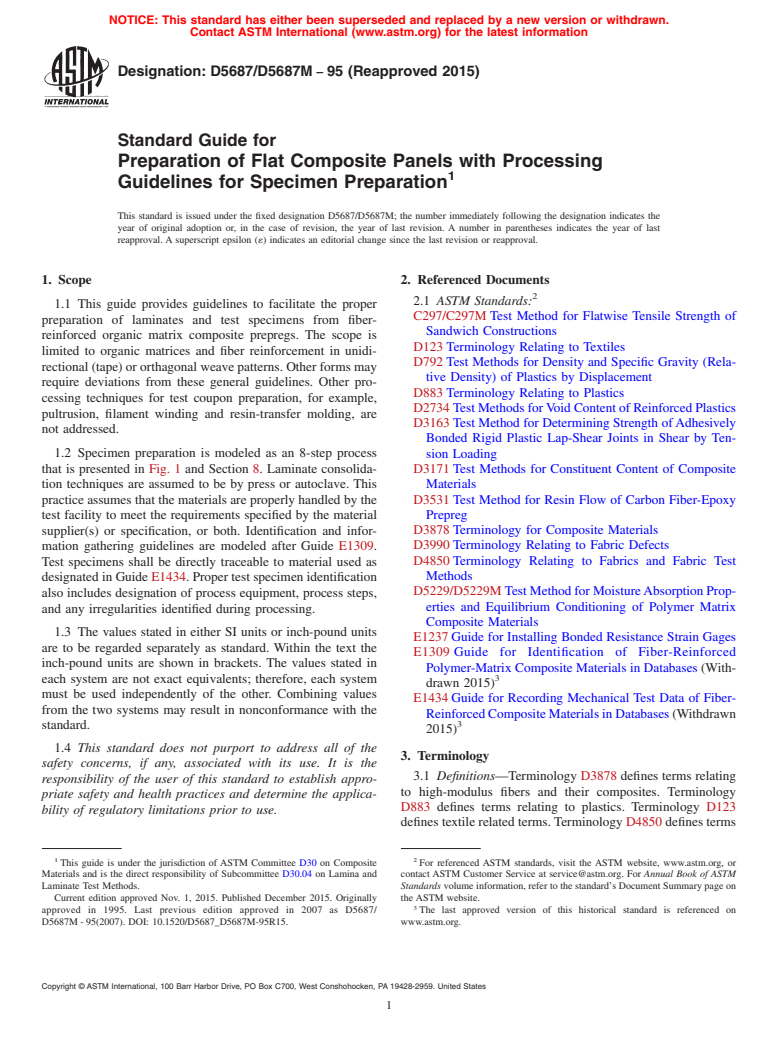
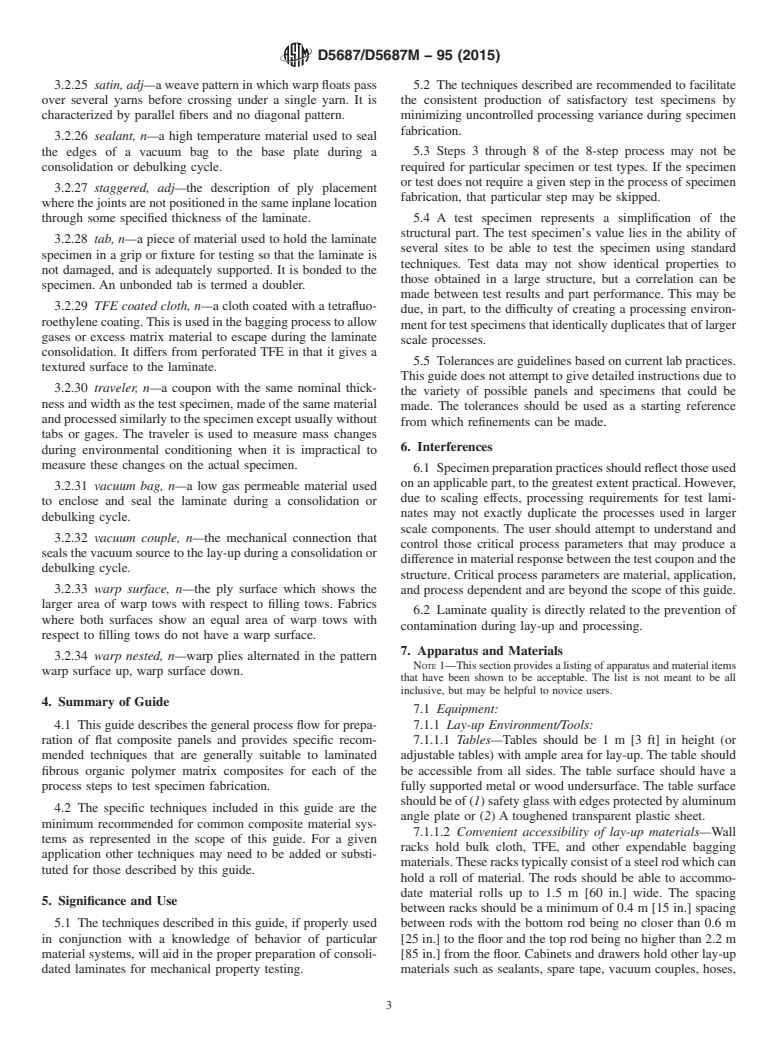
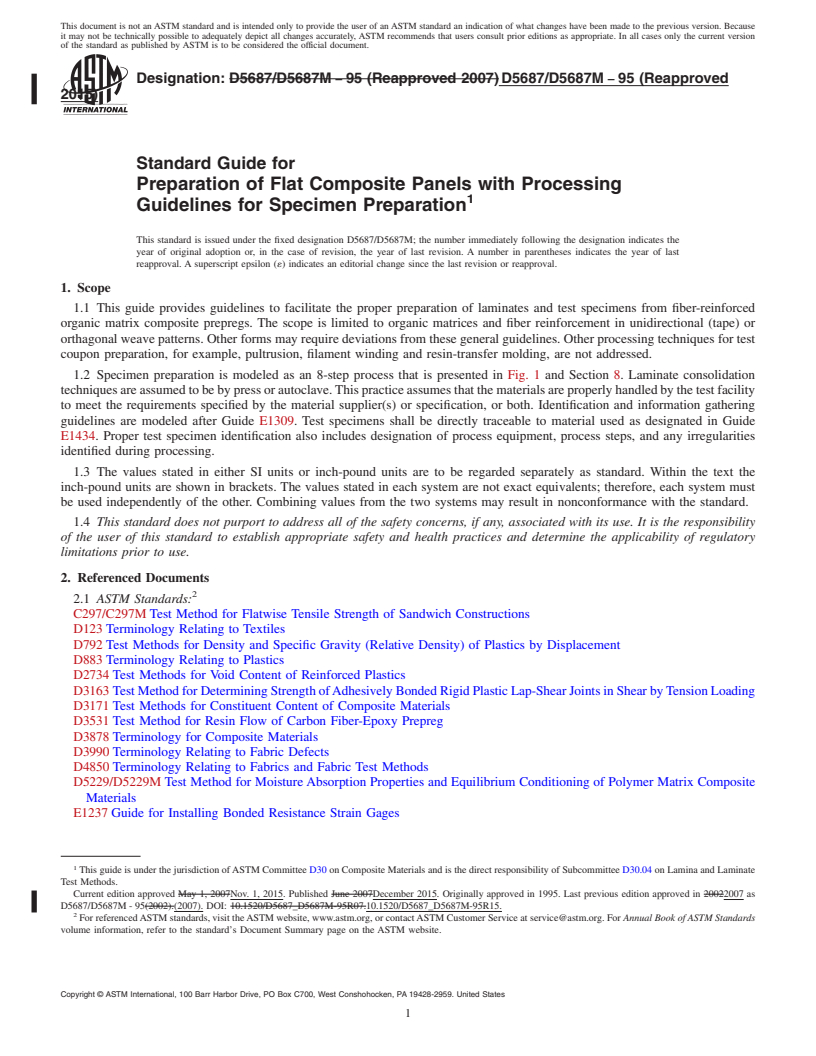
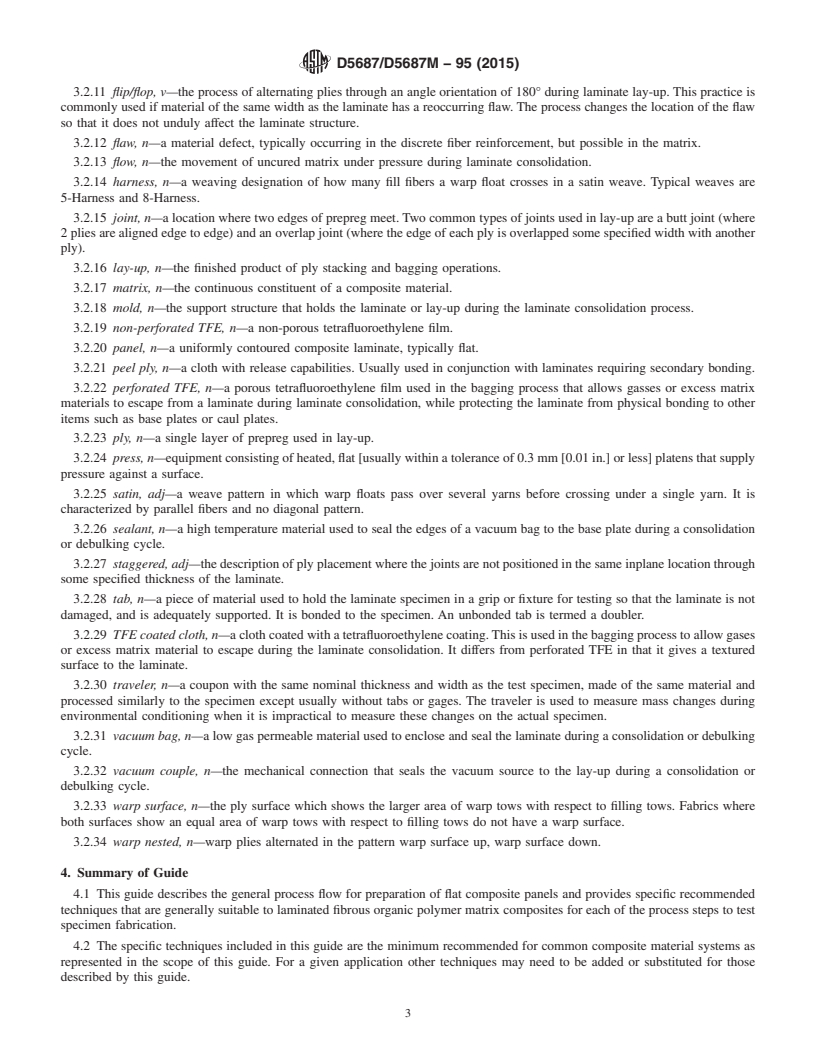
1.2 Specimen preparation is modeled as an 8-step process that is presented in Fig. 1 and Section 8. Laminate consolidation techniques are assumed to be by press or autoclave. This practice assumes that the materials are properly handled by the test facility to meet the requirements specified by the material supplier(s) or specification, or both. Identification and information gathering guidelines are modeled after Guide E1309. Test specimens shall be directly traceable to material used as designated in Guide E1434. Proper test specimen identification also includes designation of process equipment, process steps, and any irregularities identified during processing. Steps 6, 7 and 8 may be interchanged.
1.3 The values stated in either SI units or inch-pound units are to be regarded separately as standard. Within the text the inch-pound units are shown in brackets. The values stated in each system are not exact equivalents; therefore, each system must be used independently of the other. Combining values from the two systems may result in nonconformance with the standard.
1.4 This standard does not purport to address all of the safety concerns, if any, associated with its use. It is the responsibility of the user of this standard to establish appropriate safety and health practices and determine the applicability of regulatory limitations prior to use.
General Information
Buy Standard
Standards Content (Sample)
NOTICE: This standard has either been superseded and replaced by a new version or withdrawn.
Contact ASTM International (www.astm.org) for the latest information
Designation: D5687/D5687M − 95 (Reapproved 2015)
Standard Guide for
Preparation of Flat Composite Panels with Processing
Guidelines for Specimen Preparation
This standard is issued under the fixed designation D5687/D5687M; the number immediately following the designation indicates the
year of original adoption or, in the case of revision, the year of last revision. A number in parentheses indicates the year of last
reapproval. A superscript epsilon (´) indicates an editorial change since the last revision or reapproval.
1. Scope 2. Referenced Documents
2.1 ASTM Standards:
1.1 This guide provides guidelines to facilitate the proper
C297/C297MTest Method for Flatwise Tensile Strength of
preparation of laminates and test specimens from fiber-
Sandwich Constructions
reinforced organic matrix composite prepregs. The scope is
D123Terminology Relating to Textiles
limited to organic matrices and fiber reinforcement in unidi-
D792Test Methods for Density and Specific Gravity (Rela-
rectional(tape)ororthagonalweavepatterns.Otherformsmay
tive Density) of Plastics by Displacement
require deviations from these general guidelines. Other pro-
D883Terminology Relating to Plastics
cessing techniques for test coupon preparation, for example,
D2734TestMethodsforVoidContentofReinforcedPlastics
pultrusion, filament winding and resin-transfer molding, are
D3163Test Method for Determining Strength ofAdhesively
not addressed.
Bonded Rigid Plastic Lap-Shear Joints in Shear by Ten-
1.2 Specimen preparation is modeled as an 8-step process sion Loading
that is presented in Fig. 1 and Section 8. Laminate consolida-
D3171Test Methods for Constituent Content of Composite
tion techniques are assumed to be by press or autoclave. This Materials
practiceassumesthatthematerialsareproperlyhandledbythe D3531Test Method for Resin Flow of Carbon Fiber-Epoxy
test facility to meet the requirements specified by the material Prepreg
supplier(s) or specification, or both. Identification and infor- D3878Terminology for Composite Materials
D3990Terminology Relating to Fabric Defects
mation gathering guidelines are modeled after Guide E1309.
Test specimens shall be directly traceable to material used as D4850Terminology Relating to Fabrics and Fabric Test
Methods
designatedinGuideE1434.Propertestspecimenidentification
D5229/D5229MTestMethodforMoistureAbsorptionProp-
also includes designation of process equipment, process steps,
erties and Equilibrium Conditioning of Polymer Matrix
and any irregularities identified during processing.
Composite Materials
1.3 The values stated in either SI units or inch-pound units
E1237Guide for Installing Bonded Resistance Strain Gages
are to be regarded separately as standard. Within the text the
E1309 Guide for Identification of Fiber-Reinforced
inch-pound units are shown in brackets. The values stated in
Polymer-Matrix Composite Materials in Databases (With-
each system are not exact equivalents; therefore, each system
drawn 2015)
must be used independently of the other. Combining values
E1434Guide for Recording Mechanical Test Data of Fiber-
from the two systems may result in nonconformance with the
ReinforcedCompositeMaterialsinDatabases(Withdrawn
standard.
2015)
1.4 This standard does not purport to address all of the
3. Terminology
safety concerns, if any, associated with its use. It is the
3.1 Definitions—Terminology D3878 defines terms relating
responsibility of the user of this standard to establish appro-
to high-modulus fibers and their composites. Terminology
priate safety and health practices and determine the applica-
D883 defines terms relating to plastics. Terminology D123
bility of regulatory limitations prior to use.
definestextilerelatedterms.TerminologyD4850definesterms
1 2
This guide is under the jurisdiction of ASTM Committee D30 on Composite For referenced ASTM standards, visit the ASTM website, www.astm.org, or
Materials and is the direct responsibility of Subcommittee D30.04 on Lamina and contact ASTM Customer Service at service@astm.org. For Annual Book of ASTM
Laminate Test Methods. Standards volume information, refer to the standard’s Document Summary page on
Current edition approved Nov. 1, 2015. Published December 2015. Originally the ASTM website.
approved in 1995. Last previous edition approved in 2007 as D5687/ The last approved version of this historical standard is referenced on
D5687M-95(2007). DOI: 10.1520/D5687_D5687M-95R15. www.astm.org.
Copyright © ASTM International, 100 Barr Harbor Drive, PO Box C700, West Conshohocken, PA 19428-2959. United States
D5687/D5687M − 95 (2015)
3.2.7 debulk, v—process of decreasing voids between
laminabeforelaminateconsolidationthroughuseofvacuumor
by mechanical means. Laminae can be debulked at ambient or
elevated temperatures.
3.2.8 doubler, n—anunbondedtabusedtoholdthelaminate
specimen in a grip or fixture. See tab.
3.2.9 fiber washing, n—the tendency of fibers to change
orientationduetoresinflowfromtheoriginallay-updirection.
Fiber washing may occur during the laminate consolidation
process mainly at the sides of a laminate.
3.2.10 fill, n—(1) Fiber inserted by the shuttle during
weaving also designated as filling. See Terminology D123.(2)
The direction of fiber running perpendicular to the warp fibers.
3.2.11 flip/flop, v—the process of alternating plies through
an angle orientation of 180° during laminate lay-up. This
practice is commonly used if material of the same width as the
laminate has a reoccurring flaw. The process changes the
location of the flaw so that it does not unduly affect the
NOTE 1—Material identification is mandatory. Continuous traceability laminate structure.
of specimens is required throughout the process.
3.2.12 flaw, n—a material defect, typically occurring in the
Process checks (Appendix X4) may be done at the end of each step to
discrete fiber reinforcement, but possible in the matrix.
verify that the step was performed to give a laminate or specimen of
satisfactory quality.
3.2.13 flow, n—the movement of uncured matrix under
Steps 4 and 5 may be interchanged. For aramid fibers, step 5 routinely
pressure during laminate consolidation.
precedes step 4.
Steps 6, 7 and 8 may be interchanged.
3.2.14 harness, n—a weaving designation of how many fill
FIG. 1 8 Step Mechanical Test Data Model
fibersawarpfloatcrossesinasatinweave.Typicalweavesare
5-Harness and 8-Harness.
3.2.15 joint, n—alocationwheretwoedgesofprepregmeet.
relating to fabric. In the event of a conflict between terms,
Two common types of joints used in lay-up are a butt joint
Terminology D3878 shall have precedence over the other
(where 2 plies are aligned edge to edge) and an overlap joint
standards.
(wheretheedgeofeachplyisoverlappedsomespecifiedwidth
3.2 Description of Trems Used in This Standard—Theterms
with another ply).
usedinthisguidemayconflictwithgeneralusage.Thereisnot
3.2.16 lay-up, n—the finished product of ply stacking and
yetanestablishedconsensusconcerningtheuseoftheseterms.
bagging operations.
The following descriptions are intended only for use in this
3.2.17 matrix, n—the continuous constituent of a composite
guide.
material.
3.2.1 bag, v—the process of enclosing the ply layers within
a flexible container. See lay-up.
3.2.18 mold,n—thesupportstructurethatholdsthelaminate
3.2.2 base plate, n—a flat plate on which a laminate is laid or lay-up during the laminate consolidation process.
up [usually made of aluminum and 6 mm [0.25 in.] or thicker
3.2.19 non-perforated TFE, n—a non-porous tetrafluoroeth-
with a flatness requirement of 0.05 mm [0.002 in.] or less].
ylene film.
3.2.3 breather string, n—a glass string connected from the
3.2.20 panel, n—auniformlycontouredcompositelaminate,
laminate to a breather in the autoclave bag. It is used as a
typically flat.
degassing aid; providing a path for gasses to be transferred
3.2.21 peel ply, n—a cloth with release capabilities. Usually
from the laminate.
used in conjunction with laminates requiring secondary bond-
3.2.4 caul plate, n—aflatplateusedtoprovideaflatsurface
ing.
to the top of the laminate during laminate consolidation
3.2.22 perforated TFE, n—aporoustetrafluoroethylenefilm
[usually made of aluminum and 3 mm [0.125 in.] thick or
usedinthebaggingprocessthatallowsgassesorexcessmatrix
thicker with a flatness requirement of 0.05 mm [0.002 in.] or
materials to escape from a laminate during laminate
less].
consolidation, while protecting the laminate from physical
3.2.5 cloth, n—a piece of textile fabric containing woven
bonding to other items such as base plates or caul plates.
reinforcement without a load transferring matrix.
3.2.23 ply, n—a single layer of prepreg used in lay-up.
3.2.6 dam, n—asolidmaterial(suchassiliconerubber,steel
or aluminum) used in the autoclave bag to contain the matrix 3.2.24 press, n—equipment consisting of heated, flat [usu-
material within defined boundaries during laminate consolida- allywithinatoleranceof0.3mm[0.01in.]orless]platensthat
tion. supply pressure against a surface.
D5687/D5687M − 95 (2015)
3.2.25 satin, adj—aweavepatterninwhichwarpfloatspass 5.2 The techniques described are recommended to facilitate
over several yarns before crossing under a single yarn. It is the consistent production of satisfactory test specimens by
characterized by parallel fibers and no diagonal pattern. minimizing uncontrolled processing variance during specimen
fabrication.
3.2.26 sealant, n—a high temperature material used to seal
5.3 Steps 3 through 8 of the 8-step process may not be
the edges of a vacuum bag to the base plate during a
consolidation or debulking cycle. required for particular specimen or test types. If the specimen
or test does not require a given step in the process of specimen
3.2.27 staggered, adj—the description of ply placement
fabrication, that particular step may be skipped.
wherethejointsarenotpositionedinthesameinplanelocation
5.4 A test specimen represents a simplification of the
through some specified thickness of the laminate.
structural part. The test specimen’s value lies in the ability of
3.2.28 tab, n—a piece of material used to hold the laminate
several sites to be able to test the specimen using standard
specimen in a grip or fixture for testing so that the laminate is
techniques. Test data may not show identical properties to
not damaged, and is adequately supported. It is bonded to the
those obtained in a large structure, but a correlation can be
specimen. An unbonded tab is termed a doubler.
made between test results and part performance. This may be
3.2.29 TFE coated cloth, n—a cloth coated with a tetrafluo-
due, in part, to the difficulty of creating a processing environ-
roethylenecoating.Thisisusedinthebaggingprocesstoallow
mentfortestspecimensthatidenticallyduplicatesthatoflarger
gases or excess matrix material to escape during the laminate
scale processes.
consolidation. It differs from perforated TFE in that it gives a
5.5 Tolerancesareguidelinesbasedoncurrentlabpractices.
textured surface to the laminate.
Thisguidedoesnotattempttogivedetailedinstructionsdueto
3.2.30 traveler, n—a coupon with the same nominal thick-
the variety of possible panels and specimens that could be
nessandwidthasthetestspecimen,madeofthesamematerial
made. The tolerances should be used as a starting reference
andprocessedsimilarlytothespecimenexceptusuallywithout
from which refinements can be made.
tabs or gages. The traveler is used to measure mass changes
6. Interferences
during environmental conditioning when it is impractical to
measure these changes on the actual specimen.
6.1 Specimenpreparationpracticesshouldreflectthoseused
onanapplicablepart,tothegreatestextentpractical.However,
3.2.31 vacuum bag, n—a low gas permeable material used
due to scaling effects, processing requirements for test lami-
to enclose and seal the laminate during a consolidation or
nates may not exactly duplicate the processes used in larger
debulking cycle.
scale components. The user should attempt to understand and
3.2.32 vacuum couple, n—the mechanical connection that
control those critical process parameters that may produce a
sealsthevacuumsourcetothelay-upduringaconsolidationor
differenceinmaterialresponsebetweenthetestcouponandthe
debulking cycle.
structure. Critical process parameters are material, application,
3.2.33 warp surface, n—the ply surface which shows the and process dependent and are beyond the scope of this guide.
larger area of warp tows with respect to filling tows. Fabrics
6.2 Laminate quality is directly related to the prevention of
where both surfaces show an equal area of warp tows with
contamination during lay-up and processing.
respect to filling tows do not have a warp surface.
7. Apparatus and Materials
3.2.34 warp nested, n—warp plies alternated in the pattern
NOTE1—Thissectionprovidesalistingofapparatusandmaterialitems
warp surface up, warp surface down.
that have been shown to be acceptable. The list is not meant to be all
inclusive, but may be helpful to novice users.
4. Summary of Guide
7.1 Equipment:
4.1 This guide describes the general process flow for prepa- 7.1.1 Lay-up Environment/Tools:
ration of flat composite panels and provides specific recom- 7.1.1.1 Tables—Tables should be1m[3ft]in height (or
mended techniques that are generally suitable to laminated adjustable tables) with ample area for lay-up.The table should
fibrous organic polymer matrix composites for each of the be accessible from all sides. The table surface should have a
fully supported metal or wood undersurface. The table surface
process steps to test specimen fabrication.
shouldbeof(1)safetyglasswithedgesprotectedbyaluminum
4.2 The specific techniques included in this guide are the
angle plate or (2) A toughened transparent plastic sheet.
minimum recommended for common composite material sys-
7.1.1.2 Convenient accessibility of lay-up materials—Wall
tems as represented in the scope of this guide. For a given
racks hold bulk cloth, TFE, and other expendable bagging
application other techniques may need to be added or substi-
materials.Theserackstypicallyconsistofasteelrodwhichcan
tuted for those described by this guide.
hold a roll of material. The rods should be able to accommo-
date material rolls up to 1.5 m [60 in.] wide. The spacing
5. Significance and Use
between racks should be a minimum of 0.4 m [15 in.] spacing
5.1 The techniques described in this guide, if properly used between rods with the bottom rod being no closer than 0.6 m
in conjunction with a knowledge of behavior of particular [25 in.] to the floor and the top rod being no higher than 2.2 m
material systems, will aid in the proper preparation of consoli- [85 in.] from the floor. Cabinets and drawers hold other lay-up
dated laminates for mechanical property testing. materials such as sealants,
...
This document is not an ASTM standard and is intended only to provide the user of an ASTM standard an indication of what changes have been made to the previous version. Because
it may not be technically possible to adequately depict all changes accurately, ASTM recommends that users consult prior editions as appropriate. In all cases only the current version
of the standard as published by ASTM is to be considered the official document.
Designation: D5687/D5687M − 95 (Reapproved 2007) D5687/D5687M − 95 (Reapproved
2015)
Standard Guide for
Preparation of Flat Composite Panels with Processing
Guidelines for Specimen Preparation
This standard is issued under the fixed designation D5687/D5687M; the number immediately following the designation indicates the
year of original adoption or, in the case of revision, the year of last revision. A number in parentheses indicates the year of last
reapproval. A superscript epsilon (´) indicates an editorial change since the last revision or reapproval.
1. Scope
1.1 This guide provides guidelines to facilitate the proper preparation of laminates and test specimens from fiber-reinforced
organic matrix composite prepregs. The scope is limited to organic matrices and fiber reinforcement in unidirectional (tape) or
orthagonal weave patterns. Other forms may require deviations from these general guidelines. Other processing techniques for test
coupon preparation, for example, pultrusion, filament winding and resin-transfer molding, are not addressed.
1.2 Specimen preparation is modeled as an 8-step process that is presented in Fig. 1 and Section 8. Laminate consolidation
techniques are assumed to be by press or autoclave. This practice assumes that the materials are properly handled by the test facility
to meet the requirements specified by the material supplier(s) or specification, or both. Identification and information gathering
guidelines are modeled after Guide E1309. Test specimens shall be directly traceable to material used as designated in Guide
E1434. Proper test specimen identification also includes designation of process equipment, process steps, and any irregularities
identified during processing.
1.3 The values stated in either SI units or inch-pound units are to be regarded separately as standard. Within the text the
inch-pound units are shown in brackets. The values stated in each system are not exact equivalents; therefore, each system must
be used independently of the other. Combining values from the two systems may result in nonconformance with the standard.
1.4 This standard does not purport to address all of the safety concerns, if any, associated with its use. It is the responsibility
of the user of this standard to establish appropriate safety and health practices and determine the applicability of regulatory
limitations prior to use.
2. Referenced Documents
2.1 ASTM Standards:
C297/C297M Test Method for Flatwise Tensile Strength of Sandwich Constructions
D123 Terminology Relating to Textiles
D792 Test Methods for Density and Specific Gravity (Relative Density) of Plastics by Displacement
D883 Terminology Relating to Plastics
D2734 Test Methods for Void Content of Reinforced Plastics
D3163 Test Method for Determining Strength of Adhesively Bonded Rigid Plastic Lap-Shear Joints in Shear by Tension Loading
D3171 Test Methods for Constituent Content of Composite Materials
D3531 Test Method for Resin Flow of Carbon Fiber-Epoxy Prepreg
D3878 Terminology for Composite Materials
D3990 Terminology Relating to Fabric Defects
D4850 Terminology Relating to Fabrics and Fabric Test Methods
D5229/D5229M Test Method for Moisture Absorption Properties and Equilibrium Conditioning of Polymer Matrix Composite
Materials
E1237 Guide for Installing Bonded Resistance Strain Gages
This guide is under the jurisdiction of ASTM Committee D30 on Composite Materials and is the direct responsibility of Subcommittee D30.04 on Lamina and Laminate
Test Methods.
Current edition approved May 1, 2007Nov. 1, 2015. Published June 2007December 2015. Originally approved in 1995. Last previous edition approved in 20022007 as
D5687/D5687M - 95(2002).(2007). DOI: 10.1520/D5687_D5687M-95R07.10.1520/D5687_D5687M-95R15.
For referenced ASTM standards, visit the ASTM website, www.astm.org, or contact ASTM Customer Service at service@astm.org. For Annual Book of ASTM Standards
volume information, refer to the standard’s Document Summary page on the ASTM website.
Copyright © ASTM International, 100 Barr Harbor Drive, PO Box C700, West Conshohocken, PA 19428-2959. United States
D5687/D5687M − 95 (2015)
NOTE 1—Material identification is mandatory. Continuous traceability of specimens is required throughout the process.
Process checks (Appendix X4) may be done at the end of each step to verify that the step was performed to give a laminate or specimen of satisfactory
quality.
Steps 4 and 5 may be interchanged. For aramid fibers, step 5 routinely precedes step 4.
Steps 6, 7 and 8 may be interchanged.
FIG. 1 8 Step Mechanical Test Data Model
E1309 Guide for Identification of Fiber-Reinforced Polymer-Matrix Composite Materials in Databases (Withdrawn 2015)
E1434 Guide for Recording Mechanical Test Data of Fiber-Reinforced Composite Materials in Databases (Withdrawn 2015)
3. Terminology
3.1 Definitions—Terminology D3878 defines terms relating to high-modulus fibers and their composites. Terminology D883
defines terms relating to plastics. Terminology D123 defines textile related terms. Terminology D4850 defines terms relating to
fabric. In the event of a conflict between terms, Terminology D3878 shall have precedence over the other standards.
3.2 Description of Trems Used in This Standard—The terms used in this guide may conflict with general usage. There is not
yet an established consensus concerning the use of these terms. The following descriptions are intended only for use in this guide.
3.2.1 bag, v—the process of enclosing the ply layers within a flexible container. See lay-up.
3.2.2 base plate, n—a flat plate on which a laminate is laid up [usually made of aluminum and 6 mm [0.25 in.] or thicker with
a flatness requirement of 0.05 mm [0.002 in.] or less].
3.2.3 breather string, n—a glass string connected from the laminate to a breather in the autoclave bag. It is used as a degassing
aid; providing a path for gasses to be transferred from the laminate.
3.2.4 caul plate, n—a flat plate used to provide a flat surface to the top of the laminate during laminate consolidation [usually
made of aluminum and 3 mm [0.125 in.] thick or thicker with a flatness requirement of 0.05 mm [0.002 in.] or less].
3.2.5 cloth, n—a piece of textile fabric containing woven reinforcement without a load transferring matrix.
3.2.6 dam, n—a solid material (such as silicone rubber, steel or aluminum) used in the autoclave bag to contain the matrix
material within defined boundaries during laminate consolidation.
3.2.7 debulk, v—process of decreasing voids between lamina before laminate consolidation through use of vacuum or by
mechanical means. Laminae can be debulked at ambient or elevated temperatures.
3.2.8 doubler, n—an unbonded tab used to hold the laminate specimen in a grip or fixture. See tab.
3.2.9 fiber washing, n—the tendency of fibers to change orientation due to resin flow from the original lay-up direction. Fiber
washing may occur during the laminate consolidation process mainly at the sides of a laminate.
3.2.10 fill, n—(1) Fiber inserted by the shuttle during weaving also designated as filling. See Terminology D123. (2) The
direction of fiber running perpendicular to the warp fibers.
The last approved version of this historical standard is referenced on www.astm.org.
D5687/D5687M − 95 (2015)
3.2.11 flip/flop, v—the process of alternating plies through an angle orientation of 180° during laminate lay-up. This practice is
commonly used if material of the same width as the laminate has a reoccurring flaw. The process changes the location of the flaw
so that it does not unduly affect the laminate structure.
3.2.12 flaw, n—a material defect, typically occurring in the discrete fiber reinforcement, but possible in the matrix.
3.2.13 flow, n—the movement of uncured matrix under pressure during laminate consolidation.
3.2.14 harness, n—a weaving designation of how many fill fibers a warp float crosses in a satin weave. Typical weaves are
5-Harness and 8-Harness.
3.2.15 joint, n—a location where two edges of prepreg meet. Two common types of joints used in lay-up are a butt joint (where
2 plies are aligned edge to edge) and an overlap joint (where the edge of each ply is overlapped some specified width with another
ply).
3.2.16 lay-up, n—the finished product of ply stacking and bagging operations.
3.2.17 matrix, n—the continuous constituent of a composite material.
3.2.18 mold, n—the support structure that holds the laminate or lay-up during the laminate consolidation process.
3.2.19 non-perforated TFE, n—a non-porous tetrafluoroethylene film.
3.2.20 panel, n—a uniformly contoured composite laminate, typically flat.
3.2.21 peel ply, n—a cloth with release capabilities. Usually used in conjunction with laminates requiring secondary bonding.
3.2.22 perforated TFE, n—a porous tetrafluoroethylene film used in the bagging process that allows gasses or excess matrix
materials to escape from a laminate during laminate consolidation, while protecting the laminate from physical bonding to other
items such as base plates or caul plates.
3.2.23 ply, n—a single layer of prepreg used in lay-up.
3.2.24 press, n—equipment consisting of heated, flat [usually within a tolerance of 0.3 mm [0.01 in.] or less] platens that supply
pressure against a surface.
3.2.25 satin, adj—a weave pattern in which warp floats pass over several yarns before crossing under a single yarn. It is
characterized by parallel fibers and no diagonal pattern.
3.2.26 sealant, n—a high temperature material used to seal the edges of a vacuum bag to the base plate during a consolidation
or debulking cycle.
3.2.27 staggered, adj—the description of ply placement where the joints are not positioned in the same inplane location through
some specified thickness of the laminate.
3.2.28 tab, n—a piece of material used to hold the laminate specimen in a grip or fixture for testing so that the laminate is not
damaged, and is adequately supported. It is bonded to the specimen. An unbonded tab is termed a doubler.
3.2.29 TFE coated cloth, n—a cloth coated with a tetrafluoroethylene coating. This is used in the bagging process to allow gases
or excess matrix material to escape during the laminate consolidation. It differs from perforated TFE in that it gives a textured
surface to the laminate.
3.2.30 traveler, n—a coupon with the same nominal thickness and width as the test specimen, made of the same material and
processed similarly to the specimen except usually without tabs or gages. The traveler is used to measure mass changes during
environmental conditioning when it is impractical to measure these changes on the actual specimen.
3.2.31 vacuum bag, n—a low gas permeable material used to enclose and seal the laminate during a consolidation or debulking
cycle.
3.2.32 vacuum couple, n—the mechanical connection that seals the vacuum source to the lay-up during a consolidation or
debulking cycle.
3.2.33 warp surface, n—the ply surface which shows the larger area of warp tows with respect to filling tows. Fabrics where
both surfaces show an equal area of warp tows with respect to filling tows do not have a warp surface.
3.2.34 warp nested, n—warp plies alternated in the pattern warp surface up, warp surface down.
4. Summary of Guide
4.1 This guide describes the general process flow for preparation of flat composite panels and provides specific recommended
techniques that are generally suitable to laminated fibrous organic polymer matrix composites for each of the process steps to test
specimen fabrication.
4.2 The specific techniques included in this guide are the minimum recommended for common composite material systems as
represented in the scope of this guide. For a given application other techniques may need to be added or substituted for those
described by this guide.
D5687/D5687M − 95 (2015)
5. Significance and Use
5.1 The techniques described in this guide, if properly used in conjunction with a knowledge of behavior of particular material
systems, will aid in the proper preparation of consolidated laminates for mechanical property testing.
5.2 The techniques described are recommended to facilitate the consistent production of satisfactory test specimens by
minimizing uncontrolled processing variance during specimen fabrication.
5.3 Steps 3 through 8 of the 8-step process may not be required for particular specimen or test types. If the specimen or test
does not require a given step in the process of specimen fabrication, that particular step may be skipped.
5.4 A test specimen represents a simplification of the structural part. The test specimen’s value lies in the ability of several sites
to be able to test the specimen using standard techniques. Test data may not show identical properties to those obtained in a large
structure, but a correlation can be made between test results and part performance. This may be due, in part, to the difficulty of
creating a processing environment for test specimens that identically duplicates that of larger scale processes.
5.5 Tolerances are guidelines based on current lab practices. This guide does not attempt to give detailed instructions due to the
variety of possible panels and specimens that could be made. The tolerances should be used as a starting reference from which
refinements can be made.
6. Interferences
6.1 Specimen preparation practices should reflect those used on an applicable part, to the greatest extent practical. However, due
to scaling effects, processing requirements for test laminates may not exactly duplicate the processes used in larger scale
components. The user should attempt to understand and control those critical process parameters that may produce a difference in
material response between the test coupon and the structure. Critical process parameters are material, application, and process
dependent and are beyond the scope of this guide.
6.2 Laminate quality is directly related to the prevention of contamination during lay-up and processing.
7. Apparatus and Materials
NOTE 1—This section provides a listing of apparatus and material items that have been shown to be acceptable. The list is not meant to be all inclusive,
but may be helpful to novice users.
7.1 Equipment:
7.1.1 Lay-up Environment/Tools:
7.1.1.1 Tables—Tables should be 1 m [3 ft] in height (or adjustable tables) with ample area for lay-up. The table should be
accessible from all sides. The table surface should have a fully supported m
...
Questions, Comments and Discussion
Ask us and Technical Secretary will try to provide an answer. You can facilitate discussion about the standard in here.