

ASTM B108/B108M-19
(Specification)Standard Specification for Aluminum-Alloy Permanent Mold Castings
General Information
- Abstract
ABSTRACT
This specification covers aluminum-alloy permanent mold castings. The responsibility of furnishing castings that can be laid out and machined to the finished dimensions within the permissible variations specified shall rest with the producer, except where mold equipment is furnished by the purchaser. Samples for chemical analysis shall be taken by sawing, drilling, or milling the casting or test specimens in such a manner as to be representative of the material. Unless otherwise specified, only aluminum or producers foundry scrap shall be used in the re-melting furnace from which molten metal is taken for pouring directly into castings. Pure materials, recycled materials, and master alloys may be used to make alloys conforming to this specification. Foundry control shall consist of examination of castings by radiographic or other approved methods for determining internal discontinuities until the gating, pouring, and other foundry practices have been established to produce castings meeting the quality standards furnished by the purchaser or agreed upon by the purchaser and the producer. Separately cast test specimens shall be cast in iron molds. If the castings are to be heat treated and separately cast specimens are to be used, the specimens representing such castings shall be heat treated with the castings they represent. If castings are to be heat treated and tests are to be obtained on the castings, the test specimens shall be taken from the castings after heat treatment. One per melt-heat combination shall be tested when tensile properties of castings are to be determined. The finished castings shall be uniform in composition and free of blowholes, cracks, shrinks, and other discontinuities.
SCOPE
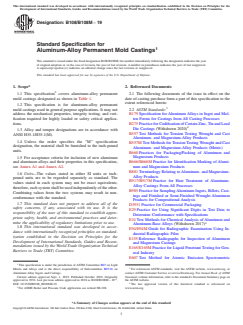
1.1 This specification2 covers aluminum-alloy permanent mold castings designated as shown in Table 1.
1.2 This specification is for aluminum-alloy permanent mold castings used in general purpose applications. It may not address the mechanical properties, integrity testing, and verification required for highly loaded or safety critical applications.
1.3 Alloy and temper designations are in accordance with ANSI H35.1/H35.1(M).
1.4 Unless the order specifies the “M” specification designation, the material shall be furnished to the inch-pound units.
1.5 For acceptance criteria for inclusion of new aluminum and aluminum alloys and their properties in this specification, see Annex A1 and Annex A2.
1.6 Units—The values stated in either SI units or inch-pound units are to be regarded separately as standard. The values stated in each system may not be exact equivalents; therefore, each system shall be used independently of the other. Combining values from the two systems may result in non-conformance with the standard.
1.7 This standard does not purport to address all of the safety concerns, if any, associated with its use. It is the responsibility of the user of this standard to establish appropriate safety, health, and environmental practices and determine the applicability of regulatory limitations prior to use.
1.8 This international standard was developed in accordance with internationally recognized principles on standardization established in the Decision on Principles for the Development of International Standards, Guides and Recommendations issued by the World Trade Organization Technical Barriers to Trade (TBT) Committee.
- Status
- Published
- Publication Date
- 31-Aug-2019
- Technical Committee
- B07 - Light Metals and Alloys
- Drafting Committee
- B07.01 - Aluminum Alloy Ingots and Castings
Buy Documents
ASTM B108/B108M-19 - Standard Specification for Aluminum-Alloy Permanent Mold Castings
REDLINE ASTM B108/B108M-19 - Standard Specification for Aluminum-Alloy Permanent Mold Castings
Overview
ASTM B108/B108M-19 is the Standard Specification for Aluminum-Alloy Permanent Mold Castings developed by ASTM International. This standard provides comprehensive requirements for aluminum-alloy castings produced using the permanent mold casting process and is widely recognized in industries where consistency, material quality, and machining precision are essential. The specification applies to general purpose applications, covering chemical composition, quality assurance, testing, inspection, and repair processes for a variety of aluminum-alloy types and tempers.
ASTM B108/B108M supports both inch-pound and SI units, ensuring flexibility and international applicability. Adherence to this standard helps manufacturers and purchasers ensure that aluminum alloy castings meet agreed-upon quality benchmarks and regulatory requirements.
Key Topics
Scope and Applicability
- Specifies requirements for aluminum-alloy castings produced by the permanent mold method.
- Applies to general purpose aluminum castings, but may not address requirements for safety-critical or highly loaded components.
Alloy and Temper Designation
- Follows ANSI H35.1/H35.1(M) designations for alloys and tempers.
- Chemical composition limits for a wide range of alloys are clearly defined.
Ordering Requirements
- Orders must specify the standard designation, alloy, temper, applicable drawings, part numbers, and quantities.
- Additional requirements (e.g., foundry control, heat treatment, inspection method, certification) can be specified by the purchaser.
Quality Assurance and Testing
- Includes procedures for tension testing, chemical analysis, and acceptance criteria.
- Provides guidance for sampling methods, frequency, and compliance evaluation.
Foundry Controls and Inspection
- Outlines foundry controls such as radiographic, liquid penetrant, and visual inspections for internal/external defects.
- Inspection criteria and acceptance standards are established by agreement between purchaser and producer.
Repairs and Marking
- Permits repair processes (welding, impregnation, peening, blending) under controlled and agreed conditions.
- Sets requirements for identification and repair marking to trace repairs and modifications.
Applications
The ASTM B108/B108M-19 standard is fundamental in many industries utilizing aluminum-alloy permanent mold castings, particularly where reliability, machinability, and consistency are critical. Key application areas include:
- Automotive: Engine components, transmission parts, and structural subassemblies where uniformity and mechanical performance are required.
- Aerospace: Housing, brackets, and supporting structures benefiting from the high strength-to-weight ratio of aluminum alloys.
- Marine: Components exposed to corrosive environments, leveraging aluminum's natural resistance to corrosion.
- Industrial Equipment: Machinery parts, pump housings, and fittings where dimension control and repeatability are vital.
- Defense and Government Projects: Applications that require documentation, traceability, and adherence to strict quality standards.
By providing clear requirements on chemical composition, mechanical properties, casting quality, and inspection methods, this standard ensures that castings match both general and special-purpose needs, supporting product quality and reducing process variability.
Related Standards
The following standards are frequently referenced or used in conjunction with ASTM B108/B108M-19:
- ASTM B179 – Specification for Aluminum Alloys in Ingot and Molten Forms for Castings from All Processes
- ASTM B557/B557M – Test Methods for Tension Testing Wrought and Cast Aluminum- and Magnesium-Alloy Products
- ASTM B917/B917M – Practice for Heat Treatment of Aluminum-Alloy Castings
- ASTM B985 – Practice for Sampling Aluminum Ingots, Billets, Castings and Finished or Semi-Finished Aluminum Products for Compositional Analysis
- ASTM E94/E94M – Guide for Radiographic Examination Using Industrial Radiographic Film
- ASTM E165/E165M – Practice for Liquid Penetrant Testing for General Industry
- ANSI H35.1/H35.1(M) – Alloy and Temper Designation Systems for Aluminum
Using ASTM B108/B108M-19 in tandem with these related standards helps bolster quality assurance, traceability, and regulatory compliance for aluminum-alloy permanent mold castings in demanding industrial environments.
Relations
- Effective Date
- 01-Nov-2023
- Effective Date
- 01-Oct-2023
- Effective Date
- 15-May-2018
- Effective Date
- 01-May-2018
- Effective Date
- 01-Nov-2017
- Effective Date
- 01-Oct-2017
- Effective Date
- 01-Oct-2017
- Effective Date
- 15-Sep-2017
- Effective Date
- 01-Nov-2016
- Effective Date
- 01-Dec-2015
- Effective Date
- 01-Oct-2014
- Effective Date
- 01-Oct-2014
- Effective Date
- 15-May-2014
- Effective Date
- 15-May-2014
- Effective Date
- 01-Dec-2013
Buy Documents
ASTM B108/B108M-19 - Standard Specification for Aluminum-Alloy Permanent Mold Castings
REDLINE ASTM B108/B108M-19 - Standard Specification for Aluminum-Alloy Permanent Mold Castings
Get Certified
Connect with accredited certification bodies for this standard

Element Materials Technology
Materials testing and product certification.

Inštitut za kovinske materiale in tehnologije
Institute of Metals and Technology. Materials testing, metallurgical analysis, NDT.
Sponsored listings
Frequently Asked Questions
ASTM B108/B108M-19 is a technical specification published by ASTM International. Its full title is "Standard Specification for Aluminum-Alloy Permanent Mold Castings". This standard covers: ABSTRACT This specification covers aluminum-alloy permanent mold castings. The responsibility of furnishing castings that can be laid out and machined to the finished dimensions within the permissible variations specified shall rest with the producer, except where mold equipment is furnished by the purchaser. Samples for chemical analysis shall be taken by sawing, drilling, or milling the casting or test specimens in such a manner as to be representative of the material. Unless otherwise specified, only aluminum or producers foundry scrap shall be used in the re-melting furnace from which molten metal is taken for pouring directly into castings. Pure materials, recycled materials, and master alloys may be used to make alloys conforming to this specification. Foundry control shall consist of examination of castings by radiographic or other approved methods for determining internal discontinuities until the gating, pouring, and other foundry practices have been established to produce castings meeting the quality standards furnished by the purchaser or agreed upon by the purchaser and the producer. Separately cast test specimens shall be cast in iron molds. If the castings are to be heat treated and separately cast specimens are to be used, the specimens representing such castings shall be heat treated with the castings they represent. If castings are to be heat treated and tests are to be obtained on the castings, the test specimens shall be taken from the castings after heat treatment. One per melt-heat combination shall be tested when tensile properties of castings are to be determined. The finished castings shall be uniform in composition and free of blowholes, cracks, shrinks, and other discontinuities. SCOPE 1.1 This specification2 covers aluminum-alloy permanent mold castings designated as shown in Table 1. 1.2 This specification is for aluminum-alloy permanent mold castings used in general purpose applications. It may not address the mechanical properties, integrity testing, and verification required for highly loaded or safety critical applications. 1.3 Alloy and temper designations are in accordance with ANSI H35.1/H35.1(M). 1.4 Unless the order specifies the “M” specification designation, the material shall be furnished to the inch-pound units. 1.5 For acceptance criteria for inclusion of new aluminum and aluminum alloys and their properties in this specification, see Annex A1 and Annex A2. 1.6 Units—The values stated in either SI units or inch-pound units are to be regarded separately as standard. The values stated in each system may not be exact equivalents; therefore, each system shall be used independently of the other. Combining values from the two systems may result in non-conformance with the standard. 1.7 This standard does not purport to address all of the safety concerns, if any, associated with its use. It is the responsibility of the user of this standard to establish appropriate safety, health, and environmental practices and determine the applicability of regulatory limitations prior to use. 1.8 This international standard was developed in accordance with internationally recognized principles on standardization established in the Decision on Principles for the Development of International Standards, Guides and Recommendations issued by the World Trade Organization Technical Barriers to Trade (TBT) Committee.
ABSTRACT This specification covers aluminum-alloy permanent mold castings. The responsibility of furnishing castings that can be laid out and machined to the finished dimensions within the permissible variations specified shall rest with the producer, except where mold equipment is furnished by the purchaser. Samples for chemical analysis shall be taken by sawing, drilling, or milling the casting or test specimens in such a manner as to be representative of the material. Unless otherwise specified, only aluminum or producers foundry scrap shall be used in the re-melting furnace from which molten metal is taken for pouring directly into castings. Pure materials, recycled materials, and master alloys may be used to make alloys conforming to this specification. Foundry control shall consist of examination of castings by radiographic or other approved methods for determining internal discontinuities until the gating, pouring, and other foundry practices have been established to produce castings meeting the quality standards furnished by the purchaser or agreed upon by the purchaser and the producer. Separately cast test specimens shall be cast in iron molds. If the castings are to be heat treated and separately cast specimens are to be used, the specimens representing such castings shall be heat treated with the castings they represent. If castings are to be heat treated and tests are to be obtained on the castings, the test specimens shall be taken from the castings after heat treatment. One per melt-heat combination shall be tested when tensile properties of castings are to be determined. The finished castings shall be uniform in composition and free of blowholes, cracks, shrinks, and other discontinuities. SCOPE 1.1 This specification2 covers aluminum-alloy permanent mold castings designated as shown in Table 1. 1.2 This specification is for aluminum-alloy permanent mold castings used in general purpose applications. It may not address the mechanical properties, integrity testing, and verification required for highly loaded or safety critical applications. 1.3 Alloy and temper designations are in accordance with ANSI H35.1/H35.1(M). 1.4 Unless the order specifies the “M” specification designation, the material shall be furnished to the inch-pound units. 1.5 For acceptance criteria for inclusion of new aluminum and aluminum alloys and their properties in this specification, see Annex A1 and Annex A2. 1.6 Units—The values stated in either SI units or inch-pound units are to be regarded separately as standard. The values stated in each system may not be exact equivalents; therefore, each system shall be used independently of the other. Combining values from the two systems may result in non-conformance with the standard. 1.7 This standard does not purport to address all of the safety concerns, if any, associated with its use. It is the responsibility of the user of this standard to establish appropriate safety, health, and environmental practices and determine the applicability of regulatory limitations prior to use. 1.8 This international standard was developed in accordance with internationally recognized principles on standardization established in the Decision on Principles for the Development of International Standards, Guides and Recommendations issued by the World Trade Organization Technical Barriers to Trade (TBT) Committee.
ASTM B108/B108M-19 is classified under the following ICS (International Classification for Standards) categories: 77.150.10 - Aluminium products. The ICS classification helps identify the subject area and facilitates finding related standards.
ASTM B108/B108M-19 has the following relationships with other standards: It is inter standard links to ASTM B660-23, ASTM D3951-18(2023), ASTM B179-18, ASTM D3951-18, ASTM B881-17, ASTM E1251-17a, ASTM B179-17, ASTM E1251-17, ASTM B985-12(2016), ASTM D3951-15, ASTM B275-14, ASTM B179-14, ASTM B557M-14, ASTM B557-14, ASTM B275-13. Understanding these relationships helps ensure you are using the most current and applicable version of the standard.
ASTM B108/B108M-19 is available in PDF format for immediate download after purchase. The document can be added to your cart and obtained through the secure checkout process. Digital delivery ensures instant access to the complete standard document.
Standards Content (Sample)
This international standard was developed in accordance with internationally recognized principles on standardization established in the Decision on Principles for the
Development of International Standards, Guides and Recommendations issued by the World Trade Organization Technical Barriers to Trade (TBT) Committee.
Designation: B108/B108M −19
Standard Specification for
Aluminum-Alloy Permanent Mold Castings
This standard is issued under the fixed designation B108/B108M; the number immediately following the designation indicates the year
of original adoption or, in the case of revision, the year of last revision. A number in parentheses indicates the year of last reapproval.
A superscript epsilon (´) indicates an editorial change since the last revision or reapproval.
This standard has been approved for use by agencies of the U.S. Department of Defense.
1. Scope* 2. Referenced Documents
1.1 This specification covers aluminum-alloy permanent 2.1 The following documents of the issue in effect on the
mold castings designated as shown in Table 1. date of casting purchase form a part of this specification to the
extent referenced herein:
1.2 This specification is for aluminum-alloy permanent
mold castings used in general purpose applications. It may not 2.2 ASTM Standards:
address the mechanical properties, integrity testing, and veri- B179 Specification for Aluminum Alloys in Ingot and Mol-
fication required for highly loaded or safety critical applica- ten Forms for Castings from All Casting Processes
tions. B275 PracticeforCodificationofCertainZinc,TinandLead
Die Castings (Withdrawn 2020)
1.3 Alloy and temper designations are in accordance with
B557 Test Methods for Tension Testing Wrought and Cast
ANSI H35.1/H35.1(M).
Aluminum- and Magnesium-Alloy Products
1.4 Unless the order specifies the “M” specification
B557M Test Methods for Tension Testing Wrought and Cast
designation, the material shall be furnished to the inch-pound
Aluminum- and Magnesium-Alloy Products (Metric)
units.
B660 Practices for Packaging/Packing of Aluminum and
1.5 For acceptance criteria for inclusion of new aluminum Magnesium Products
B666/B666M Practice for Identification Marking of Alumi-
and aluminum alloys and their properties in this specification,
see Annex A1 and Annex A2. num and Magnesium Products
B881 Terminology Relating toAluminum- and Magnesium-
1.6 Units—The values stated in either SI units or inch-
Alloy Products
pound units are to be regarded separately as standard. The
B917/B917M Practice for Heat Treatment of Aluminum-
values stated in each system may not be exact equivalents;
Alloy Castings From All Processes
therefore,eachsystemshallbeusedindependentlyoftheother.
B985 Practice for SamplingAluminum Ingots, Billets, Cast-
Combining values from the two systems may result in non-
ings and Finished or Semi-Finished Wrought Aluminum
conformance with the standard.
Products for Compositional Analysis
1.7 This standard does not purport to address all of the
D3951 Practice for Commercial Packaging
safety concerns, if any, associated with its use. It is the
E29 Practice for Using Significant Digits in Test Data to
responsibility of the user of this standard to establish appro-
Determine Conformance with Specifications
priate safety, health, and environmental practices and deter-
E34 Test Methods for Chemical Analysis of Aluminum and
mine the applicability of regulatory limitations prior to use. 4
Aluminum-Base Alloys (Withdrawn 2017)
1.8 This international standard was developed in accor-
E94/E94M Guide for Radiographic Examination Using In-
dance with internationally recognized principles on standard-
dustrial Radiographic Film
ization established in the Decision on Principles for the
E155 Reference Radiographs for Inspection of Aluminum
Development of International Standards, Guides and Recom-
and Magnesium Castings
mendations issued by the World Trade Organization Technical
E165/E165M Practice for Liquid Penetrant Testing for Gen-
Barriers to Trade (TBT) Committee.
eral Industry
E607 Test Method for Atomic Emission Spectrometric
This specification is under the jurisdiction of ASTM Committee B07 on Light
Metals and Alloys and is the direct responsibility of Subcommittee B07.01 on For referenced ASTM standards, visit the ASTM website, www.astm.org, or
Aluminum Alloy Ingots and Castings. contact ASTM Customer Service at service@astm.org. For Annual Book of ASTM
Current edition approved Sept. 1, 2019. Published October 2019. Originally Standards volume information, refer to the standard’s Document Summary page on
ε1
approved in 1936. Last previous edition approved in 2018 as B108/B108M – 18 . theASTM website.
DOI: 10.1520/B0108_B0108M-19. The last approved version of this historical standard is referenced on
For ASME Boiler and Pressure Code application see related SB-108. www.astm.org.
*A Summary of Changes section appears at the end of this standard
Copyright © ASTM International, 100 Barr Harbor Drive, PO Box C700, West Conshohocken, PA 19428-2959. United States
B108/B108M − 19
A,B,C,D
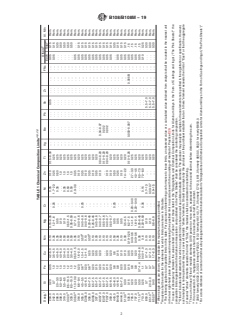
TABLE 1 Chemical Composition Limits
E
Others
I
Desig. Si Fe Cu Mn Mg Cr Ni Zn Ti Ag Be Pb Sn Zr FNs Al. Min
F
Each Total
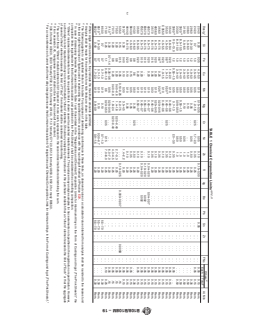
204.0 0.20 0.35 4.2–5.0 0.10 0.15–0.35 . . . 0.05 0.10 0.15–0.30 . . . . . . . . . 0.05 . . . . . . . . . 0.05 0.15 Rem.
242.0 0.7 1.0 3.5–4.5 0.35 1.2–1.8 0.25 1.7–2.3 0.35 0.25 . . . . . . . . . . . . . . . . . . . . . 0.05 0.15 Rem.
296.0 2.0–3.0 1.2 4.0–5.0 0.35 0.05 . . . 0.35 0.50 0.25 . . . . . . . . . . . . . . . . . . . . . . . . 0.35 Rem.
308.0 5.0–6.0 1.0 4.0–5.0 0.50 0.10 . . . . . . 1.0 0.25 . . . . . . . . . . . . . . . . . . . . . . . . 0.50 Rem.
319.0 5.5–6.5 1.0 3.0–4.0 0.50 0.10 . . . 0.35 1.0 0.25 . . . . . . . . . . . . . . . . . . . . . . . . 0.50 Rem.
H
332.0 8.5–10.5 1.2 2.0–4.0 0.50 0.50–1.5 . . . 0.50 1.0 0.25 . . . . . . . . . . . . . . . . . . . . . . . . 0.50 Rem.
333.0 8.0–10.0 1.0 3.0–4.0 0.50 0.05–0.50 . . . 0.50 1.0 0.25 . . . . . . . . . . . . . . . . . . . . . . . . 0.50 Rem.
H
336.0 11.0–13.0 1.2 0.50–1.5 0.35 0.7–1.3 . . . 2.0–3.0 0.35 0.25 . . . . . . . . . . . . . . . . . . . . . 0.05 . . . Rem.
354.0 8.6–9.4 0.20 1.6–2.0 0.10 0.40–0.6 . . . . . . 0.10 0.20 . . . . . . . . . . . . . . . . . . . . . 0.05 0.15 Rem.
G G
355.0 4.5–5.5 0.6 1.0–1.5 0.50 0.40–0.6 0.25 . . . 0.35 0.25 . . . . . . . . . . . . . . . . . . . . . 0.05 0.15 Rem.
C355.0 4.5–5.5 0.20 1.0–1.5 0.10 0.40–0.6 . . . . . . 0.10 0.20 . . . . . . . . . . . . . . . . . . . . . 0.05 0.15 Rem.
G G
356.0 6.5–7.5 0.6 0.25 0.35 0.20–0.45 . . . . . . 0.35 0.25 . . . . . . . . . . . . . . . . . . . . . 0.05 0.15 Rem.
A356.0 6.5–7.5 0.20 0.20 0.10 0.25–0.45 . . . . . . 0.10 0.20 . . . . . . . . . . . . . . . . . . . . . 0.05 0.15 Rem.
357.0 6.5–7.5 0.15 0.05 0.03 0.45–0.6 . . . . . . 0.05 0.20 . . . . . . . . . . . . . . . . . . . . . 0.05 0.15 Rem.
A357.0 6.5–7.5 0.20 0.20 0.10 0.40–0.7 . . . . . . 0.10 0.04–0.20 . . . 0.04–0.07 . . . . . . . . . . . . . . . 0.05 0.15 Rem.
E357.0 6.5–7.5 0.10 . . . 0.10 0.55–0.6 . . . . . . . . . 0.10–0.20 . . . 0.002 . . . . . . . . . . . . . . . 0.05 0.15 Rem.
F357.0 6.5–7.5 0.10 0.20 0.10 0.40–0.7 . . . . . . 0.10 0.04–0.20 . . . 0.002 . . . . . . . . . . . . . . . 0.05 0.15 Rem.
359.0 8.5–9.5 0.20 0.20 0.10 0.50–0.7 . . . . . . 0.10 0.20 . . . . . . . . . . . . . . . . . . . . . 0.05 0.15 Rem.
443.0 4.5–6.0 0.8 0.6 0.50 0.05 0.25 . . . 0.50 0.25 . . . . . . . . . . . . . . . . . . . . . . . . 0.35 Rem.
B443.0 4.5–6.0 0.8 0.15 0.35 0.05 . . . . . . 0.35 0.25 . . . . . . . . . . . . . . . . . . . . . 0.05 0.15 Rem.
A444.0 6.5–7.5 0.20 0.10 0.10 0.05 . . . . . . 0.10 0.20 . . . . . . . . . . . . . . . . . . . . . 0.05 0.15 Rem.
H
513.0 0.30 0.40 0.10 0.30 3.5–4.5 . . . . . . 1.4–2.2 0.20 . . . . . . . . . . . . . . . . . . . . . 0.05 0.15 Rem.
535.0 0.15 0.15 0.05 0.10–0.25 6.2–7.5 . . . . . . . . . 0.10–0.25 . . . 0.003–0.007 . . . . . . . . . 0.005B . . . 0.05 .15 Rem.
705.0 0.20 0.8 0.20 0.40–0.6 1.4–1.8 0.20–0.40 . . . 2.7–3.3 0.25 . . . . . . . . . . . . . . . . . . . . . 0.05 .15 Rem.
707.0 0.20 0.8 0.20 0.40–0.6 1.8–2.4 0.20–0.40 . . . 4.0–4.5 0.25 . . . . . . . . . . . . . . . . . . . . . 0.05 .15 Rem.
H
711.0 0.30 0.7–1.4 0.35–0.6 0.05 0.25–0.45 . . . . . . 6.0–7.0 0.20 . . . . . . . . . . . . . . . . . . . . . 0.05 .15 Rem.
713.0 0.25 1.1 0.40–1.0 0.6 0.20–0.50 0.35 0.15 7.0–8.0 0.25 . . . . . . . . . . . . . . . . . . . . . 0.10 0.25 Rem.
850.0 0.7 0.7 0.7–1.3 0.10 0.10 . . . 0.7–1.3 . . . 0.20 . . . . . . . . . 5.5–7.0 . . . . . . . . . . . . 0.30 Rem.
H
851.0 2.0–3.0 0.7 0.7–1.3 0.10 0.10 . . . 0.30–0.7 . . . 0.20 . . . . . . . . . 5.5–7.0 . . . . . . . . . . . . 0.30 Rem.
H
852.0 0.40 0.7 1.7–2.3 0.10 0.6–0.9 . . . 0.9–1.5 . . . 0.20 . . . . . . . . . 5.5–7.0 . . . . . . . . . . . . 0.30 Rem.
A
When single units are shown, they indicate the maximum amounts permitted.
B
Analysis shall be made for the elements for which limits are shown in this table.
C
The following applies to all specified limits in this table: For purposes of determining conformance to these limits, an observed value or a calculated value obtained from analysis shall be rounded to the nearest unit
in the last right-hand place of figures used in expressing the specified limit in accordance with the rounding-off method of Practice E29.
D
In case of discrepancy between the values listed in Table 1 and those listed in the “Designations and Chemical Composition Limits for Aluminum Alloys in the Form of Castings and Ingot (‘The Pink Sheets’)” the
composition limits registered with the Aluminum Association and published in the “Pink Sheets” shall be considered the controlling composition.
E
“Others” includes listed elements for which no specific limit is shown as well as unlisted metallic elements. The producer may analyze samples for trace elements not specified in the registration or specification. However,
such analysis is not required and may not cover all metallic “others” elements. Should any analysis by the producer or the purchaser establish that an “others” element exceeds the limit of “Each” or that the aggregate
of several “others” elements exceeds the limit of “Total,” the material shall be considered nonconforming.
F
The sum of those 9Others9 metallic elements 0.010 percent or more each, expressed to the second decimal before determining the sum.
G
If iron exceeds 0.45, manganese content shall not be less than one-half iron content.
H
336.0 formerly A332.0, 332.0 formerly F332.0, 513.0 formerly A514.0, 711.0 formerly C712.0, 851.0 formerly A850.0, 852.0 for merly B850.0.
I
For a cross reference of current and former alloy designations see the Aluminum Association’s “Designations and Chemical Composition Limits for Aluminum Alloys in the Form of Castings and Ingot (‘The Pink Sheets’).”
B108/B108M − 19
Analysis Aluminum Alloys by the Point to Plane Tech- 4.1.5 The quantity in either pieces or pounds [kilograms].
nique Nitrogen Atmosphere (Withdrawn 2011)
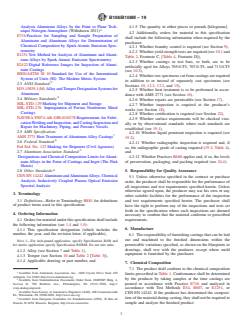
4.2 Additionally, orders for material to this specification
E716 Practices for Sampling and Sample Preparation of
shall include the following information when required by the
Aluminum and Aluminum Alloys for Determination of
purchaser.
Chemical Composition by Spark Atomic Emission Spec-
4.2.1 Whether foundry control is required (see Section 9),
trometry
4.2.2 Whether yield strength tests are required (see 10.1 and
E1251 Test Method for Analysis of Aluminum and Alumi-
Table 2, Footnote C, [Table 4, Footnote D]),
num Alloys by Spark Atomic Emission Spectrometry
4.2.3 Whether castings or test bars, or both, are to be
E2422 Digital Reference Images for Inspection of Alumi-
artificially aged for Alloys 705.0-T5, 707.0-T5, and 713.0-T5
num Castings
(see 10.3),
IEEE/ASTM SI 10 Standard for Use of the International
4.2.4 Whether test specimens cut from castings are required
System of Units (SI): The Modern Metric System
in addition to or instead of separately cast specimens (see
2.3 ANSI Standard:
Sections 10, 12.2, 13.2, and 15),
H35.1/H35.1(M) AlloyandTemperDesignationSystemsfor
4.2.5 Whether heat treatment is to be performed in accor-
Aluminum
dance with AMS 2771 (see Section 16),
2.4 Military Standards:
4.2.6 Whether repairs are permissible (see Section 17),
MIL-STD-129 Marking for Shipment and Storage
4.2.7 Whether inspection is required at the producer’s
MIL-STD-276 Impregnation of Porous Nonferrous Metal
works (see Section 18),
Castings
4.2.8 Whether certification is required (see Section 22),
NAVSEA S9074-AR-GIB-010/278 Requirements for Fabri-
4.2.9 Whether surface requirements will be checked visu-
cationWeldingandInspection,andCastingInspectionand
ally or by observational standards where such standards are
Repair for Machinery, Piping, and Pressure Vessels
established (see 19.1),
2.5 AMS Specification:
4.2.10 Whether liquid penetrant inspection is required (see
AMS 2771 Heat Treatment of Aluminum Alloy Castings
19.2),
2.6 Federal Standard:
4.2.11 Whether radiographic inspection is required and, if
Fed Std. No. 123 Marking for Shipment (Civil Agencies)
so, the radiographic grade of casting required (19.3, Table 4),
2.7 Aluminum Association Standard:
and
Designations and Chemical Composition Limits forAlumi-
4.2.12 Whether Practices B660 applies and, if so, the levels
num Alloys in the Form of Castings and Ingot (The Pink
of preservation, packaging, and packing required (see 24.4).
Sheets)
5. Responsibility for Quality Assurance
2.8 Other Standards:
CEN EN 14242 AluminumandAluminumAlloys,Chemical
5.1 Unless otherwise specified in the contract or purchase
Analysis, Inductively Coupled Plasma Optical Emission
order, the producer shall be responsible for the performance of
Spectral Analysis
all inspections and test requirements specified herein. Unless
otherwise agreed upon, the producer may use his own or any
3. Terminology
other suitable facilities for the performance of the inspection
3.1 Definitions—Refer to Terminology B881 for definitions
and test requirements specified herein. The purchaser shall
of product terms used in this specification.
have the right to perform any of the inspections and tests set
forth in the specification where such inspections are deemed
4. Ordering Information
necessary to confirm that the material conforms to prescribed
4.1 Orders for material under this specification shall include requirements.
the following information (see 1.4 and 1.5):
6. Manufacture
4.1.1 This specification designation (which includes the
number, the year, and the revision letter, if applicable),
6.1 The responsibility of furnishing castings that can be laid
out and machined to the finished dimensions within the
NOTE 1—For inch-pound application, specify Specification B108 and
permissible variations specified, as shown on the blueprints or
for metric application specify Specification B108M. Do not mix units.
drawings, shall rest with the producer, except where mold
4.1.2 Alloy (see Section 7 and Table 1),
equipment is furnished by the purchaser.
4.1.3 Temper (see Section 10 and Table 2 [Table 3]),
4.1.4 Applicable drawing or part number, and
7. Chemical Composition
7.1 The product shall conform to the chemical composition
Available from Aluminum Association, Inc., 1400 Crystal Drive Suite 430
limits prescribed in Table 1. Conformance shall be determined
Arlington, VA 22202 http://www.aluminum.org.
6 by the producer by taking samples at the time castings are
Available from Standardization Documents Order Desk, DODSSP, Bldg. 4,
poured in accordance with Practice E716 and analyzed in
Section D, 700 Robbins Ave., Philadelphia, PA 19111-5098, http://
www.dodssp.daps.mil.
accordance with Test Methods E34, E607,or E1251,or
Available from Society of Automotive Engineers (SAE), 400 Commonwealth
CEN EN 14242. If the producer has determined the composi-
Dr., Warrendale, PA 15096-0001, http://www.sae.org.
tion of the material during casting, they shall not be required to
Available from European Committee for Standardization (CEN), 36 Rue de
Stassart, B-1050, Brussels, Belgium, http://www.cenorm.be. sample and analyze the finished product.
B108/B108M − 19
A,B
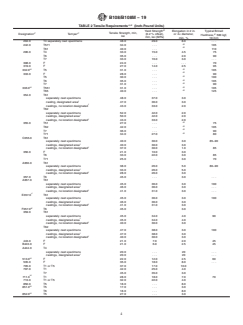
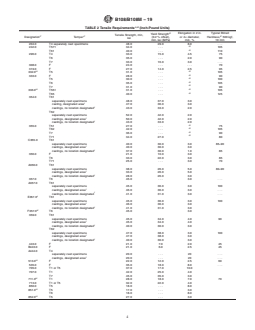
TABLE 2 Tensile Requirements (Inch-Pound Units)
D
Elongation in 2 in.
Typical Brinell
Yield Strength
Tensile Strength, min,
F C
E
Designation Temper (0.2 % offset), or 4× diameter,
Hardness, 500 kgf,
ksi
min, ksi (MPa)
min, % 10 mm
204.0 T4 separately cast specimens 48.0 29.0 8.0 . . .
G
242.0 T571 34.0 . . . 105
G
T61 40.0 . . . 110
296.0 T4 33.0 15.0 4.5 75
T6 35.0 . . . 2.0 90
T7 33.0 16.0 3.0 . . .
308.0 F 24.0 . . . . . . 70
319.0 F 27.0 14.0 2.5 95
H G
332.0 T5 31.0 . . . 105
G
333.0 F 28.0 . . . 90
G
T5 30.0 . . . 100
G
T6 35.0 . . . 105
G
T7 31.0 . . . 90
H G
336.0 T551 31.0 . . . 105
G
T65 40.0 . . . 125
354.0 T61
separately cast specimens 48.0 37.0 3.0
I
casting, designated area 47.0 36.0 3.0
I
castings, no location designated 43.0 33.0 2.0
T62
separately cast specimens 52.0 42.0 2.0
I
castings, designated area 50.0 42.0 2.0
I
castings, no location designated 43.0 33.0 2.0
G
355.0 T51 27.0 . . . 75
G
T62 42.0 . . . 105
G
T7 36.0 . . . 90
G
T71 34.0 27.0 80
C355.0 T61
separately cast specimens 40.0 30.0 3.0 85–90
I
castings, designated area 40.0 30.0 3.0
I
castings, no location designated 37.0 30.0 1.0 85
356.0 F 21.0 10.0 3.0
T6 33.0 22.0 3.0 85
T71 25.0 . . . 3.0 70
A356.0 T61
separately cast specimens 38.0 26.0 5.0 80–90
I
castings, designated area 33.0 26.0 5.0
I
castings, no location designated 28.0 26.0 3.0
357.0 T6 45.0 . . . 3.0 . . .
A357.0 T61
separately cast specimens 45.0 36.0 3.0 100
I
castings, designated area 46.0 36.0 3.0 . . .
I
castings, no location designated 41.0 31.0 3.0 . . .
J
E357.0 T61
separately cast specimens 45.0 36.0 3.0 100
I
castings, designated area 46.0 36.0 3.0
I
castings, no location designated 41.0 31.0 3.0
K
F357.0 T6 45.0 3.0
359.0 T61
separately cast specimens 45.0 34.0 4.0 90
I
castings, designated area 45.0 34.0 4.0
I
castings, no location designated 40.0 30.0 3.0
T62
separately cast specimens 47.0 38.0 3.0 100
I
castings, designated area 47.0 38.0 3.0
I
castings, no location designated 40.0 30.0 3.0
443.0 F 21.0 7.0 2.0 45
B443.0 F 21.0 6.0 2.5 45
A444.0 T4
separately cast specimens 20.0 . . . 20 . . .
I
castings, designated area 20.0 . 20 .
H
513.0 F 22.0 12.0 2.5 60
535.0 F 35.0 18.0 8.0 . . .
705.0 T1 or T5 37.0 17.0 10.0
707.0 T1 42.0 25.0 4.0
T7 45.0 35.0 3.0
H
711.0 T1 28.0 18.0 7.0 70
713.0 T1 or T5 32.0 22.0 4.0
850.0 T5 18.0 . . . 8.0
H
851.0 T5 17.0 . . . 3.0
T6 18.0 . . . 8.0
H
852.0 T5 27.0 . . . 3.0
B108/B108M − 19
A
If agreed upon by manufacturer and the purchaser, other mechanical properties may be obtained by other heat treatments such as annealing, aging, or stress relieving.
B
For purposes of determining conformance with this specification, each value for tensile strength and yield strength shall be rounded to the nearest 0.1 ksi, and each value
for elongation shall be rounded to the nearest 0.5 %, both in accordance with the rounding method of Practice E29.
C
Refer to ANSI H 35.1/H35.1(M) for description of tempers.
D
Yield strength to be evaluated only when specified in contract or purchase order.
E
Hardness values given for information only, not required for acceptance.
F
ASTM alloy designations are recorded in Practice B275.
G
Not required.
H
332.0 formerly F332.0, 336.0 formerly A332.0, 513.0 formerly A514.0, 711.0 formerly C712.0, 851.0 formerly A850.0, 852.0 formerly B850.0.
I
These properties apply only to castings having section thicknesses not greater than 2 in. except that section thicknesses of ⁄4 in., max, shall apply to Alloy A444.0.
J
Properties copied from A357.0–T61.
K
Properties copied from 357.0–T6.
7.1.1 A sample for determination of chemical composition 10. Tensile Requirements
shall be taken to represent one of the following:
10.1 The separately cast tension test specimens representing
7.1.2 Not more than 4000 lb [2000 kg] of clean castings or
the castings shall meet the mechanical properties prescribed in
a single casting poured from one furnace. The maximum
Table 2 [Table 3].
elapsed time between determinations shall be established for
10.2 When specified, the tensile strength and elongation of
each alloy, but in any case the maximum elapsed time shall not
test specimens cut from castings shall be in accordance with
exceed 8 h.
Table 2 [Table 3] for Alloys 354.0, C355.0, A356.0, A357.0,
7.1.3 The maximum elapsed time between determinations
E357.0, 359.0, and A444.0. For other alloys a minimum of
shall be established for each alloy, but in any case the
75 % of the tensile and yield strength values and not less than
maximum elapsed time shall not exceed 8 h.
25 % of the elongation values specified in Table 2 [Table 3] are
7.2 If it becomes necessary to analyze castings for confor-
required. The measurement of elongation is not required for
mance to chemical composition limits, the method used to
test specimens cut from castings if 25 % of the specified
sample castings for the determination of chemical composition
minimum elongation value published in Table 2 [Table 3]is
shall be accordance with Practice B985. Analysis shall be
0.5 % or less. If grade D quality castings as described in Table
performed in accordance with Practice E716, Test Methods
4 are specified, no tensile tests shall be specified nor tensile
E34, E607,or E1251, or CEN EN 14242 (ICP method).
requirements be met on specimens cut from castings.
10.3 Although Alloys 705.0, 707.0, and 713.0 are most
8. Material Requirements—Castings Produced for
Governmental and Military Agencies frequently used in the naturally aged condition, by agreement
of the producer and the purchaser, the castings may be
8.1 Unless otherwise specified, only aluminum alloy con-
artificially aged. The producer and the purchaser may also
formingtotherequirementsofSpecificationB179orproducers
agree to base the acceptance of castings on artificially aged test
foundry scrap, identified as being made from alloy conforming
bars. The conditions of artificial aging shown in Practice
to Specification B179, shall be used in the remelting furnace
B917/B917M or AMS 2771 shall be employed unless other
from which molten metal is taken for pouring directly into
conditions are accepted by mutual consent.
castings. Additions of small amounts of modifying and grain
refining elements or alloys are permitted.
11. Workmanship, Finish, and Appearance
8.2 Pure materials, recycled materials, and master alloys
11.1 The finished castings shall be uniform in composition
may be used to make alloys conforming to this specification,
and free of blowholes, cracks, shrinks, and other discontinui-
provided chemical analysis can be taken and adjusted to
ties in accordance with standards designated and agreed upon
conform to Table 1 prior to pouring any castings.
as acceptable by the purchaser.
9. Foundry Control—Castings Produced for
12. Test Specimens
Governmental or Military Agencies, or Both
12.1 Separately cast test specimens shall be cast in iron
9.1 When specified, castings shall be produced under
molds.Arecommended gating method is shown in Fig. 1 [Fig.
foundry control approved by the purchaser. Foundry control
2] and Fig. 3 [Fig. 4].An alternative gating design is shown in
shall consist of examination of castings by radiographic or
Appendix X4. The test section of the tension test specimen
other approved methods for determining internal discontinui-
shall be cast to size in accordance with the dimensions shown
ties until the gating, pouring, and other foundry practices have
in Fig. 1 [Fig. 2] and Fig. 3 [Fig. 4], and not machined prior to
been established to produce castings meeting the quality
test. Grip ends may be machined to adapt them in such a
standards furnished by the purchaser or agreed upon between
manner as to ensure axial loading.
the purchaser and the producer. When foundry practices have
been so established, the production method shall not be 12.2 When properties of castings are to be determined,
significantly changed without demonstrating to the satisfaction tension test specimens shall be cut from the locations desig-
of the purchaser that the change does not adversely affect the nated on the drawings, unless otherwise negotiated. If no
quality of the castings. Minor changes in pouring temperature locations are designated, one or more specimens shall be taken
of 650°F [628°C] from the established nominal temperature to include locations having significant variation in casting
are permissible. thickness, except that specimens shall not be taken from areas
B108/B108M − 19
A,B,C
TABLE 3 Tensile Requirements (SI Units)—[Metric]
Tensile F
Yield Strength Typical Brinell
Elongation
G
Strength, (0.2 % offset),
H D Hardness
Designation Temper in
min,
min, 500-kgf load,
E 5D, min, %
E MPa
10-mm ball
MPa
204.0 T4 separately cast specimens 330 200 7.0 . . .
I
242.0 T571 235 . . . 105
I
T61 275 . . . 110
296.0 T4 230 105 4.5 75
T6 240 . . . 2.0 90
T7 230 110 3.0 . . .
308.0 F 165 . . . . . . 70
319.0 F 185 95 2.5 95
J I
332.0 T5 215 . . . 105
I
333.0 F 195 . . . 90
I
T5 205 . . . 100
I
T6 240 . . . 105
I
T7 215 . . . 90
J I
336.0 T551 215 . . . 105
I
T65 275 . . . 125
354.0 T61
separately cast specimens 330 255 3.0
K
casting, designated area 325 250 3.0
K
castings, no location designated 295 230 2.0
T62
separately cast specimens 360 290 2.0
K
castings, designated area 345 290 2.0
K
castings, no location designated 295 230 2.0
I
355.0 T51 185 . . . 75
I
T62 290 . . . 105
I
T7 250 . . . 90
I
T71 235 185 80
C355.0 T61
separately cast specimens 275 205 3.0 85–90
K
castings, designated area 275 205 3.0
K
castings, no location designated 255 205 1.0 85
356.0 F 145 70 3.0
T6 230 150 3.0 85
T71 170 . . . 3.0 70
A356.0 T61
separately cast specimens 260 180 4.0 80–90
K
castings, designated area 230 180 4.0
K
castings, no location designated 195 180 3.0
357.0 T6 310 . . . 3.0 . . .
A357.0 T61
separately cast specimens 310 250 3.0 100
K
castings, designated area 315 250 3.0 . . .
K
castings, no location designated 285 215 3.0 . . .
L
E357.0 T61
separately cast specimens 310 250 3.0 100
K
castings, designated area 315 250 3.0
K
castings, no location designated 285 215 3.0
M
F357.0 T6 310 3.0
359.0 T61
separately cast specimens 310 235 4.0 90
K
castings, designated area 310 235 4.0
K
castings, no location designated 275 205 3.0
T62
separately cast specimens 325 260 3.0 100
K
castings, designated area 325 260 3.0
K
castings, no location designated 275 205 3.0
443.0 F 145 50 2.0 45
B443.0 F 145 40 2.5 45
A444.0 T4
separately cast specimens 140 . . . 18.0 . . .
K
castings, designated area 140 . . . 18.0 . . .
J
513.0 F 150 80 2.5 60
535.0 F 240 125 7.0 . . .
705.0 T1 or T5 255 115 9.0
707.0 T1 290 170 4.0
T7 310 240 3.0
J
711.0 T1 195 125 6.0 70
713.0 T1 or T5 220 150 4.0
850.0 T5 125 . . . 7.0
J
851.0 T5 115 . . . 3.0
T6 125 . . . 7.0
J
852.0 T5 185 . . . 3.0
B108/B108M − 19
A
If agreed upon by manufacturer and the purchaser, other mechanical properties may be obtained by other heat treatments such as annealing, aging, or stress relieving.
B
For purposes of determining conformance with this specification, each value for tensile strength and yield strength shall be rounded to the nearest 1 MPa and each value
for elongation shall be rounded to the nearest 0.5 %, both in accordance with the rounding method of Practice E29.
C
Guidelines for metric conversion from the “Tempers for Aluminum and Aluminum Alloys, Metric Edition (‘Tan Sheets’),” Appendix A, were used to convert the tensile and
yield values to SI units.
D
Refer to ANSI H 35.1/H35.1(M) for description of tempers.
E
For explanation of the SI Unit “MPa” see Appendix X2.
F
Yield strength to be evaluated only when specified in contract or purchase order.
G
Hardness values given for information only, not required for acceptance.
H
ASTM alloy designations are recorded in Practice B275.
I
Not required.
J
332.0 formerly F332.0, 336.0 formerly A332.0,513.0 formerly A514.0, 711.0 formerly C712.0, 851.0 formerly A850.0, 852.0 formerly B850.0.
K
These properties apply only to cas
...
This document is not an ASTM standard and is intended only to provide the user of an ASTM standard an indication of what changes have been made to the previous version. Because
it may not be technically possible to adequately depict all changes accurately, ASTM recommends that users consult prior editions as appropriate. In all cases only the current version
of the standard as published by ASTM is to be considered the official document.
´1
Designation: B108/B108M − 18 B108/B108M − 19
Standard Specification for
Aluminum-Alloy Permanent Mold Castings
This standard is issued under the fixed designation B108/B108M; the number immediately following the designation indicates the year
of original adoption or, in the case of revision, the year of last revision. A number in parentheses indicates the year of last reapproval.
A superscript epsilon (´) indicates an editorial change since the last revision or reapproval.
This standard has been approved for use by agencies of the U.S. Department of Defense.
ε NOTE—Footnote B of Table 3 was revised editorially in August 2018.
1. Scope*
1.1 This specification covers aluminum-alloy permanent mold castings designated as shown in Table 1.
1.2 This specification is for aluminum-alloy permanent mold castings used in general purpose applications. It may not address
the mechanical properties, integrity testing, and verification required for highly loaded or safety critical applications.
1.3 Alloy and temper designations are in accordance with ANSI H35.1/H35.1(M).
1.4 Unless the order specifies the “M” specification designation, the material shall be furnished to the inch-pound units.
1.5 For acceptance criteria for inclusion of new aluminum and aluminum alloys and their properties in this specification, see
Annex A1 and Annex A2.
1.6 Units—The values stated in either SI units or inch-pound units are to be regarded separately as standard. The values stated
in each system may not be exact equivalents; therefore, each system shall be used independently of the other. Combining values
from the two systems may result in non-conformance with the standard.
1.7 This standard does not purport to address all of the safety concerns, if any, associated with its use. It is the responsibility
of the user of this standard to establish appropriate safety, health, and environmental practices and determine the applicability of
regulatory limitations prior to use.
1.8 This international standard was developed in accordance with internationally recognized principles on standardization
established in the Decision on Principles for the Development of International Standards, Guides and Recommendations issued
by the World Trade Organization Technical Barriers to Trade (TBT) Committee.
2. Referenced Documents
2.1 The following documents of the issue in effect on the date of casting purchase form a part of this specification to the extent
referenced herein:
2.2 ASTM Standards:
B179 Specification for Aluminum Alloys in Ingot and Molten Forms for Castings from All Casting Processes
B275 Practice for Codification of Certain Zinc, Tin and Lead Die Castings
B557 Test Methods for Tension Testing Wrought and Cast Aluminum- and Magnesium-Alloy Products
B557M Test Methods for Tension Testing Wrought and Cast Aluminum- and Magnesium-Alloy Products (Metric)
B660 Practices for Packaging/Packing of Aluminum and Magnesium Products
B666/B666M Practice for Identification Marking of Aluminum and Magnesium Products
B881 Terminology Relating to Aluminum- and Magnesium-Alloy Products
B917/B917M Practice for Heat Treatment of Aluminum-Alloy Castings from All Processes
B985 Practice for Sampling Aluminum Ingots, Billets, Castings and Finished or Semi-Finished Wrought Aluminum Products for
Compositional Analysis
This specification is under the jurisdiction of ASTM Committee B07 on Light Metals and Alloys and is the direct responsibility of Subcommittee B07.01 on Aluminum
Alloy Ingots and Castings.
Current edition approved May 15, 2018Sept. 1, 2019. Published May 2018October 2019. Originally approved in 1936. Last previous edition approved in 20152018 as
ε1
B108/B108M – 15.B108/B108M – 18 . DOI: 10.1520/B0108_B0108M-18E01.10.1520/B0108_B0108M-19.
For ASME Boiler and Pressure Code application see related SB-108.
For referenced ASTM standards, visit the ASTM website, www.astm.org, or contact ASTM Customer Service at service@astm.org. For Annual Book of ASTM Standards
volume information, refer to the standard’s Document Summary page on the ASTM website.
*A Summary of Changes section appears at the end of this standard
Copyright © ASTM International, 100 Barr Harbor Drive, PO Box C700, West Conshohocken, PA 19428-2959. United States
B108/B108M − 19
A,B,C,D
TABLE 1 Chemical Composition Limits
E
Others
I
Desig. Si Fe Cu Mn Mg Cr Ni Zn Ti Ag Be Pb Sn Zr FNs Al. Min
F
Each Total
204.0 0.20 0.35 4.2–5.0 0.10 0.15–0.35 . . . 0.05 0.10 0.15–0.30 . . . . . . . . . 0.05 . . . . . . . . . 0.05 0.15 Rem.
242.0 0.7 1.0 3.5–4.5 0.35 1.2–1.8 0.25 1.7–2.3 0.35 0.25 . . . . . . . . . . . . . . . . . . . . . 0.05 0.15 Rem.
296.0 2.0–3.0 1.2 4.0–5.0 0.35 0.05 . . . 0.35 0.50 0.25 . . . . . . . . . . . . . . . . . . . . . . . . 0.35 Rem.
308.0 5.0–6.0 1.0 4.0–5.0 0.50 0.10 . . . . . . 1.0 0.25 . . . . . . . . . . . . . . . . . . . . . . . . 0.50 Rem.
319.0 5.5–6.5 1.0 3.0–4.0 0.50 0.10 . . . 0.35 1.0 0.25 . . . . . . . . . . . . . . . . . . . . . . . . 0.50 Rem.
H
332.0 8.5–10.5 1.2 2.0–4.0 0.50 0.50–1.5 . . . 0.50 1.0 0.25 . . . . . . . . . . . . . . . . . . . . . . . . 0.50 Rem.
333.0 8.0–10.0 1.0 3.0–4.0 0.50 0.05–0.50 . . . 0.50 1.0 0.25 . . . . . . . . . . . . . . . . . . . . . . . . 0.50 Rem.
H
336.0 11.0–13.0 1.2 0.50–1.5 0.35 0.7–1.3 . . . 2.0–3.0 0.35 0.25 . . . . . . . . . . . . . . . . . . . . . 0.05 . . . Rem.
354.0 8.6–9.4 0.20 1.6–2.0 0.10 0.40–0.6 . . . . . . 0.10 0.20 . . . . . . . . . . . . . . . . . . . . . 0.05 0.15 Rem.
G G
355.0 4.5–5.5 0.6 1.0–1.5 0.50 0.40–0.6 0.25 . . . 0.35 0.25 . . . . . . . . . . . . . . . . . . . . . 0.05 0.15 Rem.
C355.0 4.5–5.5 0.20 1.0–1.5 0.10 0.40–0.6 . . . . . . 0.10 0.20 . . . . . . . . . . . . . . . . . . . . . 0.05 0.15 Rem.
G G
356.0 6.5–7.5 0.6 0.25 0.35 0.20–0.45 . . . . . . 0.35 0.25 . . . . . . . . . . . . . . . . . . . . . 0.05 0.15 Rem.
A356.0 6.5–7.5 0.20 0.20 0.10 0.25–0.45 . . . . . . 0.10 0.20 . . . . . . . . . . . . . . . . . . . . . 0.05 0.15 Rem.
357.0 6.5–7.5 0.15 0.05 0.03 0.45–0.6 . . . . . . 0.05 0.20 . . . . . . . . . . . . . . . . . . . . . 0.05 0.15 Rem.
A357.0 6.5–7.5 0.20 0.20 0.10 0.40–0.7 . . . . . . 0.10 0.04–0.20 . . . 0.04–0.07 . . . . . . . . . . . . . . . 0.05 0.15 Rem.
E357.0 6.5–7.5 0.10 . . . 0.10 0.55–0.6 . . . . . . . . . 0.10–0.20 . . . 0.002 . . . . . . . . . . . . . . . 0.05 0.15 Rem.
F357.0 6.5–7.5 0.10 0.20 0.10 0.40–0.7 . . . . . . 0.10 0.04–0.20 . . . 0.002 . . . . . . . . . . . . . . . 0.05 0.15 Rem.
359.0 8.5–9.5 0.20 0.20 0.10 0.50–0.7 . . . . . . 0.10 0.20 . . . . . . . . . . . . . . . . . . . . . 0.05 0.15 Rem.
443.0 4.5–6.0 0.8 0.6 0.50 0.05 0.25 . . . 0.50 0.25 . . . . . . . . . . . . . . . . . . . . . . . . 0.35 Rem.
B443.0 4.5–6.0 0.8 0.15 0.35 0.05 . . . . . . 0.35 0.25 . . . . . . . . . . . . . . . . . . . . . 0.05 0.15 Rem.
A444.0 6.5–7.5 0.20 0.10 0.10 0.05 . . . . . . 0.10 0.20 . . . . . . . . . . . . . . . . . . . . . 0.05 0.15 Rem.
H
513.0 0.30 0.40 0.10 0.30 3.5–4.5 . . . . . . 1.4–2.2 0.20 . . . . . . . . . . . . . . . . . . . . . 0.05 0.15 Rem.
535.0 0.15 0.15 0.05 0.10–0.25 6.2–7.5 . . . . . . . . . 0.10–0.25 . . . 0.003–0.007 . . . . . . . . . 0.005B . . . 0.05 .15 Rem.
705.0 0.20 0.8 0.20 0.40–0.6 1.4–1.8 0.20–0.40 . . . 2.7–3.3 0.25 . . . . . . . . . . . . . . . . . . . . . 0.05 .15 Rem.
707.0 0.20 0.8 0.20 0.40–0.6 1.8–2.4 0.20–0.40 . . . 4.0–4.5 0.25 . . . . . . . . . . . . . . . . . . . . . 0.05 .15 Rem.
H
711.0 0.30 0.7–1.4 0.35–0.6 0.05 0.25–0.45 . . . . . . 6.0–7.0 0.20 . . . . . . . . . . . . . . . . . . . . . 0.05 .15 Rem.
713.0 0.25 1.1 0.40–1.0 0.6 0.20–0.50 0.35 0.15 7.0–8.0 0.25 . . . . . . . . . . . . . . . . . . . . . 0.10 0.25 Rem.
850.0 0.7 0.7 0.7–1.3 0.10 0.10 . . . 0.7–1.3 . . . 0.20 . . . . . . . . . 5.5–7.0 . . . . . . . . . . . . 0.30 Rem.
H
851.0 2.0–3.0 0.7 0.7–1.3 0.10 0.10 . . . 0.30–0.7 . . . 0.20 . . . . . . . . . 5.5–7.0 . . . . . . . . . . . . 0.30 Rem.
H
852.0 0.40 0.7 1.7–2.3 0.10 0.6–0.9 . . . 0.9–1.5 . . . 0.20 . . . . . . . . . 5.5–7.0 . . . . . . . . . . . . 0.30 Rem.
A
When single units are shown, they indicate the maximum amounts permitted.
B
Analysis shall be made for the elements for which limits are shown in this table.
C
The following applies to all specified limits in this table: For purposes of determining conformance to these limits, an observed value or a calculated value obtained from analysis shall be rounded to the nearest unit
in the last right-hand place of figures used in expressing the specified limit in accordance with the rounding-off method of Practice E29.
D
In case of discrepancy between the values listed in Table 1 and those listed in the “Designations and Chemical Composition Limits for Aluminum Alloys in the Form of Castings and Ingot (‘The Pink Sheets’)” the
composition limits registered with the Aluminum Association and published in the “Pink Sheets” shall be considered the controlling composition.
E
“Others” includes listed elements for which no specific limit is shown as well as unlisted metallic elements. The producer may analyze samples for trace elements not specified in the registration or specification. However,
such analysis is not required and may not cover all metallic “others” elements. Should any analysis by the producer or the purchaser establish that an “others” element exceeds the limit of “Each” or that the aggregate
of several “others” elements exceeds the limit of “Total,” the material shall be considered nonconforming.
F
The sum of those 9Others9 metallic elements 0.010 percent or more each, expressed to the second decimal before determining the sum.
G
If iron exceeds 0.45, manganese content shall not be less than one-half iron content.
H
336.0 formerly A332.0, 332.0 formerly F332.0, 513.0 formerly A514.0, 711.0 formerly C712.0, 851.0 formerly A850.0, 852.0 for merly B850.0.
I
For a cross reference of current and former alloy designations see the Aluminum Association’s “Designations and Chemical Composition Limits for Aluminum Alloys in the Form of Castings and Ingot (‘The Pink Sheets’).”
B108/B108M − 19
D3951 Practice for Commercial Packaging
E29 Practice for Using Significant Digits in Test Data to Determine Conformance with Specifications
E34 Test Methods for Chemical Analysis of Aluminum and Aluminum-Base Alloys (Withdrawn 2017)
E94E94/E94M Guide for Radiographic Examination Using Industrial Radiographic Film
E155 Reference Radiographs for Inspection of Aluminum and Magnesium Castings
E165E165/E165M Practice for Liquid Penetrant Testing for General Industry
E607 Test Method for Atomic Emission Spectrometric Analysis Aluminum Alloys by the Point to Plane Technique Nitrogen
Atmosphere (Withdrawn 2011)
E716 Practices for Sampling and Sample Preparation of Aluminum and Aluminum Alloys for Determination of Chemical
Composition by Spark Atomic Emission Spectrometry
E1251 Test Method for Analysis of Aluminum and Aluminum Alloys by Spark Atomic Emission Spectrometry
E2422 Digital Reference Images for Inspection of Aluminum Castings
IEEE/ASTM SI 10 Standard for Use of the International System of Units (SI): The Modern Metric System
2.3 ANSI Standard:
H35.1/H35.1(M) Alloy and Temper Designation Systems for Aluminum
2.4 Military Standards:
MIL-STD-129 Marking for Shipment and Storage
MIL-STD-276 Impregnation of Porous Nonferrous Metal Castings
NAVSEA S9074-AR-GIB-010/278 Requirements for Fabrication Welding and Inspection, and Casting Inspection and Repair for
Machinery, Piping, and Pressure Vessels
2.5 AMS Specification:
AMS 2771 Heat Treatment of Aluminum Alloy Castings
2.6 Federal Standard:
Fed Std. No. 123 Marking for Shipment (Civil Agencies)
2.7 Aluminum Association Standard:
Designations and Chemical Composition Limits for Aluminum Alloys in the Form of Castings and Ingot (The Pink Sheets)
2.8 Other Standards:
CEN EN 14242 Aluminum and Aluminum Alloys, Chemical Analysis, Inductively Coupled Plasma Optical Emission Spectral
Analysis
3. Terminology
3.1 Definitions—Refer to Terminology B881 for definitions of product terms used in this specification.
4. Ordering Information
4.1 Orders for material under this specification shall include the following information (see 1.4 and 1.5):
4.1.1 This specification designation (which includes the number, the year, and the revision letter, if applicable),
NOTE 1—For inch-pound application, specify Specification B108 and for metric application specify Specification B108M. Do not mix units.
4.1.2 Alloy (see Section 7 and Table 1),
4.1.3 Temper (see Section 10 and Table 2 [Table 3]),
4.1.4 Applicable drawing or part number, and
4.1.5 The quantity in either pieces or pounds [kilograms].
4.2 Additionally, orders for material to this specification shall include the following information when required by the purchaser.
4.2.1 Whether foundry control is required (see Section 9),
4.2.2 Whether yield strength tests are required (see 10.1 and Table 2, Footnote C, [Table 4, Footnote D]),
4.2.3 Whether castings or test bars, or both, are to be artificially aged for Alloys 705.0-T5, 707.0-T5, and 713.0-T5 (see 10.3),
4.2.4 Whether test specimens cut from castings are required in addition to or instead of separately cast specimens (see Sections
10, 12.2, 13.2, and 15),
4.2.5 Whether heat treatment is to be performed in accordance with AMS 2771 (see Section 16),
4.2.6 Whether repairs are permissible (see Section 17),
4.2.7 Whether inspection is required at the producer’s works (see Section 18),
4.2.8 Whether certification is required (see Section 22),
The last approved version of this historical standard is referenced on www.astm.org.
Available from Aluminum Association, Inc., 1400 Crystal Drive Suite 430 Arlington, VA 22202 http://www.aluminum.org.
Available from Standardization Documents Order Desk, DODSSP, Bldg. 4, Section D, 700 Robbins Ave., Philadelphia, PA 19111-5098, http://www.dodssp.daps.mil.
Available from Society of Automotive Engineers (SAE), 400 Commonwealth Dr., Warrendale, PA 15096-0001, http://www.sae.org.
Available from European Committee for Standardization (CEN), 36 Rue de Stassart, B-1050, Brussels, Belgium, http://www.cenorm.be.
B108/B108M − 19
A,B
TABLE 2 Tensile Requirements (Inch-Pound Units)
D
Elongation in 2 in.
Typical Brinell
Yield Strength
Tensile Strength, min,
F C
E
Designation Temper (0.2 % offset), or 4× diameter,
Hardness, 500 kgf,
ksi
min, ksi (MPa)
min, % 10 mm
204.0 T4 separately cast specimens 48.0 29.0 8.0 . . .
G
242.0 T571 34.0 . . . 105
G
T61 40.0 . . . 110
296.0 T4 33.0 15.0 4.5 75
T6 35.0 . . . 2.0 90
T7 33.0 16.0 3.0 . . .
308.0 F 24.0 . . . . . . 70
319.0 F 27.0 14.0 2.5 95
H G
332.0 T5 31.0 . . . 105
G
333.0 F 28.0 . . . 90
G
T5 30.0 . . . 100
G
T6 35.0 . . . 105
G
T7 31.0 . . . 90
H G
336.0 T551 31.0 . . . 105
G
T65 40.0 . . . 125
354.0 T61
separately cast specimens 48.0 37.0 3.0
I
casting, designated area 47.0 36.0 3.0
I
castings, no location designated 43.0 33.0 2.0
T62
separately cast specimens 52.0 42.0 2.0
I
castings, designated area 50.0 42.0 2.0
I
castings, no location designated 43.0 33.0 2.0
G
355.0 T51 27.0 . . . 75
G
T62 42.0 . . . 105
G
T7 36.0 . . . 90
G
T71 34.0 27.0 80
C355.0 T61
separately cast specimens 40.0 30.0 3.0 85–90
I
castings, designated area 40.0 30.0 3.0
I
castings, no location designated 37.0 30.0 1.0 85
356.0 F 21.0 10.0 3.0
T6 33.0 22.0 3.0 85
T71 25.0 . . . 3.0 70
A356.0 T61
separately cast specimens 38.0 26.0 5.0 80–90
I
castings, designated area 33.0 26.0 5.0
I
castings, no location designated 28.0 26.0 3.0
357.0 T6 45.0 . . . 3.0 . . .
A357.0 T61
separately cast specimens 45.0 36.0 3.0 100
I
castings, designated area 46.0 36.0 3.0 . . .
I
castings, no location designated 41.0 31.0 3.0 . . .
J
E357.0 T61
separately cast specimens 45.0 36.0 3.0 100
I
castings, designated area 46.0 36.0 3.0
I
castings, no location designated 41.0 31.0 3.0
K
F357.0 T6 45.0 3.0
359.0 T61
separately cast specimens 45.0 34.0 4.0 90
I
castings, designated area 45.0 34.0 4.0
I
castings, no location designated 40.0 30.0 3.0
T62
separately cast specimens 47.0 38.0 3.0 100
I
castings, designated area 47.0 38.0 3.0
I
castings, no location designated 40.0 30.0 3.0
443.0 F 21.0 7.0 2.0 45
B443.0 F 21.0 6.0 2.5 45
A444.0 T4
separately cast specimens 20.0 . . . 20 . . .
I
castings, designated area 20.0 . . . 20 . . .
H
513.0 F 22.0 12.0 2.5 60
535.0 F 35.0 18.0 8.0 . . .
705.0 T1 or T5 37.0 17.0 10.0
707.0 T1 42.0 25.0 4.0
T7 45.0 35.0 3.0
H
711.0 T1 28.0 18.0 7.0 70
713.0 T1 or T5 32.0 22.0 4.0
850.0 T5 18.0 . . . 8.0
H
851.0 T5 17.0 . . . 3.0
T6 18.0 . . . 8.0
H
852.0 T5 27.0 . . . 3.0
B108/B108M − 19
A
If agreed upon by manufacturer and the purchaser, other mechanical properties may be obtained by other heat treatments such as annealing, aging, or stress relieving.
B
For purposes of determining conformance with this specification, each value for tensile strength and yield strength shall be rounded to the nearest 0.1 ksi, and each value
for elongation shall be rounded to the nearest 0.5 %, both in accordance with the rounding method of Practice E29.
C
Refer to ANSI H 35.1/H35.1(M) for description of tempers.
D
Yield strength to be evaluated only when specified in contract or purchase order.
E
Hardness values given for information only, not required for acceptance.
F
ASTM alloy designations are recorded in Practice B275.
G
Not required.
H
332.0 formerly F332.0, 336.0 formerly A332.0, 513.0 formerly A514.0, 711.0 formerly C712.0, 851.0 formerly A850.0, 852.0 formerly B850.0.
I
These properties apply only to castings having section thicknesses not greater than 2 in. except that section thicknesses of ⁄4 in., max, shall apply to Alloy A444.0.
J
Properties copied from A357.0–T61.
K
Properties copied from 357.0–T6.
4.2.9 Whether surface requirements will be checked visually or by observational standards where such standards are established
(see 19.1),
4.2.10 Whether liquid penetrant inspection is required (see 19.2),
4.2.11 Whether radiographic inspection is required and, if so, the radiographic grade of casting required (19.3, Table 4), and
4.2.12 Whether Practices B660 applies and, if so, the levels of preservation, packaging, and packing required (see 24.4).
5. Responsibility for Quality Assurance
5.1 Unless otherwise specified in the contract or purchase order, the producer shall be responsible for the performance of all
inspections and test requirements specified herein. Unless otherwise agreed upon, the producer may use his own or any other
suitable facilities for the performance of the inspection and test requirements specified herein. The purchaser shall have the right
to perform any of the inspections and tests set forth in the specification where such inspections are deemed necessary to confirm
that the material conforms to prescribed requirements.
6. Manufacture
6.1 The responsibility of furnishing castings that can be laid out and machined to the finished dimensions within the permissible
variations specified, as shown on the blueprints or drawings, shall rest with the producer, except where mold equipment is
furnished by the purchaser.
7. Chemical Composition
7.1 The product shall conform to the chemical composition limits prescribed in Table 1. Conformance shall be determined by
the producer by taking samples at the time castings are poured in accordance with Practice E716 and analyzed in accordance with
Test Methods E34, E607, or E1251, or CEN EN 14242. If the producer has determined the composition of the material during
casting, they shall not be required to sample and analyze the finished product.
7.1.1 A sample for determination of chemical composition shall be taken to represent one of the following:
7.1.2 Not more than 4000 lb [2000 kg] of clean castings or a single casting poured from one furnace. The maximum elapsed
time between determinations shall be established for each alloy, but in any case the maximum elapsed time shall not exceed 8 h.
7.1.3 The maximum elapsed time between determinations shall be established for each alloy, but in any case the maximum
elapsed time shall not exceed 8 h.
7.2 If it becomes necessary to analyze castings for conformance to chemical composition limits, the method used to sample
castings for the determination of chemical composition shall be accordance with Practice B985. Analysis shall be performed in
accordance with Practice E716, Test Methods E34, E607, or E1251, or CEN EN 14242 (ICP method).
8. Material Requirements—Castings Produced for Governmental and Military Agencies
8.1 Unless otherwise specified, only aluminum alloy conforming to the requirements of Specification B179 or producers
foundry scrap, identified as being made from alloy conforming to Specification B179, shall be used in the remelting furnace from
which molten metal is taken for pouring directly into castings. Additions of small amounts of modifying and grain refining
elements or alloys are permitted.
8.2 Pure materials, recycled materials, and master alloys may be used to make alloys conforming to this specification, provided
chemical analysis can be taken and adjusted to conform to Table 1 prior to pouring any castings.
9. Foundry Control—Castings Produced for Governmental or Military Agencies, or Both
9.1 When specified, castings shall be produced under foundry control approved by the purchaser. Foundry control shall consist
of examination of castings by radiographic or other approved methods for determining internal discontinuities until the gating,
pouring, and other foundry practices have been established to produce castings meeting the quality standards furnished by the
purchaser or agreed upon between the purchaser and the producer. When foundry practices have been so established, the production
B108/B108M − 19
A,B,C
TABLE 3 Tensile Requirements (SI Units)—[Metric]
Tensile F
Typical Brinell
Yield Strength
Elongation
G
Strength,
H D (0.2 % offset), Hardness
Designation Temper in
min,
min, 500-kgf load,
E 5D, min, %
E MPa
10-mm ball
MPa
204.0 T4 separately cast specimens 330 200 7.0 . . .
I
242.0 T571 235 . . . 105
I
T61 275 . . . 110
296.0 T4 230 105 4.5 75
T6 240 . . . 2.0 90
T7 230 110 3.0 . . .
308.0 F 165 . . . . . . 70
319.0 F 185 95 2.5 95
J I
332.0 T5 215 . . . 105
I
333.0 F 195 . . . 90
I
T5 205 . . . 100
I
T6 240 . . . 105
I
T7 215 . . . 90
J I
336.0 T551 215 . . . 105
I
T65 275 . . . 125
354.0 T61
separately cast specimens 330 255 3.0
K
casting, designated area 325 250 3.0
K
castings, no location designated 295 230 2.0
T62
separately cast specimens 360 290 2.0
K
castings, designated area 345 290 2.0
K
castings, no location designated 295 230 2.0
I
355.0 T51 185 . . . 75
I
T62 290 . . . 105
I
T7 250 . . . 90
I
T71 235 185 80
C355.0 T61
separately cast specimens 275 205 3.0 85–90
K
castings, designated area 275 205 3.0
K
castings, no location designated 255 205 1.0 85
356.0 F 145 70 3.0
T6 230 150 3.0 85
T71 170 . . . 3.0 70
A356.0 T61
separately cast specimens 260 180 4.0 80–90
K
castings, designated area 230 180 4.0
K
castings, no location designated 195 180 3.0
357.0 T6 310 . . . 3.0 . . .
A357.0 T61
separately cast specimens 310 250 3.0 100
K
castings, designated area 315 250 3.0 . . .
K
castings, no location designated 285 215 3.0 . . .
L
E357.0 T61
separately cast specimens 310 250 3.0 100
K
castings, designated area 315 250 3.0
K
castings, no location designated 285 215 3.0
M
F357.0 T6 310 3.0
359.0 T61
separately cast specimens 310 235 4.0 90
K
castings, designated area 310 235 4.0
K
castings, no location designated 275 205 3.0
T62
separately cast specimens 325 260 3.0 100
K
castings, designated area 325 260 3.0
K
castings, no location designated 275 205 3.0
443.0 F 145 50 2.0 45
B443.0 F 145 40 2.5 45
A444.0 T4
separately cast specimens 140 . . . 18.0 . . .
K
castings, designated area 140 . . . 18.0 . . .
J
513.0 F 150 80 2.5 60
535.0 F 240 125 7.0 . . .
705.0 T1 or T5 255 115 9.0
707.0 T1 290 170 4.0
T7 310 240 3.0
J
711.0 T1 195 125 6.0 70
713.0 T1 or T5 220 150 4.0
850.0 T5 125 . . . 7.0
J
851.0 T5 115 . . . 3.0
T6 125 . . . 7.0
J
852.0 T5 185 . . . 3.0
B108/B108M − 19
A
If agreed upon by manufacturer and the purchaser, other mechanical properties may be obtained by other heat treatments such as annealing, aging, or stress relieving.
B
For purposes of determining conformance with this specification, each value for tensile strength and yield strength shall be rounded to the nearest 1 MPa and each value
for elongation shall be rounded to the nearest 0.5 %, both in accordance with the rounding method of Practice E29.
C
Guidelines for metric conversion from the “Tempers for Aluminum and Aluminum Alloys, Metric Edition (‘Tan Sheets’),” Appendix A, were used to convert the tensile and
yield values to SI units.
D
Refer to ANSI H 35.1/H35.1(M) for description of tempers.
E
For explanation of the SI Unit “MPa” see Appendix X2.
F
Yield strength to be evaluated only when specified in contract or purchase order.
G
Hardness values given for information only, not required for acceptance.
H
ASTM alloy designations are recorded in Practice B275.
I
Not required.
J
332.0 formerly F332.0, 336.0 formerly A332.0,513.0 formerly A514.0, 711.0 formerly C712.0, 851.0 formerly A850.0, 852.0 formerly B850.0.
K
These properties apply only to castings having section thicknesses not greater than 2 in. except that section thicknesses of 19-mm max, shall apply to Alloy A444.0.
L
Properties copied from A357.0–T61.
M
Properties copied from 357.0–T6.
TABLE 4 Discontinuity—Level Requirements for Aluminum Castings in Accordance with Film Reference Radiographs E155 or Digital
Reference Radiographs E2422
A
Grade A Grade B Grade C Grade D
Discontinuity Section Thickness, in. (mm)
1 3 1 3 1 3 1 3
⁄4 to ⁄4 ⁄4 ⁄4 ⁄4 ⁄4 ⁄4 ⁄4
(6.4 to 19.0) (6.4) (19.0) (6.4) (19.0) (6.4) (19.0)
Gas holes none 1 1 2 2 5 5
Gas porosity (round) none 1 1 3 3 7 7
Gas porosity (elongated) none 1 1 3 4 5 5
B B B
Shrinkage cavity none 1 2 3
Shrinkage porosity or sponge none 1 1 2 2 4 3
Foreign material (less dense material) none 1 1 2 2 4 4
Foreign material (more dense material) none 1 1 2 1 4 3
Segregation none none none none
Cracks none none none none
Cold shuts none none none none
Surface irregularity not to exceed drawing tolerance
Core shaft not to exceed drawing tolerance
A
Caution should be exercised in requesting grade A because of the difficulty in obtaining this level.
B
No radiographs available. Use ⁄4-in. [6-mm] for all thicknesses.
method shall not be significantly changed without demonstrating to the satisfaction of the purchaser that the change does not
adversely affect the quality of the castings. Minor changes in pouring temperature of 650°F [628°C] from the established nominal
temperature are permissible.
10. Tensile Requirements
10.1 The separately cast tension test specimens representing the castings shall meet the mechanical properties prescribed in
Table 2 [Table 3].
10.2 When specified, the tensile strength and elongation of test specimens cut from castings shall be in accordance with Table
2 [Table 3] for Alloys 354.0, C355.0, A356.0, A357.0, E357.0, 359.0, and A444.0. For other alloys a minimum of 75 % of the
tensile and yield strength values and not less than 25 % of the elongation values specified in Table 2 [Table 3] are required. The
measurement of elongation is not required for test specimens cut from castings if 25 % of the specified minimum elongation value
published in Table 2 [Table 3] is 0.5 % or less. If grade D quality castings as described in Table 4 are specified, no tensile tests
shall be specified nor tensile requirements be met on specimens cut from castings.
10.3 Although Alloys 705.0, 707.0, and 713.0 are most frequently used in the naturally aged condition, by agreement of the
producer and the purchaser, the castings may be artificially aged. The producer and the purchaser may also agree to base the
acceptance of castings on artificially aged test bars. The conditions of artificial aging shown in Practice B917/B917M or AMS 2771
shall be employed unless other conditions are accepted by mutual consent.
11. Workmanship, Finish, and Appearance
11.1 The finished castings shall be uniform in composition and free of blowholes, cracks, shrinks, and other discontinuities in
accordance with standards designated and agreed upon as acceptable by the purchaser.
12. Test Spe
...