

ASTM E546-14(2020)
(Test Method)Standard Test Method for Frost/Dew Point of Sealed Insulating Glass Units
General Information
- Abstract
SIGNIFICANCE AND USE
5.1 This test method and the apparatus described are intended primarily for sealed insulating glass units positioned horizontally. If the procedure is applied to such units in other than a horizontal position, the results may not be comparable to those obtained by this procedure.
Note 1: A similar method is Test Method E576.
SCOPE
1.1 This test method describes a laboratory procedure for determining the frost/dew point within the air space(s) of sealed insulating glass units, and establishes the criteria for determining whether that point is below or above a given or specified temperature.
1.2 This test method also describes the apparatus to be used for these determinations.
1.3 The values stated in inch-pound units are to be regarded as standard. The values given in parentheses are mathematical conversions to SI units that are provided for information only and are not considered standard.
1.4 This standard does not purport to address all of the safety concerns, if any, associated with its use. It is the responsibility of the user of this standard to establish appropriate safety, health, and environmental practices and determine the applicability of regulatory limitations prior to use. For specific hazard statements, see 9.1.3.
1.5 This international standard was developed in accordance with internationally recognized principles on standardization established in the Decision on Principles for the Development of International Standards, Guides and Recommendations issued by the World Trade Organization Technical Barriers to Trade (TBT) Committee.
- Status
- Published
- Publication Date
- 30-Apr-2020
- Technical Committee
- E06 - Performance of Buildings
- Drafting Committee
- E06.22 - Durability Performance of Building Constructions
Overview
ASTM E546-14(2020): Standard Test Method for Frost/Dew Point of Sealed Insulating Glass Units is a widely recognized test standard developed by ASTM International. This method describes a laboratory procedure to determine the frost or dew point within the air space(s) of sealed insulating glass units. Precise measurement of the dew point is crucial for verifying the thermal performance, durability, and quality of insulating glass used in commercial and residential glazing systems.
The test evaluates whether the frost/dew point falls above or below a specified temperature, critical information for manufacturers and building professionals to assess the risk of condensation or frost formation within double or triple-glazed units.
Key Topics
- Frost/Dew Point Measurement: The standard outlines procedures for using a specialized apparatus to progressively lower the temperature on a glass specimen and pinpoint the temperature at which condensation (dew) or frost appears.
- Applicable Specimens: Intended primarily for glass units positioned horizontally. Applying the test to vertical or other orientations could yield non-comparable results.
- Test Apparatus: Features two cylindrical aluminum alloy blocks, a bimetallic thermometer or equivalent temperature sensor, and a dry ice cooling system. Accurate temperature control and measurement are essential for valid results.
- Test Procedure:
- Conditioning of glass samples prior to testing
- Controlled chilling of the measuring apparatus using dry ice
- Progressive temperature reduction and observation for frost formation
- Determination of "frost" state (dew point above test temp) or "no-frost" state (dew point below test temp)
- Reporting Requirements: Complete documentation of specimen details, conditioning, test temperatures, and resulting dew points is mandatory.
Applications
ASTM E546-14(2020) is integral for:
- Insulating Glass Manufacturers: Ensuring products meet internal dew point and durability requirements before market release.
- Quality Control: Verifying assembled units maintain a low dew point, indicating that seals are intact and desiccant material is functioning, thus preventing premature glass failure.
- Building Envelope Performance: Confirming manufactured glass units are resistant to internal condensation, which is crucial for maintaining visibility, structural integrity, and energy efficiency.
- Regulatory Compliance: Satisfying national and international building codes or specifications referencing insulating glass performance.
- Research & Product Development: Supporting improvements in glazing technology, sealant formulations, and desiccant effectiveness.
Related Standards
- ASTM E576: Test Method for Frost/Dew Point of Sealed Insulating Glass Units in the Vertical Position – closely related procedure adapted for vertically installed specimens.
- ASTM C1036: Specification for Flat Glass – for base material standards.
- ASTM E77: Test Method for Inspection and Verification of Thermometers – calibration reference for temperature measurement.
- ASTM E631: Terminology of Building Constructions – definitions and terminology relevant to insulating glass testing.
Practical Value
Implementing ASTM E546-14(2020) helps ensure sealed insulating glass units meet industry expectations for condensation resistance, longevity, and occupant comfort. By diagnosing possible moisture infiltration and verifying insulation performance, this standard supports the delivery of high-quality, energy-efficient building products.
Keywords: ASTM E546-14(2020), frost point testing, dew point measurement, sealed insulating glass units, insulating glass performance, condensation resistance, thermal performance, building envelope, quality control, dry ice cooling, laboratory test method.
Relations
- Effective Date
- 01-May-2020
- Effective Date
- 01-May-2020
- Effective Date
- 01-Mar-2015
- Effective Date
- 01-Dec-2014
- Effective Date
- 01-Nov-2014
- Effective Date
- 01-May-2014
- Effective Date
- 01-Oct-2011
- Effective Date
- 01-Oct-2011
- Effective Date
- 01-Apr-2008
- Effective Date
- 01-Dec-2007
- Effective Date
- 15-Oct-2006
- Effective Date
- 01-Jun-2006
- Effective Date
- 01-Nov-2003
- Effective Date
- 10-Jun-2001
- Effective Date
- 10-Jun-2001
Get Certified
Connect with accredited certification bodies for this standard

DIBt (Deutsches Institut für Bautechnik)
German Institute for Building Technology.
DIN CERTCO
DIN Group product certification.

Aboma Certification B.V.
Specialized in construction, metal, and transport sectors.
Sponsored listings
Frequently Asked Questions
ASTM E546-14(2020) is a standard published by ASTM International. Its full title is "Standard Test Method for Frost/Dew Point of Sealed Insulating Glass Units". This standard covers: SIGNIFICANCE AND USE 5.1 This test method and the apparatus described are intended primarily for sealed insulating glass units positioned horizontally. If the procedure is applied to such units in other than a horizontal position, the results may not be comparable to those obtained by this procedure. Note 1: A similar method is Test Method E576. SCOPE 1.1 This test method describes a laboratory procedure for determining the frost/dew point within the air space(s) of sealed insulating glass units, and establishes the criteria for determining whether that point is below or above a given or specified temperature. 1.2 This test method also describes the apparatus to be used for these determinations. 1.3 The values stated in inch-pound units are to be regarded as standard. The values given in parentheses are mathematical conversions to SI units that are provided for information only and are not considered standard. 1.4 This standard does not purport to address all of the safety concerns, if any, associated with its use. It is the responsibility of the user of this standard to establish appropriate safety, health, and environmental practices and determine the applicability of regulatory limitations prior to use. For specific hazard statements, see 9.1.3. 1.5 This international standard was developed in accordance with internationally recognized principles on standardization established in the Decision on Principles for the Development of International Standards, Guides and Recommendations issued by the World Trade Organization Technical Barriers to Trade (TBT) Committee.
SIGNIFICANCE AND USE 5.1 This test method and the apparatus described are intended primarily for sealed insulating glass units positioned horizontally. If the procedure is applied to such units in other than a horizontal position, the results may not be comparable to those obtained by this procedure. Note 1: A similar method is Test Method E576. SCOPE 1.1 This test method describes a laboratory procedure for determining the frost/dew point within the air space(s) of sealed insulating glass units, and establishes the criteria for determining whether that point is below or above a given or specified temperature. 1.2 This test method also describes the apparatus to be used for these determinations. 1.3 The values stated in inch-pound units are to be regarded as standard. The values given in parentheses are mathematical conversions to SI units that are provided for information only and are not considered standard. 1.4 This standard does not purport to address all of the safety concerns, if any, associated with its use. It is the responsibility of the user of this standard to establish appropriate safety, health, and environmental practices and determine the applicability of regulatory limitations prior to use. For specific hazard statements, see 9.1.3. 1.5 This international standard was developed in accordance with internationally recognized principles on standardization established in the Decision on Principles for the Development of International Standards, Guides and Recommendations issued by the World Trade Organization Technical Barriers to Trade (TBT) Committee.
ASTM E546-14(2020) is classified under the following ICS (International Classification for Standards) categories: 91.060.50 - Doors and windows. The ICS classification helps identify the subject area and facilitates finding related standards.
ASTM E546-14(2020) has the following relationships with other standards: It is inter standard links to ASTM E546-14, ASTM E576-14(2020), ASTM E631-15, ASTM E576-14, ASTM E631-14, ASTM E77-14, ASTM C1036-11, ASTM C1036-11e1, ASTM E576-08, ASTM E77-07, ASTM C1036-06, ASTM E631-06, ASTM E77-98(2003), ASTM C1036-91(1997), ASTM C1036-01. Understanding these relationships helps ensure you are using the most current and applicable version of the standard.
ASTM E546-14(2020) is available in PDF format for immediate download after purchase. The document can be added to your cart and obtained through the secure checkout process. Digital delivery ensures instant access to the complete standard document.
Standards Content (Sample)
This international standard was developed in accordance with internationally recognized principles on standardization established in the Decision on Principles for the
Development of International Standards, Guides and Recommendations issued by the World Trade Organization Technical Barriers to Trade (TBT) Committee.
Designation: E546 − 14 (Reapproved 2020)
Standard Test Method for
Frost/Dew Point of Sealed Insulating Glass Units
This standard is issued under the fixed designation E546; the number immediately following the designation indicates the year of
original adoption or, in the case of revision, the year of last revision.Anumber in parentheses indicates the year of last reapproval.A
superscript epsilon (´) indicates an editorial change since the last revision or reapproval.
This standard has been approved for use by agencies of the U.S. Department of Defense.
1. Scope E631Terminology of Building Constructions
1.1 This test method describes a laboratory procedure for
3. Terminology
determining the frost/dew point within the air space(s) of
sealed insulating glass units, and establishes the criteria for
3.1 Definitions—Fordefinitionsofgeneraltermsusedinthis
determining whether that point is below or above a given or
test method, refer to Terminology E631.
specified temperature.
3.2 Definitions of Terms Specific to This Standard:
1.2 This test method also describes the apparatus to be used
3.2.1 frost/dew point, n—the temperature at which water,
for these determinations.
organic vapor, or other chemicals begin to appear on the
1.3 The values stated in inch-pound units are to be regarded
interiorglasssurfaceofasealedinsulatingglassunitincontact
as standard. The values given in parentheses are mathematical
with the measuring surface of the frost/dew-point apparatus.
conversions to SI units that are provided for information only
3.2.2 frost state—the case where the frost/dew point of a
and are not considered standard.
sealed insulating glass unit is above the test temperature
1.4 This standard does not purport to address all of the
specified by the purchaser or user.
safety concerns, if any, associated with its use. It is the
3.2.3 no-frost state—the case where the frost/dew point of a
responsibility of the user of this standard to establish appro-
sealed insulating glass unit is below the temperature specified
priate safety, health, and environmental practices and deter-
by the purchaser or user.
mine the applicability of regulatory limitations prior to use.
For specific hazard statements, see 9.1.3.
4. Summary of Test Method
1.5 This international standard was developed in accor-
dance with internationally recognized principles on standard-
4.1 This test method is conducted by the use of a special
ization established in the Decision on Principles for the
apparatus, consisting basically of two chilled cylindrical metal
Development of International Standards, Guides and Recom-
blocks positioned one over the other and separated by a gap of
mendations issued by the World Trade Organization Technical
controllable distance. The upper block has an exposed flat
Barriers to Trade (TBT) Committee.
circular surface, 1 in. (25 mm) in diameter, and can be chilled
to far below the ice point by regulating the air-gap distance
2. Referenced Documents
between it and the lower metal block which is maintained at
2.1 ASTM Standards:
approximately−109°F (−78°C) by dry ice.The test specimen
C1036Specification for Flat Glass
is placed in contact with this chilled flat circular surface of the
E77Test Method for Inspection and Verification of Ther-
upper block for specified short periods of time, with the metal
mometers
surface at successively lower temperatures, to determine at
E576Test Method for Frost/Dew Point of Sealed Insulating
what temperature frost appears on the corresponding lower air
Glass Units in the Vertical Position
space glass surface.
5. Significance and Use
This test method is under the jurisdiction of ASTM Committee E06 on
Performance of Buildings and is the direct responsibility of Subcommittee E06.22
5.1 This test method and the apparatus described are in-
on Durability Performance of Building Constructions.
Current edition approved May 1, 2020. Published May 2020. Originally
tended primarily for sealed insulating glass units positioned
approved in 1975. Last previous edition approved in 2014 as E546–14. DOI:
horizontally. If the procedure is applied to such units in other
10.1520/E0546-14R20.
thanahorizontalposition,theresultsmaynotbecomparableto
For referenced ASTM standards, visit the ASTM website, www.astm.org, or
contact ASTM Customer Service at service@astm.org. For Annual Book of ASTM those obtained by this procedure.
Standards volume information, refer to the standard’s Document Summary page on
the ASTM website. NOTE 1—A similar method is Test Method E576.
Copyright © ASTM International, 100 Barr Harbor Drive, PO Box C700, West Conshohocken, PA 19428-2959. United States
E546 − 14 (2020)
Parts List
Part No. Nomenclature Part No. Nomenclature
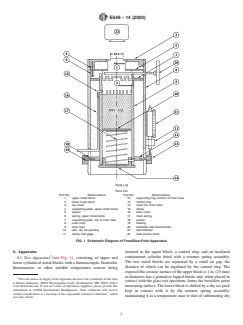
1 upper metal block 12 supporting ring, bottom of inner tube
2 lower metal block 13 control ring
3 top cover 14 cover lid, inner tube
4 supporting plate, upper metal block 15 elbow
5 spacer 16 tube, nylon
6 spring, upper metal block 17 main spring
7 supporting plate, top of inner tube 18 spacer
8 outer tube 19 bearing
9 inner tube 20 bimetallic dial thermometer
10 disk, dry ice pushing 21 dial indicator
11 clamp, dial gage 22 heat source block
FIG. 1 Schematic Diagram of Frost/Dew-Point Apparatus
6. Apparatus inserted in the upper block; a control ring; and an insulated
containment cylinder fitted with a retainer spring assembly.
6.1 Test Apparatus (see Fig. 1), consisting of upper and
The two metal blocks are separated by a small air gap, the
lower cylindrical metal blocks with a thermocouple, bimetallic
distance of which can be regulated by the control ring. The
thermometer, or other suitable temperature sensors being
exposedflatcircularsurfaceoftheupperblockis1in.(25mm)
indiameter;hasagroundorlappedfinish;and,whenplacedin
The sole source of supply of the apparatus known to the committee at this time
contact with the glass test specimen, forms the frost/dew point
is Dennis Industries, 20032 Waynegarden Court, Germantown, MD 20874, http://
www.dennisind.com. If you are aware of alternative suppliers, please provide this
measuringsurface.Thelowerblockischilledbyadryicepack
information to ASTM International Headquarters. Your comments will receive
kept in contact with it by the retainer spring assembly,
careful consideration at a meeting of the responsible technical committee, which
maintaining it at a temperature near to that of sublimating dry
you may attend.
E546 − 14 (2020)
ice (−109°F (−78°C)). Because the solid metal blocks are upside down on a soft cloth, opening the cover lid, taking out
highlyconductive,thetemperatureofeachisvirtuallyuniform. the retainer spring assembly, and repeating steps 9.1.3 and
Useofthecontrolringadjuststheairgapdistancebetweenthe 9.1.4.
two blocks to give the desired thermal resistance across the air
9.3 Determination of Frost State and No-Frost State:
gap. The circular measuring surface of the upper block is thus
9.3.1 Charge the frost/dew point apparatus with dry ice as
readily adjusted to the desired temperature while in contact
described in 9.1 or 9.2.
with the test specimen. The circular measuring surface diam-
9.3.2 Clean both exterior surfaces of the specimen.
eter specified is suitable for frost/dew point measurement of
9.3.3 Due to the changes in the cold plate design the use of
glass up to ⁄4 in. (6.0 mm) thick.
the aluminized polyester film is no longer a requirement.
6.1.1 Upper and Lower Metal Blocks, aluminum alloy that
However it is still recommended in order to ensure a pristine
may be anodized, conforming to the dimensions shown in Fig.
viewing surface.
1. Other parts of the apparatus may be fabricated from any
9.3.4 If the reflective film is used, use the following proce-
appropriate materials. 3
dure:Placeapieceofsilver-coloredaluminizedpolyesterfilm
6.1.2 Calibrated Temperature-Measuring Device; such as a
(highly reflective mirror surface, not thicker than 0.003 in.
thermocouple, thermistor, or bimetallic thermometer; having a
(0.08 mm) and 1 in. (25 mm) in diameter or 1in. by 1 in.
suitablerangegraduatedin2°F(1°C)orsmallerunits;andan
(25mm by 25 mm) on the measuring surface by wetting both
accuracy of 61°F(60.5°C) over the full scale. A suggested
surfaces of the film with acetone or alcohol (Warning—See
calibration of the bimetallic thermometer is described in
9.1.3). Center the specimen on the apparatus. Examine the
Appendix X1.
lower air space glass surface in the region where frost is to be
6.1.3 The size of the temperature measuring probe shall
deposited,tobeawareofanydirtorotherforeignparticlesthat
match the bore size drilled into the aluminum head in order to
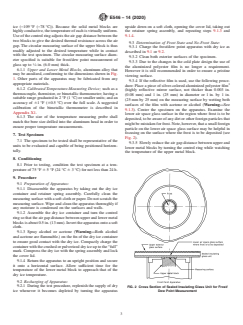
mightbemistakenforfrost.Note,however,thatasmallforeign
ensure proper temperature measurements.
particle on the lower air space glass surface may be helpful in
focusing on the surface where the frost is to be deposited (see
7. Test Specimen
Fig. 2).
7.1 The specimen to be tested shall be representative of the
9.3.5 Slowly reduce the air gap distance between upper and
units to be evaluated and capable of being positioned horizon-
lower metal blocks by turning the control ring while watching
tally.
the temperature of the upper metal block.
8. Conditioning
8.1 Prior to testing, condition the test specimen at a tem-
peratureof75°F 65°F(24°C 63°C)fornotlessthan24h.
9. Procedure
9.1 Preparation of Apparatus:
9.1.1 Disassemble the apparatus by taking out the dry ice
container and retainer spring assembly. Carefully clean the
measuringsurfacewithasoftclothorpaper.Donotscratchthe
measuring surface.Wipe and clean the apparatus thoroughly if
any moisture is condensed on the surfaces and walls.
9.1.2 Assemble the dry ice container and t
...