

ASTM B237-20
(Specification)Standard Specification for Refined Antimony
General Information
- Abstract
ABSTRACT
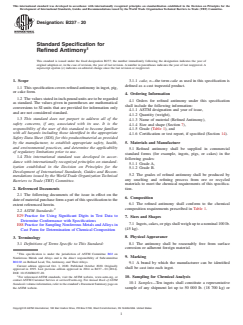
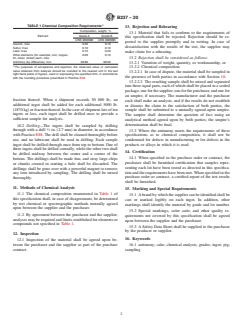
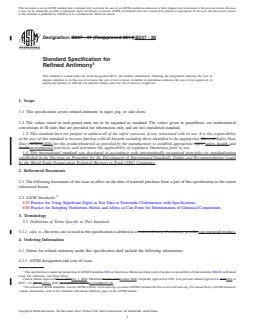
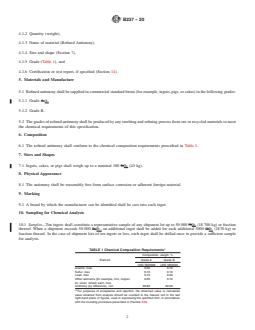
This specification covers refined antimony in ingot, pig, or cake form. Refined antimony shall be supplied in commercial standard forms in Grade A and Grade B. The grades of refined antimony shall be produced by any smelting and refining process from ore or recycled materials to meet the chemical requirements of this specification. The refined antimony shall conform to the required chemical composition of arsenic, sulfur, lead, and others. The antimony shall be reasonably free from surface corrosion or adherent foreign material.
SCOPE
1.1 This specification covers refined antimony in ingot, pig, or cake form.
1.2 The values stated in inch-pound units are to be regarded as standard. The values given in parentheses are mathematical conversions to SI units that are provided for information only and are not considered standard.
1.3 This standard does not purport to address all of the safety concerns, if any, associated with its use. It is the responsibility of the user of this standard to become familiar with all hazards including those identified in the appropriate Safety Data Sheet (SDS) for this product/material as provided by the manufacturer, to establish appropriate safety, health, and environmental practices, and determine the applicability of regulatory limitations prior to use.
1.4 This international standard was developed in accordance with internationally recognized principles on standardization established in the Decision on Principles for the Development of International Standards, Guides and Recommendations issued by the World Trade Organization Technical Barriers to Trade (TBT) Committee.
- Status
- Published
- Publication Date
- 30-Sep-2020
- Technical Committee
- B02 - Nonferrous Metals and Alloys
- Drafting Committee
- B02.02 - Refined Lead, Tin, Antimony, and Their Alloys



Overview
ASTM B237-20: Standard Specification for Refined Antimony is a key international standard developed by ASTM International. This specification defines the requirements for refined antimony in ingot, pig, or cake form, establishing criteria for chemical composition, physical appearance, markings, and more. Producers and users of antimony in industrial and metallurgical sectors rely on this standard to ensure material quality, compatibility, and safety in their supply chains. ASTM B237-20 covers both Grade A and Grade B refined antimony, referencing forms produced from both ore and recycled sources.
Key Topics
- Forms and Grades
- Covers antimony supplied in commercial standard forms: ingots, pigs, and cakes.
- Defines two grades: Grade A (higher purity) and Grade B, each with specified compositions.
- Chemical Composition
- Prescribes maximum allowable limits for elements such as arsenic, sulfur, lead, and other metals.
- Antimony content is specified by minimum percent for both grades.
- Manufacturing Sources
- Allows production via smelting and refining processes from either ore or recycled materials.
- Physical and Surface Requirements
- Material must be free from significant corrosion or foreign material.
- Each ingot must be clearly marked with the manufacturer’s brand and grade.
- Sampling and Testing
- Describes sampling practices (e.g., number of ingots per lot to test, drilling procedures).
- Recommends ASTM E88 for sampling cast nonferrous metals.
- Certification and Inspection
- Requires certification or test reports if specified in the purchase order.
- Inspection protocols must be mutually agreed upon by purchaser and supplier.
Applications
ASTM B237-20 is essential for industries requiring high-purity antimony for manufacturing processes. Key applications include:
- Lead-acid Battery Grids: Serves as a hardening agent for lead in batteries, improving mechanical properties and performance.
- Alloy Production: Used in various alloys (such as those with tin and lead) for bearings, solders, and cable sheathing.
- Flame Retardants: Acts as a synergist in plastics and textiles for improved flame resistance.
- Electronics & Semiconductors: Utilized in specialized alloys and as a dopant material.
- Chemicals: Ingredient in pigments and other chemical products.
Adhering to ASTM B237-20 ensures that antimony products are consistent, reliable, and safe for these applications, meeting the expectations of global manufacturers and regulatory agencies.
Related Standards
- ASTM E29: Practice for Using Significant Digits in Test Data to Determine Conformance with Specifications - referenced for rounding procedures.
- ASTM E88: Practice for Sampling Nonferrous Metals and Alloys in Cast Form - guiding sampling methods for chemical analysis.
- ASTM B29: Standard Specification for Refined Lead - relevant for lead alloy producers.
- International Material Safety Data Sheets (SDS): Required for proper handling and compliance.
For more information, visit the ASTM International website.
Keywords: ASTM B237-20, refined antimony, antimony ingot, antimony pig, antimony cake, Grade A antimony, Grade B antimony, chemical composition, sampling, nonferrous metals, industrial antimony standards.
Relations
- Effective Date
- 01-Sep-2017
- Effective Date
- 01-May-2011
- Effective Date
- 01-Oct-2008
- Effective Date
- 15-Nov-2006
- Effective Date
- 15-Sep-2006
- Effective Date
- 01-May-2006
- Effective Date
- 01-Oct-2005
- Effective Date
- 01-Dec-2004
- Effective Date
- 10-May-2002
- Effective Date
- 01-Jan-2001
- Effective Date
- 01-Jan-2001
- Effective Date
- 10-May-1999
Get Certified
Connect with accredited certification bodies for this standard

Element Materials Technology
Materials testing and product certification.

Inštitut za kovinske materiale in tehnologije
Institute of Metals and Technology. Materials testing, metallurgical analysis, NDT.
Sponsored listings
Frequently Asked Questions
ASTM B237-20 is a technical specification published by ASTM International. Its full title is "Standard Specification for Refined Antimony". This standard covers: ABSTRACT This specification covers refined antimony in ingot, pig, or cake form. Refined antimony shall be supplied in commercial standard forms in Grade A and Grade B. The grades of refined antimony shall be produced by any smelting and refining process from ore or recycled materials to meet the chemical requirements of this specification. The refined antimony shall conform to the required chemical composition of arsenic, sulfur, lead, and others. The antimony shall be reasonably free from surface corrosion or adherent foreign material. SCOPE 1.1 This specification covers refined antimony in ingot, pig, or cake form. 1.2 The values stated in inch-pound units are to be regarded as standard. The values given in parentheses are mathematical conversions to SI units that are provided for information only and are not considered standard. 1.3 This standard does not purport to address all of the safety concerns, if any, associated with its use. It is the responsibility of the user of this standard to become familiar with all hazards including those identified in the appropriate Safety Data Sheet (SDS) for this product/material as provided by the manufacturer, to establish appropriate safety, health, and environmental practices, and determine the applicability of regulatory limitations prior to use. 1.4 This international standard was developed in accordance with internationally recognized principles on standardization established in the Decision on Principles for the Development of International Standards, Guides and Recommendations issued by the World Trade Organization Technical Barriers to Trade (TBT) Committee.
ABSTRACT This specification covers refined antimony in ingot, pig, or cake form. Refined antimony shall be supplied in commercial standard forms in Grade A and Grade B. The grades of refined antimony shall be produced by any smelting and refining process from ore or recycled materials to meet the chemical requirements of this specification. The refined antimony shall conform to the required chemical composition of arsenic, sulfur, lead, and others. The antimony shall be reasonably free from surface corrosion or adherent foreign material. SCOPE 1.1 This specification covers refined antimony in ingot, pig, or cake form. 1.2 The values stated in inch-pound units are to be regarded as standard. The values given in parentheses are mathematical conversions to SI units that are provided for information only and are not considered standard. 1.3 This standard does not purport to address all of the safety concerns, if any, associated with its use. It is the responsibility of the user of this standard to become familiar with all hazards including those identified in the appropriate Safety Data Sheet (SDS) for this product/material as provided by the manufacturer, to establish appropriate safety, health, and environmental practices, and determine the applicability of regulatory limitations prior to use. 1.4 This international standard was developed in accordance with internationally recognized principles on standardization established in the Decision on Principles for the Development of International Standards, Guides and Recommendations issued by the World Trade Organization Technical Barriers to Trade (TBT) Committee.
ASTM B237-20 is classified under the following ICS (International Classification for Standards) categories: 77.120.99 - Other non-ferrous metals and their alloys. The ICS classification helps identify the subject area and facilitates finding related standards.
ASTM B237-20 has the following relationships with other standards: It is inter standard links to ASTM E88-11(2017), ASTM E88-11, ASTM E29-08, ASTM E29-06b, ASTM E29-06a, ASTM E29-06, ASTM E88-91(2005), ASTM E29-04, ASTM E29-02e1, ASTM E88-91(1996), ASTM E88-91(2001), ASTM E29-93a(1999). Understanding these relationships helps ensure you are using the most current and applicable version of the standard.
ASTM B237-20 is available in PDF format for immediate download after purchase. The document can be added to your cart and obtained through the secure checkout process. Digital delivery ensures instant access to the complete standard document.
Standards Content (Sample)
This international standard was developed in accordance with internationally recognized principles on standardization established in the Decision on Principles for the
Development of International Standards, Guides and Recommendations issued by the World Trade Organization Technical Barriers to Trade (TBT) Committee.
Designation:B237 −20
Standard Specification for
Refined Antimony
This standard is issued under the fixed designation B237; the number immediately following the designation indicates the year of
original adoption or, in the case of revision, the year of last revision. A number in parentheses indicates the year of last reapproval. A
superscript epsilon (´) indicates an editorial change since the last revision or reapproval.
1. Scope 3.1.1 cake, n—the term cake as used in this specification is
defined as a cast trapezoid product.
1.1 This specification covers refined antimony in ingot, pig,
or cake form.
4. Ordering Information
1.2 The values stated in inch-pound units are to be regarded
4.1 Orders for refined antimony under this specification
as standard. The values given in parentheses are mathematical
shall include the following information:
conversions to SI units that are provided for information only
4.1.1 ASTM designation and year of issue,
and are not considered standard.
4.1.2 Quantity (weight),
1.3 This standard does not purport to address all of the
4.1.3 Name of material (Refined Antimony),
safety concerns, if any, associated with its use. It is the
4.1.4 Size and shape (Section 7),
responsibility of the user of this standard to become familiar
4.1.5 Grade (Table 1), and
with all hazards including those identified in the appropriate
4.1.6 Certification or test report, if specified (Section 14).
Safety Data Sheet (SDS) for this product/material as provided
5. Materials and Manufacture
by the manufacturer, to establish appropriate safety, health,
and environmental practices, and determine the applicability
5.1 Refined antimony shall be supplied in commercial
of regulatory limitations prior to use.
standard forms (for example, ingots, pigs, or cakes) in the
1.4 This international standard was developed in accor-
following grades:
dance with internationally recognized principles on standard-
5.1.1 Grade A,
ization established in the Decision on Principles for the
5.1.2 Grade B.
Development of International Standards, Guides and Recom-
5.2 The grades of refined antimony shall be produced by
mendations issued by the World Trade Organization Technical
any smelting and refining process from ore or recycled
Barriers to Trade (TBT) Committee.
materials to meet the chemical requirements of this specifica-
2. Referenced Documents
tion.
2.1 The following documents of the issue in effect on the
6. Composition
date of material purchase form a part of this specification to the
6.1 The refined antimony shall conform to the chemical
extent referenced herein.
composition requirements prescribed in Table 1.
2.2 ASTM Standards:
E29 Practice for Using Significant Digits in Test Data to
7. Sizes and Shapes
Determine Conformance with Specifications
7.1 Ingots,cakes,orpigsshallweighuptoanominal100lb.
E88 Practice for Sampling Nonferrous Metals and Alloys in
(45 kg).
Cast Form for Determination of Chemical Composition
8. Physical Appearance
3. Terminology
8.1 The antimony shall be reasonably free from surface
3.1 Definitions of Terms Specific to This Standard:
corrosion or adherent foreign material.
This specification is under the jurisdiction of ASTM Committee B02 on
9. Marking
Nonferrous Metals and Alloys and is the direct responsibility of Subcommittee
B02.02 on Refined Lead, Tin, Antimony, and Their Alloys.
9.1 A brand by which the manufacturer can be identified
Current edition approved Oct. 1, 2020. Published October 2020. Originally
shall be cast into each ingot.
approved in 1995. Last previous edition approved in 2014 as B237 – 01 (2014).
DOI: 10.1520/B0237-20.
For referenced ASTM standards, visit the ASTM website, www.astm.org, or 10. Sampling for Chemical Analysis
contact ASTM Customer Service at service@astm.org. For Annual Book of ASTM
10.1 Samples—Ten ingots shall constitute a representative
Standards volume information, refer to the standard’s Document Summary page on
the ASTM website. sample of any shipment lot up to 50 000 lb. (18 700 kg) or
Copyright © ASTM International, 100 Barr Harbor Drive, PO Box C700, West Conshohocken, PA 19428-2959. United States
B237−20
A
TABLE 1 Chemical Composition Requirements
13. Rejection and Rehearing
Composition, weight, %
13.1 Material that fails to conform to the requirements of
Element Grade A Grade B
this specification shall be rejected. Rejection should be re-
UNS M00998 UNS M00995
ported to the supplier promptly and in writing. In case of
Arsenic, max 0.05 0.10
dissatisfaction with the results of the test, the supplier may
Sulfur, max 0.10 0.10
Lead, max 0.15 0.20
make claim for a rehearing.
Other elements (for example, iron, copper, 0.05 0.10
13.2 Rejection shall be considered as follows:
tin, silver, nickel) each, max
Antimony (by difference), min 99.80 99.50
13.2.1 Variation of weight, quantity, or workmanship, or
A
For purposes of accept
...
This document is not an ASTM standard and is intended only to provide the user of an ASTM standard an indication of what changes have been made to the previous version. Because
it may not be technically possible to adequately depict all changes accurately, ASTM recommends that users consult prior editions as appropriate. In all cases only the current version
of the standard as published by ASTM is to be considered the official document.
Designation: B237 − 01 (Reapproved 2014) B237 − 20
Standard Specification for
Refined Antimony
This standard is issued under the fixed designation B237; the number immediately following the designation indicates the year of
original adoption or, in the case of revision, the year of last revision. A number in parentheses indicates the year of last reapproval. A
superscript epsilon (´) indicates an editorial change since the last revision or reapproval.
1. Scope
1.1 This specification covers refined antimony in ingot, pig, or cake form.
1.2 The values stated in inch-pound units are to be regarded as standard. The values given in parentheses are mathematical
conversions to SI units that are provided for information only and are not considered standard.
1.3 This standard does not purport to address all of the safety concerns, if any, associated with its use. It is the responsibility
of the user of this standard to become familiar with all hazards including those identified in the appropriate Material Safety Data
Sheet (MSDS)(SDS) for this product/material as provided by the manufacturer, to establish appropriate safety safety, health, and
healthenvironmental practices, and determine the applicability of regulatory limitations prior to use.
1.4 This international standard was developed in accordance with internationally recognized principles on standardization
established in the Decision on Principles for the Development of International Standards, Guides and Recommendations issued
by the World Trade Organization Technical Barriers to Trade (TBT) Committee.
2. Referenced Documents
2.1 The following documents of the issue in effect on the date of material purchase form a part of this specification to the extent
referenced herein.
2.2 ASTM Standards:
E29 Practice for Using Significant Digits in Test Data to Determine Conformance with Specifications
E88 Practice for Sampling Nonferrous Metals and Alloys in Cast Form for Determination of Chemical Composition
3. Terminology
3.1 Definitions of Terms Specific to This Standard:
3.1.1 cake, n—the term cake as used in this specification is defined as a coalesced mass of antimony powder.cast trapezoid product.
4. Ordering Information
4.1 Orders for refined antimony under this specification shall include the following information:
4.1.1 ASTM designation and year of issue,
This specification is under the jurisdiction of ASTM Committee B02 on Nonferrous Metals and Alloys and is the direct responsibility of Subcommittee B02.02 on Refined
Lead, Tin, Antimony, and Their Alloys.
Current edition approved Oct. 1, 2014Oct. 1, 2020. Published October 2014October 2020. Originally approved in 1995. Last previous edition approved in 20102014 as
B237 – 01 (2010).(2014). DOI: 10.1520/B0237-01R14.10.1520/B0237-20.
For referenced ASTM standards, visit the ASTM website, www.astm.org, or contact ASTM Customer Service at service@astm.org. For Annual Book of ASTM Standards
volume information, refer to the standard’s Document Summary page on the ASTM website.
Copyright © ASTM International, 100 Barr Harbor Drive, PO Box C700, West Conshohocken, PA 19428-2959. United States
B237 − 20
4.1.2 Quantity (weight),
4.1.3 Name of material (Refined Antimony),
4.1.4 Size and shape (Section 7),
4.1.5 Grade (Table 1), and
4.1.6 Certification or test report, if specified (Section 14).
5. Materials and Manufacture
5.1 Refined antimony shall be supplied in commercial standard forms (for example, ingots, pigs, or cakes) in the following grades:
5.1.1 Grade A.A,
5.1.2 Grade B.
5.2 The grades of refined antimony shall be produced by any smelting and refining process from ore or recycled materials to meet
the chemical requirements of this specification.
6. Composition
6.1 The refined antimony shall conform to the chemical composition requirements prescribed in Table 1.
7. Sizes and Shapes
7.1 Ingots, cakes, or pigs shall weigh up to a nominal 100 lblb. (45 kg).
8. Physical Appearance
8.1 The antimony shall be reasonably free from surface corrosion or adherent foreign material.
9. Marking
9.1 A brand by which the manufacturer can be identified shall be cast into each ingot.
10. Sampling for Chemical Analysis
10.1 Samples—Ten ingots shall constitute a representative sample of any shipment lot up to 50 000 lblb. (18 700 kg) or fraction
thereof. When a shipment exceeds 50 000 lb,lb., an additional ingot shall be added for each additional 5000 lblb. (1870 kg) or
fraction thereof. In the case of shipment lots of ten ingots or less, each ingot shall be drilled once to provide a sufficient sample
for analysis.
A
TABLE 1 Chemical Composition Requirements
Composition, weight, %
Element Grade A Grade B
UNS M00998 UNS M00995
Arsenic, max 0.05 0.10
Sulfur, max 0.10 0.10
Lead, max 0.15 0.20
Other elements (for example, iron, copper, 0.05 0.10
tin, silver, nickel) each, max
Antimony (by difference), min 99.80 99.50
A
For purposes of acceptance and rejection, the observed value or cal
...