

ASTM A376/A376M-22
(Specification)Standard Specification for Seamless Austenitic Steel Pipe for High-Temperature Service
General Information
- Abstract
ABSTRACT
This specification covers seamless austenitic steel pipe intended for high-temperature central-station service. The grades covered are five H grades and two nitrogen grades. Pipe may be either hot finished or cold finished, with a suitable finishing treatment. All pipes shall be furnished in the heat-treated condition unless the order specifically states that no final heat treatment shall be applied. Tensile tests, hydrostatic test, nondestructive electric tests, ultrasonic tests, eddy-current tests, tension tests, and flattening tests shall be made to conform to the requirements specified.
SCOPE
1.1 This specification2 covers seamless austenitic steel pipe intended for high-temperature service. Among the grades covered are H grades and nitrogen grades that are specifically intended for high-temperature service.
Note 1: This specification was originally developed for use for piping in the central stations of electric-power generating thermal plants. However, its use is not restricted to such applications and it may be used in other applications for which the attributes of the materials, as defined by this specification, are appropriate.
1.2 Optional supplementary requirements (S1 through S10) are provided. These supplementary requirements specify additional tests that will be made only when stated in the order, together with the number of such tests required.
1.3 Grades TP321 and TP321H have lower strength requirements for nominal wall thicknesses greater than 3/8 in. [9.5 mm].
1.4 The values stated in either inch-pound units or SI units are to be regarded separately as standard. Within the text, the SI units are shown in brackets. The values stated in each system may not be exact equivalents; therefore, each system shall be used independently of the other. Combining values from the two systems may result in non-conformance with the standard. The inch-pound units shall apply unless the “M” designation of this specification is specified in the order.
Note 2: The dimensionless designators NPS (nominal pipe size) and DN (Diametre Nominel) have been substituted in this standard for such traditional terms as “nominal diameter,” “size,” and “nominal size.”
1.5 This international standard was developed in accordance with internationally recognized principles on standardization established in the Decision on Principles for the Development of International Standards, Guides and Recommendations issued by the World Trade Organization Technical Barriers to Trade (TBT) Committee.
- Status
- Published
- Publication Date
- 31-Oct-2022
- Technical Committee
- A01 - Steel, Stainless Steel and Related Alloys
- Drafting Committee
- A01.10 - Stainless and Alloy Steel Tubular Products
Buy Documents
ASTM A376/A376M-22 - Standard Specification for Seamless Austenitic Steel Pipe for High-Temperature Service
REDLINE ASTM A376/A376M-22 - Standard Specification for Seamless Austenitic Steel Pipe for High-Temperature Service
Overview
ASTM A376/A376M-22 is the internationally recognized standard specification for seamless austenitic steel pipe intended for high-temperature service. Established by ASTM International, this standard outlines requirements for pipes primarily used in central-station electric-power generating plants, though its scope is not limited to this industry. Covering a variety of H grades and nitrogen grades, ASTM A376/A376M-22 ensures consistent quality and performance of austenitic stainless steel pipe under demanding, high-temperature environments.
This specification addresses product manufacture, chemical composition, mechanical properties, testing procedures, and marking requirements, supporting stakeholders in industries where safety, reliability, and compliance are critical.
Key Topics
Scope and Materials
- Seamless austenitic steel pipes for high-temperature service
- Applicable to both H grades and nitrogen grades
- Typically used for power generation but suitable for other applications requiring high-temperature resistance
Manufacturing and Heat Treatment
- Pipes may be hot finished or cold finished, with suitable finishing treatments
- All pipes furnished in heat-treated condition unless otherwise specified in the order
- Detailed heat treatment guidelines to ensure corrosion resistance and mechanical integrity
Testing and Inspection
- Mandatory tensile, hydrostatic, nondestructive electric, ultrasonic, eddy-current, tension, and flattening tests
- Supplementary requirements (S1-S10) for additional testing or test frequency as specified in the order
- Test operator must be certified under recognized nondestructive testing qualification systems
Chemical and Mechanical Properties
- Strict adherence to chemical composition for included grades (such as TP304, TP316, TP321, TP347, TP348, etc.)
- Defined mechanical properties such as tensile strength, yield strength, and elongation, tailored to wall thickness and grade
Product Marking and Certification
- Detailed marking requirements including grade, heat number, and testing methods used
- Certification must clearly indicate compliance and, where applicable, any deviations or special requirements
Applications
ASTM A376/A376M-22 certified seamless austenitic steel pipes are widely used in environments that demand excellent mechanical strength and corrosion resistance at elevated temperatures. Key application areas include:
- High-temperature piping in central-station electric power generating plants, including feedwater heaters and superheaters
- Chemical and petrochemical processing plants where corrosion resistance and strength are essential
- Refineries and industrial boilers
- Heat exchanger tubing for critical service where reliability under high temperature and pressure is vital
- Other process plant applications outside power generation whenever high-temperature performance is necessary
The use of pipes compliant with ASTM A376/A376M-22 helps ensure operational safety, regulatory compliance, and long-term durability in systems exposed to aggressive operating conditions.
Related Standards
To ensure comprehensive compliance and compatibility, ASTM A376/A376M-22 references several related industry standards, including:
- ASTM A999/A999M: General requirements for alloy and stainless steel pipe
- ASTM A262: Testing practices for susceptibility to intergranular corrosion in austenitic stainless steels
- ASTM E112: Methods for determining average grain size
- ASTM E213: Ultrasonic testing of metal pipe and tubing
- ASTM E426: Eddy current examination of tubular products
- ASME SA-376: Boiler and Pressure Vessel Code specification for this pipe
These related standards provide additional details on testing, personnel qualification, and requirements for seamless stainless steel pipe used in high-temperature and critical service applications.
Keywords: ASTM A376, seamless austenitic steel pipe, high-temperature pipe, stainless steel pipe, power generation piping, central station service, mechanical testing, hydrostatic testing, nondestructive testing, corrosion-resistant piping, ASTM A376/A376M-22
Relations
- Effective Date
- 01-Sep-2017
- Effective Date
- 01-Sep-2016
- Effective Date
- 01-Dec-2015
- Effective Date
- 01-May-2013
- Effective Date
- 01-Apr-2013
- Effective Date
- 15-Nov-2012
- Effective Date
- 01-Aug-2012
- Effective Date
- 01-May-2012
- Effective Date
- 15-May-2011
- Effective Date
- 01-Nov-2010
- Effective Date
- 01-Apr-2010
- Effective Date
- 01-Oct-2009
- Effective Date
- 01-Jun-2009
- Effective Date
- 01-Mar-2008
- Effective Date
- 01-Dec-2007
Buy Documents
ASTM A376/A376M-22 - Standard Specification for Seamless Austenitic Steel Pipe for High-Temperature Service
REDLINE ASTM A376/A376M-22 - Standard Specification for Seamless Austenitic Steel Pipe for High-Temperature Service
Get Certified
Connect with accredited certification bodies for this standard

Institut za varilstvo d.o.o. (Welding Institute)
Slovenia's leading welding institute since 1952. ISO 3834, EN 1090, pressure equipment certification, NDT personnel, welder qualification. Only IIW Au
Sponsored listings
Frequently Asked Questions
ASTM A376/A376M-22 is a technical specification published by ASTM International. Its full title is "Standard Specification for Seamless Austenitic Steel Pipe for High-Temperature Service". This standard covers: ABSTRACT This specification covers seamless austenitic steel pipe intended for high-temperature central-station service. The grades covered are five H grades and two nitrogen grades. Pipe may be either hot finished or cold finished, with a suitable finishing treatment. All pipes shall be furnished in the heat-treated condition unless the order specifically states that no final heat treatment shall be applied. Tensile tests, hydrostatic test, nondestructive electric tests, ultrasonic tests, eddy-current tests, tension tests, and flattening tests shall be made to conform to the requirements specified. SCOPE 1.1 This specification2 covers seamless austenitic steel pipe intended for high-temperature service. Among the grades covered are H grades and nitrogen grades that are specifically intended for high-temperature service. Note 1: This specification was originally developed for use for piping in the central stations of electric-power generating thermal plants. However, its use is not restricted to such applications and it may be used in other applications for which the attributes of the materials, as defined by this specification, are appropriate. 1.2 Optional supplementary requirements (S1 through S10) are provided. These supplementary requirements specify additional tests that will be made only when stated in the order, together with the number of such tests required. 1.3 Grades TP321 and TP321H have lower strength requirements for nominal wall thicknesses greater than 3/8 in. [9.5 mm]. 1.4 The values stated in either inch-pound units or SI units are to be regarded separately as standard. Within the text, the SI units are shown in brackets. The values stated in each system may not be exact equivalents; therefore, each system shall be used independently of the other. Combining values from the two systems may result in non-conformance with the standard. The inch-pound units shall apply unless the “M” designation of this specification is specified in the order. Note 2: The dimensionless designators NPS (nominal pipe size) and DN (Diametre Nominel) have been substituted in this standard for such traditional terms as “nominal diameter,” “size,” and “nominal size.” 1.5 This international standard was developed in accordance with internationally recognized principles on standardization established in the Decision on Principles for the Development of International Standards, Guides and Recommendations issued by the World Trade Organization Technical Barriers to Trade (TBT) Committee.
ABSTRACT This specification covers seamless austenitic steel pipe intended for high-temperature central-station service. The grades covered are five H grades and two nitrogen grades. Pipe may be either hot finished or cold finished, with a suitable finishing treatment. All pipes shall be furnished in the heat-treated condition unless the order specifically states that no final heat treatment shall be applied. Tensile tests, hydrostatic test, nondestructive electric tests, ultrasonic tests, eddy-current tests, tension tests, and flattening tests shall be made to conform to the requirements specified. SCOPE 1.1 This specification2 covers seamless austenitic steel pipe intended for high-temperature service. Among the grades covered are H grades and nitrogen grades that are specifically intended for high-temperature service. Note 1: This specification was originally developed for use for piping in the central stations of electric-power generating thermal plants. However, its use is not restricted to such applications and it may be used in other applications for which the attributes of the materials, as defined by this specification, are appropriate. 1.2 Optional supplementary requirements (S1 through S10) are provided. These supplementary requirements specify additional tests that will be made only when stated in the order, together with the number of such tests required. 1.3 Grades TP321 and TP321H have lower strength requirements for nominal wall thicknesses greater than 3/8 in. [9.5 mm]. 1.4 The values stated in either inch-pound units or SI units are to be regarded separately as standard. Within the text, the SI units are shown in brackets. The values stated in each system may not be exact equivalents; therefore, each system shall be used independently of the other. Combining values from the two systems may result in non-conformance with the standard. The inch-pound units shall apply unless the “M” designation of this specification is specified in the order. Note 2: The dimensionless designators NPS (nominal pipe size) and DN (Diametre Nominel) have been substituted in this standard for such traditional terms as “nominal diameter,” “size,” and “nominal size.” 1.5 This international standard was developed in accordance with internationally recognized principles on standardization established in the Decision on Principles for the Development of International Standards, Guides and Recommendations issued by the World Trade Organization Technical Barriers to Trade (TBT) Committee.
ASTM A376/A376M-22 is classified under the following ICS (International Classification for Standards) categories: 23.040.10 - Iron and steel pipes. The ICS classification helps identify the subject area and facilitates finding related standards.
ASTM A376/A376M-22 has the following relationships with other standards: It is inter standard links to ASTM A999/A999M-17, ASTM A999/A999M-16, ASTM A999/A999M-15, ASTM A262-13, ASTM A999/A999M-13, ASTM E112-12, ASTM E426-12, ASTM A999/A999M-12, ASTM A999/A999M-11, ASTM E112-10, ASTM A262-10, ASTM A999/A999M-04a(2009), ASTM E213-09, ASTM A262-02a(2008), ASTM E426-98(2007). Understanding these relationships helps ensure you are using the most current and applicable version of the standard.
ASTM A376/A376M-22 is available in PDF format for immediate download after purchase. The document can be added to your cart and obtained through the secure checkout process. Digital delivery ensures instant access to the complete standard document.
Standards Content (Sample)
This international standard was developed in accordance with internationally recognized principles on standardization established in the Decision on Principles for the
Development of International Standards, Guides and Recommendations issued by the World Trade Organization Technical Barriers to Trade (TBT) Committee.
Designation:A376/A376M −22 Used in USDOE-NE standards
Standard Specification for
Seamless Austenitic Steel Pipe for High-Temperature
Service
This standard is issued under the fixed designationA376/A376M; the number immediately following the designation indicates the year
of original adoption or, in the case of revision, the year of last revision. A number in parentheses indicates the year of last reapproval.
A superscript epsilon (´) indicates an editorial change since the last revision or reapproval.
1. Scope* 2. Referenced Documents
2 3
1.1 This specification covers seamless austenitic steel pipe 2.1 ASTM Standards:
intended for high-temperature service. Among the grades A262 Practices for Detecting Susceptibility to Intergranular
covered are H grades and nitrogen grades that are specifically Attack in Austenitic Stainless Steels
intended for high-temperature service. A999/A999M Specification for General Requirements for
NOTE 1—This specification was originally developed for use for piping
Alloy and Stainless Steel Pipe
in the central stations of electric-power generating thermal plants.
E112 Test Methods for Determining Average Grain Size
However, its use is not restricted to such applications and it may be used
E213 Practice for Ultrasonic Testing of Metal Pipe and
inotherapplicationsforwhichtheattributesofthematerials,asdefinedby
Tubing
this specification, are appropriate.
E381 Method of Macroetch Testing Steel Bars, Billets,
1.2 Optional supplementary requirements (S1 through S10)
Blooms, and Forgings
are provided. These supplementary requirements specify addi-
E426 Practice for Electromagnetic (Eddy Current) Examina-
tional tests that will be made only when stated in the order,
tion of Seamless and Welded Tubular Products, Titanium,
together with the number of such tests required.
Austenitic Stainless Steel and Similar Alloys
1.3 GradesTP321 andTP321H have lower strength require-
2.2 Other Standards:
ments for nominal wall thicknesses greater than ⁄8 in. [9.5
SNT-TC-1A Personnel Qualification and Certification in
mm].
Nondestructive Testing
1.4 The values stated in either inch-pound units or SI units
3. Ordering Information
are to be regarded separately as standard. Within the text, the
SI units are shown in brackets. The values stated in each 3.1 Orders for material to this specification should include
system may not be exact equivalents; therefore, each system
the following, as required to describe the desired material
shall be used independently of the other. Combining values adequately:
from the two systems may result in non-conformance with the
3.1.1 Quantity (feet, centimetres, or number of lengths),
standard. The inch-pound units shall apply unless the “M” 3.1.2 Name of material (seamless austenitic steel pipe),
designation of this specification is specified in the order. 3.1.3 Grade (Table 1),
3.1.4 Size (nominal size, or outside diameter and schedule
NOTE 2—The dimensionless designators NPS (nominal pipe size) and
number or average wall thickness),
DN (Diametre Nominel) have been substituted in this standard for such
3.1.5 Lengths (specific or random), (Permissible Variations
traditional terms as “nominal diameter,” “size,” and “nominal size.”
in Length Section of Specification A999/A999M),
1.5 This international standard was developed in accor-
3.1.6 End finish (Ends Section of Specification A999/
dance with internationally recognized principles on standard-
A999M),
ization established in the Decision on Principles for the
3.1.7 Optional requirements (Section 8) (see Hydrostatic
Development of International Standards, Guides and Recom-
Test Requirements Section and the Permissible Variation in
mendations issued by the World Trade Organization Technical
Weight for Seamless Pipe Section for weighing individual
Barriers to Trade (TBT) Committee.
lengths, of Specification A999/A999M), (see 9.6, repairing by
welding; 13.3, die stamping),
This specification is under the jurisdiction of ASTM Committee A01 on Steel,
Stainless Steel and Related Alloys and is the direct responsibility of Subcommittee
A01.10 on Stainless and Alloy Steel Tubular Products. For referenced ASTM standards, visit the ASTM website, www.astm.org, or
Current edition approved Nov. 1, 2022. Published November 2022. Originally contact ASTM Customer Service at service@astm.org. For Annual Book of ASTM
approved in 1954. Last previous edition approved in 2019 as A376/A376M – 19. Standards volume information, refer to the standard’s Document Summary page on
DOI: 10.1520/A0376_A0376M-22. the ASTM website.
2 4
For ASME Boiler and Pressure Vessel Code applications see related Specifi- AvailablefromAmericanSocietyforNondestructiveTesting(ASNT),P.O.Box
cation SA-376 in Section II of that Code. 28518, 1711 Arlingate Ln., Columbus, OH 43228-0518.
*A Summary of Changes section appears at the end of this standard
Copyright © ASTM International, 100 Barr Harbor Drive, PO Box C700, West Conshohocken, PA 19428-2959. United States
A376/A376M−22
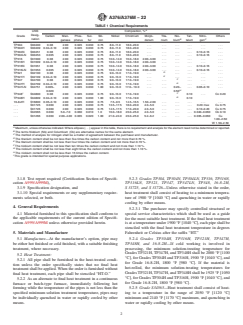
TABLE 1 Chemical Requirements
A
UNS Composition, %
Desig-
Grade
Carbon Man- Phos- Sul- Sili- Nickel Chromium Molyb- Tita- Nio- Tan- Nitro- Others
nation B C
ganese phorus fur con denum nium bium talum gen
TP304 S30400 0.08 2.00 0.045 0.030 0.75 8.0–11.0 18.0–20.0 . . . . . . . . . . . . . . . . . .
TP304H S30409 0.04–0.10 2.00 0.045 0.030 0.75 8.0–11.0 18.0–20.0 . . . . . . . . . . . . . . . . . .
TP304N S30451 0.08 2.00 0.045 0.030 0.75 8.0–11.0 18.0–20.0 . . . . . . . . . . . . 0.10–0.16 . . .
TP304LN S30453 0.035 2.00 0.045 0.030 0.75 8.0–11.0 18.0–20.0 . . . . . . . . . . . . 0.10–0.16 . . .
TP316 S31600 0.08 2.00 0.045 0.030 0.75 10.0–14.0 16.0–18.0 2.00–3.00 . . . . . . . . . . . . . . .
TP316H S31609 0.04–0.10 2.00 0.045 0.030 0.75 10.0–14.0 16.0–18.0 2.00–3.00 . . . . . . . . . . . . . . .
TP316N S31651 0.08 2.00 0.045 0.030 0.75 10.0–14.0 16.0–18.0 2.00–3.00 . . . . . . . . . 0.10–0.16 . . .
TP316LN S31653 0.035 2.00 0.045 0.030 0.75 10.0–14.0 16.0–18.0 2.00–3.00 . . . . . . . . . 0.10–0.16 . . .
D
TP321 S32100 0.08 2.00 0.045 0.030 0.75 9.0–13.0 17.0–19.0 . . . . . . .
E
TP321H S32109 0.04–0.10 2.00 0.045 0.030 0.75 9.0–13.0 17.0–19.0 . . . . . . .
F
TP347 S34700 0.08 2.00 0.045 0.030 0.75 9.0–13.0 17.0–19.0 . . . . . . . . .
G
TP347H S34709 0.04–0.10 2.00 0.045 0.030 0.75 9.0–13.0 17.0–19.0 . . . . . . . . .
TP347LN S34751 0.005– 2.00 0.045 0.030 1.00 9.0–13.0 17.0– 19.0 . . . . . . 0.20– . . . 0.06–0.10 . . .
H
0.020 0.50
I F
TP348 S34800 0.08 2.00 0.045 0.030 0.75 9.0–13.0 17.0–19.0 . . . . . . 0.10 . . . Co 0.20
G
TP348H S34809 0.04–0.10 2.00 0.045 0.030 1.00 9.0–13.0 17.0–19.0 0.10
16-8-2H S16800 0.05–0.10 2.00 0.045 0.030 0.75 7.5–9.5 14.5–16.5 1.50–2.00 . . . . . . . . . . . . . . .
. . . S31725 0.030 2.00 0.045 0.030 0.75 13.5–17.5 18.0–20.0 4.0–5.0 . . . . . . . . . 0.20 max Cu 0.75
. . . S31726 0.030 2.00 0.045 0.030 0.75 14.5–17.5 17.0–20.0 4.0–5.0 . . . . . . . . . 0.10–0.20 Cu 0.75
. . . S34565 0.030 5.0–7.0 0.030 0.010 1.0 16.0–18.0 23.0–25.0 4.0–5.0 . . . . . . . . . 0.040–0.060 Cb 0.10
. . . S31266 0.030 2.00–4.00 0.035 0.020 1.00 21.0–24.0 23.0–25.0 5.2–6.2 . . . . . . . . . 0.035–0.060 Cu
1.00–2.50
W 1.50–2.50
A
Maximum, unless otherwise indicated. Where ellipses (. . .) appear in this table, there is no requirement and analysis for the element need not be determined or reported.
B
The terms Niobium (Nb) and Columbium (Cb) are alternative names for the same element.
C
The method of analysis for nitrogen shall be a matter of agreement between the purchaser and manufacturer.
D
The titanium content shall be not less than five times the carbon content and not more than 0.70 %.
E
The titanium content shall be not less than four times the carbon content and not more than 0.70 %.
F
The niobium content shall be not less than ten times the carbon content and not more than 1.10 %.
G
The niobium content shall be not less than eight times the carbon content and not more than 1.10 %.
H
The niobium content shall not be less than 15 times the carbon content.
I
This grade is intended for special purpose applications.
3.1.8 Test report required (Certification Section of Specifi- 5.2.3 Grades TP304, TP304N, TP304LN, TP316, TP316N,
cation A999/A999M), TP316LN, TP321, TP347, TP347LN, TP348, 16-8-2H,
3.1.9 Specification designation, and
S 31725, and S 31726—Unless otherwise stated in the order,
3.1.10 Special requirements or any supplementary require-
heat treatment shall consist of heating to a minimum tempera-
ments selected, or both.
ture of 1900 °F [1040 °C] and quenching in water or rapidly
cooling by other means.
4. General Requirements
5.2.3.1 The purchaser may specify controlled structural or
4.1 Material furnished to this specification shall conform to special service characteristics which shall be used as a guide
the applicable requirements of the current edition of Specifi-
for the most suitable heat treatment. If the final heat treatment
cation A999/A999M unless otherwise provided herein. is at a temperature under 1900 °F [1040 °C], each pipe shall be
stenciled with the final heat treatment temperature in degrees
5. Materials and Manufacture
Fahrenheit or Celsius after the suffix “HT.”
5.2.4 Grades TP304H, TP316H, TP321H, TP347H,
5.1 Manufacture—At the manufacturer’s option, pipe may
be either hot finished or cold finished, with a suitable finishing TP348H, and 16-8-2H—If cold working is involved in
treatment, where necessary. processing, the minimum solution-treating temperature for
GradesTP321H,TP347H, andTP348H shall be 2000 °F [1100
5.2 Heat Treatment:
°C], for Grades TP304H and TP316H, 1900 °F [1040 °C], and
5.2.1 All pipe shall be furnished in the heat-treated condi-
for Grade 16-8-2H, 1800 °F [980 °C]. If the material is
tion unless the order specifically states that no final heat
hot-rolled, the minimum solution-treating temperatures for
treatment shall be applied.When the order is furnished without
GradesTP321H,TP347H, andTP348H shall be 1925 °F [1050
final heat treatment, each pipe shall be stenciled “HT-O.”
°C], for Grades TP304H and TP316H, 1900 °F [1040 °C], and
5.2.2 As an alternate to final heat treatment in a continuous
for Grade 16-8-2H, 1800 °F [980 °C].
furnace or batch-type furnace, immediately following hot
5.2.5 Grade S34565—Heat treatment shall consist of heat-
forming while the temperature of the pipes is not less than the
specified minimum solution treatment temperature, pipes may ing to a temperature in the range of 2050 °F [1120 °C]
minimum and 2140 °F [1170 °C] maximum, and quenching in
be individually quenched in water or rapidly cooled by other
means. water or rapidly cooling by other means.
A376/A376M−22
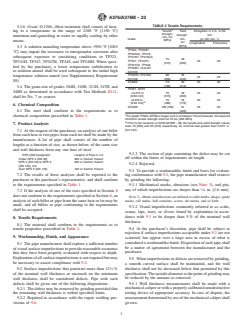
TABLE 2 Tensile Requirements
5.2.6 Grade S31266—Heat treatment shall consist of heat-
A
ing to a temperature in the range of 2100 °F [1150 °C] Tensile Yield Elongation in 2 in. or 50
strength,
strength mm
minimum and quenching in water or rapidly cooling by other
min, ksi
Grade min, (or 4D) min, %
[MPa]
means.
ksi
Longitudinal Transverse
[MPa]
5.3 A solution annealing temperature above 1950 °F [1065
TP304, TP304H,
°C] may impair the resistance to intergranular corrosion after
TP304LN, TP316,
subsequent exposure to sensitizing conditions in TP321,
TP316H, TP316LN,
75 30
TP347, TP347H, 35 25
TP321H, TP347, TP347H, TP348, and TP348H. When speci-
[515] [205]
TP347LN, TP348,
fied by the purchaser, a lower temperature stabilization or
TP348H, 16-8-2H,
re-solution anneal shall be used subsequent to the initial high S31725
TP304N, TP316N, 80 35
temperature solution anneal (see Supplementary Requirement
35 25
S31726 [550] [240]
S9).
S34565 115 60 35 30
[790] [415]
5.4 The grain size of grades 304H, 316H, 321H, 347H, and
TP321, 321H
348H as determined in accordance with Test Methods E112,
#0.375 in. 75 30 35 25
[9.50 mm] [515] [205]
shall be No. 7 or coarser.
>0.375 in. 70 25 35 25
B
[9.50 mm] [480] [170]
6. Chemical Composition
S31266 109 [750] 61 35 25
[420]
6.1 The steel shall conform to the requirements as to
A
chemical composition prescribed in Table 1. For grade TP304, NPS8 or larger, and in schedules 140 and heavier, the required
minimum tensile strength shall be 70 ksi [480 MPa].
B
Prior to the issuance of A376/A376M – 88, the tensile and yield strength values
7. Product Analysis
were 75 [520] and 30 [210] respectively, for nominal wall greater than 0.375 in.
[9.5 mm].
7.1 At the request of the purchaser, an analysis of one billet
from each heat or two pipes from each lot shall be made by the
manufacturer. A lot of pipe shall consist of the number of
lengths as a function of size, as shown below, of the same size
and wall thickness from any one heat of steel:
9.2.3 The section of pipe containing the defect may be cut
NPS [DN] Designator Lengths of Pipe in Lot
off within the limits of requirements on length.
Under NPS 2 [DN 50] 400 or fraction thereof
NPS 2 [DN 50] to NPS 5 200 or fraction thereof
9.2.4 Rejected.
[DN 125], incl
Over NPS 5 [DN 125] 100 or fraction thereof
9.3 To provide a workmanlike finish and basis for evaluat-
7.2 The results of these analyses shall be reported to the
ing conformance with 9.2, the pipe manufacturer shall remove
purchaser or the purchaser’s representative, and shall conform by grinding the following:
to the requirements specified in Table 1.
9.3.1 Mechanical marks, abrasions (see Note 3), and pits,
any of which imperfections are deeper than ⁄16 in. [1.6 mm].
7.3 If the analysis of one of the tests specified in Section 8
does not conform to the requirements specified in Section 6,an
NOTE3—Marksandabrasionsaredefinedascablemarks,dinges,guide
analysis of each billet or pipe from the same heat or lot may be marks, roll marks, ball scratches, scores, die marks, and so forth.
made, and all billets or pipe conforming to the requirements
9.3.2 Visual imperfections commonly referred to as scabs,
shall be accepted.
seams, laps, tears, or slivers found by exploration in accor-
dance with 9.1 to be deeper than 5 % of the nominal wall
8. Tensile Requirements
thickness.
8.1 The material shall conform to the requirements as to
9.4 At the purchaser’s discretion, pipe shall be subject to
tensile properties prescribed in Table 2.
rejection if surface imperfections acceptable under 9.2 are not
9. Workmanship, Finish, and Appearance
scattered, but appear over a large area in excess of what is
consideredaworkmanlikefinish.Dispositionofsuchpipeshall
9.1 The pipe manufacturer shall explore a sufficient number
be a matter of agreement between the manufacturer and the
ofvisualsurfaceimperfectionstoprovidereasonableassurance
purchaser.
that they have been properly evaluated with respect to depth.
Explorationofallsurfaceimperfectionsisnotrequiredbutmay
9.5 Whenimperfectionsordefectsareremovedbygrinding,
be necessary to assure compliance with 9.2.
a smooth curved surface shall be maintained, and the wall
thickness shall not be decreased below that permitted by this
9.2 Surface imperfections that penetrate more than 12 ⁄2 %
specification.Theoutsidediameteratthepointofgrindingmay
of the nominal wall thickness or encroach on the minimum
be reduced by the amount so removed.
wall thickness shall be considered defects. Pipe with such
defects shall be given one of the following dispositions: 9.5.1 Wall thickness measurements shall be made with a
9.2.1 The defect may be removed by grinding provided that mechanical caliper or with a properly calibrated nondestructive
the remaining wall thickness is within specified limits. testing device of appropriate accuracy. In case of dispute, the
9.2.2 Repaired in accordance with the repair welding pro- measurementdeterminedbyuseofthemechanicalcalipershall
visions of 9.6. govern.
A376/A376M−22
9.6 Weld repair shall be permitted only subject to the This requirement does not preclude additional testing at earlier
approval of the purchaser and in accordance with Specification stages in the processing.
A999/A999M.
10.6 Surface Condition:
10.6.1 All surfaces shall be free of scale, dirt, grease, paint,
9.7 The finished pipe shall be reasonably straight.
orotherforeignmaterialthatcouldinterferewithinterpretation
9.8 The pipe shall be free of scale and contaminating iron
oftestresults.Themethodsusedforcleaningandpreparingthe
particles. Pickling, blasting, or surface finishing is not manda-
surfaces for examination shall not be detrimental to the base
tory when pipe is bright annealed. The purchaser may request
metal or the surface finish.
that a passivating treatment be applied.
10.6.2 Excessive surface roughness or deep scratches can
produce signals that interfere with the test.
10. Hydrostatic or Nondestructive Electric Test
10.7 Extent of Examination:
10.1 Each pipe shall be subjected to the Nondestructive
10.7.1 The relative motion of the pipe and the transducer(s),
Electric Test or the Hydrostatic Test. Unless specified by the
coil(s), or sensor(s) shall be such that the entire pipe surface is
purchaser, either test may be used at the option of the producer.
scanned, except as in 5.2.
10.2 Hydrostatic Test—Each length of finished pipe shall be 10.7.2 The existence of end effects is recognized, and the
extent of such effects shall be determined by the manufacturer,
subjected to the hydrostatic test in accordance with Specifica-
tion A999/A999M, unless specifically exempted under the and, if requested, shall be reported to the purchaser. Other
nondestructive tests may be applied to the end areas, subject to
provisions of 10.3 and 10.4.
agreement between the purchaser and the manufacturer.
10.3 For pipe sizes NPS 24 [DN 600] and over, the
10.8 Operator Qualifications—The test unit operator shall
purchaser, with the agreement of the manufacturer, may
be certified in accordance with SNT-TC-1A, or an equivalent
complete the hydrostatic test requirement with the system
recognized and documented standard.
pressure test, which may be lower or higher than the specifi-
cation test pressure, but in no case shall the test pressure be
10.9 Test Conditions:
lower than the system design pressure. Each length of pipe
10.9.1 For eddy-current testing, the excitation coil fre-
furnished without the completed manufacturer’s hydrostatic
quency shall be chosen to ensure adequate penetration yet
test shall include with the mandatory marking the letters “NH.”
provide good signal-to-noise ratio.
10.9.2 The maximum eddy-current coil frequency used
10.4 Nondestructive Examination—Each pipe shall be ex-
shall be as follows:
amined w
...
This document is not an ASTM standard and is intended only to provide the user of an ASTM standard an indication of what changes have been made to the previous version. Because
it may not be technically possible to adequately depict all changes accurately, ASTM recommends that users consult prior editions as appropriate. In all cases only the current version
of the standard as published by ASTM is to be considered the official document.
Designation: A376/A376M − 19 A376/A376M − 22 Used in USDOE-NE standards
Standard Specification for
Seamless Austenitic Steel Pipe for High-Temperature
Service
This standard is issued under the fixed designation A376/A376M; the number immediately following the designation indicates the year
of original adoption or, in the case of revision, the year of last revision. A number in parentheses indicates the year of last reapproval.
A superscript epsilon (´) indicates an editorial change since the last revision or reapproval.
1. Scope*
1.1 This specification covers seamless austenitic steel pipe intended for high-temperature service. Among the grades covered are
H grades and nitrogen grades that are specifically intended for high-temperature service.
NOTE 1—This specification was originally developed for use for piping in the central stations of electric-power generating thermal plants. However, its
use is not restricted to such applications and it may be used in other applications for which the attributes of the materials, as defined by this specification,
are appropriate.
1.2 Optional supplementary requirements (S1 through S10) are provided. These supplementary requirements specify additional
tests that will be made only when stated in the order, together with the number of such tests required.
1.3 Grades TP321 and TP321H have lower strength requirements for nominal wall thicknesses greater than ⁄8 in. [9.5 mm].
1.4 The values stated in either inch-pound units or SI units are to be regarded separately as standard. Within the text, the SI units
are shown in brackets. The values stated in each system may not be exact equivalents; therefore, each system shall be used
independently of the other. Combining values from the two systems may result in non-conformance with the standard. The
inch-pound units shall apply unless the “M” designation of this specification is specified in the order.
NOTE 2—The dimensionless designators NPS (nominal pipe size) and DN (Diametre Nominel) have been substituted in this standard for such traditional
terms as “nominal diameter,” “size,” and “nominal size.”
1.5 This international standard was developed in accordance with internationally recognized principles on standardization
established in the Decision on Principles for the Development of International Standards, Guides and Recommendations issued
by the World Trade Organization Technical Barriers to Trade (TBT) Committee.
2. Referenced Documents
2.1 ASTM Standards:
A262 Practices for Detecting Susceptibility to Intergranular Attack in Austenitic Stainless Steels
A999/A999M Specification for General Requirements for Alloy and Stainless Steel Pipe
E112 Test Methods for Determining Average Grain Size
This specification is under the jurisdiction of ASTM Committee A01 on Steel, Stainless Steel and Related Alloys and is the direct responsibility of Subcommittee A01.10
on Stainless and Alloy Steel Tubular Products.
Current edition approved Nov. 1, 2019Nov. 1, 2022. Published November 2019November 2022. Originally approved in 1954. Last previous edition approved in 20172019
as A376/A376M – 17.A376/A376M – 19. DOI: 10.1520/A0376_A0376M-19.10.1520/A0376_A0376M-22.
For ASME Boiler and Pressure Vessel Code applications see related Specification SA-376 in Section II of that Code.
For referenced ASTM standards, visit the ASTM website, www.astm.org, or contact ASTM Customer Service at service@astm.org. For Annual Book of ASTM Standards
volume information, refer to the standard’s Document Summary page on the ASTM website.
*A Summary of Changes section appears at the end of this standard
Copyright © ASTM International, 100 Barr Harbor Drive, PO Box C700, West Conshohocken, PA 19428-2959. United States
A376/A376M − 22
E213 Practice for Ultrasonic Testing of Metal Pipe and Tubing
E381 Method of Macroetch Testing Steel Bars, Billets, Blooms, and Forgings
E426 Practice for Electromagnetic (Eddy Current) Examination of Seamless and Welded Tubular Products, Titanium, Austenitic
Stainless Steel and Similar Alloys
2.2 Other Standards:
SNT-TC-1A Personnel Qualification and Certification in Nondestructive Testing
3. Ordering Information
3.1 Orders for material to this specification should include the following, as required to describe the desired material adequately:
3.1.1 Quantity (feet, centimetres, or number of lengths),
3.1.2 Name of material (seamless austenitic steel pipe),
TABLE 1 Chemical Requirements
A
UNS Composition, %
Desig-
Carbon Man- Phos- Sul- Sili- Nickel Chromium Molyb- Tita- Colum- Tan- Nitro- Others
Grade
nation BC
ganese phorus fur con denum nium Nio- talum gen
B
bium
TP304 S30400 0.08 2.00 0.045 0.030 0.75 8.0–11.0 18.0–20.0 . . . . . . . . . . . . . . . . . .
TP304H S30409 0.04–0.10 2.00 0.045 0.030 0.75 8.0–11.0 18.0–20.0 . . . . . . . . . . . . . . . . . .
TP304N S30451 0.08 2.00 0.045 0.030 0.75 8.0–11.0 18.0–20.0 . . . . . . . . . . . . 0.10–0.16 . . .
TP304LN S30453 0.035 2.00 0.045 0.030 0.75 8.0–11.0 18.0–20.0 . . . . . . . . . . . . 0.10–0.16 . . .
TP316 S31600 0.08 2.00 0.045 0.030 0.75 11.0–14.0 16.0–18.0 2.00–3.00 . . . . . . . . . . . . . . .
TP316 S31600 0.08 2.00 0.045 0.030 0.75 10.0–14.0 16.0–18.0 2.00–3.00 . . . . . . . . . . . . . . .
TP316H S31609 0.04–0.10 2.00 0.045 0.030 0.75 11.0–14.0 16.0–18.0 2.00–3.00 . . . . . . . . . . . . . . .
TP316H S31609 0.04–0.10 2.00 0.045 0.030 0.75 10.0–14.0 16.0–18.0 2.00–3.00 . . . . . . . . . . . . . . .
TP316N S31651 0.08 2.00 0.045 0.030 0.75 11.0–14.0 16.0–18.0 2.00–3.00 . . . . . . . . . 0.10–0.16 . . .
TP316N S31651 0.08 2.00 0.045 0.030 0.75 10.0–14.0 16.0–18.0 2.00–3.00 . . . . . . . . . 0.10–0.16 . . .
TP316LN S31653 0.035 2.00 0.045 0.030 0.75 11.0–14.0 16.0–18.0 2.00–3.00 . . . . . . . . . 0.10–0.16 . . .
TP316LN S31653 0.035 2.00 0.045 0.030 0.75 10.0–14.0 16.0–18.0 2.00–3.00 . . . . . . . . . 0.10–0.16 . . .
C
TP321 S32100 0.08 2.00 0.045 0.030 0.75 9.0–13.0 17.0–19.0 . . . . . . . . . . . . . . .
D
TP321 S32100 0.08 2.00 0.045 0.030 0.75 9.0–13.0 17.0–19.0 . . . . . . . . . . . . . . .
D
TP321H S32109 0.04–0.10 2.00 0.045 0.030 0.75 9.0–13.0 17.0–19.0 . . . . . . . . . . . . . . .
E
TP321H S32109 0.04–0.10 2.00 0.045 0.030 0.75 9.0–13.0 17.0–19.0 . . . . . . . . . . . . . . .
E
TP347 S34700 0.08 2.00 0.045 0.030 0.75 9.0–13.0 17.0–19.0 . . . . . . . . . . . . . . .
F
TP347 S34700 0.08 2.00 0.045 0.030 0.75 9.0–13.0 17.0–19.0 . . . . . . . . . . . . . . .
F
TP347H S34709 0.04–0.10 2.00 0.045 0.030 0.75 9.0–13.0 17.0–19.0 . . . . . . . . . . . . . . .
G
TP347H S34709 0.04–0.10 2.00 0.045 0.030 0.75 9.0–13.0 17.0–19.0 . . . . . . . . . . . . . . .
TP347LN S34751 0.005– 2.00 0.045 0.030 1.00 9.0–13.0 17.0– 19.0 . . . . . . 0.20– . . . 0.06–0.10 . . .
G
0.020 0.50
TP347LN S34751 0.005– 2.00 0.045 0.030 1.00 9.0–13.0 17.0– 19.0 . . . . . . 0.20– . . . 0.06–0.10 . . .
H
0.020 0.50
H E
TP348 S34800 0.08 2.00 0.045 0.030 0.75 9.0–13.0 17.0–19.0 . . . . . . 0.10 . . . Co 0.20
I F
TP348 S34800 0.08 2.00 0.045 0.030 0.75 9.0–13.0 17.0–19.0 . . . . . . 0.10 . . . Co 0.20
F
TP348H S34809 0.04–0.10 2.00 0.045 0.030 1.00 9.0–13.0 17.0–19.0 0.10
G
TP348H S34809 0.04–0.10 2.00 0.045 0.030 1.00 9.0–13.0 17.0–19.0 0.10
16-8-2H S16800 0.05–0.10 2.00 0.045 0.030 0.75 7.5–9.5 14.5–16.5 1.50–2.00 . . . . . . . . . . . . . . .
. . . S31725 0.030 2.00 0.045 0.030 0.75 13.5–17.5 18.0–20.0 4.0–5.0 . . . . . . . . . 0.20 max Cu 0.75
. . . S31726 0.030 2.00 0.045 0.030 0.75 14.5–17.5 17.0–20.0 4.0–5.0 . . . . . . . . . 0.10–0.20 Cu 0.75
. . . S34565 0.030 5.0–7.0 0.030 0.010 1.0 16.0–18.0 23.0–25.0 4.0–5.0 . . . . . . . . . 0.040–0.060 Cb 0.10
. . . S31266 0.030 2.00–4.00 0.035 0.020 1.00 21.0–24.0 23.0–25.0 5.2–6.2 . . . . . . . . . 0.035–0.060 Cu
1.00–2.50
W 1.50–2.50
A
Maximum, Maximum, unless otherwise indicated. Where ellipses (. . .) appear in this table, there is no requirement and analysis for the element need not be determined
or reported.
B
The terms Niobium (Nb) and Columbium (Cb) are alternative names for the same element.
C
The method of analysis for nitrogen shall be a matter of agreement between the purchaser and manufacturer.
D
The titanium content shall be not less than five times the carbon content and not more than 0.70 %.
E
The titanium content shall be not less than four times the carbon content and not more than 0.70 %.
F
The columbiumniobium content shall be not less than ten times the carbon content and not more than 1.10 %.
G
The columbiumniobium content shall be not less than eight times the carbon content and not more than 1.10 %.
H
The columbium The niobium content shall not be less than 15 times the carbon content.
I
This grade is intended for special purpose applications.
Available from American Society for Nondestructive Testing (ASNT), P.O. Box 28518, 1711 Arlingate Ln., Columbus, OH 43228-0518.
A376/A376M − 22
3.1.3 Grade (Table 1),
3.1.4 Size (nominal size, or outside diameter and schedule number or average wall thickness),
3.1.5 Lengths (specific or random), (Permissible Variations in Length Section of Specification A999/A999M),
3.1.6 End finish (Ends Section of Specification A999/A999M),
3.1.7 Optional requirements (Section 8) (see Hydrostatic Test Requirements Section and the Permissible Variation in Weight for
Seamless Pipe Section for weighing individual lengths, of Specification A999/A999M), (see 9.6, repairing by welding; 13.3, die
stamping),
3.1.8 Test report required (Certification Section of Specification A999/A999M),
3.1.9 Specification designation, and
3.1.10 Special requirements or any supplementary requirements selected, or both.
4. General Requirements
4.1 Material furnished to this specification shall conform to the applicable requirements of the current edition of Specification
A999/A999M unless otherwise provided herein.
5. Materials and Manufacture
5.1 Manufacture—At the manufacturer’s option, pipe may be either hot finished or cold finished, with a suitable finishing
treatment, where necessary.
5.2 Heat Treatment:
5.2.1 All pipe shall be furnished in the heat-treated condition unless the order specifically states that no final heat treatment shall
be applied. When the order is furnished without final heat treatment, each pipe shall be stenciled “HT-O.”
5.2.2 As an alternate to final heat treatment in a continuous furnace or batch-type furnace, immediately following hot forming
while the temperature of the pipes is not less than the specified minimum solution treatment temperature, pipes may be individually
quenched in water or rapidly cooled by other means.
5.2.3 Grades TP304, TP304N, TP304LN, TP316, TP316N, TP316LN, TP321, TP347, TP347LN, TP348, 16-8-2H, S 31725, and
S 31726—Unless otherwise stated in the order, heat treatment shall consist of heating to a minimum temperature of 1900 °F [1040
°C] and quenching in water or rapidly cooling by other means.
5.2.3.1 The purchaser may specify controlled structural or special service characteristics which shall be used as a guide for the
most suitable heat treatment. If the final heat treatment is at a temperature under 1900 °F [1040 °C], each pipe shall be stenciled
with the final heat treatment temperature in degrees Fahrenheit or Celsius after the suffix “HT.”
5.2.4 Grades TP304H, TP316H, TP321H, TP347H, TP348H, and 16-8-2H—If cold working is involved in processing, the
minimum solution-treating temperature for Grades TP321H, TP347H, and TP348H shall be 2000 °F [1100 °C], for Grades TP304H
and TP316H, 1900 °F [1040 °C], and for Grade 16-8-2H, 1800 °F [980 °C]. If the material is hot-rolled, the minimum
solution-treating temperatures for Grades TP321H, TP347H, and TP348H shall be 1925 °F [1050 °C], for Grades TP304H and
TP316H, 1900 °F [1040 °C], and for Grade 16-8-2H, 1800 °F [980 °C].
5.2.5 Grade S34565—Heat treatment shall consist of heating to a temperature in the range of 2050 °F [1120 °C] minimum and
2140 °F [1170 °C] maximum, and quenching in water or rapidly cooling by other means.
5.2.6 Grade S31266—Heat treatment shall consist of heating to a temperature in the range of 2100 °F [1150 °C] minimum and
quenching in water or rapidly cooling by other means.
A376/A376M − 22
5.3 A solution annealing temperature above 1950 °F [1065 °C] may impair the resistance to intergranular corrosion after
subsequent exposure to sensitizing conditions in TP321, TP321H, TP347, TP347H, TP348, and TP348H. When specified by the
purchaser, a lower temperature stabilization or re-solution anneal shall be used subsequent to the initial high temperature solution
anneal (see Supplementary Requirement S9).
5.4 The grain size of grades 304H, 316H, 321H, 347H, and 348H as determined in accordance with Test Methods E112, shall be
No. 7 or coarser.
6. Chemical Composition
6.1 The steel shall conform to the requirements as to chemical composition prescribed in Table 1.
7. Product Analysis
7.1 At the request of the purchaser, an analysis of one billet from each heat or two pipes from each lot shall be made by the
manufacturer. A lot of pipe shall consist of the number of lengths as a function of size, as shown below, of the same size and wall
thickness from any one heat of steel:
NPS [DN] Designator Lengths of Pipe in Lot
Under NPS 2 [DN 50] 400 or fraction thereof
NPS 2 [DN 50] to NPS 5 200 or fraction thereof
[DN 125], incl
Over NPS 5 [DN 125] 100 or fraction thereof
7.2 The results of these analyses shall be reported to the purchaser or the purchaser’s representative, and shall conform to the
requirements specified in Table 1.
7.3 If the analysis of one of the tests specified in Section 8 does not conform to the requirements specified in Section 6, an analysis
of each billet or pipe from the same heat or lot may be made, and all billets or pipe conforming to the requirements shall be
accepted.
8. Tensile Requirements
8.1 The material shall conform to the requirements as to tensile properties prescribed in Table 2.
9. Workmanship, Finish, and Appearance
9.1 The pipe manufacturer shall explore a sufficient number of visual surface imperfections to provide reasonable assurance that
they have been properly evaluated with respect to depth. Exploration of all surface imperfections is not required but may be
necessary to assure compliance with 9.2.
9.2 Surface imperfections that penetrate more than 12 ⁄2 % of the nominal wall thickness or encroach on the minimum wall
thickness shall be considered defects. Pipe with such defects shall be given one of the following dispositions:
9.2.1 The defect may be removed by grinding provided that the remaining wall thickness is within specified limits.
9.2.2 Repaired in accordance with the repair welding provisions of 9.6.
9.2.3 The section of pipe containing the defect may be cut off within the limits of requirements on length.
9.2.4 Rejected.
9.3 To provide a workmanlike finish and basis for evaluating conformance with 9.2, the pipe manufacturer shall remove by
grinding the following:
9.3.1 Mechanical marks, abrasions (see Note 3), and pits, any of which imperfections are deeper than ⁄16 in. [1.6 mm].
A376/A376M − 22
TABLE 2 Tensile Requirements
A
Tensile Yield Elongation in 2 in. or 50
strength,
strength mm
min, ksi
Grade min, (or 4D) min, %
[MPa]
ksi
Longitudinal Transverse
[MPa]
TP304, TP304H,
TP304LN, TP316,
TP316H, TP316LN,
75 30
TP347, TP347H, 35 25
[515] [205]
TP347LN, TP348,
TP348H, 16-8-2H,
S31725
TP304N, TP316N, 80 35
35 25
S31726 [550] [240]
S34565 115 60 35 30
[790] [415]
TP321, 321H
#0.375 in. 75 30 35 25
[9.50 mm] [515] [205]
>0.375 in. 70 25 35 25
B
[9.50 mm] [480] [170]
S31266 109 [750] 61 35 25
[420]
A
For grade TP304, NPS8 or larger, and in schedules 140 and heavier, the required
minimum tensile strength shall be 70 ksi [480 MPa].
B
Prior to the issuance of A376/A376M – 88, the tensile and yield strength values
were 75 [520] and 30 [210] respectively, for nominal wall greater than 0.375 in.
[9.5 mm].
NOTE 3—Marks and abrasions are defined as cable marks, dinges, guide marks, roll marks, ball scratches, scores, die marks, and so forth.
9.3.2 Visual imperfections commonly referred to as scabs, seams, laps, tears, or slivers found by exploration in accordance with
9.1 to be deeper than 5 % of the nominal wall thickness.
9.4 At the purchaser’s discretion, pipe shall be subject to rejection if surface imperfections acceptable under 9.2 are not scattered,
but appear over a large area in excess of what is considered a workmanlike finish. Disposition of such pipe shall be a matter of
agreement between the manufacturer and the purchaser.
9.5 When imperfections or defects are removed by grinding, a smooth curved surface shall be maintained, and the wall thickness
shall not be decreased below that permitted by this specification. The outside diameter at the point of grinding may be reduced
by the amount so removed.
9.5.1 Wall thickness measurements shall be made with a mechanical caliper or with a properly calibrated nondestructive testing
device of appropriate accuracy. In case of dispute, the measurement determined by use of the mechanical caliper shall govern.
9.6 Weld repair shall be permitted only subject to the approval of the purchaser and in accordance with Specification
A999/A999M.
9.7 The finished pipe shall be reasonably straight.
9.8 The pipe shall be free of scale and contaminating iron particles. Pickling, blasting, or surface finishing is not mandatory when
pipe is bright annealed. The purchaser may request that a passivating treatment be applied.
10. Hydrostatic or Nondestructive Electric Test
10.1 Each pipe shall be subjected to the Nondestructive Electric Test or the Hydrostatic Test. Unless specified by the purchaser,
either test may be used at the option of the producer.
10.2 Hydrostatic Test—Each length of finished pipe shall be subjected to the hydrostatic test in accordance with Specification
A999/A999M, unless specifically exempted under the provisions of 10.3 and 10.4.
A376/A376M − 22
10.3 For pipe sizes NPS 24 [DN 600] and over, the purchaser, with the agreement of the manufacturer, may complete the
hydrostatic test requirement with the system pressure test, which may be lower or higher than the specification test pressure, but
in no case shall the test pressure be lower than the system design pressure. Each length of pipe furnished without the completed
manufacturer’s hydrostatic test shall include with the mandatory marking the letters “NH.”
10.4 Nondestructive Examination—Each pipe shall be examined with a nondestructive test in accordance with Practice E213 or
Practice E426. Unless specifically called out by the purchaser, the selection of the nondestructive electric test will be at the option
of the manufacturer. The range of pipe sizes that may be examined by each method shall be subject to the limitations in the scope
of the respective practices.
10.4.1 The following information is for the benefit of the user of this specification:
10.4.1.1 The reference standards defined in 10.10.1 through 11.10.4 are convenient standards for calibration of nondestructive
testing equipment. The dimensions of these standards should not be construed as the minimum size imperfection detectable by such
equipment.
10.4.1.2 The ultrasonic testing (UT) can be performed to detect both longitudinally and circumferentially oriented defects. It
should be recognized that different tec
...