

ASTM B626-19
(Specification)Standard Specification for Welded Nickel and Nickel-Cobalt Alloy Tube
General Information
- Abstract
ABSTRACT
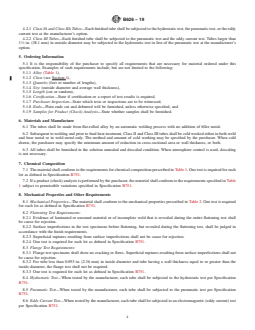
This specification covers welded tubes made from nickel and nickel-cobalt alloys with UNS Nos. N10001, N10242, N10665, N12160, N10629, N10624, N10675, N10276, N06455, N06007, N06975, N08320, N06985, N06002, N06022, N06030, N06035, N06058, N06059, N06200, N06210, N08031, R30556, N06230, N06686, and R20033. These alloys are intended for heat exchanger and condenser tubes and tubes for general corrosive service for heat-resisting applications. The tubes shall be made from flat-rolled alloy by an automatic welding process with no addition of filler metal, and shall be furnished in the solution annealed and descaled conditions. Materials shall adhere to mechanical (tensile strength, yield strength, and elongation), chemical composition, flattening test, flange test, hydrostatic test, pneumatic test, and eddy current test requirements.
SCOPE
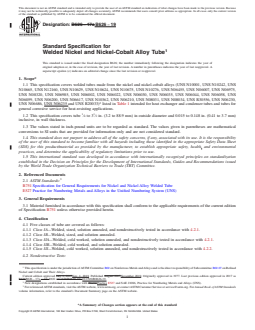
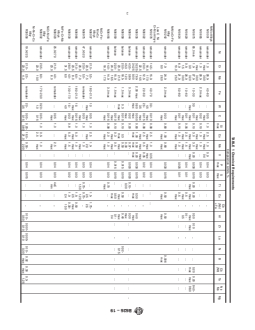
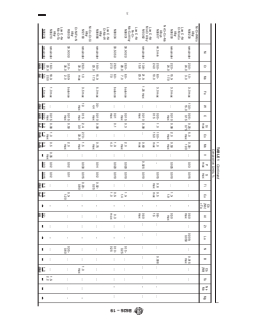
1.1 This specification covers welded tubes made from the nickel and nickel-cobalt alloys (UNS N10001, UNS N10242, UNS N10665, UNS N12160, UNS N10629, UNS N10624, UNS N10675, UNS N10276, UNS N06455, UNS N06007, UNS N06975, UNS N08320, UNS N06985, UNS N06002, UNS N06022, UNS N06030, UNS N06035, UNS N06044, UNS N06058, UNS N06059, UNS N06200, UNS N06617, UNS N10362, UNS N06210, UNS N08031, UNS N08034, UNS R30556, UNS N06230, UNS N06686, UNS N06235 and UNS R20033)2 listed in Table 1 intended for heat exchanger and condenser tubes and tubes for general corrosive service for heat-resisting applications.
1.2 This specification covers tube 1/8 to 31/2 in. (3.2 to 88.9 mm) in outside diameter and 0.015 to 0.148 in. (0.41 to 3.7 mm) inclusive, in wall thickness.
1.3 The values stated in inch-pound units are to be regarded as standard. The values given in parentheses are mathematical conversions to SI units that are provided for information only and are not considered standard.
1.4 This standard does not purport to address all of the safety concerns, if any, associated with its use. It is the responsibility of the user of this standard to become familiar with all hazards including those identified in the appropriate Safety Data Sheet (SDS) for this product/material as provided by the manufacturer, to establish appropriate safety, health, and environmental practices, and determine the applicability of regulatory limitations prior to use.
1.5 This international standard was developed in accordance with internationally recognized principles on standardization established in the Decision on Principles for the Development of International Standards, Guides and Recommendations issued by the World Trade Organization Technical Barriers to Trade (TBT) Committee.
- Status
- Published
- Publication Date
- 31-Oct-2019
- Technical Committee
- B02 - Nonferrous Metals and Alloys
- Drafting Committee
- B02.07 - Refined Nickel and Cobalt and Their Alloys
Buy Documents
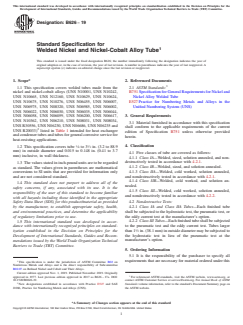
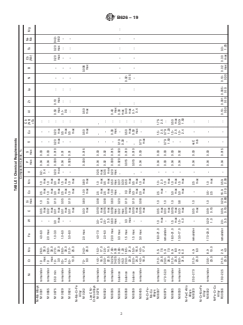
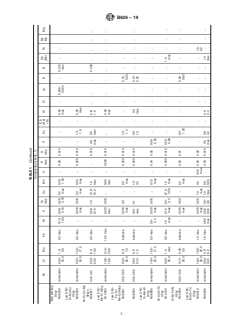
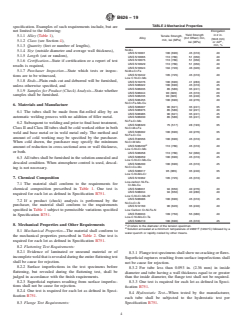
ASTM B626-19 - Standard Specification for Welded Nickel and Nickel-Cobalt Alloy Tube
REDLINE ASTM B626-19 - Standard Specification for Welded Nickel and Nickel-Cobalt Alloy Tube
Overview
ASTM B626-19: Standard Specification for Welded Nickel and Nickel-Cobalt Alloy Tube is a key ASTM standard developed to ensure the quality and performance of welded nickel and nickel-cobalt alloy tubes. Covered under the jurisdiction of ASTM Committee B02, this specification applies to tubes manufactured using nickel and nickel-cobalt alloys with various UNS designations, such as N10001, N10242, N10665, N12160, and others. The standard is primarily intended for tubes used in heat exchangers, condensers, and general corrosive service in heat-resistant applications.
The tubes must be manufactured from flat-rolled alloys using an automatic welding process without filler metal and must be supplied in the solution annealed and descaled condition. ASTM B626-19 outlines requirements for chemical composition, mechanical properties, testing, and inspection to promote safety, reliability, and international compatibility.
Key Topics
- Material Identification: Specifies nickel and nickel-cobalt alloys by the Unified Numbering System (UNS), promoting consistency and traceability.
- Tube Dimensions: Covers tubes with outside diameters from 1/8 to 3-1/2 inches (3.2 to 88.9 mm) and wall thicknesses from 0.015 to 0.148 inches (0.41 to 3.7 mm).
- Manufacturing Process: Requires tubes to be welded from flat-rolled alloy, without the addition of filler metal.
- Product Classes: Five distinct classes, reflecting combinations of welding, sizing, cold-working, annealing, and nondestructive testing.
- Mechanical and Chemical Requirements: Ensures each alloy meets prescribed tensile strength, yield strength, elongation, and chemical composition limits.
- Testing Protocols: Mandates hydrostatic, pneumatic, eddy current, flattening, and flange tests to confirm weld integrity and material soundness.
- Inspection and Certification: Outlines purchaser options for inspection, sampling, and certification.
Applications
ASTM B626-19 is widely used in industries that demand corrosion-resistant, heat-resistant tubing, including:
- Power generation - Heat exchanger and condenser tubes exposed to aggressive cooling waters or steam.
- Chemical and petrochemical - Tubes in processing equipment, piping systems, and critical infrastructure handling corrosive media.
- Pharmaceutical and food processing - Heat transfer applications requiring sanitary, corrosion-resistant tubing.
- Oil and gas - Downhole, subsea, and production practices where environmental resistance is essential.
- Refining and desalination - Condenser tubes and heat exchangers dealing with saline and high-chloride environments.
The standard supports engineers and specifiers in selecting tube materials that will perform reliably under harsh operational conditions, extending equipment lifespan and reducing maintenance costs.
Related Standards
For comprehensive tube quality and specification in nickel and nickel-cobalt alloys, the following related ASTM standards may also be applicable:
- ASTM B751 - General Requirements for Nickel and Nickel Alloy Welded Tube
- ASTM E527 - Practice for Numbering Metals and Alloys in the Unified Numbering System (UNS)
- ASTM B622 - Seamless Nickel and Nickel-Cobalt Alloy Pipe and Tube (for seamless alternatives)
- ASTM B619 - Welded Nickel and Nickel-Cobalt Alloy Pipe
Stakeholders are encouraged to reference these and other relevant standards for holistic project and procurement specifications.
Keywords: ASTM B626-19, welded nickel tube, nickel-cobalt alloy tube, heat exchanger tube, condenser tube, corrosion-resistant tubing, UNS N10242, industrial tubing standard, ASTM standards.
Relations
- Effective Date
- 01-Nov-2019
- Effective Date
- 01-Apr-2019
- Effective Date
- 01-Nov-2018
- Effective Date
- 01-Feb-2013
- Effective Date
- 01-Nov-2008
- Effective Date
- 10-Jun-2003
- Effective Date
- 10-Apr-2003
- Effective Date
- 10-Oct-2002
- Effective Date
- 10-Nov-2001
- Effective Date
- 10-Nov-2001
- Effective Date
- 10-Mar-1997
- Effective Date
- 01-Nov-2019
- Effective Date
- 01-Nov-2019
- Effective Date
- 01-Nov-2019
Buy Documents
ASTM B626-19 - Standard Specification for Welded Nickel and Nickel-Cobalt Alloy Tube
REDLINE ASTM B626-19 - Standard Specification for Welded Nickel and Nickel-Cobalt Alloy Tube
Get Certified
Connect with accredited certification bodies for this standard

Institut za varilstvo d.o.o. (Welding Institute)
Slovenia's leading welding institute since 1952. ISO 3834, EN 1090, pressure equipment certification, NDT personnel, welder qualification. Only IIW Au
Sponsored listings
Frequently Asked Questions
ASTM B626-19 is a technical specification published by ASTM International. Its full title is "Standard Specification for Welded Nickel and Nickel-Cobalt Alloy Tube". This standard covers: ABSTRACT This specification covers welded tubes made from nickel and nickel-cobalt alloys with UNS Nos. N10001, N10242, N10665, N12160, N10629, N10624, N10675, N10276, N06455, N06007, N06975, N08320, N06985, N06002, N06022, N06030, N06035, N06058, N06059, N06200, N06210, N08031, R30556, N06230, N06686, and R20033. These alloys are intended for heat exchanger and condenser tubes and tubes for general corrosive service for heat-resisting applications. The tubes shall be made from flat-rolled alloy by an automatic welding process with no addition of filler metal, and shall be furnished in the solution annealed and descaled conditions. Materials shall adhere to mechanical (tensile strength, yield strength, and elongation), chemical composition, flattening test, flange test, hydrostatic test, pneumatic test, and eddy current test requirements. SCOPE 1.1 This specification covers welded tubes made from the nickel and nickel-cobalt alloys (UNS N10001, UNS N10242, UNS N10665, UNS N12160, UNS N10629, UNS N10624, UNS N10675, UNS N10276, UNS N06455, UNS N06007, UNS N06975, UNS N08320, UNS N06985, UNS N06002, UNS N06022, UNS N06030, UNS N06035, UNS N06044, UNS N06058, UNS N06059, UNS N06200, UNS N06617, UNS N10362, UNS N06210, UNS N08031, UNS N08034, UNS R30556, UNS N06230, UNS N06686, UNS N06235 and UNS R20033)2 listed in Table 1 intended for heat exchanger and condenser tubes and tubes for general corrosive service for heat-resisting applications. 1.2 This specification covers tube 1/8 to 31/2 in. (3.2 to 88.9 mm) in outside diameter and 0.015 to 0.148 in. (0.41 to 3.7 mm) inclusive, in wall thickness. 1.3 The values stated in inch-pound units are to be regarded as standard. The values given in parentheses are mathematical conversions to SI units that are provided for information only and are not considered standard. 1.4 This standard does not purport to address all of the safety concerns, if any, associated with its use. It is the responsibility of the user of this standard to become familiar with all hazards including those identified in the appropriate Safety Data Sheet (SDS) for this product/material as provided by the manufacturer, to establish appropriate safety, health, and environmental practices, and determine the applicability of regulatory limitations prior to use. 1.5 This international standard was developed in accordance with internationally recognized principles on standardization established in the Decision on Principles for the Development of International Standards, Guides and Recommendations issued by the World Trade Organization Technical Barriers to Trade (TBT) Committee.
ABSTRACT This specification covers welded tubes made from nickel and nickel-cobalt alloys with UNS Nos. N10001, N10242, N10665, N12160, N10629, N10624, N10675, N10276, N06455, N06007, N06975, N08320, N06985, N06002, N06022, N06030, N06035, N06058, N06059, N06200, N06210, N08031, R30556, N06230, N06686, and R20033. These alloys are intended for heat exchanger and condenser tubes and tubes for general corrosive service for heat-resisting applications. The tubes shall be made from flat-rolled alloy by an automatic welding process with no addition of filler metal, and shall be furnished in the solution annealed and descaled conditions. Materials shall adhere to mechanical (tensile strength, yield strength, and elongation), chemical composition, flattening test, flange test, hydrostatic test, pneumatic test, and eddy current test requirements. SCOPE 1.1 This specification covers welded tubes made from the nickel and nickel-cobalt alloys (UNS N10001, UNS N10242, UNS N10665, UNS N12160, UNS N10629, UNS N10624, UNS N10675, UNS N10276, UNS N06455, UNS N06007, UNS N06975, UNS N08320, UNS N06985, UNS N06002, UNS N06022, UNS N06030, UNS N06035, UNS N06044, UNS N06058, UNS N06059, UNS N06200, UNS N06617, UNS N10362, UNS N06210, UNS N08031, UNS N08034, UNS R30556, UNS N06230, UNS N06686, UNS N06235 and UNS R20033)2 listed in Table 1 intended for heat exchanger and condenser tubes and tubes for general corrosive service for heat-resisting applications. 1.2 This specification covers tube 1/8 to 31/2 in. (3.2 to 88.9 mm) in outside diameter and 0.015 to 0.148 in. (0.41 to 3.7 mm) inclusive, in wall thickness. 1.3 The values stated in inch-pound units are to be regarded as standard. The values given in parentheses are mathematical conversions to SI units that are provided for information only and are not considered standard. 1.4 This standard does not purport to address all of the safety concerns, if any, associated with its use. It is the responsibility of the user of this standard to become familiar with all hazards including those identified in the appropriate Safety Data Sheet (SDS) for this product/material as provided by the manufacturer, to establish appropriate safety, health, and environmental practices, and determine the applicability of regulatory limitations prior to use. 1.5 This international standard was developed in accordance with internationally recognized principles on standardization established in the Decision on Principles for the Development of International Standards, Guides and Recommendations issued by the World Trade Organization Technical Barriers to Trade (TBT) Committee.
ASTM B626-19 is classified under the following ICS (International Classification for Standards) categories: 23.040.15 - Non-ferrous metal pipes. The ICS classification helps identify the subject area and facilitates finding related standards.
ASTM B626-19 has the following relationships with other standards: It is inter standard links to ASTM B626-17a, ASTM B751-19, ASTM B751-08(2018), ASTM B751-08(2013), ASTM B751-08, ASTM B751-03, ASTM E527-83(2003), ASTM B751-02, ASTM B751-99, ASTM B751-01, ASTM E527-83(1997)e1, ASTM B924-02(2022), ASTM B751-21, ASTM B366/B366M-23. Understanding these relationships helps ensure you are using the most current and applicable version of the standard.
ASTM B626-19 is available in PDF format for immediate download after purchase. The document can be added to your cart and obtained through the secure checkout process. Digital delivery ensures instant access to the complete standard document.
Standards Content (Sample)
This international standard was developed in accordance with internationally recognized principles on standardization established in the Decision on Principles for the
Development of International Standards, Guides and Recommendations issued by the World Trade Organization Technical Barriers to Trade (TBT) Committee.
Designation:B626 −19
Standard Specification for
Welded Nickel and Nickel-Cobalt Alloy Tube
This standard is issued under the fixed designation B626; the number immediately following the designation indicates the year of
original adoption or, in the case of revision, the year of last revision. A number in parentheses indicates the year of last reapproval. A
superscript epsilon (´) indicates an editorial change since the last revision or reapproval.
1. Scope* 2. Referenced Documents
1.1 This specification covers welded tubes made from the 2.1 ASTM Standards:
nickel and nickel-cobalt alloys (UNS N10001, UNS N10242, B751 Specification for General Requirements for Nickel and
Nickel Alloy Welded Tube
UNS N10665, UNS N12160, UNS N10629, UNS N10624,
UNS N10675, UNS N10276, UNS N06455, UNS N06007, E527 Practice for Numbering Metals and Alloys in the
Unified Numbering System (UNS)
UNS N06975, UNS N08320, UNS N06985, UNS N06002,
UNS N06022, UNS N06030, UNS N06035, UNS N06044,
3. General Requirements
UNS N06058, UNS N06059, UNS N06200, UNS N06617,
UNS N10362, UNS N06210, UNS N08031, UNS N08034,
3.1 Material furnished in accordance with this specification
UNS R30556, UNS N06230, UNS N06686, UNS N06235 and
shall conform to the applicable requirements of the current
UNS R20033) listed in Table 1 intended for heat exchanger
edition of Specification B751 unless otherwise provided
and condenser tubes and tubes for general corrosive service for
herein.
heat-resisting applications.
1 1
4. Classification
1.2 This specification covers tube ⁄8 to 3 ⁄2 in. (3.2 to 88.9
mm) in outside diameter and 0.015 to 0.148 in. (0.41 to 3.7
4.1 Five classes of tube are covered as follows:
mm) inclusive, in wall thickness.
4.1.1 Class IA—Welded, sized, solution annealed, and non-
destructively tested in accordance with 4.2.1.
1.3 The values stated in inch-pound units are to be regarded
4.1.2 Class IB—Welded, sized, and solution annealed.
as standard. The values given in parentheses are mathematical
4.1.3 Class IIA—Welded, cold worked, solution annealed,
conversions to SI units that are provided for information only
and nondestructively tested in accordance with 4.2.1.
and are not considered standard.
4.1.4 Class IIB—Welded, cold worked, and solution an-
1.4 This standard does not purport to address all of the
nealed.
safety concerns, if any, associated with its use. It is the
4.1.5 Class III—Welded, cold worked, solution annealed,
responsibility of the user of this standard to become familiar
and nondestructively tested in accordance with 4.2.2.
with all hazards including those identified in the appropriate
4.2 Nondestructive Tests:
Safety Data Sheet (SDS) for this product/material as provided
by the manufacturer, to establish appropriate safety, health, 4.2.1 Class IA and Class IIA Tubes—Each finished tube
shall be subjected to the hydrostatic test, the pneumatic test, or
and environmental practices, and determine the applicability
of regulatory limitations prior to use. the eddy current test at the manufacturer’s option.
4.2.2 Class III Tubes—Each finished tube shall be subjected
1.5 This international standard was developed in accor-
to the pneumatic test and the eddy current test. Tubes larger
dance with internationally recognized principles on standard-
than 1 ⁄2 in. (38.1 mm) in outside diameter may be subjected to
ization established in the Decision on Principles for the
the hydrostatic test in lieu of the pneumatic test at the
Development of International Standards, Guides and Recom-
manufacturer’s option.
mendations issued by the World Trade Organization Technical
Barriers to Trade (TBT) Committee.
5. Ordering Information
5.1 It is the responsibility of the purchaser to specify all
requirements that are necessary for material ordered under this
This specification is under the jurisdiction of ASTM Committee B02 on
Nonferrous Metals and Alloys and is the direct responsibility of Subcommittee
B02.07 on Refined Nickel and Cobalt and Their Alloys.
Current edition approved Nov. 1, 2019. Published November 2019. Originally
approved in 1977. Last previous edition approved in 2017 as B626 – 17a. DOI: For referenced ASTM standards, visit the ASTM website, www.astm.org, or
10.1520/B0626-19. contact ASTM Customer Service at service@astm.org. For Annual Book of ASTM
New designations established in accordance with Practice E527 and SAE Standards volume information, refer to the standard’s Document Summary page on
J1086, Practice for Numbering Metals and Alloys (UNS). the ASTM website.
*A Summary of Changes section appears at the end of this standard
Copyright © ASTM International, 100 Barr Harbor Drive, PO Box C700, West Conshohocken, PA 19428-2959. United States
B626−19
TABLE 1 Chemical Requirements
Composition Limits, %
Cb
Si P S Cb Ni+
Ni Cr Mo Fe W C Co Mn V Ti Cu (Nb) Al Zr La N B Ta Mg
max max max (Nb) Mo
+Ta
Ni-Mo Alloys
N10001 remainder 1.0 26.0- 4.0-6.0 . 0.05 1.0 2.5 1.0 0.2- 0.04 0.03 . . .
max 30.0 max max max 0.4
N10665 remainder 1.0 26.0- 2.0 max . 0.02 0.10 1.0 1.0 . 0.04 0.03 . . .
max 30.0 max max max
N10675 65.0 min 1.0- 27.0- 1.0-3.0 3.0 0.01 0.10 3.0 3.0 0.20 0.030 0.010 0.20 0.20 . 0.50 0.10 . . . 0.20 0.20 94.0-
3.0 32.0 max max max max max max max max max max max 98.0
N10629 remainder 0.5- 26.0- 1.0-6.0 . 0.01 0.05 2.5 1.5 . 0.04 0.01 . 0.5 . 0.1- . . . . . . .
1.5 30.0 max max max max 0.5
N10624 remainder 6.0- 21.0- 5.0-8.0 . 0.01 0.10 1.0 1.0 . 0.025 0.01 . 0.5 . . . . . . . . .
10.0 25.0 max max max max
Ni-Mo-Cr-Fe
Alloy
N10242 remainder 7.0- 24.0- 2.0 max 0.03 0.80 1.00 0.80 0.030 0.015 0.50 0.50 0.006
9.0 26.0 max max max max max max
LowCNi-
Cr-Mo Alloys
N10276 remainder 14.5- 15.0- 4.0-7.0 3.0- 0.010 0.08 2.5 1.0 0.35 0.04 0.03 . . .
16.5 17.0 4.5 max max max max
N06022 remainder 20.0- 12.5- 2.0-6.0 2.5- 0.015 0.08 2.5 0.5 0.35 0.02 0.02 . . .
22.5 14.5 3.5 max max max max
N06035 remainder 32.25- 7.60- 2.00 max 0.60 0.050 0.60 1.00 0.50 0.20 0.030 0.015 . 0.30 . 0.40
34.25 9.00 max max max max max max max
N06044 balance 43.5- 0.80- 0.3 max . 0.02 0.20 . 0.07- . 0.020 0.020 0.10- . . 0.30 . . . . . . . .
45.3 1.20 max 0.30 0.30 max
N06058 balance 20.0- 18.5- 1.5 max 0.3 0.010 0.10 0.3 0.50 0.015 0.010 . 0.50 . 0.40 0.02-
23.0 21.0 max max max max max max 0.15
N06059 balance 22.0- 15.0- 1.5 max . 0.010 0.10 0.3 0.5 . 0.015 0.010 . 0.50 . 0.1- . . . . . . .
24.0 16.5 max max max max 0.4
N06455 remainder 14.0- 14.0- 3.0 max . 0.015 0.08 2.0 1.0 . 0.04 0.03 0.70 . .
18.0 17.0 max max max max
Ni-Cr-Fe-
Mo-Cu
Alloys
N06007 remainder 21.0- 5.5- 18.0-21.0 1.0 0.05 1.0 2.5 1.0- . 0.04 0.03 . 1.5- 1.75-
23.5 7.5 max max max 2.0 2.5 2.5
N06975 47.0-52.0 23.0- 5.0- remainder . 0.03 1.0 . 1.0 . 0.03 0.03 0.70- 0.70- .
26.0 7.0 max max 1.50 1.20
N06985 remainder 21.0- 6.0- 18.0-21.0 1.5 0.015 1.0 5.0 1.0 . 0.04 0.03 . 1.5- 0.50
23.5 8.0 max max max max 2.5 max
N06030 remainder 28.0- 4.0- 13.0-17.0 1.5- 0.03 0.8 5.0 1.5 . 0.04 0.02 . 1.0- 0.30-
31.5 6.0 4.0 max max max 2.4 1.50
Ni-Fe-Cr-Mo
Alloys
N08320 25.0-27.0 21.0- 4.0- remainder . 0.05 1.0 . 2.5 . 0.04 0.03 4xC . .
23.0 6.0 max max min
Ni-Cr-Mo-Fe
Alloy
N06002 remainder 20.5- 8.0- 17.0-20.0 0.20- 0.05- 1.0 0.5- 1.0 . 0.04 0.03 . . .
23.0 10.0 1.0 0.15 2.5 max
Ni-Fe-Cr-Co
Alloy
R30556 19.0-22.5 21.0- 2.5- remainder 2.0- 0.05- 0.20- 16.0- 0.50- . 0.04 0.015 . . . 0.10- 0.001- 0.005- 0.10- 0.02 0.30 0.3-
23.0 4.0 3.5 0.15 0.80 21.0 2.00 0.50 0.10 0.10 0.30 max max 1.25
B626−19
TABLE1 Continued
Composition Limits, %
Cb
Si P S Cb Ni+
Ni Cr Mo Fe W C Co Mn V Ti Cu (Nb) Al Zr La N B Ta Mg
max max max (Nb) Mo
+Ta
Ni-Cr-W-Mo
Alloy
N06230 remainder 20.0- 1.0- 3.0 max 13.0- 0.05- 0.25- 5.0 0.30- . 0.03 0.015 . . . 0.50 . 0.005- . 0.015 . .
24.0 3.0 15.0 0.15 0.75 max 1.00 max 0.050 max
Low C-Ni-
Cr-Mo-Cu
Alloy
N06200 remainder 22.0- 15.0- 3.0 max . 0.010 0.08 2.0 0.50 . 0.025 0.010 . 1.3- . 0.50
24.0 17.0 max max max 1.9 max
Ni-Cr-Co-Mo
Alloys
N06617 44.5 min 20.0- 8.0- 3.0 max . 0.05- 1.0 10.0- 1.0 . . 0.015 0.6 0.5 . 0.8- . . . 0.006 . . . .
24.0 10.
...
This document is not an ASTM standard and is intended only to provide the user of an ASTM standard an indication of what changes have been made to the previous version. Because
it may not be technically possible to adequately depict all changes accurately, ASTM recommends that users consult prior editions as appropriate. In all cases only the current version
of the standard as published by ASTM is to be considered the official document.
Designation: B626 − 17a B626 − 19
Standard Specification for
Welded Nickel and Nickel-Cobalt Alloy Tube
This standard is issued under the fixed designation B626; the number immediately following the designation indicates the year of
original adoption or, in the case of revision, the year of last revision. A number in parentheses indicates the year of last reapproval. A
superscript epsilon (´) indicates an editorial change since the last revision or reapproval.
1. Scope*
1.1 This specification covers welded tubes made from the nickel and nickel-cobalt alloys (UNS N10001, UNS N10242, UNS
N10665, UNS N12160, UNS N10629, UNS N10624, UNS N10675, UNS N10276, UNS N06455, UNS N06007, UNS N06975,
UNS N08320, UNS N06985, UNS N06002, UNS N06022, UNS N06030, UNS N06035, UNS N06044, UNS N06058, UNS
N06059, UNS N06200, UNS N06617, UNS N10362, UNS N06210, UNS N08031, UNS N08034, UNS R30556, UNS N06230,
UNS N06686, UNS N06235 and UNS R20033) listed in Table 1 intended for heat exchanger and condenser tubes and tubes for
general corrosive service for heat-resisting applications.
1 1
1.2 This specification covers tube ⁄8 to 3 ⁄2 in. (3.2 to 88.9 mm) in outside diameter and 0.015 to 0.148 in. (0.41 to 3.7 mm)
inclusive, in wall thickness.
1.3 The values stated in inch-pound units are to be regarded as standard. The values given in parentheses are mathematical
conversions to SI units that are provided for information only and are not considered standard.
1.4 This standard does not purport to address all of the safety concerns, if any, associated with its use. It is the responsibility
of the user of this standard to become familiar with all hazards including those identified in the appropriate Safety Data Sheet
(SDS) for this product/material as provided by the manufacturer, to establish appropriate safety, health, and environmental
practices, and determine the applicability of regulatory limitations prior to use.
1.5 This international standard was developed in accordance with internationally recognized principles on standardization
established in the Decision on Principles for the Development of International Standards, Guides and Recommendations issued
by the World Trade Organization Technical Barriers to Trade (TBT) Committee.
2. Referenced Documents
2.1 ASTM Standards:
B751 Specification for General Requirements for Nickel and Nickel Alloy Welded Tube
E527 Practice for Numbering Metals and Alloys in the Unified Numbering System (UNS)
3. General Requirements
3.1 Material furnished in accordance with this specification shall conform to the applicable requirements of the current edition
of Specification B751 unless otherwise provided herein.
4. Classification
4.1 Five classes of tube are covered as follows:
4.1.1 Class IA—Welded, sized, solution annealed, and nondestructively tested in accordance with 4.2.1.
4.1.2 Class IB—Welded, sized, and solution annealed.
4.1.3 Class IIA—Welded, cold worked, solution annealed, and nondestructively tested in accordance with 4.2.1.
4.1.4 Class IIB—Welded, cold worked, and solution annealed.
4.1.5 Class III—Welded, cold worked, solution annealed, and nondestructively tested in accordance with 4.2.2.
4.2 Nondestructive Tests:
This specification is under the jurisdiction of ASTM Committee B02 on Nonferrous Metals and Alloys and is the direct responsibility of Subcommittee B02.07 on Refined
Nickel and Cobalt and Their Alloys.
Current edition approved July 1, 2017Nov. 1, 2019. Published August 2017November 2019. Originally approved in 1977. Last previous edition approved in 2017 as
B626B626 – 17a. – 17. DOI: 10.1520/B0626-17a.10.1520/B0626-19.
New designations established in accordance with PracticPractice E527 and SAE J1086, Practice for Numbering Metals and Alloys (UNS).
For referenced ASTM standards, visit the ASTM website, www.astm.org, or contact ASTM Customer Service at service@astm.org. For Annual Book of ASTM Standards
volume information, refer to the standard’s Document Summary page on the ASTM website.
*A Summary of Changes section appears at the end of this standard
Copyright © ASTM International, 100 Barr Harbor Drive, PO Box C700, West Conshohocken, PA 19428-2959. United States
B626 − 19
TABLE 1 Chemical Requirements
Composition Limits, %
Cb
Si P S Cb Ni+
Ni Cr Mo Fe W C Co Mn V Ti Cu (Nb) Al Zr La N B Ta Mg
max max max (Nb) Mo
+Ta
Ni-Mo Alloys
N10001 remainder 1.0 26.0- 4.0-6.0 . 0.05 1.0 2.5 1.0 0.2- 0.04 0.03 . . .
max 30.0 max max max 0.4
N10665 remainder 1.0 26.0- 2.0 max . 0.02 0.10 1.0 1.0 . 0.04 0.03 . . .
max 30.0 max max max
N10675 65.0 min 1.0- 27.0- 1.0-3.0 3.0 0.01 0.10 3.0 3.0 0.20 0.030 0.010 0.20 0.20 . 0.50 0.10 . . . 0.20 0.20 94.0-
3.0 32.0 max max max max max max max max max max max 98.0
N10629 remainder 0.5- 26.0- 1.0-6.0 . 0.01 0.05 2.5 1.5 . 0.04 0.01 . 0.5 . 0.1- . . . . . . .
1.5 30.0 max max max max 0.5
N10624 remainder 6.0- 21.0- 5.0-8.0 . 0.01 0.10 1.0 1.0 . 0.025 0.01 . 0.5 . . . . . . . . .
10.0 25.0 max max max max
Ni-Mo-Cr-Fe
Alloy
N10242 remainder 7.0- 24.0- 2.0 max 0.03 0.80 1.00 0.80 0.030 0.015 0.50 0.50 0.006
9.0 26.0 max max max max max max
Low C Ni-
Cr-Mo Alloys
N10276 remainder 14.5- 15.0- 4.0-7.0 3.0- 0.010 0.08 2.5 1.0 0.35 0.04 0.03 . . .
16.5 17.0 4.5 max max max max
N06022 remainder 20.0- 12.5- 2.0-6.0 2.5- 0.015 0.08 2.5 0.5 0.35 0.02 0.02 . . .
22.5 14.5 3.5 max max max max
N06035 remainder 32.25- 7.60- 2.00 max 0.60 0.050 0.60 1.00 0.50 0.20 0.030 0.015 . 0.30 . 0.40
34.25 9.00 max max max max max max max
N06044 balance 43.5- 0.80- 0.3 max . 0.02 0.20 . 0.07- . 0.020 0.020 0.10- . . 0.30 . . . . . . . .
45.3 1.20 max 0.30 0.30 max
N06058 balance 20.0- 18.5- 1.5 max 0.3 0.010 0.10 0.3 0.50 0.015 0.010 . 0.50 . 0.40 0.02-
23.0 21.0 max max max max max max 0.15
N06059 balance 22.0- 15.0- 1.5 max . 0.010 0.10 0.3 0.5 . 0.015 0.010 . 0.50 . 0.1- . . . . . . .
24.0 16.5 max max max max 0.4
N06455 remainder 14.0- 14.0- 3.0 max . 0.015 0.08 2.0 1.0 . 0.04 0.03 0.70 . .
18.0 17.0 max max max max
Ni-Cr-Fe-
Mo-Cu
Alloys
N06007 remainder 21.0- 5.5- 18.0-21.0 1.0 0.05 1.0 2.5 1.0- . 0.04 0.03 . 1.5- 1.75-
23.5 7.5 max max max 2.0 2.5 2.5
N06975 47.0-52.0 23.0- 5.0- remainder . 0.03 1.0 . 1.0 . 0.03 0.03 0.70- 0.70- .
26.0 7.0 max max 1.50 1.20
N06985 remainder 21.0- 6.0- 18.0-21.0 1.5 0.015 1.0 5.0 1.0 . 0.04 0.03 . 1.5- 0.50
23.5 8.0 max max max max 2.5 max
N06030 remainder 28.0- 4.0- 13.0-17.0 1.5- 0.03 0.8 5.0 1.5 . 0.04 0.02 . 1.0- 0.30-
31.5 6.0 4.0 max max max 2.4 1.50
Ni-Fe-Cr-Mo
Alloys
N08320 25.0-27.0 21.0- 4.0- remainder . 0.05 1.0 . 2.5 . 0.04 0.03 4xC . .
23.0 6.0 max max min
Ni-Cr-Mo-Fe
Alloy
N06002 remainder 20.5- 8.0- 17.0-20.0 0.20- 0.05- 1.0 0.5- 1.0 . 0.04 0.03 . . .
23.0 10.0 1.0 0.15 2.5 max
Ni-Fe-Cr-Co
Alloy
R30556 19.0-22.5 21.0- 2.5- remainder 2.0- 0.05- 0.20- 16.0- 0.50- . 0.04 0.015 . . . 0.10- 0.001- 0.005- 0.10- 0.02 0.30 0.3-
23.0 4.0 3.5 0.15 0.80 21.0 2.00 0.50 0.10 0.10 0.30 max max 1.25
B626 − 19
TABLE 1 Continued
Composition Limits, %
Cb
Si P S Cb Ni+
Ni Cr Mo Fe W C Co Mn V Ti Cu (Nb) Al Zr La N B Ta Mg
max max max (Nb) Mo
+Ta
Ni-Cr-W-Mo
Alloy
N06230 remainder 20.0- 1.0- 3.0 max 13.0- 0.05- 0.25- 5.0 0.30- . 0.03 0.015 . . . 0.50 . 0.005- . 0.015 . .
24.0 3.0 15.0 0.15 0.75 max 1.00 max 0.050 max
Low C-Ni-
Cr-Mo-Cu
Alloy
N06200 remainder 22.0- 15.0- 3.0 max . 0.010 0.08 2.0 0.50 . 0.025 0.010 . 1.3- . 0.50
24.0 17.0 max max max 1.9 max
Ni-Cr-Co-Mo
Alloys
N06617 44.5 min 20.0- 8.0- 3.0 max . 0.05- 1.0 10.0- 1.0 . . 0.015 0.6 0.5 . 0.8- . . . 0.006 . . . .
24.0 10.0 0.15 15.0 max max max 1.5
Low C-Ni-
Mo-Cr Alloy
N10362 remainder 13.8- 21.5- 1.25 max . 0.010 0.08 . 0.60 . 0.025 0.010 . . . 0.50 . . . . . . . .
15.6 23.0 max max max
Low C-Ni-
Fe-Cr-
Mo-Cu Alloy
N08031 30.0-32.0 26.0- 6.0- balance . 0.015 0.3 . 2.0 . 0.020 0.010 . 1.0- . . . . 0.15- . . .
28.0 7.0 max max 1.4 0.25
N08034 33.5-35.0 26.0- 6.0- balance . 0.01 0.1 . 1.0- . 0.020 0.010 . 0.5- . 0.3 . . 0.10- . . . . .
27.0 7.0 max 4.0 1.0 max 0.25
Low C-Ni-
Cr-Mo-W
Alloy
N06686 remainder 19.0- 15.0- 5.0 max 3.0- 0.010 0.08 . 0.75 . 0.04 0.02 0.02- . . . . . . . . .
23.0 17.0 4.4 max max 0.25
Ni-Co-Cr-Si
...