


ASTM B130-19
(Specification)Standard Specification for Commercial Bronze Strip for Bullet Jackets
Standard Specification for Commercial Bronze Strip for Bullet Jackets
ABSTRACT
This specification covers the standard for commercial bronze strip for manufacture of bullet jacket cups and ammunition components from copper alloy UNS No. C22000. The specimens shall be manufactured by such hot working, cold working, and annealing processes to produce a uniform wrought structure. Each specimen shall be subjected to tension test and Rockwell hardness test. In addition to tensile properties for strips, purchaser may also specify grain size. If specimens fail to conform to the prescribed specification, analysis shall be made on a new composite sample.
SIGNIFICANCE AND USE
17.1 For purposes of determining compliance with the specified property limits for the properties listed in the following table, an observed value of a calculated value shall be rounded as indicated in accordance with the rounding method of Practice E29:
Property
Rounded Unit for Observed or
Calculated Value
Chemical composition
Hardness
nearest unit in the last right-hand
significant digit used in expressing
the limiting value.
Tensile strength
nearest ksi (5 MPa)
Grain size:
Up to 0.055 mm, incl
nearest multiple of 0.005 mm
Over 0.055 to 0.160 mm, incl
nearest 0.01 mm
Elongation:
5 % and over
nearest 1 %
SCOPE
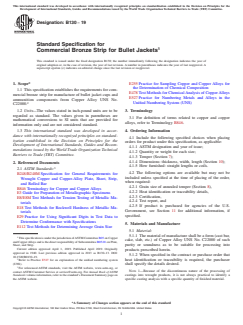
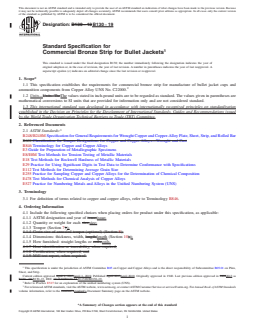
1.1 This specification establishes the requirements for commercial bronze strip for manufacture of bullet jacket cups and ammunition components from Copper Alloy UNS No. C22000.2
1.2 Units—The values stated in inch-pound units are to be regarded as standard. The values given in parentheses are mathematical conversions to SI units that are provided for information only and are not considered standard.
1.3 This international standard was developed in accordance with internationally recognized principles on standardization established in the Decision on Principles for the Development of International Standards, Guides and Recommendations issued by the World Trade Organization Technical Barriers to Trade (TBT) Committee.
General Information
- Status
- Published
- Publication Date
- 31-Mar-2019
- Technical Committee
- B05 - Copper and Copper Alloys
- Drafting Committee
- B05.01 - Plate, Sheet, and Strip
Relations
- Effective Date
- 01-Apr-2019
- Effective Date
- 01-Jan-2024
- Effective Date
- 01-Aug-2019
- Effective Date
- 01-Jan-2019
- Effective Date
- 01-Jul-2018
- Effective Date
- 01-Jul-2017
- Effective Date
- 15-Jul-2016
- Effective Date
- 01-Feb-2015
- Effective Date
- 01-Jun-2013
- Effective Date
- 01-Dec-2012
- Effective Date
- 15-Nov-2012
- Effective Date
- 01-Dec-2011
- Effective Date
- 01-Nov-2011
- Effective Date
- 01-Jun-2011
- Effective Date
- 01-Jan-2011
Overview
ASTM B130-19: Standard Specification for Commercial Bronze Strip for Bullet Jackets sets forth requirements for commercial bronze strip used in the manufacture of bullet jacket cups and ammunition components. Specifically, this standard specifies material produced from copper alloy UNS No. C22000. It addresses critical manufacturing aspects such as hot and cold working, annealing, and uniform wrought structure to ensure the bronze strip meets demanding performance and quality criteria. The standard includes mandates for mechanical and chemical property testing, dimensional tolerances, and inspection, making it essential for ammunition manufacturers and material suppliers involved in production of bullet jackets and related components.
Key Topics
- Material Requirements: The bronze strip must be made from copper alloy UNS No. C22000, ensuring a consistent and reliable base material for bullet jacket cups.
- Manufacturing Processes: The strip is produced using a combination of hot working, cold working, and annealing techniques to achieve a uniform wrought structure suitable for forming operations.
- Mechanical and Chemical Testing:
- Tensile Strength: The product must undergo a tension test to confirm adequate mechanical properties as outlined in the standard.
- Rockwell Hardness: A Rockwell hardness test is performed to assess conformity with required hardness ranges.
- Grain Size: Purchasers may specify grain size, with grain size testing required if stipulated.
- Chemical Composition: Strict limits are set for copper, zinc, lead, iron, and bismuth, ensuring controlled alloy composition.
- Dimensional Tolerances: Precise thickness, width, length, and straightness tolerances are specified. These tolerances ensure consistent processing and reliable performance during bullet and ammunition manufacturing.
- Inspection and Certification: The standard covers detailed procedures for sampling, inspection, retesting, and rejection criteria to meet quality control requirements.
- Packaging and Marking: Guidelines for packaging, marking, and traceability are included to ensure correct delivery and identification.
Applications
ASTM B130-19 is widely adopted in the ammunition industry for the fabrication of bullet jacket cups and similar components requiring high-performance, work-hardened bronze strip. The use of UNS C22000 commercial bronze provides a balance of formability, strength, and corrosion resistance-essential for the demanding environments in which ammunition is manufactured and used.
Typical practical applications include:
- Production of bullet jackets for small arms and commercial ammunition
- Manufacture of ammunition components such as base cups and other strip-formed parts
- Supply chains for military, law enforcement, and civilian ammunition manufacturers
Manufacturers and suppliers who comply with ASTM B130-19 benefit by ensuring their materials are compatible with a broad range of forming and assembly processes, and by providing assurance of consistent quality to customers.
Related Standards
To ensure comprehensive compliance and quality, users of ASTM B130-19 should also be aware of these related standards:
- ASTM B248/B248M: General requirements for wrought copper and copper-alloy plate, sheet, strip, and rolled bar.
- ASTM B601: Classification for temper designations for copper and copper alloys.
- ASTM B846: Terminology for copper and copper alloys, important for specification consistency.
- ASTM E3, E8/E8M, E18: Guides and methods for metallographic preparation, tension testing, and Rockwell hardness testing of metallic materials.
- ASTM E29: Practice for using significant digits in test data to determine conformance.
- ASTM E112: Methods for determining average grain size.
- ASTM E255, E478, E527: Practices for sampling and chemical analysis relevant to copper alloys.
By adhering to ASTM B130-19 and the associated referenced standards, manufacturers and suppliers maintain high standards for bullet jacket material quality, enhancing safety, performance, and market acceptance across the ammunition sector.
Buy Documents
ASTM B130-19 - Standard Specification for Commercial Bronze Strip for Bullet Jackets
REDLINE ASTM B130-19 - Standard Specification for Commercial Bronze Strip for Bullet Jackets
Get Certified
Connect with accredited certification bodies for this standard

Element Materials Technology
Materials testing and product certification.

Inštitut za kovinske materiale in tehnologije
Institute of Metals and Technology. Materials testing, metallurgical analysis, NDT.
Sponsored listings
Frequently Asked Questions
ASTM B130-19 is a technical specification published by ASTM International. Its full title is "Standard Specification for Commercial Bronze Strip for Bullet Jackets". This standard covers: ABSTRACT This specification covers the standard for commercial bronze strip for manufacture of bullet jacket cups and ammunition components from copper alloy UNS No. C22000. The specimens shall be manufactured by such hot working, cold working, and annealing processes to produce a uniform wrought structure. Each specimen shall be subjected to tension test and Rockwell hardness test. In addition to tensile properties for strips, purchaser may also specify grain size. If specimens fail to conform to the prescribed specification, analysis shall be made on a new composite sample. SIGNIFICANCE AND USE 17.1 For purposes of determining compliance with the specified property limits for the properties listed in the following table, an observed value of a calculated value shall be rounded as indicated in accordance with the rounding method of Practice E29: Property Rounded Unit for Observed or Calculated Value Chemical composition Hardness nearest unit in the last right-hand significant digit used in expressing the limiting value. Tensile strength nearest ksi (5 MPa) Grain size: Up to 0.055 mm, incl nearest multiple of 0.005 mm Over 0.055 to 0.160 mm, incl nearest 0.01 mm Elongation: 5 % and over nearest 1 % SCOPE 1.1 This specification establishes the requirements for commercial bronze strip for manufacture of bullet jacket cups and ammunition components from Copper Alloy UNS No. C22000.2 1.2 Units—The values stated in inch-pound units are to be regarded as standard. The values given in parentheses are mathematical conversions to SI units that are provided for information only and are not considered standard. 1.3 This international standard was developed in accordance with internationally recognized principles on standardization established in the Decision on Principles for the Development of International Standards, Guides and Recommendations issued by the World Trade Organization Technical Barriers to Trade (TBT) Committee.
ABSTRACT This specification covers the standard for commercial bronze strip for manufacture of bullet jacket cups and ammunition components from copper alloy UNS No. C22000. The specimens shall be manufactured by such hot working, cold working, and annealing processes to produce a uniform wrought structure. Each specimen shall be subjected to tension test and Rockwell hardness test. In addition to tensile properties for strips, purchaser may also specify grain size. If specimens fail to conform to the prescribed specification, analysis shall be made on a new composite sample. SIGNIFICANCE AND USE 17.1 For purposes of determining compliance with the specified property limits for the properties listed in the following table, an observed value of a calculated value shall be rounded as indicated in accordance with the rounding method of Practice E29: Property Rounded Unit for Observed or Calculated Value Chemical composition Hardness nearest unit in the last right-hand significant digit used in expressing the limiting value. Tensile strength nearest ksi (5 MPa) Grain size: Up to 0.055 mm, incl nearest multiple of 0.005 mm Over 0.055 to 0.160 mm, incl nearest 0.01 mm Elongation: 5 % and over nearest 1 % SCOPE 1.1 This specification establishes the requirements for commercial bronze strip for manufacture of bullet jacket cups and ammunition components from Copper Alloy UNS No. C22000.2 1.2 Units—The values stated in inch-pound units are to be regarded as standard. The values given in parentheses are mathematical conversions to SI units that are provided for information only and are not considered standard. 1.3 This international standard was developed in accordance with internationally recognized principles on standardization established in the Decision on Principles for the Development of International Standards, Guides and Recommendations issued by the World Trade Organization Technical Barriers to Trade (TBT) Committee.
ASTM B130-19 is classified under the following ICS (International Classification for Standards) categories: 77.150.30 - Copper products. The ICS classification helps identify the subject area and facilitates finding related standards.
ASTM B130-19 has the following relationships with other standards: It is inter standard links to ASTM B130-13, ASTM E8/E8M-24, ASTM B846-19a, ASTM B846-19, ASTM E18-18, ASTM E18-17, ASTM E8/E8M-16, ASTM E8/E8M-15, ASTM E8/E8M-13, ASTM E18-12, ASTM E112-12, ASTM E8/E8M-11, ASTM E18-11, ASTM B846-11a, ASTM B846-11. Understanding these relationships helps ensure you are using the most current and applicable version of the standard.
ASTM B130-19 is available in PDF format for immediate download after purchase. The document can be added to your cart and obtained through the secure checkout process. Digital delivery ensures instant access to the complete standard document.
Standards Content (Sample)
This international standard was developed in accordance with internationally recognized principles on standardization established in the Decision on Principles for the
Development of International Standards, Guides and Recommendations issued by the World Trade Organization Technical Barriers to Trade (TBT) Committee.
Designation:B130 −19
Standard Specification for
Commercial Bronze Strip for Bullet Jackets
This standard is issued under the fixed designation B130; the number immediately following the designation indicates the year of
original adoption or, in the case of revision, the year of last revision.Anumber in parentheses indicates the year of last reapproval.A
superscript epsilon (´) indicates an editorial change since the last revision or reapproval.
1. Scope* E255Practice for Sampling Copper and Copper Alloys for
the Determination of Chemical Composition
1.1 This specification establishes the requirements for com-
E478Test Methods for ChemicalAnalysis of CopperAlloys
mercial bronze strip for manufacture of bullet jacket cups and
E527Practice for Numbering Metals and Alloys in the
ammunition components from Copper Alloy UNS No.
2 Unified Numbering System (UNS)
C22000.
1.2 Units—The values stated in inch-pound units are to be
3. Terminology
regarded as standard. The values given in parentheses are
3.1 For definition of terms related to copper and copper
mathematical conversions to SI units that are provided for
alloys, refer to Terminology B846.
information only and are not considered standard.
1.3 This international standard was developed in accor-
4. Ordering Information
dance with internationally recognized principles on standard-
4.1 Include the following specified choices when placing
ization established in the Decision on Principles for the
orders for product under this specification, as applicable:
Development of International Standards, Guides and Recom-
4.1.1 ASTM designation and year of issue;
mendations issued by the World Trade Organization Technical
4.1.2 Quantity or weight for each size;
Barriers to Trade (TBT) Committee.
4.1.3 Temper (Section 7);
4.1.4 Dimensions: thickness, width, length (Section 10);
2. Referenced Documents
4.1.5 How furnished: straight lengths or coils.
2.1 ASTM Standards:
4.2 The following options are available but may not be
B248/B248MSpecification for General Requirements for
included unless specified at the time of placing of the order,
Wrought Copper and Copper-Alloy Plate, Sheet, Strip,
when required:
and Rolled Bar
4.2.1 Grain size of annealed temper (Section 8),
B846Terminology for Copper and Copper Alloys
4.2.2 Heat identification or traceability details,
E3Guide for Preparation of Metallographic Specimens
4.2.3 Certification,
E8/E8MTest Methods for Tension Testing of Metallic Ma-
4.2.4 Test report, and
terials
4.2.5 If product is purchased for agencies of the U.S.
E18Test Methods for Rockwell Hardness of Metallic Ma-
Government, see Section 11 for additional information, if
terials
specified.
E29Practice for Using Significant Digits in Test Data to
Determine Conformance with Specifications
5. Materials and Manufacture
E112Test Methods for Determining Average Grain Size
5.1 Material:
5.1.1 The material of manufacture shall be a form (cast bar,
ThisspecificationisunderthejurisdictionofASTMCommitteeB05onCopper
cake, slab, etc.) of Copper Alloy UNS No. C22000 of such
andCopperAlloysandisthedirectresponsibilityofSubcommitteeB05.01onPlate,
Sheet, and Strip. purity or soundness as to be suitable for processing into
Current edition approved April 1, 2019. Published April 2019. Originally
products prescribed herein.
approved in 1940. Last previous edition approved in 2013 as B130–13. DOI:
5.1.2 When specified in the contract or purchase order that
10.1520/B0130–19.
heat identification or traceability is required, the purchaser
Refer to Practice E527 for an explanation of the unified numbering system
(UNS).
shall specify the details desired.
For referenced ASTM standards, visit the ASTM website, www.astm.org, or
NOTE 1—Because of the discontinuous nature of the processing of
contact ASTM Customer Service at service@astm.org. For Annual Book of ASTM
castings into wrought products, it is not always practical to identify a
Standards volume information, refer to the standard’s Document Summary page on
the ASTM website. specific casting analysis with a specific quantity of finished material.
*A Summary of Changes section appears at the end of this standard
Copyright © ASTM International, 100 Barr Harbor Drive, PO Box C700, West Conshohocken, PA 19428-2959. United States
B130−19
TABLE 1 Chemical Requirements TABLE 3 Grain Size Requirements of Annealed Strip
Copper Alloy UNS No. C22000 Annealed Temper Designation Grain Size, mm
Element Composition Nominal
Standard Min Max
Average
Copper 89.0–91.0
A
Lead, max 0.05 OS015 0.015 0.025
Iron, max 0.05 OS025 0.025 0.015 0.040
Bismuth, max 0.006 OS035 0.035 0.025 0.050
Zinc remainder
A
Although no minimum grain size is required, this material must be fully
recrystallized.
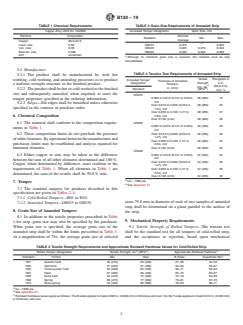
5.2 Manufacture:
TABLE 4 Tension Test Requirements of Annealed Strip
5.2.1 The product shall be manufactured by such hot
Elongation in
working, cold working, and annealing processes as to produce Tensile
Annealed Temper
Thickness of Annealed
2in.
Designation Strength
a uniform wrought structure in the finished product. Tempers,
A
(50.8 mm),
min. ksi
in. (mm) B
5.2.2 Theproductshallbehotorcoldworkedtothefinished Standard
(MPa )
min, %
size and subsequently annealed, when required, to meet the
OS015
0.005 to 0.010 (0.127 to 0.254), 38 (260) 15
temper properties specified in the ordering information.
incl
5.2.3 Edges—Slit edges shall be furnished unless otherwise
Over 0.010 to 0.050 (0.254 to 38 (260) 25
specified in the contract or purchase order.
1.27), incl
Over 0.050 to 0.100 (1.27 to 38 (260) 27
2.54), incl
6. Chemical Composition
Over 0.100 (2.54) 38 (260) 30
6.1 The material shall conform to the composition require-
OS025
0.005 to 0.010 (0.127 to 0.254), 36 (250) 20
ments in Table 1.
incl
Over 0.010 to 0.050 (0.254 to 36 (250) 30
6.2 These composition limits do not preclude the presence
1.27), incl
ofotherelements.Byagreementbetweenthemanufacturerand
Over 0.050 to 0.100 (1.27 to 36 (250) 32
purchaser, limits may be established and analysis required for
2.54), incl
Over 0.100 (2.54) 36 (250) 35
unnamed elements.
OS035
6.3 Either copper or zinc may be taken as the difference 0.005 to 0.010 (0.127 to 0.254), 34 (235) 25
incl
between the sum of all other elements determined and 100%.
Over 0.010 to 0.050 (0.254 to 34 (235) 35
Copper, when determined by difference, must conform to the
1.27), incl
requirements of Table 1. When all elements in Table 1 are Over 0.050 to 0.100 (1.27 to 34 (235) 38
2.54), incl
determined, the sum of the results shall be 99.8% min.
Over 0.100 (2.54) 34 (235) 40
A
ksi = 1000 psi.
7. Temper
B
See Appendix X1
7.1 The standard tempers for products described in this
specification are given in Tables 2-4:
7.1.1 Cold-Rolled Tempers—H01 to H10.
areas 79.8 mm in diameter of each of two samples of annealed
7.1.2 Annealed Tempers—OS015 to OS035.
strip shall be determined on a plane parallel to the surface of
8. Grain Size of Annealed Tempers
the strip.
8.1 In addition to the tensile properties prescribed in Table
9. Mechanical Property Requirements
4 for strip, grain size may also be specified by the purchaser.
When grain size is specified, the average grain size of the 9.1 Tensile Strength of Rolled Tempers—The tension test
annealed strip shall be within the limits prescribed in Table 3. shall be the standard test for all tempers of cold-rolled strip,
At a magnification of 75×, the average grain size of selected and the acceptance or rejection, based upon mechanical
TABLE 2 Tensile Strength Requirements and Approximate Rockwell Hardness Values for Cold-Rolled Strip
A B C
Rolled Temper Designation Tensile Strength, ksi (MPa ) Approximate Rockwell Hardness
Standard Former Min Max B Scale Superficial 30-T
H01 Quarter-hard 40 (275) 50 (345) 27–56 34–54
H02 Half-hard 47 (325) 57 (395) 50–66 50–61
H03 Three-quarter hard 52 (360) 62 (425) 59–71 55–64
H04 Hard 57 (395) 66 (455) 65–75 60–67
H06 Extra-hard 64 (440) 72 (495) 72–79 64–69
H08 Spring 69 (475) 77 (530) 76–81 67–70
H10 Extra-spring 72 (495) 80 (550) 78–83 68–71
A
ksi = 1000 psi.
B
See Appendix X1.
C
Rockwell hardness values apply as follows: The B scale applies to metal 0.020 in. (0.058 mm) in thickness and over; the 30-T scale applies to metal 0.012 in. (0.305 mm)
in thickness and over.
B130−19
TABLE 6 Width Tolerances
properties,shalldependonlyonthetensilestrengthwhichshall
conformtotherequirementsprescribedinTable2.Tensiontest Slit Metal and Slit Metal with Rolled Edges
A
Width Tolerances
specimens shall be taken so the longitudinal axis is parallel to
Plus and Minus, in. (mm)
the direction of rolling.
0.004 to 0.032 in. Over 0.032 to 0.188 in.
Width, in. (mm) (0.102 to 0.813 mm), (0.813 to 4.78 mm),
9.2 Rockwell Hardness of Rolled Tempers—Since a Rock-
incl, in Thickness incl, in Thickness
2 (50.8) and under 0.005 (0.13) 0.010 (0.25)
well hardness test offers a quick and convenient method of
Over 2 to 8 (50.8 to 203), incl 0.008 (0.20) 0.013 (0.33)
checking commercial bronze for general conformity to the
Over 8 to 14 (203 to 356), incl 0.010 (0.25) 0.015 (0.38)
requirements for tensile strength, the approximate Rockwell
Over 14 to 20 (356 to 508), incl 0.013 (0.33) 0.018 (0.46)
hardnessvaluesforeachofthecold-rolledtempersaregivenin Square Sheared Metal (All Lengths up to 120 in. (3.05 m), incl)
Table 2 for general information and assistance in testing.
A
Width Tolerances,
9.3 Tensile Strength of Annealed Tempers—The tension test
Plus and Minus, in. (mm)
Width, in.
shall be the standard test for all tempers of annealed strip, and 1 1 1
⁄16 in. Over ⁄16 to Over ⁄8 in.
(mm)
the acceptance or rejection, based upon mechanical properties,
(1.59 mm) ⁄8 in. (1.59 (3.18 mm) in
shall depend only on the tensile strength which shall conform
and Under in to 3.18 Thickness
Thickness mm) incl, in
to the requirements prescribed in Table 4. Tension test speci-
Thicknesses
mens shall be taken so that the longitudinal axis is parallel to
1 3 1
20 (508) and ⁄32 (0.79) ⁄64 (1.2) ⁄16 (1.6)
the direction of rolling. When grain size is specified by the under
A
purchaser (8.1), the acceptance and rejection shall be based on
When tolerances are specified as all plus or all minus, double the values given.
both the grain size (Table 3) and tensile strength (Table 4).
10. Dimensions, Mass, and Permissible Variations
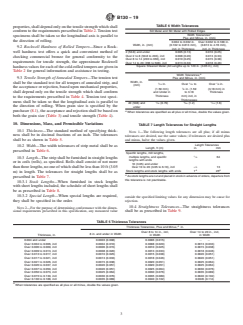
TABLE 7 Length Tolerances for Straight Lengths
10.1 Thickness—The standard method of specifying thick-
NOTE 1—The following length tolerances are all plus; if all minus
ness shall be in decimal fractions of an inch. The tolerances
tolerances are desired, use the same values; if tolerances are desired plus
and minus, halve the values given.
shall be as shown in Table 5.
Length Tolerances
10.2 Width—The width tolerances of strip metal shall be as
Length, ft (m) in. mm
prescribed in Table 6.
Specific lengths, mill lengths,
multiple lengths, and specific ⁄4 64
10.3 Length—Thestripshallbefurnishedinstraightlengths
lengths with ends
or in coils (rolls), as specified. Rolls shall consist of not more
10 (3.05) and under
thanthreelengths,nooneofwhichshallbelessthan10ft(3.05 Over 10 to 20 (3.05 to 6.10), incl ⁄2 13
A A
Stock lengths and stock lengths with ends 1 25
m) in length. The tolerances for straight lengths shall be as
A
As stock lengths are cut and placed in stock in advance of orders, departure from
prescribed in Table 7.
this tolerance is not practicable.
10.3.1 Stock Lengths—When furnished in stock lengths
with short lengths included, the schedule of short lengths shall
be as prescribed in Table 8.
10.3.2 Special Length—When special lengths are required,
outside the specified limiting values for any dimension may be cause for
rejection.
they shall be specified in the order.
10.4 Straightness Tolerances—The straightness tolerances
NOTE 2—For the purpose of determining conformance with the dimen-
sional requirements prescribed in this specification, any measured value shall be as prescribed in Table 9.
TABLE 5 Thickness Tolerances
A
Thickness Tolerances, Plus and Minus, in.
Over 8 to 14 in., incl, Over 14 to 20 in., incl,
8 in. and under in Width
Thickness, in. in Width in Width
0.004 and under 0.0003 (0.008) 0.0006 (0.015) . .
Over 0.004 to 0.006, incl 0.0004 (0.010) 0.0008 (0.020) 0.0013 (0.033)
Over 0.006 to 0.009, incl 0.0006 (0.015) 0.0010 (0.025) 0.0015 (0.038)
Over 0.009 to 0.013, incl 0.0008 (0.020) 0.0013 (0.033) 0.0018 (0.046)
Over 0.013 to 0.017, incl 0.0010 (0.025) 0.0015 (0.038) 0.0020 (0.051)
Over 0.017 to 0.021, incl 0.0013 (0.033) 0.0018 (0.046) 0.0020 (0.051)
Over 0.021 to 0.026, incl 0.0015 (0.038) 0.0020 (0.051) 0.0025 (0.064)
Over 0.026 to 0.037, incl 0.0020 (0.051) 0.0020 (0.051) 0.0025 (0.064)
Over 0.037 to 0.050, incl 0.0020 (0.051) 0.0025 (0.064) 0.0030 (0.076)
Over 0.050 to 0.073, incl 0.0025 (0.064) 0.0030 (0.076) 0.0035 (0.089)
Over 0.073 to 0.130, incl 0.0030 (0.076) 0.0035 (0.089) 0.0040 (0.102)
Over 0.130 to 0.188, incl 0.0035 (0.089) 0.0040 (0.102) 0.0045 (0.114)
A
When tolerances are specified as all plus or all minus, double the values given.
B130−19
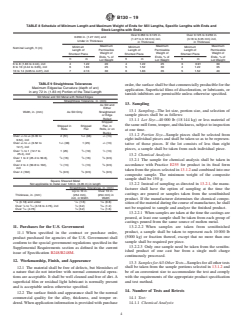
TABLE 8 Schedule of Minimum Length and Maximum Weight of Ends for Mill Lengths, Specific Lengths with Ends and
Stock Lengths with Ends
Over 0.050 to 0.125 in. Over 0.125 to 0.250 in.
0.050 in. (1.27 mm) and
(1.27 to 3.18 mm) incl, (3.18 to 6.35 mm) incl,
Under in Thickness
in Thickness in Thickness
Maximum Maximum Maximum
Minimum Minimum Minimum
Nominal Length, ft (m)
Permissible Permissible Permissible
Length of Length of Length of
Weight of Weight of Weight of
Shortest Piece Shortest Piece Shortest Piece
Ends, % of Ends, % of Ends, % of
ft m ft m ft m
Lot Weight Lot Weight Lot Weight
...
This document is not an ASTM standard and is intended only to provide the user of an ASTM standard an indication of what changes have been made to the previous version. Because
it may not be technically possible to adequately depict all changes accurately, ASTM recommends that users consult prior editions as appropriate. In all cases only the current version
of the standard as published by ASTM is to be considered the official document.
Designation: B130 − 13 B130 − 19
Standard Specification for
Commercial Bronze Strip for Bullet Jackets
This standard is issued under the fixed designation B130; the number immediately following the designation indicates the year of
original adoption or, in the case of revision, the year of last revision. A number in parentheses indicates the year of last reapproval. A
superscript epsilon (´) indicates an editorial change since the last revision or reapproval.
1. Scope*
1.1 This specification establishes the requirements for commercial bronze strip for manufacture of bullet jacket cups and
ammunition components from Copper Alloy UNS No. C22000.
1.2 Units—Units–TheThe values stated in inch-pound units are to be regarded as standard. The values given in parentheses are
mathematical conversions to SI units that are provided for information only and are not considered standard.
1.3 This international standard was developed in accordance with internationally recognized principles on standardization
established in the Decision on Principles for the Development of International Standards, Guides and Recommendations issued
by the World Trade Organization Technical Barriers to Trade (TBT) Committee.
2. Referenced Documents
2.1 ASTM Standards:
B248/B248M Specification for General Requirements for Wrought Copper and Copper-Alloy Plate, Sheet, Strip, and Rolled Bar
B601 Classification for Temper Designations for Copper and Copper Alloys—Wrought and Cast
B846 Terminology for Copper and Copper Alloys
E3 Guide for Preparation of Metallographic Specimens
E8/E8M Test Methods for Tension Testing of Metallic Materials
E18 Test Methods for Rockwell Hardness of Metallic Materials
E29 Practice for Using Significant Digits in Test Data to Determine Conformance with Specifications
E112 Test Methods for Determining Average Grain Size
E255 Practice for Sampling Copper and Copper Alloys for the Determination of Chemical Composition
E478 Test Methods for Chemical Analysis of Copper Alloys
E527 Practice for Numbering Metals and Alloys in the Unified Numbering System (UNS)
3. Terminology
3.1 For definition of terms related to copper and copper alloys, refer to Terminology B846.
4. Ordering Information
4.1 Include the following specified choices when placing orders for product under this specification, as applicable:
4.1.1 ASTM designation and year of issue,issue;
4.1.2 Quantity or weight for each size,size;
4.1.3 Temper (Section 7),);
4.1.4 Grain size of annealed temper (optional) (Section 8),
4.1.4 Dimensions: thickness, width, length,length (Section 10),);
4.1.5 How furnished: straight lengths or coils,coils.
4.1.7 Heat identification or traceability, when required,
4.1.8 Certification, when required, and
4.1.9 Mill test report, when required.
This specification is under the jurisdiction of ASTM Committee B05 on Copper and Copper Alloys and is the direct responsibility of Subcommittee B05.01 on Plate,
Sheet, and Strip.
Current edition approved April 1, 2013April 1, 2019. Published April 2013April 2019. Originally approved in 1940. Last previous edition approved in 20082013 as
B130 – 08.B130–13. DOI: 10.1520/B0130-13.10.1520/B0130–19.
Refer to Practice E527 for an explanation of the unified numbering system (UNS).
For referenced ASTM standards, visit the ASTM website, www.astm.org, or contact ASTM Customer Service at service@astm.org. For Annual Book of ASTM Standards
volume information, refer to the standard’sstandard’s Document Summary page on the ASTM website.
*A Summary of Changes section appears at the end of this standard
Copyright © ASTM International, 100 Barr Harbor Drive, PO Box C700, West Conshohocken, PA 19428-2959. United States
B130 − 19
4.1.10 When material is purchased for agencies of the U.S. government, see Section 11.
4.2 The following options are available but may not be included unless specified at the time of placing of the order, when
required:
4.2.1 Grain size of annealed temper (Section 8),
4.2.2 Heat identification or traceability details,
4.2.3 Certification,
4.2.4 Test report, and
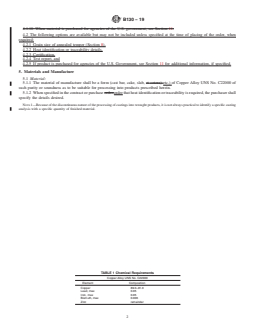
4.2.5 If product is purchased for agencies of the U.S. Government, see Section 11 for additional information, if specified.
5. Materials and Manufacture
5.1 Material:
5.1.1 The material of manufacture shall be a form (cast bar, cake, slab, et cetera) etc.) of Copper Alloy UNS No. C22000 of
such purity or soundness as to be suitable for processing into products prescribed herein.
5.1.2 When specified in the contract or purchase order,order that heat identification or traceability is required, the purchaser shall
specify the details desired.
NOTE 1—Because of the discontinuous nature of the processing of castings into wrought products, it is not always practical to identify a specific casting
analysis with a specific quantity of finished material.
TABLE 1 Chemical Requirements
Copper Alloy UNS No. C22000
Element Composition
Copper 89.0–91.0
Lead, max 0.05
Iron, max 0.05
Bismuth, max 0.006
Zinc remainder
B130 − 19
5.2 Manufacture:
5.2.1 The product shall be manufactured by such hot working, cold working, and annealing processes as to produce a uniform
wrought structure in the finished product.
5.2.2 The product shall be hot or cold worked to the finished size and subsequently annealed, when required, to meet the temper
properties specified in the ordering information.
5.2.3 Edges—Slit edges shall be furnished unless otherwise specified in the contract or purchase order.
6. Chemical Composition
6.1 The productmaterial shall conform to the composition prescribedrequirements in Table 1.
6.2 These composition limits do not preclude the presence of other elements. By agreement between the manufacturer and
purchaser, limits may be established and analysis required for unnamed elements.
6.3 Either copper or zinc may be taken as the difference between the sum of all other elements analyzeddetermined and 100 %.
Copper, when determined by difference, must conform to the requirements of Table 1. When all elements in Table 1 are analyzed,
their sum determined, the sum of the results shall be 99.8 % min.
7. Temper
7.1 The standard tempers for products described in this specification are given in Tables 2-4:
7.1.1 Cold-Rolled Tempers—H01 to H10.
7.1.2 Annealed Tempers—OS015 to OS035.
8. Grain Size of Annealed Tempers
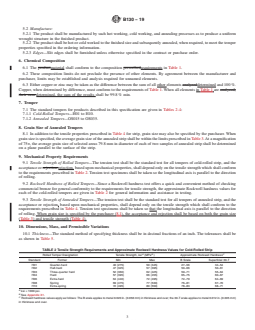
8.1 In addition to the tensile properties prescribed in Table 4 for strip, grain size may also be specified by the purchaser. When
grain size is specified, the average grain size of the annealed strip shall be within the limits prescribed in Table 3. At a magnification
of 75×, the average grain size of selected areas 79.8 mm in diameter of each of two samples of annealed strip shall be determined
on a plane parallel to the surface of the strip.
9. Mechanical Property Requirements
9.1 Tensile Strength of Rolled Tempers—The tension test shall be the standard test for all tempers of cold-rolled strip, and the
acceptance or rejection.rejection, based upon mechanical properties, shall depend only on the tensile strength which shall conform
to the requirements prescribed in Table 2. Tension test specimens shall be taken so the longitudinal axis is parallel to the direction
of rolling.
9.2 Rockwell Hardness of Rolled Tempers—Since a Rockwell hardness test offers a quick and convenient method of checking
commercial bronze for general conformity to the requirements for tensile strength, the approximate Rockwell hardness values for
each of the cold-rolled tempers are given in Table 2 for general information and assistance in testing.
9.3 Tensile Strength of Annealed Tempers—The tension test shall be the standard test for all tempers of annealed strip, and the
acceptance or rejection, based upon mechanical properties, shall depend only on the tensile strength which shall conform to the
requirements prescribed in Table 4. Tension test specimens shall be taken so that the longitudinal axis is parallel to the direction
of rolling. When grain size is specified by the purchaser (8.1), the acceptance and rejection shall be based on both the grain size
(Table 3) and tensile strength (Table 4).
10. Dimensions, Mass, and Permissible Variations
10.1 Thickness—The standard method of specifying thickness shall be in decimal fractions of an inch. The tolerances shall be
as shown in Table 5.
TABLE 2 Tensile Strength Requirements and Approximate Rockwell Hardness Values for Cold-Rolled Strip
A B C
Rolled Temper Designation Tensile Strength, ksi (MPa ) Approximate Rockwell Hardness
Standard Former Min Max B Scale Superficial 30-T
H01 Quarter-hard 40 (275) 50 (345) 27–56 34–54
H02 Half-hard 47 (325) 57 (395) 50–66 50–61
H03 Three-quarter hard 52 (360) 62 (425) 59–71 55–64
H04 Hard 57 (395) 66 (455) 65–75 60–67
H06 Extra-hard 64 (440) 72 (495) 72–79 64–69
H08 Spring 69 (475) 77 (530) 76–81 67–70
H10 Extra-spring 72 (495) 80 (550) 78–83 68–71
A
ksi = 1000 psi.
B
See Appendix X1.
C
Rockwell hardness values apply as follows: The B scale applies to metal 0.020 in. (0.058 mm) in thickness and over; the 30-T scale applies to metal 0.012 in. (0.305 mm)
in thickness and over.
B130 − 19
TABLE 3 Grain Size Requirements of Annealed Strip
Annealed Temper Designation Grain Size, mm
Nominal
Standard Min Max
Average
A
OS015 0.015 0.025
OS025 0.025 0.015 0.040
OS035 0.035 0.025 0.050
A
Although no minimum grain size is required, this material must be fully
recrystallized.
TABLE 4 Tension Test Requirements of Annealed Strip
Tensile Elongation in
Annealed Temper
Thickness of Annealed
2 in.
Designation Strength
Tempers,
A
(50.8 mm),
min. ksi
in. (mm) B
Standard (MPa )
min, %
OS015
0.005 to 0.010 (0.127 to 0.254), 38 (260) 15
incl
Over 0.010 to 0.050 (0.254 to 38 (260) 25
1.27), incl
Over 0.050 to 0.100 (1.27 to 38 (260) 27
2.54), incl
Over 0.100 (2.54) 38 (260) 30
OS025
0.005 to 0.010 (0.127 to 0.254), 36 (250) 20
incl
Over 0.010 to 0.050 (0.254 to 36 (250) 30
1.27), incl
Over 0.050 to 0.100 (1.27 to 36 (250) 32
2.54), incl
Over 0.100 (2.54) 36 (250) 35
OS035
0.005 to 0.010 (0.127 to 0.254), 34 (235) 25
incl
Over 0.010 to 0.050 (0.254 to 34 (235) 35
1.27), incl
Over 0.050 to 0.100 (1.27 to 34 (235) 38
2.54), incl
Over 0.100 (2.54) 34 (235) 40
A
ksi = 1000 psi.
B
See Appendix X1
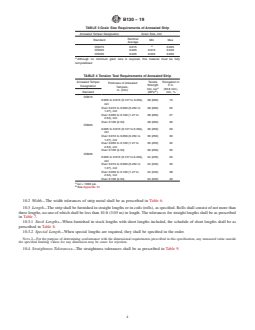
10.2 Width—The width tolerances of strip metal shall be as prescribed in Table 6.
10.3 Length—The strip shall be furnished in straight lengths or in coils (rolls), as specified. Rolls shall consist of not more than
three lengths, no one of which shall be less than 10 ft (3.05 m) in length. The tolerances for straight lengths shall be as prescribed
in Table 7.
10.3.1 Stock Lengths—When furnished in stock lengths with short lengths included, the schedule of short lengths shall be as
prescribed in Table 8.
10.3.2 Special Length—When special lengths are required, they shall be specified in the order.
NOTE 2—For the purpose of determining conformance with the dimensional requirements prescribed in this specification, any measured value outside
the specified limiting values for any dimension may be cause for rejection.
10.4 Straightness Tolerances—The straightness tolerances shall be as prescribed in Table 9.
B130 − 19
TABLE 5 Thickness Tolerances
A
Thickness Tolerances, Plus and Minus, in.
Over 8 to 14 in., incl, Over 14 to 20 in., incl,
8 in. and under in Width
Thickness, in. in Width in Width
A
Thickness Tolerances, plus and minus, in.
Over 8 to 14 in., incl, in Over 14 to 20 in., incl, in
Thickness, in. 8 in. and under in Width
Width Width
0.004 and under 0.0003 (0.008) 0.0006 (0.015) . .
0.004 and under 0.0003 (0.008) 0.0006 (0.015) . .
Over 0.004 to 0.006, incl 0.0004 (0.010) 0.0008 (0.020) 0.0013 (0.033)
Over 0.006 to 0.009, incl 0.0006 (0.015) 0.0010 (0.025) 0.0015 (0.038)
Over 0.009 to 0.013, incl 0.0008 (0.020) 0.0013 (0.033) 0.0018 (0.046)
Over 0.013 to 0.017, incl 0.0010 (0.025) 0.0015 (0.038) 0.0020 (0.051)
Over 0.013 to 0.017, incl 0.0010 (0.025) 0.0015 (0.038) 0.0020 (0.051)
Over 0.017 to 0.021, incl 0.0013 (0.033) 0.0018 (0.046) 0.0020 (0.051)
Over 0.017 to 0.021, incl 0.0013 (0.033) 0.0018 (0.046) 0.0020 (0.051)
Over 0.021 to 0.026, incl 0.0015 (0.038) 0.0020 (0.051) 0.0025 (0.064)
Over 0.021 to 0.026, incl 0.0015 (0.038) 0.0020 (0.051) 0.0025 (0.064)
Over 0.026 to 0.037, incl 0.0020 (0.051) 0.0020 (0.051) 0.0025 (0.064)
Over 0.026 to 0.037, incl 0.0020 (0.051) 0.0020 (0.051) 0.0025 (0.064)
Over 0.037 to 0.050, incl 0.0020 (0.051) 0.0025 (0.064) 0.0030 (0.076)
Over 0.037 to 0.050, incl 0.0020 (0.051) 0.0025 (0.064) 0.0030 (0.076)
Over 0.050 to 0.073, incl 0.0025 (0.064) 0.0030 (0.076) 0.0035 (0.089)
Over 0.050 to 0.073, incl 0.0025 (0.064) 0.0030 (0.076) 0.0035 (0.089)
Over 0.073 to 0.130, incl 0.0030 (0.076) 0.0035 (0.089) 0.0040 (0.102)
Over 0.073 to 0.130, incl 0.0030 (0.076) 0.0035 (0.089) 0.0040 (0.102)
Over 0.130 to 0.188, incl 0.0035 (0.089) 0.0040 (0.102) 0.0045 (0.114)
Over 0.130 to 0.188, incl 0.0035 (0.089) 0.0040 (0.102) 0.0045 (0.114)
A
When tolerances are specified as all plus or all minus, double the values given.
TABLE 6 Width Tolerances
Slit Metal and Slit Metal with Rolled Edges
A
Width Tolerances
Plus and
Minus, in. (mm)
A
Width Tolerances
Plus and
Minus, in. (mm)
0.004 to 0.032 in. Over 0.032 to 0.188 in.
Width, in. (mm) (0.102 to 0.813 mm), (0.813 to 4.78 mm),
incl, in Thickness incl, in Thickness
2 (50.8) and under 0.005 (0.13) 0.010 (0.25)
Over 2 to 8 (50.8 to 203), incl 0.008 (0.20) 0.013 (0.33)
Over 8 to 14 (203 to 356), incl 0.010 (0.25) 0.015 (0.38)
Over 14 to 20 (356 to 508), incl 0.013 (0.33) 0.018 (0.46)
Square Sheared Metal (All Lengths up to 120 in. (3.05 m), incl)
A
Width Tolerances,
Plus and
Minus, in. (mm)
A
Width Tolerances,
Plus and
Minus, in. (mm)
Width, in.
1 1 1
⁄16 in. Over ⁄16 to Over ⁄8 in.
(mm)
(1.59 mm) ⁄8 in. (1.59 (3.18 mm) in
and Under in to 3.18 Thickness
Thickness mm) incl, in
Thicknesses
1 3 1
20 (508) and ⁄32 (0.79) ⁄64 (1.2) ⁄16 (1.6)
under
A
When tolerances are specified as all plus or all minus, double the values given.
11. Purchases for the U.S. Government
11.1 When specified in the contract or purchase order, product purchased for agencies of the U.S. Government shall conform
to the special government regulations specified in the Supplemental Requirements section as defined in the current issue of
Specification B248/B248M.
B130 − 19
TABLE 7 Length Tolerances for Straight Lengths
NOTE 1—The following length tolerances are all plus; if all minus
tolerances are desired, use the same values; if tolerances are desired plus
and minus, halve the values given.
Length Tolerances
Length, ft (m) in. mm
Length Tolerances
Length, ft (m) in. mm
Specific lengths, mill lengths,
multiple lengths, and specific ⁄4 64
lengths with ends
10 (3.05) and under
Over 10 to 20 (3.05 to 6.10), incl ⁄2 13
A A
Stock lengths and stock lengths with ends 1 25
A A
Stock lengths and stock lengths with ends 1 25
A
As stock lengths are cut and placed in stock in advance of orders, departure from
this tolerance is not practicable.
12. Workmanship, Finish, and Appearance
12.1 The material shall be free of defects, but blemishes of a nature that do not interfere with normal commercial operations
are acceptable. It shall be well-cleaned well cleaned and free of dirt. A superficial film or residual light lubricant is normally present
and is acceptable unless otherwise specified.
12.2 The surface finish and appearance shall be the normal commercial quality for the alloy, thickness, and temper ordered.
When application information is provided with purchase order, the surface shall be that commer
...
Questions, Comments and Discussion
Ask us and Technical Secretary will try to provide an answer. You can facilitate discussion about the standard in here.
Loading comments...