

ASTM F1498-08(2020)
(Specification)Standard Specification for Taper Pipe Threads 60° for Thermoplastic Pipe and Fittings
General Information
- Abstract
ABSTRACT
This specification establishes requirements for dimensions and gaging of taper pipe threads used on threaded plastic pipe and fittings. The type of pipe threads are designated by specifying in sequence the nominal pipe size, number of threads per inch, and the thread series symbols as follows. For left-hand threads add LH to the designation, otherwise right-hand threads will be understood. Different physical properties of pipe threads such as form, dimensions, angle, truncation, height, sealing capacity, and tightness shall be in accordance with the requirements specified. The gages have two types which may be used to completely cover gage requirements: (1) master gages used to check working gages; and (2) working gages used to check threads during manufacture and for conformance inspection. Both external and internal taper threads shall be gaged.
SCOPE
1.1 This specification establishes requirements for dimensions and gaging of taper pipe threads used on threaded plastic pipe and fittings.
1.2 Threads meeting this specification shall only be used on those plastic materials deemed suitable by the manufacturer.
1.3 Specialty threads or threads not requiring a leak-tight joint are not covered in this specification.
Note 1: The terms “wrench makeup” and “wrench tight” are standard terminology for tightness and do not imply using a pipe wrench or other tools which would damage plastic pipe and fittings. The terms “hand-tight” and “hand-tight engagement” refer only to thread gaging (not pipe and fitting connections) and is the definition of the L1 gage length.
1.4 Thread Designations—The type of pipe threads included in this specification are designated by specifying in sequence the nominal pipe size, number of threads per inch, and the thread series symbols as follows in accordance with ANSI/ASME B 1.20.1: 3/8-18 NPT. For left-hand threads add LH to the end of the designation, otherwise right-hand threads will be understood. For example: 3/8-18 NPT-LH.
1.4.1 Each of these letters in the symbol has a definite significance as follows:
N
=
National (American Standard)
P
=
Pipe
T
=
Taper
1.5 The values stated in inch-pound units are to be regarded as the standard. No other units of measurement are included in this standard.
1.6 This standard does not purport to address all of the safety concerns, if any, associated with its use. It is the responsibility of the user of this standard to establish appropriate safety, health, and environmental practices and determine the applicability of regulatory limitations prior to use. For specific precautionary statements, see 7.2.1 and 8.3.
1.7 This international standard was developed in accordance with internationally recognized principles on standardization established in the Decision on Principles for the Development of International Standards, Guides and Recommendations issued by the World Trade Organization Technical Barriers to Trade (TBT) Committee.
- Status
- Published
- Publication Date
- 31-Oct-2020
- Technical Committee
- F17 - Plastic Piping Systems
- Drafting Committee
- F17.10 - Fittings
Overview
ASTM F1498-08(2020) is the recognized international standard developed by ASTM for specifying the dimensions and gaging requirements of 60-degree taper pipe threads on thermoplastic pipes and fittings. This specification plays a critical role in ensuring that threaded plastic piping systems maintain consistency, tightness, and leak resistance in both pressure and non-pressure applications. The standard is widely adopted in industries utilizing acrylonitrile butadiene styrene (ABS), chlorinated polyvinyl chloride (CPVC), and polyvinyl chloride (PVC) plumbing and piping.
Key Topics
- Thread Type and Designation: Defines American National (NPT) 60° taper pipe threads used on plastic components. Designations specify nominal pipe size, threads per inch, and series symbol, with right-hand threads as standard unless otherwise indicated.
- Form and Dimensions: Requirements for thread form, dimensions, angle, truncation, and height to promote effective sealing and fit.
- Material Suitability: Restricts application to those plastic materials deemed suitable by the manufacturer, based on chemical and mechanical compatibility.
- Gaging and Tolerances: Outlines comprehensive gaging procedures, including both master and working gages, to ensure threads meet dimensional and functional requirements.
- Thread Tightness and Sealing: Details on "wrench makeup" (the number of turns for tight fitting), and recommendations for sealing materials such as PTFE tape or suitable sealant-lubricant compatible with the plastic material.
- Inspection: Prescribes inspection methods using gages and optical comparators, and defines acceptable tolerances for thread elements.
- Units and Safety: Measurement units are inch-pound only; users are responsible for safety, health, and environmental precautions.
Applications
The requirements of ASTM F1498-08(2020) are vital for manufacturers, installers, and inspectors working with thermoplastic pipes and fittings in:
- Water distribution systems: Ensuring reliable, leak-tight threaded joints in potable and non-potable water systems.
- Irrigation and agricultural piping: Providing secure thread connections where plastic pipes are commonly utilized.
- Industrial chemical piping: Where thermoplastic resistance to corrosion is necessary, and threaded joints require tightly controlled dimensional accuracy.
- Building and construction: Use in drainage, waste, and vent (DWV) applications, as well as pressure and non-pressure piping systems.
- Inspection and Quality Control: Facilitating conformance verification of plastic thread dimensions and engagement during manufacturing and installation.
By specifying thread dimensions and gaging methods, the standard safeguards against performance failures due to incompatible threads, over-tightening, or improper sealing materials that may cause leaks or split fittings.
Related Standards
- ANSI/ASME B1.20.1 - Pipe Threads, General Purpose (inch): Primary reference for thread characteristics and dimensions.
- ASME B1.7 - Nomenclature, Definitions, and Letter Symbols for Screw Threads: For terminology and symbols.
- ASTM F412 - Terminology Relating to Plastic Piping Systems: Contains definitions relevant to plastic pipes and fittings.
- ASTM D1600 - Terminology for Abbreviated Terms Relating to Plastics.
Practical Value
Adherence to ASTM F1498-08(2020) supports:
- Interoperability: Consistent thread profiles ensure compatibility across manufacturers and with metal-threaded components (external plastic to internal metal preferred).
- Product Quality: Defined tolerances and gaging methods improve process control and product reliability.
- Leak Prevention: Reliable thread engagement and sealing reduce the risk of leaks or failures under pressure.
- Regulatory Compliance: Alignment with internationally recognized principles facilitates trade, inspection, and approval in global markets.
- Safety: Guidance on thread tightness and the selection of sealants helps prevent damage to plastic components and associated hazards.
In summary, ASTM F1498-08(2020) establishes essential criteria for manufacturing and verifying the quality of taper pipe threads used on thermoplastic pipes and fittings, contributing to the long-term integrity and safety of piping systems.
Relations
- Effective Date
- 01-Apr-2020
- Effective Date
- 01-Jan-2019
- Refers
ASTM D1600-18 - Standard Terminology for Abbreviated Terms Relating to Plastics (Withdrawn 2024) - Effective Date
- 01-Jan-2018
- Effective Date
- 01-Aug-2017
- Effective Date
- 01-Feb-2017
- Effective Date
- 15-Nov-2016
- Effective Date
- 01-Aug-2016
- Effective Date
- 01-Jun-2015
- Effective Date
- 01-May-2014
- Effective Date
- 01-Feb-2014
- Effective Date
- 01-May-2013
- Effective Date
- 15-Apr-2013
- Effective Date
- 15-Feb-2013
- Effective Date
- 01-Apr-2012
- Effective Date
- 01-Oct-2010
Get Certified
Connect with accredited certification bodies for this standard

Institut za varilstvo d.o.o. (Welding Institute)
Slovenia's leading welding institute since 1952. ISO 3834, EN 1090, pressure equipment certification, NDT personnel, welder qualification. Only IIW Au
Sponsored listings
Frequently Asked Questions
ASTM F1498-08(2020) is a technical specification published by ASTM International. Its full title is "Standard Specification for Taper Pipe Threads 60° for Thermoplastic Pipe and Fittings". This standard covers: ABSTRACT This specification establishes requirements for dimensions and gaging of taper pipe threads used on threaded plastic pipe and fittings. The type of pipe threads are designated by specifying in sequence the nominal pipe size, number of threads per inch, and the thread series symbols as follows. For left-hand threads add LH to the designation, otherwise right-hand threads will be understood. Different physical properties of pipe threads such as form, dimensions, angle, truncation, height, sealing capacity, and tightness shall be in accordance with the requirements specified. The gages have two types which may be used to completely cover gage requirements: (1) master gages used to check working gages; and (2) working gages used to check threads during manufacture and for conformance inspection. Both external and internal taper threads shall be gaged. SCOPE 1.1 This specification establishes requirements for dimensions and gaging of taper pipe threads used on threaded plastic pipe and fittings. 1.2 Threads meeting this specification shall only be used on those plastic materials deemed suitable by the manufacturer. 1.3 Specialty threads or threads not requiring a leak-tight joint are not covered in this specification. Note 1: The terms “wrench makeup” and “wrench tight” are standard terminology for tightness and do not imply using a pipe wrench or other tools which would damage plastic pipe and fittings. The terms “hand-tight” and “hand-tight engagement” refer only to thread gaging (not pipe and fitting connections) and is the definition of the L1 gage length. 1.4 Thread Designations—The type of pipe threads included in this specification are designated by specifying in sequence the nominal pipe size, number of threads per inch, and the thread series symbols as follows in accordance with ANSI/ASME B 1.20.1: 3/8-18 NPT. For left-hand threads add LH to the end of the designation, otherwise right-hand threads will be understood. For example: 3/8-18 NPT-LH. 1.4.1 Each of these letters in the symbol has a definite significance as follows: N = National (American Standard) P = Pipe T = Taper 1.5 The values stated in inch-pound units are to be regarded as the standard. No other units of measurement are included in this standard. 1.6 This standard does not purport to address all of the safety concerns, if any, associated with its use. It is the responsibility of the user of this standard to establish appropriate safety, health, and environmental practices and determine the applicability of regulatory limitations prior to use. For specific precautionary statements, see 7.2.1 and 8.3. 1.7 This international standard was developed in accordance with internationally recognized principles on standardization established in the Decision on Principles for the Development of International Standards, Guides and Recommendations issued by the World Trade Organization Technical Barriers to Trade (TBT) Committee.
ABSTRACT This specification establishes requirements for dimensions and gaging of taper pipe threads used on threaded plastic pipe and fittings. The type of pipe threads are designated by specifying in sequence the nominal pipe size, number of threads per inch, and the thread series symbols as follows. For left-hand threads add LH to the designation, otherwise right-hand threads will be understood. Different physical properties of pipe threads such as form, dimensions, angle, truncation, height, sealing capacity, and tightness shall be in accordance with the requirements specified. The gages have two types which may be used to completely cover gage requirements: (1) master gages used to check working gages; and (2) working gages used to check threads during manufacture and for conformance inspection. Both external and internal taper threads shall be gaged. SCOPE 1.1 This specification establishes requirements for dimensions and gaging of taper pipe threads used on threaded plastic pipe and fittings. 1.2 Threads meeting this specification shall only be used on those plastic materials deemed suitable by the manufacturer. 1.3 Specialty threads or threads not requiring a leak-tight joint are not covered in this specification. Note 1: The terms “wrench makeup” and “wrench tight” are standard terminology for tightness and do not imply using a pipe wrench or other tools which would damage plastic pipe and fittings. The terms “hand-tight” and “hand-tight engagement” refer only to thread gaging (not pipe and fitting connections) and is the definition of the L1 gage length. 1.4 Thread Designations—The type of pipe threads included in this specification are designated by specifying in sequence the nominal pipe size, number of threads per inch, and the thread series symbols as follows in accordance with ANSI/ASME B 1.20.1: 3/8-18 NPT. For left-hand threads add LH to the end of the designation, otherwise right-hand threads will be understood. For example: 3/8-18 NPT-LH. 1.4.1 Each of these letters in the symbol has a definite significance as follows: N = National (American Standard) P = Pipe T = Taper 1.5 The values stated in inch-pound units are to be regarded as the standard. No other units of measurement are included in this standard. 1.6 This standard does not purport to address all of the safety concerns, if any, associated with its use. It is the responsibility of the user of this standard to establish appropriate safety, health, and environmental practices and determine the applicability of regulatory limitations prior to use. For specific precautionary statements, see 7.2.1 and 8.3. 1.7 This international standard was developed in accordance with internationally recognized principles on standardization established in the Decision on Principles for the Development of International Standards, Guides and Recommendations issued by the World Trade Organization Technical Barriers to Trade (TBT) Committee.
ASTM F1498-08(2020) is classified under the following ICS (International Classification for Standards) categories: 23.040.20 - Plastics pipes. The ICS classification helps identify the subject area and facilitates finding related standards.
ASTM F1498-08(2020) has the following relationships with other standards: It is inter standard links to ASTM F412-20, ASTM F412-19, ASTM D1600-18, ASTM F412-17a, ASTM F412-17, ASTM F412-16a, ASTM F412-16, ASTM F412-15, ASTM E177-14, ASTM D1600-14, ASTM E177-13, ASTM D1600-13, ASTM F412-13, ASTM F412-12, ASTM E177-10. Understanding these relationships helps ensure you are using the most current and applicable version of the standard.
ASTM F1498-08(2020) is available in PDF format for immediate download after purchase. The document can be added to your cart and obtained through the secure checkout process. Digital delivery ensures instant access to the complete standard document.
Standards Content (Sample)
This international standard was developed in accordance with internationally recognized principles on standardization established in the Decision on Principles for the
Development of International Standards, Guides and Recommendations issued by the World Trade Organization Technical Barriers to Trade (TBT) Committee.
Designation:F1498 −08 (Reapproved 2020) An American National Standard
Standard Specification for
Taper Pipe Threads 60° for Thermoplastic Pipe and Fittings
This standard is issued under the fixed designation F1498; the number immediately following the designation indicates the year of
original adoption or, in the case of revision, the year of last revision.Anumber in parentheses indicates the year of last reapproval.A
superscript epsilon (´) indicates an editorial change since the last revision or reapproval.
1. Scope* Development of International Standards, Guides and Recom-
mendations issued by the World Trade Organization Technical
1.1 This specification establishes requirements for dimen-
Barriers to Trade (TBT) Committee.
sions and gaging of taper pipe threads used on threaded plastic
pipe and fittings.
2. Referenced Documents
1.2 Threads meeting this specification shall only be used on
2.1 ASTM Standards:
those plastic materials deemed suitable by the manufacturer.
D1600TerminologyforAbbreviatedTermsRelatingtoPlas-
1.3 Specialty threads or threads not requiring a leak-tight
tics
joint are not covered in this specification.
E177Practice for Use of the Terms Precision and Bias in
ASTM Test Methods
NOTE 1—The terms “wrench makeup” and “wrench tight” are standard
F412Terminology Relating to Plastic Piping Systems
terminology for tightness and do not imply using a pipe wrench or other
tools which would damage plastic pipe and fittings. The terms “hand-
2.2 ASME Standards:
tight” and “hand-tight engagement” refer only to thread gaging (not pipe
B1.20.1Pipe Threads, General Purpose (inch)
and fitting connections) and is the definition of the L gage length.
B1.7 Nomenclature, Definitions and Letter Symbols for
1.4 ThreadDesignations—Thetypeofpipethreadsincluded 3
Screw Threads
in this specification are designated by specifying in sequence
B47.1Gage Blanks
the nominal pipe size, number of threads per inch, and the
thread series symbols as follows in accordance with ANSI/
3. Terminology
ASME B 1.20.1: ⁄8-18 NPT. For left-hand threads add LH to
3.1 Terminology is in accordance with Terminology F412
theendofthedesignation,otherwiseright-handthreadswillbe
and abbreviations are in accordance with Terminology D1600,
understood. For example: ⁄8-18 NPT-LH.
unless otherwise indicated.
1.4.1 Each of these letters in the symbol has a definite
3.2 Nomenclature, definitions, and letter symbols for screw
significance as follows:
threads are in accordance with ASME/ANSI B1.7.
N = National (American Standard)
P = Pipe
T = Taper
4. American National Standard Taper Pipe Thread Form
1.5 The values stated in inch-pound units are to be regarded
4.1 Thread Form—The form of thread profile specified in
as the standard. No other units of measurement are included in
this specification shall be known as the American National
this standard.
Standard Taper Pipe Thread Form. The relations as specified
1.6 This standard does not purport to address all of the herein, for form of thread and general notations are shown in
safety concerns, if any, associated with its use. It is the Fig. 1.
responsibility of the user of this standard to establish appro-
4.2 Angle of Thread—The angle between the sides of the
priate safety, health, and environmental practices and deter-
thread is 60° when measured in an axial plane. The line
mine the applicability of regulatory limitations prior to use.
bisecting this angle is perpendicular to the axis.
For specific precautionary statements, see 7.2.1 and 8.3.
4.3 Truncation and Thread Height—The height of the sharp
1.7 This international standard was developed in accor-
V thread, H, is as follows:
dance with internationally recognized principles on standard-
ization established in the Decision on Principles for the
For referenced ASTM standards, visit the ASTM website, www.astm.org, or
contact ASTM Customer Service at service@astm.org. For Annual Book of ASTM
This specification is under the jurisdiction ofASTM Committee F17 on Plastic Standards volume information, refer to the standard’s Document Summary page on
Piping Systems and is the direct responsibility of Subcommittee F17.10 on Fittings. the ASTM website.
Current edition approved Nov. 1, 2020. Published November 2020. Originally Available from American Society of Mechanical Engineers (ASME), ASME
ɛ1
approved in 1994. Last previous edition approved in 2012 as F1498–12 . DOI: International Headquarters, Two Park Ave., New York, NY 10016-5990, http://
10.1520/F1498-08R20 www.asme.org.
*A Summary of Changes section appears at the end of this standard
Copyright © ASTM International, 100 Barr Harbor Drive, PO Box C700, West Conshohocken, PA 19428-2959. United States
F1498−08 (2020)
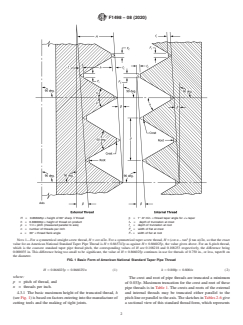
H = 0.866025p = height of 60° sharp V thread β = 1° 47 min. = thread taper angle for ⁄16 taper
h = 0.800000p = height of thread on product f = depth of truncation at crest
c
p =1/n = pitch (measured parallel to axis) f = depth of truncation at root
r
n = number of threads per inch F = width of flat at crest
c
α = 30° = thread flank angle F = width of flat at root
r
NOTE 1—For a symmetrical straight screw thread, H = cot α/2n. For a symmetrical taper screw thread, H = (cot α − tan β tan α)/2n, so that the exact
value for anAmerican National Standard Taper Pipe Thread is H = 0.865743p as against H = 0.866025p, the value given above. For an 8-pitch thread,
which is the coarsest standard taper pipe thread pitch, the corresponding values of H are 0.108218 and 0.108253 respectively, the difference being
0.000035 in. This difference being too small to be significant, the value of H = 0.866025p continues in use for threads of 0.750 in., or less, taper/ft on
the diameter.
FIG. 1Basic Form of American National Standard Taper Pipe Thread
H 50.866025p 50.866025/n (1) h 50.800p 50.800/n (2)
where:
The crest and root of pipe threads are truncated a minimum
p = pitch of thread, and
of 0.033p. Maximum truncation for the crest and root of these
n = threads per inch.
pipe threads is in Table 1. The crests and roots of the external
and internal threads may be truncated either parallel to the
4.3.1 The basic maximum height of the truncated thread, h
pitchlineorparalleltotheaxis.ThesketchesinTables2-6give
(seeFig.1)isbasedonfactorsenteringintothemanufactureof
cutting tools and the making of tight joints. a sectional view of this standard thread form, which represents
F1498−08 (2020)
A
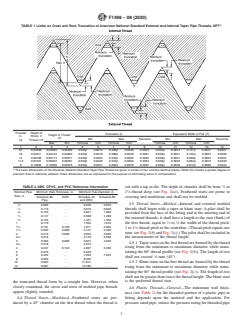
TABLE 1 Limits on Crest and Root Truncation of American National Standard External and Internal Taper Pipe Threads, NPT
Threads/ Height of
Truncation (f) Equivalent Width of Flat (F)
Height of Thread
in. Sharp V
(h)
Min Max Tolerance Min Max Tolerance
(n) Thread (H)
Max Min Formula Inch Formula Inch Formula Inch Formula Inch
123456789 10 11 12 13 14
27 0.03208 0.02963 0.02496 0.033p 0.0012 0.096p 0.0036 0.0024 0.038p 0.0014 0.111p 0.0041 0.0027
18 0.04811 0.04444 0.03833 0.033p 0.0018 0.088p 0.0049 0.0031 0.038p 0.0021 0.102p 0.0057 0.0036
14 0.06186 0.05714 0.05071 0.033p 0.0024 0.078p 0.0056 0.0032 0.038p 0.0027 0.090p 0.0064 0.0037
11.5 0.07531 0.06957 0.06261 0.033p 0.0029 0.073p 0.0063 0.0034 0.038p 0.0033 0.084p 0.0073 0.0040
8 0.10825 0.10000 0.09275 0.033p 0.0041 0.062p 0.0078 0.0037 0.038p 0.0048 0.072p 0.0090 0.0042
A
The basic dimensions of the American National Standard Taper Pipe Thread are given in inches to four and five decimal places. While this implies a greater degree of
precision than is ordinarily attained, these dimensions are so expressed for the purpose of eliminating errors in computations.
TABLE 2 ABS, CPVC, and PVC Reference Information
cut with a tap or die. The depth of chamfer shall be from ⁄4to
Nominal Pipe Minimum Wall-Thickness, in. Minimum Hub-Diameter, in. 1 ⁄4thread deep (see Fig. 2(a)). Feathered starts are prone to
Size, in.
crossing and mutilation and shall not be molded.
Schedule 80 DWV Schedule 40 Schedule 80
Pipe and DWV
4.5 Thread Starts—Molded—Internal and external molded
⁄8 0.095 . . . 0.526 0.645
⁄4 0.119 . . . 0.672 0.840 threads shall begin with a taper or blunt start. A pilot shall be
⁄8 0.126 . . . 0.821 1.000
provided from the face of the fitting and at the entering end of
⁄2 0.147 . . . 0.998 1.280
theexternalthreads;itshallhavealengthtothestart(flank)of
⁄4 0.154 . . . 1.221 1.450
1 3
1 0.179 . . . 1.504 1.810 the first thread, equal to ⁄2to ⁄4the width of the thread pitch,
1 ⁄4 0.191 0.100 1.871 2.200 1
1to1 ⁄4threadpitchtothecenterline.(Threadpitchequalsone
1 ⁄2 0.200 0.088 2.127 2.450
turn; see Fig. 2(b) and Fig. 2(c).)The pilot shall be included in
2 0.218 0.066 2.634 3.000
2 ⁄2 0.276 . . . 3.170 3.560 the measurement of the thread length.
3 0.300 0.086 3.841 4.250
4.5.1 Taperstartsonthefirstthreadareformedbythethread
3 ⁄2 0.318 . . . 4.374 . . .
rising from the minimum to maximum diameter while main-
4 0.337 0.104 4.907 5.350
5 0.375 . . . 6.039 . . .
taining the 60° thread profile (see Fig. 2(b)).The length of rise
6 0.432 . . . 7.203 7.625
shall not exceed ⁄8turn (45°).
8 0.500 . . . 9.320 . . .
10 0.593 . . . 11.614 . . . 4.5.2 Bluntstartsonthefirstthreadareformedbythethread
12 0.687 . . . 13.786 . . .
rising from the minimum to maximum diameter while main-
taining the 60° thread profile (see Fig. 2(c)).The length of rise
shallnotbegreaterthantwicethethreadheight.Thebluntstart
is the preferred thread start.
the truncated thread form by a straight line. However, when
closely examined, the crests and roots of molded pipe threads
4.6 Plastic Threads—General—The minimum wall thick-
appear slightly rounded.
ness (see Table 2) for the threaded portion of a plastic pipe or
4.4 Thread Starts—Machined—Feathered starts are pro- fitting depends upon the material and the application. For
duced by a 45° chamfer on the first thread when the thread is pressureratedpipe,reducethepressureratingforthreadedpipe
F1498−08 (2020)
A
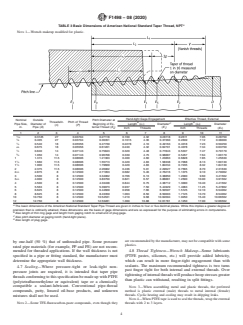
TABLE 3 Basic Dimensions of American National Standard Taper Thread, NPT
NOTE 1—Wrench makeup modified for plastic.
Hand-tight Gage Engagement Effective Thread, External
Nominal Outside Pitch Diameter at
Threads/in. Pitch of Thread
B D
Pipe Size, Diameter of Beginning of Ex- Length (L ) C Length (L )
1 Diameter 2 Diameter
(n) (P)
in. Pipe (D) ternal Thread (E ) (E )
0 (E )
Inch Threads Inch Threads 2
1 2 3 4 5 6 789 10 11
⁄16 0.3125 27 0.03704 0.27118 0.160 4.32 0.28118 0.2611 7.05 0.28750
⁄8 0.405 27 0.03704 0.36351 0.1615 4.36 0.37360 0.2639 7.12 0.38000
⁄4 0.540 18 0.05556 0.47739 0.2278 4.10 0.49163 0.4018 7.23 0.50250
⁄8 0.675 18 0.05556 0.61201 0.240 4.32 0.62701 0.4078 7.34 0.63750
⁄2 0.840 14 0.07143 0.75843 0.320 4.48 0.77843 0.5337 7.47 0.79179
⁄4 1.050 14 0.07143 0.96768 0.339 4.75 0.98887 0.5457 7.64 1.00179
1 1.315 11.5 0.08696 1.21363 0.400 4.60 1.23863 0.6828 7.85 1.25630
1 ⁄4 1.660 11.5 0.08696 1.55713 0.420 4.83 1.58338 0.7068 8.13 1.60130
1 ⁄2 1.900 11.5 0.08696 1.79609 0.420 4.83 1.82234 0.7235 8.32 1.84130
2 2.375 11.5 0.08696 2.26902 0.436 5.01 2.29627 0.7565 8.70 2.31630
2 ⁄2 2.875 8 0.12500 2.71953 0.682 5.46 2.76216 1.1375 9.10 2.79062
3 3.500 8 0.12500 3.34062 0.766 6.13 3.38850 1.2000 9.60 3.41562
3 ⁄2 4.000 8 0.12500 3.83750 0.821 6.57 3.88881 1.2500 10.00 3.91562
4 4.500 8 0.12500 4.33438 0.844 6.75 4.38712 1.3000 10.40 4.41562
5 5.563 8 0.12500 5.39073 0.937 7.50 5.44929 1.4063 11.25 5.47862
6 6.625 8 0.12500 6.44609 0.958 7.66 6.50597 1.5125 12.10 6.54062
8 8.625 8 0.12500 8.43359 1.063 8.50 8.50003 1.7125 13.70 8.54062
10 10.750 8 0.12500 10.54531 1.210 9.68 10.62094 1.9250 15.40 10.66562
12 12.750 8 0.12500 12.53281 1.360 10.88 12.61781 2.1250 17.00 12.66562
A
The basic dimensions of the American National Standard Taper Pipe Thread are given in inches to four or five decimal places. While this implies a greater degree of
precision than is ordinarily attained, these dimensions are the basis of gage dimensions and are so expressed for the purpose of eliminating errors in computations.
B
Also length of thin ring gage and length from gaging notch to small end of plug gage.
C
Also pitch diameter at gaging notch (hand-tight plane).
D
Also length of plug gage.
are recommended by the manufacturer, may not be compatible with some
by one-half (50 %) that of unthreaded pipe. Some pressure
plastics.
rated pipe materials (for example, PP and PE) are not recom-
mended for threaded applications. If the wall thickness is not 4.8 Thread Tightness—Wrench Makeup—Some lubricants
specified in a pipe or fitting standard, the manufacturer must (PTFE pastes, silicones, etc.) will provide added lubricity,
determine the appropriate wall thickness. which can result in more finger-tight engagement than with
sealants. The maximum recommended tightness is two turns
4.7 Sealing—Where pressure-tight or leak-tight non-
past finger tight for both internal and external threads. Over
pressure joints are required, it is intended that taper pipe
tighteningofinternalthreadswillproducehoopstressesgreater
threadsconformingtothisspecificationbemadeupwithPTFE
than plastic can withstand, resulting in split fittings.
(polytetrafluoroethylene or equivalent) tape or a chemically
compatible a sealant-lubricant. Conventional pipe-thread
NOTE 3—When assembling metal and plastic threads, the preferred
method is plastic external (male) threads to metal internal (female)
compounds, putty, linseed oil-base products, and unknown
threads. Cyclic heating and cooling may result in dripping leaks.
mixtures shall not be used.
NOTE4—WhenPTFEtapeisusedtosealthethreads,wraptheexternal
NOTE 2—Some TFE-fluorocarbon-paste compounds, even though they threads with 2 to 3 layers.
F1498−08 (2020)
TABLE 3 Basic Dimensions of American National Standard Taper Thread, NPT (continued)
Wrench Makeup Length for
Basic
Length, L Plane to L A
1 2 B
Internal Thread
Overall
Increase in Minor
Plane External Thread Nominal Complete
Nominal
Length
Vanish Thread (V)
Diameter C Height of Diameter Diameter
(L −L ) External Thread
Pipe Size, 2 1 Length (L ) External
(E ) Thread (h) per Thread at Small
Thread
in.
(0.0625/n) End of
(L )
4 Length (L )Diameter
Inch Thread Inch Thread Inch Thread
Pipe (K )
(E )
1 12131415161718192021222324
⁄16 0.1011 2.73 0.0741 2 0.26656 0.1285 3.47 0.3896 0.1870 0.28287 0.02963 0.00231 0.2416
⁄8 0.1024 2.76 0.0741 2 0.35889 0.1285 3.47 0.3924 0.1898 0.37537 0.02963 0.00231 0.3339
⁄4 0.1740 3.13 0.1111 2 0.47045 0.1928 3.47 0.5946 0.2907 0.49556 0.04444 0.00347 0.4329
⁄8 0.1678 3.02 0.1111 2 0.60507 0.1928 3.47 0.6006 0.2967 0.63056 0.04444 0.00347 0.5676
⁄2 0.2137 2.99 0.1429 2 0.74951 0.2478 3.47 0.7815 0.3909 0.78286 0.05714 0.00446 0.7013
⁄4 0.2067 2.89 0.1429 2 0.95876 0.2478 3.47 0.7935 0.4029 0.99286 0.05714 0.00446 0.9105
1 0.2828 3.25 0.1739 2 1.20277 0.3017 3.47 0.9845 0.5089 1.24543 0.06957 0.00543 1.1441
1 ⁄4 0.2868 3.30 0.1739 2 1.54627 0.3017 3.47 1.0085 0.5329 1.59043 0.06957 0.00543 1.4876
1 ⁄2 0.3035 3.49 0.1739 2 1.78523 0.3017 3.47 1.0252 0.5496 1.83043 0.06957 0.00543 1.7265
2 0.3205 3.69 0.1739 2 2.25816 0.3017 3.47 1.0582 0.5826 2.30543 0.06957 0.00543 2.1995
2 ⁄2 0.4555 3.64 0.2500 2 2.70391 0.4337 3.47 1.5712 0.8875 2.77500 0.100000 0.00781 2.6195
3 0.4340 3.47 0.2500 2 3.32500 0.4337 3.47 1.6337 0.9500 3.40000 0.100000 0.00781 3.2406
3 ⁄2 0.4290 3.43 0.2500 2 3.82188 0.4337 3.47 1.6837 1.0000 3.90000 0.100000 0.00781 3.7375
4 0.4560 3.65 0.2500 2 4.31875 0.4337 3.47 1.7337 1.0500 4.40000 0.100000 0.00781 4.2344
5 0.4693 3.75 0.2500 2 5.37511 0.4337 3.47 1.8400 1.1563 5.46300 0.100000 0.00781 5.2907
6 0.5545 4.44 0.2500 2 6.43047 0.4337 3.47 1.9462 1.2625 6.52500 0.100000 0.00781 6.3461
8 0.6495 5.20 0.2500 2 8.41797 0.4337 3.47 2.1462 1.4625 8.52500 0.100000 0.00781 8.3336
10 0.7150 5.72 0.2500 2 10.52969 0.4337 3.47 2.3587 1.6750 10.65000 0.100000 0.00781 10.4453
12 0.7650 6.12 0.2500 2 12.51719 0.4337 3.47 2.5587 1.8750 12.65000 0.100000 0.00781 12.4328
A
Maximum wrench-tightness is two turns past finger-tight. Over tightening may result in split fittings.
B
Reference dimension.
C
The length L from the end of the pipe determines the plane beyond which the thread form is incomplete at the crest. The next two threads are complete at the root.
At this plane the cone formed by the crests of the thread intersects the cylinder forming the external surface of the pipe, L =L − 2p.
5 2
4.9 Inspection—Agagingmethodoftolerancesisprescribed 5.1.1 Thread Designation and Notation—American Na-
in this specification to effect a functional inspection of the tional Standard Taper Pipe Threads are designated in accor-
hand-tight L engagement threads. However, conformance to dance with 3.2 as follows: ⁄8-18 NPT.
this specification requires that all basic design dimensions be
5.1.1.1 Standard notation applicable to American National
met (within applicable tolerances) including extension of the
Standard Taper Pipe Threads is shown in Fig. 4.
thread elements (L − L ) to provide for wrench-tight makeup.
2 1 5.1.2 Form of Thread:
Therefore, additional methods of gaging may be employed to
5.1.2.1 The basic dimensions of American National Stan-
evaluate conformance to the basic design dimensions. When
dard PipeThreads, NPT, are given in Table 3 (wrench makeup
additional methods of gaging are employed, they shall be
has been changed from three turns to two turns for sizes 2 in.
agreeduponbetweenthesupplierandthepurchaser.Becauseit
and smaller), which is for machined threads. (See 4.1.)
is known that injection molded threads that are removed from
5.1.2.2 The basic dimensions of molded taper pipe threads
themoldbeforetheyarecompletelycooledwilldistortinform
for pressure fittings are given in Table 4. The overall length
so that they will not gage properly, threads suspected of being
(L ) is slightly less than that of American National Standard
so distorted should be inspected with an optical comparator to
Taper Pipe Threads, NPT, because there are no vanish threads.
determine their true quality.
5.1.2.3 The basic dimensions of molded taper pipe threads
for DWV fittings are given in Table 5. The overall length (L )
5. Specification for General Purpose Taper Pipe Threads,
is shorter than that ofAmerican National Standard Taper Pipe
NPT
Threads, NPT, and molded pressure fitting threads.
5.1 Taper Pipe Threads—Threads made in accordance with
5.1.2.4 The basic dimension of molded taper pipe threads
these specifications consist of an external taper and an internal
for DWV plugs and cleanout fittings are given in Table 6.
taper thread, to form a normal type of joint having general
These threads are shorter than DWV threads.
application on pipe and fittings (see Fig. 3). The NPT taper
5.1.3 Taper of Thread—The taper of the thread is 1 in 16 or
pipe threads are intended to be made up wrench-tight (maxi-
0.75 in./ft measured on the diameter and along the axis.
mum two turns past finger-tight), and with a lubricant
...