


ASTM D1785-21a
(Specification)Standard Specification for Poly(Vinyl Chloride) (PVC) Plastic Pipe, Schedules 40, 80, and 120
Standard Specification for Poly(Vinyl Chloride) (PVC) Plastic Pipe, Schedules 40, 80, and 120
ABSTRACT
This specification covers poly(vinyl chloride) (PVC) plastic pipe, schedules 40, 80, and 120 for use with the distribution of pressurized liquids only. This specification also includes classification criteria, nomenclature system, test methods, requirements, workmanship, dimensions, sustained pressure, burst pressure, flattening, extrusion quality, finish, appearance, and marking methods for PVC plastic pipe. PVC pipe covered are marked with one of six type/grade/design stress designation and defined by four hydrostatic design stresses. PVC plastics are categorized by short-term and long term-strength tests.
SCOPE
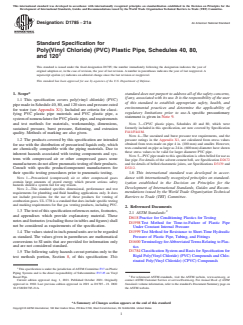
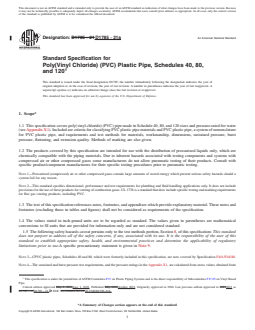
1.1 This specification covers poly(vinyl chloride) (PVC) pipe made in Schedule 40, 80, and 120 sizes and pressure-rated for water (see Appendix X1). Included are criteria for classifying PVC plastic pipe materials and PVC plastic pipe, a system of nomenclature for PVC plastic pipe, and requirements and test methods for materials, workmanship, dimensions, sustained pressure, burst pressure, flattening, and extrusion quality. Methods of marking are also given.
1.2 The products covered by this specification are intended for use with the distribution of pressurized liquids only, which are chemically compatible with the piping materials. Due to inherent hazards associated with testing components and systems with compressed air or other compressed gases some manufacturers do not allow pneumatic testing of their products. Consult with specific product/component manufacturers for their specific testing procedures prior to pneumatic testing.
Note 1: Pressurized (compressed) air or other compressed gases contain large amounts of stored energy which present serious saftey hazards should a system fail for any reason.
Note 2: This standard specifies dimensional, performance and test requirements for plumbing and fluid handling applications only. It does not include provisions for the use of these products for venting of combustion gases. UL 1738 is a standard that does include specific testing and marking requirements for flue gas venting products, including PVC.
1.3 The text of this specification references notes, footnotes, and appendixes which provide explanatory material. These notes and footnotes (excluding those in tables and figures) shall not be considered as requirements of the specification.
1.4 The values stated in inch-pound units are to be regarded as standard. The values given in parentheses are mathematical conversions to SI units that are provided for information only and are not considered standard.
1.5 The following safety hazards caveat pertains only to the test methods portion, Section 8, of this specification: This standard does not purport to address all of the safety concerns, if any, associated with its use. It is the responsibility of the user of this standard to establish appropriate safety, health, and environmental practices and determine the applicability of regulatory limitations prior to use.A specific precautionary statement is given in Note 9.
Note 3: CPVC plastic pipes, Schedules 40 and 80, which were formerly included in this specification, are now covered by Specification F441/F441M.
Note 4: The sustained and burst pressure test requirements, and the pressure ratings in the Appendix X1, are calculated from stress values obtained from tests made on pipe 4 in. (100 mm) and smaller. However, tests conducted on pipe as large as 24 in. (600 mm) diameter have shown these stress values to be valid for larger diameter PVC pipe.
Note 5: PVC pipe made to this specification is often belled for use as line pipe. For details of the solvent cement bell, see Specification D2672 and for details of belled elastomeric joints, see Specifications D3139 and D3212.
1.6 This international standard was developed in accordance with internationally recognized principles on standardization established in the Decision on Principles for the Development of International Sta...
General Information
- Status
- Published
- Publication Date
- 31-Jul-2021
- Technical Committee
- F17 - Plastic Piping Systems
- Drafting Committee
- F17.25 - Vinyl Based Pipe
Relations
- Effective Date
- 01-Nov-2023
- Effective Date
- 01-Apr-2020
- Effective Date
- 15-Jan-2020
- Effective Date
- 01-Nov-2019
- Effective Date
- 01-Jan-2019
- Effective Date
- 01-Sep-2018
- Refers
ASTM D1600-18 - Standard Terminology for Abbreviated Terms Relating to Plastics (Withdrawn 2024) - Effective Date
- 01-Jan-2018
- Effective Date
- 01-Nov-2017
- Effective Date
- 01-Aug-2017
- Effective Date
- 01-Feb-2017
- Effective Date
- 15-Nov-2016
- Effective Date
- 01-Aug-2016
- Effective Date
- 01-Nov-2015
- Effective Date
- 01-Aug-2015
- Effective Date
- 01-Jun-2015
Overview
ASTM D1785-21a is a key international standard that specifies requirements for Poly(Vinyl Chloride) (PVC) plastic pipe in Schedule 40, 80, and 120 wall thicknesses. This standard, published by ASTM International, establishes essential criteria for pipes used exclusively for the distribution of pressurized liquids that are chemically compatible with PVC. The specification details classification, nomenclature, test methods, dimensions, reliability under pressure, workmanship, marking, and applicable safety considerations for PVC pipe products. It is widely referenced in plumbing, water supply, and industrial fluid transport applications where pipe durability, pressure resistance, and quality are essential.
Key Topics
- Scope of Application
- Covers PVC pipes made in Schedules 40, 80, and 120, designed for pressurized liquids.
- Intended for piping systems handling fluids only-does not cover venting of combustion gases.
- Classification and Designation
- Defines a nomenclature system based on material type, grade, and hydrostatic design stress.
- Six type/grade/design stress codes with four specific hydrostatic design stress categories.
- Physical and Performance Requirements
- Dimensions, tolerances, and pipe quality requirements.
- Mandatory pressure performance including sustained pressure and burst pressure test protocols.
- Requirements for flattening tests and extrusion quality.
- Marking and Traceability
- Specifies permanent marking including pipe size, schedule, design stress code, pressure rating, manufacturer details, and compliance marks for potable water use.
- Special marking for pipes intended for reclaimed water applications.
- Workmanship and Appearance
- Sets requirements for homogeneity, absence of defects, uniformity in appearance, and labeling for identification.
Applications
PVC pipes manufactured to ASTM D1785-21a are used in a range of demanding pressurized fluid handling applications, including:
- Water Distribution Systems: Widely used for transporting potable and non-potable water in municipal, commercial, and residential settings.
- Industrial Fluid Handling: Suitable for many industrial processes that require reliable pressure-rated piping for chemically compatible fluids.
- Irrigation Networks: Common in agricultural irrigation and landscape watering systems where pressure and durability matter.
- Reclaimed Water Systems: Marked and color-coded for safe identification in non-potable recycled water conveyance.
- Plumbing Installations: Trusted in building and facility plumbing for high-performance cold-water delivery.
Note: This standard does not address use for venting or exhaust gas applications-separate standards (such as UL 1738) are required for those cases.
Related Standards
Understanding ASTM D1785-21a in the context of related standards helps ensure comprehensive compliance for piping systems:
- ASTM D1784: Classification for rigid PVC and CPVC compounds used for piping.
- ASTM D2672: Joints for PVC pipe using solvent cement.
- ASTM D3139 & D3212: Standards for joints with elastomeric seals in plastic pressure/drainage piping.
- NSF/ANSI Standard 61: Health effects testing for drinking water system components.
- UL 1738: Standards for venting systems and gas-burning appliance exhausts (not covered in D1785).
- ASTM D1598 / D1599 / D2152: Test methods for hydraulic pressure, burst resistance, and fusion quality.
- F441/F441M: Specification for chlorinated poly(vinyl chloride) (CPVC) pipes.
Keywords: ASTM D1785, PVC pipe, Schedule 40 pipe, Schedule 80 pipe, Schedule 120 pipe, pressurized liquids, water distribution, plastic piping standards, pipe marking, hydrostatic design stress, fluid handling, industrial piping, potable water pipes.
By adhering to ASTM D1785-21a, specifiers, manufacturers, and installers ensure that PVC pipe systems provide reliable performance, durability, and safety in pressurized liquid applications.
Buy Documents
ASTM D1785-21a - Standard Specification for Poly(Vinyl Chloride) (PVC) Plastic Pipe, Schedules 40, 80, and 120
REDLINE ASTM D1785-21a - Standard Specification for Poly(Vinyl Chloride) (PVC) Plastic Pipe, Schedules 40, 80, and 120
Get Certified
Connect with accredited certification bodies for this standard

Institut za varilstvo d.o.o. (Welding Institute)
Slovenia's leading welding institute since 1952. ISO 3834, EN 1090, pressure equipment certification, NDT personnel, welder qualification. Only IIW Au
Sponsored listings
Frequently Asked Questions
ASTM D1785-21a is a technical specification published by ASTM International. Its full title is "Standard Specification for Poly(Vinyl Chloride) (PVC) Plastic Pipe, Schedules 40, 80, and 120". This standard covers: ABSTRACT This specification covers poly(vinyl chloride) (PVC) plastic pipe, schedules 40, 80, and 120 for use with the distribution of pressurized liquids only. This specification also includes classification criteria, nomenclature system, test methods, requirements, workmanship, dimensions, sustained pressure, burst pressure, flattening, extrusion quality, finish, appearance, and marking methods for PVC plastic pipe. PVC pipe covered are marked with one of six type/grade/design stress designation and defined by four hydrostatic design stresses. PVC plastics are categorized by short-term and long term-strength tests. SCOPE 1.1 This specification covers poly(vinyl chloride) (PVC) pipe made in Schedule 40, 80, and 120 sizes and pressure-rated for water (see Appendix X1). Included are criteria for classifying PVC plastic pipe materials and PVC plastic pipe, a system of nomenclature for PVC plastic pipe, and requirements and test methods for materials, workmanship, dimensions, sustained pressure, burst pressure, flattening, and extrusion quality. Methods of marking are also given. 1.2 The products covered by this specification are intended for use with the distribution of pressurized liquids only, which are chemically compatible with the piping materials. Due to inherent hazards associated with testing components and systems with compressed air or other compressed gases some manufacturers do not allow pneumatic testing of their products. Consult with specific product/component manufacturers for their specific testing procedures prior to pneumatic testing. Note 1: Pressurized (compressed) air or other compressed gases contain large amounts of stored energy which present serious saftey hazards should a system fail for any reason. Note 2: This standard specifies dimensional, performance and test requirements for plumbing and fluid handling applications only. It does not include provisions for the use of these products for venting of combustion gases. UL 1738 is a standard that does include specific testing and marking requirements for flue gas venting products, including PVC. 1.3 The text of this specification references notes, footnotes, and appendixes which provide explanatory material. These notes and footnotes (excluding those in tables and figures) shall not be considered as requirements of the specification. 1.4 The values stated in inch-pound units are to be regarded as standard. The values given in parentheses are mathematical conversions to SI units that are provided for information only and are not considered standard. 1.5 The following safety hazards caveat pertains only to the test methods portion, Section 8, of this specification: This standard does not purport to address all of the safety concerns, if any, associated with its use. It is the responsibility of the user of this standard to establish appropriate safety, health, and environmental practices and determine the applicability of regulatory limitations prior to use.A specific precautionary statement is given in Note 9. Note 3: CPVC plastic pipes, Schedules 40 and 80, which were formerly included in this specification, are now covered by Specification F441/F441M. Note 4: The sustained and burst pressure test requirements, and the pressure ratings in the Appendix X1, are calculated from stress values obtained from tests made on pipe 4 in. (100 mm) and smaller. However, tests conducted on pipe as large as 24 in. (600 mm) diameter have shown these stress values to be valid for larger diameter PVC pipe. Note 5: PVC pipe made to this specification is often belled for use as line pipe. For details of the solvent cement bell, see Specification D2672 and for details of belled elastomeric joints, see Specifications D3139 and D3212. 1.6 This international standard was developed in accordance with internationally recognized principles on standardization established in the Decision on Principles for the Development of International Sta...
ABSTRACT This specification covers poly(vinyl chloride) (PVC) plastic pipe, schedules 40, 80, and 120 for use with the distribution of pressurized liquids only. This specification also includes classification criteria, nomenclature system, test methods, requirements, workmanship, dimensions, sustained pressure, burst pressure, flattening, extrusion quality, finish, appearance, and marking methods for PVC plastic pipe. PVC pipe covered are marked with one of six type/grade/design stress designation and defined by four hydrostatic design stresses. PVC plastics are categorized by short-term and long term-strength tests. SCOPE 1.1 This specification covers poly(vinyl chloride) (PVC) pipe made in Schedule 40, 80, and 120 sizes and pressure-rated for water (see Appendix X1). Included are criteria for classifying PVC plastic pipe materials and PVC plastic pipe, a system of nomenclature for PVC plastic pipe, and requirements and test methods for materials, workmanship, dimensions, sustained pressure, burst pressure, flattening, and extrusion quality. Methods of marking are also given. 1.2 The products covered by this specification are intended for use with the distribution of pressurized liquids only, which are chemically compatible with the piping materials. Due to inherent hazards associated with testing components and systems with compressed air or other compressed gases some manufacturers do not allow pneumatic testing of their products. Consult with specific product/component manufacturers for their specific testing procedures prior to pneumatic testing. Note 1: Pressurized (compressed) air or other compressed gases contain large amounts of stored energy which present serious saftey hazards should a system fail for any reason. Note 2: This standard specifies dimensional, performance and test requirements for plumbing and fluid handling applications only. It does not include provisions for the use of these products for venting of combustion gases. UL 1738 is a standard that does include specific testing and marking requirements for flue gas venting products, including PVC. 1.3 The text of this specification references notes, footnotes, and appendixes which provide explanatory material. These notes and footnotes (excluding those in tables and figures) shall not be considered as requirements of the specification. 1.4 The values stated in inch-pound units are to be regarded as standard. The values given in parentheses are mathematical conversions to SI units that are provided for information only and are not considered standard. 1.5 The following safety hazards caveat pertains only to the test methods portion, Section 8, of this specification: This standard does not purport to address all of the safety concerns, if any, associated with its use. It is the responsibility of the user of this standard to establish appropriate safety, health, and environmental practices and determine the applicability of regulatory limitations prior to use.A specific precautionary statement is given in Note 9. Note 3: CPVC plastic pipes, Schedules 40 and 80, which were formerly included in this specification, are now covered by Specification F441/F441M. Note 4: The sustained and burst pressure test requirements, and the pressure ratings in the Appendix X1, are calculated from stress values obtained from tests made on pipe 4 in. (100 mm) and smaller. However, tests conducted on pipe as large as 24 in. (600 mm) diameter have shown these stress values to be valid for larger diameter PVC pipe. Note 5: PVC pipe made to this specification is often belled for use as line pipe. For details of the solvent cement bell, see Specification D2672 and for details of belled elastomeric joints, see Specifications D3139 and D3212. 1.6 This international standard was developed in accordance with internationally recognized principles on standardization established in the Decision on Principles for the Development of International Sta...
ASTM D1785-21a is classified under the following ICS (International Classification for Standards) categories: 23.040.20 - Plastics pipes. The ICS classification helps identify the subject area and facilitates finding related standards.
ASTM D1785-21a has the following relationships with other standards: It is inter standard links to ASTM D2152-23, ASTM F412-20, ASTM D1784-20, ASTM D3139-19, ASTM F412-19, ASTM D1599-18, ASTM D1600-18, ASTM D2152-17, ASTM F412-17a, ASTM F412-17, ASTM F412-16a, ASTM F412-16, ASTM D1598-15, ASTM F441/F441M-15, ASTM F412-15. Understanding these relationships helps ensure you are using the most current and applicable version of the standard.
ASTM D1785-21a is available in PDF format for immediate download after purchase. The document can be added to your cart and obtained through the secure checkout process. Digital delivery ensures instant access to the complete standard document.
Standards Content (Sample)
This international standard was developed in accordance with internationally recognized principles on standardization established in the Decision on Principles for the
Development of International Standards, Guides and Recommendations issued by the World Trade Organization Technical Barriers to Trade (TBT) Committee.
Designation:D1785 −21a An American National Standard
Standard Specification for
Poly(Vinyl Chloride) (PVC) Plastic Pipe, Schedules 40, 80,
and 120
This standard is issued under the fixed designation D1785; the number immediately following the designation indicates the year of
original adoption or, in the case of revision, the year of last revision. A number in parentheses indicates the year of last reapproval. A
superscript epsilon (´) indicates an editorial change since the last revision or reapproval.
This standard has been approved for use by agencies of the U.S. Department of Defense.
1. Scope* standard does not purport to address all of the safety concerns,
if any, associated with its use. It is the responsibility of the user
1.1 This specification covers poly(vinyl chloride) (PVC)
of this standard to establish appropriate safety, health, and
pipemadeinSchedule40,80,and120sizesandpressure-rated
environmental practices and determine the applicability of
for water (see Appendix X1). Included are criteria for classi-
regulatory limitations prior to use.A specific precautionary
fying PVC plastic pipe materials and PVC plastic pipe, a
statement is given in Note 9.
systemofnomenclatureforPVCplasticpipe,andrequirements
and test methods for materials, workmanship, dimensions,
NOTE 3—CPVC plastic pipes, Schedules 40 and 80, which were
formerly included in this specification, are now covered by Specification
sustained pressure, burst pressure, flattening, and extrusion
F441/F441M.
quality. Methods of marking are also given.
NOTE 4—The sustained and burst pressure test requirements, and the
1.2 The products covered by this specification are intended
pressure ratings in the Appendix X1, are calculated from stress values
obtained from tests made on pipe 4 in. (100 mm) and smaller. However,
for use with the distribution of pressurized liquids only, which
tests conducted on pipe as large as 24 in. (600 mm) diameter have shown
are chemically compatible with the piping materials. Due to
these stress values to be valid for larger diameter PVC pipe.
inherent hazards associated with testing components and sys-
NOTE 5—PVC pipe made to this specification is often belled for use as
tems with compressed air or other compressed gases some
line pipe. For details of the solvent cement bell, see Specification D2672
manufacturersdonotallowpneumatictestingoftheirproducts. and for details of belled elastomeric joints, see Specifications D3139 and
D3212.
Consult with specific product/component manufacturers for
their specific testing procedures prior to pneumatic testing. 1.6 This international standard was developed in accor-
NOTE 1—Pressurized (compressed) air or other compressed gases
dance with internationally recognized principles on standard-
contain large amounts of stored energy which present serious saftey
ization established in the Decision on Principles for the
hazards should a system fail for any reason.
Development of International Standards, Guides and Recom-
NOTE 2—This standard specifies dimensional, performance and test
mendations issued by the World Trade Organization Technical
requirements for plumbing and fluid handling applications only. It does
not include provisions for the use of these products for venting of Barriers to Trade (TBT) Committee.
combustion gases. UL1738 is a standard that does include specific testing
and marking requirements for flue gas venting products, including PVC.
2. Referenced Documents
1.3 The text of this specification references notes, footnotes, 2
2.1 ASTM Standards:
and appendixes which provide explanatory material. These
D618 Practice for Conditioning Plastics for Testing
notesandfootnotes(excludingthoseintablesandfigures)shall
D1598 Test Method for Time-to-Failure of Plastic Pipe
not be considered as requirements of the specification.
Under Constant Internal Pressure
1.4 The values stated in inch-pound units are to be regarded D1599 Test Method for Resistance to Short-Time Hydraulic
as standard. The values given in parentheses are mathematical
Pressure of Plastic Pipe, Tubing, and Fittings
conversions to SI units that are provided for information only D1600 Terminology forAbbreviatedTerms Relating to Plas-
and are not considered standard.
tics
D1784 Classification System and Basis for Specification for
1.5 The following safety hazards caveat pertains only to the
Rigid Poly(Vinyl Chloride) (PVC) Compounds and Chlo-
test methods portion, Section 8, of this specification: This
rinated Poly(Vinyl Chloride) (CPVC) Compounds
This specification is under the jurisdiction ofASTM Committee F17 on Plastic
Piping Systems and is the direct responsibility of Subcommittee F17.25 on Vinyl
Based Pipe. For referenced ASTM standards, visit the ASTM website, www.astm.org, or
Current edition approved Aug. 1, 2021. Published October 2021. Originally contact ASTM Customer Service at service@astm.org. For Annual Book of ASTM
approved in 1960. Last previous edition approved in 2021 as D1785 – 21. DOI: Standards volume information, refer to the standard’s Document Summary page on
10.1520/D1785-21A. the ASTM website.
*A Summary of Changes section appears at the end of this standard
Copyright © ASTM International, 100 Barr Harbor Drive, PO Box C700, West Conshohocken, PA 19428-2959. United States
D1785−21a
D2122 Test Method for Determining Dimensions of Ther- where:
moplastic Pipe and Fittings
S = hydrostatic design stress, psi (or MPa),
D2152 Test Method for Adequacy of Fusion of Extruded
P = pressure rating, psi (or MPa),
Poly(Vinyl Chloride) (PVC) Pipe and Molded Fittings by D = average outside diameter, in. (or mm), and
Acetone Immersion t = minimum wall thickness, in. (or mm).
D2672 Specification for Joints for IPS PVC Pipe Using
3.2.4 standard thermoplastic pipe materials designation
Solvent Cement
code—the pipe materials designation code shall consist of the
D2837 Test Method for Obtaining Hydrostatic Design Basis
abbreviation PVC for the type of plastic, followed by the
forThermoplasticPipeMaterialsorPressureDesignBasis
ASTM type and grade inArabic numerals and the design stress
for Thermoplastic Pipe Products
inunitsof100psi(0.7MPa)withanydecimalfiguresdropped.
D3139 Specification for Joints for Plastic Pressure Pipes
When the design stress code contains less than two figures, a
Using Flexible Elastomeric Seals
cipher shall be used before the number. Thus a complete
D3212 Specification for Joints for Drain and Sewer Plastic
material code shall consist of three letters and four figures for
Pipes Using Flexible Elastomeric Seals
PVC plastic pipe materials (see Section 5).
F412 Terminology Relating to Plastic Piping Systems
4. Classification
F441/F441M SpecificationforChlorinatedPoly(VinylChlo-
ride) (CPVC) Plastic Pipe, Schedules 40 and 80
4.1 General—This specification covers PVC pipe made to
2.2 Federal Standard:
and marked with one of six type/grade/design stress designa-
Fed. Std. No. 123 Marking for Shipment (Civil Agencies)
tions (see X1.2) in Schedule 40, 80, and 120 wall sizes.
2.3 Military Standard:
4.2 Hydrostatic Design Stresses—This specification covers
MIL-STD-129 Marking for Shipment and Storage
pipe made from PVC plastics as defined by four hydrostatic
2.4 NSF/ANSI Standards:
design stresses which have been developed on the basis of
Standard No. 14 for Plastic Piping System Components and
long-term tests (Appendix X1).
Related Materials
Standard No. 61 for Drinking Water System Components—
5. Materials and Manufacture
Health Effects
5.1 General—Poly(vinyl chloride) plastics used to make
2.5 UL Standard:
pipe meeting the requirements of this specification are catego-
UL 1738 Standard for Venting Systems for Gas-Burning
rized by means of two criteria, namely, (1) short-term strength
Appliances, Categories II, III, and IV
tests and (2) long-term strength tests.
3. Terminology
NOTE 6—The PVC pipe intended for use in the transport of potable
watershouldbeevaluatedandcertifiedassafeforthispurposebyatesting
3.1 Definitions:—Definitions are in accordance with Termi-
agency acceptable to the local health authority. The evaluation should be
nology F412 and abbreviations are in accordance with Termi-
in accordance with requirements for chemical extraction, taste, and odors
nologyD1600,unlessotherwisespecified.Theabbreviationfor
that are no less restrictive than those included in NSF/ANSI Standard No.
14. The seal or mark of the laboratory making the evaluation should be
poly(vinyl chloride) plastic is PVC.
included on the pipe. See pipe marking requirement for reclaimed water
3.2 Definitions of Terms Specific to This Standard:
systems.
3.2.1 hydrostatic design stress—the estimated maximum
5.2 Basic Materials—This specification covers pipe made
tensile stress the material is capable of withstanding continu-
from PVC plastics having certain physical and chemical
ously with a high degree of certainty that failure of the pipe
properties as described in Specification D1784.
will not occur. This stress is circumferential when internal
hydrostatic water pressure is applied.
5.3 Compound—The PVC compounds used for this pipe
shall equal or exceed the following classes described in
3.2.2 pressure rating (PR)—the estimated maximum water
Specification D1784; PVC 12454, or 14333.
pressure the pipe is capable of withstanding continuously with
ahighdegreeofcertaintythatfailureofthepipewillnotoccur.
5.4 Rework Material—The manufacturer shall use only his
own clean rework pipe material and the pipe produced shall
3.2.3 relation between dimensions, design stress, and pres-
sure rating—the following expression, commonly known as meet all the requirements of this specification.
the ISO equation, is used in this specification to relate
6. Requirements
dimensions, hydrostatic design stress, and pressure rating:
6.1 Dimensions and Tolerances:
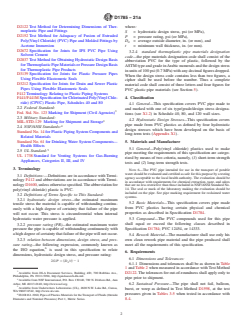
2S/P 5 D /t 2 1
~ !
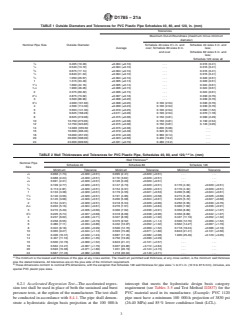
6.1.1 Dimensions and tolerances shall be as shown in Table
1 and Table 2 when measured in accordance with Test Method
Available from DLA Document Services, Building 4/D, 700 Robbins Ave.,
D2122.The tolerances for out-of-roundness shall apply only to
Philadelphia, PA 19111-5094, http://quicksearch.dla.mil.
pipe prior to shipment.
Available from NSF International, P.O. Box 130140, 789 N. Dixboro Rd.,Ann
Arbor, MI 48113-0140, http://www.nsf.org.
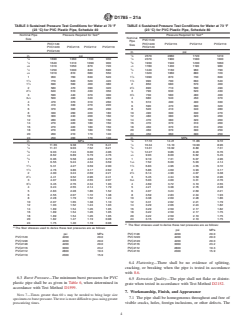
6.2 Sustained Pressure—The pipe shall not fail, balloon,
Available from Underwriters Laboratories (UL), 2600 N.W. Lake Rd., Camas,
burst, or weep as defined in Test Method D1598, at the test
WA 98607-8542, http://www.ul.com.
6 pressures given in Tables 3-5 when tested in accordance with
ISOR161-1960,PipesofPlasticsMaterialsfortheTransportofFluids(Outside
Diameters and Nominal Pressures) Part 1, Metric Series. 8.4.
D1785−21a
TABLE 1 Outside Diameters and Tolerances for PVC Plastic Pipe Schedules 40, 80, and 120, in. (mm)
Tolerances
Maximum Out-of-Roundness (maximum minus minimum
diameter)
Schedule 40 sizes 3 ⁄2 in. and Schedule 40 sizes 3 in. and
Nominal Pipe Size Outside Diameter
Average
over; Schedule 80 sizes 8 in. less;
and over Schedule 80 sizes 6 in. and
less;
Schedule 120 sizes all
⁄8 0.405 (10.29) ±0.004 (±0.10) . . . 0.016 (0.41)
⁄4 0.540 (13.72) ±0.004 (±0.10) . . . 0.016 (0.41)
⁄8 0.675 (17.14) ±0.004 (±0.10) . . . 0.016 (0.41)
⁄2 0.840 (21.34) ±0.004 (±0.10) . . . 0.016 (0.41)
⁄4 1.050 (26.67) ±0.004 (±0.10) . . . 0.020 (0.51)
1 1.315 (33.40) ±0.005 (±0.13) . . . 0.020 (0.51)
1 ⁄4 1.660 (42.16) ±0.005 (±0.13) . . . 0.024 (0.61)
1 ⁄2 1.900 (48.26) ±0.006 (±0.15) . . . 0.024 (0.61)
2 2.375 (60.32) ±0.006 (±0.15) . . . 0.024 (0.61)
2 ⁄2 2.875 (73.02) ±0.007 (±0.18) . . . 0.030 (0.76)
3 3.500 (88.90) ±0.008 (±0.20) . . . 0.030 (0.76)
3 ⁄2 4.000 (101.60) ±0.008 (±0.20) 0.100 (2.54) 0.030 (0.76)
4 4.500 (114.30) ±0.009 (±0.23) 0.100 (2.54) 0.030 (0.76)
5 5.563 (141.30) ±0.010 (±0.25) 0.100 (2.54) 0.060 (1.52)
6 6.625 (168.28) ±0.011 (±0.28) 0.100 (2.54) 0.070 (1.78)
8 8.625 (219.08) ±0.015 (±0.38) 0.150 (3.81) 0.090 (2.29)
10 10.750 (273.05) ±0.015 (±0.38) 0.150 (3.81) 0.100 (2.54)
12 12.750 (323.85) ±0.015 (±0.38) 0.150 (3.81) 0.120 (3.05)
14 14.000 (355.60 ±0.015 (±0.38) 0.200 (5.08) . . .
16 16.000 (406.40) ±0.019 (±0.48) 0.320 (8.13) . . .
18 18.000 (457.20) ±0.019 (±0.48) 0.360 (9.14) . . .
20 20.000 (508.00) ±0.023 (±0.58) 0.400 (10.2) . . .
24 24.000 (609.60) ±0.031 (±0.79) 0.480 (12.2) . . .
A,B
TABLE 2 Wall Thicknesses and Tolerances for PVC Plastic Pipe, Schedules 40, 80, and 120, in. (mm)
A
Wall Thickness
Nominal Pipe
Schedule 40 Schedule 80 Schedule 120
Size
Minimum Tolerance Minimum Tolerance Minimum Tolerance
⁄8 0.068 (1.73) +0.020 (+0.51) 0.095 (2.41) +0.020 (+0.51) . . . . . .
⁄4 0.088 (2.24) +0.020 (+0.51) 0.119 (3.02) +0.020 (+0.51) . . . . . .
⁄8 0.091 (2.31) +0.020 (+0.51) 0.126 (3.20) +0.020 (+0.51) . . . . . .
⁄2 0.109 (2.77) +0.020 (+0.51) 0.147 (3.73) +0.020 (+0.51) 0.170 (4.32) +0.020 (+0.51)
⁄4 0.113 (2.87) +0.020 (+0.51) 0.154 (3.91) +0.020 (+0.51) 0.170 (4.32) +0.020 (+0.51)
1 0.133 (3.38) +0.020 (+0.51) 0.179 (4.55) +0.021 (+0.53) 0.200 (5.08) +0.024 (+0.61)
1 ⁄4 0.140 (3.56) +0.020 (+0.51) 0.191 (4.85) +0.023 (+0.58) 0.215 (5.46) +0.026 (+0.66)
1 ⁄2 0.145 (3.68) +0.020 (+0.51) 0.200 (5.08) +0.024 (+0.61) 0.225 (5.72) +0.027 (+0.68)
2 0.154 (3.91) +0.020 (+0.51) 0.218 (5.54) +0.026 (+0.66) 0.250 (6.35) +0.030 (+0.76)
2 ⁄2 0.203 (5.16) +0.024 (+0.61) 0.276 (7.01) +0.033 (+0.84) 0.300 (7.62) +0.036 (+0.91)
3 0.216 (5.49) +0.026 (+0.66) 0.300 (7.62) +0.036 (+0.91) 0.350 (8.89) +0.042 (+1.07)
3 ⁄2 0.226 (5.74) +0.027 (+0.68) 0.318 (8.08) +0.038 (+0.96) 0.350 (8.89) +0.042 (+1.07)
4 0.237 (6.02) +0.028 (+0.71) 0.337 (8.56) +0.040 (+1.02) 0.437 (11.10) +0.052 (+1.32)
5 0.258 (6.55) +0.031 (+0.79) 0.375 (9.52) +0.045 (+1.14) 0.500 (12.70) +0.060 (+1.52)
6 0.280 (7.11) +0.034 (+0.86) 0.432 (10.97) +0.052 (+1.32) 0.562 (14.27) +0.067 (+1.70)
8 0.322 (8.18) +0.039 (+0.99) 0.500 (12.70) +0.060 (+1.52) 0.718 (18.24) +0.086 (+2.18)
10 0.365 (9.27) +0.044 (+1.12) 0.593 (15.06) +0.071 (+1.80) 0.843 (21.41) +0.101 (+2.56)
12 0.406 (10.31) +0.049 (+1.24) 0.687 (17.45) +0.082 (+2.08) 1.000 (25.40) +0.120 (+3.05)
14 0.437 (11.10) +0.053 (+1.35) 0.750 (19.05) +0.090 (+2.29) . . . . . .
16 0.500 (12.70) +0.060 (+1.52) 0.843 (21.41) +0.101 (+2.57) . . . . . .
18 0.562 (14.27) +0.067 (+1.70) 0.937 (23.80) +0.112 (+2.84) . . . . . .
20 0.593 (15.06) +0.071 (+1.80) 1.031 (26.19) +0.124 (+3.15) . . . . . .
24 0.687 (17.45) +0.082 (+2.08) 1.218 (30.94) +0.146 (+3.71) . . . . . .
A
The minimum is the lowest wall thickness of the pipe at any cross section. The maximum permitted wall thickness, at any cross section, is the minimum wall thickness
plus the stated tolerance. All tolerances are on the plus side of the minimum requirement.
B 1 1
These dimensions conform to nominal IPS dimensions, with the exception that Schedule 120 wall thickness for pipe sizes ⁄2 to 3 ⁄2 in. (12.5 to 87.5 mm), inclusive, are
special PVC plastic pipe sizes.
6.2.1 Accelerated Regression Test—The accelerated regres- intercept that meets the hydrostatic design basis category
sion test shall be used in place of both the sustained and burst requirement (see Tables 3-5 and Test Method D2837) for the
pressure tests, at the option of the manufacturer. The test shall PVC material used in its manufacture. (Example: PVC 1120
be conducted in accordance with 8.4.1. The pipe shall demon- pipe must have a minimum 100 000-h projection of 3830 psi
strate a hydrostatic design basis projection at the 100 000-h (26.40 MPa) and 85 % lower confidence limit (LCL).
D1785−21a
TABLE 3 Sustained Pressure Test Conditions for Water at 73°F TABLE 4 Sustained Pressure Test Conditions for Water at 73°F
(23°C) for PVC Plastic Pipe, Schedule 40 (23°C) for PVC Plastic Pipe, Schedule 80
A A
Nominal Pipe Pressure Required for Test Pressure Required for Test
Nominal
Size
PVC1120
Pipe
PVC1120 PVC1220 PVC2116 PVC2112 PVC2110
Size
PVC1220 PVC2116 PVC2112 PVC2110 PVC2120
PVC2120
in. psi
in. psi ⁄8 2570 2060 1720 1410
1 1
⁄8 1690 1360 1130 930 ⁄4 2370 1900 1580 1300
1 3
⁄4 1640 1310 1090 900 ⁄8 1930 1540 1290 1060
3 1
⁄8 1310 1050 870 720 ⁄2 1780 1430 1190 980
1 3
⁄2 1250 1000 840 690 ⁄4 1440 1160 960 790
⁄4 1010 810 680 550 1 1320 1060 880 720
1 950 760 630 520 1 ⁄4 1090 870 730 600
1 1
1 ⁄4 770 620 520 420 1 ⁄2 990 790 660 540
1 ⁄2 690 560 460 380 2 850 680 570 460
2 580 470 390 320 2 ⁄2 890 710 590 490
2 ⁄2 640 510 430 350
3 790 630 520 430
3 590 440 370 300 3 ⁄2 730 580 480 400
3 ⁄2 500 400 340 280 4 680 540 450 370
4 470 370 310 260 5 610 490 400 330
5 410 330 270 220 6 590 470 390 320
6 370 300 250 200 8 520 410 340 280
8 330 260 220 180 10 490 390 330 270
10 300 240 200 160 12 480 380 320 260
12 280 220 180 150 14 470 380 320 260
14 270 220 180 150
16 470 370 310 260
16 270 220 180 150 18 460 370 310 250
18 270 220 180 150 20 460 370 300 250
20 260 210 170 140 24 450 360 300 250
24 250 200 170 140 in. MPa
in. MPa ⁄8 17.72 14.21 11.86 9.72
1 1
⁄8 11.65 9.38 7.79 6.41 ⁄4 16.34 13.10 10.90 8.96
1 3
⁄4 11.31 9.03 7.52 6.21
⁄8 13.31 10.62 8.89 7.31
3 1
⁄8 9.03 7.24 6.00 4.96 ⁄2 12.27 9.86 8.20 6.76
1 3
⁄2 8.62 6.89 5.79 4.76 ⁄4 9.93 8.00 6.62 5.45
⁄4 6.96 5.58 4.69 3.79 1 9.10 7.31 6.07 4.96
1 6.55 5.24 4.34 3.59 1 ⁄4 7.52 6.00 5.03 4.14
1 1
1 ⁄4 5.31 4.27 3.59 2.90 1 ⁄2 6.83 4.96 4.55 3.72
1 ⁄2 4.76 3.86 3.17 2.62 2 5.86 4.69 3.93 3.17
2 4.00 3.24 2.69 2.21 2 ⁄2 6.14 4.90 4.07 3.38
2 ⁄2 4.41 3.52 2.96 2.41 3 5.45 4.34 3.59 2.96
3 4.07 3.03 2.55 2.07
3 ⁄2 5.03 4.00 3.31 2.76
3 ⁄2 3.45 2.76 2.34 1.93 4 4.69 3.72 3.10 2.55
4 3.24 2.55 2.14 1.79 5 4.21 3.38 2.76 2.28
5 2.83 2.28 1.86 1.52 6 4.07 3.24 2.69 2.21
6 2.55 2.07 1.72 1.38 8 3.59 2.83 2.34 1.93
8 2.28 1.79 1.52 1.24 10 3.38 2.69 2.28 1.86
10 2.07 1.65 1.38 1.10 12 3.31 2.62 2.21 1.79
12 1.93 1.52 1.24 1.03 14 3.29 2.66 2.24 1.82
14 1.89 1.54 1.26 1.05 16 3.29 2.59 2.17 1.82
16 1.89 1.54 1.26 1.05 18 3.22 2.59 2.17 1.75
18 1.89 1.54 1.26 1.05 20 3.22 2.59 2.10 1.75
20 1.82 1.47 1.19 0.98 24 3.15 2.52 2.10 1.75
24 1.75 1.40 1.19 0.98
A
The fiber stresses used to derive these test pressures are as follows:
A
The fiber stresses used to derive these test pressures are as follows:
psi MPa
psi MPa PVC1120 4200 29.0
PVC1120 4200 29.0 PVC1220 4200 29.0
PVC1220 4200 29.0 PVC2120 4200 29.0
PVC2120 4200 29.0 PVC2116 3360 23.2
PVC2116 3360 23.2 PVC2112 2800 19.3
PVC2112 2800 19.3
PVC2110 2300 15.9
PVC2110 2300 15.9
6.4 Flattening—There shall be no evidence of splitting,
cracking, or breaking when the pipe is tested in accordance
with 8.6.
6.3 Burst Pressure—The minimum burst pressures for PVC
6.5 Extrusion Quality—The pipe shall not flake or disinte-
plastic pipe shall be as given in Table 6, when determined in
grate when tested in accordance with Test Method D2152.
accordance with Test Method D1599.
7. Workmanship, Finish, and Appearance
NOTE 7—Times greater than 60 s may be needed to bring large size
7.1 The pipe shall be homogeneous throughout and free of
specimens to burst pressure.The test is more difficult to pass using greater
pressurizing times. visible cracks, holes, foreign inclusions, or other defects. The
D1785−21a
TABLE 5 Sustained Pressure Test Conditions for Water at 73°F (23°C) for PVC Plastic Pipe, Schedule 120
A
Pressure Required for Test
Nominal Pipe
PVC1120
Size
PVC1220 PVC2116 PVC2112 PVC2110
PVC2120
in. psi
⁄2 2130 1710 1420 1170
⁄4 1620 1300 1080 890
1 1510 1200 1000 830
1 ⁄4 1250 1000 830 680
1 ⁄2 1130 900 750 620
2 990 790 660 540
2 ⁄2 980 780 650 540
3 930 750 620 510
3 ⁄2 810 640 540 440
4 900 720 600 490
5 830 660 550 450
6 780 620 520 430
8 760 610 510 420
10 770 620 510 420
12 710 570 480 390
in. MPa
⁄2 14.69 11.79 9.79 8.07
⁄4 11.17 8.96 7.45 6.14
1 10.41 8.27 6.89 5.72
1 ⁄4 8.62 6.89 5.72 4.69
1 ⁄2 7.79 6.21 5.17 4.27
2 6.83 5.45 4.55 3.72
2 ⁄2 6.76 5.38 4.48 3.72
3 6.41 5.17 4.27 3.52
3 ⁄2 5.58 4.41 3.72 3.03
4 6.21 4.96 4.14 3.38
5 5.72 4.55 3.79 3.10
6 5.38 4.27 3.59 2.96
8 5.24 4.21 3.52 2.90
10 5.31 4.27 3.52 2.90
12 4.90 3.93 3.31 2.69
A
The fiber stresses used to derive these test pressures are as follows:
psi MPa
PVC1120 4200 29.0
PVC1220 4200 29.0
PVC2120 4200 29.0
PVC2116 3360 23.2
PVC2112 2800 19.3
PVC2110 2300 15.9
pipe shall be as uniform as commercially practicable in color, 8.3 Sampling—The selection of the sample or samples of
opacity, density, and other physical properties. pipeshallbeasagreeduponbythepurchaseran
...
This document is not an ASTM standard and is intended only to provide the user of an ASTM standard an indication of what changes have been made to the previous version. Because
it may not be technically possible to adequately depict all changes accurately, ASTM recommends that users consult prior editions as appropriate. In all cases only the current version
of the standard as published by ASTM is to be considered the official document.
Designation: D1785 − 21 D1785 − 21a An American National Standard
Standard Specification for
Poly(Vinyl Chloride) (PVC) Plastic Pipe, Schedules 40, 80,
and 120
This standard is issued under the fixed designation D1785; the number immediately following the designation indicates the year of
original adoption or, in the case of revision, the year of last revision. A number in parentheses indicates the year of last reapproval. A
superscript epsilon (´) indicates an editorial change since the last revision or reapproval.
This standard has been approved for use by agencies of the U.S. Department of Defense.
1. Scope*
1.1 This specification covers poly(vinyl chloride) (PVC) pipe made in Schedule 40, 80, and 120 sizes and pressure-rated for water
(see Appendix X1). Included are criteria for classifying PVC plastic pipe materials and PVC plastic pipe, a system of nomenclature
for PVC plastic pipe, and requirements and test methods for materials, workmanship, dimensions, sustained pressure, burst
pressure, flattening, and extrusion quality. Methods of marking are also given.
1.2 The products covered by this specification are intended for use with the distribution of pressurized liquids only, which are
chemically compatible with the piping materials. Due to inherent hazards associated with testing components and systems with
compressed air or other compressed gases some manufacturers do not allow pneumatic testing of their products. Consult with
specific product/component manufacturers for their specific testing procedures prior to pneumatic testing.
NOTE 1—Pressurized (compressed) air or other compressed gases contain large amounts of stored energy which present serious saftey hazards should a
system fail for any reason.
NOTE 2—This standard specifies dimensional, performance and test requirements for plumbing and fluid handling applications only. It does not include
provisions for the use of these products for venting of combustion gases. UL 1738 is a standard that does include specific testing and marking requirements
for flue gas venting products, including PVC.
1.3 The text of this specification references notes, footnotes, and appendixes which provide explanatory material. These notes and
footnotes (excluding those in tables and figures) shall not be considered as requirements of the specification.
1.4 The values stated in inch-pound units are to be regarded as standard. The values given in parentheses are mathematical
conversions to SI units that are provided for information only and are not considered standard.
1.5 The following safety hazards caveat pertains only to the test methods portion, Section 8, of this specification: This standard
does not purport to address all of the safety concerns, if any, associated with its use. It is the responsibility of the user of this
standard to establish appropriate safety, health, and environmental practices and determine the applicability of regulatory
limitations prior to use.A specific precautionary statement is given in Note 9.
NOTE 3—CPVC plastic pipes, Schedules 40 and 80, which were formerly included in this specification, are now covered by Specification F441/F441M.
NOTE 4—The sustained and burst pressure test requirements, and the pressure ratings in the Appendix X1, are calculated from stress values obtained from
This specification is under the jurisdiction of ASTM Committee F17 on Plastic Piping Systems and is the direct responsibility of Subcommittee F17.25 on Vinyl Based
Pipe.
Current edition approved May 1, 2021Aug. 1, 2021. Published May 2021October 2021. Originally approved in 1960. Last previous edition approved in 20152021 as
ɛ1
D1785 – 15D1785 – 21. . DOI: 10.1520/D1785-21.10.1520/D1785-21A.
*A Summary of Changes section appears at the end of this standard
Copyright © ASTM International, 100 Barr Harbor Drive, PO Box C700, West Conshohocken, PA 19428-2959. United States
D1785 − 21a
tests made on pipe 4 in. (100 mm) and smaller. However, tests conducted on pipe as large as 24 in. (600 mm) diameter have shown these stress values
to be valid for larger diameter PVC pipe.
NOTE 5—PVC pipe made to this specification is often belled for use as line pipe. For details of the solvent cement bell, see Specification D2672 and for
details of belled elastomeric joints, see Specifications D3139 and D3212.
1.6 This international standard was developed in accordance with internationally recognized principles on standardization
established in the Decision on Principles for the Development of International Standards, Guides and Recommendations issued
by the World Trade Organization Technical Barriers to Trade (TBT) Committee.
2. Referenced Documents
2.1 ASTM Standards:
D618 Practice for Conditioning Plastics for Testing
D1598 Test Method for Time-to-Failure of Plastic Pipe Under Constant Internal Pressure
D1599 Test Method for Resistance to Short-Time Hydraulic Pressure of Plastic Pipe, Tubing, and Fittings
D1600 Terminology for Abbreviated Terms Relating to Plastics
D1784 Classification System and Basis for Specification for Rigid Poly(Vinyl Chloride) (PVC) Compounds and Chlorinated
Poly(Vinyl Chloride) (CPVC) Compounds
D2122 Test Method for Determining Dimensions of Thermoplastic Pipe and Fittings
D2152 Test Method for Adequacy of Fusion of Extruded Poly(Vinyl Chloride) (PVC) Pipe and Molded Fittings by Acetone
Immersion
D2672 Specification for Joints for IPS PVC Pipe Using Solvent Cement
D2837 Test Method for Obtaining Hydrostatic Design Basis for Thermoplastic Pipe Materials or Pressure Design Basis for
Thermoplastic Pipe Products
D3139 Specification for Joints for Plastic Pressure Pipes Using Flexible Elastomeric Seals
D3212 Specification for Joints for Drain and Sewer Plastic Pipes Using Flexible Elastomeric Seals
F412 Terminology Relating to Plastic Piping Systems
F441/F441M Specification for Chlorinated Poly(Vinyl Chloride) (CPVC) Plastic Pipe, Schedules 40 and 80
2.2 Federal Standard:
Fed. Std. No. 123 Marking for Shipment (Civil Agencies)
2.3 Military Standard:
MIL-STD-129 Marking for Shipment and Storage
2.4 NSF/ANSI Standards:
Standard No. 14 for Plastic Piping System Components and Related Materials
Standard No. 61 for Drinking Water System Components—Health Effects
2.5 UL Standard:
UL 1738 Standard for Venting Systems for Gas-Burning Appliances, Categories II, III, and IV
3. Terminology
3.1 Definitions:—Definitions are in accordance with Terminology F412 and abbreviations are in accordance with Terminology
D1600, unless otherwise specified. The abbreviation for poly(vinyl chloride) plastic is PVC.
3.2 Definitions of Terms Specific to This Standard:
3.2.1 hydrostatic design stress—the estimated maximum tensile stress the material is capable of withstanding continuously with
a high degree of certainty that failure of the pipe will not occur. This stress is circumferential when internal hydrostatic water
pressure is applied.
3.2.2 pressure rating (PR)—the estimated maximum water pressure the pipe is capable of withstanding continuously with a high
degree of certainty that failure of the pipe will not occur.
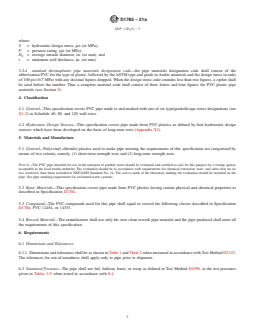
3.2.3 relation between dimensions, design stress, and pressure rating—the following expression, commonly known as the ISO
equation, is used in this specification to relate dimensions, hydrostatic design stress, and pressure rating:
For referenced ASTM standards, visit the ASTM website, www.astm.org, or contact ASTM Customer Service at service@astm.org. For Annual Book of ASTM Standards
volume information, refer to the standard’s Document Summary page on the ASTM website.
Available from DLA Document Services, Building 4/D, 700 Robbins Ave., Philadelphia, PA 19111-5094, http://quicksearch.dla.mil.
Available from NSF International, P.O. Box 130140, 789 N. Dixboro Rd., Ann Arbor, MI 48113-0140, http://www.nsf.org.
Available from Underwriters Laboratories (UL), 2600 N.W. Lake Rd., Camas, WA 98607-8542, http://www.ul.com.
ISO R161-1960, Pipes of Plastics Materials for the Transport of Fluids (Outside Diameters and Nominal Pressures) Part 1, Metric Series.
D1785 − 21a
2S/P 5 D /t 2 1
~ !
where:
S = hydrostatic design stress, psi (or MPa),
P = pressure rating, psi (or MPa),
D = average outside diameter, in. (or mm), and
t = minimum wall thickness, in. (or mm).
3.2.4 standard thermoplastic pipe materials designation code—the pipe materials designation code shall consist of the
abbreviation PVC for the type of plastic, followed by the ASTM type and grade in Arabic numerals and the design stress in units
of 100 psi (0.7 MPa) with any decimal figures dropped. When the design stress code contains less than two figures, a cipher shall
be used before the number. Thus a complete material code shall consist of three letters and four figures for PVC plastic pipe
materials (see Section 5).
4. Classification
4.1 General—This specification covers PVC pipe made to and marked with one of six type/grade/design stress designations (see
X1.2) in Schedule 40, 80, and 120 wall sizes.
4.2 Hydrostatic Design Stresses—This specification covers pipe made from PVC plastics as defined by four hydrostatic design
stresses which have been developed on the basis of long-term tests (Appendix X1).
5. Materials and Manufacture
5.1 General—Poly(vinyl chloride) plastics used to make pipe meeting the requirements of this specification are categorized by
means of two criteria, namely, (1) short-term strength tests and (2) long-term strength tests.
NOTE 6—The PVC pipe intended for use in the transport of potable water should be evaluated and certified as safe for this purpose by a testing agency
acceptable to the local health authority. The evaluation should be in accordance with requirements for chemical extraction, taste, and odors that are no
less restrictive than those included in NSF/ANSI Standard No. 14. The seal or mark of the laboratory making the evaluation should be included on the
pipe. See pipe marking requirement for reclaimed water systems.
5.2 Basic Materials—This specification covers pipe made from PVC plastics having certain physical and chemical properties as
described in Specification D1784.
5.3 Compound—The PVC compounds used for this pipe shall equal or exceed the following classes described in Specification
D1784; PVC 12454, or 14333.
5.4 Rework Material—The manufacturer shall use only his own clean rework pipe material and the pipe produced shall meet all
the requirements of this specification.
6. Requirements
6.1 Dimensions and Tolerances:
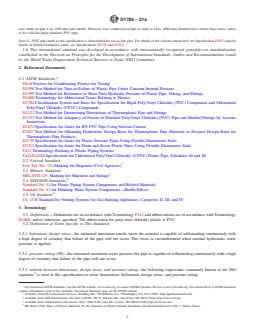
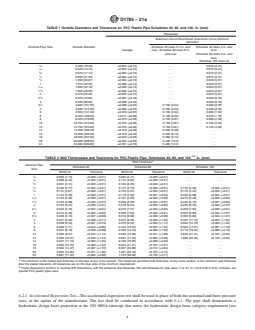
6.1.1 Dimensions and tolerances shall be as shown in Table 1 and Table 2 when measured in accordance with Test Method D2122.
The tolerances for out-of-roundness shall apply only to pipe prior to shipment.
6.2 Sustained Pressure—The pipe shall not fail, balloon, burst, or weep as defined in Test Method D1598, at the test pressures
given in Tables 3-5 when tested in accordance with 8.4.
D1785 − 21a
TABLE 1 Outside Diameters and Tolerances for PVC Plastic Pipe Schedules 40, 80, and 120, in. (mm)
Tolerances
Maximum Out-of-Roundness (maximum minus minimum
diameter)
Schedule 40 sizes 3 ⁄2 in. and Schedule 40 sizes 3 in. and
Nominal Pipe Size Outside Diameter
Average
over; Schedule 80 sizes 8 in. less;
and over Schedule 80 sizes 6 in. and
less;
Schedule 120 sizes all
⁄8 0.405 (10.29) ±0.004 (±0.10) . . . 0.016 (0.41)
⁄4 0.540 (13.72) ±0.004 (±0.10) . . . 0.016 (0.41)
⁄8 0.675 (17.14) ±0.004 (±0.10) . . . 0.016 (0.41)
⁄2 0.840 (21.34) ±0.004 (±0.10) . . . 0.016 (0.41)
⁄4 1.050 (26.67) ±0.004 (±0.10) . . . 0.020 (0.51)
1 1.315 (33.40) ±0.005 (±0.13) . . . 0.020 (0.51)
1 ⁄4 1.660 (42.16) ±0.005 (±0.13) . . . 0.024 (0.61)
1 ⁄2 1.900 (48.26) ±0.006 (±0.15) . . . 0.024 (0.61)
2 2.375 (60.32) ±0.006 (±0.15) . . . 0.024 (0.61)
2 ⁄2 2.875 (73.02) ±0.007 (±0.18) . . . 0.030 (0.76)
3 3.500 (88.90) ±0.008 (±0.20) . . . 0.030 (0.76)
3 ⁄2 4.000 (101.60) ±0.008 (±0.20) 0.100 (2.54) 0.030 (0.76)
4 4.500 (114.30) ±0.009 (±0.23) 0.100 (2.54) 0.030 (0.76)
5 5.563 (141.30) ±0.010 (±0.25) 0.100 (2.54) 0.060 (1.52)
6 6.625 (168.28) ±0.011 (±0.28) 0.100 (2.54) 0.070 (1.78)
8 8.625 (219.08) ±0.015 (±0.38) 0.150 (3.81) 0.090 (2.29)
10 10.750 (273.05) ±0.015 (±0.38) 0.150 (3.81) 0.100 (2.54)
12 12.750 (323.85) ±0.015 (±0.38) 0.150 (3.81) 0.120 (3.05)
14 14.000 (355.60 ±0.015 (±0.38) 0.200 (5.08) . . .
16 16.000 (406.40) ±0.019 (±0.48) 0.320 (8.13) . . .
18 18.000 (457.20) ±0.019 (±0.48) 0.360 (9.14) . . .
20 20.000 (508.00) ±0.023 (±0.58) 0.400 (10.2) . . .
24 24.000 (609.60) ±0.031 (±0.79) 0.480 (12.2) . . .
A,B
TABLE 2 Wall Thicknesses and Tolerances for PVC Plastic Pipe, Schedules 40, 80, and 120, in. (mm)
A
Wall Thickness
Nominal Pipe
Schedule 40 Schedule 80 Schedule 120
Size
Minimum Tolerance Minimum Tolerance Minimum Tolerance
⁄8 0.068 (1.73) +0.020 (+0.51) 0.095 (2.41) +0.020 (+0.51) . . . . . .
⁄4 0.088 (2.24) +0.020 (+0.51) 0.119 (3.02) +0.020 (+0.51) . . . . . .
⁄8 0.091 (2.31) +0.020 (+0.51) 0.126 (3.20) +0.020 (+0.51) . . . . . .
⁄2 0.109 (2.77) +0.020 (+0.51) 0.147 (3.73) +0.020 (+0.51) 0.170 (4.32) +0.020 (+0.51)
⁄4 0.113 (2.87) +0.020 (+0.51) 0.154 (3.91) +0.020 (+0.51) 0.170 (4.32) +0.020 (+0.51)
1 0.133 (3.38) +0.020 (+0.51) 0.179 (4.55) +0.021 (+0.53) 0.200 (5.08) +0.024 (+0.61)
1 ⁄4 0.140 (3.56) +0.020 (+0.51) 0.191 (4.85) +0.023 (+0.58) 0.215 (5.46) +0.026 (+0.66)
1 ⁄2 0.145 (3.68) +0.020 (+0.51) 0.200 (5.08) +0.024 (+0.61) 0.225 (5.72) +0.027 (+0.68)
2 0.154 (3.91) +0.020 (+0.51) 0.218 (5.54) +0.026 (+0.66) 0.250 (6.35) +0.030 (+0.76)
2 ⁄2 0.203 (5.16) +0.024 (+0.61) 0.276 (7.01) +0.033 (+0.84) 0.300 (7.62) +0.036 (+0.91)
3 0.216 (5.49) +0.026 (+0.66) 0.300 (7.62) +0.036 (+0.91) 0.350 (8.89) +0.042 (+1.07)
3 ⁄2 0.226 (5.74) +0.027 (+0.68) 0.318 (8.08) +0.038 (+0.96) 0.350 (8.89) +0.042 (+1.07)
4 0.237 (6.02) +0.028 (+0.71) 0.337 (8.56) +0.040 (+1.02) 0.437 (11.10) +0.052 (+1.32)
5 0.258 (6.55) +0.031 (+0.79) 0.375 (9.52) +0.045 (+1.14) 0.500 (12.70) +0.060 (+1.52)
6 0.280 (7.11) +0.034 (+0.86) 0.432 (10.97) +0.052 (+1.32) 0.562 (14.27) +0.067 (+1.70)
8 0.322 (8.18) +0.039 (+0.99) 0.500 (12.70) +0.060 (+1.52) 0.718 (18.24) +0.086 (+2.18)
10 0.365 (9.27) +0.044 (+1.12) 0.593 (15.06) +0.071 (+1.80) 0.843 (21.41) +0.101 (+2.56)
12 0.406 (10.31) +0.049 (+1.24) 0.687 (17.45) +0.082 (+2.08) 1.000 (25.40) +0.120 (+3.05)
14 0.437 (11.10) +0.053 (+1.35) 0.750 (19.05) +0.090 (+2.29) . . . . . .
16 0.500 (12.70) +0.060 (+1.52) 0.843 (21.41) +0.101 (+2.57) . . . . . .
18 0.562 (14.27) +0.067 (+1.70) 0.937 (23.80) +0.112 (+2.84) . . . . . .
20 0.593 (15.06) +0.071 (+1.80) 1.031 (26.19) +0.124 (+3.15) . . . . . .
24 0.687 (17.45) +0.082 (+2.08) 1.218 (30.94) +0.146 (+3.71) . . . . . .
A
The minimum is the lowest wall thickness of the pipe at any cross section. The maximum permitted wall thickness, at any cross section, is the minimum wall thickness
plus the stated tolerance. All tolerances are on the plus side of the minimum requirement.
B
1 1
These dimensions conform to nominal IPS dimensions, with the exception that Schedule 120 wall thickness for pipe sizes ⁄2 to 3 ⁄2 in. (12.5 to 87.5 mm), inclusive, are
special PVC plastic pipe sizes.
6.2.1 Accelerated Regression Test—The accelerated regression test shall be used in place of both the sustained and burst pressure
tests, at the option of the manufacturer. The test shall be conducted in accordance with 8.4.1. The pipe shall demonstrate a
hydrostatic design basis projection at the 100 000-h intercept that meets the hydrostatic design basis category requirement (see
D1785 − 21a
TABLE 3 Sustained Pressure Test Conditions for Water at 73 °F
(23 °C) for PVC Plastic Pipe, Schedule 40
A
Nominal Pipe Pressure Required for Test
Size
PVC1120
PVC1220 PVC2116 PVC2112 PVC2110
PVC2120
in. psi
⁄8 1690 1360 1130 930
⁄4 1640 1310 1090 900
⁄8 1310 1050 870 720
⁄2 1250 1000 840 690
⁄4 1010 810 680 550
1 950 760 630 520
1 ⁄4 770 620 520 420
1 ⁄2 690 560 460 380
2 580 470 390 320
2 ⁄2 640 510 430 350
3 590 440 370 300
3 ⁄2 500 400 340 280
4 470 370 310 260
5 410 330 270 220
6 370 300 250 200
8 330 260 220 180
10 300 240 200 160
12 280 220 180 150
14 270 220 180 150
16 270 220 180 150
18 270 220 180 150
20 260 210 170 140
24 250 200 170 140
in. MPa
⁄8 11.65 9.38 7.79 6.41
⁄4 11.31 9.03 7.52 6.21
⁄8 9.03 7.24 6.00 4.96
⁄2 8.62 6.89 5.79 4.76
⁄4 6.96 5.58 4.69 3.79
1 6.55 5.24 4.34 3.59
1 ⁄4 5.31 4.27 3.59 2.90
1 ⁄2 4.76 3.86 3.17 2.62
2 4.00 3.24 2.69 2.21
2 ⁄2 4.41 3.52 2.96 2.41
3 4.07 3.03 2.55 2.07
3 ⁄2 3.45 2.76 2.34 1.93
4 3.24 2.55 2.14 1.79
5 2.83 2.28 1.86 1.52
6 2.55 2.07 1.72 1.38
8 2.28 1.79 1.52 1.24
10 2.07 1.65 1.38 1.10
12 1.93 1.52 1.24 1.03
14 1.89 1.54 1.26 1.05
16 1.89 1.54 1.26 1.05
18 1.89 1.54 1.26 1.05
20 1.82 1.47 1.19 0.98
24 1.75 1.40 1.19 0.98
A
The fiber stresses used to derive these test pressures are as follows:
psi MPa
PVC1120 4200 29.0
PVC1220 4200 29.0
PVC2120 4200 29.0
PVC2116 3360 23.2
PVC2112 2800 19.3
PVC2110 2300 15.9
Tables 3-5 and Test Method D2837) for the PVC material used in its manufacture. (Example: PVC 1120 pipe must have a minimum
100 000-h projection of 3830 psi (26.40 MPa) and 85 % lower confidence limit (LCL).
6.3 Burst Pressure—The minimum burst pressures for PVC plastic pipe shall be as given in Table 6, when determined in
accordance with Test Method D1599.
D1785 − 21a
TABLE 4 Sustained Pressure Test Conditions for Water at 73 °F
(23 °C) for PVC Plastic Pipe, Schedule 80
A
Pressure Required for Test
Nominal
PVC1120
Pipe
PVC1220 PVC2116 PVC2112 PVC2110
Size
PVC2120
in. psi
⁄8 2570 2060 1720 1410
⁄4 2370 1900 1580 1300
⁄8 1930 1540 1290 1060
⁄2 1780 1430 1190 980
⁄4 1440 1160 960 790
1 1320 1060 880 720
1 ⁄4 1090 870 730 600
1 ⁄2 990 790 660 540
2 850 680 570 460
2 ⁄2 890 710 590 490
3 790 630 520 430
3 ⁄2 730 580 480 400
4 680 540 450 370
5 610 490 400 330
6 590 470 390 320
8 520 410 340 280
10 490 390 330 270
12 480 380 320 260
14 470 380 320 260
16 470 370 310 260
18 460 370 310 250
20 460 370 300 250
24 450 360 300 250
in. MPa
⁄8 17.72 14.21 11.86 9.72
⁄4 16.34 13.10 10.90 8.96
⁄8 13.31 10.62 8.89 7.31
⁄2 12.27 9.86 8.20 6.76
⁄4 9.93 8.00 6.62 5.45
1 9.10 7.31 6.07 4.96
1 ⁄4 7.52 6.00 5.03 4.14
1 ⁄2 6.83 4.96 4.55 3.72
2 5.86 4.69 3.93 3.17
2 ⁄2 6.14 4.90 4.07 3.38
3 5.45 4.34 3.59 2.96
3 ⁄2 5.03 4.00 3.31 2.76
4 4.69 3.72 3.10 2.55
5 4.21 3.38 2.76 2.28
6 4.07 3.24 2.69 2.21
8 3.59 2.83 2.34 1.93
10 3.38 2.69 2.28 1.86
12 3.31 2.62 2.21 1.79
14 3.29 2.66 2.24 1.82
16 3.29 2.59 2.17 1.82
18 3.22 2.59 2.17 1.75
20 3.22 2.59 2.10 1.75
24 3.15 2.52 2.10 1.75
A
The fiber stresses used to derive these test pressures are as follows:
psi MPa
PVC1120 4200 29.0
PVC1220 4200 29.0
PVC2120 4200 29.0
PVC2116 3360 23.2
PVC2112 2800 19.3
PVC2110 2300 15.9
NOTE 7—Times greater than 60 s may be needed to bring large size specimens to burst pressure. The test is more difficult to pass using greater pressurizing
times.
6.4 Flattening—There shall be no evidence of splitting, cracking, or breaking when the pipe is tested in accordance with 8.6.
6.5 Extrusion Quality—The pipe shall not flake or disintegrate when tested in accordance with Test Method D2152.
D1785 − 21a
TABLE 5 Sustained Pressure Test Conditions for Water at 73 °F (23 °C) for PVC Plastic Pipe, Schedule 120
A
Pressure Required for Test
Nominal Pipe
PVC1120
Size
PVC1220 PVC2116 PVC2112 PVC2110
PVC2120
in. psi
⁄2 2130 1710 1420 1170
⁄4 1620 1300 1080 890
1 1510 1200 1000 830
1 ⁄4 1250 1000 830 680
1 ⁄2 1130 900 750 620
2 990 790 660 540
2 ⁄2 980 780 650 540
3 930 750 620 510
3 ⁄2 810 640 540 440
4 900 720 600 490
5 830 660 550 450
6 780 620 520 430
8 760 610 510 420
10 770 620 510 420
12 710 570 480 390
in. MPa
⁄2 14.69 11.79 9.79 8.07
⁄4 11.17 8.96 7.45 6.14
1 10.41 8.27 6.89 5.72
1 ⁄4 8.62 6.89 5.72 4.69
1 ⁄2 7.79 6.21 5.17 4.27
2 6.83 5.45 4.55 3.72
2 ⁄2 6.76 5.38 4.48 3.72
3 6.41 5.17 4.27 3.52
3 ⁄2 5.58 4.41 3.72 3.03
4 6.21 4.96 4.14 3.38
5 5.72 4.55 3.79 3.10
6 5.38 4.27 3.59 2.96
8 5.24 4.21 3.52 2.90
10 5.31 4.27 3.52 2.90
12 4.90 3.93 3.31 2.69
A
The fiber stresses used to derive these test pressures are as follows:
psi MPa
PVC1120 4200 29.0
PVC1220 4200 29.0
PVC2120 4200 29.0
PVC2116 3360 23.2
PVC2112 2800 19.3
PVC2110 2300 15.9
7. Workmanship, Finish, and Appearance
7.1 The pipe shall be homogeneous throughout and free of visible cracks, holes, foreign inclusions, or other defects. The pipe shall
be as uniform as commercially practicable in color, opacity, density, and other physical properties.
NOTE 8—Color and transparency or opacity should be specified in the contract or purchase
...
Questions, Comments and Discussion
Ask us and Technical Secretary will try to provide an answer. You can facilitate discussion about the standard in here.
Loading comments...