


ASTM F2559/F2559M-06(2015)
(Guide)Standard Guide for Writing a Specification for Sterilizable Peel Pouches
Standard Guide for Writing a Specification for Sterilizable Peel Pouches
SIGNIFICANCE AND USE
5.1 Medical device peel pouches are universally used by the industry and produced by a myriad of suppliers. They may be constructed of many different materials including films, foils, paper, nonwovens such as Tyvek, and combinations thereof. However, even with the diversity of materials, there are still basic requirements that all pouches should exhibit. Above all, the pouches must contain and protect the device while maintaining sterility during all physical handling.
5.2 Pouch requirements may be divided into two categories, initial pouch and material qualification, and routine production and receipt requirements to ensure the purchaser receives exactly what is ordered. While all requirements should be included in the written specification, initial qualification tests may only be needed prior to the first order. Routine production and receipt requirements should be adhered to on every order. Initial qualification requirements are indicated within each clause, where applicable.
5.3 This guide provides an understanding of the requirements needed for the manufacture, purchase, and acceptance of a preformed peelable pouch. Appropriate test methods for compliance are also cited.
Note 1: All test methods for a particular requirement may not be cited due to specific or unique circumstances. For additional guidance on applicable methods, refer to Guide F2097.
5.4 The specification and its requirements should be mutually agreed to by the supplier and purchaser of pouches. This helps ensure that pouches will comply to specified requirements.
SCOPE
1.1 This guide defines the requirements and considerations for flexible peel pouches with one open, unsealed end that are intended to be sterilized containing medical devices. These are also known as preformed sterile barrier systems.
1.2 Pouch styles are categorized as chevron, header, and corner peel. These pouches are typically manufactured by heat sealing, or in some cases, by cohesive cold sealing. The sealing bond is intended to be peeled open to aseptically dispense the contents.
1.3 Pouch materials may be either porous, nonporous, or any combination of the two.
1.4 This guide addresses some critical printing requirements on the pouch.
1.5 The values stated in either SI units or inch-pound units are to be regarded separately as standard. The values stated in each system may not be exact equivalents; therefore, each system shall be used independently of the other. Combining values from the two systems may result in non-conformance with the standard.
1.6 This standard does not purport to address all of the safety concerns, if any, associated with its use. It is the responsibility of the user of this standard to establish appropriate safety and health practices and determine the applicability of regulatory limitations prior to use.
General Information
Buy Standard
Standards Content (Sample)
NOTICE: This standard has either been superseded and replaced by a new version or withdrawn.
Contact ASTM International (www.astm.org) for the latest information
Designation:F2559/F2559M −06 (Reapproved 2015)
Standard Guide for
Writing a Specification for Sterilizable Peel Pouches
ThisstandardisissuedunderthefixeddesignationF2559/F2559M;thenumberimmediatelyfollowingthedesignationindicatestheyear
of original adoption or, in the case of revision, the year of last revision. A number in parentheses indicates the year of last reapproval.
A superscript epsilon (´) indicates an editorial change since the last revision or reapproval.
1. Scope F88 Test Method for Seal Strength of Flexible Barrier
Materials
1.1 This guide defines the requirements and considerations
F1140 Test Methods for Internal Pressurization Failure Re-
for flexible peel pouches with one open, unsealed end that are
sistance of Unrestrained Packages
intended to be sterilized containing medical devices. These are
F1886 Test Method for Determining Integrity of Seals for
also known as preformed sterile barrier systems.
Medical Packaging by Visual Inspection
1.2 Pouch styles are categorized as chevron, header, and
F2054 Test Method for Burst Testing of Flexible Package
corner peel. These pouches are typically manufactured by heat
Seals Using InternalAir PressurizationWithin Restraining
sealing, or in some cases, by cohesive cold sealing.The sealing
Plates
bond is intended to be peeled open to aseptically dispense the
F2097 Guide for Design and Evaluation of Primary Flexible
contents.
Packaging for Medical Products
F2203 TestMethodforLinearMeasurementUsingPrecision
1.3 Pouch materials may be either porous, nonporous, or
any combination of the two. Steel Rule
F2250 Practice for Evaluation of Chemical Resistance of
1.4 Thisguideaddressessomecriticalprintingrequirements
Printed Inks and Coatings on Flexible Packaging Materi-
on the pouch.
als
1.5 The values stated in either SI units or inch-pound units
F2475 Guide for Biocompatibility Evaluation of Medical
are to be regarded separately as standard. The values stated in
Device Packaging Materials
each system may not be exact equivalents; therefore, each
2.2 TAPPI Standards:
system shall be used independently of the other. Combining
T437 Dirt in Paper and Paperboard
values from the two systems may result in non-conformance
3. Terminology
with the standard.
1.6 This standard does not purport to address all of the 3.1 Definitions—For definitions and terms used in this
safety concerns, if any, associated with its use. It is the guide, see Terminology F17.
responsibility of the user of this standard to establish appro-
3.2 Definitions of Terms Specific to This Standard:
priate safety and health practices and determine the applica-
3.2.1 pouch, n—a flexible package constructed of one or
bility of regulatory limitations prior to use.
more materials sealed together to form a preformed sterile
barrier system. When purchased, one end or side is open to
2. Referenced Documents
allow for product loading and final sealing.
2.1 ASTM Standards:
3.2.2 specification, n—an explicit set of requirements to be
E122 Practice for Calculating Sample Size to Estimate,With
satisfied by a material, product, system, or service. Examples
Specified Precision, the Average for a Characteristic of a
of specifications include, but are not limited to, requirements
Lot or Process
for; physical, mechanical, or chemical properties, and safety,
F17 Terminology Relating to Flexible Barrier Packaging
quality, or performance criteria. A specification identifies the
test methods for determining whether each of the requirements
is satisfied.
This guide is under the jurisdiction of ASTM Committee F02 on Flexible
Barrier Packaging and is the direct responsibility of Subcommittee F02.50 on
4. Summary
Package Design and Development.
4.1 This guide provides guidance for writing a peel pouch
Current edition approved Oct. 1, 2015. Published October 2015. Originally
approved in 2006. Last previous edition approved in 2010 as F2559/F2559M-
material specification. Materials, method of manufacture,
ϵ1
06(2010) . DOI: 10.1520/F2559_F2559M-06R15.
For referenced ASTM standards, visit the ASTM website, www.astm.org, or
contact ASTM Customer Service at service@astm.org. For Annual Book of ASTM Available from Technical Association of the Pulp and Paper Industry (TAPPI),
Standards volume information, refer to the standard’s Document Summary page on 15 Technology Parkway South, Norcross, GA 30092, http://www.tappi.org.
the ASTM website. In accordance with ASTM International Form and Style for ASTM Standards.
Copyright © ASTM International, 100 Barr Harbor Drive, PO Box C700, West Conshohocken, PA 19428-2959. United States
F2559/F2559M−06 (2015)
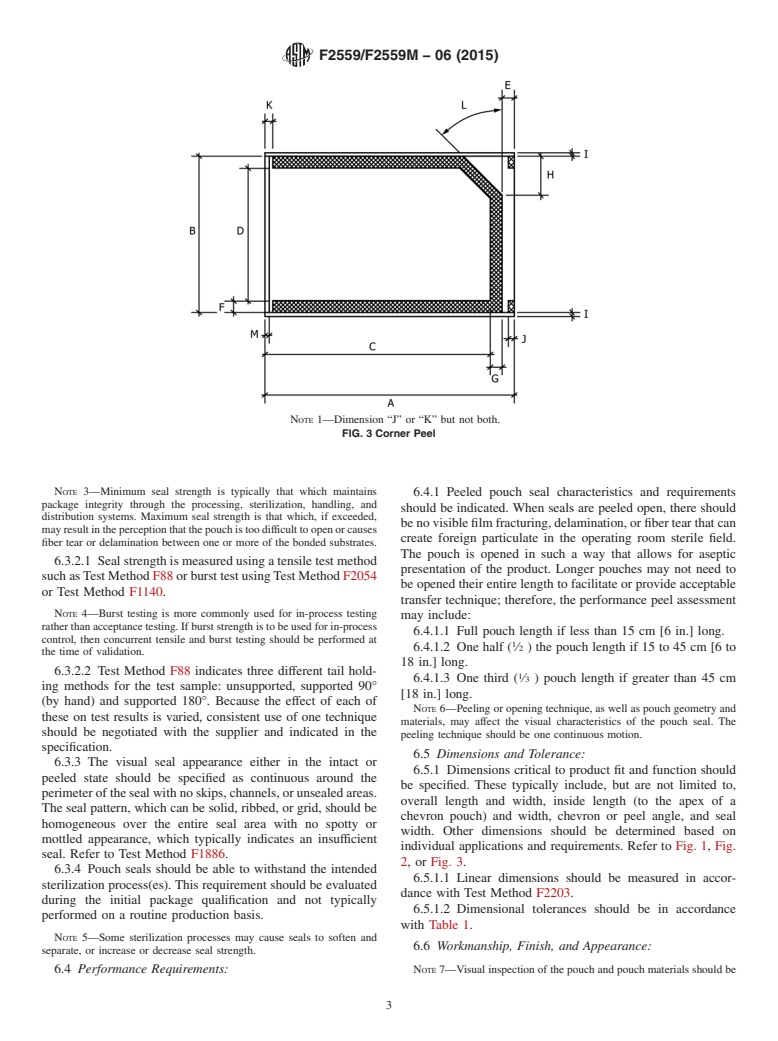
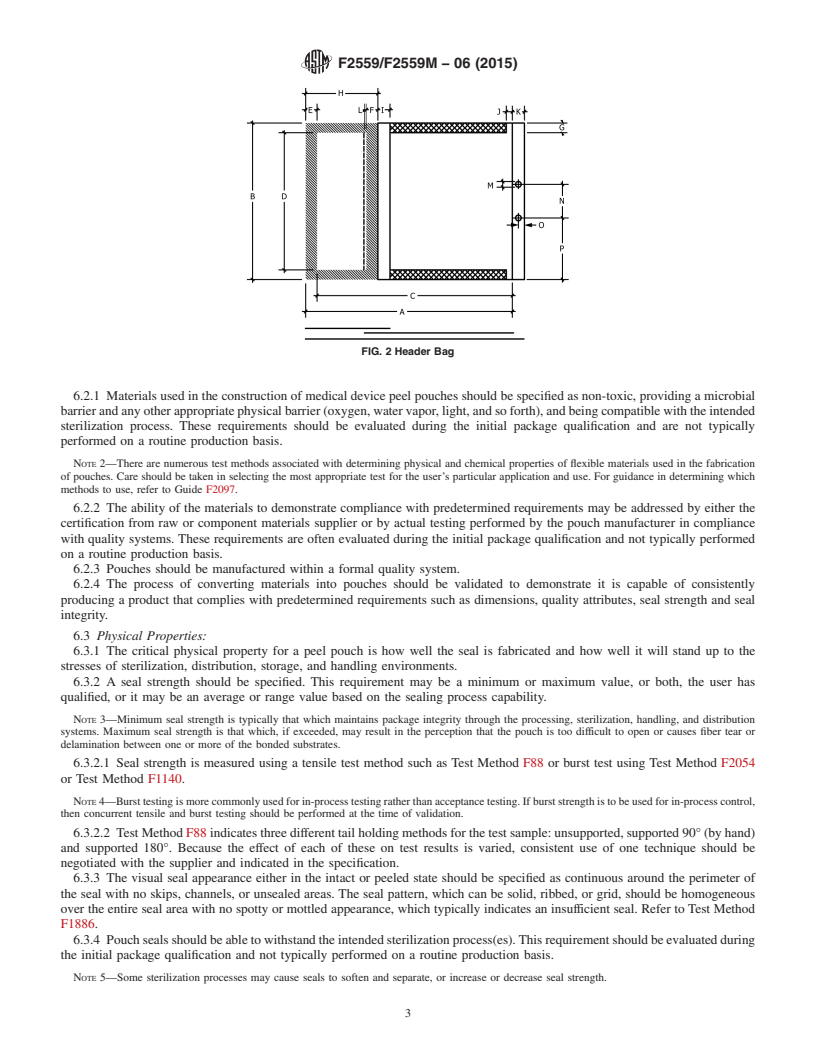
physical properties, performance requirements, dimensioning, 6.1.1.2 Corner peel pouch (see Fig. 2), and
appearance, and printing are all issues that need to be ad- 6.1.1.3 Header bag (see Fig. 3).
dressedinapeelpouchspecification.Appropriaterequirements
6.2 Materials and Manufacture:
and test methods are suggested for preparing a specification.
6.2.1 Materials used in the construction of medical device
peel pouches should be specified as non-toxic, providing a
5. Significance and Use
microbial barrier and any other appropriate physical barrier
5.1 Medical device peel pouches are universally used by the
(oxygen, water vapor, light, and so forth), and being compat-
industry and produced by a myriad of suppliers. They may be
ible with the intended sterilization process.These requirements
constructed of many different materials including films, foils,
should be evaluated during the initial package qualification and
paper, nonwovens such as Tyvek, and combinations thereof.
are not typically performed on a routine production basis.
However, even with the diversity of materials, there are still
NOTE 2—There are numerous test methods associated with determining
basic requirements that all pouches should exhibit. Above all,
physical and chemical properties of flexible materials used in the
the pouches must contain and protect the device while main-
fabrication of pouches. Care should be taken in selecting the most
taining sterility during all physical handling.
appropriate test for the user’s particular application and use. For guidance
in determining which methods to use, refer to Guide F2097.
5.2 Pouch requirements may be divided into two categories,
6.2.2 The ability of the materials to demonstrate compliance
initial pouch and material qualification, and routine production
with predetermined requirements may be addressed by either
and receipt requirements to ensure the purchaser receives
the certification from raw or component materials supplier or
exactly what is ordered. While all requirements should be
by actual testing performed by the pouch manufacturer in
included in the written specification, initial qualification tests
compliance with quality systems.These requirements are often
may only be needed prior to the first order. Routine production
evaluated during the initial package qualification and not
and receipt requirements should be adhered to on every order.
typically performed on a routine production basis.
Initial qualification requirements are indicated within each
6.2.3 Pouches should be manufactured within a formal
clause, where applicable.
quality system.
5.3 This guide provides an understanding of the require-
6.2.4 The process of converting materials into pouches
ments needed for the manufacture, purchase, and acceptance of
should be validated to demonstrate it is capable of consistently
a preformed peelable pouch. Appropriate test methods for
producing a product that complies with predetermined require-
compliance are also cited.
ments such as dimensions, quality attributes, seal strength and
NOTE 1—All test methods for a particular requirement may not be cited
seal integrity.
due to specific or unique circumstances. For additional guidance on
applicable methods, refer to Guide F2097.
6.3 Physical Properties:
5.4 The specification and its requirements should be mutu-
6.3.1 The critical physical property for a peel pouch is how
ally agreed to by the supplier and purchaser of pouches. This well the seal is fabricated and how well it will stand up to the
helps ensure that pouches will comply to specified require-
stresses of sterilization, distribution, storage, and handling
ments. environments.
6.3.2 A seal strength should be specified. This requirement
6. Specification
may be a minimum or maximum value, or both, the user has
qualified, or it may be an average or range value based on the
6.1 Classification:
sealing process capability.
6.1.1 Style:
6.1.1.1 Chevron pouch (see Fig. 1),
NOTE 1—Dimension “I” or “J” but not both.
FIG. 1Chevron Pouch FIG. 2Header Bag
F2559/F2559M−06 (2015)
NOTE 1—Dimension “J” or “K” but not both.
FIG. 3Corner Peel
NOTE 3—Minimum seal strength is typically that which maintains
6.4.1 Peeled pouch seal characteristics and requirements
package integrity through the processing, sterilization, handling, and
should be indicated. When seals are peeled open, there should
distribution systems. Maximum seal strength is that which, if exceeded,
benovisiblefilmfracturing,delamination,orfibertearthatcan
mayresultintheperceptionthatthepouchistoodifficulttoopenorcauses
create foreign particulate in the operating room sterile field.
fiber tear or delamination between one or more of the bonded substrates.
The pouch is opened in such a way that allows for aseptic
6.3.2.1 Seal strength is measured using a tensile test method
presentation of the product. Longer pouches may not need to
suchasTestMethodF88orbursttestusingTestMethodF2054
be opened their entire length to facilitate or provide acceptable
or Test Method F1140.
transfer technique; therefore, the performance peel assessment
NOTE 4—Burst testing is more commonly used for in-process testing
may include:
rather than acceptance testing. If burst strength is to be used for in-process
6.4.1.1 Full pouch length if less than 15 cm [6 in.] long.
control, then concurrent tensile and burst testing should be performed at
6.4.1.2 One half ( ⁄2 ) the pouch length if 15 to 45 cm [6 to
the time of validation.
18 in.] long.
6.3.2.2 Test Method F88 indicates three different tail hold-
6.4.1.3 One third ( ⁄3 ) pouch length if greater than 45 cm
ing methods for the test sample: unsupported, supported 90°
[18 in.] long.
(by hand) and supported 180°. Because the effect of each of
NOTE 6—Peeling or opening technique, as well as pouch geometry and
these on test results is varied, consistent use of one technique
materials, may affect the visual characteristics of the pouch seal. The
should be negotiated with the supplier and indicated in the
peeling technique should be one continuous motion.
specification.
6.5 Dimensions and Tolerance:
6.3.3 The visual seal appearance either in the intact or
6.5.1 Dimensions critical to product fit and function should
peeled state should be specified as continuous around the
be specified. These typically include, but are not limited to,
perimeterofthesealwithnoskips,channels,orunsealedareas.
overall length and width, inside length (to the apex of a
The seal pattern, which can be solid, ribbed, or grid, should be
chevron pouch) and width, chevron or peel angle, and seal
homogeneous over the entire seal area with no spotty or
width. Other dimensions should be determined based on
mottled appearance, which typically indicates an insufficient
individual applications and requirements. Refer to Fig. 1, Fig.
seal. Refer to Test Method F1886.
2,or Fig. 3.
6.3.4 Pouch seals should be able to withstand the intended
6.5.1.1 Linear dimensions should be measured in accor-
sterilization process(es). This requirement should be evaluated
dance with Test Method F2203.
during the initial package qualification and not typically
6.5.1.2 Dimensional tolerances should be in accordance
performed on a routine production basis.
with Table 1.
NOTE 5—Some sterilization processes may cause seals to soften and
6.6 Workmanship, Finish, and Appearance:
separate, or increase or decrease seal strength.
6.4 Performance Requirements: NOTE 7—Visual inspection of the pouch and pouch materials should be
F2559/F2559M−06 (2015)
TABLE 1 Dimensional Tolerances
Style Dimension Description Tolerance
Chevron Pouch A Length OD ±3 mm up to 0.5 m [ ⁄8in.upto20in.]
±6 mm between 0.5 and 1.0-m [ ⁄4 in. between 20 and 40 in.]
±12 mm over 1.0 m [ ⁄2 in. over 40 in.]
B Width OD ±3 mm up to 0.5 m [ ⁄8in.upto20in.]
±6 mm over 0.5 m [ ⁄4 in. over 20 in.]
C Length ID ±3 mm up to 0.5 m [ ⁄8in.upto20in.]
±6 mm over 0.5 m [ ⁄4 in. over 20 in.]
D Width ID ±1.5 mm up to 0.5 m [ ⁄16in.upto20in.]
±3 mm over 0.5 m [ ⁄8 in. over 20 in.]
and for highly heat sensitive materials
E Chevron setback ±3 mm up to 0.5 m [ ⁄8in.upto20in.]
±6 mm between 0.5 and 1.0-m [ ⁄4 in. between 20 and 40 in.]
±12 mm over 1.0 m [ ⁄2 in. over 40 in.]
F Side seal width ±1.5 mm [ ⁄16 in.]
±3 mm [ ⁄8 in.] for highly heat sensitive materials
G Chevron seal width ±1.5 mm [ ⁄16 in.]
±3 mm [ ⁄8 in.] for highly heat sensitive materials
H Seal flange ±1.5 mm [ ⁄16 in.]
I Tack seal length ±3 mm up to 0.5 m [ ⁄8in.upto20in.]
(not present on pouches with ±6 mm between 0.5 and 1.0-m [ ⁄4 in. between 20 and 40 in.]
end gaps/seal gaps) ±12 mm over 1.0 m [ ⁄2 in. over 40 in.]
J End gap/Seal gap ±3 mm up to 0.5 m [ ⁄8 8 in. up to 20 in.]
(not present on pouches with ±6 mm between 0.5 and 1.0-m [ ⁄4 in. between 20 and 40 in.]
tack seals) ±12 mm over 1.0 m [ ⁄2 in. over 40 in.]
K Chevron seal angle ±5°
L Lip ±3 mm [ ⁄8 in.]
M Thumb notch width ±3 mm [ ⁄8 in.]
N Thumb notch depth ±3 mm [ ⁄8 in.]
O Thumb notch position ±3 mm [ ⁄8 in.]
(to thumb notch c/l)
P Hang hole size ±1.5 mm [ ⁄16 in.]
R Hang hole setback ±3 mm up to 0.5 m [ ⁄8in.upto20in.]
(to hang hole c/l) ±6 mm between 0.5 and 1.0-m [ ⁄4 in. between 20 and 40 in.]
±12 mm over 1.0 m [ ⁄2 in. over 40 in.]
S Hang hole position ±3 mm [ ⁄8 in.]
(to hang hole c/l)
Header Bag A Length OD ±3 mm up to 0.5 m [ ⁄8in.upto20in.]
(to end of shorter web) ±6 mm over 0.5 m [ ⁄4 in. over 20 in.]
B Width OD ±3 mm up to 0.5 m [ ⁄8in.upto20in.]
±6 mm between 0.5 and 1.0-m [ ⁄4 in. between 20 and 40 in.]
±12 mm over 1.0 m [ ⁄2 in. over 40 in.]
C Length ID ±3 mm up to 0.5 m [ ⁄8in.upto20in.]
±6 mm over 0.5 m [ ⁄4 in. over 20 in.]
D Width ID ±3 mm up to 0.5 m [ ⁄8in.upto20in.]
±6 mm between 0.5 and 1.0-m [ ⁄4 in. between 20 and 40 in.]
±12 mm over 1.0 m [ ⁄2 in. over 40 in.]
E Top seal width ±3 mm [ ⁄8 in.]
F Bottom header seal width ±3 mm [ ⁄8 in.]
G Side seal width ±3 mm [ ⁄8 in.]
H Header length ±3 mm [ ⁄8 in.]
I Bottom header lip/Pull tab ±3 mm [ ⁄8 in.]
J End gap/Seal gap
...
This document is not an ASTM standard and is intended only to provide the user of an ASTM standard an indication of what changes have been made to the previous version. Because
it may not be technically possible to adequately depict all changes accurately, ASTM recommends that users consult prior editions as appropriate. In all cases only the current version
of the standard as published by ASTM is to be considered the official document.
´1
Designation: F2559/F2559M − 06 (Reapproved 2010) F2559/F2559M − 06 (Reapproved
2015)
Standard Guide for
Writing a Specification for Sterilizable Peel Pouches
This standard is issued under the fixed designation F2559/F2559M; the number immediately following the designation indicates the year
of original adoption or, in the case of revision, the year of last revision. A number in parentheses indicates the year of last reapproval.
A superscript epsilon (´) indicates an editorial change since the last revision or reapproval.
ε NOTE—Units information was editorially revised in November 2010.
1. Scope
1.1 This guide defines the requirements and considerations for flexible peel pouches with one open, unsealed end that are
intended to be sterilized containing medical devices. These are also known as preformed sterile barrier systems.
1.2 Pouch styles are categorized as chevron, header, and corner peel. These pouches are typically manufactured by heat sealing,
or in some cases, by cohesive cold sealing. The sealing bond is intended to be peeled open to aseptically dispense the contents.
1.3 Pouch materials may be either porous, nonporous, or any combination of the two.
1.4 This guide addresses some critical printing requirements on the pouch.
1.5 The values stated in either SI units or inch-pound units are to be regarded separately as standard. The values stated in each
system may not be exact equivalents; therefore, each system shall be used independently of the other. Combining values from the
two systems may result in non-conformance with the standard.
1.6 This standard does not purport to address all of the safety concerns, if any, associated with its use. It is the responsibility
of the user of this standard to establish appropriate safety and health practices and determine the applicability of regulatory
limitations prior to use.
2. Referenced Documents
2.1 ASTM Standards:
E122 Practice for Calculating Sample Size to Estimate, With Specified Precision, the Average for a Characteristic of a Lot or
Process
F17 Terminology Relating to Flexible Barrier Packaging
F88 Test Method for Seal Strength of Flexible Barrier Materials
F1140 Test Methods for Internal Pressurization Failure Resistance of Unrestrained Packages
F1886 Test Method for Determining Integrity of Seals for Medical Packaging by Visual Inspection
F2054 Test Method for Burst Testing of Flexible Package Seals Using Internal Air Pressurization Within Restraining Plates
F2097 Guide for Design and Evaluation of Primary Flexible Packaging for Medical Products
F2203 Test Method for Linear Measurement Using Precision Steel Rule
F2250 Practice for Evaluation of Chemical Resistance of Printed Inks and Coatings on Flexible Packaging Materials
F2475 Guide for Biocompatibility Evaluation of Medical Device Packaging Materials
2.2 TAPPI Standards:
T437 Dirt in Paper and Paperboard
3. Terminology
3.1 Definitions—For definitions and terms used in this guide, see Terminology F17.
3.2 Definitions of Terms Specific to This Standard:
This guide is under the jurisdiction of ASTM Committee F02 on Flexible Barrier Packaging and is the direct responsibility of Subcommittee F02.50 on Package Design
and Development.
Current edition approved Oct. 1, 2010Oct. 1, 2015. Published November 2010October 2015. Originally approved in 2006. Last previous edition approved in 20062010
ϵ1
as F2559 – 06.F2559/F2559M-06(2010) . DOI: 10.1520/F2559_F2559M-06R10E01.10.1520/F2559_F2559M-06R15.
For referenced ASTM standards, visit the ASTM website, www.astm.org, or contact ASTM Customer Service at service@astm.org. For Annual Book of ASTM Standards
volume information, refer to the standard’s Document Summary page on the ASTM website.
Available from Technical Association of the Pulp and Paper Industry (TAPPI), 15 Technology Parkway South, Norcross, GA 30092, http://www.tappi.org.
Copyright © ASTM International, 100 Barr Harbor Drive, PO Box C700, West Conshohocken, PA 19428-2959. United States
F2559/F2559M − 06 (2015)
3.2.1 pouch, n—a flexible package constructed of one or more materials sealed together to form a preformed sterile barrier
system. When purchased, one end or side is open to allow for product loading and final sealing.
3.2.2 specification, n—an explicit set of requirements to be satisfied by a material, product, system, or service. Examples of
specifications include, but are not limited to, requirements for; physical, mechanical, or chemical properties, and safety, quality,
or performance criteria. A specification identifies the test methods for determining whether each of the requirements is satisfied.
4. Summary
4.1 This guide provides guidance for writing a peel pouch material specification. Materials, method of manufacture, physical
properties, performance requirements, dimensioning, appearance, and printing are all issues that need to be addressed in a peel
pouch specification. Appropriate requirements and test methods are suggested for preparing a specification.
5. Significance and Use
5.1 Medical device peel pouches are universally used by the industry and produced by a myriad of suppliers. They may be
constructed of many different materials including films, foils, paper, nonwovens such as Tyvek, and combinations thereof.
However, even with the diversity of materials, there are still basic requirements that all pouches should exhibit. Above all, the
pouches must contain and protect the device while maintaining sterility during all physical handling.
5.2 Pouch requirements may be divided into two categories, initial pouch and material qualification, and routine production and
receipt requirements to ensure the purchaser receives exactly what is ordered. While all requirements should be included in the
written specification, initial qualification tests may only be needed prior to the first order. Routine production and receipt
requirements should be adhered to on every order. Initial qualification requirements are indicated within each clause, where
applicable.
5.3 This guide provides an understanding of the requirements needed for the manufacture, purchase, and acceptance of a
preformed peelable pouch. Appropriate test methods for compliance are also cited.
NOTE 1—All test methods for a particular requirement may not be cited due to specific or unique circumstances. For additional guidance on applicable
methods, refer to Guide F2097.
5.4 The specification and its requirements should be mutually agreed to by the supplier and purchaser of pouches. This helps
ensure that pouches will comply to specified requirements.
6. Specification
6.1 Classification:
6.1.1 Style:
6.1.1.1 Chevron pouch (see Fig. 1),
6.1.1.2 Corner peel pouch (see Fig. 2), and
6.1.1.3 Header bag (see Fig. 3).
6.2 Materials and Manufacture:
In accordance with ASTM International Form and Style for ASTM Standards.
NOTE 1—Dimension “I” or “J” but not both.
FIG. 1 Chevron Pouch
F2559/F2559M − 06 (2015)
FIG. 2 Header Bag
6.2.1 Materials used in the construction of medical device peel pouches should be specified as non-toxic, providing a microbial
barrier and any other appropriate physical barrier (oxygen, water vapor, light, and so forth), and being compatible with the intended
sterilization process. These requirements should be evaluated during the initial package qualification and are not typically
performed on a routine production basis.
NOTE 2—There are numerous test methods associated with determining physical and chemical properties of flexible materials used in the fabrication
of pouches. Care should be taken in selecting the most appropriate test for the user’s particular application and use. For guidance in determining which
methods to use, refer to Guide F2097.
6.2.2 The ability of the materials to demonstrate compliance with predetermined requirements may be addressed by either the
certification from raw or component materials supplier or by actual testing performed by the pouch manufacturer in compliance
with quality systems. These requirements are often evaluated during the initial package qualification and not typically performed
on a routine production basis.
6.2.3 Pouches should be manufactured within a formal quality system.
6.2.4 The process of converting materials into pouches should be validated to demonstrate it is capable of consistently
producing a product that complies with predetermined requirements such as dimensions, quality attributes, seal strength and seal
integrity.
6.3 Physical Properties:
6.3.1 The critical physical property for a peel pouch is how well the seal is fabricated and how well it will stand up to the
stresses of sterilization, distribution, storage, and handling environments.
6.3.2 A seal strength should be specified. This requirement may be a minimum or maximum value, or both, the user has
qualified, or it may be an average or range value based on the sealing process capability.
NOTE 3—Minimum seal strength is typically that which maintains package integrity through the processing, sterilization, handling, and distribution
systems. Maximum seal strength is that which, if exceeded, may result in the perception that the pouch is too difficult to open or causes fiber tear or
delamination between one or more of the bonded substrates.
6.3.2.1 Seal strength is measured using a tensile test method such as Test Method F88 or burst test using Test Method F2054
or Test Method F1140.
NOTE 4—Burst testing is more commonly used for in-process testing rather than acceptance testing. If burst strength is to be used for in-process control,
then concurrent tensile and burst testing should be performed at the time of validation.
6.3.2.2 Test Method F88 indicates three different tail holding methods for the test sample: unsupported, supported 90° (by hand)
and supported 180°. Because the effect of each of these on test results is varied, consistent use of one technique should be
negotiated with the supplier and indicated in the specification.
6.3.3 The visual seal appearance either in the intact or peeled state should be specified as continuous around the perimeter of
the seal with no skips, channels, or unsealed areas. The seal pattern, which can be solid, ribbed, or grid, should be homogeneous
over the entire seal area with no spotty or mottled appearance, which typically indicates an insufficient seal. Refer to Test Method
F1886.
6.3.4 Pouch seals should be able to withstand the intended sterilization process(es). This requirement should be evaluated during
the initial package qualification and not typically performed on a routine production basis.
NOTE 5—Some sterilization processes may cause seals to soften and separate, or increase or decrease seal strength.
F2559/F2559M − 06 (2015)
NOTE 1—Dimension “J” or “K” but not both.
FIG. 3 Corner Peel
6.4 Performance Requirements:
6.4.1 Peeled pouch seal characteristics and requirements should be indicated. When seals are peeled open, there should be no
visible film fracturing, delamination, or fiber tear that can create foreign particulate in the operating room sterile field. The pouch
is opened in such a way that allows for aseptic presentation of the product. Longer pouches may not need to be opened their entire
length to facilitate or provide acceptable transfer technique; therefore, the performance peel assessment may include:
6.4.1.1 Full pouch length if less than 15 cm [6 in.] long.
6.4.1.2 One half ( ⁄2 ) the pouch length if 15 to 45 cm [6 to 18 in.] long.
6.4.1.3 One third ( ⁄3 ) pouch length if greater than 45 cm [18 in.] long.
NOTE 6—Peeling or opening technique, as well as pouch geometry and materials, may affect the visual characteristics of the pouch seal. The peeling
technique should be one continuous motion.
6.5 Dimensions and Tolerance:
6.5.1 Dimensions critical to product fit and function should be specified. These typically include, but are not limited to, overall
length and width, inside length (to the apex of a chevron pouch) and width, chevron or peel angle, and seal width. Other dimensions
should be determined based on individual applications and requirements. Refer to Fig. 1, Fig. 2, or Fig. 3.
6.5.1.1 Linear dimensions should be measured in accordance with Test Method F2203.
6.5.1.2 Dimensional tolerances should be in accordance with Table 1.
6.6 Workmanship, Finish, and Appearance:
NOTE 7—Visual inspection of the pouch and pouch materials should be without magnification under normal lighting conditions at a distance of
approximately 30 to 45 cm [12 to 18 in.] and any defects should be noticeable without an extended inspection time.
6.6.1 Loose foreign matter limits for both inside and outside of the pouch should be specified and negotiated with and agreed
to by all parties. Requirements may be established based on the Dirt Estimation Chart in TAPPI T437.
6.6.2 There should be no wrinkles that could cause channeling through the seal or voids in the seal, and no holes or tears in
the pouch.
6.6.3 There should be no scratches or scuffing on the film, if applicable. The degree of scratches or scuffing, if any, should be
determined as appropriate for the material used.
6.6.4 Embedded foreign matter limits and gel limitations for each individual component should be established based on the Dirt
Estimation Chart in TAPPI T437. Typically, a maximum allowable number of a certain size is specified for a given individual
sample area or dimension.
6.6.5 Pouch edges should be smooth and cleanly cut.
6.7 Printing:
6.7.1 The printed material should comply with Guide F2475. This requirement should be evaluated during the initial package
qualification and not typically performed on a routine production basis.
F2559/F2559M − 06 (2015)
TABLE 1 Dimensional Tolerances
Style Dimension Description Tolerance
Chevron Pouch A Length OD ±3 mm up to 0.5 m [ ⁄8 in. up to 20 in.]
±6 mm between 0.5 and 1.0-m [ ⁄4 in. between 20 and 40 in.]
±12 mm over 1.0 m [ ⁄2 in. over 40 in.]
B Width OD ±3 mm up to 0.5 m [ ⁄8 in. up to 20 in.]
±6 mm over 0.5 m [ ⁄4 in. over 20 in.]
C Length ID ±3 mm up to 0.5 m [ ⁄8 in. up to 20 in.]
±6 mm over 0.5 m [ ⁄4 in. over 20 in.]
D Width ID ±1.5 mm up to 0.5 m [ ⁄16 in. up to 20 in.]
±3 mm over 0.5 m [ ⁄8 in. over 20 in.]
and for highly heat sensitive materials
E Chevron setback ±3 mm up to 0.5 m [ ⁄8 in. up to 20 in.]
±6 mm between 0.5 and 1.0-m [ ⁄4 in. between 2
...
Questions, Comments and Discussion
Ask us and Technical Secretary will try to provide an answer. You can facilitate discussion about the standard in here.