


ASTM D7096-16
(Test Method)Standard Test Method for Determination of the Boiling Range Distribution of Gasoline by Wide-Bore Capillary Gas Chromatography
Standard Test Method for Determination of the Boiling Range Distribution of Gasoline by Wide-Bore Capillary Gas Chromatography
SIGNIFICANCE AND USE
5.1 The determination of the boiling range distribution of gasoline by gas chromatographic simulated distillation provides an insight into the composition of the components from which the gasoline has been blended. Knowledge of the boiling range distribution of gasoline blending components is useful for the control of refinery processes and for the blending of finished gasoline.
5.2 The determination of the boiling range distribution of light hydrocarbon mixtures by gas chromatographic simulated distillation has better precision than the conventional distillation by Test Method D86. Additionally, this test method provides more accurate and detailed information about the composition of the light ends. The distillation data produced by this test method are similar to that which would be obtained from a cryogenic, true boiling point (15 theoretical plates) distillation.
SCOPE
1.1 This test method covers the determination of the boiling range distribution of gasoline and liquid gasoline blending components. It is applicable to petroleum products and fractions with a final boiling point of 280 °C (536 °F) or lower, as measured by this test method.
1.2 This test method is designed to measure the entire boiling range of gasoline and gasoline components with either high or low vapor pressure and is commonly referred to as Simulated Distillation (SimDis) by gas chromatographers.
1.3 This test method has been validated for gasoline containing ethanol. Gasolines containing other oxygenates are not specifically excluded, but they were not used in the development of this test method.
1.4 This test method can estimate the concentration of n-pentane and lighter saturated hydrocarbons in gasoline.
1.5 The values stated in SI units are to be regarded as standard. No other units of measurement are included in this standard.
1.5.1 Results in degrees Fahrenheit can be obtained by simply substituting Fahrenheit boiling points in the calculation of the boiling point-retention time correlation.
1.6 This standard does not purport to address all of the safety concerns, if any, associated with its use. It is the responsibility of the user of this standard to establish appropriate safety and health practices and determine the applicability of regulatory limitations prior to use.
General Information
Buy Standard



Standards Content (Sample)
NOTICE: This standard has either been superseded and replaced by a new version or withdrawn.
Contact ASTM International (www.astm.org) for the latest information
Designation: D7096 − 16
Standard Test Method for
Determination of the Boiling Range Distribution of Gasoline
1
by Wide-Bore Capillary Gas Chromatography
This standard is issued under the fixed designation D7096; the number immediately following the designation indicates the year of
original adoption or, in the case of revision, the year of last revision.Anumber in parentheses indicates the year of last reapproval.A
superscript epsilon (´) indicates an editorial change since the last revision or reapproval.
1. Scope* Liquid Fuels at Atmospheric Pressure
D2421Practice for Interconversion of Analysis of C and
5
1.1 Thistestmethodcoversthedeterminationoftheboiling
Lighter Hydrocarbons to Gas-Volume, Liquid-Volume, or
range distribution of gasoline and liquid gasoline blending
Mass Basis
components. It is applicable to petroleum products and frac-
D3700Practice for Obtaining LPG Samples Using a Float-
tions with a final boiling point of 280°C (536°F) or lower, as
ing Piston Cylinder
measured by this test method.
D4057Practice for Manual Sampling of Petroleum and
1.2 This test method is designed to measure the entire
Petroleum Products
boiling range of gasoline and gasoline components with either
D4307Practice for Preparation of Liquid Blends for Use as
high or low vapor pressure and is commonly referred to as
Analytical Standards
Simulated Distillation (SimDis) by gas chromatographers.
D4626Practice for Calculation of Gas Chromatographic
1.3 This test method has been validated for gasoline con-
Response Factors
taining ethanol. Gasolines containing other oxygenates are not
D4814Specification for Automotive Spark-Ignition Engine
specifically excluded, but they were not used in the develop-
Fuel
ment of this test method.
D4815Test Method for Determination of MTBE, ETBE,
1.4 This test method can estimate the concentration of
TAME, DIPE, tertiary-Amyl Alcohol and C to C Alco-
1 4
n-pentane and lighter saturated hydrocarbons in gasoline.
hols in Gasoline by Gas Chromatography
1.5 The values stated in SI units are to be regarded as D5191Test Method for Vapor Pressure of Petroleum Prod-
standard. No other units of measurement are included in this ucts (Mini Method)
standard. D5599Test Method for Determination of Oxygenates in
1.5.1 Results in degrees Fahrenheit can be obtained by
Gasoline by Gas Chromatography and Oxygen Selective
simply substituting Fahrenheit boiling points in the calculation
Flame Ionization Detection
of the boiling point-retention time correlation.
D6300Practice for Determination of Precision and Bias
1.6 This standard does not purport to address all of the Data for Use in Test Methods for Petroleum Products and
safety concerns, if any, associated with its use. It is the Lubricants
responsibility of the user of this standard to establish appro-
E594Practice for Testing Flame Ionization Detectors Used
priate safety and health practices and determine the applica-
in Gas or Supercritical Fluid Chromatography
bility of regulatory limitations prior to use.
E1510Practice for Installing Fused Silica Open Tubular
Capillary Columns in Gas Chromatographs
2. Referenced Documents
2
2.1 ASTM Standards: 3. Terminology
D86Test Method for Distillation of Petroleum Products and
3.1 Definitions:
3.1.1 area slice, n—area under a chromatogram within a
1
This test method is under the jurisdiction of ASTM Committee D02 on specified retention time interval.
Petroleum Products, Liquid Fuels, and Lubricants and is the direct responsibility of
3.1.2 final boiling point (FBP), n—the point at which a
Subcommittee D02.04.0H on Chromatographic Distribution Methods.
Current edition approved Jan. 1, 2016. Published February 2016. Originally
cumulative volume count equal to 99.5% of the total volume
approved in 2005. Last previous edition approved in 2010 as D7096–10. DOI:
counts under the chromatogram is obtained.
10.1520/D7096-16.
2
For referenced ASTM standards, visit the ASTM website, www.astm.org, or
3.1.3 initial boiling point (IBP), n—the point at which a
contact ASTM Customer Service at service@astm.org. For Annual Book of ASTM
cumulative volume count equal to 0.5% of the total volume
Standards volume information, refer to the standard’s Document Summary page on
the ASTM website. counts under the chromatogram is obtained.
*A Summary of Changes section appears at the end of this standard
Copyright © ASTM International, 100 Barr Harbor Drive, PO Box C700, West Conshohocken, PA 19428-2959. United States
1
---------------------- Page: 1 ----------------------
D7096 − 16
3.1.4 relative volume response factor (RVRF), n—the vol- eluting olefins present in the gasoline samples may coelute
umeresponsefactor(see3.1.8)ofacomponent irelativetothe with these compounds.
volume response factor of n-heptane.
6.3 For samples containing ethanol, this test method will
3.1.5 slice time,
...
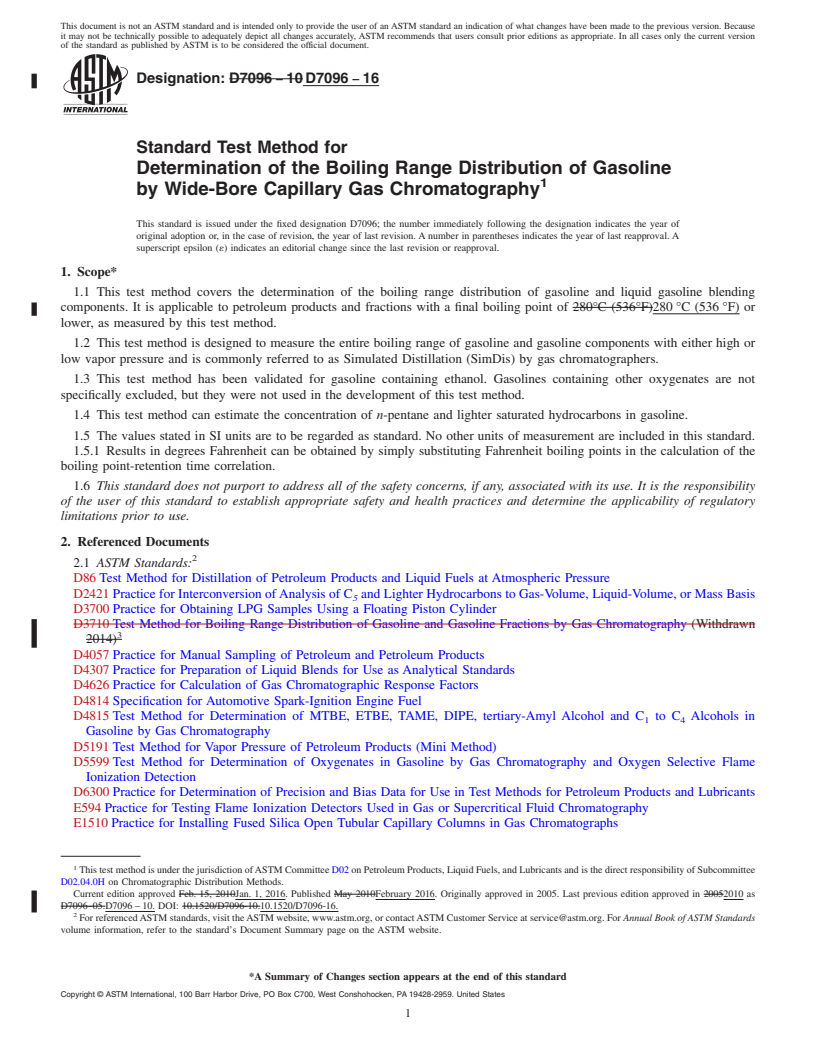
This document is not an ASTM standard and is intended only to provide the user of an ASTM standard an indication of what changes have been made to the previous version. Because
it may not be technically possible to adequately depict all changes accurately, ASTM recommends that users consult prior editions as appropriate. In all cases only the current version
of the standard as published by ASTM is to be considered the official document.
Designation: D7096 − 10 D7096 − 16
Standard Test Method for
Determination of the Boiling Range Distribution of Gasoline
1
by Wide-Bore Capillary Gas Chromatography
This standard is issued under the fixed designation D7096; the number immediately following the designation indicates the year of
original adoption or, in the case of revision, the year of last revision. A number in parentheses indicates the year of last reapproval. A
superscript epsilon (´) indicates an editorial change since the last revision or reapproval.
1. Scope*
1.1 This test method covers the determination of the boiling range distribution of gasoline and liquid gasoline blending
components. It is applicable to petroleum products and fractions with a final boiling point of 280°C (536°F)280 °C (536 °F) or
lower, as measured by this test method.
1.2 This test method is designed to measure the entire boiling range of gasoline and gasoline components with either high or
low vapor pressure and is commonly referred to as Simulated Distillation (SimDis) by gas chromatographers.
1.3 This test method has been validated for gasoline containing ethanol. Gasolines containing other oxygenates are not
specifically excluded, but they were not used in the development of this test method.
1.4 This test method can estimate the concentration of n-pentane and lighter saturated hydrocarbons in gasoline.
1.5 The values stated in SI units are to be regarded as standard. No other units of measurement are included in this standard.
1.5.1 Results in degrees Fahrenheit can be obtained by simply substituting Fahrenheit boiling points in the calculation of the
boiling point-retention time correlation.
1.6 This standard does not purport to address all of the safety concerns, if any, associated with its use. It is the responsibility
of the user of this standard to establish appropriate safety and health practices and determine the applicability of regulatory
limitations prior to use.
2. Referenced Documents
2
2.1 ASTM Standards:
D86 Test Method for Distillation of Petroleum Products and Liquid Fuels at Atmospheric Pressure
D2421 Practice for Interconversion of Analysis of C and Lighter Hydrocarbons to Gas-Volume, Liquid-Volume, or Mass Basis
5
D3700 Practice for Obtaining LPG Samples Using a Floating Piston Cylinder
D3710 Test Method for Boiling Range Distribution of Gasoline and Gasoline Fractions by Gas Chromatography (Withdrawn
3
2014)
D4057 Practice for Manual Sampling of Petroleum and Petroleum Products
D4307 Practice for Preparation of Liquid Blends for Use as Analytical Standards
D4626 Practice for Calculation of Gas Chromatographic Response Factors
D4814 Specification for Automotive Spark-Ignition Engine Fuel
D4815 Test Method for Determination of MTBE, ETBE, TAME, DIPE, tertiary-Amyl Alcohol and C to C Alcohols in
1 4
Gasoline by Gas Chromatography
D5191 Test Method for Vapor Pressure of Petroleum Products (Mini Method)
D5599 Test Method for Determination of Oxygenates in Gasoline by Gas Chromatography and Oxygen Selective Flame
Ionization Detection
D6300 Practice for Determination of Precision and Bias Data for Use in Test Methods for Petroleum Products and Lubricants
E594 Practice for Testing Flame Ionization Detectors Used in Gas or Supercritical Fluid Chromatography
E1510 Practice for Installing Fused Silica Open Tubular Capillary Columns in Gas Chromatographs
1
This test method is under the jurisdiction of ASTM Committee D02 on Petroleum Products, Liquid Fuels, and Lubricants and is the direct responsibility of Subcommittee
D02.04.0H on Chromatographic Distribution Methods.
Current edition approved Feb. 15, 2010Jan. 1, 2016. Published May 2010February 2016. Originally approved in 2005. Last previous edition approved in 20052010 as
D7096–05.D7096 – 10. DOI: 10.1520/D7096-10.10.1520/D7096-16.
2
For referenced ASTM standards, visit the ASTM website, www.astm.org, or contact ASTM Customer Service at service@astm.org. For Annual Book of ASTM Standards
volume information, refer to the standard’s Document Summary page on the ASTM website.
*A Summary of Changes section appears at the end of this standard
Copyright © ASTM International, 100 Barr Harbor Drive, PO Box C700, West Conshohocken, PA 19428-2959. United States
1
---------------------- Page: 1 ----------------------
D7096 − 16
3. Terminology
3.1 Definitions:
3.1.1 area slice, n—area under a chromatogram within a specified retention time interval.
3.1.2 final boiling point (FBP), n—the point at which a cumulative volume count equal to 99.5 % of the total volume counts
under th
...
Questions, Comments and Discussion
Ask us and Technical Secretary will try to provide an answer. You can facilitate discussion about the standard in here.