


ASTM D5824-98(2017)
(Test Method)Standard Test Method for Determining Resistance to Delamination of Adhesive Bonds in Overlay-Wood Core Laminates Exposed to Heat and Water
Standard Test Method for Determining Resistance to Delamination of Adhesive Bonds in Overlay-Wood Core Laminates Exposed to Heat and Water
SIGNIFICANCE AND USE
4.1 This test method measures quantitatively the effects of water soaking and drying, and their associated swelling and shrinking stresses on adhesive bonds in overlay-laminated assemblies.
4.2 Adhesive bond performance is based on the ability of the adhesive and adhesive bonds to resist delamination during accelerated exposure to water and heat.
4.3 Resistance to delamination when subjected to environmental factors is critical to the performance of the laminated assembly in service.
4.4 This test method is to be used to determine the quality of adhesive bonds in overlay-wood core laminates after the adhesive has been certified by a specification appropriate for the product, class, and end use.
SCOPE
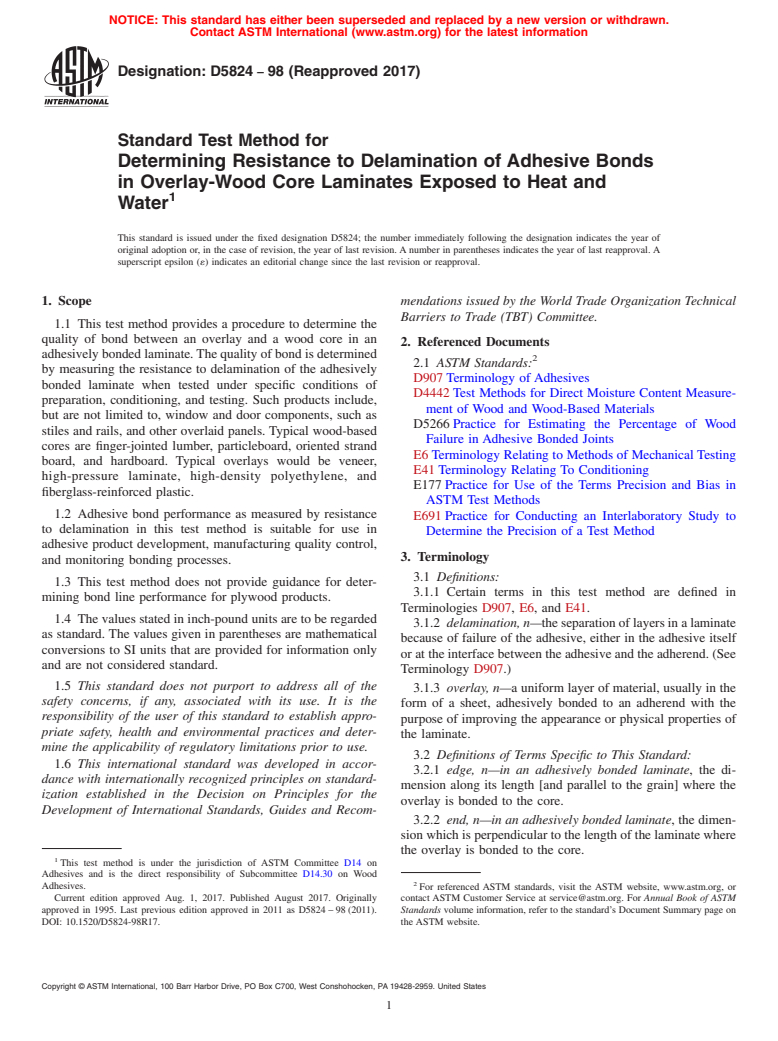
1.1 This test method provides a procedure to determine the quality of bond between an overlay and a wood core in an adhesively bonded laminate. The quality of bond is determined by measuring the resistance to delamination of the adhesively bonded laminate when tested under specific conditions of preparation, conditioning, and testing. Such products include, but are not limited to, window and door components, such as stiles and rails, and other overlaid panels. Typical wood-based cores are finger-jointed lumber, particleboard, oriented strand board, and hardboard. Typical overlays would be veneer, high-pressure laminate, high-density polyethylene, and fiberglass-reinforced plastic.
1.2 Adhesive bond performance as measured by resistance to delamination in this test method is suitable for use in adhesive product development, manufacturing quality control, and monitoring bonding processes.
1.3 This test method does not provide guidance for determining bond line performance for plywood products.
1.4 The values stated in inch-pound units are to be regarded as standard. The values given in parentheses are mathematical conversions to SI units that are provided for information only and are not considered standard.
1.5 This standard does not purport to address all of the safety concerns, if any, associated with its use. It is the responsibility of the user of this standard to establish appropriate safety, health and environmental practices and determine the applicability of regulatory limitations prior to use.
1.6 This international standard was developed in accordance with internationally recognized principles on standardization established in the Decision on Principles for the Development of International Standards, Guides and Recommendations issued by the World Trade Organization Technical Barriers to Trade (TBT) Committee.
General Information
Buy Standard
Standards Content (Sample)
NOTICE: This standard has either been superseded and replaced by a new version or withdrawn.
Contact ASTM International (www.astm.org) for the latest information
Designation: D5824 − 98 (Reapproved 2017)
Standard Test Method for
Determining Resistance to Delamination of Adhesive Bonds
in Overlay-Wood Core Laminates Exposed to Heat and
Water
This standard is issued under the fixed designation D5824; the number immediately following the designation indicates the year of
original adoption or, in the case of revision, the year of last revision. A number in parentheses indicates the year of last reapproval. A
superscript epsilon (´) indicates an editorial change since the last revision or reapproval.
1. Scope mendations issued by the World Trade Organization Technical
Barriers to Trade (TBT) Committee.
1.1 This test method provides a procedure to determine the
quality of bond between an overlay and a wood core in an
2. Referenced Documents
adhesively bonded laminate. The quality of bond is determined
2.1 ASTM Standards:
by measuring the resistance to delamination of the adhesively
D907 Terminology of Adhesives
bonded laminate when tested under specific conditions of
D4442 Test Methods for Direct Moisture Content Measure-
preparation, conditioning, and testing. Such products include,
ment of Wood and Wood-Based Materials
but are not limited to, window and door components, such as
D5266 Practice for Estimating the Percentage of Wood
stiles and rails, and other overlaid panels. Typical wood-based
Failure in Adhesive Bonded Joints
cores are finger-jointed lumber, particleboard, oriented strand
E6 Terminology Relating to Methods of Mechanical Testing
board, and hardboard. Typical overlays would be veneer,
E41 Terminology Relating To Conditioning
high-pressure laminate, high-density polyethylene, and
E177 Practice for Use of the Terms Precision and Bias in
fiberglass-reinforced plastic.
ASTM Test Methods
1.2 Adhesive bond performance as measured by resistance
E691 Practice for Conducting an Interlaboratory Study to
to delamination in this test method is suitable for use in
Determine the Precision of a Test Method
adhesive product development, manufacturing quality control,
3. Terminology
and monitoring bonding processes.
3.1 Definitions:
1.3 This test method does not provide guidance for deter-
3.1.1 Certain terms in this test method are defined in
mining bond line performance for plywood products.
Terminologies D907, E6, and E41.
1.4 The values stated in inch-pound units are to be regarded
3.1.2 delamination, n—the separation of layers in a laminate
as standard. The values given in parentheses are mathematical
because of failure of the adhesive, either in the adhesive itself
conversions to SI units that are provided for information only
or at the interface between the adhesive and the adherend. (See
and are not considered standard.
Terminology D907.)
1.5 This standard does not purport to address all of the
3.1.3 overlay, n—a uniform layer of material, usually in the
safety concerns, if any, associated with its use. It is the
form of a sheet, adhesively bonded to an adherend with the
responsibility of the user of this standard to establish appro-
purpose of improving the appearance or physical properties of
priate safety, health and environmental practices and deter-
the laminate.
mine the applicability of regulatory limitations prior to use.
3.2 Definitions of Terms Specific to This Standard:
1.6 This international standard was developed in accor-
3.2.1 edge, n—in an adhesively bonded laminate, the di-
dance with internationally recognized principles on standard-
mension along its length [and parallel to the grain] where the
ization established in the Decision on Principles for the
overlay is bonded to the core.
Development of International Standards, Guides and Recom-
3.2.2 end, n—in an adhesively bonded laminate, the dimen-
sion which is perpendicular to the length of the laminate where
the overlay is bonded to the core.
This test method is under the jurisdiction of ASTM Committee D14 on
Adhesives and is the direct responsibility of Subcommittee D14.30 on Wood
Adhesives. For referenced ASTM standards, visit the ASTM website, www.astm.org, or
Current edition approved Aug. 1, 2017. Published August 2017. Originally contact ASTM Customer Service at service@astm.org. For Annual Book of ASTM
approved in 1995. Last previous edition approved in 2011 as D5824 – 98 (2011). Standards volume information, refer to the standard’s Document Summary page on
DOI: 10.1520/D5824-98R17. the ASTM website.
Copyright © ASTM International, 100 Barr Harbor Drive, PO Box C700, West Conshohocken, PA 19428-2959. United States
D5824 − 98 (2017)
4. Significance and Use 6.2 Cut field specimens from test panels (see Fig. 3) to the
form and dimensions shown in Fig. 2 and Table 1. When the
4.1 This test method measures quantitatively the effects of
nominal width of the panel is used, the edges are to be prepared
water soaking and drying, and their associated swelling and
as the product would exist in service.
shrinking stresses on adhesive bonds in overlay-laminated
assemblies.
6.3 Test ten specimens, representing at least four different
panels.
4.2 Adhesive bond performance is based on the ability of
the adhesive and adhesive bonds to resist delamination during
7. Preparation and Conditioning of Laboratory Test
accelerated exposure to water and heat.
Panels
4.3 Resistance to delamination when subjected to environ-
7.1 Select veneer, either rotary cut or sliced, 0.063 in. (1.6
mental factors is critical to the performance of the laminated
mm) in thickness, and wood-based core, a minimum of 0.5 in.
assembly in service.
(13 mm) in thickness, so that they are free from defects such as
4.4 This test method is to be used to determine the quality of
knots, cracks, rough surfaces, or any unusual amount of
adhesive bonds in overlay-wood core laminates after the
discoloration. The species and type of veneer and composition
adhesive has been certified by a specification appropriate for
of the wood core are to be agreed upon between the purchaser
the product, class, and end use.
and the manufacturer of the adhesive. As an alternative to
veneer, specific overlays can be used as agreed upon between
5. Apparatus
the purchaser and the adhesive manufacturer. Surface the core
5.1 Oven(s)—Forced-air oven capable of maintaining 170 6
to a thickness tolerance of 60.005 in. (0.13 mm) (see Table 1).
5°F (77 6 3°C), with sufficient air circulation to ensure that the
If finger-jointed/edge-bonded core stock is used, it must remain
prescribed drying temperature is uniformly maintained when
intact without delamination during the test cycle. Both the
the oven is fully loaded and the air flow is parallel to the faces
veneer and the wood-based core are to be 61 % of the
of the specimens. A mechanism is to be provided for moisture
moisture content recommended by the manufacture of the
to be removed from the chamber during drying of the speci-
adhesive. In the absence of such a recommendation, the
mens.
moisture content is to be from 10 to 12 %, based on oven-dry
5.1.1 Use an oven to accommodate a sufficient number of
weight as determined on representative samples in accordance
test specimens and to provide for at least 3-in. (76-mm)
with Method A of Test Methods D4442. Cut the veneer and
separation between the test specimens so that the drying
wood core to a suitable size and grain orientation in order to
temperature is uniformly maintained.
build a panel with the grain of the veneer parallel to the grain
5.2 Vacuum-Pressure Vessel—Autoclave or similar vessel
of the wood core. A size that has been found to be convenient
capable of withstanding 80-psi (562-kPa) pressure, equipped
is shown in Fig. 1.
with a pump or similar device capable of drawing a vacuum of
7.2 Follow the adhesive manufacturer’s instructions for
25 in. Hg (84.4 kPa). Provide a system so that pressure is
conditions and procedures for preparing the adhesive and
maintained at 75 psi (517 kPa).
applying it to the wood core, as well as for assembling,
5.2.1 Use a vessel so that all the specimens are at least 2 in.
pressing, and curing the panel.
(51 mm) below the water level during the complete cycle.
7.3 After assembly, condition the panels for a period of
6. Test Specimens
seven days (or until the panels reach equilibrium) at a relative
6.1 Cut laboratory specimens from prepared test panels (see humidity of 50 6 2 % and a temperature of 73.4 6 2°F (23 6
Fig. 1) as described in Sections 7 and 8 to the form and 1°C), or condition them in accordance with a specific recom-
dimensions shown in Fig. 2 and Table 1. mendation by the adhesive manufacturer.
FIG. 1 Laboratory Test Panel
D5824 − 98 (2017)
FIG. 2 Fo
...
This document is not an ASTM standard and is intended only to provide the user of an ASTM standard an indication of what changes have been made to the previous version. Because
it may not be technically possible to adequately depict all changes accurately, ASTM recommends that users consult prior editions as appropriate. In all cases only the current version
of the standard as published by ASTM is to be considered the official document.
Designation: D5824 − 98 (Reapproved 2011) D5824 − 98 (Reapproved 2017)
Standard Test Method for
Determining Resistance to Delamination of Adhesive Bonds
in Overlay-Wood Core Laminates Exposed to Heat and
Water
This standard is issued under the fixed designation D5824; the number immediately following the designation indicates the year of
original adoption or, in the case of revision, the year of last revision. A number in parentheses indicates the year of last reapproval. A
superscript epsilon (´) indicates an editorial change since the last revision or reapproval.
1. Scope
1.1 This test method provides a procedure to determine the quality of bond between an overlay and a wood core in an adhesively
bonded laminate. The quality of bond is determined by measuring the resistance to delamination of the adhesively bonded laminate
when tested under specific conditions of preparation, conditioning, and testing. Such products include, but are not limited to,
window and door components, such as stiles and rails, and other overlaid panels. Typical wood-based cores are finger-jointed
lumber, particleboard, oriented strand board, and hardboard. Typical overlays would be veneer, high-pressure laminate,
high-density polyethylene, and fiberglass-reinforced plastic.
1.2 Adhesive bond performance as measured by resistance to delamination in this test method is suitable for use in adhesive
product development, manufacturing quality control, and monitoring bonding processes.
1.3 This test method does not provide guidance for determining bond line performance for plywood products.
1.4 The values stated in inch-pound units are to be regarded as standard. The values given in parentheses are mathematical
conversions to SI units that are provided for information only and are not considered standard.
1.5 This standard does not purport to address all of the safety concerns, if any, associated with its use. It is the responsibility
of the user of this standard to establish appropriate safety safety, health and healthenvironmental practices and determine the
applicability of regulatory limitations prior to use.
1.6 This international standard was developed in accordance with internationally recognized principles on standardization
established in the Decision on Principles for the Development of International Standards, Guides and Recommendations issued
by the World Trade Organization Technical Barriers to Trade (TBT) Committee.
2. Referenced Documents
2.1 ASTM Standards:
D907 Terminology of Adhesives
D4442 Test Methods for Direct Moisture Content Measurement of Wood and Wood-Based Materials
D5266 Practice for Estimating the Percentage of Wood Failure in Adhesive Bonded Joints
E6 Terminology Relating to Methods of Mechanical Testing
E41 Terminology Relating To Conditioning
E177 Practice for Use of the Terms Precision and Bias in ASTM Test Methods
E691 Practice for Conducting an Interlaboratory Study to Determine the Precision of a Test Method
3. Terminology
3.1 Definitions:
3.1.1 Certain terms in this test method are defined in Terminologies D907, E6, and E41.
3.1.2 delamination, n—the separation of layers in a laminate because of failure of the adhesive, either in the adhesive itself or
at the interface between the adhesive and the adherend. (See Terminology D907.)
This test method is under the jurisdiction of ASTM Committee D14 on Adhesives and is the direct responsibility of Subcommittee D14.30 on Wood Adhesives.
Current edition approved April 1, 2011Aug. 1, 2017. Published April 2011August 2017. Originally approved in 1995. Last previous edition approved in 20032011 as
D5824 – 98 (2003).(2011). DOI: 10.1520/D5824-98R11.10.1520/D5824-98R17.
For referenced ASTM standards, visit the ASTM website, www.astm.org, or contact ASTM Customer Service at service@astm.org. For Annual Book of ASTM Standards
volume information, refer to the standard’s Document Summary page on the ASTM website.
Copyright © ASTM International, 100 Barr Harbor Drive, PO Box C700, West Conshohocken, PA 19428-2959. United States
D5824 − 98 (2017)
3.1.3 overlay, n—a uniform layer of material, usually in the form of a sheet, adhesively bonded to an adherend with the purpose
of improving the appearance or physical properties of the laminate.
3.2 Definitions of Terms Specific to This Standard:
3.2.1 edge, n—in an adhesively bonded laminate, the dimension along its length [and parallel to the grain] where the overlay
is bonded to the core.
3.2.2 end, n—in an adhesively bonded laminate, the dimension which is perpendicular to the length of the laminate where the
overlay is bonded to the core.
4. Significance and Use
4.1 This test method measures quantitatively the effects of water soaking and drying, and their associated swelling and shrinking
stresses on adhesive bonds in overlay-laminated assemblies.
4.2 Adhesive bond performance is based on the ability of the adhesive and adhesive bonds to resist delamination during
accelerated exposure to water and heat.
4.3 Resistance to delamination when subjected to environmental factors is critical to the performance of the laminated assembly
in service.
4.4 This test method is to be used to determine the quality of adhesive bonds in overlay-wood core laminates after the adhesive
has been certified by a specification appropriate for the product, class, and end use.
5. Apparatus
5.1 Oven(s)—Forced-air oven capable of maintaining 170 6 5°F (77 6 3°C), with sufficient air circulation to ensure that the
prescribed drying temperature is uniformly maintained when the oven is fully loaded and the air flow is parallel to the faces of
the specimens. A mechanism is to be provided for moisture to be removed from the chamber during drying of the specimens.
5.1.1 Use an oven to accommodate a sufficient number of test specimens and to provide for at least 3-in. (76-mm) separation
between the test specimens so that the drying temperature is uniformly maintained.
5.2 Vacuum-Pressure Vessel—Autoclave or similar vessel capable of withstanding 80-psi (562-kPa) pressure, equipped with a
pump or similar device capable of drawing a vacuum of 25 in. Hg (84.4 kPa). Provide a system so that pressure is maintained at
75 psi (517 kPa).
5.2.1 Use a vessel so that all the specimens are at least 2 in. (51 mm) below the water level during the complete cycle.
6. Test Specimens
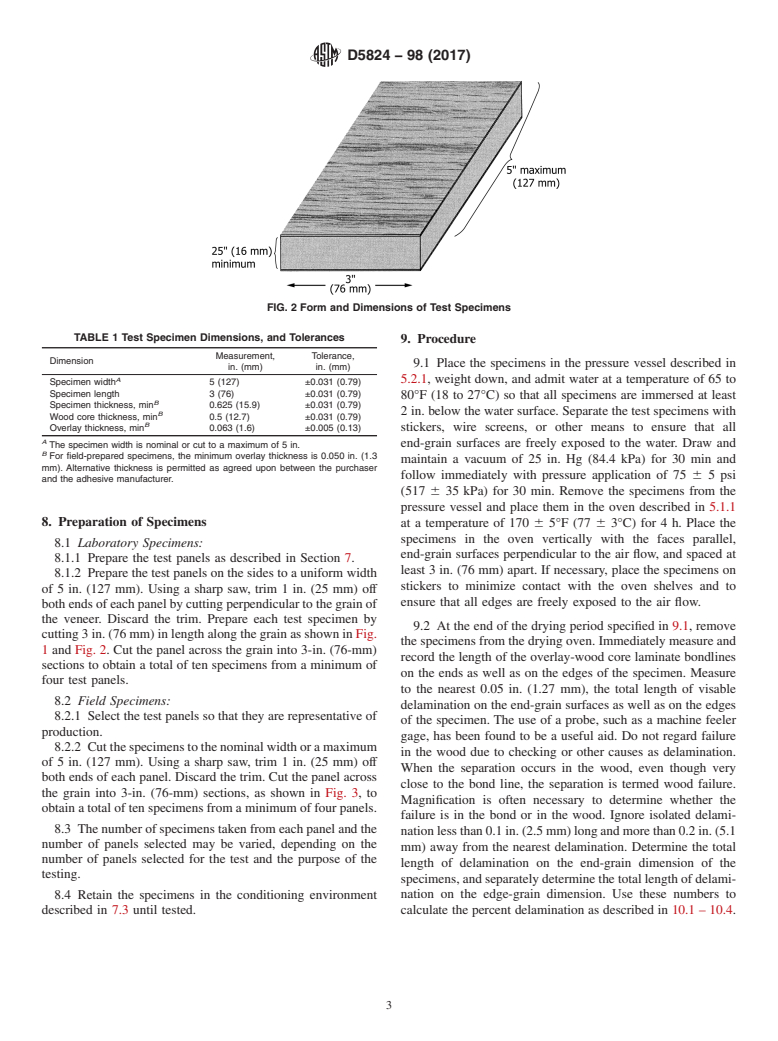
6.1 Cut laboratory specimens from prepared test panels (see Fig. 1) as described in Sections 7 and 8 to the form and dimensions
shown in Fig. 2 and Table 1.
6.2 Cut field specimens from test panels (see Fig. 3) to the form and dimensions shown in Fig. 2 and Table 1. When the nominal
width of the panel is used, the edges are to be prepared as the product would exist in service.
6.3 Test ten specimens, representing at least four different panels.
7. Preparation and Conditioning of Laboratory Test Panels
7.1 Select veneer, either rotary cut or sliced, 0.063 in. (1.6 mm) in thickness, and wood-based core, a minimum of 0.5 in. (13
mm) in thickness, so that they are free from defects such as knots, cracks, rough surfaces, or any unusual amount of discoloration.
FIG. 1 Laboratory Test Panel
D5824 − 98 (2017)
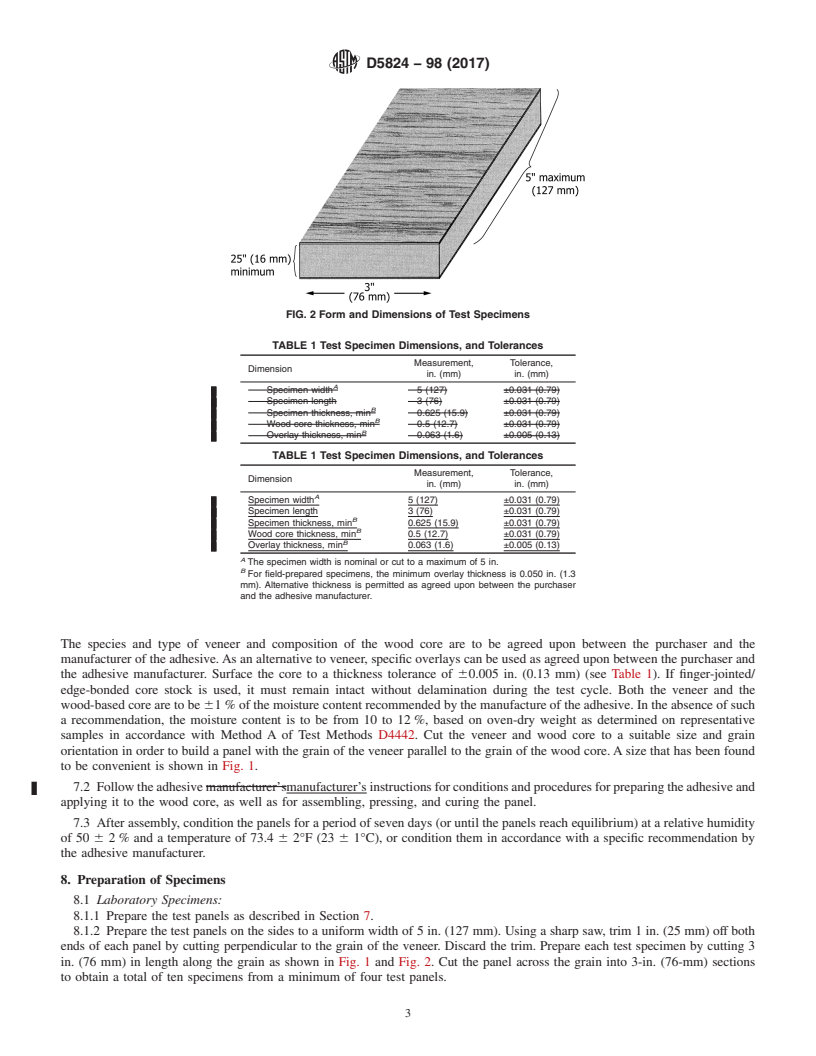
FIG. 2 Form and Dimensions of Test Specimens
TABLE 1 Test Specimen Dimensions, and Tolerances
Measurement, Tolerance,
Dimension
in. (mm) in. (mm)
A
Specimen width 5 (127) ±0.031 (0.79)
Specimen length 3 (76) ±0.031 (0.79)
B
Specimen thickness, min 0.625 (15.9) ±0.031 (0.79)
B
Wood core thickness, min 0.5 (12.7) ±0.031 (0.79)
B
Overlay thickness, min 0.063 (1.6) ±0.005 (0.13)
TABLE 1 Test Specimen Dimensions, and Tolerances
Measurement, Tolerance,
Dimension
in. (mm) in. (mm)
A
Specimen width 5 (127) ±0.031 (0.79)
Specimen length 3 (76) ±0.031 (0.79)
B
Specimen thickness, min 0.625 (15.9) ±0.031 (0.79)
B
Wood core thickness, min 0.5 (12.7) ±0.031 (0.79)
B
Overlay thickness, min 0.063 (1.6) ±0.005 (0.13)
A
The specimen width is nominal or cut to a maximum of 5 in.
B
For field-prepared specimens, the minimum overlay thickness is 0.050 in. (1.3
mm). Alternative thickness is permitted as agreed upon between the purchaser
and the adhesive manufacturer.
The species and type of veneer and composition of the wood core are to be agreed upon between the purchaser and the
manufacturer of the adhesive. As an alternative to veneer, specific overlays can be used as agreed upon between the purchaser and
the adhesive manufacturer. Surface the core to a thickness tolerance of 60.005 in. (0.13 mm) (see Table 1). If finger-jointed/
edge-bonded core stock is used, it must remain intact without delamination during the test cycle. Both the veneer and the
wood-based core are to be 61 % of the moisture content recommended by the manufacture of the adhesiv
...
Questions, Comments and Discussion
Ask us and Technical Secretary will try to provide an answer. You can facilitate discussion about the standard in here.