


ASTM F1675-13(2017)
(Practice)Standard Practice for Life-Cycle Cost Analysis of Plastic Pipe Used for Culverts, Storm Sewers, and Other Buried Conduits
Standard Practice for Life-Cycle Cost Analysis of Plastic Pipe Used for Culverts, Storm Sewers, and Other Buried Conduits
SIGNIFICANCE AND USE
5.1 LCC analysis is an economic method to evaluate alternatives that are characterized by differing cash flows over the designated project design life. The method entails calculating the LCC of each alternative capable of satisfying the functional requirements of the project and comparing them to determine which have the lowest estimated LCC over the project design life.
5.2 The LCC method is particularly suitable for determining whether the higher initial cost of an alternative is economically justified by reductions in future costs (for example, operating maintenance, rehabilitation, or replacement) when compared to an alternative with lower initial costs but higher future costs. If a design alternative has both a lower initial cost and lower future costs than other alternatives, an LCC analysis is not necessary to show the former is the economically preferable choice.
SCOPE
1.1 This practice establishes a procedure for using life cycle cost (LCC) analysis techniques to evaluate alternative drainage system designs, using plastic pipe that satisfy the same functional requirements.
1.2 The LCC technique measures the present value of all relevant costs to install, operate, and maintain alternative drainage systems such as engineering, construction, maintenance, rehabilitation, or replacement over a specified period of time. The practice also accommodates any remaining residual or salvage value.
1.3 The decision maker, using the results of the LCC analysis, can then identify the alternative(s) with the lowest estimated total cost based on the present value of all costs.
1.4 This standard does not purport to address all of the safety concerns, if any, associated with its use. It is the responsibility of the user of this standard to establish appropriate safety and health practices and determine the applicability of regulatory limitations prior to use.
1.5 This international standard was developed in accordance with internationally recognized principles on standardization established in the Decision on Principles for the Development of International Standards, Guides and Recommendations issued by the World Trade Organization Technical Barriers to Trade (TBT) Committee.
General Information
Buy Standard
Standards Content (Sample)
NOTICE: This standard has either been superseded and replaced by a new version or withdrawn.
Contact ASTM International (www.astm.org) for the latest information
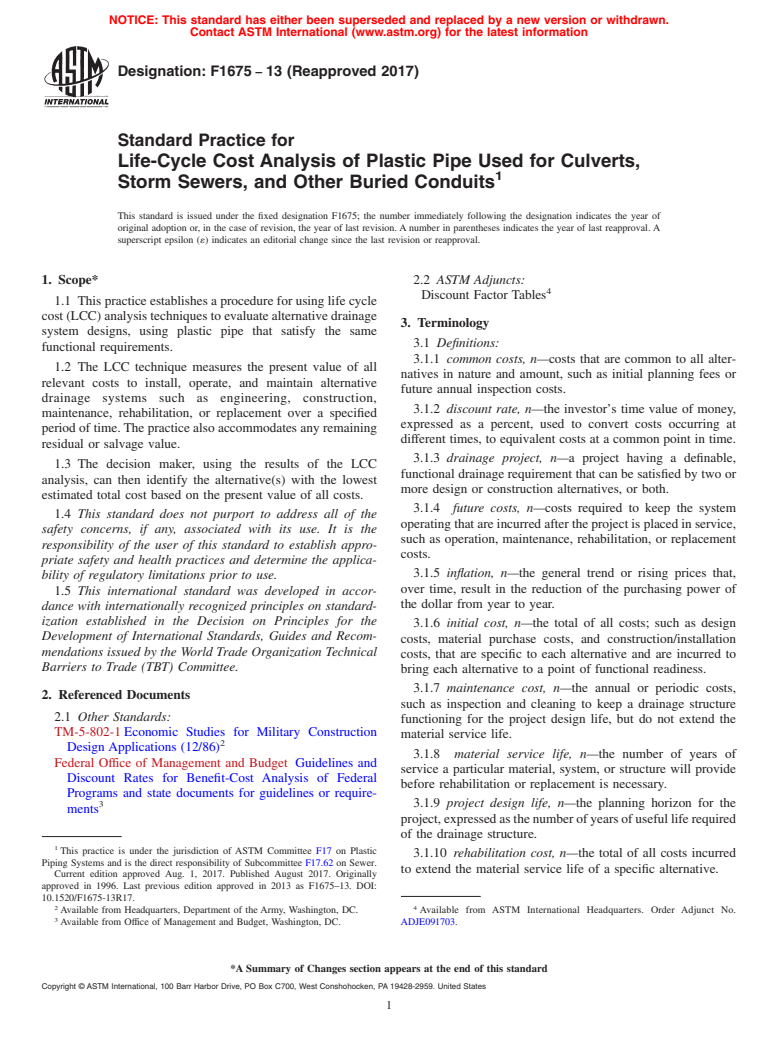
Designation: F1675 − 13 (Reapproved 2017)
Standard Practice for
Life-Cycle Cost Analysis of Plastic Pipe Used for Culverts,
Storm Sewers, and Other Buried Conduits
This standard is issued under the fixed designation F1675; the number immediately following the designation indicates the year of
original adoption or, in the case of revision, the year of last revision. A number in parentheses indicates the year of last reapproval. A
superscript epsilon (´) indicates an editorial change since the last revision or reapproval.
1. Scope* 2.2 ASTM Adjuncts:
Discount Factor Tables
1.1 This practice establishes a procedure for using life cycle
cost (LCC) analysis techniques to evaluate alternative drainage
3. Terminology
system designs, using plastic pipe that satisfy the same
3.1 Definitions:
functional requirements.
3.1.1 common costs, n—costs that are common to all alter-
1.2 The LCC technique measures the present value of all
natives in nature and amount, such as initial planning fees or
relevant costs to install, operate, and maintain alternative
future annual inspection costs.
drainage systems such as engineering, construction,
3.1.2 discount rate, n—the investor’s time value of money,
maintenance, rehabilitation, or replacement over a specified
expressed as a percent, used to convert costs occurring at
period of time. The practice also accommodates any remaining
different times, to equivalent costs at a common point in time.
residual or salvage value.
3.1.3 drainage project, n—a project having a definable,
1.3 The decision maker, using the results of the LCC
functional drainage requirement that can be satisfied by two or
analysis, can then identify the alternative(s) with the lowest
more design or construction alternatives, or both.
estimated total cost based on the present value of all costs.
3.1.4 future costs, n—costs required to keep the system
1.4 This standard does not purport to address all of the
operating that are incurred after the project is placed in service,
safety concerns, if any, associated with its use. It is the
such as operation, maintenance, rehabilitation, or replacement
responsibility of the user of this standard to establish appro-
costs.
priate safety and health practices and determine the applica-
3.1.5 inflation, n—the general trend or rising prices that,
bility of regulatory limitations prior to use.
over time, result in the reduction of the purchasing power of
1.5 This international standard was developed in accor-
the dollar from year to year.
dance with internationally recognized principles on standard-
ization established in the Decision on Principles for the
3.1.6 initial cost, n—the total of all costs; such as design
Development of International Standards, Guides and Recom-
costs, material purchase costs, and construction/installation
mendations issued by the World Trade Organization Technical
costs, that are specific to each alternative and are incurred to
Barriers to Trade (TBT) Committee.
bring each alternative to a point of functional readiness.
3.1.7 maintenance cost, n—the annual or periodic costs,
2. Referenced Documents
such as inspection and cleaning to keep a drainage structure
2.1 Other Standards:
functioning for the project design life, but do not extend the
TM-5-802-1 Economic Studies for Military Construction
material service life.
Design Applications (12/86)
3.1.8 material service life, n—the number of years of
Federal Office of Management and Budget Guidelines and
service a particular material, system, or structure will provide
Discount Rates for Benefit-Cost Analysis of Federal
before rehabilitation or replacement is necessary.
Programs and state documents for guidelines or require-
3.1.9 project design life, n—the planning horizon for the
ments
project,expressedasthenumberofyearsofusefulliferequired
of the drainage structure.
This practice is under the jurisdiction of ASTM Committee F17 on Plastic
3.1.10 rehabilitation cost, n—the total of all costs incurred
Piping Systems and is the direct responsibility of Subcommittee F17.62 on Sewer.
to extend the material service life of a specific alternative.
Current edition approved Aug. 1, 2017. Published August 2017. Originally
approved in 1996. Last previous edition approved in 2013 as F1675–13. DOI:
10.1520/F1675-13R17.
2 4
Available from Headquarters, Department of the Army, Washington, DC. Available from ASTM International Headquarters. Order Adjunct No.
Available from Office of Management and Budget, Washington, DC. ADJE091703.
*A Summary of Changes section appears at the end of this standard
Copyright © ASTM International, 100 Barr Harbor Drive, PO Box C700, West Conshohocken, PA 19428-2959. United States
F1675 − 13 (2017)
3.1.11 replacement cost, n—the total of all costs incurred to 6.3.1 Establish the uniform assumptions to be made in the
replace a material before the end of the project design life. LCC analysis of all alternatives.These assumptions include the
selection of the discount rate, the treatment of inflation, general
3.1.12 terminal value, n—the remaining value of the drain-
inflation rate, the project design life, and the desired compre-
age structure in place at the end of the project design life.
hensiveness of the analysis.
6.3.2 Discount Rate—The discount rate selected should
4. Summary of Practice
reflect the owner’s time value of money. That is, the discount
4.1 This practice outlines a procedure for conducting an
rate should reflect the rate of interest that makes the owner
LCC analysis of two or more drainage pipe alternatives using
indifferentbetweenpayingorreceivingadollarnoworatsome
plastic pipe over a specified project design life. This practice
futuretime.Thediscountrateisusedtoconvertcostsoccurring
identifies the project data and general assumptions needed for
atdifferenttimestoequivalentcostsatacommonpointintime.
the analysis and the method of computation.
6.3.2.1 There is no single correct discount rate for all
owners. Selection of the discount rate should be guided by the
5. Significance and Use
rate of return on alternative investment opportunities of com-
5.1 LCC analysis is an economic method to evaluate alter- parable risk (that is, the opportunity cost of capital), or, in the
natives that are characterized by differing cash flows over the case of some public organizations, on mandated or legislated
designated project design life. The method entails calculating federal or state requirements. (See Federal Office of Manage-
the LCC of each alternative capable of satisfying the functional ment and Budget.)
requirements of the project and comparing them to determine
6.3.2.2 The discount rate may include general price inflation
which have the lowest estimated LCC over the project design over the study period. This discount rate is referred to as the
life.
“nominal” discount rate in this practice. The discount rate may
also be expressed as the real earning power of money over and
5.2 The LCC method is particularly suitable for determining
above general price inflation, referred to as the “real” discount
whether the higher initial cost of an alternative is economically
rate.
justified by reductions in future costs (for example, operating
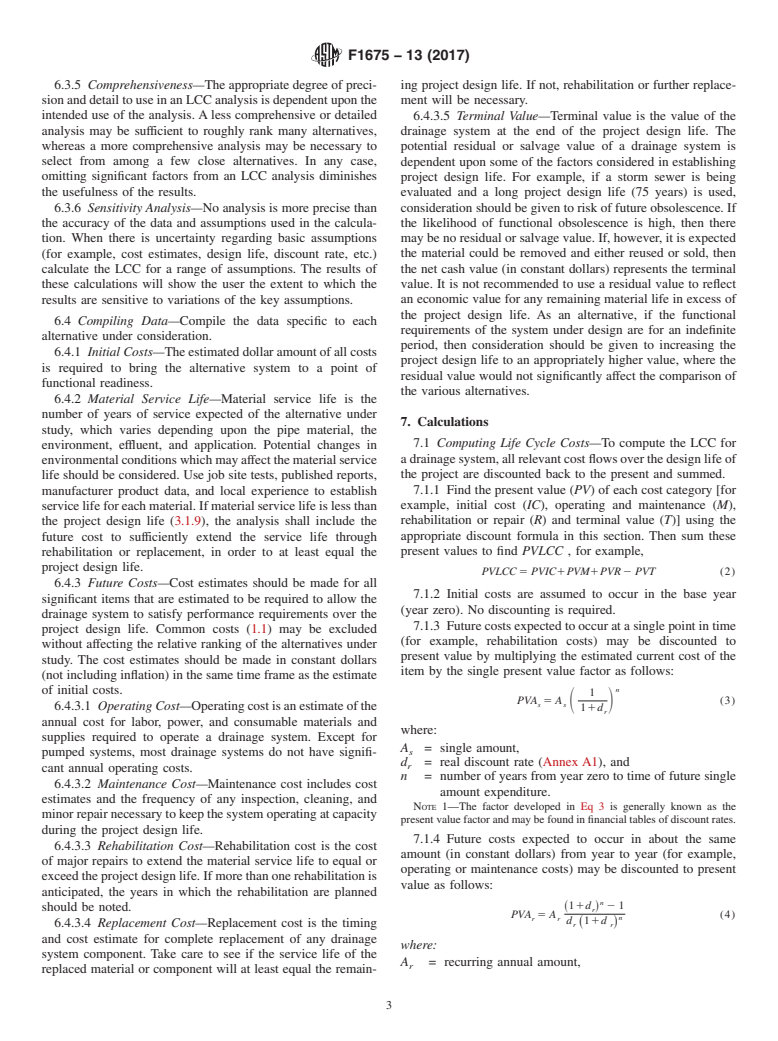
6.3.2.3 A nominal discount rate (d ) and the corresponding
maintenance,rehabilitation,orreplacement)whencomparedto n
real discount rate (d ) are related as follows:
r
an alternative with lower initial costs but higher future costs. If
a design alternative has both a lower initial cost and lower
11d
n
d 5 21or d 5 ~11d !~11I! 21 (1)
r n r
future costs than other alternatives, an LCC analysis is not
11I
necessary to show the former is the economically preferable
where:
choice.
I = the rate of general price inflation.
6. Procedure
6.3.2.4 The same discount rate should be used in evaluating
each design alternative. Annex A1 contains a procedure to
6.1 The procedure for performing an LCC analysis for
follow in developing the discount rate. This procedure may be
drainage pipe applications is as follows:
applied by those who wish to select their own values as well as
6.1.1 Identify project objectives, alternatives, and con-
those who are required to follow mandated or legislated
straints (6.2).
requirements.
6.1.2 Establish basic assumptions (6.3).
6.3.3 Inflation—This practice is designed only to accommo-
6.1.3 Compile data (6.4).
date a uniform rate of general inflation. Calculate the LCC in
6.1.4 Compute life cycle cost for each alternative (7.1).
constant dollar terms (not including general inflation) or in
6.1.5 Evaluate results (7.2).
current dollar terms (including general inflation). If the latter is
6.2 Project Objectives, Alternatives, and Constraints:
used, a consistent projection of general price inflation shall be
6.2.1 Specify the design objective that is to be
used throughout the LCC analysis, including adjustment of the
accomplished, identify alternative systems or designs that
discount rate to incorporate general inflation (6.3.2.2). The
accomplish that objective, and identify any constraints that
percentage change in GNP deflator and the Producers Price
may limit the options to be considered.
Index are two broad indicators of general inflation.
6.2.2 An example is the design of a storm water drainage
6.3.3.1 If the user desires or is required to treat inflation on
system for a residential development project. The system must
an incremental (differential) basis, or uniquely to each indi-
satisfy mandated drainage system objectives, such as specified
vidual cost component (for example, energy costs), consult
rainfall intensities and storm water runoff limits. Available
either TM-5-802-1 or Discount Factor Tables , respectively.
alternatives, such as different pipe materials and varying
6.3.4 Project Design Life—Establish the project design life
configurations of catch basins, ponds, or underground deten-
(3.1.9) from mandated public policy, legislated requirements,
tion chambers may have different initial costs as well as
or selection by the owner based on situation requirements. Use
expected future costs. The system design may be constrained
the same design life for each alternative under comparison and
by structural and hydraulic limits such as minimum and
for all categories of cost under consideration. The potential for
maximumslopesanddepthofburial,limitsonsurfaceflowson
future obsolescence, that is, th
...
This document is not an ASTM standard and is intended only to provide the user of an ASTM standard an indication of what changes have been made to the previous version. Because
it may not be technically possible to adequately depict all changes accurately, ASTM recommends that users consult prior editions as appropriate. In all cases only the current version
of the standard as published by ASTM is to be considered the official document.
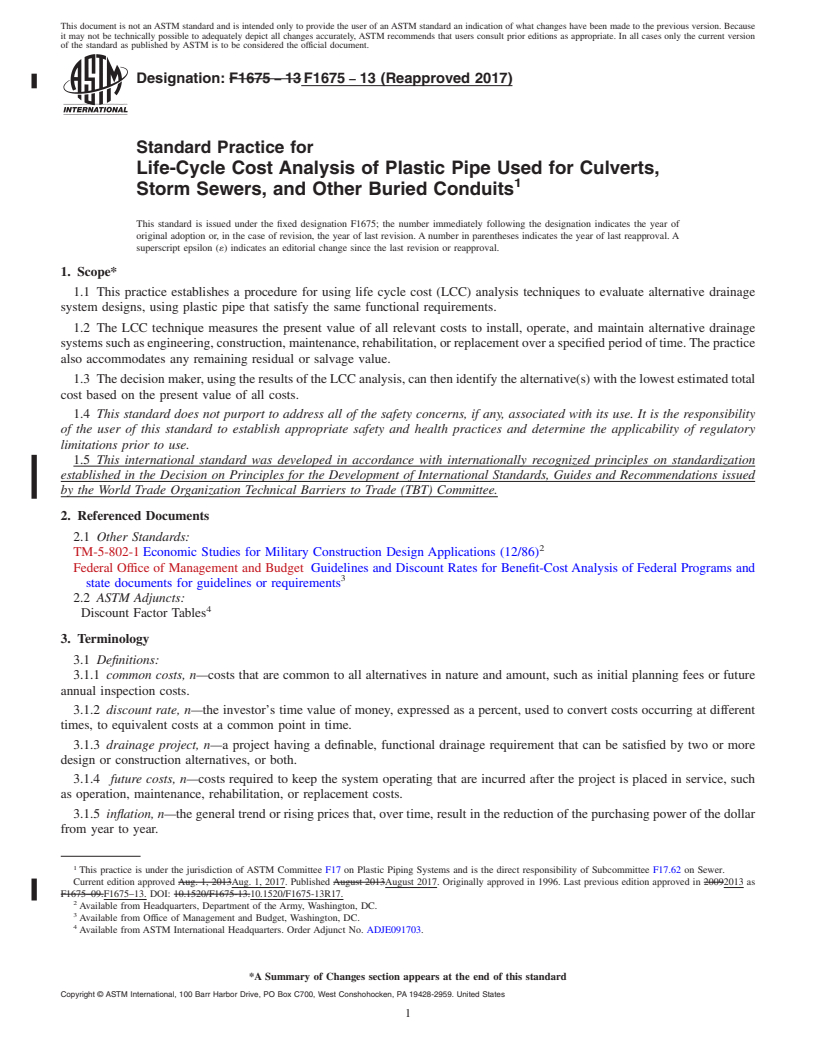
Designation: F1675 − 13 F1675 − 13 (Reapproved 2017)
Standard Practice for
Life-Cycle Cost Analysis of Plastic Pipe Used for Culverts,
Storm Sewers, and Other Buried Conduits
This standard is issued under the fixed designation F1675; the number immediately following the designation indicates the year of
original adoption or, in the case of revision, the year of last revision. A number in parentheses indicates the year of last reapproval. A
superscript epsilon (´) indicates an editorial change since the last revision or reapproval.
1. Scope*
1.1 This practice establishes a procedure for using life cycle cost (LCC) analysis techniques to evaluate alternative drainage
system designs, using plastic pipe that satisfy the same functional requirements.
1.2 The LCC technique measures the present value of all relevant costs to install, operate, and maintain alternative drainage
systems such as engineering, construction, maintenance, rehabilitation, or replacement over a specified period of time. The practice
also accommodates any remaining residual or salvage value.
1.3 The decision maker, using the results of the LCC analysis, can then identify the alternative(s) with the lowest estimated total
cost based on the present value of all costs.
1.4 This standard does not purport to address all of the safety concerns, if any, associated with its use. It is the responsibility
of the user of this standard to establish appropriate safety and health practices and determine the applicability of regulatory
limitations prior to use.
1.5 This international standard was developed in accordance with internationally recognized principles on standardization
established in the Decision on Principles for the Development of International Standards, Guides and Recommendations issued
by the World Trade Organization Technical Barriers to Trade (TBT) Committee.
2. Referenced Documents
2.1 Other Standards:
TM-5-802-1 Economic Studies for Military Construction Design Applications (12/86)
Federal Office of Management and Budget Guidelines and Discount Rates for Benefit-Cost Analysis of Federal Programs and
state documents for guidelines or requirements
2.2 ASTM Adjuncts:
Discount Factor Tables
3. Terminology
3.1 Definitions:
3.1.1 common costs, n—costs that are common to all alternatives in nature and amount, such as initial planning fees or future
annual inspection costs.
3.1.2 discount rate, n—the investor’s time value of money, expressed as a percent, used to convert costs occurring at different
times, to equivalent costs at a common point in time.
3.1.3 drainage project, n—a project having a definable, functional drainage requirement that can be satisfied by two or more
design or construction alternatives, or both.
3.1.4 future costs, n—costs required to keep the system operating that are incurred after the project is placed in service, such
as operation, maintenance, rehabilitation, or replacement costs.
3.1.5 inflation, n—the general trend or rising prices that, over time, result in the reduction of the purchasing power of the dollar
from year to year.
This practice is under the jurisdiction of ASTM Committee F17 on Plastic Piping Systems and is the direct responsibility of Subcommittee F17.62 on Sewer.
Current edition approved Aug. 1, 2013Aug. 1, 2017. Published August 2013August 2017. Originally approved in 1996. Last previous edition approved in 20092013 as
F1675–09.F1675–13. DOI: 10.1520/F1675-13.10.1520/F1675-13R17.
Available from Headquarters, Department of the Army, Washington, DC.
Available from Office of Management and Budget, Washington, DC.
Available from ASTM International Headquarters. Order Adjunct No. ADJE091703.
*A Summary of Changes section appears at the end of this standard
Copyright © ASTM International, 100 Barr Harbor Drive, PO Box C700, West Conshohocken, PA 19428-2959. United States
F1675 − 13 (2017)
3.1.6 initial cost, n—the total of all costs; such as design costs, material purchase costs, and construction/installation costs, that
are specific to each alternative and are incurred to bring each alternative to a point of functional readiness.
3.1.7 maintenance cost, n—the annual or periodic costs, such as inspection and cleaning to keep a drainage structure functioning
for the project design life, but do not extend the material service life.
3.1.8 material service life, n—the number of years of service a particular material, system, or structure will provide before
rehabilitation or replacement is necessary.
3.1.9 project design life, n—the planning horizon for the project, expressed as the number of years of useful life required of the
drainage structure.
3.1.10 rehabilitation cost, n—the total of all costs incurred to extend the material service life of a specific alternative.
3.1.11 replacement cost, n—the total of all costs incurred to replace a material before the end of the project design life.
3.1.12 terminal value, n—the remaining value of the drainage structure in place at the end of the project design life.
4. Summary of Practice
4.1 This practice outlines a procedure for conducting an LCC analysis of two or more drainage pipe alternatives using plastic
pipe over a specified project design life. This practice identifies the project data and general assumptions needed for the analysis
and the method of computation.
5. Significance and Use
5.1 LCC analysis is an economic method to evaluate alternatives that are characterized by differing cash flows over the
designated project design life. The method entails calculating the LCC of each alternative capable of satisfying the functional
requirements of the project and comparing them to determine which have the lowest estimated LCC over the project design life.
5.2 The LCC method is particularly suitable for determining whether the higher initial cost of an alternative is economically
justified by reductions in future costs (for example, operating maintenance, rehabilitation, or replacement) when compared to an
alternative with lower initial costs but higher future costs. If a design alternative has both a lower initial cost and lower future costs
than other alternatives, an LCC analysis is not necessary to show the former is the economically preferable choice.
6. Procedure
6.1 The procedure for performing an LCC analysis for drainage pipe applications is as follows:
6.1.1 Identify project objectives, alternatives, and constraints (6.2).
6.1.2 Establish basic assumptions (6.3).
6.1.3 Compile data (6.4).
6.1.4 Compute life cycle cost for each alternative (7.1).
6.1.5 Evaluate results (7.2).
6.2 Project Objectives, Alternatives, and Constraints:
6.2.1 Specify the design objective that is to be accomplished, identify alternative systems or designs that accomplish that
objective, and identify any constraints that may limit the options to be considered.
6.2.2 An example is the design of a storm water drainage system for a residential development project. The system must satisfy
mandated drainage system objectives, such as specified rainfall intensities and storm water runoff limits. Available alternatives,
such as different pipe materials and varying configurations of catch basins, ponds, or underground detention chambers may have
different initial costs as well as expected future costs. The system design may be constrained by structural and hydraulic limits such
as minimum and maximum slopes and depth of burial, limits on surface flows on streets, etc.
6.3 Basic Assumptions:
6.3.1 Establish the uniform assumptions to be made in the LCC analysis of all alternatives. These assumptions include the
selection of the discount rate, the treatment of inflation, general inflation rate, the project design life, and the desired
comprehensiveness of the analysis.
6.3.2 Discount Rate—The discount rate selected should reflect the owner’s time value of money. That is, the discount rate should
reflect the rate of interest that makes the owner indifferent between paying or receiving a dollar now or at some future time. The
discount rate is used to convert costs occurring at different times to equivalent costs at a common point in time.
6.3.2.1 There is no single correct discount rate for all owners. Selection of the discount rate should be guided by the rate of
return on alternative investment opportunities of comparable risk (that is, the opportunity cost of capital), or, in the case of some
public organizations, on mandated or legislated federal or state requirements. (See Federal Office of Management and Budget.)
6.3.2.2 The discount rate may include general price inflation over the study period. This discount rate is referred to as the
“nominal” discount rate in this practice. The discount rate may also be expressed as the real earning power of money over and
above general price inflation, referred to as the “real” discount rate.
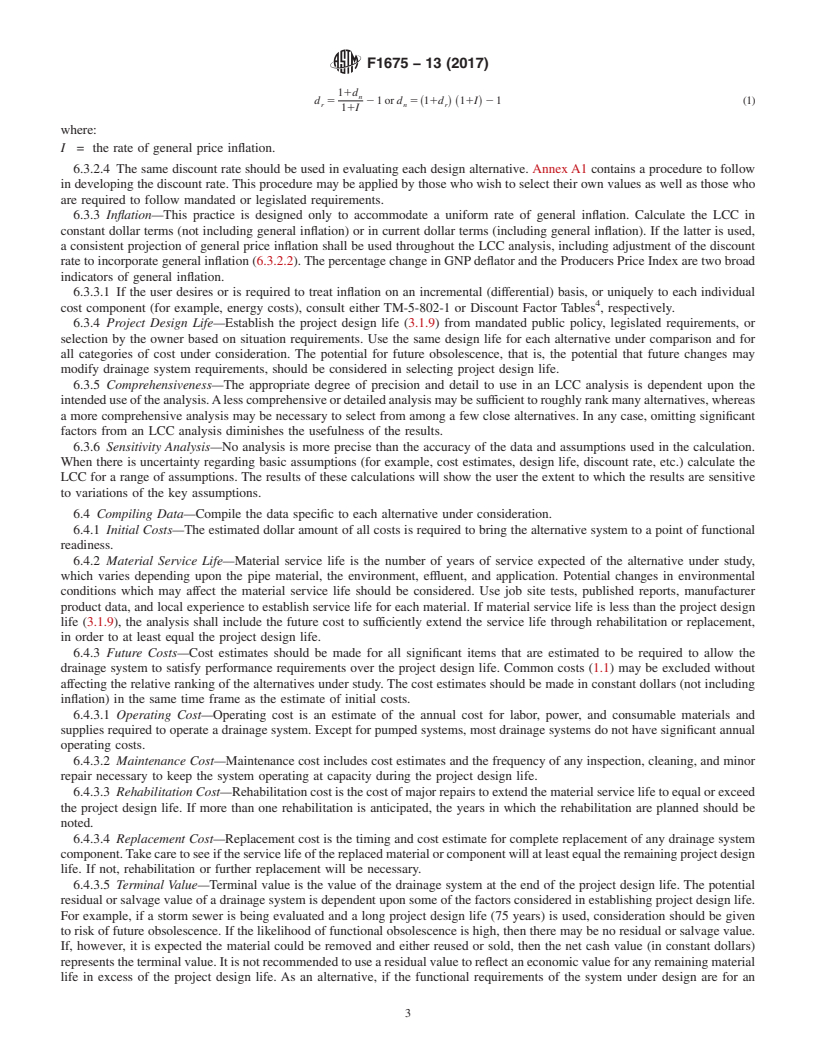
6.3.2.3 A nominal discount rate (d ) and the corresponding real discount rate (d ) are related as follows:
n r
F1675 − 13 (2017)
11d
n
d 5 2 1 or d 5 ~11d ! ~11I! 2 1 (1)
r n r
11I
where:
I = the rate of general price inflation.
6.3.2.4 The same discount rate should be used in evaluating each design alternative. Annex A1 contains a procedure to follow
in developing the discount rate. This procedure may be applied by those who wish to select their own values as well as those who
are required to follow mandated or legislated requirements.
6.3.3 Inflation—This practice is designed only to accommodate a uniform rate of general inflation. Calculate the LCC in
constant dollar terms (not including general inflation) or in current dollar terms (including general inflation). If the latter is used,
a consistent projection of general price inflation shall be used throughout the LCC analysis, including adjustment of the discount
rate to incorporate general inflation (6.3.2.2). The percentage change in GNP deflator and the Producers Price Index are two broad
indicators of general inflation.
6.3.3.1 If the user desires or is required to treat inflation on an incremental (differential) basis, or uniquely to each individual
cost component (for example, energy costs), consult either TM-5-802-1 or Discount Factor Tables , respectively.
6.3.4 Project Design Life—Establish the project design life (3.1.9) from mandated public policy, legisla
...
Questions, Comments and Discussion
Ask us and Technical Secretary will try to provide an answer. You can facilitate discussion about the standard in here.