

ASTM D7303-23
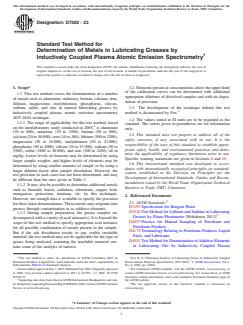
(Test Method)Standard Test Method for Determination of Metals in Lubricating Greases by Inductively Coupled Plasma Atomic Emission Spectrometry
General Information
- Abstract
SIGNIFICANCE AND USE
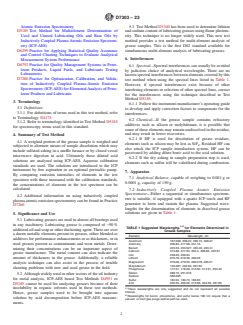
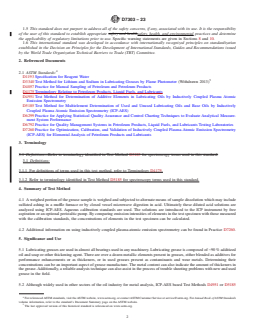
5.1 Lubricating greases are used in almost all bearings used in any machinery. Lubricating grease is composed of ~90 % additized oil and soap or other thickening agent. There are over a dozen metallic elements present in greases, either blended as additives for performance enhancements or as thickeners, or in used greases present as contaminants and wear metals. Determining their concentrations can be an important aspect of grease manufacture. The metal content can also indicate the amount of thickeners in the grease. Additionally, a reliable analysis technique can also assist in the process of trouble shooting problems with new and used grease in the field.
5.2 Although widely used in other sectors of the oil industry for metal analysis, ICP-AES based Test Methods D4951 or D5185 cannot be used for analyzing greases because of their insolubility in organic solvents used in these test methods. Hence, grease samples need to be brought into aqueous solution by acid decomposition before ICP-AES measurements.
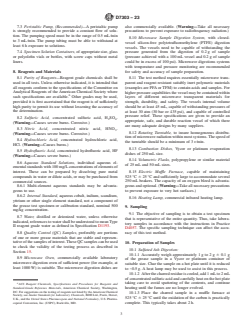
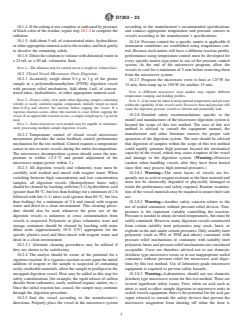
5.3 Test Method D3340 has been used to determine lithium and sodium content of lubricating greases using flame photometry. This technique is no longer widely used. This new test method provides a test method for multi-element analysis of grease samples. This is the first D02 standard available for simultaneous multi-element analysis of lubricating greases.
SCOPE
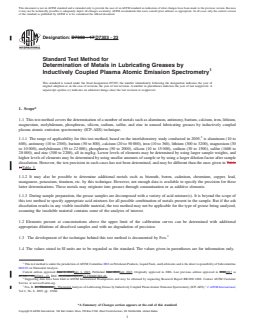
1.1 This test method covers the determination of a number of metals such as aluminum, antimony, barium, calcium, iron, lithium, magnesium, molybdenum, phosphorus, silicon, sodium, sulfur, and zinc in unused lubricating greases by inductively coupled plasma atomic emission spectrometry (ICP-AES) technique.
1.1.1 The range of applicability for this test method, based on the interlaboratory study conducted in 2005,2 is aluminum (10 to 600), antimony (10 to 2300), barium (50 to 800), calcium (20 to 50 000), iron (10 to 360), lithium (300 to 3200), magnesium (30 to 10 000), molybdenum (50 to 22 000), phosphorus (50 to 2000), silicon (10 to 15 000), sodium (30 to 1500), sulfur (1600 to 28 000), and zinc (300 to 2200), all in mg/kg. Lower levels of elements may be determined by using larger sample weights, and higher levels of elements may be determined by using smaller amounts of sample or by using a larger dilution factor after sample dissolution. However, the test precision in such cases has not been determined, and may be different than the ones given in Table 3.
1.1.2 It may also be possible to determine additional metals such as bismuth, boron, cadmium, chromium, copper, lead, manganese, potassium, titanium, etc. by this technique. However, not enough data is available to specify the precision for these latter determinations. These metals may originate into greases through contamination or as additive elements.
1.1.3 During sample preparation, the grease samples are decomposed with a variety of acid mixture(s). It is beyond the scope of this test method to specify appropriate acid mixtures for all possible combination of metals present in the sample. But if the ash dissolution results in any visible insoluble material, the test method may not be applicable for the type of grease being analyzed, assuming the insoluble material contains some of the analytes of interest.
1.2 Elements present at concentrations above the upper limit of the calibration curves can be determined with additional appropriate dilutions of dissolved samples and with no degradation of precision.
1.3 The development of the technique behind this test method is documented by Fox.3
1.4 The values stated in SI units are to be regarded as the standard. The values given in parentheses are for information only.
1.5 This standard does not purport to address all of the safety concerns, if any, associated with its use. It is the responsibility of the user of this standard to establish appropriate safety, health, and environmental practices and dete...
- Status
- Published
- Publication Date
- 30-Jun-2023
- Technical Committee
- D02 - Petroleum Products, Liquid Fuels, and Lubricants
- Drafting Committee
- D02.03 - Elemental Analysis
Buy Documents
ASTM D7303-23 - Standard Test Method for Determination of Metals in Lubricating Greases by Inductively Coupled Plasma Atomic Emission Spectrometry
REDLINE ASTM D7303-23 - Standard Test Method for Determination of Metals in Lubricating Greases by Inductively Coupled Plasma Atomic Emission Spectrometry
Overview
ASTM D7303-23, titled Standard Test Method for Determination of Metals in Lubricating Greases by Inductively Coupled Plasma Atomic Emission Spectrometry (ICP-AES), establishes a standardized procedure to determine the concentration of various metals in unused lubricating greases. Lubricating greases are essential in machinery bearings and typically consist of 90% additized oil and a soap or other thickening agent. Metals in greases may serve as performance additives, thickeners, or may be present as contaminants and wear metals in service. Accurate determination of metal content is vital for grease formulation, quality control, and diagnosing operational issues.
Key Topics
- ICP-AES Multi-Element Analysis: This method uses Inductively Coupled Plasma Atomic Emission Spectrometry to simultaneously analyze several metallic elements in grease samples after they are converted into aqueous solutions via acid decomposition.
- Applicable Metals: The standard addresses the quantification of elements such as aluminum, antimony, barium, calcium, iron, lithium, magnesium, molybdenum, phosphorus, silicon, sodium, sulfur, and zinc. It also allows for the potential analysis of additional metals (e.g., bismuth, boron, cadmium, chromium, copper, lead, manganese, potassium, titanium) pending validation of precision.
- Sample Preparation: Due to the insolubility of greases in organic solvents, acid digestion is required to dissolve grease samples for analysis. Options include sulfated ashing in a muffle furnace or microwave-assisted digestion.
- Precision and Calibration: The method includes quality control procedures, calibration using aqueous standards, and recommendations for dilutions if analyte concentrations exceed calibration ranges.
- Interferences and Safety: The standard discusses the potential for spectral and chemical interferences and emphasizes the importance of following safety protocols, especially when using strong acids and high pressure/temperature digestion systems.
Applications
- Grease Manufacturing and Quality Control: The test method aids manufacturers in verifying the concentration of metallic additives and thickeners, ensuring product consistency and compliance with specifications.
- Troubleshooting and Field Analysis: Detection of wear metals or contaminants assists in diagnosing machinery health and operational anomalies.
- Research and Product Development: Enables the development and optimization of new grease formulations by providing precise analytical data on metal content.
- Regulatory and Environmental Compliance: Supports adherence to industry and environmental guidelines on metal content in lubricating greases.
Related Standards
- ASTM D4951 - Determination of Additive Elements in Lubricating Oils by ICP-AES (not applicable to greases due to solubility limitations).
- ASTM D5185 - Multielement Determination of Used and Unused Lubricating Oils and Base Oils by ICP-AES.
- ASTM D3340 - Lithium and Sodium Determination in Lubricating Greases by Flame Photometry (now largely superseded by D7303).
- ASTM D7260 - Optimization, Calibration, and Validation of ICP-AES for Elemental Analysis of Petroleum Products and Lubricants.
- ASTM D4057 - Manual Sampling of Petroleum and Petroleum Products.
- ASTM D6792 - Quality Management Systems in Petroleum Products Testing Laboratories.
Keywords: ASTM D7303, lubricating grease, metals determination, ICP-AES, elemental analysis, grease additives, quality control, metal contaminants, grease manufacturing, oil analysis.
Relations
- Refers
ASTM D4175-23a - Standard Terminology Relating to Petroleum Products, Liquid Fuels, and Lubricants - Effective Date
- 15-Dec-2023
- Effective Date
- 01-Dec-2023
- Effective Date
- 01-Nov-2023
- Effective Date
- 01-Oct-2023
- Refers
ASTM D4175-23e1 - Standard Terminology Relating to Petroleum Products, Liquid Fuels, and Lubricants - Effective Date
- 01-Jul-2023
- Effective Date
- 01-May-2019
- Effective Date
- 01-Apr-2018
- Effective Date
- 15-Dec-2017
- Effective Date
- 15-Nov-2017
- Effective Date
- 01-Jan-2017
- Effective Date
- 01-Oct-2013
- Refers
ASTM D4057-06(2011) - Standard Practice for Manual Sampling of Petroleum and Petroleum Products - Effective Date
- 01-Jun-2011
- Effective Date
- 01-Mar-2010
- Effective Date
- 01-Mar-2010
- Effective Date
- 01-Nov-2009
Buy Documents
ASTM D7303-23 - Standard Test Method for Determination of Metals in Lubricating Greases by Inductively Coupled Plasma Atomic Emission Spectrometry
REDLINE ASTM D7303-23 - Standard Test Method for Determination of Metals in Lubricating Greases by Inductively Coupled Plasma Atomic Emission Spectrometry
Get Certified
Connect with accredited certification bodies for this standard

Element Materials Technology
Materials testing and product certification.

ABS Group Brazil
ABS Group certification services in Brazil.

ABS Quality Evaluations Inc.
American Bureau of Shipping quality certification.
Sponsored listings
Frequently Asked Questions
ASTM D7303-23 is a standard published by ASTM International. Its full title is "Standard Test Method for Determination of Metals in Lubricating Greases by Inductively Coupled Plasma Atomic Emission Spectrometry". This standard covers: SIGNIFICANCE AND USE 5.1 Lubricating greases are used in almost all bearings used in any machinery. Lubricating grease is composed of ~90 % additized oil and soap or other thickening agent. There are over a dozen metallic elements present in greases, either blended as additives for performance enhancements or as thickeners, or in used greases present as contaminants and wear metals. Determining their concentrations can be an important aspect of grease manufacture. The metal content can also indicate the amount of thickeners in the grease. Additionally, a reliable analysis technique can also assist in the process of trouble shooting problems with new and used grease in the field. 5.2 Although widely used in other sectors of the oil industry for metal analysis, ICP-AES based Test Methods D4951 or D5185 cannot be used for analyzing greases because of their insolubility in organic solvents used in these test methods. Hence, grease samples need to be brought into aqueous solution by acid decomposition before ICP-AES measurements. 5.3 Test Method D3340 has been used to determine lithium and sodium content of lubricating greases using flame photometry. This technique is no longer widely used. This new test method provides a test method for multi-element analysis of grease samples. This is the first D02 standard available for simultaneous multi-element analysis of lubricating greases. SCOPE 1.1 This test method covers the determination of a number of metals such as aluminum, antimony, barium, calcium, iron, lithium, magnesium, molybdenum, phosphorus, silicon, sodium, sulfur, and zinc in unused lubricating greases by inductively coupled plasma atomic emission spectrometry (ICP-AES) technique. 1.1.1 The range of applicability for this test method, based on the interlaboratory study conducted in 2005,2 is aluminum (10 to 600), antimony (10 to 2300), barium (50 to 800), calcium (20 to 50 000), iron (10 to 360), lithium (300 to 3200), magnesium (30 to 10 000), molybdenum (50 to 22 000), phosphorus (50 to 2000), silicon (10 to 15 000), sodium (30 to 1500), sulfur (1600 to 28 000), and zinc (300 to 2200), all in mg/kg. Lower levels of elements may be determined by using larger sample weights, and higher levels of elements may be determined by using smaller amounts of sample or by using a larger dilution factor after sample dissolution. However, the test precision in such cases has not been determined, and may be different than the ones given in Table 3. 1.1.2 It may also be possible to determine additional metals such as bismuth, boron, cadmium, chromium, copper, lead, manganese, potassium, titanium, etc. by this technique. However, not enough data is available to specify the precision for these latter determinations. These metals may originate into greases through contamination or as additive elements. 1.1.3 During sample preparation, the grease samples are decomposed with a variety of acid mixture(s). It is beyond the scope of this test method to specify appropriate acid mixtures for all possible combination of metals present in the sample. But if the ash dissolution results in any visible insoluble material, the test method may not be applicable for the type of grease being analyzed, assuming the insoluble material contains some of the analytes of interest. 1.2 Elements present at concentrations above the upper limit of the calibration curves can be determined with additional appropriate dilutions of dissolved samples and with no degradation of precision. 1.3 The development of the technique behind this test method is documented by Fox.3 1.4 The values stated in SI units are to be regarded as the standard. The values given in parentheses are for information only. 1.5 This standard does not purport to address all of the safety concerns, if any, associated with its use. It is the responsibility of the user of this standard to establish appropriate safety, health, and environmental practices and dete...
SIGNIFICANCE AND USE 5.1 Lubricating greases are used in almost all bearings used in any machinery. Lubricating grease is composed of ~90 % additized oil and soap or other thickening agent. There are over a dozen metallic elements present in greases, either blended as additives for performance enhancements or as thickeners, or in used greases present as contaminants and wear metals. Determining their concentrations can be an important aspect of grease manufacture. The metal content can also indicate the amount of thickeners in the grease. Additionally, a reliable analysis technique can also assist in the process of trouble shooting problems with new and used grease in the field. 5.2 Although widely used in other sectors of the oil industry for metal analysis, ICP-AES based Test Methods D4951 or D5185 cannot be used for analyzing greases because of their insolubility in organic solvents used in these test methods. Hence, grease samples need to be brought into aqueous solution by acid decomposition before ICP-AES measurements. 5.3 Test Method D3340 has been used to determine lithium and sodium content of lubricating greases using flame photometry. This technique is no longer widely used. This new test method provides a test method for multi-element analysis of grease samples. This is the first D02 standard available for simultaneous multi-element analysis of lubricating greases. SCOPE 1.1 This test method covers the determination of a number of metals such as aluminum, antimony, barium, calcium, iron, lithium, magnesium, molybdenum, phosphorus, silicon, sodium, sulfur, and zinc in unused lubricating greases by inductively coupled plasma atomic emission spectrometry (ICP-AES) technique. 1.1.1 The range of applicability for this test method, based on the interlaboratory study conducted in 2005,2 is aluminum (10 to 600), antimony (10 to 2300), barium (50 to 800), calcium (20 to 50 000), iron (10 to 360), lithium (300 to 3200), magnesium (30 to 10 000), molybdenum (50 to 22 000), phosphorus (50 to 2000), silicon (10 to 15 000), sodium (30 to 1500), sulfur (1600 to 28 000), and zinc (300 to 2200), all in mg/kg. Lower levels of elements may be determined by using larger sample weights, and higher levels of elements may be determined by using smaller amounts of sample or by using a larger dilution factor after sample dissolution. However, the test precision in such cases has not been determined, and may be different than the ones given in Table 3. 1.1.2 It may also be possible to determine additional metals such as bismuth, boron, cadmium, chromium, copper, lead, manganese, potassium, titanium, etc. by this technique. However, not enough data is available to specify the precision for these latter determinations. These metals may originate into greases through contamination or as additive elements. 1.1.3 During sample preparation, the grease samples are decomposed with a variety of acid mixture(s). It is beyond the scope of this test method to specify appropriate acid mixtures for all possible combination of metals present in the sample. But if the ash dissolution results in any visible insoluble material, the test method may not be applicable for the type of grease being analyzed, assuming the insoluble material contains some of the analytes of interest. 1.2 Elements present at concentrations above the upper limit of the calibration curves can be determined with additional appropriate dilutions of dissolved samples and with no degradation of precision. 1.3 The development of the technique behind this test method is documented by Fox.3 1.4 The values stated in SI units are to be regarded as the standard. The values given in parentheses are for information only. 1.5 This standard does not purport to address all of the safety concerns, if any, associated with its use. It is the responsibility of the user of this standard to establish appropriate safety, health, and environmental practices and dete...
ASTM D7303-23 is classified under the following ICS (International Classification for Standards) categories: 75.100 - Lubricants, industrial oils and related products. The ICS classification helps identify the subject area and facilitates finding related standards.
ASTM D7303-23 has the following relationships with other standards: It is inter standard links to ASTM D4175-23a, ASTM D6299-23a, ASTM D6792-23c, ASTM D6792-23b, ASTM D4175-23e1, ASTM D7260-19, ASTM D5185-18, ASTM D6299-17b, ASTM D6299-17a, ASTM D6299-17, ASTM D6299-13e1, ASTM D4057-06(2011), ASTM D6299-10, ASTM D6299-10e2, ASTM D6299-09. Understanding these relationships helps ensure you are using the most current and applicable version of the standard.
ASTM D7303-23 is available in PDF format for immediate download after purchase. The document can be added to your cart and obtained through the secure checkout process. Digital delivery ensures instant access to the complete standard document.
Standards Content (Sample)
This international standard was developed in accordance with internationally recognized principles on standardization established in the Decision on Principles for the
Development of International Standards, Guides and Recommendations issued by the World Trade Organization Technical Barriers to Trade (TBT) Committee.
Designation: D7303 − 23
Standard Test Method for
Determination of Metals in Lubricating Greases by
Inductively Coupled Plasma Atomic Emission Spectrometry
This standard is issued under the fixed designation D7303; the number immediately following the designation indicates the year of
original adoption or, in the case of revision, the year of last revision. A number in parentheses indicates the year of last reapproval. A
superscript epsilon (´) indicates an editorial change since the last revision or reapproval.
1. Scope* 1.2 Elements present at concentrations above the upper limit
of the calibration curves can be determined with additional
1.1 This test method covers the determination of a number
appropriate dilutions of dissolved samples and with no degra-
of metals such as aluminum, antimony, barium, calcium, iron,
dation of precision.
lithium, magnesium, molybdenum, phosphorus, silicon,
sodium, sulfur, and zinc in unused lubricating greases by 1.3 The development of the technique behind this test
inductively coupled plasma atomic emission spectrometry method is documented by Fox.
(ICP-AES) technique.
1.4 The values stated in SI units are to be regarded as the
1.1.1 The range of applicability for this test method, based
standard. The values given in parentheses are for information
on the interlaboratory study conducted in 2005, is aluminum
only.
(10 to 600), antimony (10 to 2300), barium (50 to 800),
1.5 This standard does not purport to address all of the
calcium (20 to 50 000), iron (10 to 360), lithium (300 to 3200),
safety concerns, if any, associated with its use. It is the
magnesium (30 to 10 000), molybdenum (50 to 22 000),
responsibility of the user of this standard to establish appro-
phosphorus (50 to 2000), silicon (10 to 15 000), sodium (30 to
priate safety, health, and environmental practices and deter-
1500), sulfur (1600 to 28 000), and zinc (300 to 2200), all in
mine the applicability of regulatory limitations prior to use.
mg/kg. Lower levels of elements may be determined by using
Specific warning statements are given in Sections 8 and 10.
larger sample weights, and higher levels of elements may be
1.6 This international standard was developed in accor-
determined by using smaller amounts of sample or by using a
dance with internationally recognized principles on standard-
larger dilution factor after sample dissolution. However, the
ization established in the Decision on Principles for the
test precision in such cases has not been determined, and may
Development of International Standards, Guides and Recom-
be different than the ones given in Table 3.
mendations issued by the World Trade Organization Technical
1.1.2 It may also be possible to determine additional metals
Barriers to Trade (TBT) Committee.
such as bismuth, boron, cadmium, chromium, copper, lead,
manganese, potassium, titanium, etc. by this technique.
2. Referenced Documents
However, not enough data is available to specify the precision
2.1 ASTM Standards:
for these latter determinations. These metals may originate into
D1193 Specification for Reagent Water
greases through contamination or as additive elements.
D3340 Test Method for Lithium and Sodium in Lubricating
1.1.3 During sample preparation, the grease samples are
Greases by Flame Photometer (Withdrawn 2013)
decomposed with a variety of acid mixture(s). It is beyond the
D4057 Practice for Manual Sampling of Petroleum and
scope of this test method to specify appropriate acid mixtures
Petroleum Products
for all possible combination of metals present in the sample.
D4175 Terminology Relating to Petroleum Products, Liquid
But if the ash dissolution results in any visible insoluble
Fuels, and Lubricants
material, the test method may not be applicable for the type of
D4951 Test Method for Determination of Additive Elements
grease being analyzed, assuming the insoluble material con-
in Lubricating Oils by Inductively Coupled Plasma
tains some of the analytes of interest.
1 3
This test method is under the jurisdiction of ASTM Committee D02 on Fox, B. S.,“Elemental Analysis of Lubricating Grease by Inductively Coupled
Petroleum Products, Liquid Fuels, and Lubricants and is the direct responsibility of Plasm Atomic Emission Spectrometry (ICP-AES),” J. ASTM International, Vol 2,
Subcommittee D02.03 on Elemental Analysis. No. 8, 2005, pp. 12966.
Current edition approved July 1, 2023. Published July 2023. Originally approved For referenced ASTM standards, visit the ASTM website, www.astm.org, or
in 2006. Last previous edition approved in 2017 as D7303 – 17. DOI: 10.1520/ contact ASTM Customer Service at service@astm.org. For Annual Book of ASTM
D7303-23. Standards volume information, refer to the standard’s Document Summary page on
Supporting data have been filed at ASTM International Headquarters and may the ASTM website.
be obtained by requesting Research Report RR:D02-1608. Contact ASTM Customer The last approved version of this historical standard is referenced on
Service at service@astm.org. www.astm.org.
*A Summary of Changes section appears at the end of this standard
Copyright © ASTM International, 100 Barr Harbor Drive, PO Box C700, West Conshohocken, PA 19428-2959. United States
D7303 − 23
Atomic Emission Spectrometry 5.3 Test Method D3340 has been used to determine lithium
D5185 Test Method for Multielement Determination of and sodium content of lubricating greases using flame photom-
Used and Unused Lubricating Oils and Base Oils by etry. This technique is no longer widely used. This new test
Inductively Coupled Plasma Atomic Emission Spectrom- method provides a test method for multi-element analysis of
etry (ICP-AES) grease samples. This is the first D02 standard available for
D6299 Practice for Applying Statistical Quality Assurance simultaneous multi-element analysis of lubricating greases.
and Control Charting Techniques to Evaluate Analytical
6. Interferences
Measurement System Performance
D6792 Practice for Quality Management Systems in Petro-
6.1 Spectral—Spectral interferences can usually be avoided
leum Products, Liquid Fuels, and Lubricants Testing
by judicious choice of analytical wavelengths. There are no
Laboratories
known spectral interferences between elements covered by this
D7260 Practice for Optimization, Calibration, and Valida-
test method when using the spectral lines listed in Table 1.
tion of Inductively Coupled Plasma-Atomic Emission
However, if spectral interferences exist because of other
Spectrometry (ICP-AES) for Elemental Analysis of Petro-
interfering elements or selection of other spectral lines, correct
leum Products and Lubricants
for the interferences using the technique described in Test
Method D5185.
3. Terminology
6.1.1 Follow the instrument manufacturer’s operating guide
3.1 Definitions:
to develop and apply correction factors to compensate for the
3.1.1 For definitions of terms used in this test method, refer
interferences.
to Terminology D4175.
6.2 Chemical—If the grease sample contains refractory
3.1.2 Refer to terminology identified in Test Method D5185
additives such as silicon or molybdenum, it is possible that
for spectroscopy terms used in this standard.
some of these elements may remain undissolved in the residue,
and may result in lower recoveries.
4. Summary of Test Method
6.2.1 If HF is used for dissolution of grease residues,
4.1 A weighed portion of the grease sample is weighed and
elements such as silicon may be lost as SiF . Residual HF can
subjected to alternate means of sample dissolution which may
also attack the ICP sample introduction system. HF can be
include sulfated ashing in a muffle furnace or by closed vessel
passivated by adding dilute boric acid to the acid solution.
microwave digestion in acid. Ultimately these diluted acid
6.2.2 If the dry ashing in sample preparation step is used,
solutions are analyzed using ICP-AES. Aqueous calibration
elements such as sulfur will be volatilized during combustion.
standards are used. The solutions are introduced to the ICP
instrument by free aspiration or an optional peristaltic pump.
7. Apparatus
By comparing emission intensities of elements in the test
7.1 Analytical Balance, capable of weighing to 0.001 g or
specimen with those measured with the calibration standards,
0.0001 g, capacity of 150 g.
the concentrations of elements in the test specimen can be
calculated. 7.2 Inductively Coupled Plasma Atomic Emission
Spectrometer—Either a sequential or simultaneous spectrom-
4.2 Additional information on using inductively coupled
eter is suitable, if equipped with a quartz ICP torch and RF
plasma-atomic emission spectrometry can be found in Practice
generator to form and sustain the plasma. Suggested wave-
D7260.
lengths for the determination of elements in dissolved grease
solutions are given in Table 1.
5. Significance and Use
5.1 Lubricating greases are used in almost all bearings used
in any machinery. Lubricating grease is composed of ~90 %
A,B
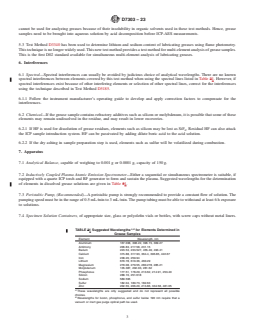
TABLE 1 Suggested Wavelengths for Elements Determined in
additized oil and soap or other thickening agent. There are over
Grease Samples
a dozen metallic elements present in greases, either blended as
Element Wavelength, nm
additives for performance enhancements or as thickeners, or in
Aluminum 167.038, 308.22, 396.15, 309.27
used greases present as contaminants and wear metals. Deter-
Antimony 206.83, 217.58, 231.15
Barium 223.53, 233.527, 455.40, 493.41
mining their concentrations can be an important aspect of
Calcium 315.88, 317.93, 364.4, 396.85, 422.67
grease manufacture. The metal content can also indicate the
Iron 238.20, 259.94
amount of thickeners in the grease. Additionally, a reliable
Lithium 670.78, 610.36, 460.29
Magnesium 279.08, 279.55, 280.278, 285.21
analysis technique can also assist in the process of trouble
Molybdenum 135.387, 202.03, 281.62
shooting problems with new and used grease in the field.
Phosphorus 177.51, 178.29, 213.62, 214.91, 253.40
Silicon 288.16, 251.618
5.2 Although widely used in other sectors of the oil industry
Sodium 589.595
for metal analysis, ICP-AES based Test Methods D4951 or
Sulfur 182.04, 180.73, 182.63
Zinc 202.55, 206.20, 213.86, 334.58, 481.05
D5185 cannot be used for analyzing greases because of their
A
insolubility in organic solvents used in these test methods. These wavelengths are only suggested and do not represent all possible
choices.
Hence, grease samples need to be brought into aqueous
B
Wavelengths for boron, phosphorus, and sulfur below 190 nm require that a
solution by acid decomposition before ICP-AES measure-
vacuum or inert gas purge optical path be used.
ments.
D7303 − 23
7.3 Peristaltic Pump, (Recommended)—A peristaltic pump also commercially available. (Warning—Take all necessary
is strongly recommended to provide a constant flow of solu- precautions to prevent exposure to radiofrequency radiation.)
tion. The pumping speed must be in the range of 0.5 mL ⁄min
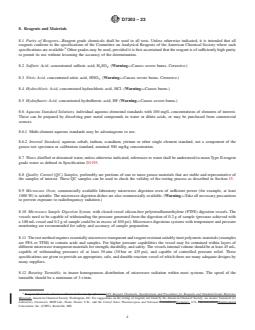
8.10 Microwave Sample Digestion System, with closed-
to 3 mL ⁄min. The pump tubing must be able to withstand at
vessel silicon-free polytetrafluoroethylene (PTFE) digestion
least 6 h exposure to solutions.
vessels. The vessels need to be capable of withstanding the
7.4 Specimen Solution Containers, of appropriate size, glass pressure generated from the digestion of 0.2 g of sample
or polyolefin vials or bottles, with screw caps without metal
(pressure achieved with a 100 mL vessel and 0.2 g of sample
liners. could be in excess of 100 psi). Microwave digestions systems
with temperature and pressure monitoring are recommended
8. Reagents and Materials for safety and accuracy of sample preparation.
8.1 Purity of Reagents—Reagent grade chemicals shall be 8.11 The test method requires essentially microwave trans-
used in all tests. Unless otherwise indicated, it is intended that
parent and reagent resistant suitably inert polymeric materials
all reagents conform to the specifications of the Committee on
(examples are PFA or TFM) to contain acids and samples. For
Analytical Reagents of the American Chemical Society where
higher pressure capabilities the vessel may be contained within
such specifications are available. Other grades may be used,
layers of different microwave transparent materials for
provided it is first ascertained that the reagent is of sufficiently
strength, durability, and safety. The vessels internal volume
high purity to permit its use without lessening the accuracy of
should be at least 45 mL, capable of withstanding pressures of
the determination.
at least 30 atm (30 bar or 435 psi), and capable of controlled
pressure relief. These specifications are given to provide an
8.2 Sulfuric Acid, concentrated sulfuric acid, H SO .
2 4
appropriate, safe, and durable reaction vessel of which there
(Warning—Causes severe burns. Corrosive.)
are many adequate designs by many suppliers.
8.3 Nitric Acid, concentrated nitric acid, HNO .
8.12 Rotating Turntable, to insure homogeneous distribu-
(Warning—Causes severe burns. Corrosive.)
tion of microwave radiation within most systems. The speed of
8.4 Hydrochloric Acid, concentrated hydrochloric acid,
the turntable should be a minimum of 3 r ⁄min.
HCl. (Warning—Causes burns.)
8.13 Combustion Dishes, Vycor or platinum evaporation
8.5 Hydrofluoric Acid, concentrated hydrofluoric acid, HF
dishes of 250 mL size.
(Warning—Causes severe burns.)
8.14 Volumetric Flasks, polypropylene or similar material
8.6 Aqueous Standard Solutions, individual aqueous el-
of 25 mL and 50 mL sizes.
emental standards with 100 mg/L concentrations of elements of
8.15 Electric Muffle Furnace, capable of maintaining
interest. These can be prepared by dissolving pure metal
525 °C 6 25 °C and sufficiently large to accommodate several
compounds in water or dilute acids, or may be purchased from
250 mL beakers. The capacity of an oxygen bleed is advanta-
commercial sources.
8.6.1 Multi-element aqueous standards may be advanta- geous and optional. (Warning—Take all necessary precautions
to prevent exposure to very hot surfaces.)
geous to use.
8.6.2 Internal Standard, aqueous cobalt, indium, scandium,
8.16 Heating Lamp, commercial infrared heating lamp.
yttrium or other single element standard, not a component of
the grease test specimen or calibration standard, nominal 500
9. Sampling
mg/kg concentration.
9.1 The objective of sampling is to obtain a test specimen
8.7 Water, distilled or deionized water, unless otherwise
that is representative of the entire quantity. Thus, take labora-
indicated, references to water shall be understood to mean Type
tory samples in accordance with the instructions in Practice
II reagent grade water as defined in Specification D1193.
D4057. The specific sampling technique can affect the accu-
8.8 Quality Control (QC) Samples, preferably are portions racy of this test method.
of one or more grease materials that are stable and represen-
tative of the samples of interest. These QC samples can be used
10. Preparation of Samples
to check the validity of the testing process as described in
10.1 Sulfated Ash Digestion:
Section 15.
10.1.1 Accurately weigh approximately 1 g to 2 g 6 0.1 g
8.9 Microwave Oven, commercially available laboratory
of the grease sample in a Vycor or platinum container of
microwave digestion oven of sufficient power (for example, at
suitable size. Char the sample on a hot plate until it is reduced
least 1000 W) is suitable. The microwave digestion dishes are
to ~0.5 g. A heat lamp may be used to assist in this process.
10.1.2 After the charred residue is cooled, add 1 mL to 2 mL
of concentrated sulfuric acid and carefully heat on the hot plate
taking care to avoid spattering of the contents, and continue
ACS Reagent Chemicals, Specifications and Procedures for Reagents and
Standard-Grade Reference Materials, American Chemical Society, Washington,
heating until the fumes are no longer evolved.
DC. For suggestions on the testing of reagents not listed by the American Chemical
10.1.3 Place the charred sample in a muffle furnace at
Society, see Analar Standards for Laboratory Chemicals, BDH Ltd., Poole, Dorset,
525 °C 6 25 °C until the oxidation of the carbon is practically
U.K., and the United States Pharmacopeia and National Formulary, U.S. Pharma-
copeial Convention, Inc. (USPC), Rockville, MD. complete. This typically takes about 2 h.
D7303 − 23
10.1.4 If the ashing is not complete as indicated by presence according to the manufacturer’s recommended specifications
of black color of the residue, repeat step 10.1.2 to complete the and connect appropriate temperature and pressure sensors to
sulfation. vessels according to the manufacturer’s specifications.
10.1.5 Add about 5 mL of concentrated nitric, hydrochloric
10.2.6 Pressure control for a specific matrix is applicable if
or other appropriate mineral acid to the residue, and heat gently instrument conditions are established using temperature con-
to dissolve the remaining solids.
trol. Because each matrix will have a different reaction profile,
10.1.6 Dilute the solution to volume with deionized water in performance using temperature control must be developed for
a 25 mL or a 50 mL volumetric flask. every specific matrix type prior to use of the pressure control
system. At the end of the microwave program, allow the
NOTE 1—The dilutions may be carried out on a weight or volume basis.
vessels to cool for a minimum of 5 min before removing them
10.2 Closed Vessel Microwave Oven Digestion:
from the microwave system.
10.2.1 Accurately weigh about 0.1 g to 1 g of the grease
10.2.7 Program the microwave oven to heat at 125 W for
sample in a polytetrafluoroethylene (PTFE) digestion vessel
15 min, then ramp up to 190 W for another 15 min.
with pressure relief mechanism. Add about 4 mL of concen-
NOTE 4—Different microwave oven models may require different
trated nitric, hydrochloric, or other appropriate mineral acid.
temperature ramping and holding profiles.
NOTE 2—From a safety view point when digesting samples containing NOTE 5—Care must be taken to keep internal temperature and pressure
volatile or easily oxidized organic compounds, initially weigh no more
within the capability of the vessels used. Excessive heat and pressure will
than 0.10 g and observe the reaction before capping the vessel. If a
cause the digestion pressure vessels to deform and potentially leak.
vigorous reaction occurs, allow the reaction to cease before capping the
10.2.8 Detailed safety recommendations specific to the
vessel. If no appreciable reaction occurs, a sample weight up to 1 g can be
model and manufacturer of the microwave digestion system is
used.
NOTE 3—Some microwave oven models may be capable of simultane-
beyond the scope of this test method. The user of this test
ously processing multiple sample digestion vessels.
method is advised to consult the equipment manual, the
manufacturer and other literature sources for proper safe
10.2.2 Temperature control of closed vessel microwave
operation of the digestion system. The user should be advised
instruments provides the main feedback control performance
that digestion of samples within the scope of this test method
mechanism for the test method. Control requires a temperature
could rapidly generate high pressure beyond the mechan
...
This document is not an ASTM standard and is intended only to provide the user of an ASTM standard an indication of what changes have been made to the previous version. Because
it may not be technically possible to adequately depict all changes accurately, ASTM recommends that users consult prior editions as appropriate. In all cases only the current version
of the standard as published by ASTM is to be considered the official document.
Designation: D7303 − 17 D7303 − 23
Standard Test Method for
Determination of Metals in Lubricating Greases by
Inductively Coupled Plasma Atomic Emission Spectrometry
This standard is issued under the fixed designation D7303; the number immediately following the designation indicates the year of
original adoption or, in the case of revision, the year of last revision. A number in parentheses indicates the year of last reapproval. A
superscript epsilon (´) indicates an editorial change since the last revision or reapproval.
1. Scope*
1.1 This test method covers the determination of a number of metals such as aluminum, antimony, barium, calcium, iron, lithium,
magnesium, molybdenum, phosphorus, silicon, sodium, sulfur, and zinc in unused lubricating greases by inductively coupled
plasma atomic emission spectrometry (ICP-AES) technique.
1.1.1 The range of applicability for this test method, based on the interlaboratory study conducted in 2005, is aluminum (10 to
600), antimony (10 to 2300), barium (50 to 800), calcium (20 to 50 000), iron (10 to 360), lithium (300 to 3200), magnesium (30
to 10 000), molybdenum (50 to 22 000), phosphorus (50 to 2000), silicon (10 to 15 000), sodium (30 to 1500), sulfur (1600 to
28 000), and zinc (300 to 2200), all in mg/kg. Lower levels of elements may be determined by using larger sample weights, and
higher levels of elements may be determined by using smaller amounts of sample or by using a larger dilution factor after sample
dissolution. However, the test precision in such cases has not been determined, and may be different than the ones given in Table
1.Table 3.
1.1.2 It may also be possible to determine additional metals such as bismuth, boron, cadmium, chromium, copper, lead,
manganese, potassium, titanium, etc. by this technique. However, not enough data is available to specify the precision for these
latter determinations. These metals may originate into greases through contamination or as additive elements.
1.1.3 During sample preparation, the grease samples are decomposed with a variety of acid mixture(s). It is beyond the scope of
this test method to specify appropriate acid mixtures for all possible combination of metals present in the sample. But if the ash
dissolution results in any visible insoluble material, the test method may not be applicable for the type of grease being analyzed,
assuming the insoluble material contains some of the analytes of interest.
1.2 Elements present at concentrations above the upper limit of the calibration curves can be determined with additional
appropriate dilutions of dissolved samples and with no degradation of precision.
1.3 The development of the technique behind this test method is documented by Fox.
1.4 The values stated in SI units are to be regarded as the standard. The values given in parentheses are for information only.
This test method is under the jurisdiction of ASTM Committee D02 on Petroleum Products, Liquid Fuels, and Lubricants and is the direct responsibility of Subcommittee
D02.03 on Elemental Analysis.
Current edition approved June 1, 2017July 1, 2023. Published June 2017July 2023. Originally approved in 2006. Last previous edition approved in 20122017 as
D7303 – 12.D7303 – 17. DOI: 10.1520/D7303-17.10.1520/D7303-23.
Supporting data have been filed at ASTM International Headquarters and may be obtained by requesting Research Report RR:D02-1608. Contact ASTM Customer
Service at service@astm.org.
Fox, B. S., “Elemental S.,“Elemental Analysis of Lubricating Grease by Inductively Coupled Plasm Atomic Emission Spectrometry (ICP-AES),” J. ASTM International,
Vol 2, No. 8, 2005, pp. 12966.
*A Summary of Changes section appears at the end of this standard
Copyright © ASTM International, 100 Barr Harbor Drive, PO Box C700, West Conshohocken, PA 19428-2959. United States
D7303 − 23
1.5 This standard does not purport to address all of the safety concerns, if any, associated with its use. It is the responsibility
of the user of this standard to establish appropriate safety and healthsafety, health, and environmental practices and determine
the applicability of regulatory limitations prior to use. Specific warning statements are given in Sections 8 and 10.
1.6 This international standard was developed in accordance with internationally recognized principles on standardization
established in the Decision on Principles for the Development of International Standards, Guides and Recommendations issued
by the World Trade Organization Technical Barriers to Trade (TBT) Committee.
2. Referenced Documents
2.1 ASTM Standards:
D1193 Specification for Reagent Water
D3340 Test Method for Lithium and Sodium in Lubricating Greases by Flame Photometer (Withdrawn 2013)
D4057 Practice for Manual Sampling of Petroleum and Petroleum Products
D4175 Terminology Relating to Petroleum Products, Liquid Fuels, and Lubricants
D4951 Test Method for Determination of Additive Elements in Lubricating Oils by Inductively Coupled Plasma Atomic
Emission Spectrometry
D5185 Test Method for Multielement Determination of Used and Unused Lubricating Oils and Base Oils by Inductively
Coupled Plasma Atomic Emission Spectrometry (ICP-AES)
D6299 Practice for Applying Statistical Quality Assurance and Control Charting Techniques to Evaluate Analytical Measure-
ment System Performance
D6792 Practice for Quality Management Systems in Petroleum Products, Liquid Fuels, and Lubricants Testing Laboratories
D7260 Practice for Optimization, Calibration, and Validation of Inductively Coupled Plasma-Atomic Emission Spectrometry
(ICP-AES) for Elemental Analysis of Petroleum Products and Lubricants
3. Terminology
3.1 Definitions—Refer to terminology identified in Test Method D5185 for spectroscopy terms used in this standard.
3.1 Definitions:
3.1.1 For definitions of terms used in this test method, refer to Terminology D4175.
3.1.2 Refer to terminology identified in Test Method D5185 for spectroscopy terms used in this standard.
4. Summary of Test Method
4.1 A weighed portion of the grease sample is weighed and subjected to alternate means of sample dissolution which may include
sulfated ashing in a muffle furnace or by closed vessel microwave digestion in acid. Ultimately these diluted acid solutions are
analyzed using ICP-AES. Aqueous calibration standards are used. The solutions are introduced to the ICP instrument by free
aspiration or an optional peristaltic pump. By comparing emission intensities of elements in the test specimen with those measured
with the calibration standards, the concentrations of elements in the test specimen can be calculated.
4.2 Additional information on using inductively coupled plasma-atomic emission spectrometry can be found in Practice D7260.
5. Significance and Use
5.1 Lubricating greases are used in almost all bearings used in any machinery. Lubricating grease is composed of ~90 % additized
oil and soap or other thickening agent. There are over a dozen metallic elements present in greases, either blended as additives for
performance enhancements or as thickeners, or in used greases present as contaminants and wear metals. Determining their
concentrations can be an important aspect of grease manufacture. The metal content can also indicate the amount of thickeners in
the grease. Additionally, a reliable analysis technique can also assist in the process of trouble shooting problems with new and used
grease in the field.
5.2 Although widely used in other sectors of the oil industry for metal analysis, ICP-AES based Test Methods D4951 or D5185
For referenced ASTM standards, visit the ASTM website, www.astm.org, or contact ASTM Customer Service at service@astm.org. For Annual Book of ASTM Standards
volume information, refer to the standard’s Document Summary page on the ASTM website.
The last approved version of this historical standard is referenced on www.astm.org.
D7303 − 23
cannot be used for analyzing greases because of their insolubility in organic solvents used in these test methods. Hence, grease
samples need to be brought into aqueous solution by acid decomposition before ICP-AES measurements.
5.3 Test Method D3340 has been used to determine lithium and sodium content of lubricating greases using flame photometry.
This technique is no longer widely used. This new test method provides a test method for multi-element analysis of grease samples.
This is the first D02 standard available for simultaneous multi-element analysis of lubricating greases.
6. Interferences
6.1 Spectral—Spectral interferences can usually be avoided by judicious choice of analytical wavelengths. There are no known
spectral interferences between elements covered by this test method when using the spectral lines listed in Table 21. However, if
spectral interferences exist because of other interfering elements or selection of other spectral lines, correct for the interferences
using the technique described in Test Method D5185.
6.1.1 Follow the instrument manufacturer’s operating guide to develop and apply correction factors to compensate for the
interferences.
6.2 Chemical—If the grease sample contains refractory additives such as silicon or molybdenum, it is possible that some of these
elements may remain undissolved in the residue, and may result in lower recoveries.
6.2.1 If HF is used for dissolution of grease residues, elements such as silicon may be lost as SiF . Residual HF can also attack
the ICP sample introduction system. HF can be passivated by adding dilute boric acid to the acid solution.
6.2.2 If the dry ashing in sample preparation step is used, elements such as sulfur will be volatilized during combustion.
7. Apparatus
7.1 Analytical Balance, capable of weighing to 0.001 g or 0.0001 g, capacity of 150 g.
7.2 Inductively Coupled Plasma Atomic Emission Spectrometer—Either a sequential or simultaneous spectrometer is suitable, if
equipped with a quartz ICP torch and RF generator to form and sustain the plasma. Suggested wavelengths for the determination
of elements in dissolved grease solutions are given in Table 21.
7.3 Peristaltic Pump, (Recommended)—A peristaltic pump is strongly recommended to provide a constant flow of solution. The
pumping speed must be in the range of 0.5 mL ⁄min to 3 mL ⁄min. The pump tubing must be able to withstand at least 6 h exposure
to solutions.
7.4 Specimen Solution Containers, of appropriate size, glass or polyolefin vials or bottles, with screw caps without metal liners.
A,B
TABLE 21 Suggested Wavelengths for Elements Determined in
Grease Samples
Element Wavelength, nm
Aluminum 167.038, 308.22, 396.15, 309.27
Antimony 206.83, 217.58, 231.15
Barium 223.53, 233.527, 455.40, 493.41
Calcium 315.88, 317.93, 364.4, 396.85, 422.67
Iron 238.20, 259.94
Lithium 670.78, 610.36, 460.29
Magnesium 279.08, 279.55, 280.278, 285.21
Molybdenum 135.387, 202.03, 281.62
Phosphorus 177.51, 178.29, 213.62, 214.91, 253.40
Silicon 288.16, 251.618
Sodium 589.595
Sulfur 182.04, 180.73, 182.63
Zinc 202.55, 206.20, 213.86, 334.58, 481.05
A
These wavelengths are only suggested and do not represent all possible
choices.
B
Wavelengths for boron, phosphorus, and sulfur below 190 nm require that a
vacuum or inert gas purge optical path be used.
D7303 − 23
8. Reagents and Materials
8.1 Purity of Reagents—Reagent grade chemicals shall be used in all tests. Unless otherwise indicated, it is intended that all
reagents conform to the specifications of the Committee on Analytical Reagents of the American Chemical Society where such
specifications are available. Other grades may be used, provided it is first ascertained that the reagent is of sufficiently high purity
to permit its use without lessening the accuracy of the determination.
8.2 Sulfuric Acid, concentrated sulfuric acid, H SO . (Warning—Causes severe burns. Corrosive.)
2 4
8.3 Nitric Acid, concentrated nitric acid, HNO . (Warning—Causes severe burns. Corrosive.)
8.4 Hydrochloric Acid, concentrated hydrochloric acid, HCl. (Warning—Causes burns.)
8.5 Hydrofluoric Acid, concentrated hydrofluoric acid, HF (Warning—Causes severe burns.)
8.6 Aqueous Standard Solutions, individual aqueous elemental standards with 100 mg/L concentrations of elements of interest.
These can be prepared by dissolving pure metal compounds in water or dilute acids, or may be purchased from commercial
sources.
8.6.1 Multi-element aqueous standards may be advantageous to use.
8.6.2 Internal Standard, aqueous cobalt, indium, scandium, yttrium or other single element standard, not a component of the
grease test specimen or calibration standard, nominal 500 mg/kg concentration.
8.7 Water, distilled or deionized water, unless otherwise indicated, references to water shall be understood to mean Type II reagent
grade water as defined in Specification D1193.
8.8 Quality Control (QC) Samples, preferably are portions of one or more grease materials that are stable and representative of
the samples of interest. These QC samples can be used to check the validity of the testing process as described in Section 15.
8.9 Microwave Oven, commercially available laboratory microwave digestion oven of sufficient power (for example, at least
1000 W) is suitable. The microwave digestion dishes are also commercially available. (Warning—Take all necessary precautions
to prevent exposure to radiofrequency radiation.)
8.10 Microwave Sample Digestion System, with closed-vessel silicon-free polytetrafluoroethylene (PTFE) digestion vessels. The
vessels need to be capable of withstanding the pressure generated from the digestion of 0.2 g of sample (pressure achieved with
a 100 mL vessel and 0.2 g of sample could be in excess of 100 psi). Microwave digestions systems with temperature and pressure
monitoring are recommended for safety and accuracy of sample preparation.
8.11 The test method requires essentially microwave transparent and reagent resistant suitably inert polymeric materials (examples
are PFA or TFM) to contain acids and samples. For higher pressure capabilities the vessel may be contained within layers of
different microwave transparent materials for strength, durability, and safety. The vessels internal volume should be at least 45 mL,
capable of withstanding pressures of at least 30 atm (30 bar or 435 psi), and capable of controlled pressure relief. These
specifications are given to provide an appropriate, safe, and durable reaction vessel of which there are many adequate designs by
many suppliers.
8.12 Rotating Turntable, to insure homogeneous distribution of microwave radiation within most systems. The speed of the
turntable should be a minimum of 3 r ⁄min.
Reagent Chemicals, American Chemical Society Specifications,ACS Reagent Chemicals, Specifications and Procedures for Reagents and Standard-Grade Reference
Materials, American Chemical Society, Washington, DC. For suggestions on the testing of reagents not listed by the American Chemical Society, see Analar Standards for
Laboratory Chemicals, BDH Ltd., Poole, Dorset, U.K., and the United States Pharmacopeia and National Formulatory,Formulary, U.S. PharmaceuticalPharmacopeial
Convention, Inc. (USPC), Rockville, MD.
D7303 − 23
8.13 Combustion Dishes, Vycor or platinum evaporation dishes of 250 mL size.
8.14 Volumetric Flasks, polypropylene or similar material of 25 mL and 50 mL sizes.
8.15 Electric Muffle Furnace, capable of maintaining 525 °C 6 25 °C and sufficiently large to accommodate several 250 mL
beakers. The capacity of an oxygen bleed is advantageous and optional. (Warning—Take all necessary precautions to prevent
exposure to very hot surfaces.)
8.16 Heating Lamp, commercial infrared heating lamp.
9. Sampling
9.1 The objective of sampling is to obtain a test specimen that is representative of the entire quantity. Thus, take laboratory
samples in accordance with the instructions in Practice D4057. The specific sampling technique can affect the accuracy of this test
method.
10. Preparation of Samples
10.1 Sulfated Ash Digestion:
10.1.1 Accurately weigh approximately 1 g to 2 g 6 0.1 g of the grease sample in a Vycor or platinum container of suitable size.
Char the sample on a hot plate until it is reduced to ~0.5 g. A heat lamp may be used to assist in this process.
10.1.2 After the charred residue is cooled, add 1 mL to 2 mL of concentrated sulfuric acid and carefully heat on the hot plate taking
care to avoid spattering of the contents, and continue heating until the fumes are no longer evolved.
10.1.3 Place the charred sample in a muffle furnace at 525 °C 6 25 °C until the oxidation of the carbon is practically complete.
This typically takes about 2 h.
10.1.4 If the ashing is not complete as indicated by presence of black color of the residue, repeat step 10.1.2 to complete the
sulfation.
10.1.5 Add about 5 mL of concentrated nitric, hydrochloric or other appropriate mineral acid to the residue, and heat gently to
dissolve the remaining solids.
10.1.6 Dilute the solution to volume with deionized water in a 25 mL or a 50 mL volumetric flask.
NOTE 1—The dilutions may be carried out on a weight or volume basis.
10.2 Closed Vessel Microwave Oven Digestion:
10.2.1 Accurately weigh about 0.1 g to 1 g of the grease sample in a polytetrafluoroethylene (PTFE) digestion vessel with pressure
relief mechanism. Add about 4 mL of concentrated nitric, hydrochloric, or other appropriate mineral acid.
NOTE 2—From a safety view point when digesting samples containing volatile or easily oxidized organic compounds, initially weigh no more than 0.10 g
and observe the reaction before capping the vessel. If a vigorous reaction occurs, allow the reaction to cease before capping the vessel. If no appreciable
reaction occurs, a sample weight up to 1 g can be used.
NOTE 3—Some microwave oven models may be capable of simultaneously processing multiple sample digestion vessels.
10.2.2 Temperature control of closed vessel microwave instruments provides the main feedback control performance mechanism
for the test method. Control requires a temperature sensor in one or more vessels during the entire decomposition. The microwave
decomposition system should sense the temperature to within 62.5 °C and permit adjustment of the microwave output power
within 2 s.
10.2.3 All digestion vessels and volumetric ware must be carefully acid washed and rinsed with reagent water. When switching
D7303 − 23
between high concentration and low concentration samples, all digestion vessels (fluoropolymer liners only) should be cleaned by
leaching with hot (1:1) hydrochloric acid (greater than 80 °C, but less than boiling) for a minimum of 2 h followed with hot (1:1)
nitric acid (greater than 80 °C, but less than boiling) for a minimum of 2 h and rinsed with reagent water and dried in a clean
environment. This cleaning procedure should also be used whenever the prior use of the digestion vessels is unknown or cross
contamination from vessels is suspected. Polymeric or glass volumetric ware and storage containers should be cleaned by leaching
with more dilute acids (approximately 10 % V/V) appropriate for the specific plastics used and then rinsed with reagent water and
dried in a clean environment.
10.2.3.1 Alternate cleaning procedures may be utilized if they are shown to be satisfactory.
10.2.4 The analyst should be aware of the potential for a vigorous reaction. If a vigorous reaction occurs upon the initial addition
of reagent or the sample is suspected of containing easily oxidizable materials, allow the sample to predigest in the uncapped
digestion vessel. Heat may be added in this step for safety considerations (for example, the rapid release of carbon dioxide from
carbonates, easily oxidized organic matter, etc.). Once the initial reaction has ceased, the sample may continue through the
d
...