


ASTM F2730/F2730M-18a
(Specification)Standard Specification for Silicon Nitride Cylindrical Bearing Rollers
Standard Specification for Silicon Nitride Cylindrical Bearing Rollers
SCOPE
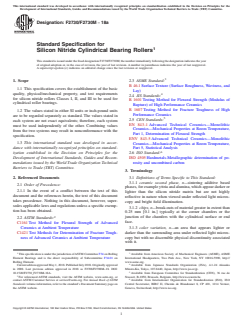
1.1 This specification covers the establishment of the basic quality, physical/mechanical property, and test requirements for silicon nitride rollers Classes I, II, and III to be used for cylindrical roller bearings.
1.2 The values stated in either SI units or inch-pound units are to be regarded separately as standard. The values stated in each system are not exact equivalents; therefore, each system must be used independently of the other. Combining values from the two systems may result in nonconformance with the specification.
1.3 This international standard was developed in accordance with internationally recognized principles on standardization established in the Decision on Principles for the Development of International Standards, Guides and Recommendations issued by the World Trade Organization Technical Barriers to Trade (TBT) Committee.
General Information
- Status
- Published
- Publication Date
- 30-Apr-2018
- Technical Committee
- F34 - Rolling Element Bearings
- Drafting Committee
- F34.01 - Rolling Element
Relations
- Replaces
ASTM F2730/F2730M-18 - Standard Specification for Silicon Nitride Cylindrical Bearing Rollers - Effective Date
- 01-May-2018
- Effective Date
- 01-Jan-2018
- Effective Date
- 01-Jan-2016
- Effective Date
- 01-Jul-2015
- Effective Date
- 01-Aug-2013
- Effective Date
- 01-Dec-2010
- Effective Date
- 01-May-2009
- Effective Date
- 01-Jan-2008
- Effective Date
- 01-Jan-2008
- Effective Date
- 01-Feb-2007
- Effective Date
- 10-Oct-2002
- Effective Date
- 10-Jun-2002
- Effective Date
- 10-Mar-2002
- Effective Date
- 10-Oct-2001
- Effective Date
- 10-Oct-2001
Overview
ASTM F2730/F2730M-18a is a standard specification developed by ASTM International for silicon nitride cylindrical bearing rollers, addressing Classes I, II, and III materials. This standard establishes the key requirements for quality, physical and mechanical properties, dimensions, as well as inspection and test procedures for silicon nitride rollers used in cylindrical roller bearings. The specification aligns with internationally recognized principles and is essential for manufacturers, suppliers, and end users who demand reliable, high-performance ceramic bearing components.
Key Topics
Material Classes: Defines three classes of silicon nitride material:
- Class I: Highest grade, suitable for demanding and high-performance applications.
- Class II: General purpose, applicable to most bearing applications balancing durability and noise considerations.
- Class III: Lower grade, suited to low duty applications that benefit from the chemical and physical properties of silicon nitride.
Quality and Property Requirements:
- Minimum values for density, flexural strength, hardness, and fracture toughness.
- Limits on microstructural features such as porosity and inclusions.
- Tolerances for density variation and dimensional stability.
Testing Methods:
- Flexural strength, hardness, toughness, and density measured using standardized techniques (e.g., ASTM C1161, C1421, EN 843-1/5, JIS standards).
- Visual, black light, fluorescent penetrant, and ultrasonic inspection methods for defects.
Dimensional and Surface Specifications:
- Tolerances for diameter, length, runout, taper, straightness, roundness, and waviness of rollers.
- Strict surface roughness limits for roller diameter, end faces, and chamfers.
- Recommendations for avoiding contamination and ensuring uniform machining.
Applications
ASTM F2730/F2730M-18a is widely referenced in the quality assurance, purchase, and production of silicon nitride cylindrical bearing rollers. Practical applications include:
- Aerospace and Aviation: Where lightweight, high-strength, and high-precision ceramic bearings are essential for turbines, gearboxes, and control systems.
- Automotive Engineering: Enhancing performance and longevity in high-speed and electric motor bearings.
- Industrial Machinery: Providing reliability and reduced maintenance in harsh or high-load environments such as pumps, compressors, and robotic arms.
- High-Speed Spindles and Wind Energy: Benefiting from the extended service life, low friction, and thermal stability offered by silicon nitride rollers.
- Precision Equipment: Including semiconductor manufacturing systems and medical devices, where contamination and surface finish are critical.
Related Standards
Implementation of ASTM F2730/F2730M-18a may reference or be complemented by additional national and international standards, such as:
ASTM Standards:
- ASTM C1161: Flexural Strength of Advanced Ceramics
- ASTM C1421: Fracture Toughness of Advanced Ceramics
- ASTM E384: Microindentation Hardness Testing
- ASTM E1417: Liquid Penetrant Testing
ASME Standard:
- ASME B46.1: Surface Texture (Surface Roughness, Waviness, and Lay)
ISO & CEN Standards:
- ISO 1132-1: Rolling Bearings Terms and Definitions
- ISO 4505: Hardmetals-Metallographic Determination of Porosity
- EN 843 Series: Mechanical Properties of Monolithic Ceramics
- EN 821 Series: Thermo-physical Properties of Ceramics
JIS Standards:
- JIS R 1601, R 1607: Testing Methods for Flexural Strength and Fracture Toughness
By adhering to ASTM F2730/F2730M-18a, manufacturers and users ensure that silicon nitride cylindrical bearing rollers meet consistent global benchmarks for performance, reliability, and safety in advanced engineering applications. Use of this standard supports competitive procurement, quality assurance, and facilitates international trade of high-precision ceramic bearing components.
Buy Documents
ASTM F2730/F2730M-18a - Standard Specification for Silicon Nitride Cylindrical Bearing Rollers
REDLINE ASTM F2730/F2730M-18a - Standard Specification for Silicon Nitride Cylindrical Bearing Rollers
Frequently Asked Questions
ASTM F2730/F2730M-18a is a technical specification published by ASTM International. Its full title is "Standard Specification for Silicon Nitride Cylindrical Bearing Rollers". This standard covers: SCOPE 1.1 This specification covers the establishment of the basic quality, physical/mechanical property, and test requirements for silicon nitride rollers Classes I, II, and III to be used for cylindrical roller bearings. 1.2 The values stated in either SI units or inch-pound units are to be regarded separately as standard. The values stated in each system are not exact equivalents; therefore, each system must be used independently of the other. Combining values from the two systems may result in nonconformance with the specification. 1.3 This international standard was developed in accordance with internationally recognized principles on standardization established in the Decision on Principles for the Development of International Standards, Guides and Recommendations issued by the World Trade Organization Technical Barriers to Trade (TBT) Committee.
SCOPE 1.1 This specification covers the establishment of the basic quality, physical/mechanical property, and test requirements for silicon nitride rollers Classes I, II, and III to be used for cylindrical roller bearings. 1.2 The values stated in either SI units or inch-pound units are to be regarded separately as standard. The values stated in each system are not exact equivalents; therefore, each system must be used independently of the other. Combining values from the two systems may result in nonconformance with the specification. 1.3 This international standard was developed in accordance with internationally recognized principles on standardization established in the Decision on Principles for the Development of International Standards, Guides and Recommendations issued by the World Trade Organization Technical Barriers to Trade (TBT) Committee.
ASTM F2730/F2730M-18a is classified under the following ICS (International Classification for Standards) categories: 21.100.20 - Rolling bearings. The ICS classification helps identify the subject area and facilitates finding related standards.
ASTM F2730/F2730M-18a has the following relationships with other standards: It is inter standard links to ASTM F2730/F2730M-18, ASTM C1421-18, ASTM C1421-16, ASTM C1421-15, ASTM C1161-13, ASTM C1421-10, ASTM C1421-09, ASTM C1161-02c(2008), ASTM C1161-02c(2008)e1, ASTM C1421-01b(2007), ASTM C1161-02ce1, ASTM C1161-02c, ASTM C1161-02, ASTM C1421-01a, ASTM C1421-01b. Understanding these relationships helps ensure you are using the most current and applicable version of the standard.
ASTM F2730/F2730M-18a is available in PDF format for immediate download after purchase. The document can be added to your cart and obtained through the secure checkout process. Digital delivery ensures instant access to the complete standard document.
Standards Content (Sample)
This international standard was developed in accordance with internationally recognized principles on standardization established in the Decision on Principles for the
Development of International Standards, Guides and Recommendations issued by the World Trade Organization Technical Barriers to Trade (TBT) Committee.
Designation:F2730/F2730M −18a
Standard Specification for
Silicon Nitride Cylindrical Bearing Rollers
ThisstandardisissuedunderthefixeddesignationF2730/F2730M;thenumberimmediatelyfollowingthedesignationindicatestheyear
of original adoption or, in the case of revision, the year of last revision.Anumber in parentheses indicates the year of last reapproval.
A superscript epsilon (´) indicates an editorial change since the last revision or reapproval.
1. Scope 2.3 ASME Standard:
B 46.1Surface Texture (Surface Roughness, Waviness, and
1.1 This specification covers the establishment of the basic
Lay)
quality, physical/mechanical property, and test requirements
2.4 JIS Standards:
for silicon nitride rollers Classes I, II, and III to be used for
R 1601Testing Method for Flexural Strength (Modulus of
cylindrical roller bearings.
Rupture) of High Performance Ceramics
R 1607Testing Method for Fracture Toughness of High
1.2 The values stated in either SI units or inch-pound units
Performance Ceramics
are to be regarded separately as standard. The values stated in
2.5 CEN Standards:
each system are not exact equivalents; therefore, each system
EN 843-1 Advanced Technical Ceramics—Monolithic
must be used independently of the other. Combining values
Ceramics—Mechanical Properties at Room Temperature,
from the two systems may result in nonconformance with the
Part 1, Determination of Flexural Strength
specification.
ENV 843-5 Advanced Technical Ceramics—Monolithic
1.3 This international standard was developed in accor-
Ceramics—Mechanical Properties at Room Temperature,
dance with internationally recognized principles on standard-
Part 5, Statistical Analysis
ization established in the Decision on Principles for the
2.6 ISO Standard:
Development of International Standards, Guides and Recom- ISO 4505Hardmetals-Metallographic determination of po-
mendations issued by the World Trade Organization Technical rosity and uncombined carbon
Barriers to Trade (TBT) Committee.
3. Terminology
2. Referenced Documents 3.1 Definitions of Terms Specific to This Standard:
3.1.1 ceramic second phase, n—sintering additive based
2.1 Order of Precedence:
phases,forexampleyttriaandalumina,whichappeardarkeror
2.1.1 In the event of a conflict between the text of this
lighter than the silicon nitride matrix but are not highly
document and the references herein, the text of this document
reflective in nature when viewed under reflected light micros-
takes precedence. Nothing in this document, however, super-
copy and bright field illumination.
sedes applicable laws and regulations unless a specific exemp-
3.1.2 chips, n—break-outs of material greater in extent than
tion has been obtained.
0.25 mm [0.1 in.] typically at the corner chamfers or the
junction of the chamfers with the cylindrical surface or end
2.2 ASTM Standards:
face.
C1161Test Method for Flexural Strength of Advanced
3.1.3 color variation, n—an area that appears lighter or
Ceramics at Ambient Temperature
darker than the surrounding area under reflected light micros-
C1421Test Methods for Determination of Fracture Tough-
copy but with no discernible physical discontinuity associated
ness of Advanced Ceramics at Ambient Temperature
with it.
1 3
ThisspecificationisunderthejurisdictionofASTMCommitteeF34onRolling Available from American Society of Mechanical Engineers (ASME), ASME
Element Bearings and is the direct responsibility of Subcommittee F34.01 on International Headquarters, Two Park Ave., New York, NY 10016-5990, http://
Rolling Element. www.asme.org.
CurrenteditionapprovedMay1,2018.PublishedJuly2018.Originallyapproved Available from Japanese Standards Organization (JSA), 4-1-24 Akasaka
in 2008. Last previous edition approved in 2018 as F2708/F2708M–18. DOI: Minato-Ku, Tokyo, 107-8440, Japan, http://www.jsa.or.jp.
10.1520/F2730_F2730M-18A. Available from European Committee for Standardization (CEN), 36 rue de
For referenced ASTM standards, visit the ASTM website, www.astm.org, or Stassart, B-1050, Brussels, Belgium, http://www.cenorm.be.
contact ASTM Customer Service at service@astm.org. For Annual Book of ASTM Available from International Organization for Standardization (ISO), ISO
Standards volume information, refer to the standard’s Document Summary page on Central Secretariat, BIBC II, Chemin de Blandonnet 8, CP 401, 1214 Vernier,
the ASTM website. Geneva, Switzerland, http://www.iso.org.
Copyright © ASTM International, 100 Barr Harbor Drive, PO Box C700, West Conshohocken, PA 19428-2959. United States
F2730/F2730M−18a
3.1.3.1 Discussion—Color variation is often not visible 3.1.13 metallic smears, n—metallic material from machin-
under scanning electron microscopy (SEM) examination. ingormeasuringequipmenttransferredontotherollersurface.
3.1.4 cracks, n—irregular, narrow breaks in the surface of 3.1.14 pits, n—voids or cavities in the roller surface.
the roller typically having a visible width of less than 0.002
3.1.14.1 Discussion—Pits can be formed by severe material
mm. [0.00008 in.] pullout during roller finishing. Pits can also be a result of the
3.1.4.1 Discussion—Mostcracksareformedafterdensifica-
breakout of inclusions during machining.
tion but occasionally may be present as material faults. Some
3.1.15 porosity,n—small,closelyspacedvoidspermeatinga
cracks may not be visible with normal white light microscopy
region of the roller surface or the whole roller.
and may only show up under ultraviolet light after processing
3.1.16 pressing defects, n—the result of cracks in roller
with a suitable fluorescent penetrant.
preforms prior to densification.
3.1.5 cuts, n—shortlinearorcircumferentialgrooveshaving
3.1.16.1 Discussion—Some pressing defects heal more or
a width of more than 0.005 mm [0.002 in.] and a length of
less completely on densification resulting in a region of
more than 0.20 mm [0.008 in.]. Cuts are normally assessed
material with slightly different composition and optical char-
under roller surface appearance but large or numerous cuts, or
acteristicsthantherestoftheroller.Theseareknownashealed
both can be considered defects.
orpartiallyhealedpressingdefects.Unhealedoropenpressing
3.1.6 flats, n—flat bands running along the length of the
defects can have the appearance of cracks or fissures.
cylindrical part of the roller, usually caused by a stop in
3.1.17 raw material lot, n—single process lot of raw silicon
rotation of the roller during machining.
nitride or raw silicon metal powder received from a material
3.1.6.1 Discussion—Flats can also be formed at one end
supplier.
only by incorrect approach into a machining operation.
3.1.18 scratches, n—narrow, linear, shallow abrasions on
3.1.7 grooves, n—shallow machining marks having a width
the surface.
of more than 0.005 mm [0.002 in.] extending more than one
3.1.19 snowflakes, n—regions of microporosity in the grain
quarter of the circumference on the cylindrical surface or
boundary phase that often display a dendritic appearance.
having a length of more than one quarter of the roller diameter
3.1.19.1 Discussion—Snowflakes show up as white den-
on the end faces.
dritic features when viewed with oblique illumination or with
3.1.8 inclusion, n—any discrete imhomogeneity in the mi-
ultraviolet light after processing with a fluorescent penetrant.
crostructure that is not intended to be included in the material.
The individual micropores are often submicron in size and the
3.1.8.1 Discussion—Inclusions typically consist of foreign
snowflakes can range in size from less than 10 µm [.00039 in.]
material as a result of unintended external powder contamina-
to over 1,000 µm [.039 in] in extreme cases.
tion and resulting reaction product after sintering.
3.1.20 steps, n—regions at the edge of a roller end face that
3.1.9 materiallot,n—singleprocesslotofablendedpowder
have been machined to a lower depth than the rest of the end
(blended with additives), produced from a single lot of silicon
face.
nitride or silicon metal raw powder received from a material
3.1.21 surface roughness, Ra, n—surface irregularities with
supplier.
relative small spacings, which usually include irregularities
3.1.9.1 Discussion—What constitutes a “single process lot”
resulting from the method of manufacture being used, other
of blended powder can vary depending on the standard
influences, or both.
practices of the vendor and the requirements of the customer
and application. For example, for many customers/
3.1.22 tears, n—circumferential machining marks associ-
applications, combining multiple mill charges from one raw
ated with lateral surface cracks.
material lot into a single material lot is acceptable while for
3.1.23 unfinished areas, n—regions on the roller surfaces
others, each mill charge would be considered a separate
that should be machined but have not been machined at all, or
material lot. It is difficult, if not impossible, for a single
have not been completely machined and finished, because of
definition of material lot to apply to all applications. The
either faults in blank geometry or errors in the machining
materiallotshouldbedefinedsuchthatapplication-appropriate
process.
traceability is maintained and adequate testing appropriate for
the intended application is performed to ensure that the
4. Classification
chemistry and material properties of densified parts meet
4.1 Silicon nitride materials for bearing applications are
specifications. The material lot requirements should be dis-
specified according to the following material classes:
cussed and agreed between the vendor and customer.
4.1.1 Class I—Highest grade of material in terms of prop-
3.1.10 mean roller diameter, n—one half the sum of the
erties and microstructure and suitable for use in the most
largest and smallest of individual diameters measured in a
demanding applications. This group adds high reliability and
single radial plane.
durability for extreme performance requirements.
3.1.11 mean roller length, n—onehalfthesumofthelargest
4.1.2 Class II—General class of material for most bearing
and smallest lengths measured on a roller.
applications. This group addresses the concerns of roller
3.1.12 metallic phase, n—material phase that is highly defects as is relative to fatigue life, levels of torque, and noise.
reflective when viewed by reflected light microscopy and 4.1.3 Class III—Lower grade of material for low duty
bright field illumination. applications only. This group of applications primarily takes
F2730/F2730M−18a
advantage of silicon nitride material properties (for example, 6.7 A residual content of up to 2% tungsten carbide from
light weight, chemical inertness, lubricant life extension be- powder processing is allowable.
cause of dissimilarity with race materials, and so forth.).
6.8 Final composition shall meet and be reported according
4.1.4 A material grade approved as a Class I material may
to the specification of the individual supplier.
be supplied where Class II or III is specified and, similarly, a
6.9 Notification will be made upon process changes.
Class II material for a Class III.
6.10 Specific requirements such as specific material grade
5. Roller Dimensions
designation, physical/mechanical property requirements (for
5.1 Cylindricalrollersaregenerallyidentifiedusinganomi-
example, density) or quality or testing requirements shall be
nal diameter (D) and nominal length (L) where the first value
established by specific application. The special requirements
is that of nominal diameter (for example, 9×9 mm, 18×21
shall be in addition to the general requirements established in
mm).
this specification.
5.2 Rollersarenormallymanufacturedtomillimetredimen-
6.11 Typicalmechanicalpropertieswillfallwithintherange
sionswith Dequalto L.However,manyvariationsexistwhere
listed in Table 2. Individual requirements may have tighter
L is larger or smaller than D. There may be a practical
ranges.Thevendorshallcertifythatthesiliconnitridematerial
limitation to this as L becomes significantly larger than D
supplied has physical and mechanical properties within the
because of pressing limitations. In these cases, the roller blank
range given in Table 2. In the case of properties indicated by
supplier should be consulted.
(+), the provision of the data is not mandatory.
5.3 There should be sufficient stock allowance on the roller
7. Physical Properties
blank so that all surface skin effects are removed during
machining. 7.1 The following physical properties shall be measured, at
a minimum, on each material lot.
5.4 Silicon nitride rollers should be machined entirely over
7.1.1 Average values for room temperature rupture strength
the diameter and end face surfaces. Corner chamfers need not
(bend strength/modulus of rupture) for a minimum of 20
be machined providing the corners are uniform and have a
individual determinations shall exceed the minimum values
smooth transition from the diameter to the end face.
giveninTable3.Either3-pointor4-pointtestmethodsmaybe
6. Material
used for flexural strength, which should be measured in
accordancewithTestMethodC1161(sizeB),EN843-5,orJIS
6.1 Unless otherwise specified, physical and mechanical
R1601. Weibull modulus for each test series shall also exceed
property requirements will apply to all material classes.
theminimumpermittedvaluesgiveninTable3.Ifasampleset
6.2 TobeclassifiedasClassI,siliconnitriderollersshallbe
of specimens for a material lot does not meet the Weibull
produced from either silicon nitride powder having the com-
modulusrequirementinTable3,thenasecondsamplesetmay
positionallimitslistedinTable1orfromsiliconmetalpowder,
be tested to establish conformance.
which,afternitridation,complieswiththecompositionallimits
7.1.2 Thehardness(HV)shallbedeterminedbytheVickers
listed in Table 1.
method(seeAnnexA1)usingaloadofatleast5kg[11lbs]but
6.3 Composition is measured in weight percent. Testing
not exceeding 20 kg [44 lbs]. Fracture resistance shall be
shall be carried out by a facility qualified and approved by the
measuredbyeitheranindentationtechnique(seeAnnexA1)or
supplier. Specific equipment, tests, and/or methods are subject by a standard fracture toughness test method. Average values
to agreement between suppliers and their customers.
for hardness and fracture resistance shall exceed the minimum
of values for the specified material class given in Table 4.
6.4 Compounds may be added to promote densification and
7.1.3 Microstructure constituents visible at magnification in
enhance product performance and quality.
the range ×100 to ×200 shall not exceed the maximum values
6.5 Iron oxides may be added to promote densification with
given in Table 5 for the specified material class.
the total iron content for the final product not to exceed 1.0
7.1.4 Thenumberinclusionsobservedintransversesections
weight%.
s
...
This document is not an ASTM standard and is intended only to provide the user of an ASTM standard an indication of what changes have been made to the previous version. Because
it may not be technically possible to adequately depict all changes accurately, ASTM recommends that users consult prior editions as appropriate. In all cases only the current version
of the standard as published by ASTM is to be considered the official document.
Designation: F2730/F2730M − 18 F2730/F2730M − 18a
Standard Specification for
Silicon Nitride Cylindrical Bearing Rollers
This standard is issued under the fixed designation F2730/F2730M; the number immediately following the designation indicates the year
of original adoption or, in the case of revision, the year of last revision. A number in parentheses indicates the year of last reapproval.
A superscript epsilon (´) indicates an editorial change since the last revision or reapproval.
1. Scope
1.1 This specification covers the establishment of the basic quality, physical/mechanical property, and test requirements for
silicon nitride rollers Classes I, II, and III to be used for cylindrical roller bearings.
1.2 The values stated in either SI units or inch-pound units are to be regarded separately as standard. The values stated in each
system are not exact equivalents; therefore, each system must be used independently of the other. Combining values from the two
systems may result in nonconformance with the specification.
1.3 This international standard was developed in accordance with internationally recognized principles on standardization
established in the Decision on Principles for the Development of International Standards, Guides and Recommendations issued
by the World Trade Organization Technical Barriers to Trade (TBT) Committee.
2. Referenced Documents
2.1 Order of Precedence:
2.1.1 In the event of a conflict between the text of this document and the references herein, the text of this document takes
precedence. Nothing in this document, however, supersedes applicable laws and regulations unless a specific exemption has been
obtained.
2.2 ASTM Standards:
C1161 Test Method for Flexural Strength of Advanced Ceramics at Ambient Temperature
C1421 Test Methods for Determination of Fracture Toughness of Advanced Ceramics at Ambient Temperature
2.3 ASME Standard:
B 46.1 Surface Texture (Surface Roughness, Waviness, and Lay)
2.4 JIS Standards:
R 1601 Testing Method for Flexural Strength (Modulus of Rupture) of High Performance Ceramics
R 1607 Testing Method for Fracture Toughness of High Performance Ceramics
2.5 CEN Standards:
EN 843-1 Advanced Technical Ceramics—Monolithic Ceramics—Mechanical Properties at Room Temperature, Part 1,
Determination of Flexural Strength
ENV 843-5 Advanced Technical Ceramics—Monolithic Ceramics—Mechanical Properties at Room Temperature, Part 5,
Statistical Analysis
2.6 ISO Standard:
Hardmetals-Metallographic determination of porosity and uncombined carbonISO 4505 Hardmetals-Metallographic determi-
nation of porosity and uncombined carbon
This specification is under the jurisdiction of ASTM Committee F34 on Rolling Element Bearings and is the direct responsibility of Subcommittee F34.01 on Rolling
Element.
Current edition approved April 1, 2018May 1, 2018. Published July 2018. Originally approved in 2008. Last previous edition approved in 20142018 as
F2708/F2708M–14.–18. DOI: 10.1520/F2730_F2730M-18.10.1520/F2730_F2730M-18A.
For referenced ASTM standards, visit the ASTM website, www.astm.org, or contact ASTM Customer Service at service@astm.org. For Annual Book of ASTM Standards
volume information, refer to the standard’s Document Summary page on the ASTM website.
Available from American Society of Mechanical Engineers (ASME), ASME International Headquarters, Two Park Ave., New York, NY 10016-5990, http://
www.asme.org.
Available from Japanese Standards Organization (JSA), 4-1-24 Akasaka Minato-Ku, Tokyo, 107-8440, Japan, http://www.jsa.or.jp.
Available from European Committee for Standardization (CEN), 36 rue de Stassart, B-1050, Brussels, Belgium, http://www.cenorm.be.
Available from International Organization for Standardization (ISO), ISO Central Secretariat, BIBC II, Chemin de Blandonnet 8, CP 401, 1214 Vernier, Geneva,
Switzerland, http://www.iso.org.
Copyright © ASTM International, 100 Barr Harbor Drive, PO Box C700, West Conshohocken, PA 19428-2959. United States
F2730/F2730M − 18a
3. Terminology
3.1 Definitions of Terms Specific to This Standard:
3.1.1 ceramic second phase, n—sintering additive based phases, for example yttria and alumina, which appear darker or lighter
than the silicon nitride matrix but are not highly reflective in nature when viewed under reflected light microscopy and bright field
illumination.
3.1.2 chips, n—break-outs of material greater in extent than 0.25 mm [0.1 in.] typically at the corner chamfers or the junction
of the chamfers with the cylindrical surface or end face.
3.1.3 color variation, n—an area that appears lighter or darker than the surrounding area under reflected light microscopy but
with no discernible physical discontinuity associated with it.
3.1.3.1 Discussion—
Color variation is often not visible under scanning electron microscopy (SEM) examination.
3.1.4 cracks, n—irregular, narrow breaks in the surface of the roller typically having a visible width of less than 0.002 mm.
[0.00008 in.]
3.1.4.1 Discussion—
Most cracks are formed after densification but occasionally may be present as material faults. Some cracks may not be visible with
normal white light microscopy and may only show up under ultraviolet light after processing with a suitable fluorescent penetrant.
3.1.5 cuts, n—short linear or circumferential grooves having a width of more than 0.005 mm [0.002 in.] and a length of more
than 0.20 mm [0.008 in.]. Cuts are normally assessed under roller surface appearance but large or numerous cuts, or both can be
considered defects.
3.1.6 flats, n—flat bands running along the length of the cylindrical part of the roller, usually caused by a stop in rotation of the
roller during machining.
3.1.6.1 Discussion—
Flats can also be formed at one end only by incorrect approach into a machining operation.
3.1.7 grooves, n—shallow machining marks having a width of more than 0.005 mm [0.002 in.] extending more than one quarter
of the circumference on the cylindrical surface or having a length of more than one quarter of the roller diameter on the end faces.
3.1.8 inclusion, n—any discrete imhomogeneity in the microstructure that is not intended to be included in the material.
3.1.8.1 Discussion—
Inclusions typically consist of foreign material as a result of unintended external powder contamination and resulting reaction
product after sintering.
3.1.9 material lot, n—single process lot of a blended powder (blended with additives), produced from a single lot of silicon
nitride or silicon metal raw powder received from a material supplier.
3.1.9.1 Discussion—
What constitutes a “single process lot” of blended powder can vary depending on the standard practices of the vendor and the
requirements of the customer and application. For example, for many customers/applications, combining multiple mill charges
from one raw material lot into a single material lot is acceptable while for others, each mill charge would be considered a separate
material lot. It is difficult, if not impossible, for a single definition of material lot to apply to all applications. The material lot should
be defined such that application-appropriate traceability is maintained and adequate testing appropriate for the intended application
is performed to ensure that the chemistry and material properties of densified parts meet specifications. The material lot
requirements should be discussed and agreed between the vendor and customer.
3.1.10 mean roller diameter, n—one half the sum of the largest and smallest of individual diameters measured in a single radial
plane.
3.1.11 mean roller length, n—one half the sum of the largest and smallest lengths measured on a roller.
3.1.12 metallic phase, n—material phase that is highly reflective when viewed by reflected light microscopy and bright field
illumination.
F2730/F2730M − 18a
3.1.13 metallic smears, n—metallic material from machining or measuring equipment transferred onto the roller surface.
3.1.14 pits, n—voids or cavities in the roller surface.
3.1.14.1 Discussion—
Pits can be formed by severe material pullout during roller finishing. Pits can also be a result of the breakout of inclusions during
machining.
3.1.15 porosity, n—small, closely spaced voids permeating a region of the roller surface or the whole roller.
3.1.16 pressing defects, n—the result of cracks in roller preforms prior to densification.
3.1.16.1 Discussion—
Some pressing defects heal more or less completely on densification resulting in a region of material with slightly different
composition and optical characteristics than the rest of the roller. These are known as healed or partially healed pressing defects.
Unhealed or open pressing defects can have the appearance of cracks or fissures.
3.1.17 raw material lot, n—single process lot of raw silicon nitride or raw silicon metal powder received from a material
supplier.
3.1.18 scratches, n—narrow, linear, shallow abrasions on the surface.
3.1.19 snowflakes, n—regions of microporosity in the grain boundary phase that often display a dendritic appearance.
3.1.19.1 Discussion—
Snowflakes show up as white dendritic features when viewed with oblique illumination or with ultraviolet light after processing
with a fluorescent penetrant. The individual micropores are often submicron in size and the snowflakes can range in size from less
than 10 μm [.00039 in.] to over 1,000 μm [.039 in] in extreme cases.
3.1.20 steps, n—regions at the edge of a roller end face that have been machined to a lower depth than the rest of the end face.
3.1.21 surface roughness, Ra, n—surface irregularities with relative small spacings, which usually include irregularities
resulting from the method of manufacture being used, other influences, or both.
3.1.22 tears, n—circumferential machining marks associated with lateral surface cracks.
3.1.23 unfinished areas, n—regions on the roller surfaces that should be machined but have not been machined at all, or have
not been completely machined and finished, because of either faults in blank geometry or errors in the machining process.
4. Classification
4.1 Silicon nitride materials for bearing applications are specified according to the following material classes:
4.1.1 Class I—Highest grade of material in terms of properties and microstructure and suitable for use in the most demanding
applications. This group adds high reliability and durability for extreme performance requirements.
4.1.2 Class II—General class of material for most bearing applications. This group addresses the concerns of roller defects as
is relative to fatigue life, levels of torque, and noise.
4.1.3 Class III—Lower grade of material for low duty applications only. This group of applications primarily takes advantage
of silicon nitride material properties (for example, light weight, chemical inertness, lubricant life extension because of dissimilarity
with race materials, and so forth.).
4.1.4 A material grade approved as a Class I material may be supplied where Class II or III is specified and, similarly, a Class
II material for a Class III.
5. Roller Dimensions
5.1 Cylindrical rollers are generally identified using a nominal diameter (D) and nominal length (L) where the first value is that
of nominal diameter (for example, 9 × 9 mm, 18 × 21 mm).
5.2 Rollers are normally manufactured to millimetre dimensions with D equal to L. However, many variations exist where L
is larger or smaller than D. There may be a practical limitation to this as L becomes significantly larger than D because of pressing
limitations. In these cases, the roller blank supplier should be consulted.
5.3 There should be sufficient stock allowance on the roller blank so that all surface skin effects are removed during machining.
5.4 Silicon nitride rollers should be machined entirely over the diameter and end face surfaces. Corner chamfers need not be
machined providing the corners are uniform and have a smooth transition from the diameter to the end face.
F2730/F2730M − 18a
6. Material
6.1 Unless otherwise specified, physical and mechanical property requirements will apply to all material classes.
6.2 To be classified as Class I, silicon nitride rollers shall be produced from either silicon nitride powder having the
compositional limits listed in Table 1 or from silicon metal powder, which, after nitridation, complies with the compositional limits
listed in Table 1.
6.3 Composition is measured in weight percent. Testing shall be carried out by a facility qualified and approved by the supplier.
Specific equipment, tests, and/or methods are subject to agreement between suppliers and their customers.
6.4 Compounds may be added to promote densification and enhance product performance and quality.
6.5 Iron oxides may be added to promote densification with the total iron content for the final product not to exceed 1.0
weight %.
6.6 Precautions should be taken to minimize contamination by foreign materials during all stages of processing up to and
including densification.
6.7 A residual content of up to 2 % tungsten carbide from powder processing is allowable.
6.8 Final composition shall meet and be reported according to the specification of the individual supplier.
6.9 Notification will be made upon process changes.
6.10 Specific requirements such as specific material grade designation, physical/mechanical property requirements (for
example, density) or quality or testing requirements shall be established by specific application. The special requirements shall be
in addition to the general requirements established in this specification.
6.11 Typical mechanical properties will fall within the range listed in Table 2. Individual requirements may have tighter ranges.
The vendor shall certify that the silicon nitride material supplied has physical and mechanical properties within the range given
in Table 2. In the case of properties indicated by (+), the provision of the data is not mandatory.
7. Physical Properties
7.1 The following physical properties shall be measured, at a minimum, on each material lot.
7.1.1 Average values for room temperature rupture strength (bend strength/modulus of rupture) for a minimum of 20 individual
determinations shall exceed the minimum values given in Table 3. Either 3-point or 4-point test methods may be used for flexural
strength, which should be measured in accordance with Test Method C1161 (size B), EN 843-5, or JIS R 1601. Weibull modulus
for each test series shall also exceed the minimum permitted values given in Table 3. If a sample set of specimens for a material
lot does not meet the Weibull modulus requirement in Table 3, then a second sample set may be tested to establish conformance.
7.1.2 The hardness (HV) shall be determined by the Vickers method (see Annex A1) using a load of at least 5 kg [11 lbs] but
not exceeding 20 kg [44 lbs]. Fracture resistance shall be measured by either an indentation technique (see Annex A1) or by a
standard fracture toughness test method. Average values for hardness and fracture resistance shall exceed the minimum of values
for the specified material class given in Table 4.
7.1.3 Microstructure constituents visible at magnification in the range ×100 to ×200 shall not exceed the maximum values given
in Table 5 for the specified material class.
7.1.4 The number inclusions observed in transverse sections shall not exceed the limit
...
Questions, Comments and Discussion
Ask us and Technical Secretary will try to provide an answer. You can facilitate discussion about the standard in here.
Loading comments...