

ASTM C1421-18
(Test Method)Standard Test Methods for Determination of Fracture Toughness of Advanced Ceramics at Ambient Temperature
General Information
- Abstract
SIGNIFICANCE AND USE
5.1 Fracture toughness, KIc, is a measure of the resistance to crack extension in a brittle material. These test methods may be used for material development, material comparison, quality assessment, and characterization.
5.2 The pb and the vb fracture toughness values provide information on the fracture resistance of advanced ceramics containing large sharp cracks, while the sc fracture toughness value provides this information for small cracks comparable in size to natural fracture sources. Cracks of different sizes may be used for the sc method. If the fracture toughness values vary as a function of the crack size it can be expected that KIsc will differ from KIpb and KIvb. Table 1 tabulates advantages, disadvantages, and applicability of each method.
SCOPE
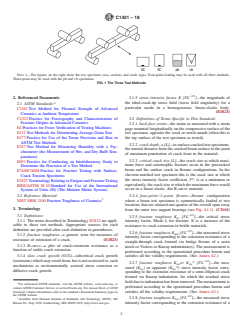
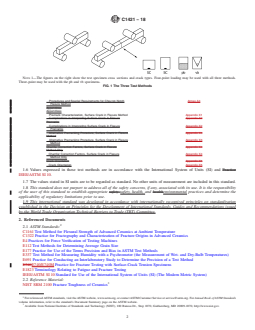
1.1 These test methods cover the fracture toughness, KIc, determination of advanced ceramics at ambient temperature. The methods determine KIpb (precracked beam test specimen), KIsc (surface crack in flexure), and KIvb (chevron-notched beam test specimen). The fracture toughness values are determined using beam test specimens with a sharp crack. The crack is either a straight-through crack formed via bridge flexure (pb), or a semi-elliptical surface crack formed via Knoop indentation (sc), or it is formed and propagated in a chevron notch (vb), as shown in Fig. 1.
1.6 Values expressed in these test methods are in accordance with the International System of Units (SI) and IEEE/ASTM SI 10.
1.7 The values stated in SI units are to be regarded as standard. No other units of measurement are included in this standard.
1.8 This standard does not purport to address all of the safety concerns, if any, associated with its use. It is the responsibility of the user of this standard to establish appropriate safety, health, and environmental practices and determine the applicability of regulatory limitations prior to use.
1.9 This international standard was developed in accordance with internationally recognized principles on standardization established in the Decision on Principles for the Development of International Standards, Guides and Recommendations issued by the World Trade Organization Technical Barriers to Trade (TBT) Committee.
- Status
- Published
- Publication Date
- 31-Dec-2017
- Technical Committee
- C28 - Advanced Ceramics
- Drafting Committee
- C28.01 - Mechanical Properties and Performance
Buy Documents
ASTM C1421-18 - Standard Test Methods for Determination of Fracture Toughness of Advanced Ceramics at Ambient Temperature
REDLINE ASTM C1421-18 - Standard Test Methods for Determination of Fracture Toughness of Advanced Ceramics at Ambient Temperature
Overview
ASTM C1421-18 is the definitive standard developed by ASTM International for determining the fracture toughness of advanced ceramics at ambient temperature. This document outlines three distinct test methods to measure the critical stress intensity factor (K_Ic), providing a comprehensive approach to characterizing the resistance of ceramics to crack extension. These standardized test methods are essential for material development, comparison, quality assessment, and general characterization within the advanced ceramics industry.
Key Topics
- Fracture Toughness (K_Ic): Central to this standard, K_Ic quantifies a material's ability to resist the propagation of cracks-a critical property for ceramics, which are inherently brittle.
- Test Methods: ASTM C1421-18 specifies three validated test methods:
- Precracked Beam (K_Ipb): Utilizes a straight-through precrack in a beam specimen, formed via bridge flexure, to measure fracture toughness for large, sharp cracks.
- Surface Crack in Flexure (K_Isc): Introduces a semi-elliptical surface crack through Knoop indentation, ideal for assessing resistance to small cracks similar in size to natural defects.
- Chevron-Notched Beam (K_Ivb): Forms and grows a crack from a chevron notch during loading, eliminating the need to measure crack length directly and best suited for large sharp cracks.
- Applicability to Materials: These methods are suitable for macroscopically homogenous and microstructurally dense advanced ceramics, including some whisker- or particle-reinforced compositions and single crystals.
- Environmental and Test Rate Effects: Fracture toughness is sensitive to ambient conditions and testing rates, highlighting the need for controlled testing environments to ensure meaningful, reproducible results.
- Reporting and Validation: The standard provides clear guidance for test procedures, specimen measurements, reporting of results, and determination of accuracy and bias using reference materials.
Applications
ASTM C1421-18 is widely adopted across industries that rely on advanced ceramics for high-performance and critical applications, particularly where mechanical reliability is paramount. Practical applications include:
- Material Development and R&D: Enables researchers to compare new ceramic formulations, optimize processing, and develop tougher, more reliable materials.
- Quality Control: Utilized in manufacturing to verify that ceramics meet specified fracture toughness criteria before deployment in demanding environments.
- Product Comparison: Facilitates standardized assessment for competitive benchmarking between different ceramic products or suppliers.
- Component Characterization: Applied in sectors such as aerospace, automotive, biomedical devices, and electronics, where component failure due to fracture could have severe consequences.
- Failure Analysis: Provides industry-accepted methodologies for investigating the fracture origins and mechanical performance of failed or at-risk components.
Related Standards
Understanding and implementing ASTM C1421-18 is often complemented by other ASTM and reference documents:
- ASTM C1161: Test Method for Flexural Strength of Advanced Ceramics at Ambient Temperature, closely related to specimen and fixture configurations.
- ASTM C1322: Practice for Fractography and Characterization of Fracture Origins in Advanced Ceramics, assisting in the analysis of fracture surfaces.
- ASTM E4: Practices for Force Verification of Testing Machines, ensures testing machines meet accuracy requirements.
- ASTM E112, E177, E337, E691, and E1823: Additional methods covering grain size determination, terminology, humidity measurement, and precision studies.
- IEEE/ASTM SI 10: Standard for the Use of SI Units, referenced for all values within ASTM C1421-18.
- NIST SRM 2100: Reference material for verifying laboratory bias in fracture toughness testing of ceramics.
By following ASTM C1421-18 and reviewing these related standards, organizations can ensure consistency, accuracy, and global relevance in measuring and reporting the fracture toughness of advanced ceramics. This enhances both material quality and product reliability in highly demanding applications.
Relations
- Effective Date
- 01-Jan-2018
- Effective Date
- 15-Feb-2024
- Effective Date
- 01-Feb-2024
- Refers
ASTM E740/E740M-23 - Standard Practice for Fracture Testing with Surface-Crack Tension Specimens - Effective Date
- 15-Nov-2023
- Effective Date
- 01-Feb-2020
- Effective Date
- 01-Jul-2019
- Effective Date
- 01-Oct-2016
- Effective Date
- 01-Jul-2015
- Effective Date
- 01-Jun-2014
- Effective Date
- 01-May-2014
- Effective Date
- 01-Aug-2013
- Effective Date
- 01-May-2013
- Effective Date
- 01-May-2013
- Effective Date
- 15-Dec-2012
- Effective Date
- 15-Nov-2012
Buy Documents
ASTM C1421-18 - Standard Test Methods for Determination of Fracture Toughness of Advanced Ceramics at Ambient Temperature
REDLINE ASTM C1421-18 - Standard Test Methods for Determination of Fracture Toughness of Advanced Ceramics at Ambient Temperature
Frequently Asked Questions
ASTM C1421-18 is a standard published by ASTM International. Its full title is "Standard Test Methods for Determination of Fracture Toughness of Advanced Ceramics at Ambient Temperature". This standard covers: SIGNIFICANCE AND USE 5.1 Fracture toughness, KIc, is a measure of the resistance to crack extension in a brittle material. These test methods may be used for material development, material comparison, quality assessment, and characterization. 5.2 The pb and the vb fracture toughness values provide information on the fracture resistance of advanced ceramics containing large sharp cracks, while the sc fracture toughness value provides this information for small cracks comparable in size to natural fracture sources. Cracks of different sizes may be used for the sc method. If the fracture toughness values vary as a function of the crack size it can be expected that KIsc will differ from KIpb and KIvb. Table 1 tabulates advantages, disadvantages, and applicability of each method. SCOPE 1.1 These test methods cover the fracture toughness, KIc, determination of advanced ceramics at ambient temperature. The methods determine KIpb (precracked beam test specimen), KIsc (surface crack in flexure), and KIvb (chevron-notched beam test specimen). The fracture toughness values are determined using beam test specimens with a sharp crack. The crack is either a straight-through crack formed via bridge flexure (pb), or a semi-elliptical surface crack formed via Knoop indentation (sc), or it is formed and propagated in a chevron notch (vb), as shown in Fig. 1. 1.6 Values expressed in these test methods are in accordance with the International System of Units (SI) and IEEE/ASTM SI 10. 1.7 The values stated in SI units are to be regarded as standard. No other units of measurement are included in this standard. 1.8 This standard does not purport to address all of the safety concerns, if any, associated with its use. It is the responsibility of the user of this standard to establish appropriate safety, health, and environmental practices and determine the applicability of regulatory limitations prior to use. 1.9 This international standard was developed in accordance with internationally recognized principles on standardization established in the Decision on Principles for the Development of International Standards, Guides and Recommendations issued by the World Trade Organization Technical Barriers to Trade (TBT) Committee.
SIGNIFICANCE AND USE 5.1 Fracture toughness, KIc, is a measure of the resistance to crack extension in a brittle material. These test methods may be used for material development, material comparison, quality assessment, and characterization. 5.2 The pb and the vb fracture toughness values provide information on the fracture resistance of advanced ceramics containing large sharp cracks, while the sc fracture toughness value provides this information for small cracks comparable in size to natural fracture sources. Cracks of different sizes may be used for the sc method. If the fracture toughness values vary as a function of the crack size it can be expected that KIsc will differ from KIpb and KIvb. Table 1 tabulates advantages, disadvantages, and applicability of each method. SCOPE 1.1 These test methods cover the fracture toughness, KIc, determination of advanced ceramics at ambient temperature. The methods determine KIpb (precracked beam test specimen), KIsc (surface crack in flexure), and KIvb (chevron-notched beam test specimen). The fracture toughness values are determined using beam test specimens with a sharp crack. The crack is either a straight-through crack formed via bridge flexure (pb), or a semi-elliptical surface crack formed via Knoop indentation (sc), or it is formed and propagated in a chevron notch (vb), as shown in Fig. 1. 1.6 Values expressed in these test methods are in accordance with the International System of Units (SI) and IEEE/ASTM SI 10. 1.7 The values stated in SI units are to be regarded as standard. No other units of measurement are included in this standard. 1.8 This standard does not purport to address all of the safety concerns, if any, associated with its use. It is the responsibility of the user of this standard to establish appropriate safety, health, and environmental practices and determine the applicability of regulatory limitations prior to use. 1.9 This international standard was developed in accordance with internationally recognized principles on standardization established in the Decision on Principles for the Development of International Standards, Guides and Recommendations issued by the World Trade Organization Technical Barriers to Trade (TBT) Committee.
ASTM C1421-18 is classified under the following ICS (International Classification for Standards) categories: 81.060.30 - Advanced ceramics. The ICS classification helps identify the subject area and facilitates finding related standards.
ASTM C1421-18 has the following relationships with other standards: It is inter standard links to ASTM C1421-16, ASTM E1823-24a, ASTM E1823-24, ASTM E740/E740M-23, ASTM E1823-20, ASTM C1322-15(2019), ASTM E740/E740M-03(2016), ASTM C1322-15, ASTM E4-14, ASTM E177-14, ASTM C1161-13, ASTM E177-13, ASTM E691-13, ASTM E1823-12e, ASTM E112-12. Understanding these relationships helps ensure you are using the most current and applicable version of the standard.
ASTM C1421-18 is available in PDF format for immediate download after purchase. The document can be added to your cart and obtained through the secure checkout process. Digital delivery ensures instant access to the complete standard document.
Standards Content (Sample)
This international standard was developed in accordance with internationally recognized principles on standardization established in the Decision on Principles for the
Development of International Standards, Guides and Recommendations issued by the World Trade Organization Technical Barriers to Trade (TBT) Committee.
Designation: C1421 − 18
Standard Test Methods for
Determination of Fracture Toughness of Advanced Ceramics
at Ambient Temperature
This standard is issued under the fixed designation C1421; the number immediately following the designation indicates the year of
original adoption or, in the case of revision, the year of last revision.Anumber in parentheses indicates the year of last reapproval.A
superscript epsilon (´) indicates an editorial change since the last revision or reapproval.
1. Scope
Main Body Section
Scope 1
1.1 These test methods cover the fracture toughness, K ,
Ic Referenced Documents 2
determination of advanced ceramics at ambient temperature. Terminology (including definitions, orientation and symbols) 3
Summary of Test Methods 4
The methods determine K (precracked beam test specimen),
Ipb
Significance and Use 5
K (surfacecrackinflexure),and K (chevron-notchedbeam
Isc Ivb Interferences 6
test specimen). The fracture toughness values are determined Apparatus 7
Test Specimen Configurations, Dimensions and Preparations 8
using beam test specimens with a sharp crack. The crack is
General Procedures 9
either a straight-through crack formed via bridge flexure (pb),
Report (including reporting tables) 10
Precision and Bias 11
orasemi-ellipticalsurfacecrackformedviaKnoopindentation
Keywords 12
(sc), or it is formed and propagated in a chevron notch (vb), as
Annexes
shown in Fig. 1.
Test Fixture Geometries Annex A1
Procedures and Special Requirements for Precracked Beam Annex A2
NOTE 1—The terms bend(ing) and flexure are synonymous in these test
Method
methods.
Procedures and Special Requirements for Surface Crack in Annex A3
Flexure Method
1.2 These test methods are applicable to materials with
Procedures and Special Requirements for Chevron Notch Annex A4
eitherflatorwithrisingR-curves.Differencesintestprocedure
Flexure Method
Appendixes
and analysis may cause the values from each test method to be
Precrack Characterization, Surface Crack in Flexure Method Appendix X1
different. For many materials, such as the silicon nitride
Complications in Interpreting Surface Crack in Flexure Appendix X2
Standard Reference Material 2100, the three methods give
Precracks
Alternative Precracking Procedure, Surface Crack in Flexure Appendix X3
identical results at room temperature in ambient air.
Method
1.3 The fracture toughness values for a material can be Chamfer Correction Factors, Surface Crack in Flexure Appendix X4
Method Only
functionsofenvironment,testrate,andtemperature.Thesetest
Crack Orientation Appendix X5
methods give fracture toughness values for specific conditions
1.6 Valuesexpressedinthesetestmethodsareinaccordance
of environment, test rate, and temperature.
with the International System of Units (SI) and IEEE/ASTM
1.4 These test methods are intended primarily for use with
SI10.
advanced ceramics that are macroscopically homogeneous and
1.7 The values stated in SI units are to be regarded as
microstructurally dense. Certain whisker- or particle-
standard. No other units of measurement are included in this
reinforced ceramics may also meet the macroscopic behavior
standard.
assumptions. Single crystals may also be tested.
1.8 This standard does not purport to address all of the
1.5 This standard begins with a main body that provides
safety concerns, if any, associated with its use. It is the
information on fracture toughness testing in general. It is
responsibility of the user of this standard to establish appro-
followed by annexes and appendixes with specific information
priate safety, health, and environmental practices and deter-
for the particular test methods.
mine the applicability of regulatory limitations prior to use.
1.9 This international standard was developed in accor-
dance with internationally recognized principles on standard-
These test methods are under the jurisdiction of ASTM Committee C28 on
Advanced Ceramics and is the direct responsibility of Subcommittee C28.01 on
ization established in the Decision on Principles for the
Mechanical Properties and Performance.
Development of International Standards, Guides and Recom-
Current edition approved Jan. 1, 2018. Published January 2018. Originally
mendations issued by the World Trade Organization Technical
approved in 1999. Last previous edition approved in 2016 as C1421–16. DOI:
10.1520/C1421-18. Barriers to Trade (TBT) Committee.
Copyright ©ASTM International, 100 Barr Harbor Drive, PO Box C700, West Conshohocken, PA19428-2959. United States
C1421 − 18
NOTE 1—The figures on the right show the test specimen cross sections and crack types. Four-point loading may be used with all three methods.
Three-point may be used with the pb and vb specimens.
FIG. 1 The Three Test Methods
–3/2
2. Referenced Documents 3.1.5 stress intensity factor, K [FL ]—the magnitude of
2 the ideal-crack-tip stress field (stress field singularity) for a
2.1 ASTM Standards:
particular mode in a homogeneous, linear-elastic body.
C1161Test Method for Flexural Strength of Advanced
(E1823)
Ceramics at Ambient Temperature
C1322Practice for Fractography and Characterization of 3.2 Definitions of Terms Specific to This Standard:
Fracture Origins in Advanced Ceramics
3.2.1 back-face strain—the strain as measured with a strain
E4Practices for Force Verification of Testing Machines
gagemountedlongitudinallyonthecompressivesurfaceofthe
E112Test Methods for Determining Average Grain Size
test specimen, opposite the crack or notch mouth (often this is
E177Practice for Use of the Terms Precision and Bias in
the top surface of the test specimen as tested).
ASTM Test Methods
3.2.2 crack depth, a [L]—insurface-crackedtestspecimens,
E337Test Method for Measuring Humidity with a Psy-
thenormaldistancefromthecrackedbeamsurfacetothepoint
chrometer (the Measurement of Wet- and Dry-Bulb Tem-
of maximum penetration of crack front in the material.
peratures)
3.2.3 critical crack size [L]—the crack size at which maxi-
E691Practice for Conducting an Interlaboratory Study to
mum force and catastrophic fracture occur in the precracked
Determine the Precision of a Test Method
beam and the surface crack in flexure configurations. In the
E740/E740MPractice for Fracture Testing with Surface-
chevron-notched test specimen this is the crack size at which
Crack Tension Specimens
the stress intensity factor coefficient, Y*, is at a minimum or
E1823TerminologyRelatingtoFatigueandFractureTesting
equivalently,thecracksizeatwhichthemaximumforcewould
IEEE/ASTM SI10Standard for Use of the International
occur in a linear elastic, flat R-curve material.
System of Units (SI) (The Modern Metric System)
2.2 Reference Material: 3.2.4 four-point- ⁄4-point flexure—flexure configuration
NIST SRM 2100Fracture Toughness of Ceramics where a beam test specimen is symmetrically loaded at two
locations that are situated one-quarter of the overall span away
3. Terminology
from the outer two support bearings (see Fig. A1.1). (C1161)
–3/2
3.1 Definitions:
3.2.5 fracture toughness K [FL ]—the critical stress
Ic
3.1.1 The terms described in Terminology E1823 are appli-
intensity factor, Mode I, for fracture. It is a measure of the
cable to these test methods. Appropriate sources for each
resistance to crack extension in brittle materials.
definition are provided after each definition in parentheses.
–3/2
3.2.6 fracture toughness K [FL ]—the measured stress
Ipb
3.1.2 fracture toughness—a generic term for measures of
intensity factor corresponding to the extension resistance of a
resistance of extension of a crack. (E1823)
straight-through crack formed via bridge flexure of a sawn
3.1.3 R-curve—a plot of crack-extension resistance as a
notch orVickers or Knoop indentation(s).The measurement is
function of stable crack extension.
performed according to the operational procedure herein and
3.1.4 slow crack growth (SCG)—subcritical crack growth satisfies all the validity requirements. (See Annex A2.)
(extension)whichmayresultfrom,butisnotrestrictedto,such –3/2
3.2.7 fracture toughness K or K * [FL ]—the mea-
Isc Isc
mechanisms as environmentally assisted stress corrosion or
sured (K ) or apparent (K *) stress intensity factor corre-
Isc Isc
diffusive crack growth.
sponding to the extension resistance of a semi-elliptical crack
formed via Knoop indentation, for which the residual stress
fieldduetoindentationhasbeenremoved.Themeasurementis
For referenced ASTM standards, visit the ASTM website, www.astm.org, or
performed according to the operational procedure herein and
contact ASTM Customer Service at service@astm.org. For Annual Book of ASTM
Standards volume information, refer to the standard’s Document Summary page on satisfies all the validity requirements. (See Annex A3.)
the ASTM website.
-3/2
3.2.8 fracture toughness K [FL ]—the measured stress
Available from National Institute of Standards and Technology (NIST), 100 Ivb
Bureau Dr., Stop 1070, Gaithersburg, MD 20899-1070, http://www.nist.gov. intensity factor corresponding to the extension resistance of a
C1421 − 18
stablyextendingcrackinachevron-notchedtestspecimen.The 3.3.17 g(a/W)—function of the ratio a/W, pb method, three-
measurement is performed according to the operational proce- point flexure, Eq A2.2 and Eq A2.4.
dure herein and satisfies all the validity requirements. (See
3.3.18 h—depth of Knoop or Vickers indent, sc method, Eq
Annex A4.)
A3.1.
3.2.9 minimum stress-intensity factor coeffıcient, Y* —the
min 3.3.19 H (a/c, a/W)—a polynomial in the stress intensity
minimum value of Y* determined from Y* as a function of
factorcoefficient,fortheprecrackperipherywhereitintersects
dimensionless crack length, α = a/W.
the test specimen surface, sc method, Eq A3.7.
3.2.10 pop-in—thesuddenformationorextensionofacrack
3.3.20 H (a/c, a/W)—a polynomial in the stress intensity
without catastrophic fracture of the test specimen, apparent
factor coefficient, for the deepest part of a surface crack, sc
from a force drop in the applied force-displacement curve.
method, see Eq A3.5.
Pop-in may be accompanied by an audible sound or other
3.3.21 K —stress intensity factor, Mode I.
I
acoustic energy emission.
3.3.22 K —fracture toughness, critical stress intensity
Ic
3.2.11 precrack—a crack that is intentionally introduced
factor, Mode I.
into the test specimen prior to testing the test specimen to
3.3.23 K —fracture toughness, pb method, Eq A2.1 and
Ipb
fracture.
Eq A2.3.
3.2.12 stable crack extension—controllable, time-
3.3.24 K —fracture toughness, sc method, Eq A3.9.
Isc
independent, noncritical crack propagation.
3.3.25 K —fracture toughness, vb method, Eq A4.1.
3.2.12.1 Discussion—The mode of crack extension (stable Ivb
or unstable) depends on the compliance of the test specimen
3.3.26 L—test specimen length, Fig. A2.1 and Fig. A3.1.
and test fixture, the test specimen and crack geometries,
3.3.27 L,L —precracking fixture dimensions, pb method,
1 2
R-curve behavior of the material, and susceptibility of the
Fig. A2.2.
material to slow crack growth.
3.3.28 M(a/c, a/W)—a polynomial in the stress intensity
3.2.13 three-point flexure—flexure configuration where a
factor coefficient, sc method, see Eq A3.4.
beam test specimen is loaded at a location midway between
3.3.29 P—force.
two support bearings (see Fig. A1.2). (C1161)
3.3.30 P —force maximum.
max
3.2.14 unstable crack extension—uncontrollable, time-
3.3.31 Q(a/c)—a polynomial function of the surface crack
independent, critical crack propagation.
ellipticity, sc method, Eq A3.3.
3.3 Symbols:
3.3.32 S(a/c, a/W)—factor in the stress intensity factor
3.3.1 a—crack depth, crack length, crack size.
coefficient, sc method, Eq A3.8.
3.3.2 a —chevron tip dimension, vb method, Fig. A4.1.
o
3.3.33 S —outer span, three- or four-point test fixture. Figs.
o
3.3.3 a —chevron dimension, vb method, (a =(a +a )/
1 1 11 12
A1.1 and A1.2.
2), Fig. A4.1.
3.3.34 S—inner span, four-point test fixture, Fig. A1.1.
i
3.3.4 a —chevron dimension, vb method, Fig. A4.1.
3.3.35 t—notch thickness, pb and vb method, Fig.A2.3 and
3.3.5 a —chevron dimension, vb method, Fig. A4.1.
12 Fig. A4.1.
3.3.6 a —crack length measured at 0.25B, pb method,
0.25 3.3.36 W—thetop-to-bottomdimensionofthetestspecimen
Fig. A4.2.
paralleltothecracklength(depth)asshowninA2.4,A3.7,and
A4.1.
3.3.7 a —crack length measured at 0.5B, pb method, Fig.
0.50
A4.2.
3.3.37 Y—stress intensity factor coefficient.
3.3.8 a —crack length measured at 0.75B, pb method,
3.3.38 Y*—stress intensity factor coefficient for vb method.
0.75
Fig. A4.2.
3.3.39 Y —maximum stress intensity factor coefficient
max
3.3.9 a/W—normalized crack size.
occurring around the periphery of an assumed semi-elliptical
precrack, sc method.
3.3.10 B—the side-to-side dimension of the test specimen
perpendicular to the crack length (depth) as shown in Fig. 3.3.40 Y* —minimum stress intensity factor coefficient,
min
A2.4, Fig. A3.7, and Fig. A4.1. vb method, Eq A4.2-A4.5.
3.3.11 c—crack half width, sc method, Fig. A3.7. 3.3.41 Y —stress intensity factor coefficient at the deepest
d
part of a surface crack, sc method, Eq A3.2.
3.3.12 d—length of long diagonal for a Knoop indent,
length of a diagonal for a Vickers indent, sc method. 3.3.42 Y —stress intensity factor coefficient at the intersec-
s
tion of the surface crack with the test specimen surface, sc
3.3.13 E—elastic modulus.
method, Eq A3.6.
3.3.14 f(a/W)—function of the ratio a/W, pb method, four-
point flexure, Eq A2.6.
4. Summary of Test Methods
3.3.15 F—indent force, sc method.
4.1 These methods involve application of force to a beam
3.3.16 F —chamfer correction factor, sc method. testspecimeninthree-orfour-pointflexure.Thetestspecimen
C
C1421 − 18
NOTE 1—Other three-point and four-point spans are permitted for the sc and pb methods.
FIG. 2 Primary Test Specimen and Fixture Configurations – General Schematic (All Dimensions in Millimetres)
is very similar to a common flexural strength test specimen. classic fracture configuration and the precracks are large and
Thetestspecimeneithercontainsasharpcrackinitially(pb,sc) not too difficult to measure. A disadvantage is that a special
or develops one during loading (vb). The equations for bridge precracking fixture is required to pop in a precrack. A
calculatingthefracturetoughnesshavebeenestablishedonthe well-designed and well-crafted bridge precracking fixture is
basis of elastic stress analyses of the test specimen configura- needed to obtain good precracks.Another disadvantage is that
tions. Specific sizes are given for the test specimens and the large compression forces are needed to pop in the precrack.
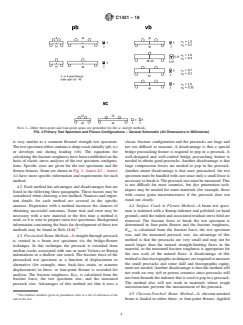
flexure fixtures. Some are shown in Fig. 2. AnnexA2 – Annex Another minor disadvantage is that once precracked, the test
A4 have more specific information and requirements for each specimenmustbehandledwithcaresinceonlyasmallforceis
method. necessarytobreakit.Theprecracksizemustbemeasured.This
is not difficult for most ceramics, but dye penetration tech-
4.2 Each method has advantages and disadvantages that are
niques may be needed for some materials (for example, those
listed in the following three paragraphs. These factors may be
with coarse grain microstructures) if the precrack does not
considered when choosing a test method. Nuances and impor-
stand out clearly.
tant details for each method are covered in the specific
annexes. Experience with a method increases the chances of
4.4 Surface Crack in Flexure Method—A beam test speci-
obtaining successful outcomes. Some trial and error may be
men is indented with a Knoop indenter and polished (or hand
necessary with a new material or the first time a method is
ground),untiltheindentandassociatedresidualstressfieldare
used, so it is wise to prepare extra test specimens. Background
removed. The fracture force to break the test specimen is
information concerning the basis for development of these test
determined in four-point flexure and the fracture toughness,
methods may be found in Refs (1-6).
K , is calculated from the fracture force, the test specimen
Isc
size, and the measured precrack size. An advantage of this
4.3 Precracked Beam Method—Astraight-through precrack
method is that the precracks are very small and may not be
is created in a beam test specimen via the bridge-flexure
much larger than the natural strength-limiting flaws in the
technique. In this technique the precrack is extended from
material, so the measured fracture toughness is appropriate for
median cracks associated with one or more Vickers or Knoop
the size scale of the natural flaws. A disadvantage of this
indentations or a shallow saw notch. The fracture force of the
methodisthatfractographictechniquesarerequiredtomeasure
precracked test specimen as a function of displacement or
the small precracks and some skill and fractographic equip-
alternative (for example, time, back-face strain, or actuator
mentareneeded.Anotherdisadvantageisthatthismethodwill
displacement) in three- or four-point flexure is recorded for
not work on very soft or porous ceramics since precracks will
analysis. The fracture toughness, K , is calculated from the
Ipb
not form beneath the indenter that is used to pop in a precrack.
fracture force, the test specimen size, and the measured
The method also will not work in materials whose rough
precrack size. Advantages of this method are that it uses a
microstructure prevents the measurement of the precrack.
4 4.5 Chevron-Notched Beam Method—A chevron-notched
The boldface numbers given in parentheses refer to a list of references at the
end of the text. beam is loaded in either three- or four-point flexure. Applied
C1421 − 18
force versus displacement or an alternative (for example, time, force, P , or they are due to the details of the precracking
max
back-face strain, or actuator displacement) is recorded in order methods. For materials tested to date the fracture toughness
to detect unstable fracture, since the test is invalid for unstable values generally increase in the following order: K , K ,
Isc Ipb
conditions.The fracture toughness, K , is calculated from the K (7). However, there is insufficient experience to extend
Ivb Ivb
maximum force applied to the test specimen after extension of this statement to all materials. In the analysis of the vb method
the crack in a stable manner. The crack forms during the it is assumed that the material has a flat (no) R-curve. If
loading sequence. One major advantage of this method is that significant R-curve behavior is suspected, then the sc method
itisnotnecessarytomeasurethecracksize.Ontheotherhand, shouldbeusedforestimatesofsmall-crackfracturetoughness,
itisessentialthatstablecrackextensionbeobtainedduringthe whereas the vb test may be used for estimates of longer-crack
test. This may be difficult for some ceramics with large elastic fracture toughness. The pb fracture toughness may reflect
moduliandsmallfracturetoughnessvalues.Thechevronnotch eithershort-orlong-cracklengthfracturetoughnessdepending
mustbemachinedverycarefullyasdescribedinthismethodin on the precracking conditions. For materials with a flat (no)
order to facilitate stable crack extension and also to satisfy the R-curve, the values of K , K , and K are expected to be
Ipb Isc Ivb
requirements for a valid test result. A stiff machine/load the same. NIST Standard Reference Material 2100 has a flat
train/fixtureisoftennecessarytoobtainstablecrackextension. R-curve and K = K = K .
Ipb Isc Ivb
NOTE 2—The fracture toughness of many ceramics varies as a function 6.2 Time-Dependent Phenomenon and Environmental
of the crack extension occurring up to the relevant maximum force. The
Effects—The values of K , K , and K for any material can
Ipb Isc Ivb
actual crack extension to achieve the minimum stress intensity factor
befunctionsoftestratebecauseoftheeffectsoftemperatureor
coefficient (Y* ) of the chevron notch configurations described in this
min
environment (1). Static forces applied for long durations can
method is 0.68 to 0.93 mm.This is likely to result in a fracture toughness
cause crack extension at K values less than those measured in
value in the upper region of the R-curve. I
these methods. The rate of, and level at which, such crack
5. Significance and Use
extension occurs can be changed by the presence of an
aggressive environment, which is material specific. This time-
5.1 Fracturetoughness, K ,isameasureoftheresistanceto
Ic
dependent phenomenon is known as slow crack growth (SCG)
crackextensioninabrittlematerial.Thesetestmethodsmaybe
in the ceramics community. SCG can be meaningful even for
used for material development, material comparison, quality
the relatively short times involved during testing and can lead
assessment, and characterization.
to measured fracture toughness values less than the inherent
5.2 The pb and the vb fracture toughness values provide
resistance in the absence of environmental effects. This effect
information on the fracture resistance of advanced ceramics
maybesignificantevenatambientconditionsandcanoftenbe
containing large sharp cracks, while the sc fracture toughness
minimized or emphasized by selecting a fast or slow test rate,
value provides this information for small cracks comparable in
respectively, or by changing the environment. The recom-
size to natural fracture sources. Cracks of different sizes may
mended testing rates specified are an attempt to limit environ-
beusedforthescmethod.Ifthefracturetoughnessvaluesvary
mental effects (1).
as a function of the crack size it can be expected that K will
Isc
6.3 Stability—This standard permits measurements of frac-
differ from K and K . Table 1 tabulates advantages,
Ipb Ivb
ture toughness whereby the crack propagates unstably (sc and
disadvantages, and applicability of each method.
pb methods) or stably (sc, pb, vb). The stiffness of the test
6. Interferences set-up can affect whether the crack grows stably or unstably.
There is limited data that suggests a stably propagating crack
6.1 R-curve—The microstructural features of advanced ce-
may give a slightly lower fracture toughness value than an
ramics can cause rising R-curve behavior. For such materials
unstably propagating crack (1-3).
the three test methods are expected to result in different
fracture toughness values. These differences are due to the 6.4 Processing details, service history, and environment
amount of crack extension prior to the relevant maximum test may alter the fracture toughness of the material.
TABLE 1 Advantages, Disadvantages, and Applicability of Each Method
Method Advantages Disadvantages Applicability
pb - Classic fracture configuration - Special bridge precracking fixture - Large sharp cracks
- Large precracks - Large forces for precracking
- Cracks measurable - Low force to fracture after precrack
- Post-fracture crack length measurement
sc - Small precracks similar to natural cracks - Fractographic techniques for precrack - Small cracks comparable to natural
measurement cracks in dense materials
- Skill and fractographic equipment required
- Not appropriate for soft or porous materials
- Not appropriate for coarse microstructure
vb - No need to measure crack length - Stable crack extension required - Large sharp cracks
- May not work for stiff materials with low fracture - Flat R-curve material
toughness or materials not susceptible to slow crack
growth
- Precision machining of notch
- Requires stiff load train
C1421 − 18
7. Apparatus 7.4.4 The fixture shall be capable of maintaining the test
specimen alignment to the tolerances specified in AnnexA2 –
7.1 Testing—Use a testing machine that has provisions for
Annex A4.
autographic recording of force applied to the test specimen
7.4.5 Athree-point test fixture (see Fig.A1.2) may be used
versus either test specimen centerline deflection or time. The
for the vb and pb methods. For the pb method, use an outer
force accuracy of the testing machine shall be in accordance
span, S , between 16 and 40 mm. Since W = 4 mm (the top to
o
with Practices E4.
bottom dimension of the test specimen parallel to the crack
S
o
7.2 Deflection Measurement—Deflection measurements are
length), then the fixture span to specimen size ratio is: 4#
W
optional, but if determined, measure test specimen deflection
#10. For the vb method, W can range from 4 mm to 6.35 mm
for the pb and vb close to the crack. The deflection gauge
dependingonthespecimentypeinAnnexA4.Chooseanouter
−3
should be capable of resolving1×10 mm (1 µm) while
S
o
exerting a contacting force of less than 1% of the maximum span, S ,suchthat 4# #10.Theoutertworollersshallbefree
o
W
test force, P .
max to roll outwards to minimize friction effects. The middle
flexurerollershallbefixed.Alternatively,aroundedknifeedge
NOTE 3—If actuator displacement (stroke) is used to infer deflection of
withdiameterinaccordancewith7.4.2maybeusedinplaceof
thetestspecimenforthepurposesofassessingstability,cautionisadvised.
Actuator displacement (stroke), although sometimes successfully used for the middle roller.
this purpose (8), may not be as sensitive to changes of fracture behavior
NOTE 5—A stiff test system with displacement control and a stiff load
in the test specimen as measurements taken on the test specimen itself,
train may be required to obtain stable crack extension for the vb test.
such as back-face strain, load-point displacement, or displacement at the
Stable crack extension is essential for a valid vb test. A test system
−5
crack plane (9).
compliance of less than or equal to 4.43 × 10 m/N (including force
transducer and fixtures) is adequate for most vb tests. Stable crack
7.3 Recording Equipment—Provide a means for automati-
extension is not required for the pb test. See Refs (8, 10, 11).
callyrecordingtheappliedforce-displacementorload-timetest
7.5 Dimension Measuring Devices—Micrometers and other
record, (such as an X-Yrecorder). For digital data acquisition,
devices used for measuring test specimen dimensions shall be
sampling rates of 500 Hz or greater are recommended.
accurate and precise to 0.0025 mm or better. Flat, anvil-type
7.4 Fixtures—Thepbandvbtestspecimensmaybetestedin
micrometerswithresolutionsof0.0025orlessshallbeusedfor
either three-point or four-point fixtures. AnnexA2 and Annex
test specimen dimensions. Ball-tipped or sharp-anvil microm-
A3 give the recommended span sizes for these two methods, eters are not recommended as they may damage the test
respectively.sctestspecimensshallonlybetestedinfour-point
specimen surface by inducing localized cracking. Non-
fixtures. Bend fixtures designed for flexural strength testing in contacting (for example, optical comparator, light microscopy,
accordance with Test Method C1161 are suitable, but this test
etc.) measurements are recommended for crack, precrack or
method allows spans and configurations not in Test Method notch measurements, or all of these.
C1161.Abridgeprecrackingfixtureisalsonecessaryforthepb
7.6 A conventional hardness testing machine is needed for
method. It is described in Annex A2.
the sc method in order to make an indentation-induced pre-
crack. A conventional hardness machine may also be used for
NOTE 4—Hereafter in this document the term four-point flexure will
making a starter flaw for pb test specimens.
refer to the specific case of ⁄4-(that is, quarter) point flexure.
7.7 A bridge precracking fixture is needed for precracking
7.4.1 The four-point test fixture (see Fig. A1.1) for the pb,
pb specimens. See Annex A2.
vb, or sc methods shall conform to the general fixture require-
ments of Test Method C1161. The recommended outer and
8. Test Specimen Configurations, Dimensions, and
inner spans are S =40mmand S = 20 mm, respectively, but
o i
Preparation
this standard allows other span sizes provided that the mini-
8.1 Test Specimens—Three precrack configurations are
mum outer and inner spans shall be S =20mmand S =
o i
equally acceptable: a straight-through pb-crack, a semi-
10mm, respectively. The outer rollers shall be free to roll
outwards and the inner rollers shall be free to roll inwards. ellipticalsc-crack,oravb-chevronnotch.Theseconfigurations
are shown in Figs. 1 and 2. Details of the crack geometry, the
Place the rollers initially against their stops and hold them in
position by low-tension springs or rubber bands or magnets. specimen dimensions, and preparation requirements are given
inAnnexA2forthepb,AnnexA3forthesc,andAnnexA4for
Because of the very low forces used to break precracked test
specimens, very low-stiffness rubber bands or springs should the vb.
NOTE 6—Atypical “plastic” (or deformation) zone, if such exists, is no
be used. Roller pins shall have a hardness of HRC 40 or
greaterthanafractionofamicrometerinmostceramics,thusthespecified
greater.
sizes are large enough to meet generally accepted plane strain require-
7.4.2 The length of each roller shall be at least three times
ments at the crack tip from a plasticity viewpoint.
thetestspecimendimension,B.Therollerdiametershallbe4.5
9. General Procedures for Test Methods and Calculations
6 0.5 mm. The rollers shall be parallel to each other within
0.015 mm over either the length of the roller or a length of 3B
9.1 Number of Tests—Complete a minimum of five valid
or greater.
tests for each material and testing condition. It is prudent to
7.4.3 If the test specimen parallelism requirements set forth preparemorethanfivetestpieces.Thiswillprovidespecimens
in Fig.A2.1 and Fig.A3.1 are not met, use a fully articulating for practice tests to determine the best precracking conditions
fixture as described in Test Method C1161. and also provide specimens to make up for unsuccessful or
C1421 − 18
TABLE 2 Fracture Toughness Values of Sintered Silicon Carbide (Hexoloy SA) in MPa m
œ
NOTE 1—(n) = Number of test specimens tested.
NOTE 2—± = 1 standard deviation.
NOTE 3—? = quantity unknown.
Precracked Beam Surface Crack in Flexure Chevron Notch
Ref
(pb) (sc) (vb)
2.62±0.06(6)
A,B
(A config.)
using II-UW material,
A
2.54±0.20(3) 2.69±0.08(6)
vintage 1985
2.68±0.03(2)
(B config.)
A A,B
2.58±0.08(4) 2.76±0.08(4) 2.61±0.05(6) using JAS material,
vintage 1980
(A config.)
2.46±0.03(5)
(C config.)
C D
... 3.01 ± 0.35 (3) 2.91±0.31(3)
(B config.)
A
Quinn,G.D.andSalem,J.A.,“EffectofLateralCracksUponFractureToughnessDeterminedbytheSurfaceCrackinFlexureMethod,”JournaloftheAmericanCeramic
Society, Vol 85, No. 4, 2002, pp. 873–880.
B
Salem, J.A., Ghosn, L. J., Jenkins, M. G., and Quinn, G. D., “Stress Intensity Factor Coefficients for Chevron-Notched Flexure Specimens,” Ceramic Engineering and
Science Proceedings, Vol 20, No. 3, 1999, pp. 503–512.
C
This data set may have been susceptible to overestimation of the sc fracture toughness due to the interference of vestigial lateral cracks.
D
Ghosn,A., Jenkins, M. G., White, K. W., Kobayashi,A. S., and Bradt, R. C., “Elevated-Temperature Fracture Resistance of a Sintered α-Silicon Carbide,” Journal of the
American Ceramic Society, Vol 72, No. 2, 1989, pp. 242–247.
invalid tests. More specimens are needed if environment, compared. The pb and sc tests typically have less stable crack
testing rate, or precrack sizes will be varied. extension than the vb test.
9.2 Valid Tests—A valid individual test is one which meets
9.5 Test Specimens and Fracture Experiments—Specifictest
allthegeneraltestingrequirementsin9.2.1,andallthespecific specimen measurements, procedures, and calculations are in
testing requirements for a valid test of the particular test
Annex A2 – Annex A4.
method as specified in the appropriate annex.
9.6 Test Rate—Test the test specimen so that one of the test
9.2.1 A valid test shall meet the following general require-
rates determined in 9.3 will result in a rate of increase in stress
ments.
intensity factor between 0.1 and 2.75 MPa=m/s. Applied
9.2.1.1 Test machine shall have provisions for autographic
force, or displacement (actuator or stroke) rates, or both,
recording of force versus deflection or time, and the test
corresponding to these stress intensity factor rates are dis-
machine shall have an accuracy in accordance with Practices
cussed in the appropriate annex. Other test rates are permitted
E4 (7.1).
if environmental effects are suspected in accordance with 9.3.
9.2.1.2 Test fixtures shall comply with specifications of 7.4.
9.7 Humidity and Temperature—Measure the temperature
9.2.1.3 Dimension measuring devices shall comply with
and humidity according to Test Method E337.
specifications of 7.5.
9.3 Environmental Effects—If susceptibility to environmen-
10. Report
tal degradation, such as slow crack growth, is a concern, tests
10.1 For each test specimen, report the following informa-
should be performed and reported at two different test rates, or
in appropriately different environments. Testing in an inert tion:
10.1.1 Test specimen identification.
environment (dry nitrogen, argon, or vacuum) can eliminate
environmental effects. Susceptibility to slow crack growth can 10.1.2 Form of product tested, and materials processing
be assessed by testing at two different testing rates in an air or
information, if available.
water environment. The rates should differ by two to three 10.1.3 Mean grain size, if available, by Test Methods E112
orders of magnitude (or greater), however, attainment of stable
or other appropriate method.
crack extension in vb may be difficult at high rates or in dry
10.1.4 Environment of test, relative humidity, temperature.
environments.Alternatively, the susceptibility can be assessed
10.1.5 Test specimen dimensions: B and W.
by choosing different environments such that the expected
10.1.5.1 For the pb test specimen crack length, a, and notch
effectissmallinonecase(forexample,inertdrynitrogen)and
thickness, t, if applicable.
large in the other case (that is, water vapor). If an effect of the
10.1.5.2 Forthesctestspecimenthecrackdimensionsaand
environment is detected, select the fracture toughness values
2c.
measured at the greater test rates or in the inert environment.
10.1.5.3 For the vb test specimen the notch parameters, a
An example of the effect of environment on the fracture
and a and a and the notch thickness, t.
11 12
toughness of alumina is given in Refs (9) and (1).
10.1.6 Test fixture specifics.
10.1.6.1 Whetherthetestwasinthree-orfour-pointflexure.
9.4 R-Curve—When rising R-curve behavior is to be
10.1.6.2 Outer span, S , and inner span (if applicable), S.
documented, two different test methods with different amounts
o i
of stable crack extension should be used and the results 10.1.7 Applied force or displacement rate.
C1421 − 18
10.1.8 Measured inclination of the crack plane as specified 11.2 Bias—Standard Reference Material (SRM) 2100 from
in the appropriate annex. the National Institute of Standards and Technology may be
10.1.9 Relevant maximum test force, P , as specified in
used to check for laboratory test result bias. The laboratory
max
the appropriate annex.
averagevaluemaybecomparedtothecertifiedreferencevalue
10.1.10 Testingdiagrams(forexample,appliedforceversus
of fracture toughness of 4.57 MPa√m 6 0.11 MPa√m (or
displacement) as required.
2.3%) at a 95 % confidence level. SRM 2100 is a set of five
10.1.11 Number of test specimens tested and the number of
silicon nitride beam test specimens. Identical results are
valid tests.
obtainedwiththethreetestmethodsinthisstandardwhenused
10.1.12 Fracture toughness values for each valid test with a
with SRM 2100.
statement confirming that all tests were indeed valid.
11.3 Variation in Results with Test Method for Other
10.1.13 Additional information as required in the appropri-
Materials—As discussed in 1.4, 6.1, and 6.2, for some mate-
ate annex.
rials K , K , and K values may differ from each other (for
Ipb Isc Ivb
10.2 Mean and standard deviation of the fracture toughness
example, (14)). Nevertheless, a comparison of test results
for each test method used.
obtained by the three different methods is instructive. Such
10.3 Crack plane and direction of crack propagation as
comparisons are shown in Table 2. The experimental proce-
appropriate (see Appendix X5).
dures used in the studies cited in Table 2 varied somewhat and
were not always in accordance with this standard, although the
11. Precision and Bias
data are presented here for illustrative purposes. Table 2
11.1 Precision—The precision of a fracture toughness mea-
contains results for sintered silicon carbide, an advanced
surement is a function of the precision of the various measure-
ceramic which is known to be insensitive to environmental
ments of linear dimensions of the test specimen and test
effects in ambient laboratory conditions. This material is also
fixtures, and the precision of the force measurement. The
known to have a fracture toughness independent of crack size
within-laboratory (repeatability) and between-laboratory (re-
(flat R-curve).
producibility) precisions of some of the fracture toughness
procedures in this test method have been determined from
12. Keywords
inter-laboratory test programs (12, 13). More information
about the precisions of the three test methods are in the Annex 12.1 advancedceramics;chevronnotch;fracturetoughness;
A2 – Annex A4. precracked beam; surface crack in flexure
ANNEXES
(Mandatory Information)
A1. SUGGESTED TEST FIXTURE SCHEMATICS
A1.1 See Figs. A1.1 and A1.2.
FIG. A1.1 Four-Point Test Fixture Schematic Which Illustrates the General Requirements for a Semi-Articulating Fixture
C1421 − 18
FIG. A1.2 Three-Point Test Fixture Schematic Which Illustrates
the General Requirements of the Test Fixture
A2. PROCEDURES AND SPECIAL REQUIREMENTS FOR THE PRECRACKED BEAM METHOD
A2.1 Test Specimen parallel to the test specimen long axis. The stock removal rate
shallnotexceed0.02mmperpasstothelast0.06mmperface.
A2.1.1 Test Specimen Size—Thetestspecimenshallbe3by
A2.1.2.2 Performfinishgrindingwithadiamond-gritwheel
4 mm in cross section with the tolerances shown in Fig.A2.1.
of 320 grit or finer. No less than 0.06 mm per face shall be
Thetestspecimenmayormaynotcontainasaw-cutnotch.For
both four-point and three-point flexure tests the length shall be removed during the final finishing phase, and at a rate of not
at least 20 mm but not more than 50 mm. Test specimens of more than 0.002 mm per pass.
larger cross section can be tested as long as the proportions
A2.1.2.3 Thetwoendfacesneednotbeprecisionmachined.
given in Fig. A2.1 are maintained.
The four long edges shall be chamfered at 45° a distance of
A2.1.2 Test Specimen Preparation—Test specimens pre- 0.12 6 0.03 mm, or alternatively, they may be rounded with a
radius of 0.15 6 0.05 mm as shown in Fig. A2.1. Edge
paredinaccordancewiththeProcedureofTestMethodC1161,
test specimen Type B, are suitable as summarized in A2.1.2.1 finishing shall be comparable to that applied to the test
– A2.1.2.3. Alternative procedures may be utilized provided
specimensurfaces.Inparticular,thedirectionofthemachining
that unwanted machining damage and residual stresses are
shall be parallel to the test specimen long axis.
minimized. Report any alternative test specimen preparation
A2.1.2.4 The notch, if used, should be made in the 3-mm
procedure in the test report.
face, should be less than 0.10 mm in thickness, and should
A2.1.2.1 Allgrindingshallbedonewithanamplesupplyof
have a length of 0.12 ≤ a/W ≤ 0.30.
appropriate filtered coolant to keep workpiece and wheel
constantlyfloodedandparticlesflushed.Grindingshallbeinat A2.1.3 Itisrecommendedthatatleasttentestspecimensbe
prepared. This will provide test specimens for practice tests to
least two stages, ranging from coarse to fine rates of material
removal. All machining shall be in the surface grinding mode determine the best precracking parameters. It will also provide
FIG. A2.1 Dimensions of Rectangular Beam
C1421 − 18
make-up test specimens for unsuccessful or invalid tests so as within 0.1 mm. Seat the displacement indicator close to the
to meet the requirements of 9.1 and 9.2. crack plane if used. Alternatively, monitor actuator (or cross-
head) displacement, back-face strain, or a time sweep.
A2.1.4 Measure the cross section dimensions B and W to
within 0.002 mm near the middle of the test piece.
NOTEA2.1—Forshortspans(forexample, S =16mm)and S /W=4.0
o o
inthree-pointflexure,errorsofupto3%indeterminingthecriticalmode
A2.2 Apparatus
I stress intensity factor may occur because of misalignment of the middle
roller, misalignment of the support span, or angularity of the precrack at
A2.2.1 General—This fracture test is conducted in either
the extremes of the tolerances allowed (16, 17).
three- or four-point flexure. A displacement measurement (or
A2.2.3.3 Thismethodpermitseitherunstableorstablecrack
alternative) is required for fracture testing in order to detect
extension during the fracture test. When the critical stress
signs of crack extension.
intensity, K , is reached, the crack propagates unstably
Ipb
A2.2.2 BridgePrecrackingFixture—Theconfigurationused
through the test piece. This is acceptable and the normal way
for precracking is different from that used for the actual
this test method is performed. If stable extension is desired,
fracture test. A bridge compression fixture is used to create a
extra attention to the test setup is needed and very stiff test
precrackfromanindentationcrackorfromasawednotch.The
fixtures and load train may be necessary. The stability (that is,
fixture consists of a square support lower plate with a center
the tendency to obtain stable crack extension) of the test setup
groove (which is bridged by the test specimen) and a top
is affected not only by the test system compliance (see Note
pusher plate with a bonded pusher plate insert (for example,
A2.2) but also by the test specimen dimensions, the S ⁄W
o
silicon nitride).The lengths of both plates (L in Fig.A2.2) are
ratio, and the elastic modulus of the material (8, 10). The
equal to each other and are less than or equal to 18 mm. The
degree of stability can be detected easily with back-face strain.
surfacesthatcontactthetestspecimenareofamaterialwithan
NOTEA2.2—There is a limited amount of data indicating unstable tests
elastic modulus greater than 300 GPa. The support plate can
may result in slightly greater fracture toughness values than those from
haveseveralgrooves(L inFig.A2.2)rangingfrom2to6mm
tests with stable crack extension (8, 10). If stable crack extension cannot
in width. Alternatively, several parts, each with a different
be obtained with four-point flexure, it may be possible to obtain stable
groove width, can be used. A fixture design is shown in Fig. crack extension by using a three-point flexure configuration in a stiff test
setup. Nonlinearity of the initial part of the applied force-displacement
A2.2. The support and pusher plates shall be parallel within
curve (sometimes called “windup”) is usually an artifact of the test setup
0.01 mm. Alternatively, a self-aligning fixture can be used.
and may not be indicative of material behavior. This type of nonlinearity
A2.2.3 Fracture Test Fixture—The general principles of the does not contribute directly to instability unless such nonlinearity extends
to the region of maximum force.
four- and three-point test fixture are detailed in 7.4 and
illustrated in Fig. A1.1 and Fig. A1.2, respectively. For
A2.3 Procedure
three-point flexure, choose the outer support span such that 4
A2.3.1 Preparation of Crack Starter—Either the machined
S
o
# #10.
notch (Fig.A2.3a), or one or more Vickers or Knoop indenta-
W
tions (Fig.A2.3b), acts as the crack starter. For a test specimen
A2.2.3.1 For four-point flexure, the plane of the crack shall
without a notch, create a Vickers indentation in the middle of
be located within 1.0 mm of the midpoint between the two
the surface of the 3-mm face (Fig. A2.3b). Additional inden-
inner rollers, S. Measure the inner and outer spans to within
i
tations can be placed on both sides of the first indentation,
0.1 mm.Align the midpoint of the two inner rollers relative to
alignedinthesameplaneandperpendiculartothelongitudinal
themidpointofthetwoouterrollerstowithin0.1mm.Seatthe
axis of the test specimen, as shown in Fig. A2.3b. One of the
displacement indicator (if used) close to the crack plane.
diagonals of each of the indentations shall be aligned parallel
Alternatively, use actuator (or crosshe
...
This document is not an ASTM standard and is intended only to provide the user of an ASTM standard an indication of what changes have been made to the previous version. Because
it may not be technically possible to adequately depict all changes accurately, ASTM recommends that users consult prior editions as appropriate. In all cases only the current version
of the standard as published by ASTM is to be considered the official document.
Designation: C1421 − 16 C1421 − 18
Standard Test Methods for
Determination of Fracture Toughness of Advanced Ceramics
at Ambient Temperature
This standard is issued under the fixed designation C1421; the number immediately following the designation indicates the year of
original adoption or, in the case of revision, the year of last revision. A number in parentheses indicates the year of last reapproval. A
superscript epsilon (´) indicates an editorial change since the last revision or reapproval.
1. Scope
1.1 These test methods cover the fracture toughness, K , determination of advanced ceramics at ambient temperature. The
Ic
methods determine K (precracked beam test specimen), K (surface crack in flexure), and K (chevron-notched beam test
Ipb Isc Ivb
specimen). The fracture toughness values are determined using beam test specimens with a sharp crack. The crack is either a
straight-through crack formed via bridge flexure (pb), or a semi-elliptical surface crack formed via Knoop indentation (sc), or it
is formed and propagated in a chevron notch (vb), as shown in Fig. 1.
NOTE 1—The terms bend(ing) and flexure are synonymous in these test methods.
1.2 These test methods are applicable to materials with either flat or with rising R-curves. Differences in test procedure and
analysis may cause the values from each test method to be different. For many materials, such as the silicon nitride Standard
Reference Material 2100, the three methods give identical results at room temperature in ambient air.
1.3 The fracture toughness values for a material can be functions of environment, test rate, and temperature. These test methods
give fracture toughness values for specific conditions of environment, test rate, and temperature.
1.4 These test methods are intended primarily for use with advanced ceramics that are macroscopically homogeneous and
microstructurally dense. Certain whisker- or particle-reinforced ceramics may also meet the macroscopic behavior assumptions.
Single crystals may also be tested.
1.5 This standard begins with a main body that provides information on fracture toughness testing in general. It is followed by
annexes and appendicesappendixes with specific information for the particular test methods.
Main Body Section
Scope 1
Referenced Documents 2
Terminology (including definitions, orientation and symbols) 3
Summary of Test Methods 4
Significance and Use 5
Interferences 6
Apparatus 7
Test Specimen Configurations, Dimensions and Preparations 8
General Procedures 9
Report (including reporting tables) 10
Precision and Bias 11
Keywords 12
Summary of Changes
Annexes
Test Fixture Geometries Annex A1
Procedures and Special Requirements for Precracked Beam Annex A2
Method
Procedures and Special Requirements for Precracked Beam Annex A2
Method
Procedures and Special Requirements for Surface Crack in Annex A3
Flexure Method
Procedures and Special Requirements for Surface Crack in Annex A3
Flexure Method
Procedures and Special Requirements for Chevron Notch Annex A4
Flexure Method
ThisThese test method ismethods are under the jurisdiction of ASTM Committee C28 on Advanced Ceramics and is the direct responsibility of Subcommittee C28.01
on Mechanical Properties and Performance.
Current edition approved Jan. 1, 2016Jan. 1, 2018. Published March 2016January 2018. Originally approved in 1999. Last previous edition approved in 20152016 as
C1421 – 15.C1421 – 16. DOI: 10.1520/C1421-16.10.1520/C1421-18.
Copyright © ASTM International, 100 Barr Harbor Drive, PO Box C700, West Conshohocken, PA 19428-2959. United States
C1421 − 18
NOTE 1—The figures on the right show the test specimen cross sections and crack types. Four-point loading may be used with all three methods.
Three-point may be used with the pb and vb specimens.
FIG. 1 The Three Test Methods
Procedures and Special Requirements for Chevron Notch Annex A4
Flexure Method
Appendices
Appendixes
Precrack Characterization, Surface Crack in Flexure Method Appendix X1
Complications in Interpreting Surface Crack in Flexure Appendix X2
Precracks
Complications in Interpreting Surface Crack in Flexure Appendix X2
Precracks
Alternative Precracking Procedure, Surface Crack in Flexure Appendix X3
Method
Alternative Precracking Procedure, Surface Crack in Flexure Appendix X3
Method
Chamfer Correction Factors, Surface Crack in Flexure Appendix X4
Method Only
Chamfer Correction Factors, Surface Crack in Flexure Appendix X4
Method Only
Crack Orientation Appendix X5
Crack Orientation Appendix X5
1.6 Values expressed in these test methods are in accordance with the International System of Units (SI) and Practice
IEEE/ASTM SI 10.
1.7 The values stated in SI units are to be regarded as standard. No other units of measurement are included in this standard.
1.8 This standard does not purport to address all of the safety concerns, if any, associated with its use. It is the responsibility
of the user of this standard to establish appropriate safety safety, health, and healthenvironmental practices and determine the
applicability of regulatory limitations prior to use.
1.9 This international standard was developed in accordance with internationally recognized principles on standardization
established in the Decision on Principles for the Development of International Standards, Guides and Recommendations issued
by the World Trade Organization Technical Barriers to Trade (TBT) Committee.
2. Referenced Documents
2.1 ASTM Standards:
C1161 Test Method for Flexural Strength of Advanced Ceramics at Ambient Temperature
C1322 Practice for Fractography and Characterization of Fracture Origins in Advanced Ceramics
E4 Practices for Force Verification of Testing Machines
E112 Test Methods for Determining Average Grain Size
E177 Practice for Use of the Terms Precision and Bias in ASTM Test Methods
E337 Test Method for Measuring Humidity with a Psychrometer (the Measurement of Wet- and Dry-Bulb Temperatures)
E691 Practice for Conducting an Interlaboratory Study to Determine the Precision of a Test Method
E740E740/E740M Practice for Fracture Testing with Surface-Crack Tension Specimens
E1823 Terminology Relating to Fatigue and Fracture Testing
IEEE/ASTM SI 10 Standard for Use of the International System of Units (SI) (The Modern Metric System)
2.2 Reference Material:
NIST SRM 2100 Fracture Toughness of Ceramics
For referenced ASTM standards, visit the ASTM website, www.astm.org, or contact ASTM Customer Service at service@astm.org. For Annual Book of ASTM Standards
volume information, refer to the standard’s Document Summary page on the ASTM website.
Available from National Institute of Standards and Technology (NIST), 100 Bureau Dr., Stop 1070, Gaithersburg, MD 20899-1070, http://www.nist.gov.
C1421 − 18
3. Terminology
3.1 Definitions:
3.1.1 The terms described in Terminology E1823 are applicable to these test methods. Appropriate sources for each definition
are provided after each definition in parentheses.
3.1.2 fracture toughness—a generic term for measures of resistance of extension of a crack. (E1823)
3.1.3 R-curve—a plot of crack-extension resistance as a function of stable crack extension.
3.1.4 slow crack growth (SCG)—sub critical subcritical crack growth (extension) which may result from, but is not restricted
to, such mechanisms as environmentally-assisted environmentally assisted stress corrosion or diffusive crack growth.
-3/2–3/2
3.1.5 stress-intensity stress intensity factor, K [FL ]—the magnitude of the ideal-crack-tip stress field (stress field
singularity) for a particular mode in a homogeneous, linear-elastic body. (E1823)
3.2 Definitions of Terms Specific to This Standard:
3.2.1 back-face strain—the strain as measured with a strain gage mounted longitudinally on the compressive surface of the test
specimen, opposite the crack or notch mouth (often this is the top surface of the test specimen as tested).
3.2.2 crack depth, a [L]—in surface-cracked test specimens, the normal distance from the cracked beam surface to the point of
maximum penetration of crack front in the material.
3.2.3 critical crack size [L]—Thethe crack size at which maximum force and catastrophic fracture occur in the precracked beam
and the surface crack in flexure configurations. In the chevron-notched test specimen this is the crack size at which the stress
intensity factor coefficient, Y*, is at a minimum or equivalently, the crack size at which the maximum force would occur in a linear
elastic, flat R-curve material.
3.2.4 four-point - four-point- ⁄4-point flexure—flexure configuration where a beam test specimen is symmetrically loaded at two
locations that are situated one quarter one-quarter of the overall span,span away from the outer two support bearings (see Fig.
A1.1). (C1161)
-3/2–3/2
3.2.5 fracture toughness K [FL ]—the critical stress intensity factor, Mode I, for fracture. It is a measure of the resistance
Ic
to crack extension in brittle materials.
-3/2–3/2
3.2.6 fracture toughness K [FL ]—the measured stress intensity factor corresponding to the extension resistance of a
Ipb
straight-through crack formed via bridge flexure of a sawn notch or Vickers or Knoop indentation(s). The measurement is
performed according to the operational procedure herein and satisfies all the validity requirements. (See Annex A2).)
-3/2–3/2
3.2.7 fracture toughness K or K * [FL ]—the measured (K(K ) or apparent (K(K *) stress intensity factor
Isc Isc Isc Isc
corresponding to the extension resistance of a semi-elliptical crack formed via Knoop indentation, for which the residual stress field
due to indentation has been removed. The measurement is performed according to the operational procedure herein and satisfies
all the validity requirements. (See Annex A3).)
-3/2
3.2.8 fracture toughness K [FL ]—the measured stress intensity factor corresponding to the extension resistance of a
Ivb
stably-extending stably extending crack in a chevron-notched test specimen. The measurement is performed according to the
operational procedure herein and satisfies all the validity requirements. (See Annex A4).)
3.2.9 minimum stress-intensity factor coeffıcient, Y* —the minimum value of Y* determined from Y* as a function of
min
dimensionless crack length, α = a/W.
3.2.10 pop-in—Thethe sudden formation or extension of a crack without catastrophic fracture of the test specimen, apparent
from a force drop in the applied force-displacement curve. Pop-in may be accompanied by an audible sound or other acoustic
energy emission.
3.2.11 precrack—a crack that is intentionally introduced into the test specimen prior to testing the test specimen to fracture.
3.2.12 stable crack extension—controllable, time-independent, noncritical crack propagation.
3.2.12.1 Discussion—
The mode of crack extension (stable or unstable) depends on the compliance of the test specimen and test fixture;fixture, the test
specimen and crack geometries;geometries, R-curve behavior of the material;material, and susceptibility of the material to slow
crack growth.
3.2.13 three-point flexure—flexure configuration where a beam test specimen is loaded at a location midway between two
support bearings (see Fig. A1.2). (C1161)
3.2.14 unstable crack extension—uncontrollable, time-independent, critical crack propagation.
3.3 Symbols:
3.3.1 a—crack depth, crack length, crack size.
3.3.2 a —chevron tip dimension, vb method, Fig. A4.1.
o
C1421 − 18
3.3.3 a —chevron dimension, vb method, (a = (a +a )/2), Fig. A4.1.
1 1 11 12
3.3.4 a —chevron dimension, vb method, Fig. A4.1.
3.3.5 a —chevron dimension, vb method, Fig. A4.1.
3.3.6 a —crack length measured at 0.25B, pb method, Fig. A4.2.
0.25
3.3.7 a —crack length measured at 0.5B, pb method, Fig. A4.2.
0.50
3.3.8 a —crack length measured at 0.75B, pb method, Fig. A4.2.
0.75
3.3.9 a/W—normalized crack size.
3.3.10 B—the side to side side-to-side dimension of the test specimen perpendicular to the crack length (depth) as shown in Fig.
A2.4, Fig. A3.7, and Fig. A4.1.
3.3.11 c—crack half width, sc method, Fig. A3.7.
3.3.12 d—length of long diagonal for a Knoop indent, length of a diagonal for a Vickers indent, sc method.
3.3.13 E—elastic modulus.
3.3.14 f(a/W)—function of the ratio a/W, pb method, four-point flexure, Eq A2.6.
3.3.15 F—indent force, sc method.
3.3.16 F —chamfer correction factor, sc method.
C
3.3.17 g(a/W)—function of the ratio a/W, pb method, three-point flexure, Eq A2.2 and Eq A2.4.
3.3.18 h—depth of Knoop or Vickers indent, sc method, Eq A3.1.
3.3.19 H (a/c, a/W)—a polynomial in the stress intensity factor coefficient, for the precrack periphery where it intersects the test
specimen surface, sc method, Eq A3.7.
3.3.20 H (a/c, a/W)—a polynomial in the stress intensity factor coefficient, for the deepest part of a surface crack, sc method,
see Eq A3.5.
3.3.21 K —stress intensity factor, Mode I.
I
3.3.22 K —fracture toughness, critical stress intensity factor, Mode I.
Ic
3.3.23 K —fracture toughness, pb method, Eq A2.1 and Eq A2.3.
Ipb
3.3.24 K —fracture toughness, sc method, Eq A3.9.
Isc
3.3.25 K —fracture toughness, vb method, Eq A4.1.
Ivb
3.3.26 L—test specimen length, Fig. A2.1 and Fig. A3.1.
3.3.27 L , L —precracking fixture dimensions, pb method, Fig. A2.2.
1 2
3.3.28 M(a/c, a/W)—a polynomial in the stress intensity factor coefficient, sc method, see Eq A3.4.
3.3.29 P—force.
3.3.30 P —force maximum.
max
3.3.31 Q(a/c)—a polynomial function of the surface crack ellipticity, sc method, Eq A3.3.
3.3.32 S(a/c, a/W)—factor in the stress intensity factor coefficient, sc method, Eq A3.8.
3.3.33 S —outer span, three- or four-point test fixture. Figs. A1.1 and A1.2.
o
3.3.34 S —inner span, four-point test fixture, Fig. A1.1.
i
3.3.35 t—notch thickness, pb and vb method, Fig. A2.3 and Fig. A4.1.
3.3.36 W—the top to bottom top-to-bottom dimension of the test specimen parallel to the crack length (depth) as shown in A2.4,
A3.7, and A4.1.
3.3.37 Y—stress intensity factor coefficient.
3.3.38 Y*—stress intensity factor coefficient for vb method.
3.3.39 Y —maximum stress intensity factor coefficient occurring around the periphery of an assumed semi-elliptical precrack,
max
sc method.
3.3.40 Y* —minimum stress intensity factor coefficient, vb method, Eq A4.2-A4.5.
min
3.3.41 Y —stress intensity factor coefficient at the deepest part of a surface crack, sc method, Eq A3.2.
d
3.3.42 Y —stress intensity factor coefficient at the intersection of the surface crack with the test specimen surface, sc method,
s
Eq A3.6.
C1421 − 18
NOTE 1—Other three-point and four-point spans are permitted for the sc and pb methods.
FIG. 2 Primary Test Specimen and Fixture Configurations: Configurations – General Schematic (all dimensions(All Dimensions in milli-
metres)Millimetres)
4. Summary of Test Methods
4.1 These methods involve application of force to a beam test specimen in three- or four-point flexure. The test specimen is very
similar to a common flexural strength test specimen. The test specimen either contains a sharp crack initially (pb, sc) or develops
one during loading (vb). The equations for calculating the fracture toughness have been established on the basis of elastic stress
analyses of the test specimen configurations. Specific sizes are given for the test specimens and the flexure fixtures. Some are
shown in Fig. 2. Annex A2Annex A2 – Annex A4, Annex A3, and Annex A4have more specific information and requirements for
each method.
4.2 Each method has advantages and disadvantages that are listed in the following three paragraphs. These factors may be
considered when choosing a test method. Nuances and important details for each method are covered in the specific annexes.
Experience with a method increases the chances of obtaining successful outcomes. Some trial and error may be necessary with a
new material or the first time a method is used, so it is wise to prepare extra test specimens. Background information concerning
the basis for development of these test methods may be found in Refs.Refs (1-6).
4.3 Precracked Beam Method—A straight-through precrack is created in a beam test specimen via the bridge-flexure technique.
In this technique the precrack is extended from median cracks associated with one or more Vickers or Knoop indentations or a
shallow saw notch. The fracture force of the precracked test specimen as a function of displacement or alternative (for example,
time, back-face strain, or actuator displacement) in three- or four-point flexure is recorded for analysis. The fracture toughness,
K , is calculated from the fracture force, the test specimen size, and the measured precrack size. Advantages of this method are
Ipb
that it uses a classic fracture configuration and the precracks are large and not too difficult to measure. A disadvantage is that a
special bridge precracking fixture is required to pop in a precrack. A well designed and well crafted well-designed and well-crafted
bridge precracking fixture is needed to obtain good precracks. Another disadvantage is that large compression forces are needed
to pop in the precrack. Another minor disadvantage is that once precracked, the test specimen must be handled with care since only
a small force is necessary to break it. The precrack size must be measured. This is not difficult for most ceramics, but dye
penetration techniques may be needed for some materials (e.g., (for example, those with coarse grain microstructures) if the
precrack does not stand out clearly.
4.4 Surface Crack in Flexure Method—A beam test specimen is indented with a Knoop indenter and polished (or hand ground),
until the indent and associated residual stress field are removed. The fracture force to break the test specimen is determined in
four-point flexure and the fracture toughness, K , is calculated from the fracture force, the test specimen size, and the measured
Isc
precrack size. An advantage of this method is that the precracks are very small and may not be much larger than the natural strength
limiting strength-limiting flaws in the material, so the measured fracture toughness is appropriate for the size scale of the natural
flaws. A disadvantage of this method is that fractographic techniques are required to measure the small precracks and some skill
The boldface numbers given in parentheses refer to a list of references at the end of the text.
C1421 − 18
and fractographic equipment isare needed. Another disadvantage is that this method will not work on very soft or porous ceramics
since precracks will not form beneath the indenter that is used to pop in a precrack. The method also will not work in materials
whose rough microstructure prevents the measurement of the precrack.
4.5 Chevron-Notched Beam Method—A chevron-notched beam is loaded in either three- or four-point flexure. Applied force
versus displacement or an alternative (for example, time, back-face strain, or actuator displacement) is recorded in order to detect
unstable fracture, since the test is invalid for unstable conditions. The fracture toughness, K , is calculated from the maximum
Ivb
force applied to the test specimen after extension of the crack in a stable manner. The crack forms during the loading sequence.
One major advantage of this method is that it is not necessary to measure the crack size. On the other hand, it is essential that stable
crack extension be obtained during the test. This may be difficult for some ceramics with large elastic moduli and small fracture
toughness values. The chevron notch must be machined very carefully as described in this method in order to facilitate stable crack
extension and also to satisfy the requirements for a valid test result. A stiff machine/load train/fixture is often necessary to obtain
stable crack extension.
NOTE 2—The fracture toughness of many ceramics varies as a function of the crack extension occurring up to the relevant maximum force. The actual
crack extension to achieve the minimum stress intensity factor coefficient (Y* ) of the chevron notch configurations described in this method is 0.68
min
to 0.93 mm. This is likely to result in a fracture toughness value in the upper region of the R-curve.
5. Significance and Use
5.1 Fracture toughness, K , is a measure of the resistance to crack extension in a brittle material. These test methods may be
Ic
used for material development, material comparison, quality assessment, and characterization.
5.2 The pb and the vb fracture toughness values provide information on the fracture resistance of advanced ceramics containing
large sharp cracks, while the sc fracture toughness value provides this information for small cracks comparable in size to natural
fracture sources. Cracks of different sizes may be used for the sc method. If the fracture toughness values vary as a function of
the crack size it can be expected that K will differ from K and K .Table 1 tabulates advantages, disadvantages, and
Isc Ipb Ivb
applicability of each method.
6. Interferences
6.1 R-curve—The microstructural features of advanced ceramics can cause rising R-curve behavior. For such materials the three
test methods are expected to result in different fracture toughness values. These differences are due to the amount of crack
extension prior to the relevant maximum test force, P , or they are due to the details of the precracking methods. For materials
max
tested to date the fracture toughness values generally increase in the following order: K ,K ,K (7). However, there is
Isc Ipb Ivb
insufficient experience to extend this statement to all materials. In the analysis of the vb method it is assumed that the material has
a flat (no) R-curve. If significant R-curve behavior is suspected, then the sc method should be used for estimates of small-crack
fracture toughness, whereas the vb test may be used for estimates of longer-crack fracture toughness. The pb fracture toughness
may reflect either short- or long-crack length fracture toughness depending on the precracking conditions. For materials with a flat
(no) R-curveR-curve, the values of K ,K , and K are expected to be the same. NIST Standard Reference Material 2100 has
Ipb Isc Ivb
a flat R-curve and K = K = K .
Ipb Isc Ivb
6.2 Time-Dependent Phenomenon and Environmental Effects—The values of K ,K , and K , for any material can be
Ipb Isc Ivb
functions of test rate because of the effects of temperature or environment (1). Static forces applied for long durations can cause
crack extension at K values less than those measured in these methods. The rate of, and level at which, such crack extension occurs
I
can be changed by the presence of an aggressive environment, which is material specific. This time-dependent phenomenon is
known as slow crack growth (SCG) in the ceramics community. SCG can be meaningful even for the relatively short times
involved during testing and can lead to measured fracture toughness values less than the inherent resistance in the absence of
TABLE 1 Advantages, Disadvantages, and Applicability of Each Method
Method Advantages Disadvantages Applicability
pb - Classic fracture configuration - Special bridge precracking fixture - Large sharp cracks
- Large precracks - Large forces for precracking
- Cracks measurable - Low force to fracture after precrack
- Post-fracture crack length measurement
sc - Small precracks similar to natural cracks - Fractographic techniques for precrack - Small cracks comparable to natural
measurement cracks in dense materials
- Skill and fractographic equipment required
- Not appropriate for soft or porous materials
- Not appropriate for coarse microstructure
vb - No need to measure crack length - Stable crack extension required - Large sharp cracks
- May not work for stiff materials with low fracture - Flat R-curve material
toughness or materials not susceptible to slow crack
growth
- Precision machining of notch
- Requires stiff load train
C1421 − 18
environmental effects. This effect may be significant even at ambient conditions and can often be minimized or emphasized by
selecting a fast or slow test rate, respectively, or by changing the environment. The recommended testing rates specified are an
attempt to limit environmental effects (1).
6.3 Stability—This standard permits measurements of fracture toughness whereby the crack propagates unstably (sc and pb
methods) or stably (sc, pb, vb). The stiffness of the test set-up can affect whether the crack grows stably or unstably. There is limited
data that suggests a stably propagating crack may give a slightly lower fracture toughness value than an unstably propagating crack
(1-3).
Processing details, service history, and environment may alter the fracture toughness of the material.
6.4 Processing details, service history, and environment may alter the fracture toughness of the material.
7. Apparatus
7.1 Testing—Use a testing machine that has provisions for autographic recording of force applied to the test specimen versus
either test specimen centerline deflection or time. The force accuracy of the testing machine shall be in accordance with
PracticePractices E4.
7.2 Deflection Measurement—Deflection measurements are optional, but if determined, measure test specimen deflection for the
−3
pb and vb close to the crack. The deflection gauge should be capable of resolving 1×101 × 10 mm (1 μm) while exerting a
contacting force of less than 1 % of the maximum test force, P .
max
NOTE 3—If actuator displacement (stroke) is used to infer deflection of the test specimen for the purposes of assessing stability, caution is advised.
Actuator displacement (stroke), although sometimes successfully used for this purpose (8), may not be as sensitive to changes of fracture behavior in the
test specimen as measurements taken on the test specimen itself, such as back-face strain, load-point displacement, or displacement at the crack plane
(9).
7.3 Recording Equipment—Provide a means for automatically recording the applied force-displacement or load-time test record,
(such as aan X-Y recorder). For digital data acquisition, sampling rates of 500 Hz or greater are recommended.
7.4 Fixtures—The pb and vb test specimens may be tested in either three-point or four-point fixtures. Annex A2Annex A2 and
Annex A3 and Annex A3give the recommended span sizes for these two methods, respectively. sc test specimens shall only be
tested in four-point fixtures. Bend fixtures designed for flexural strength testing in accordance with Test Method C1161 are suitable,
but this test method allows spans and configurations not in Test Method C1161. A bridge precracking fixture is also necessary for
the pb method. It is described in Annex A2.
NOTE 4—Hereafter in this document the term four-point flexure will refer to the specific case of ⁄4-(that is, quarter) point flexure.
7.4.1 The four-point test fixture (see Fig. A1.1) for the pb, vb, or sc methods shall conform to the general fixture requirements
of Test Method C1161. The recommended outer and inner spans are S = 40 mm and S = 20 mm, respectively, but this standard
o i
allows other span sizes provided that the minimum outer and inner spans shall be S = 20 mm and S = 10 mm, 10 mm, respectively.
o i
The outer rollers shall be free to roll outwards and the inner rollers shall be free to roll inwards. Place the rollers initially against
their stops and hold them in position by low-tension springs or rubber bands or magnets. Because of the very low forces used to
break precracked test specimens, very low-stiffness rubber bands or springs should be used. Roller pins shall have a hardness of
HRC 40 or greater.
7.4.2 The length of each roller shall be at least three times the test specimen dimension, B. The roller diameter shall be 4.5 6
0.5 mm. The rollers shall be parallel to each other within 0.015 mm over either the length of the roller or a length of 3B or greater.
7.4.3 If the test specimen parallelism requirements set forth in Fig. A2.1 and Fig. A3.1 are not met, use a fully-articulating fully
articulating fixture as described in Test Method C1161.
7.4.4 The fixture shall be capable of maintaining the test specimen alignment to the tolerances specified in Annex A2 – Annex
A4.
7.4.5 A three-point test fixture (see Fig. A1.2) may be used for the vb and pb methods. For the pb method, use an outer span,
S , between 16 and 40 mm. Since W = 4 mm (the top to bottom dimension of the test specimen parallel to the crack length), then
o
S
o
the fixture span to specimen size ratio is: 4# #10. For the vb method, W can range from 4 mm to 6.35 mm depending on the
W
S
o
specimen type in Annex A4. Choose an outer span, S , such that 4# #10. The outer two rollers shall be free to roll outwards to
o
W
minimize friction effects. The middle flexure roller shall be fixed. Alternatively, a rounded knife edge with diameter in accordance
with 7.4.2 may be used in place of the middle roller.
NOTE 5—A stiff test system with displacement control and a stiff load train may be required to obtain stable crack extension for the vb test. Stable crack
−5
extension is essential for a valid vb test. A test system compliance of less than or equal to 4.43 × 10 m/N (including force transducer and fixtures) is
adequate for most vb tests. Stable crack extension is not required for the pb test. See Refs.Refs (8),, (10),, (11).
7.5 Dimension-Measuring Dimension Measuring Devices—Micrometers and other devices used for measuring test specimen
dimensions shall be accurate and precise to 0.0025 mm or better. Flat, anvil-type micrometers with resolutions of 0.0025 or less
shall be used for test specimen dimensions. Ball-tipped or sharp-anvil micrometers are not recommended as they may damage the
C1421 − 18
test specimen surface by inducing localized cracking. Non-contacting (for example, optical comparator, light microscopy, etc.)
measurements are recommended for crack, pre-crackprecrack or notch measurements, or all of these.
7.6 A conventional hardness testing machine is needed for the sc method in order to make an indentation-induced precrack. A
conventional hardness machine may also be used for making a starter flaw for pb test specimens.
7.7 A bridge precracking fixture is needed for precracking pb specimens. See Annex A2.
8. Test Specimen Configurations, Dimensions, and Preparation
8.1 Test Specimens—Three precrack configurations are equally acceptable: a straight-through pb-crack, a semi-elliptical
sc-crack, or a vb-chevron notch. These configurations are shown in Fig. 1Figs. 1 and 2 and Fig. 2. Details of the crack geometry,
the specimen dimensions, and preparation requirements are given in Annex A2 for the pb, Annex A3 for the sc, and Annex A4
for the vb.
NOTE 6—A typical “plastic” (or deformation) zone, if such exists, is no greater than a fraction of a micrometer in most ceramics, thus the specified
sizes are large enough to meet generally-accepted generally accepted plane strain requirements at the crack tip from a plasticity viewpoint.
9. General Procedures for Test Methods and Calculations
9.1 Number of Tests—Complete a minimum of five valid tests for each material and testing condition. It is prudent to prepare
more than 5five test pieces. This will provide specimens for practice tests to determine the best precracking conditions and also
provide specimens to make up for unsuccessful or invalid tests. More specimens are needed if environment, testing rate, or
precrack sizes will be varied.
9.2 Valid Tests—A valid individual test is one which meets all the general testing requirements in 9.2.1, and all the specific
testing requirements for a valid test of the particular test method as specified in the appropriate annex.
9.2.1 A valid test shall meet the following general requirements.
9.2.1.1 Test machine shall have provisions for autographic recording of force versus deflection or time, and the test machine
shall have an accuracy in accordance with PracticePractices E4 (7.1).
9.2.1.2 Test fixtures shall comply with specifications of 7.4.
9.2.1.3 Dimension-measuring Dimension measuring devices shall comply with specifications of 7.5.
9.3 Environmental Effects—If susceptibility to environmental degradation, such as slow crack growth, is a concern, tests should
be performed and reported at two different test rates, or in appropriately different environments. Testing in an inert environment
(dry nitrogen, argon, or vacuum) can eliminate environmental effects. Susceptibility to slow crack growth can be assessed by
testing at two different testing rates in an air or water environment. The rates should differ by two to three orders of magnitude
(or greater), however, attainment of stable crack extension in vb may be difficult at high rates or in dry environments. Alternatively,
the susceptibility can be assessed by choosing different environments such that the expected effect is small in one case (for
example, inert dry nitrogen) and large in the other case (that is, water vapor). If an effect of the environment is detected, select
TABLE 2 Fracture Toughness Values of Sintered Silicon Carbide (Hexoloy SA) in MPa m
œ
NOTE 1—(n) = Number of test specimens testedtested.
NOTE 2—± = 1 Standard Deviationstandard deviation.
NOTE 3—? = quantity unknownunknown.
Chevron-
Precracked Beam Surface Crack in Flexure NotchChevron
Ref
(pb) (sc) Notch
(vb)
2.62 ± 0.06 (6)
A,B
(A config.) using II-UW material,
A
2.54 ± 0.20 (3) 2.69 ± 0.08 (6)
vintage 1985
2.68 ± 0.03 (2)
(B config.)
A A,B
2.58 ± 0.08 (4) 2.76 ± 0.08 (4) 2.61 ± 0.05 (6) using JAS material,
vintage 1980
(A config.)
2.46 ± 0.03 (5)
(C config.)
C D
... 3.01 ± 0.35 (3) 2.91 ± 0.31 (3)
(B config.)
A
Quinn, G. D. Quinn and Salem, J. A. Salem, A., “Effect of Lateral Cracks Upon Fracture Toughness Determined by the Surface crackCrack in Flexure Method,” J. Am.
Ceram. Soc.Journal of the American Ceramic Society,85 [4] pp. 873 – 880, 2002. Vol 85, No. 4, 2002, pp. 873–880.
B
Salem, J. A. Salem, L. J. Ghosn, M. G. Jenkins, and G. D. Quinn, A., Ghosn, L. J., Jenkins, M. G., and Quinn, G. D., “Stress Intensity Factor Coefficients for
Chevron-Notched Flexure Specimens,” Ceramic Engineering and Science Proceedings, 20 [3] Vol 20, No. 3, 1999, pp. 503–512.
C
This data set may have been susceptible to overestimation of the sc fracture toughness due to the interference of vestigial lateral cracks.
D
A. Ghosn, M. G. Jenkins, K. W. White, A. S. Kobayashi, and R. C. Bradt, A., Jenkins, M. G., White, K. W., Kobayashi, A. S., and Bradt, R. C., “Elevated-Temperature
Fracture Resistance of a Sintered α-Silicon Carbide,” J. Am. Ceram. Soc.,Journal of the American Ceramic Society, 72 [2] pp. 242–247, 1989.Vol 72, No. 2, 1989, pp.
242–247.
C1421 − 18
the fracture toughness values measured at the greater test rates or in the inert environment. An example of the effect of environment
on the fracture toughness of alumina is given in Refs (9) and (1).
9.4 R-curve—R-Curve—When rising R-curve behavior is to be documented, two different test methods with different amounts
of stable crack extension should be used and the results compared. The pb and sc tests typically have less stable crack extension
than the vb test.
9.5 Test Specimens and Fracture Experiments—Specific test specimen measurements, procedures, and calculations are in Annex
A2 – Annex A4.
9.6 Test Rate—Test the test specimen so that one of the test rates determined in 9.3 will result in a rate of increase in stress
intensity factor between 0.1 and 2.75 MPa=m/s. Applied force, or displacement (actuator or stroke) rates, or both, corresponding
to these stress intensity factor rates are discussed in the appropriate annex. Other test rates are permitted if environmental effects
are suspected in accordance with 9.3.
9.7 Humidity and Temperature—Measure the temperature and humidity according to Test Method E337.
10. Report
10.1 For each test specimen, report the following information:
10.1.1 Test specimen identification,identification.
10.1.2 Form of product tested, and materials processing information, if available,available.
10.1.3 Mean grain size, if available, by Test MethodMethods E112 or other appropriate method,method.
10.1.4 Environment of test, relative humidity, temperature,temperature.
10.1.5 Test specimen dimensions: B and W,W.
10.1.5.1 For the pb test specimen crack length, a, and notch thickness, t, if applicable,applicable.
10.1.5.2 For the sc test specimen the crack dimensions a and 2c,c.
10.1.5.3 For the vb test specimen the notch parameters, a and a and a and the notch thickness, t,t.
0 11 12
10.1.6 Test fixture specifics,specifics.
10.1.6.1 Whether the test was in three- or four-point flexure,flexure.
10.1.6.2 Outer span, S , and inner span (if applicable), S ,.
o i
10.1.7 Applied force or displacement rate,rate.
10.1.8 Measured inclination of the crack plane as specified in the appropriate annex,annex.
10.1.9 Relevant maximum test force, P , as specified in the appropriate annex,annex.
max
10.1.10 Testing diagrams (for example, applied force vs.versus displacement) as required,required.
10.1.11 Number of test specimens tested and the number of valid tests,tests.
10.1.12 Fracture toughness values for each valid test with a statement confirming that all tests were indeed valid,valid.
10.1.13 Additional information as required in the appropriate annex, andannex.
10.2 Mean and standard deviation of the fracture toughness for each test method used.
10.3 Crack plane and direction of crack propagation as appropriate (see Appendix X5).
11. Precision and Bias
11.1 Precision—The precision of a fracture toughness measurement is a function of the precision of the various measurements
of linear dimensions of the test specimen and test fixtures, and the precision of the force measurement. The within-laboratory
(repeatability) and between-laboratory (reproducibility) precisions of some of the fracture toughness procedures in this test method
have been determined from inter-laboratory test programs (12, 13). More information about the precisions of the three test methods
are in the Annex A2 – Annex A4.
11.2 Bias—Standard Reference Material (SRM) 2100 from the National Institute of Standards and Technology may be used to
check for laboratory test result bias. The laboratory average value may be compared to the certified reference value of fracture
toughness of 4.57 MPa√m 6 0.11 MPa√m (or 2.3 %) 2.3 %) at a 95 % confidence level. SRM 2100 is a set of five silicon nitride
beam test specimens. Identical results are obtained with the three test methods in this standard when used with SRM 2100.
11.3 Variation in Results with Test Method for Other Materials—As discussed in 1.4, 6.1, and 6.2, for some materials K ,K ,
Ipb Isc
and K values may differ from each other (for example, (14)). Nevertheless, a comparison of test results obtained by the three
Ivb
different methods is instructive. Such comparisons are shown in Table 2. The experimental procedures used in the studies cited
in Table 2 varied somewhat and were not always in accordance with this standard, although the data are presented here for
illustrative purposes. Table 2 contains results for sintered silicon carbide, an advanced ceramic which is known to be insensitive
to environmental effects in ambient laboratory conditions. This material is also known to have a fracture toughness independent
of crack size (flat R-curve).
C1421 − 18
12. Keywords
12.1 advanced ceramics; chevron notch; fracture toughness; precracked beam; surface crack in flexure
ANNEXES
(Mandatory Information)
A1. SUGGESTED TEST FIXTURE SCHEMATICS
A1.1 See Fig. A1.1Figs. A1.1 and A1.2 and Fig. A1.2.
FIG. A1.1 Four-point test fixture schematic which illustrates the general requirements for a semi-articulating fixture.Four-Point Test Fix-
ture Schematic Which Illustrates the General Requirements for a Semi-Articulating Fixture
C1421 − 18
FIG. A1.2 Three-point test fixture schematic which illustrates the
general requirements of the test fixture.Three-Point Test Fixture
Schematic Which Illustrates the General Requirements of the
Test Fixture
A2. PROCEDURES AND SPECIAL REQUIREMENTS FOR THE PRECRACKED BEAM METHOD
A2.1 Test Specimen
A2.1.1 Test Specimen Size—The test specimen shall be 3 by 4 mm in cross section with the tolerances shown in Fig. A2.1. The
test specimen may or may not contain a saw-cut notch. For both four-point and three-point flexure tests the length shall be at least
20 mm but not more than 50 mm. Test specimens of larger cross section can be tested as long as the proportions given in Fig. A2.1
are maintained.
A2.1.2 Test Specimen Preparation—Test specimens prepared in accordance with the Procedure of Test Method C1161, test
specimen Type B, are suitable as summarized in the following paragraphs, A2.1.2.1 – A2.1.2.3. Alternative procedures may be
utilized provided that unwanted machining damage and residual stresses are minimized. Report any alternative test specimen
preparation procedure in the test report.
A2.1.2.1 All grinding shall be done with an ample supply of appropriate filtered coolant to keep workpiece and wheel constantly
flooded and particles flushed. Grinding shall be in at least two stages, ranging from coarse to fine rates of material removal. All
machining shall be in the surface grinding mode parallel to the test specimen long axis. The stock removal rate shall not exceed
0.02 mm per pass to the last 0.06 mm per face.
FIG. A2.1 Dimensions of Rectangular Beam
C1421 − 18
A2.1.2.2 Perform finish grinding with a diamond-grit wheel of 320 grit or finer. No less than 0.06 mm per face shall be removed
during the final finishing phase, and at a rate of not more than 0.002 mm per pass.
A2.1.2.3 The two end faces need not be precision machined. The four long edges shall be chamfered at 45° a distance of 0.12 6
0.03 mm, or alternatively, they may be rounded with a radius of 0.15 6 0.05 mm as shown in Fig. A2.1. Edge finishing shall be
comparable to that applied to the test specimen surfaces. In particular, the direction of the machining shall be parallel to the test
specimen long axis.
A2.1.2.4 The notch, if used, should be made in the 3-mm face, should be less than 0.10 mm in thickness, and should have a length
of 0.12 ≤ a/W ≤ 0.30.
A2.1.3 It is recommended that at least ten test specimens be prepared. This will provide test specimens for practice tests to
determine the best precracking parameters. It will also provide make-up test specimens for unsuccessful or invalid tests so as to
meet the requirements of 9.1 and 9.2.
A2.1.4 Measure the cross section dimensions B and W to within 0.002 mm near the middle of the test piece.
A2.2 Apparatus
A2.2.1 General—This fracture test is conducted in either three- or four-point flexure. A displacement measurement (or alternative)
is required for fracture testing in order to detect signs of crack extension.
A2.2.2 Bridge Precracking Fixture—The configuration used for precracking is different from that used for the actual fracture test.
A bridge compression fixture is used to create a precrack from an indentation crack or from a sawed notch. The fixture consists
of a square support lower plate with a center groove (which is bridged by the test specimen) and a top pusher plate with a bonded
pusher plate insert (for example, silicon nitride). The lengths of both plates (L in Fig. A2.2) are equal to each other and are less
than or equal to 18 mm. The surfaces that contact the test specimen are of a material with an elastic modulus greater than 300 GPa.
The support plate can have several grooves (L(L in Fig. A2.2) ranging from 2 to 6 mm in width. Alternatively, several parts, each
with a different groove width, can be used. A fixture design is shown in Fig. A2.2. The support and pusher plates shall be parallel
within 0.01 mm. Alternatively, a self-aligning fixture can be used.
A2.2.3 Fracture Test Fixture—The general principles of the four-and four- and three-point test fixture are detailed in 7.4 and
S
o
illustrated in Fig. A1.1 and Fig. A1.2, respectively. For three-point flexure, choose the outer support span such that 4# #10.
W
A2.2.3.1 For f
...