

ASTM B267-07(2023)
(Specification)Standard Specification for Wire for Use In Wire-Wound Resistors
General Information
- Abstract
ABSTRACT
This specification covers round wires and ribbons with controlled electrical properties made from magnetic and nonmagnetic class 1a-11 alloys. The wires and ribbons, which may have insulated coverings or enamel coatings, are recommended for use in wire-wound resistance units like precision resistors and other similar applications, but not for use as electrical heating elements. Each bare wire should conform to the requirements for nominal resistivity, elongation, thermal electromotive force with respect to copper, and the temperature coefficient of resistance contained in this specification. The nominal resistance per unit length for a round wire is calculated from the nominal resistivity and nominal cross-sectional area.
SCOPE
1.1 This specification covers round wire and ribbon with controlled electrical properties for use in wire-wound resistance units and similar applications, but not for use as electrical heating elements.
1.2 The values stated in inch-pound units are to be regarded as standard. The values given in parentheses are mathematical conversions to SI units that are provided for information only and are not considered standard.
1.3 This standard does not purport to address all of the safety concerns, if any, associated with its use. It is the responsibility of the user of this standard to become familiar with all hazards including those identified in the appropriate Safety Data Sheet (SDS) for this product/material as provided by the manufacturer, to establish appropriate safety, health, and environmental practices, and determine the applicability of regulatory limitations prior to use.
1.4 This international standard was developed in accordance with internationally recognized principles on standardization established in the Decision on Principles for the Development of International Standards, Guides and Recommendations issued by the World Trade Organization Technical Barriers to Trade (TBT) Committee.
- Status
- Published
- Publication Date
- 31-Oct-2023
- Technical Committee
- B02 - Nonferrous Metals and Alloys
- Drafting Committee
- B02.10 - Thermostat Metals and Electrical Resistance Heating Materials
Overview
ASTM B267-07(2023) - Standard Specification for Wire for Use In Wire-Wound Resistors provides detailed requirements for round wires and ribbons with controlled electrical properties, intended for use in wire-wound resistor units and similar applications. Published by ASTM International, this standard covers a variety of magnetic and nonmagnetic alloys classified into multiple categories, ensuring wires meet rigorous criteria for resistivity, elongation, temperature coefficient of resistance, and thermal electromotive force relative to copper.
This specification addresses wires both in bare form and with various forms of insulation or enamel coating. It emphasizes product reliability and performance, especially in applications where precision electrical characteristics are essential. The standard excludes wires intended for electrical heating elements.
Key Topics
- Alloy Classes: Covers fifteen distinct classes, including nickel base, iron base, copper-nickel, manganin, and other specialized alloys. Each class is designed for specific resistivity and stability properties.
- Electrical Requirements:
- Resistivity: Strict tolerances on nominal resistivity to ensure precision in resistance units.
- Temperature Coefficient of Resistance: Defined limits for resistance changes over temperature, crucial for stable resistor function.
- Thermal EMF (Electromotive Force): Maximum allowable thermal emf with respect to copper, minimizing undesired voltages in mixed-metal applications.
- Mechanical Properties:
- Elongation: Minimum elongation requirements to ensure wire flexibility and mechanical robustness.
- Finish and Uniformity: Provisions for surface quality and absence of defects.
- Coatings and Insulations
- Enamel Coatings: Specifications on thickness, quality, and thermal performance of enamel insulation, including recommended maximum temperatures for different coating types.
- Wrapped Insulated Coverings: Requirements for textile insulating materials such as cotton, silk, nylon, and glass.
- Dimensional Controls: While primary control is exerted over electrical properties, physical dimensions for coated and insulated wires, as well as packaging, are detailed for consistency.
- Testing Procedures: References methods for measuring key electrical and mechanical properties, ensuring compliance and quality assurance.
Applications
ASTM B267-07(2023) is widely used in the manufacturing of:
- Precision Wire-Wound Resistors: Essential for laboratory, instrumentation, and high-precision electrical circuits where resistance stability is critical.
- Resistive Components for Electronics: Including shunts, divider networks, and current-sensing devices.
- Power and Signal Conditioning: Where consistent performance over temperature variations is required.
- Components in Control Systems: Used in aerospace, automotive, industrial, and telecommunications sectors.
The standard's guidance on wire coatings, insulation, and uniformity addresses diverse operational environments, maximizing durability and electrical reliability.
Related Standards
- ASTM B63: Test Method for Resistivity of Metallically Conducting Resistance and Contact Materials
- ASTM B77: Test Method for Thermoelectric Power of Electrical-Resistance Alloys
- ASTM B84: Test Method for Temperature-Resistance Constants of Alloy Wires for Precision Resistors
These related standards outline the procedures necessary to evaluate and confirm wire properties that are specified in ASTM B267.
Keywords: wire-wound resistors, resistor wire specification, ASTM B267, resistivity, temperature coefficient of resistance, thermal EMF, resistor alloys, precision resistors, enamel coated wire, insulated wire for resistors.
Relations
- Effective Date
- 01-Nov-2023
Get Certified
Connect with accredited certification bodies for this standard

IMQ S.p.A. (Certification)
Italian electrical product certification.

SLG Prüf- und Zertifizierungs GmbH
German testing and certification body.

UL Solutions
Global safety science company with testing, inspection and certification.
Sponsored listings
Frequently Asked Questions
ASTM B267-07(2023) is a technical specification published by ASTM International. Its full title is "Standard Specification for Wire for Use In Wire-Wound Resistors". This standard covers: ABSTRACT This specification covers round wires and ribbons with controlled electrical properties made from magnetic and nonmagnetic class 1a-11 alloys. The wires and ribbons, which may have insulated coverings or enamel coatings, are recommended for use in wire-wound resistance units like precision resistors and other similar applications, but not for use as electrical heating elements. Each bare wire should conform to the requirements for nominal resistivity, elongation, thermal electromotive force with respect to copper, and the temperature coefficient of resistance contained in this specification. The nominal resistance per unit length for a round wire is calculated from the nominal resistivity and nominal cross-sectional area. SCOPE 1.1 This specification covers round wire and ribbon with controlled electrical properties for use in wire-wound resistance units and similar applications, but not for use as electrical heating elements. 1.2 The values stated in inch-pound units are to be regarded as standard. The values given in parentheses are mathematical conversions to SI units that are provided for information only and are not considered standard. 1.3 This standard does not purport to address all of the safety concerns, if any, associated with its use. It is the responsibility of the user of this standard to become familiar with all hazards including those identified in the appropriate Safety Data Sheet (SDS) for this product/material as provided by the manufacturer, to establish appropriate safety, health, and environmental practices, and determine the applicability of regulatory limitations prior to use. 1.4 This international standard was developed in accordance with internationally recognized principles on standardization established in the Decision on Principles for the Development of International Standards, Guides and Recommendations issued by the World Trade Organization Technical Barriers to Trade (TBT) Committee.
ABSTRACT This specification covers round wires and ribbons with controlled electrical properties made from magnetic and nonmagnetic class 1a-11 alloys. The wires and ribbons, which may have insulated coverings or enamel coatings, are recommended for use in wire-wound resistance units like precision resistors and other similar applications, but not for use as electrical heating elements. Each bare wire should conform to the requirements for nominal resistivity, elongation, thermal electromotive force with respect to copper, and the temperature coefficient of resistance contained in this specification. The nominal resistance per unit length for a round wire is calculated from the nominal resistivity and nominal cross-sectional area. SCOPE 1.1 This specification covers round wire and ribbon with controlled electrical properties for use in wire-wound resistance units and similar applications, but not for use as electrical heating elements. 1.2 The values stated in inch-pound units are to be regarded as standard. The values given in parentheses are mathematical conversions to SI units that are provided for information only and are not considered standard. 1.3 This standard does not purport to address all of the safety concerns, if any, associated with its use. It is the responsibility of the user of this standard to become familiar with all hazards including those identified in the appropriate Safety Data Sheet (SDS) for this product/material as provided by the manufacturer, to establish appropriate safety, health, and environmental practices, and determine the applicability of regulatory limitations prior to use. 1.4 This international standard was developed in accordance with internationally recognized principles on standardization established in the Decision on Principles for the Development of International Standards, Guides and Recommendations issued by the World Trade Organization Technical Barriers to Trade (TBT) Committee.
ASTM B267-07(2023) is classified under the following ICS (International Classification for Standards) categories: 29.050 - Superconductivity and conducting materials. The ICS classification helps identify the subject area and facilitates finding related standards.
ASTM B267-07(2023) has the following relationships with other standards: It is inter standard links to ASTM B267-07(2018). Understanding these relationships helps ensure you are using the most current and applicable version of the standard.
ASTM B267-07(2023) is available in PDF format for immediate download after purchase. The document can be added to your cart and obtained through the secure checkout process. Digital delivery ensures instant access to the complete standard document.
Standards Content (Sample)
This international standard was developed in accordance with internationally recognized principles on standardization established in the Decision on Principles for the
Development of International Standards, Guides and Recommendations issued by the World Trade Organization Technical Barriers to Trade (TBT) Committee.
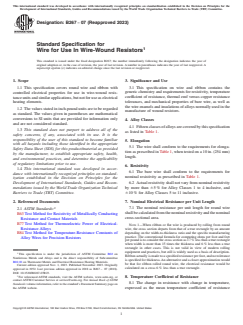
Designation: B267 − 07 (Reapproved 2023)
Standard Specification for
Wire for Use In Wire-Wound Resistors
This standard is issued under the fixed designation B267; the number immediately following the designation indicates the year of
original adoption or, in the case of revision, the year of last revision. A number in parentheses indicates the year of last reapproval. A
superscript epsilon (´) indicates an editorial change since the last revision or reapproval.
1. Scope 3. Significance and Use
3.1 This specification on wire and ribbon contains the
1.1 This specification covers round wire and ribbon with
generic chemistry and requirements for resistivity, temperature
controlled electrical properties for use in wire-wound resis-
coefficient of resistance, thermal emf versus copper resistance
tance units and similar applications, but not for use as electrical
tolerances, and mechanical properties of bare wire, as well as
heating elements.
the wire enamels and insulations of alloys normally used in the
1.2 The values stated in inch-pound units are to be regarded
manufacture of wound resistors.
as standard. The values given in parentheses are mathematical
conversions to SI units that are provided for information only
4. Alloy Classes
and are not considered standard.
4.1 Fifteen classes of alloys are covered by this specification
1.3 This standard does not purport to address all of the
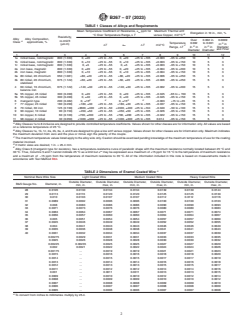
as listed in Table 1.
safety concerns, if any, associated with its use. It is the
responsibility of the user of this standard to become familiar
5. Elongation
with all hazards including those identified in the appropriate
5.1 The wire shall conform to the requirements for elonga-
Safety Data Sheet (SDS) for this product/material as provided
tion as prescribed in Table 1, when tested on a 10 in. (254 mm)
by the manufacturer, to establish appropriate safety, health,
length.
and environmental practices, and determine the applicability
of regulatory limitations prior to use.
6. Resistivity
1.4 This international standard was developed in accor-
6.1 The bare wire shall conform to the requirements for
dance with internationally recognized principles on standard-
nominal resistivity as prescribed in Table 1.
ization established in the Decision on Principles for the
Development of International Standards, Guides and Recom-
6.2 Actual resistivity shall not vary from nominal resistivity
mendations issued by the World Trade Organization Technical by more than 65 % for Alloy Classes 1 to 4 inclusive, and
Barriers to Trade (TBT) Committee.
610 % for Alloy Classes 5 to 11 inclusive.
7. Nominal Electrical Resistance per Unit Length
2. Referenced Documents
7.1 The nominal resistance per unit length for round wire
2.1 ASTM Standards:
shall be calculated from the nominal resistivity and the nominal
B63 Test Method for Resistivity of Metallically Conducting
cross-sectional area.
Resistance and Contact Materials
B77 Test Method for Thermoelectric Power of Electrical-
NOTE 1—When ribbon or flat wire is produced by rolling from round
Resistance Alloys wire, the cross section departs from that of a true rectangle by an amount
depending on the width-to-thickness ratio and the specific manufacturing
B84 Test Method for Temperature-Resistance Constants of
practice. The conventional formula for computing ohms per foot and feet
Alloy Wires for Precision Resistors
per pound is to consider the cross section as 17 % less than a true rectangle
when width is more than 15 times the thickness and 6 % less than a true
rectangle in other cases. This is not valid in view of modern rolling
equipment and practices, but still is widely used as a basis of description.
This specification is under the jurisdiction of ASTM Committee B02 on
Ribbon actually is made to a specified resistance per foot, and no tolerance
Nonferrous Metals and Alloys and is the direct responsibility of Subcommittee
is specified for thickness. An alternative and a closer approximation would
B02.10 on Thermostat Metals and Electrical Resistance Heating Materials.
be that for ribbon rolled round wire, the electrical resistance would be
Current edition approved Nov. 1, 2023. Published November 2023. Originally
calculated on a cross 6 % less than a true rectangle.
approved in 1952. Last previous edition approved in 2018 as B267 – 07 (2018).
DOI: 10.1520/B0267-07R23.
For referenced ASTM standards, visit the ASTM website, www.astm.org, or 8. Temperature Coefficient of Resistance
contact ASTM Customer Service at service@astm.org. For Annual Book of ASTM
8.1 The change in resistance with change in temperature,
Standards volume information, refer to the standard’s Document Summary page on
the ASTM website. expressed as the mean temperature coefficient of resistance
Copyright © ASTM International, 100 Barr Harbor Drive, PO Box C700, West Conshohocken, PA 19428-2959. United States
B267 − 07 (2023)
TABLE 1 Classes of Alloys and Requirements
Mean Temperature Coefficient of Resistance, α ppm for Maximum Thermal emf
m
Elongation in 10 in., min, %
B
°C Over Temperature Range,Δ T versus Copper, mV/°C
Resistivity,
Alloy Alloy Composition,
Over 0.002 in.
0.0009
Ω·cmil/ft
A
Class approximate, % D
Temperature 0.002 to 0.001
in. in
(μΩ·m)
ΔT α ΔT mV/°C
m C
D D
Range, ΔT Diameter
in. in in. in
and Finer
Diameter Diameter
1 2 3 4 5 6 7 8 9 10 11 12
1a nickel base, nonmagnetic 800 (1.330) 0, ±20 +25 to −55 0, ±20 +25 to +105 +0.003 −65 to +250 10 5 3
1b nickel base, nonmagnetic 800 (1.330) 0, ±10 +25 to −55 0, ±10 +25 to +105 +0.003 −65 to +150 10 5 3
1c nickel base, nonmagnetic 800 (1.330) 0, ±5 +25 to −55 0, ±5 +25 to +105 +0.003 −65 to +150 10 5 3
2a iron base, magnetic 800 (1.330) 0, ±20 +25 to −55 0, ±20 +25 to +105 −0.004 −65 to +200 10 5 3
2b iron base, magnetic 800 (1.330) 0, ±10 +25 to −55 0, ±10 +25 to +105 −0.004 −65 to +150 10 5 3
3a 80 nickel, 20 chromium 650 (1.081) +80, ±20 +25 to −55 +80, ±20 +25 to +105 +0.006 −65 to +250 15 5 3
3b 80 nickel, 20 chromium, 675 (1.122) +60, ±20 +25 to −55 +60, ±20 +25 to +105 +0.006 −65 to +250 15 5 3
stabilized
4 60 nickel, 16 chromium, 675 (1.122) +140, ±30 +25 to −55 +140, ±30 +25 to +105 +0.002 −65 to +200 15 5 3
balance iron
5a 55 copper, 45 nickel 300 (0.499) 0, ±20 +25 to −55 0, ±20 +25 to +105 −0.045 −65 to + 150 15 5 3
5b 55 copper, 45 nickel 300 (0.499) 0, ±40 +25 to −55 0, ±40 +25 to +105 −0.045 −65 to +150 15 5 3
E E E E
6 manganin type 290 (0.482) 0, ±15 0, ±15 −0.003 +15 to +35 15 5 3
7 77 copper, 23 nickel 180 (0.299) +180, ±30 +25 to −55 +180, ±30 +25 to +105 −0.037 −65 to +150 15 5 3
8 70 nickel, 30 iron 125 (0.199) +3600, ±400 +25 to −50 +4300, ±400 +25 to +104 −0.040 −50 to +100 15 5 3
9 90 copper, 10 nickel 90 (0.150) +450, ±50 +25 to −55 +450, ±50 +25 to +105 −0.026 −65 to +150 15 5 3
10 94 copper, 6 nickel 60 (0.100) +700, ±200 +25 to −55 +700, ±200 +25 to +105 −0.022 −65 to +150 15 5 3
11 98 copper, 2 nickel 30 (0.050) +1400, ±300 +25 to −55 +1400, ±300 +25 to +105 0.014 −65 to +150 15 5 3
A
Alloy Classes 1a to 8 inclusive are designed to provide controlled temperature coefficients. Values shown for other classes are for information only. All values are based
on a reference temperature of 25 °C.
B
Alloy Classes 1a, 1b, 1c, 2a, 2b, 3a, 4, and 6 are designed to give a low emf versus copper. Values shown for other classes are for information only. Maximum indicates
the maximum deviation from zero and the plus or minus sign the polarity of the couple.
C
The maximum temperature values listed apply to the alloy wire only. Caution should be exercised pending knowledge of the maximum temperature of use for the coating
material involved.
D
If metric sizes are desired, 1 in. = 25.4 mm.
E
Alloy Class 6 (manganin type for resistors), has a temperature-resistance curve of parabolic shape with the maximum resistance normally located between 25 °C and
m
30 °C. Thus, Columns 5 and 7 cannot indicate 25 °C as a limit but α may be expressed as a maximum of +15 ppm for 15 °C to the temperature of maximum resistance
and a maximum of −15 ppm from the temperature of maximum resistance to 35 °C. All of the information included in this note is based on measurements made in
accordance with Test Method B84.
A
TABLE 2 Dimensions of Enamel Coated Wire
Nominal Bare Wire Size Light Coated Wire Medium Coated Wire Heavy Coated Wire
Outside Diameter, Outside Diameter, Outside Diameter, Outside Diameter, Outside Diameter, Outside Diameter,
B&S Gauge No. Diameter, in.
min, in. max, in. min, in. max, in. min, in. max, in.
28 0.0126 0.0130 0.0134 0.0134 0.0139 0.0139 0.0144
29 0.0113 0.0116 0.0120 0.0120 0.0125 0.0125 0.0130
30 0.010 0.0103 0.0107 0.0107 0.0112 0.0112 0.0116
31 0.0089 0.0092 0.0096 0.0096 0.0100 0.0100 0.0103
32 0.008 0.0083 0.0086 0.0086 0.0090 0.0090 0.0093
33 0.0071 0.0073 0.0076 0.0076 0.0080 0.0080 0.0083
34 0.0063 0.0064 0.0067 0.0067 0.0071 0.0071 0.0074
35 0.0056 0.0057 0.0060 0.0060 0.0064 0.0064 0.0067
36 0.005 0.0051 0.0054 0.0054 0.0057 0.0057 0.0060
37 0.0045 0.0046 0.0049 0.0049 0.0052 0.0052 0.0055
38 0.004 0.0041 0.0043 0.0043 0.0046 0.0046 0.0049
39 0.0035 0.0036 0.0038 0.0038 0.0041 0.0041 0.0043
40 0.0031 0.0032 0.0034 0.0034 0.0037 0.0037 0.0039
0.00275 0.0029 0.0031 0.0031 0.0033 0.0033 0.0035
0.0025 0.0026 0.0028 0.0028 0.0030 0.0030 0.0032
0.00225 0.00235 0.0025 0.0025 0.0027 0.0027 0.0029
0.002 0.0021 0.0022 0.0022 0.0024 0.0024 0.0026
0.00175 . 0.0019 0.0019 0.0021 0.0021 0.0023
0.0015 . 0.0016 0.0016 0.0018 0.0018 0.0020
0.0014 . 0.0015 0.0015 0.0017 0.0017 0.0019
0.0013 . 0.0014 0.0014 0.0016 0.0016 0.0018
0.0012 . 0.0013 0.0013 0.0015 0.0015 0.0017
0.0011 . 0.0012 0.0012 0.0014 0.0014 0.0016
0.001 . 0.0011 0.0011 0.0013 0.0013 0.0015
0.0009 . 0.0010 0.0010 0.0012 0.0012 0.0014
0.0008 . 0.0009 0.0009 0.0010 0.0010 0.0012
0.0007 . 0.0008 0.0008 0.0009 0.0009 0.0010
0.0006 . 0.0007 0.0007 0.0008 0.0008 0.0009
0.0005 . 0.0006 0.0006 0.0007 0.0007 0.0008
A
To convert from inches to millimetres multiply by 25.4.
B267 − 07 (2023)
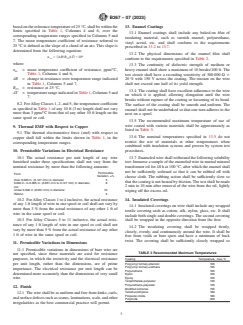
based on the reference temperature of 25 °C, shall be within the 13. Enamel Coatings
limits specified in Table 1, Columns 4 and 6, over the
13.1 Enamel coatings shall include any baked-on film of
corresponding temperature ranges specified in Columns 5 and
insulating material, such as varnish enamel, polyurethane,
7. The mean temperature coefficient of resistance referred to
vinyl acetal, etc. and shall conform to the requir
...