

ASTM F2281-04(2017)
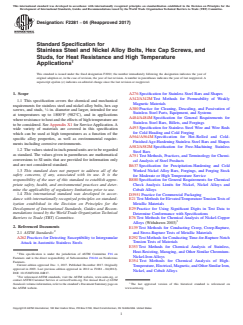
(Specification)Standard Specification for Stainless Steel and Nickel Alloy Bolts, Hex Cap Screws, and Studs, for Heat Resistance and High Temperature Applications
General Information
- Abstract
ABSTRACT
This specification covers the chemical and mechanical requirements for stainless steel and nickel alloy bolts, hex cap screws, and studs intended for use in applications where resistance to heat and the effects of high temperature are to be considered. Three types of materials covered in this specification are: Type I—heat resisting alloys for continuous service applications; Type II—heat resisting alloys for continuous and intermittent service applications; and Type III—high temperature alloys for continuous and intermittent service applications. Type I is classified further into Class A—austenitic grades, Class B—martensitic grades, and Class C—ferritic grades. Type III is also classified further into Class A—nickel based alloy, Class B—precipitation hardened alloy, and Class C—precipitation hardened alloy. The products shall be subject to: chemical analysis; mechanical tests to determine yield strength, wedge tensile strength, or axial tensile strength; and corrosion resistance tests to determine freedom from precipitated carbides.
SCOPE
1.1 This specification covers the chemical and mechanical requirements for stainless steel and nickel alloy bolts, hex cap screws, and studs, 1/4 in. diameter and larger, intended for use at temperatures up to 1800°F (982°C), and in applications where resistance to heat and the effects of high temperature are to be considered. See Appendix X1 for Service Application. A wide variety of materials are covered in this specification which can be used at high temperatures as a function of the specific alloy properties, as well as environmental requirements including corrosive environments.
1.2 The values stated in inch-pound units are to be regarded as standard. The values given in parentheses are mathematical conversions to SI units that are provided for information only and are not considered standard.
1.3 This standard does not purport to address all of the safety concerns, if any, associated with its use. It is the responsibility of the user of this standard to establish appropriate safety, health, and environmental practices and determine the applicability of regulatory limitations prior to use.
1.4 This international standard was developed in accordance with internationally recognized principles on standardization established in the Decision on Principles for the Development of International Standards, Guides and Recommendations issued by the World Trade Organization Technical Barriers to Trade (TBT) Committee.
- Status
- Published
- Publication Date
- 30-Nov-2017
- Technical Committee
- F16 - Fasteners
- Drafting Committee
- F16.04 - Nonferrous Fasteners
Overview
ASTM F2281-04(2017) is the standard specification developed by ASTM International for stainless steel and nickel alloy bolts, hex cap screws, and studs designed for heat resistance and high temperature applications. This standard establishes the chemical and mechanical property requirements for fasteners used in environments where temperatures can reach up to 1800°F (982°C) and where resistance to heat and the effects of high temperature is critical.
The specification covers a range of alloys, categorized into three types according to their performance under heat and high temperature:
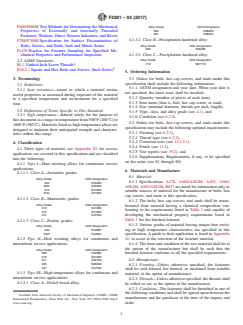
- Type I: Heat-resisting stainless steels for continuous service
- Type II: Heat-resisting stainless steels for continuous and intermittent service
- Type III: High temperature alloys, including nickel-based and precipitation-hardened varieties, for continuous and intermittent service
By following ASTM F2281, manufacturers and end-users ensure that fasteners maintain structural integrity, mechanical strength, and corrosion resistance under demanding thermal conditions.
Key Topics
Material Types and Classes:
- Austenitic, martensitic, and ferritic grades for stainless steels
- Nickel-based and precipitation-hardened alloys, offering diverse options based on service requirements
Mechanical Properties:
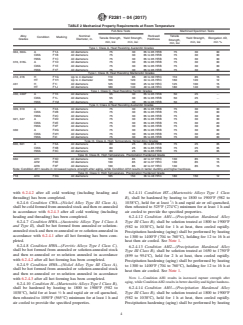
- Fasteners must meet specified tensile strength, yield strength, and elongation requirements at room temperature
- High temperature mechanical properties are outlined for selected alloys
Chemical Composition:
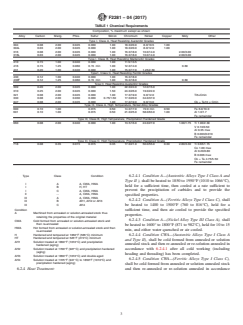
- Strict chemical requirements for each alloy to ensure performance in heat-resistant and corrosive environments
Manufacturing and Testing:
- Methods for forming, heat treatment, and threading
- Requirements for testing, including chemical analysis, mechanical tests, and corrosion resistance tests (e.g., intergranular corrosion for austenitic alloys)
Dimensions and Marking:
- Standard dimensions based on ASME B18.2.1 and B1.1 for bolts, screws, and studs
- Clear marking for manufacturer and alloy type to guarantee traceability and compliance
Inspection and Certification:
- Procedures for lot sampling, inspection, and quality control
- Requirements for certification and test reporting to ensure product quality
Applications
ASTM F2281-compliant bolts, hex cap screws, and studs are essential in applications where exposure to high temperatures and corrosive environments is routine. Typical use cases include:
- Heat exchangers in power generation and chemical processing
- Furnace construction and high temperature processing equipment
- Petrochemical plants where equipment faces thermal cycling and aggressive chemicals
- Aerospace and automotive for engine, exhaust, and turbine components
- Industrial ovens, kilns, and incinerators
Selecting fasteners per this standard enhances equipment reliability, safety, and longevity, minimizing the risk of failure due to heat- or corrosion-induced degradation.
Related Standards
Organizations involved in the manufacture, selection, or use of high-temperature fasteners should also consider the following related ASTM and ASME standards:
- ASTM A276: Stainless Steel Bars and Shapes
- ASTM A484/A484M: General Requirements for Stainless Steel Bars, Billets, and Forgings
- ASTM B637: Precipitation-Hardening and Cold Worked Nickel Alloy Bars, Forgings, and Forging Stock
- ASTM F606/F606M: Mechanical Testing of Externally and Internally Threaded Fasteners
- ASTM A262: Practices for Detecting Susceptibility to Intergranular Attack in Austenitic Stainless Steels
- ASME B1.1: Unified Inch Screw Threads
- ASME B18.2.1: Square and Hex Bolts and Screws
Adhering to these internationally recognized standards alongside ASTM F2281 ensures comprehensive compliance and optimal fastener performance in challenging heat and high temperature environments.
Keywords: ASTM F2281, heat resistant fasteners, high temperature bolts, stainless steel hex cap screws, nickel alloy studs, mechanical properties, corrosion resistance, industrial fasteners, ASTM standards, high temperature applications
Relations
- Effective Date
- 01-Dec-2017
- Effective Date
- 01-Jan-2024
- Effective Date
- 01-Jan-2024
- Effective Date
- 01-Dec-2023
- Effective Date
- 01-Nov-2023
- Effective Date
- 01-Oct-2023
- Effective Date
- 01-Sep-2023
- Effective Date
- 01-Mar-2023
- Effective Date
- 05-May-2020
- Effective Date
- 01-Sep-2019
- Effective Date
- 01-May-2019
- Effective Date
- 01-Nov-2018
- Effective Date
- 01-May-2018
- Effective Date
- 01-Feb-2018
- Effective Date
- 01-Jan-2018
Frequently Asked Questions
ASTM F2281-04(2017) is a technical specification published by ASTM International. Its full title is "Standard Specification for Stainless Steel and Nickel Alloy Bolts, Hex Cap Screws, and Studs, for Heat Resistance and High Temperature Applications". This standard covers: ABSTRACT This specification covers the chemical and mechanical requirements for stainless steel and nickel alloy bolts, hex cap screws, and studs intended for use in applications where resistance to heat and the effects of high temperature are to be considered. Three types of materials covered in this specification are: Type I—heat resisting alloys for continuous service applications; Type II—heat resisting alloys for continuous and intermittent service applications; and Type III—high temperature alloys for continuous and intermittent service applications. Type I is classified further into Class A—austenitic grades, Class B—martensitic grades, and Class C—ferritic grades. Type III is also classified further into Class A—nickel based alloy, Class B—precipitation hardened alloy, and Class C—precipitation hardened alloy. The products shall be subject to: chemical analysis; mechanical tests to determine yield strength, wedge tensile strength, or axial tensile strength; and corrosion resistance tests to determine freedom from precipitated carbides. SCOPE 1.1 This specification covers the chemical and mechanical requirements for stainless steel and nickel alloy bolts, hex cap screws, and studs, 1/4 in. diameter and larger, intended for use at temperatures up to 1800°F (982°C), and in applications where resistance to heat and the effects of high temperature are to be considered. See Appendix X1 for Service Application. A wide variety of materials are covered in this specification which can be used at high temperatures as a function of the specific alloy properties, as well as environmental requirements including corrosive environments. 1.2 The values stated in inch-pound units are to be regarded as standard. The values given in parentheses are mathematical conversions to SI units that are provided for information only and are not considered standard. 1.3 This standard does not purport to address all of the safety concerns, if any, associated with its use. It is the responsibility of the user of this standard to establish appropriate safety, health, and environmental practices and determine the applicability of regulatory limitations prior to use. 1.4 This international standard was developed in accordance with internationally recognized principles on standardization established in the Decision on Principles for the Development of International Standards, Guides and Recommendations issued by the World Trade Organization Technical Barriers to Trade (TBT) Committee.
ABSTRACT This specification covers the chemical and mechanical requirements for stainless steel and nickel alloy bolts, hex cap screws, and studs intended for use in applications where resistance to heat and the effects of high temperature are to be considered. Three types of materials covered in this specification are: Type I—heat resisting alloys for continuous service applications; Type II—heat resisting alloys for continuous and intermittent service applications; and Type III—high temperature alloys for continuous and intermittent service applications. Type I is classified further into Class A—austenitic grades, Class B—martensitic grades, and Class C—ferritic grades. Type III is also classified further into Class A—nickel based alloy, Class B—precipitation hardened alloy, and Class C—precipitation hardened alloy. The products shall be subject to: chemical analysis; mechanical tests to determine yield strength, wedge tensile strength, or axial tensile strength; and corrosion resistance tests to determine freedom from precipitated carbides. SCOPE 1.1 This specification covers the chemical and mechanical requirements for stainless steel and nickel alloy bolts, hex cap screws, and studs, 1/4 in. diameter and larger, intended for use at temperatures up to 1800°F (982°C), and in applications where resistance to heat and the effects of high temperature are to be considered. See Appendix X1 for Service Application. A wide variety of materials are covered in this specification which can be used at high temperatures as a function of the specific alloy properties, as well as environmental requirements including corrosive environments. 1.2 The values stated in inch-pound units are to be regarded as standard. The values given in parentheses are mathematical conversions to SI units that are provided for information only and are not considered standard. 1.3 This standard does not purport to address all of the safety concerns, if any, associated with its use. It is the responsibility of the user of this standard to establish appropriate safety, health, and environmental practices and determine the applicability of regulatory limitations prior to use. 1.4 This international standard was developed in accordance with internationally recognized principles on standardization established in the Decision on Principles for the Development of International Standards, Guides and Recommendations issued by the World Trade Organization Technical Barriers to Trade (TBT) Committee.
ASTM F2281-04(2017) is classified under the following ICS (International Classification for Standards) categories: 21.060.10 - Bolts, screws, studs. The ICS classification helps identify the subject area and facilitates finding related standards.
ASTM F2281-04(2017) has the following relationships with other standards: It is inter standard links to ASTM F2281-04(2012), ASTM A484/A484M-24, ASTM F1470-24, ASTM B637-23, ASTM A493-23, ASTM D3951-18(2023), ASTM A484/A484M-23a, ASTM A484/A484M-23, ASTM A484/A484M-20a, ASTM A484/A484M-19, ASTM A564/A564M-19, ASTM A484/A484M-18a, ASTM D3951-18, ASTM F1470-18, ASTM A484/A484M-18. Understanding these relationships helps ensure you are using the most current and applicable version of the standard.
ASTM F2281-04(2017) is available in PDF format for immediate download after purchase. The document can be added to your cart and obtained through the secure checkout process. Digital delivery ensures instant access to the complete standard document.
Standards Content (Sample)
This international standard was developed in accordance with internationally recognized principles on standardization established in the Decision on Principles for the
Development of International Standards, Guides and Recommendations issued by the World Trade Organization Technical Barriers to Trade (TBT) Committee.
Designation:F2281 −04 (Reapproved 2017)
Standard Specification for
Stainless Steel and Nickel Alloy Bolts, Hex Cap Screws, and
Studs, for Heat Resistance and High Temperature
Applications
This standard is issued under the fixed designation F2281; the number immediately following the designation indicates the year of
original adoption or, in the case of revision, the year of last revision. A number in parentheses indicates the year of last reapproval. A
superscript epsilon (´) indicates an editorial change since the last revision or reapproval.
1. Scope A276 Specification for Stainless Steel Bars and Shapes
A342/A342M Test Methods for Permeability of Weakly
1.1 This specification covers the chemical and mechanical
Magnetic Materials
requirements for stainless steel and nickel alloy bolts, hex cap
A380 Practice for Cleaning, Descaling, and Passivation of
screws, and studs, ⁄4 in. diameter and larger, intended for use
Stainless Steel Parts, Equipment, and Systems
at temperatures up to 1800°F (982°C), and in applications
A484/A484M Specification for General Requirements for
where resistance to heat and the effects of high temperature are
Stainless Steel Bars, Billets, and Forgings
to be considered. See Appendix X1 for ServiceApplication.A
A493 Specification for Stainless Steel Wire and Wire Rods
wide variety of materials are covered in this specification
for Cold Heading and Cold Forging
which can be used at high temperatures as a function of the
A564/A564M Specification for Hot-Rolled and Cold-
specific alloy properties, as well as environmental require-
Finished Age-Hardening Stainless Steel Bars and Shapes
ments including corrosive environments.
A582/A582M Specification for Free-Machining Stainless
1.2 The values stated in inch-pound units are to be regarded
Steel Bars
as standard. The values given in parentheses are mathematical
A751 Test Methods, Practices, and Terminology for Chemi-
conversions to SI units that are provided for information only
cal Analysis of Steel Products
and are not considered standard.
B637 Specification for Precipitation-Hardening and Cold
1.3 This standard does not purport to address all of the
Worked Nickel Alloy Bars, Forgings, and Forging Stock
safety concerns, if any, associated with its use. It is the for Moderate or High Temperature Service
responsibility of the user of this standard to establish appro-
B880 Specification for General Requirements for Chemical
priate safety, health, and environmental practices and deter-
Check Analysis Limits for Nickel, Nickel Alloys and
mine the applicability of regulatory limitations prior to use. Cobalt Alloys
1.4 This international standard was developed in accor-
D3951 Practice for Commercial Packaging
dance with internationally recognized principles on standard- E21 TestMethodsforElevatedTemperatureTensionTestsof
ization established in the Decision on Principles for the
Metallic Materials
Development of International Standards, Guides and Recom- E29 Practice for Using Significant Digits in Test Data to
mendations issued by the World Trade Organization Technical
Determine Conformance with Specifications
Barriers to Trade (TBT) Committee. E76 Test Methods for Chemical Analysis of Nickel-Copper
Alloys (Withdrawn 2003)
2. Referenced Documents
E139 Test Methods for Conducting Creep, Creep-Rupture,
2.1 ASTM Standards: and Stress-Rupture Tests of Metallic Materials
E292 Test Methods for Conducting Time-for-Rupture Notch
A262 Practices for Detecting Susceptibility to Intergranular
Attack in Austenitic Stainless Steels Tension Tests of Materials
E353 Test Methods for Chemical Analysis of Stainless,
Heat-Resisting, Maraging, and Other Similar Chromium-
This specification is under the jurisdiction of ASTM Committee F16 on
Nickel-Iron Alloys
Fasteners and is the direct responsibility of Subcommittee F16.04 on Nonferrous
Fasteners. E354 Test Methods for Chemical Analysis of High-
Current edition approved Dec. 1, 2017. Published December 2017. Originally
Temperature,Electrical,Magnetic,andOtherSimilarIron,
approved in 2003. Last previous edition approved in 2012 as F2281 – 04(2012).
Nickel, and Cobalt Alloys
DOI: 10.1520/F2281-04R17.
For referenced ASTM standards, visit the ASTM website, www.astm.org, or
contact ASTM Customer Service at service@astm.org. For Annual Book of ASTM
Standards volume information, refer to the standard’s Document Summary page on The last approved version of this historical standard is referenced on
the ASTM website. www.astm.org.
Copyright © ASTM International, 100 Barr Harbor Drive, PO Box C700, West Conshohocken, PA 19428-2959. United States
F2281−04 (2017)
F606/F606M Test Methods for Determining the Mechanical
Alloy Grade UNS Designation
600 N06600
Properties of Externally and Internally Threaded
601 N06601
Fasteners, Washers, Direct Tension Indicators, and Rivets
4.1.3.2 Class B—Precipitation hardened alloy:
F788/F788M Specification for Surface Discontinuities of
Bolts, Screws, and Studs, Inch and Metric Series Alloy Grade UNS Designation
660 S66286
F1470 Practice for Fastener Sampling for Specified Me-
4.1.3.3 Class C—Precipitation hardened alloy:
chanical Properties and Performance Inspection
Alloy Grade UNS Designation
2.2 ASME Standards:
718 N07718
B1.1 Unified Inch Screw Threads
B18.2.1 Square and Hex Bolts and Screws, (Inch Series)
5. Ordering Information
3. Terminology 5.1 Orders for bolts, hex cap screws, and studs under this
specification shall include the following information:
3.1 Definitions:
5.1.1 ASTM designation and year date. When year date is
3.1.1 heat resistance—extent to which a material retains
not specified, the latest issue shall be invoked;
useful properties as measured during exposure of the material
5.1.2 Quantity (number of pieces of each item),
to a specified temperature and environment for a specified
5.1.3 Item name (that is, bolt, hex cap screw, or stud),
time.
5.1.4 Size (nominal diameter, threads per inch, length),
3.2 Definitions of Terms Specific to This Standard:
5.1.5 Type, class, and alloy grade (see 4.1), and
3.2.1 high temperature—defined solely for the purpose of
5.1.6 Condition (see 6.2.3).
thisdocumentasarangeintemperaturefrom500°F(260°C)to
5.2 Orders for bolts, hex cap screws, and studs under this
1800°F(982°C).Materialslistedashightemperaturealloysare
specification may include the following optional requirements:
designed to maintain their anticipated strength and character-
5.2.1 Forming (see 6.2.1),
istics within this range.
5.2.2 Thread type (see 6.2.2),
5.2.3 Corrosion tests (see 13.1.2.1),
4. Classification
5.2.4 Finish (see 11.3),
4.1 Three types of material, see Appendix X1 for service
5.2.5 Test reports (see 19.2), and
application, are covered in this specification and are classified
5.2.6 Supplementary Requirements, if any, to be specified
into the following:
on the order (see S1 through S8).
4.1.1 Type I—Heat resisting alloys for continuous service
applications:
6. Materials and Manufacture
4.1.1.1 Class A—Austenitic grades:
6.1 Material:
Alloy Grade UNS Designation
6.1.1 Specifications A276, A484/A484M, A493, A564/
304 S30400
304L S30403
A564M,A582/A582M,B637arenotedforinformationonlyas
316 S31600
suitable sources of material for the manufacture of bolts, hex
316L S31603
cap screws, and studs to this specification.
4.1.1.2 Class B—Martensitic grades:
6.1.2 The bolts, hex cap screws, and studs shall be manu-
Alloy Grade UNS Designation
factured from material having a chemical composition con-
410 S41000
forming to the requirements listed in Table 1 and capable of
416 S41600
431 S43100
developing the mechanical property requirements listed in
Table 2 for the finished fastener.
4.1.1.3 Class C—Ferritic grades:
6.1.3 Various grades of material having unique heat resist-
Alloy Grade UNS Designation
ing or high temperature characteristics are specified in this
430 S43000
430F S43020
specification.Aguide to their application is listed in Appendix
4.1.2 Type II—Heat resisting alloys for continuous and X1 to assist in the selection of the fastener material.
6.1.4 The form and condition of the raw material shall be at
intermittent service applications:
the option of the manufacturer but shall be such that the
Alloy Grade UNS Designation
309 S30900 finished fastener conforms to all the specified requirements.
310 S31000
6.2 Manufacture:
321 S32100
330 N08330
6.2.1 Forming—Unless otherwise specified, the fasteners
347 S34700
shall be cold formed, hot formed, or machined from suitable
4.1.3 Type III—High temperature alloys for continuous and
material, at the option of manufacturer.
intermittent service applications:
6.2.2 Threads—Unless otherwise specified, the threads shall
4.1.3.1 Class A—Nickel based alloy:
be rolled or cut, at the option of the manufacturer.
6.2.3 Condition—The fasteners shall be furnished in one of
the following conditions and shall be agreed upon between the
Available from American Society of Mechanical Engineers (ASME), ASME
manufacturer and the purchaser at the time of the inquiry and
International Headquarters, Three Park Ave., New York, NY 10016-5990, http://
www.asme.org. order.
F2281−04 (2017)
TABLE 1 Chemical Requirements
Composition, % maximum except as shown
Alloy Carbon Mang. Phos. Sulfur Silicon Chromium Nickel Copper Moly Other
Type I, Class A, Heat Resisting Austenitic Grades
304 0.08 2.00 0.045 0.030 1.00 18.0/20.0 8.0/10.5 1.00
304L 0.03 2.00 0.045 0.030 1.00 18.0/20.0 8.0/12.0 1.00
316 0.08 2.00 0.045 0.030 1.00 16.0/18.0 10.0/14.0 2.00/3.00
316L 0.03 2.00 0.045 0.030 1.00 16.0/18.0 10.0/14.0 2.00/3.00
Type I, Class B, Heat Resisting Martensitic Grades
410 0.15 1.00 0.040 0.030 1.00 11.5/13.5
416 0.15 1.25 0.060 0.15 min 1.00 12.0/14.0 0.60
431 0.20 1.00 0.040 0.030 1.00 15.0/17.0 1.25/2.50
Type1, Class C, Heat Resisting Ferritic Grades
430 0.12 1.00 0.040 0.030 1.00 16.0/18.0
430F 0.12 1.25 0.060 0.15 min 1.00 16.0/18.0 0.60
Type II, Heat Resisting Austenitic Grades
309 0.20 2.00 0.045 0.030 1.00 22.0/24.0 12.0/15.0
310 0.25 2.00 0.045 0.030 1.50 24.0/26.0 19.0/22.0
321 0.08 2.00 0.045 0.030 1.00 17.0/19.0 9.0/12.0 Ti5×Cmin
330 0.08 2.00 0.030 0.030 0.75/1.50 17.0/20.0 34.0/37.0
347 0.08 2.00 0.045 0.030 1.00 17.0/19.0 9.0/13.0 Cb + Ta10 × Cmin
Type III, Class A, High Temperature, Nickel Alloy Grades
600 0.10 1.00 0.015 0.50 14.0/17.0 72.0 min 0.50 Fe 6.0/10.0
601 0.10 1.00 0.015 0.50 21.0/25.0 58.0/63.0 1.00 Al 1.0/1.7
Fe remainder
Type III, Class B, High Temperature, Precipitation Hardened Grade
660 0.08 2.00 0.040 0.030 1.00 13.5/16.0 24.0/27.0 1.00/1.75 Ti 1.90/2.30
V 0.10/0.50
Al 0.35 max
B 0.003/0.010
Fe remainder
Type III, Class C, High Temperature, Precipitation Hardened Grade
718 0.08 0.35 0.015 0.015 0.35 17.0/21.0 50.0/55.0 0.30 2.80/3.30 Ti 0.65/1.15
Co 1.00 max
Al 0.20/0.80
B 0.006 max
Cb + Ta 4.75/5.50
Fe remainder
6.2.4.1 Condition A—(Austenitic Alloys Type I Class A and
Type Class Condition
Type II ), shall be heated to 1850 to 1950°F (1010 to 1066°C),
I A A, CWA, HWA
held for a sufficient time, then cooled at a rate sufficient to
I B H, HT
prevent the precipitation of carbides and to provide the
I C A, CWA, HWA
II . A, CWA, HWA
specified properties.
III A A,CWA,HWA
6.2.4.2 Condition A—(Ferritic Alloys Type I Class C), shall
III B AH1, AH2 or AH3
III C AH4 be heated to 1400 to 1500°F (760 to 816°C), held for a
Condition sufficient time, and then air cooled to provide the specified
A Machined from annealed or solution-annealed stock thus
properties.
retaining the properties of the original material
6.2.4.3 Condition A—(Nickel Alloy Type III Class A), shall
CWA Cold formed from annealed or solution-annealed stock and
then re-annealed
be heated to 1600° to 1800°F (871 to 982°C), held for 10 to 15
HWA Hot formed from annealed or solution-annealed stock and then
min, and either water quenched or air cooled.
re-annealed
H Hardened and tempered at 1050°F (565°C) minimum
6.2.4.4 Condition CWA—(Austenitic Alloys Type I Class A
HT Hardened and tempered at 525°F (274°C) minimum
and Type II), shall be cold formed from annealed or solution
AH1 Solution treated at 1850°F (1010°C) and precipitation
annealed stock and then re-annealed or re-solution annealed in
hardened (aging)
AH2 Solution treated at 1700°F (927°C) and precipitation hardened
accordance with 6.2.4.1 after all cold working (including
(aging)
heading and threading) has been completed.
AH3 Solution treated at 1850°F (1010°C) and double aged
6.2.4.5 Condition CWA—(Ferritic Alloys Type I Class C),
AH4 Solution treated at 1725°F (941°C) to 1850°F (1010°C) and
precipitation hardened (aging)
shall be cold formed from annealed or solution annealed stock
6.2.4 Heat Treatment: and then re-annealed or re-solution annealed in accordance
F2281−04 (2017)
TABLE 2 Mechanical Property Requirements at Room Temperature
Full-Size Tests Machined Specimen Tests
Alloy Nominal Rockwell
Tensile
Condition Marking
Tensile Strength, Yield Strength, Yield Strength, Elongation 4D,
Grades Diameter, in. Hardness
Strength,
min, ksi min, ksi min, ksi min %
min, ksi
Type I, Class A, Heat Resisting Austenitic Grades
304, 304L A F1A All diameters 75 30 65 to 95 HRB 75 30 30
CWA F1B All diameters 75 30 65 to 95 HRB 75 30 30
HWA F1C All diameters 75 30 65 to 95 HRB 75 30 30
316, 316L A F1D All diameters 75 30 65 to 95 HRB 75 30 30
CWA F1E All diameters 75 30 65 to 95 HRB 75 30 30
HWA F1F All diameters 75 30 65 to 95 HRB 75 30 30
Type I, Class B, Heat Resisting Martensitic Grades
410, 416 H F1G Up to 4 diameter 110 85 20 to 30 HRC 110 85 15
HT F1H Up to 4 diameter 160 120 34 to 45 HRC 160 120 12
431 H F1I All diameters 125 100 25 to 32 HRC 125 100 15
HT F1J All diameters 180 140 40 to 48 HRC 180 140 10
Type I, Class C, Heat Resisting Ferritic Grades
430, 430F A F1K All diameters 55 30 65 to 95 HRB 50 25 .
CWA F1L All diameters 55 30 65 to 95 HRB 50 25 .
HWA F1M All diameters 55 30 65 to 95 HRB 50 25 .
Type II, Class A Heat Resisting Austenitic Grades
309, 310 A F2A All diameters 75 30 85 to 95 HRB 75 30 30
CWA F2B All diameters 75 30 65 to 95 HRB 75 30 30
HWA F2C All diameters 75 30 65 to 95 HRB 75 30 30
321, 347 A F2D All diameters 75 30 85 to 95 HRB 75 30 30
CWA F2E All diameters 75 30 65 to 95 HRB 75 30 20
HWA F2F All diameters 75 30 65 to 95 HRB 75 30 30
330 A F2G All diameters 75 30 85 to 95 HRB 75 30 30
CWA F2H All diameters 75 30 65 to 95 HRB 75 30 20
HWA F2I All diameters 75 30 65 to 95 HRB 75 30 30
Type III, Class A, High Temperature, Nickel Alloy Grades
600, 601 A F3A All diameters 80 25 65 to 85 HRB 75 25 35
CWA F3B All diameters 80 25 65 to 85 HRB 75 25 35
HWA F3C All diameters 80 25 65 to 85 HRB 75 25 35
Type III, Class B, High Temperature, Precipitation Hardened Grade
660 AH1 F3D All diameters 130 85 22 to 37 HRC 130 85 15
AH2 F3E All diameters 130 85 22 to 37 HRC 130 85 15
AH3 F3F All diameters 130 85 22 to 37 HRC 130 85 15
Note: Condition AH1 results in increased rupture strength after aging, while Condition AH2 results in better ductility and higher hardness.
Type III, Class C High Temperature, Precipitation Hardened Grade
718 AH4 F3G All diameters 185 150 36 to 48 HRC 180 150 12
with 6.2.4.2 after all cold working (including heading and 6.2.4.11 Condition HT—(Martensitic Alloys Type 1 Class
threading) has been completed. B), shall be hardened by heating to 1800 to 1900°F (982 to
6.2.4.6 Condition CWA—(Nickel Alloy Type III Class A), 1038°C), held for at least ⁄2 h and rapid air or oil quenched,
shall be cold formed from annealed stock and then re-annealed then reheated to 525°F (274°C) minimum for at least1hand
in accordance with 6.2.4.3 after all cold working (including air cooled to provide the specified properties.
heading and threading) has been completed.
6.2.4.12 Condition AH1—(Precipitation Hardened Alloy
6.2.4.7 Condition HWA—(Austenitic Alloys Type I Class A
Type III Class B), shall be solution treated at 1800 to 1900°F
and Type II), shall be hot formed from annealed or solution-
(982 to 1038°C), held for1hat heat, then cooled rapidly.
annealed stock and then re-annealed or re-solution annealed in
Precipitation hardening (aging) shall be performed by heating
accordance with 6.2.4.1 after all hot forming has been com-
to 1300 to 1400°F (704 to 760°C), holding for 12 to 16 h at
pleted.
heat then air cooled. See Note 1.
6.2.4.8 Condition HWA—(Ferritic Alloys Type I Class C),
6.2.4.13 Condition AH2—(Precipitation Hardened Alloy
shall be hot formed from annealed or solution-annealed stock
Type III Class B), shall be solution treated at 1650 to 1750°F
and then re-annealed or re-solution annealed in accordance
(899 to 954°C), held for 2 h at heat, then cooled rapidly.
with 6.2.4.2 after all hot forming has been completed.
Precipitation hardening (aging) shall be performed by heating
6.2.4.9 Condition HWA—(Nickel Alloy Type III Class A),
to 1300 to 1400°F (704 to 760°C), holding for 12 to 16 h at
shall be hot formed from annealed or solution-annealed stock
heat then air cooled. See Note 1.
and then re-annealed or re-solution annealed in accordance
NOTE 1—Condition AH1 results in increased rupture strength after
with 6.2.4.3 after all hot forming has been completed.
aging,whileConditionAH2resultsinbetterductilityandhigherhardness.
6.2.4.10 Condition H—(Martensitic Alloys Type I Class B),
shall be hardened by heating to 1800 to 1900°F (982 to 6.2.4.14 Condition AH3—(Precipitation Hardened Alloy
1038°C), held for at least ⁄2 h and rapid air or oil quenched, Type III Class B), shall be solution treated at 1800 to 1900°F
then reheated to 1050°F (565°C) minimum for at least1hand (982 to 1038°C), held for1hat heat, then cooled rapidly.
air cooled to provide the specified properties. Precipitation hardening (aging) shall be performed by heating
F2281−04 (2017)
TABLE 3 Elevated Temperature Mechanical Property
to 1425 6 25°F (775 6 14°C) holding for 16 h at heat then air
Requirements for Type III High Temperature Alloys
cooled.Heatedagainto1200 625°F(650 614°C)holdingfor
Tensile Yield 0.2 % Elongation
16 h at heat then air cooled. Temperature
Strength, Strength, in2in.,
6.2.4.15 Condition AH4—(Precipitation Hardened Alloy
°F °C
ksi, min ksi, min %, min
Type III Class C), shall be solution treated at 1725°F (941°C)
Class A—Nickel Based Alloys
to 1850°F (1010°C), held at the selected temperature for a time Alloy Grade 600 Annealed at 1600°F (871°C)
600 316 89.0 34.0 45.0
commensurate with cross-sectional thickness, and cooled at a
1000 538 82.0 33.0 42.0
rate equivalent to an air cool or faster. Solution treating
1400 760 37.0 26.0 70.0
temperatures shall be controlled in a range of 625°F (614°C).
1800 982 11.0 5.0 115.0
Alloy Grade 601 Annealed at 1800°F (982°C)
Precipitation hardening (aging) shall be performed by heating
800 427 104.0 54.5 36.0
to 1325°F (718°C) held at heat for 8 h, cooled to 1150°F
1000 538 94.8 51.5 34.0
(621°C) at a rate of 100°F (56°C)/h, held for8hat heat and air 1200 649 73.5 46.5 32.0
1400 760 37.3 36.6 88.0
cooled. Alternatively, parts may be furnace cooled to 1150°F
1800 982 8.7 7.5 173.0
(621°C) at any rate provided the time at 1150°F (621°C) is
Class B—Precipitation Hardened Alloys
adjusted so the total heat treat time is 18 h minimum. Alloy Grade 660
800 427 138.0 93.0 18.0
Precipitation treatment temperatures and cooling rates shall be
1000 538 131.0 87.5 18.0
controlled in the range of 615°F (68°
...