

ASTM E2688-23
(Practice)Standard Practice for Specimen Preparation and Mounting of Tapes to Assess Surface Burning Characteristics
General Information
- Abstract
SIGNIFICANCE AND USE
5.1 Building products made with tapes are often used for applications for which Test Method E84 is used for compliance with building, life safety code or mechanical code requirements. This practice describes, in detail, specimen mounting procedures for tapes.
5.2 Codes are often silent with regard to testing tapes for the assessment of flame spread and smoke development as surface burning characteristics. This practice describes specimen preparation and mounting procedures for such materials and products.
5.3 The material shall be representative of the materials used in actual field installations.
5.4 The limitations for this procedure are those associated with Test Method E84.
SCOPE
1.1 This practice covers a procedure for specimen preparation and mounting when testing tapes to assess flame spread and smoke development as surface burning characteristics using Test Method E84. Tapes are to be tested in full coverage as applied to fiber cement board as described in Test Method E84.
1.2 This practice applies to any tape intended for various uses within buildings.
1.3 Testing is conducted in accordance with Test Method E84.
1.4 This practice does not provide pass/fail criteria that can be used as a regulatory tool.
1.5 This practice is not for system evaluation. It is for the comparison of the materials only.
1.6 Use the values stated in inch-pound units as the standard, in referee decisions. The values in the SI system of units are given in parentheses, for information only; see IEEE/ASTM SI-10 for further details.
1.7 This fire standard cannot be used to provide quantitative measures.
1.8 Fire testing is inherently hazardous. Adequate safeguards for personnel and property shall be employed in conducting these tests.
1.9 This standard gives instructions on specimen preparation and mounting, but the fire-test-response method is given in Test Method E84. See also Section 9.
1.10 The text of this standard references notes and footnotes which provide explanatory material. These notes and footnotes shall not be considered requirements of the standard.
1.11 This standard does not purport to address all of the safety concerns, if any, associated with its use. It is the responsibility of the user of this standard to establish appropriate safety, health, and environmental practices and determine the applicability of regulatory limitations prior to use.
1.12 This international standard was developed in accordance with internationally recognized principles on standardization established in the Decision on Principles for the Development of International Standards, Guides and Recommendations issued by the World Trade Organization Technical Barriers to Trade (TBT) Committee.
- Status
- Published
- Publication Date
- 14-Dec-2023
- Technical Committee
- E05 - Fire Standards
- Drafting Committee
- E05.22 - Surface Burning
Buy Documents
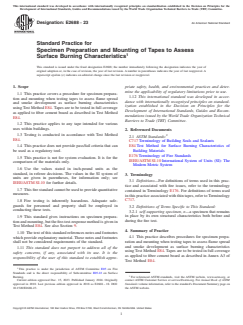


ASTM E2688-23 - Standard Practice for Specimen Preparation and Mounting of Tapes to Assess Surface Burning Characteristics
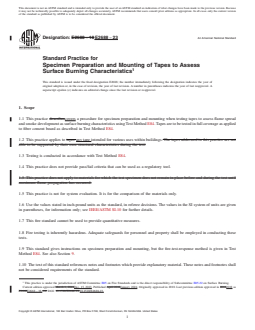
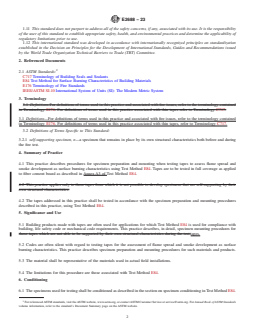


REDLINE ASTM E2688-23 - Standard Practice for Specimen Preparation and Mounting of Tapes to Assess Surface Burning Characteristics
Overview
ASTM E2688-23, Standard Practice for Specimen Preparation and Mounting of Tapes to Assess Surface Burning Characteristics, provides detailed guidance on preparing and mounting tape specimens for fire tests. This standard addresses the evaluation of the surface burning characteristics of tapes, focusing on flame spread and smoke development, using the established ASTM E84 Test Method. It is managed by ASTM Committee E05 on Fire Standards.
Building products that incorporate tapes are commonly used in construction, where assessment of their performance in fire scenarios is essential to meet building, mechanical, and life safety code requirements. ASTM E2688-23 ensures that specimen preparation and mounting are consistent and representative of real-world installations, improving the reliability and comparability of fire test results.
Key Topics
- Applicability: Covers tapes used in buildings that are not structurally self-supporting during fire testing.
- Specimen Preparation: Specifies the procedure for preparing tape specimens by applying them to a fiber-cement board (or metal when appropriate) with full coverage, reflecting field applications.
- Mounting Techniques: Details methods for mounting tape using only manufacturer-applied adhesives. When necessary, limited use of nails or staples is permitted to maintain tape placement during the test.
- Testing Procedure: Directs all testing to be executed per ASTM E84, the standard test method for surface burning characteristics of building materials.
- Limitations:
- The practice is not for full system evaluations but allows for direct comparison of different tape products.
- Does not establish pass/fail criteria or quantitative performance measures suitable for regulatory use.
- Safety Considerations: Highlights the inherently hazardous nature of fire testing, recommending appropriate safeguards for personnel and property and adherence to E84 safety procedures.
Applications
ASTM E2688-23 is primarily used by:
- Manufacturers of Building Tapes: To prepare specimens for compliance testing to demonstrate flame spread and smoke development characteristics of their products.
- Testing Laboratories: For standardized preparation and mounting of tape materials during fire testing, ensuring consistent results.
- Building Code Officials and Designers: As a reference for evaluating the fire performance of tape materials intended for use in various building assemblies.
- Quality Assurance and Product Development: For comparing the surface burning characteristics of various tape products in controlled laboratory settings.
Typical products tested under this standard include adhesive tapes for seams, vapor barriers, electrical insulation, and other specialized tapes used within wall systems, HVAC assemblies, and throughout building construction.
Related Standards
- ASTM E84: Test Method for Surface Burning Characteristics of Building Materials - The principal fire test referenced for assessing flame spread and smoke development.
- ASTM C717: Terminology of Building Seals and Sealants - For definitions related to tapes and thin-film materials.
- ASTM E176: Terminology of Fire Standards - Provides definitions for fire-related terms used in this practice.
- IEEE/ASTM SI-10: International System of Units (SI): The Modern Metric System - For guidance on unit usage and conversions.
Adhering to ASTM E2688-23 ensures that tape materials used in buildings can be reliably assessed for fire response, supporting building safety objectives and regulatory compliance. This standard provides essential guidance for those responsible for product certification, specification, and fire performance evaluation of tapes in the built environment.
Relations
- Effective Date
- 15-Dec-2023
- Effective Date
- 01-Jan-2024
- Effective Date
- 01-Dec-2023
- Effective Date
- 15-Dec-2023
- Referred By
ASTM E84-23c - Standard Test Method for Surface Burning Characteristics of Building Materials - Effective Date
- 15-Dec-2023
Buy Documents
ASTM E2688-23 - Standard Practice for Specimen Preparation and Mounting of Tapes to Assess Surface Burning Characteristics
REDLINE ASTM E2688-23 - Standard Practice for Specimen Preparation and Mounting of Tapes to Assess Surface Burning Characteristics
Get Certified
Connect with accredited certification bodies for this standard

CIS Institut d.o.o.
Personal Protective Equipment (PPE) certification body. Notified Body NB-2890 for EU Regulation 2016/425 PPE.

Kiwa BDA Testing
Building and construction product certification.
Kmetijski inštitut Slovenije
Agricultural Institute of Slovenia. Soil testing, plant health, agricultural product analysis.
Sponsored listings
Frequently Asked Questions
ASTM E2688-23 is a standard published by ASTM International. Its full title is "Standard Practice for Specimen Preparation and Mounting of Tapes to Assess Surface Burning Characteristics". This standard covers: SIGNIFICANCE AND USE 5.1 Building products made with tapes are often used for applications for which Test Method E84 is used for compliance with building, life safety code or mechanical code requirements. This practice describes, in detail, specimen mounting procedures for tapes. 5.2 Codes are often silent with regard to testing tapes for the assessment of flame spread and smoke development as surface burning characteristics. This practice describes specimen preparation and mounting procedures for such materials and products. 5.3 The material shall be representative of the materials used in actual field installations. 5.4 The limitations for this procedure are those associated with Test Method E84. SCOPE 1.1 This practice covers a procedure for specimen preparation and mounting when testing tapes to assess flame spread and smoke development as surface burning characteristics using Test Method E84. Tapes are to be tested in full coverage as applied to fiber cement board as described in Test Method E84. 1.2 This practice applies to any tape intended for various uses within buildings. 1.3 Testing is conducted in accordance with Test Method E84. 1.4 This practice does not provide pass/fail criteria that can be used as a regulatory tool. 1.5 This practice is not for system evaluation. It is for the comparison of the materials only. 1.6 Use the values stated in inch-pound units as the standard, in referee decisions. The values in the SI system of units are given in parentheses, for information only; see IEEE/ASTM SI-10 for further details. 1.7 This fire standard cannot be used to provide quantitative measures. 1.8 Fire testing is inherently hazardous. Adequate safeguards for personnel and property shall be employed in conducting these tests. 1.9 This standard gives instructions on specimen preparation and mounting, but the fire-test-response method is given in Test Method E84. See also Section 9. 1.10 The text of this standard references notes and footnotes which provide explanatory material. These notes and footnotes shall not be considered requirements of the standard. 1.11 This standard does not purport to address all of the safety concerns, if any, associated with its use. It is the responsibility of the user of this standard to establish appropriate safety, health, and environmental practices and determine the applicability of regulatory limitations prior to use. 1.12 This international standard was developed in accordance with internationally recognized principles on standardization established in the Decision on Principles for the Development of International Standards, Guides and Recommendations issued by the World Trade Organization Technical Barriers to Trade (TBT) Committee.
SIGNIFICANCE AND USE 5.1 Building products made with tapes are often used for applications for which Test Method E84 is used for compliance with building, life safety code or mechanical code requirements. This practice describes, in detail, specimen mounting procedures for tapes. 5.2 Codes are often silent with regard to testing tapes for the assessment of flame spread and smoke development as surface burning characteristics. This practice describes specimen preparation and mounting procedures for such materials and products. 5.3 The material shall be representative of the materials used in actual field installations. 5.4 The limitations for this procedure are those associated with Test Method E84. SCOPE 1.1 This practice covers a procedure for specimen preparation and mounting when testing tapes to assess flame spread and smoke development as surface burning characteristics using Test Method E84. Tapes are to be tested in full coverage as applied to fiber cement board as described in Test Method E84. 1.2 This practice applies to any tape intended for various uses within buildings. 1.3 Testing is conducted in accordance with Test Method E84. 1.4 This practice does not provide pass/fail criteria that can be used as a regulatory tool. 1.5 This practice is not for system evaluation. It is for the comparison of the materials only. 1.6 Use the values stated in inch-pound units as the standard, in referee decisions. The values in the SI system of units are given in parentheses, for information only; see IEEE/ASTM SI-10 for further details. 1.7 This fire standard cannot be used to provide quantitative measures. 1.8 Fire testing is inherently hazardous. Adequate safeguards for personnel and property shall be employed in conducting these tests. 1.9 This standard gives instructions on specimen preparation and mounting, but the fire-test-response method is given in Test Method E84. See also Section 9. 1.10 The text of this standard references notes and footnotes which provide explanatory material. These notes and footnotes shall not be considered requirements of the standard. 1.11 This standard does not purport to address all of the safety concerns, if any, associated with its use. It is the responsibility of the user of this standard to establish appropriate safety, health, and environmental practices and determine the applicability of regulatory limitations prior to use. 1.12 This international standard was developed in accordance with internationally recognized principles on standardization established in the Decision on Principles for the Development of International Standards, Guides and Recommendations issued by the World Trade Organization Technical Barriers to Trade (TBT) Committee.
ASTM E2688-23 is classified under the following ICS (International Classification for Standards) categories: 13.220.40 - Ignitability and burning behaviour of materials and products. The ICS classification helps identify the subject area and facilitates finding related standards.
ASTM E2688-23 has the following relationships with other standards: It is inter standard links to ASTM E2688-18, ASTM E176-24, ASTM E84-23d, ASTM E176-21ae1, ASTM E84-23c. Understanding these relationships helps ensure you are using the most current and applicable version of the standard.
ASTM E2688-23 is available in PDF format for immediate download after purchase. The document can be added to your cart and obtained through the secure checkout process. Digital delivery ensures instant access to the complete standard document.
Standards Content (Sample)
This international standard was developed in accordance with internationally recognized principles on standardization established in the Decision on Principles for the
Development of International Standards, Guides and Recommendations issued by the World Trade Organization Technical Barriers to Trade (TBT) Committee.
Designation: E2688 − 23 An American National Standard
Standard Practice for
Specimen Preparation and Mounting of Tapes to Assess
Surface Burning Characteristics
This standard is issued under the fixed designation E2688; the number immediately following the designation indicates the year of
original adoption or, in the case of revision, the year of last revision. A number in parentheses indicates the year of last reapproval. A
superscript epsilon (´) indicates an editorial change since the last revision or reapproval.
1. Scope priate safety, health, and environmental practices and deter-
mine the applicability of regulatory limitations prior to use.
1.1 This practice covers a procedure for specimen prepara-
1.12 This international standard was developed in accor-
tion and mounting when testing tapes to assess flame spread
dance with internationally recognized principles on standard-
and smoke development as surface burning characteristics
ization established in the Decision on Principles for the
using Test Method E84. Tapes are to be tested in full coverage
Development of International Standards, Guides and Recom-
as applied to fiber cement board as described in Test Method
mendations issued by the World Trade Organization Technical
E84.
Barriers to Trade (TBT) Committee.
1.2 This practice applies to any tape intended for various
uses within buildings.
2. Referenced Documents
1.3 Testing is conducted in accordance with Test Method
2.1 ASTM Standards:
E84.
C717 Terminology of Building Seals and Sealants
1.4 This practice does not provide pass/fail criteria that can E84 Test Method for Surface Burning Characteristics of
Building Materials
be used as a regulatory tool.
E176 Terminology of Fire Standards
1.5 This practice is not for system evaluation. It is for the
IEEE/ASTM SI-10 International System of Units (SI): The
comparison of the materials only.
Modern Metric System
1.6 Use the values stated in inch-pound units as the
standard, in referee decisions. The values in the SI system of
3. Terminology
units are given in parentheses, for information only; see
3.1 Definitions—For definitions of terms used in this prac-
IEEE/ASTM SI-10 for further details.
tice and associated with fire issues, refer to the terminology
1.7 This fire standard cannot be used to provide quantitative
contained in Terminology E176. For definitions of terms used
measures.
in this practice associated with thin tapes, refer to Terminology
C717.
1.8 Fire testing is inherently hazardous. Adequate safe-
guards for personnel and property shall be employed in
3.2 Definitions of Terms Specific to This Standard:
conducting these tests.
3.2.1 self-supporting specimen, n—a specimen that remains
in place by its own structural characteristics both before and
1.9 This standard gives instructions on specimen prepara-
during the fire test.
tion and mounting, but the fire-test-response method is given in
Test Method E84. See also Section 9.
4. Summary of Practice
1.10 The text of this standard references notes and footnotes
4.1 This practice describes procedures for specimen prepa-
which provide explanatory material. These notes and footnotes
ration and mounting when testing tapes to assess flame spread
shall not be considered requirements of the standard.
and smoke development as surface burning characteristics
1.11 This standard does not purport to address all of the
using Test Method E84. Tapes are to be tested in full coverage
safety concerns, if any, associated with its use. It is the
as applied to fiber cement board as described in Annex A3 of
responsibility of the user of this standard to establish appro-
Test Method E84.
This practice is under the jurisdiction of ASTM Committee E05 on Fire
Standards and is the direct responsibility of Subcommittee E05.22 on Surface
Burning. For referenced ASTM standards, visit the ASTM website, www.astm.org, or
Current edition approved Dec. 15, 2023. Published January 2024. Originally contact ASTM Customer Service at service@astm.org. For Annual Book of ASTM
approved in 2010. Last previous edition approved in 2018 as E2668 – 18. DOI: Standards volume info
...
This document is not an ASTM standard and is intended only to provide the user of an ASTM standard an indication of what changes have been made to the previous version. Because
it may not be technically possible to adequately depict all changes accurately, ASTM recommends that users consult prior editions as appropriate. In all cases only the current version
of the standard as published by ASTM is to be considered the official document.
Designation: E2688 − 18 E2688 − 23 An American National Standard
Standard Practice for
Specimen Preparation and Mounting of Tapes to Assess
Surface Burning Characteristics
This standard is issued under the fixed designation E2688; the number immediately following the designation indicates the year of
original adoption or, in the case of revision, the year of last revision. A number in parentheses indicates the year of last reapproval. A
superscript epsilon (´) indicates an editorial change since the last revision or reapproval.
1. Scope
1.1 This practice describescovers a procedure for specimen preparation and mounting when testing tapes to assess flame spread
and smoke development as surface burning characteristics using Test Method E84. Tapes are to be tested in full coverage as applied
to fiber cement board as described in Test Method E84.
1.2 This practice applies to tapes any tape intended for various uses within buildings. The tapes addressed in this practice are not
able to be supported by their own structural characteristics during the test.
1.3 Testing is conducted in accordance with Test Method E84.
1.4 This practice does not provide pass/fail criteria that can be used as a regulatory tool.
1.5 This practice does not apply to materials for which the test specimen does not remain in place before and during the test until
maximum flame propagation has occurred.
1.5 This practice is not for system evaluation. It is for the comparison of the materials only.
1.6 Use the values stated in inch-pound units as the standard, in referee decisions. The values in the SI system of units are given
in parentheses, for information only; see IEEE/ASTM SI-10 for further details.
1.7 This fire standard cannot be used to provide quantitative measures.
1.8 Fire testing is inherently hazardous. Adequate safeguards for personnel and property shall be employed in conducting these
tests.
1.9 This standard gives instructions on specimen preparation and mounting, but the fire-test-response method is given in Test
Method E84. See also Section 9.
1.10 The text of this standard references notes and footnotes which provide explanatory material. These notes and footnotes shall
not be considered requirements of the standard.
This practice is under the jurisdiction of ASTM Committee E05 on Fire Standards and is the direct responsibility of Subcommittee E05.22 on Surface Burning.
Current edition approved March 1, 2018Dec. 15, 2023. Published April 2018January 2024. Originally approved in 2010. Last previous edition approved in 20162018 as
E2668E2668 – 18.-16. DOI: 10.1520/E2688-18.10.1520/E2688-23.
Copyright © ASTM International, 100 Barr Harbor Drive, PO Box C700, West Conshohocken, PA 19428-2959. United States
E2688 − 23
1.11 This standard does not purport to address all of the safety concerns, if any, associated with its use. It is the responsibility
of the user of this standard to establish appropriate safety, health, and environmental practices and determine the applicability of
regulatory limitations prior to use.
1.12 This international standard was developed in accordance with internationally recognized principles on standardization
established in the Decision on Principles for the Development of International Standards, Guides and Recommendations issued
by the World Trade Organization Technical Barriers to Trade (TBT) Committee.
2. Referenced Documents
2.1 ASTM Standards:
C717 Terminology of Building Seals and Sealants
E84 Test Method for Surface Burning Characteristics of Building Materials
E176 Terminology of Fire Standards
IEEE/ASTM SI-10 International System of Units (SI): The Modern Metric System
3. Terminology
3.1 Definitions:For definitions of terms used in this practice and associated with fire issues, refer to the terminology contained
in Terminology E176. For definitions of terms used in this practice associated with thin tapes refer to Terminology C717.
3.1 Definitions—For definitions of terms used in this practice and associated with fire issues, refer to the terminology contained
in Terminology E176. For definitions of terms used in this practice associated with thin tapes, refer to Terminology C717.
3.2 Definitions of Terms Specific to This Standard:
3.2.1 self-supporting specimen, n—a specimen that remains in place by its own structural characteristics both before and during
the fire test.
4. Summary of Practice
4.1 This practice describes procedures for specimen preparation and mounting when testing tap
...