

ASTM D3288/D3288M-20
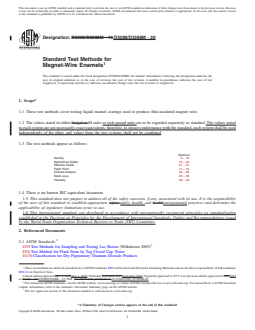
(Test Method)Standard Test Methods for Magnet-Wire Enamels
General Information
- Abstract
SIGNIFICANCE AND USE
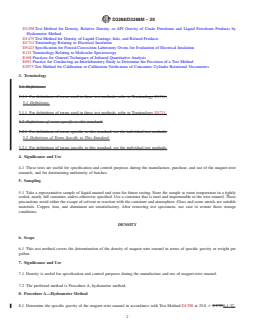
4.1 These tests are useful for specification and control purposes during the manufacture, purchase, and use of the magnet-wire enamels, and for determining uniformity of batches.
SCOPE
1.1 These test methods cover testing liquid enamel coatings used to produce film-insulated magnet wire.
1.2 The values stated in either SI units or inch-pound units are to be regarded separately as standard. The values stated in each system are not necessarily exact equivalents; therefore, to ensure conformance with the standard, each system shall be used independently of the other, and values from the two systems shall not be combined
1.3 The test methods appear as follows:
Sections
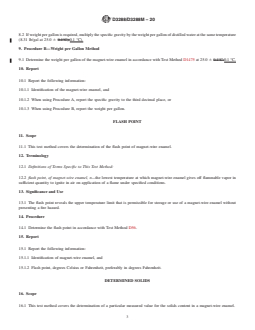
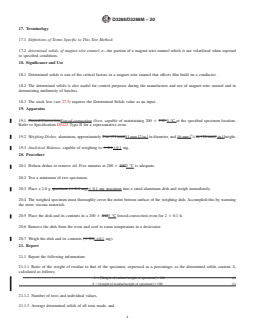
Density
6 – 10
Determined Solids
16 – 22
Effective Solids
31 – 37
Flash Point
11 – 15
Infrared Analysis
45 – 50
Stack Loss
23 – 30
Viscosity
38 – 44
1.4 There is no known IEC equivalent document.
1.5 This standard does not purport to address all of the safety concerns, if any, associated with its use. It is the responsibility of the user of this standard to establish appropriate safety, health, and environmental practices and determine the applicability of regulatory limitations prior to use.
1.6 This international standard was developed in accordance with internationally recognized principles on standardization established in the Decision on Principles for the Development of International Standards, Guides and Recommendations issued by the World Trade Organization Technical Barriers to Trade (TBT) Committee.
- Status
- Published
- Publication Date
- 31-Jul-2020
- Technical Committee
- D09 - Electrical and Electronic Insulating Materials
- Drafting Committee
- D09.12 - Electrical Tests
Overview
ASTM D3288/D3288M-20 is a comprehensive standard test method developed by ASTM International for evaluating liquid enamel coatings used in the production of film-insulated magnet wire. These standardized test methods are vital for manufacturers, purchasers, and users of magnet-wire enamels to ensure product quality, batch uniformity, and conformity to specifications. The standard outlines procedures for testing properties such as density, solids content, flash point, viscosity, and infrared analysis, serving as an essential control tool throughout the enamel's lifecycle.
Magnet-wire enamels are critical in providing electrical insulation for wires used in transformers, motors, solenoids, and other electronic components. Consistency and reliability in enamel properties help prevent insulation failures and enhance performance.
Key Topics
The ASTM D3288/D3288M-20 standard encompasses a comprehensive suite of test methods, each addressing specific enamel characteristics:
- Density Measurement: Utilizes both the hydrometer and weight-per-gallon methods to assess magnet-wire enamel density for quality control purposes.
- Flash Point Determination: Establishes the lowest temperature at which the enamel emits flammable vapors, aiding in safe handling and storage procedures.
- Determined Solids: Measures the non-volatile portion of the enamel, directly impacting film build and enamel efficiency.
- Effective Solids and Stack Loss: Determines the percentage of enamel that remains on the conductor after application and baking, accounting for simulated manufacturing losses.
- Viscosity Assessment: Uses rotational viscometry to evaluate the enamel’s flow characteristics, influencing application and batch uniformity.
- Infrared Spectroscopy: Provides information on the generic chemical composition, supporting identification and specification compliance.
These test methods use clearly defined procedures, ensuring both repeatability and accuracy in test results across industry laboratories.
Applications
The practical applications of ASTM D3288/D3288M-20 span various stages of the magnet-wire production and quality control process:
- Manufacturing Control: Ensures batch-to-batch consistency and helps identify deviations early, reducing waste and rework.
- Raw Material Verification: Supports the purchase process by enabling comparison of material specifications from different suppliers.
- Quality Assurance: Provides measurable parameters for product acceptance and certification.
- Process Optimization: Enables manufacturers to fine-tune enamel formulations and application methods for improved process efficiency and product durability.
- Failure Analysis: Supplies reliable test data for troubleshooting insulation issues related to the enamel.
Industries utilizing magnet-wire enamels, such as the electrical, automotive, and electronic sectors, rely on this standard to maintain stringent insulation performance and safety standards.
Related Standards
Several ASTM standards and references complement ASTM D3288/D3288M-20, contributing to broader quality assurance in coating and insulation materials:
- ASTM D56: Test Method for Flash Point by Tag Closed Cup Tester
- ASTM D1298: Test Method for Density of Liquid Petroleum Products
- ASTM D1475: Test Method for Density of Liquid Coatings
- ASTM D5423: Specification for Forced-Convection Laboratory Ovens
- ASTM E168: Practices for Infrared Quantitative Analysis
- ASTM E2975: Calibration of Concentric Cylinder Rotational Viscometers
- ASTM D1711: Terminology Relating to Electrical Insulation
There is currently no IEC equivalent for this standard, making ASTM D3288/D3288M-20 the primary international reference for magnet-wire enamel test methods.
Keywords: ASTM D3288, magnet-wire enamels, enamel test methods, density, determined solids, effective solids, flash point, viscosity, stack loss, infrared analysis, film-insulated magnet wire, enamel quality control.
Relations
- Effective Date
- 01-Aug-2020
- Effective Date
- 01-Mar-2024
- Effective Date
- 01-Dec-2016
- Effective Date
- 01-Jun-2016
- Effective Date
- 01-Nov-2015
- Refers
ASTM E2975-15 - Standard Test Method for Calibration of Concentric Cylinder Rotational Viscometers - Effective Date
- 01-Sep-2015
- Effective Date
- 01-Nov-2014
- Refers
ASTM E2975-14 - Standard Test Method for Calibration of Concentric Cylinder Rotational Viscometers - Effective Date
- 01-Aug-2014
- Effective Date
- 01-May-2014
- Effective Date
- 01-Nov-2013
- Effective Date
- 01-Jun-2013
- Effective Date
- 01-May-2013
- Effective Date
- 01-Nov-2012
- Effective Date
- 15-May-2012
- Effective Date
- 01-Apr-2012
Get Certified
Connect with accredited certification bodies for this standard

DVS-ZERT GmbH
German welding certification society.
CARES (UK Certification Authority for Reinforcing Steels)
UK certification for reinforcing steels and construction.
EWF/IIW (European/International Welding Federation)
International welding personnel certification.
Sponsored listings
Frequently Asked Questions
ASTM D3288/D3288M-20 is a standard published by ASTM International. Its full title is "Standard Test Methods for Magnet-Wire Enamels". This standard covers: SIGNIFICANCE AND USE 4.1 These tests are useful for specification and control purposes during the manufacture, purchase, and use of the magnet-wire enamels, and for determining uniformity of batches. SCOPE 1.1 These test methods cover testing liquid enamel coatings used to produce film-insulated magnet wire. 1.2 The values stated in either SI units or inch-pound units are to be regarded separately as standard. The values stated in each system are not necessarily exact equivalents; therefore, to ensure conformance with the standard, each system shall be used independently of the other, and values from the two systems shall not be combined 1.3 The test methods appear as follows: Sections Density 6 – 10 Determined Solids 16 – 22 Effective Solids 31 – 37 Flash Point 11 – 15 Infrared Analysis 45 – 50 Stack Loss 23 – 30 Viscosity 38 – 44 1.4 There is no known IEC equivalent document. 1.5 This standard does not purport to address all of the safety concerns, if any, associated with its use. It is the responsibility of the user of this standard to establish appropriate safety, health, and environmental practices and determine the applicability of regulatory limitations prior to use. 1.6 This international standard was developed in accordance with internationally recognized principles on standardization established in the Decision on Principles for the Development of International Standards, Guides and Recommendations issued by the World Trade Organization Technical Barriers to Trade (TBT) Committee.
SIGNIFICANCE AND USE 4.1 These tests are useful for specification and control purposes during the manufacture, purchase, and use of the magnet-wire enamels, and for determining uniformity of batches. SCOPE 1.1 These test methods cover testing liquid enamel coatings used to produce film-insulated magnet wire. 1.2 The values stated in either SI units or inch-pound units are to be regarded separately as standard. The values stated in each system are not necessarily exact equivalents; therefore, to ensure conformance with the standard, each system shall be used independently of the other, and values from the two systems shall not be combined 1.3 The test methods appear as follows: Sections Density 6 – 10 Determined Solids 16 – 22 Effective Solids 31 – 37 Flash Point 11 – 15 Infrared Analysis 45 – 50 Stack Loss 23 – 30 Viscosity 38 – 44 1.4 There is no known IEC equivalent document. 1.5 This standard does not purport to address all of the safety concerns, if any, associated with its use. It is the responsibility of the user of this standard to establish appropriate safety, health, and environmental practices and determine the applicability of regulatory limitations prior to use. 1.6 This international standard was developed in accordance with internationally recognized principles on standardization established in the Decision on Principles for the Development of International Standards, Guides and Recommendations issued by the World Trade Organization Technical Barriers to Trade (TBT) Committee.
ASTM D3288/D3288M-20 is classified under the following ICS (International Classification for Standards) categories: 25.220.50 - Enamels. The ICS classification helps identify the subject area and facilitates finding related standards.
ASTM D3288/D3288M-20 has the following relationships with other standards: It is inter standard links to ASTM D3288/D3288M-15, ASTM D1711-24, ASTM E2975-16, ASTM D56-16, ASTM D1711-15, ASTM E2975-15, ASTM D1711-14a, ASTM E2975-14, ASTM D1711-14, ASTM D1711-13, ASTM D476-13, ASTM E691-13, ASTM D1475-98(2012), ASTM D1298-12a, ASTM D1298-12. Understanding these relationships helps ensure you are using the most current and applicable version of the standard.
ASTM D3288/D3288M-20 is available in PDF format for immediate download after purchase. The document can be added to your cart and obtained through the secure checkout process. Digital delivery ensures instant access to the complete standard document.
Standards Content (Sample)
This international standard was developed in accordance with internationally recognized principles on standardization established in the Decision on Principles for the
Development of International Standards, Guides and Recommendations issued by the World Trade Organization Technical Barriers to Trade (TBT) Committee.
Designation: D3288/D3288M − 20
Standard Test Methods for
Magnet-Wire Enamels
This standard is issued under the fixed designation D3288/D3288M; the number immediately following the designation indicates the
year of original adoption or, in the case of revision, the year of last revision. A number in parentheses indicates the year of last
reapproval. A superscript epsilon (´) indicates an editorial change since the last revision or reapproval.
1. Scope* D29 Test Methods for Sampling and Testing Lac Resins
(Withdrawn 2005)
1.1 These test methods cover testing liquid enamel coatings
D56 Test Method for Flash Point by Tag Closed Cup Tester
used to produce film-insulated magnet wire.
D476 Classification for Dry Pigmentary Titanium Dioxide
1.2 The values stated in either SI units or inch-pound units
Products
are to be regarded separately as standard. The values stated in
D1298 Test Method for Density, Relative Density, or API
each system are not necessarily exact equivalents; therefore, to
Gravity of Crude Petroleum and Liquid Petroleum Prod-
ensure conformance with the standard, each system shall be
ucts by Hydrometer Method
used independently of the other, and values from the two
D1475 Test Method for Density of Liquid Coatings, Inks,
systems shall not be combined
and Related Products
D1711 Terminology Relating to Electrical Insulation
1.3 The test methods appear as follows:
D5423 Specification for Forced-Convection Laboratory Ov-
Sections
ens for Evaluation of Electrical Insulation
Density 6–10
Determined Solids 16–22 E131 Terminology Relating to Molecular Spectroscopy
Effective Solids 31–37
E168 Practices for General Techniques of Infrared Quanti-
Flash Point 11–15
tative Analysis
Infrared Analysis 45–50
Stack Loss 23–30
E691 Practice for Conducting an Interlaboratory Study to
Viscosity 38–44
Determine the Precision of a Test Method
1.4 There is no known IEC equivalent document.
E2975 Test Method for Calibration or Calibration Verifica-
tion of Concentric Cylinder Rotational Viscometers
1.5 This standard does not purport to address all of the
safety concerns, if any, associated with its use. It is the
3. Terminology
responsibility of the user of this standard to establish appro-
3.1 Definitions:
priate safety, health, and environmental practices and deter-
3.1.1 For definitions of terms used in these test methods,
mine the applicability of regulatory limitations prior to use.
refer to Terminology D1711.
1.6 This international standard was developed in accor-
3.2 Definitions of Terms Specific to This Standard:
dance with internationally recognized principles on standard-
3.2.1 For definitions of terms specific to this standard, see
ization established in the Decision on Principles for the
the individual test methods.
Development of International Standards, Guides and Recom-
mendations issued by the World Trade Organization Technical
4. Significance and Use
Barriers to Trade (TBT) Committee.
4.1 These tests are useful for specification and control
purposes during the manufacture, purchase, and use of the
2. Referenced Documents
magnet-wire enamels, and for determining uniformity of
2.1 ASTM Standards:
batches.
5. Sampling
5.1 Take a representative sample of liquid enamel and store
These test methods are under the jurisdiction of ASTM Committee D09 on
Electrical and Electronic Insulating Materials and are the direct responsibility of
for future testing. Store the sample at room temperature in a
Subcommittee D09.12 on Electrical Tests.
tightly sealed, nearly full container, unless otherwise specified.
Current edition approved Aug. 1, 2020. Published September 2020. Originally
Use a container that is inert and impermeable to the wire
approved in 1973. Last previous edition approved in 2015 as D3288/D3288M – 15.
DOI: 10.1520/D3288_D3288M-20. enamel.These precautions avoid either the escape of solvent or
For referenced ASTM standards, visit the ASTM website, www.astm.org, or
contact ASTM Customer Service at service@astm.org. For Annual Book of ASTM
Standards volume information, refer to the standard’s Document Summary page on The last approved version of this historical standard is referenced on
the ASTM website. www.astm.org.
*A Summary of Changes section appears at the end of this standard
Copyright © ASTM International, 100 Barr Harbor Drive, PO Box C700, West Conshohocken, PA 19428-2959. United States
D3288/D3288M − 20
reaction with the container and atmosphere. Glass and some 14. Procedure
metals are suitable materials. Copper, iron, and aluminum are
14.1 Determine the flash point in accordance with Test
unsatisfactory. After removing test specimens, use care to
Method D56.
restore these storage conditions.
15. Report
DENSITY
15.1 Report the following information:
15.1.1 Identification of magnet-wire enamel, and
6. Scope
15.1.2 Flash point, degrees Celsius or Fahrenheit, prefer-
6.1 This test method covers the determination of the density
ably in degrees Fahrenheit.
of magnet-wire enamel in terms of specific gravity or weight
per gallon.
DETERMINED SOLIDS
7. Significance and Use
16. Scope
7.1 Density is useful for specification and control purposes
16.1 This test method covers the determination of a particu-
during the manufacture and use of magnet-wire enamel. lar measured value for the solids content in a magnet-wire
enamel.
7.2 The preferred method is Procedure A, hydrometer
method.
17. Terminology
17.1 Definitions of Terms Specific to This Test Method:
8. Procedure A—Hydrometer Method
17.2 determined solids, of magnet-wire enamel, n—the por-
8.1 Determine the specific gravity of the magnet-wire
tion of a magnet-wire enamel which is not volatilized when
enamel in accordance with Test Method D1298 at 25.0 6
exposed to specified conditions.
0.1 °C.
8.2 If weight per gallon is required, multiply the specific
18. Significance and Use
gravity by the weight per gallon of distilled water at the same
18.1 Determined solids is one of the critical factors in a
temperature (8.31 lb/gal at 25.0 6 0.1 °C).
magnet-wire enamel that affects film build on a conductor.
9. Procedure B—Weight per Gallon Method
18.2 The determined solids is also useful for control pur-
poses during the manufacture and use of magnet-wire enamel
9.1 Determine the weight per gallon of the magnet-wire
and in determining uniformity of batches.
enamel in accordance with Test Method D1475 at 25.0 6
0.1 °C.
18.3 The stack loss (see 27.3) requires the Determined
Solids value as an input.
10. Report
19. Apparatus
10.1 Report the following information:
10.1.1 Identification of the magnet-wire enamel, and 19.1 Forced-convection Oven, capable of maintaining 200
6 3 °C at the specified specimen location. Refer to Specifica-
10.1.2 When using Procedure A, report the specific gravity
to the third decimal place, or tion D5423 Type II for a representative oven.
10.1.3 When using Procedure B, report the weight per
19.2 Weighing Dishes, aluminum, approximately 51 mm [2
gallon.
in.] in diameter, and 16 mm [ ⁄8 in.] height.
19.3 Analytical Balance, capable of weighing to 60.1 mg.
FLASH POINT
20. Procedure
11. Scope
20.1 Preheat dishes to remove oil. Five minutes at 200 6
11.1 This test method covers the determination of the flash
3 °C is adequate.
point of magnet-wire enamel.
20.2 Test a minimum of two specimens.
12. Terminology
20.3 Placea2.0g 6 0.1mgspecimenintoataredaluminum
12.1 Definitions of Terms Specific to This Test Method:
dish and weigh immediately.
12.2 flash point, of magnet-wire enamel, n—the lowest
20.4 The weighed specimen must thoroughly cover the
temperature at which magnet-wire enamel gives off flammable
entire bottom surface of the weighing dish.Accomplish this by
vapor in sufficient quantity to ignite in air on application of a
warming the more viscous materials.
flame under specified conditions.
20.5 Place the dish and its contents in a 200 6 3°C
forced-convection oven for 2 6 0.1 h.
13. Significance and Use
20.6 Remove the dish from the oven and cool to room
13.1 The flash point reveals the upper temperature limit that
temperature in a desiccator.
is permissible for storage or use of a magnet-wire enamel
without presenting a fire hazard. 20.7 Weigh the dish and its contents (60.1 mg).
D3288/D3288M − 20
21. Report 26.10 Titanium Dioxide (TiO ), meeting the specifications
outlined in Specification D476, Type III.
21.1 Report the following information:
21.1.1 Ratiooftheweightofresiduetothatofthespecimen,
27. Procedure
expressed as a percentage, as the determined solids content, S,
calculated as follows:
27.1 Determine the optimum conditions for applying the
magnet-wire enamel using laboratory coating equipment.
S 5 weight of residue/weight of specimen 3100 (1)
~ !
27.2 Condition the crucible in a muffle furnace maintained
21.1.2 Number of tests and individual values,
at 600 6 20 °C to a constant weight (Note 2), and immediately
21.1.3 Average determined solids of all tests made, and
place it in a desiccator for storage.
21.1.4 Identification of the magnet-wire enamel.
NOTE 2—In practice, crucibles will come to constant weight at 600 °C,
22. Precision and Bias
if held in the muffle furnace for 14 to 16 h (overnight).
22.1 Precision:
27.3 Measure the determined solids of the magnet-wire
22.1.1 The results of all measurements on the sample
enamel in accordance with Sections 16–22, and the ash
typically agree within 60.5 %.
content of the solids in accordance with Test Methods D29.
22.2 Bias:
27.4 Weigh into the container 1000 6 1 g of the magnet-
22.2.1 Statements of bias are not applicable in view of the
wire enamel.
unavailabilityofastandardreferencematerialforthisproperty.
27.5 Weigh into the container an amount of TiO equal to
STACK LOSS the weight (61.0 g) of the solids in the 1000 g specimen of the
magnet-wire enamel.
23. Scope
27.6 Mix the contents in the container until the TiO is
23.1 This test method covers the determination of the stack
completely dispersed in the wire enamel.
loss of magnet-wire enamel applied toAWG No. 18 (1.02 mm)
27.7 Apply this enamel in accordance with 27.1, using the
electrical conductor using an inorganic material as a reference.
same conditions and obtaining the same increase in build.
NOTE 1—With other sizes of electrical conductor, expect a variation in
Within2hof applying the enamel to the conductor, completely
stack loss. This is particularly true with smaller diameter wire. Expect
stir the enamel to ensure dispersion.
difficulty in removing the coating from fine wire.
27.8 Remove this coating from the wire by snapping and
24. Terminology
twistingthewireorbyothersuitablemeans.Placetheremoved
24.1 Definitions of Terms Specific to This Test Method: coating in a weighing bottle. For the coatings that are difficult
to remove, try chilling the wire before snapping. In all cases,
24.2 stack loss, of magnet-wire enamel, n—that portion of
take care to prevent including any of the metal conductor.
the magnet-wire enamel solids which are lost during the
conductor-coating process.
27.9 Toremovemoisture,placetheweighingbottlecontain-
ing the coating in a 110 6 2.5 °C forced-convention oven for
25. Significance and Use
60 6 2 min.
25.1 The stack loss of magnet-wire enamel will affect the
27.10 Remove the weighing bottle and contents from the
increase in dimensions, the amount of enamel used, the weight
oven and allow it to cool to room temperature in a desiccator.
increase, and the economics of applying the enamel to the
27.11 Weigh two conditioned crucibles and weigh into each
conductor.
0.5to0.6gofthedriedcoatingfromtheweighingbottle.Make
26. Apparatus and Reagent
all weighings to the nearest 0.1 mg.
26.1 Laboratory Magnet-wire Coating Equipment, that
27.12 Weigh two conditioned crucibles and weigh into each
will duplicate production application conditions and a supply
0.5 to 0.6 g of TiO .
of bare conductor to be used for the test.
27.13 Place all four crucibles in the cold muffle furnace.
26.2 Laboratory Mixer or Drill Press.
Start the furnace, allowing the temperature to come to 600 °C
in1to2h.
26.3 Muffle Furnace, capable of maintaining 600 °C.
27.14 Leave the crucibles in the muffle furnace at 600 6 20
26.4 Oven, forced-convection, capable of maintaining 110
°C until they reach a constant weight (Note 2). Remove the
6 2.5 °C (refer to Specification D5423 Type II).
crucibles and allow them to cool in a desiccator to room
26.5 Analytical Balance, capable of weighing to the nearest
temperature.
0.1 mg.
27.15 Weigh the crucibles.
26.6 Balance, capable of weighing 2 kg 61g.
26.7 Weighing Bottles, tall-form cylindrical, glass.
28. Calculation
26.8 Crucibles, high-form, high-temperature.
28.1 Calculate the percent stack loss, L, of the magnet-wire
26.9 Container, at least 2 L in capacity. enamel as follows:
D3288/D3288M − 20
Let F 5 EA / AB1CD (2) 34. Procedure
~ ! ~ !
34.1 Evaporative Solids:
Let R 5 ~100/F!~G 2 F!
34.1.1 Test a minimum of two specimens.
34.1.2 Preheat the aluminum weighing pans to remove oil.
Then L 5 100 2 R
Five min at 200 6 3 °C is adequate.
where:
34.1.3 Remove the pans from the oven and cool to room
A =TiO mixed with the wire enamel, g,
temperature in a desiccator.
B = percent of TiO ash, expressed as a decimal,
34.1.4 Measure the tare weight (p) of the dried aluminum
C = solids in the wire-enamel specimen, g,
pan to an accuracy of 60.1 mg.
D = percent ash of the wire-enamel solids, expressed as a
34.1.5 Add 1 6 0.1 g of liquid magnet wire enamel into
decimal,
eachtaredaluminumweighingpanandmeasuretoanaccuracy
E = weight of ash i
...
This document is not an ASTM standard and is intended only to provide the user of an ASTM standard an indication of what changes have been made to the previous version. Because
it may not be technically possible to adequately depict all changes accurately, ASTM recommends that users consult prior editions as appropriate. In all cases only the current version
of the standard as published by ASTM is to be considered the official document.
Designation: D3288/D3288M − 15 D3288/D3288M − 20
Standard Test Methods for
Magnet-Wire Enamels
This standard is issued under the fixed designation D3288/D3288M; the number immediately following the designation indicates the
year of original adoption or, in the case of revision, the year of last revision. A number in parentheses indicates the year of last
reapproval. A superscript epsilon (´) indicates an editorial change since the last revision or reapproval.
1. Scope*
1.1 These test methods cover testing liquid enamel coatings used to produce film-insulated magnet wire.
1.2 The values stated in either lbs/gal or SI units or inch-pound units are to be regarded separately as standard. The values stated
in each system are not necessarily exact equivalents; therefore, to ensure conformance with the standard, each system shall be used
independently of the other, and values from the two systems shall not be combined
1.3 The test methods appear as follows:
Sections
Density 6 – 10
Determined Solids 16 – 22
Effective Solids 31 – 37
Flash Point 11 – 15
Infrared Analysis 45 – 50
Stack Loss 23 – 30
Viscosity 38 – 44
1.4 There is no known IEC equivalent document.
1.5 This standard does not purport to address all of the safety concerns, if any, associated with its use. It is the responsibility
of the user of this standard to establish appropriate safety safety, health, and healthenvironmental practices and determine the
applicability of regulatory limitations prior to use.
1.6 This international standard was developed in accordance with internationally recognized principles on standardization
established in the Decision on Principles for the Development of International Standards, Guides and Recommendations issued
by the World Trade Organization Technical Barriers to Trade (TBT) Committee.
2. Referenced Documents
2.1 ASTM Standards:
D29 Test Methods for Sampling and Testing Lac Resins (Withdrawn 2005)
D56 Test Method for Flash Point by Tag Closed Cup Tester
D476 Classification for Dry Pigmentary Titanium Dioxide Products
These test methods are under the jurisdiction of ASTM Committee D09 on Electrical and Electronic Insulating Materials and are the direct responsibility of Subcommittee
D09.12 on Electrical Tests.
Current edition approved Nov. 1, 2015Aug. 1, 2020. Published November 2015September 2020. Originally approved in 1973. Last previous edition approved in 20082015
as D3288 – 08.D3288/D3288M – 15. DOI: 10.1520/D3288_D3288M-15.10.1520/D3288_D3288M-20.
For referenced ASTM standards, visit the ASTM website, www.astm.org, or contact ASTM Customer Service at service@astm.org. For Annual Book of ASTM Standards
volume information, refer to the standard’s Document Summary page on the ASTM website.
The last approved version of this historical standard is referenced on www.astm.org.
*A Summary of Changes section appears at the end of this standard
Copyright © ASTM International, 100 Barr Harbor Drive, PO Box C700, West Conshohocken, PA 19428-2959. United States
D3288/D3288M − 20
D1298 Test Method for Density, Relative Density, or API Gravity of Crude Petroleum and Liquid Petroleum Products by
Hydrometer Method
D1475 Test Method for Density of Liquid Coatings, Inks, and Related Products
D1711 Terminology Relating to Electrical Insulation
D5423 Specification for Forced-Convection Laboratory Ovens for Evaluation of Electrical Insulation
E131 Terminology Relating to Molecular Spectroscopy
E168 Practices for General Techniques of Infrared Quantitative Analysis
E691 Practice for Conducting an Interlaboratory Study to Determine the Precision of a Test Method
E2975 Test Method for Calibration or Calibration Verification of Concentric Cylinder Rotational Viscometers
3. Terminology
3.1 Definitions:
3.1.1 For definitions of terms used in these test methods, refer to Terminology D1711.
3.1 Definitions:
3.1.1 For definitions of terms used in these test methods, refer to Terminology D1711.
3.2 Definitions of terms specific to this standard:
3.2.1 For definitions of terms specific to this standard, see the individual test methods.
3.2 Definitions of Terms Specific to This Standard:
3.2.1 For definitions of terms specific to this standard, see the individual test methods.
4. Significance and Use
4.1 These tests are useful for specification and control purposes during the manufacture, purchase, and use of the magnet-wire
enamels, and for determining uniformity of batches.
5. Sampling
5.1 Take a representative sample of liquid enamel and store for future testing. Store the sample at room temperature in a tightly
sealed, nearly full container, unless otherwise specified. Use a container that is inert and impermeable to the wire enamel. These
precautions avoid either the escape of solvent or reaction with the container and atmosphere. Glass and some metals are suitable
materials. Copper, iron, and aluminum are unsatisfactory. After removing test specimens, use care to restore these storage
conditions.
DENSITY
6. Scope
6.1 This test method covers the determination of the density of magnet-wire enamel in terms of specific gravity or weight per
gallon.
7. Significance and Use
7.1 Density is useful for specification and control purposes during the manufacture and use of magnet-wire enamel.
7.2 The preferred method is Procedure A, hydrometer method.
8. Procedure A—Hydrometer Method
8.1 Determine the specific gravity of the magnet-wire enamel in accordance with Test Method D1298 at 25.0 6 0.1°C.0.1 °C.
D3288/D3288M − 20
8.2 If weight per gallon is required, multiply the specific gravity by the weight per gallon of distilled water at the same temperature
(8.31 lb/gal at 25.0 6 0.1°C).0.1 °C).
9. Procedure B—Weight per Gallon Method
9.1 Determine the weight per gallon of the magnet-wire enamel in accordance with Test Method D1475 at 25.0 6 0.1°C.0.1 °C.
10. Report
10.1 Report the following information:
10.1.1 Identification of the magnet-wire enamel, and
10.1.2 When using Procedure A, report the specific gravity to the third decimal place, or
10.1.3 When using Procedure B, report the weight per gallon.
FLASH POINT
11. Scope
11.1 This test method covers the determination of the flash point of magnet-wire enamel.
12. Terminology
12.1 Definitions of Terms Specific to This Test Method:
12.2 flash point, of magnet-wire enamel, n—the lowest temperature at which magnet-wire enamel gives off flammable vapor in
sufficient quantity to ignite in air on application of a flame under specified conditions.
13. Significance and Use
13.1 The flash point reveals the upper temperature limit that is permissible for storage or use of a magnet-wire enamel without
presenting a fire hazard.
14. Procedure
14.1 Determine the flash point in accordance with Test Method D56.
15. Report
15.1 Report the following information:
15.1.1 Identification of magnet-wire enamel, and
15.1.2 Flash point, degrees Celsius or Fahrenheit, preferably in degrees Fahrenheit.
DETERMINED SOLIDS
16. Scope
16.1 This test method covers the determination of a particular measured value for the solids content in a magnet-wire enamel.
D3288/D3288M − 20
17. Terminology
17.1 Definitions of Terms Specific to This Test Method:
17.2 determined solids, of magnet-wire enamel, n—the portion of a magnet-wire enamel which is not volatilized when exposed
to specified conditions.
18. Significance and Use
18.1 Determined solids is one of the critical factors in a magnet-wire enamel that affects film build on a conductor.
18.2 The determined solids is also useful for control purposes during the manufacture and use of magnet-wire enamel and in
determining uniformity of batches.
18.3 The stack loss (see 27.3) requires the Determined Solids value as an input.
19. Apparatus
19.1 Forced-ConvectionForced-convection Oven, capable of maintaining 200 6 3°C 3 °C at the specified specimen location.
Refer to Specification D5423 Type II for a representative oven.
19.2 Weighing Dishes, aluminum, approximately 2 in. (51 mm)51 mm [2 in.] in diameter, and 16 mm [ ⁄8 in. (16 mm) in.] height.
19.3 Analytical Balance, capable of weighing to 6 0.160.1 mg.
20. Procedure
20.1 Preheat dishes to remove oil. Five minutes at 200 6 3°C3 °C is adequate.
20.2 Test a minimum of two specimens.
20.3 Place a 2.0 g specimen (6 0.1 mg)6 0.1 mg specimen into a tared aluminum dish and weigh immediately.
20.4 The weighed specimen must thoroughly cover the entire bottom surface of the weighing dish. Accomplish this by warming
the more viscous materials.
20.5 Place the dish and its contents in a 200 6 3°C3 °C forced-convection oven for 2 6 0.1 h.
20.6 Remove the dish from the oven and cool to room temperature in a desiccator.
20.7 Weigh the dish and its contents (6 0.1(60.1 mg).
21. Report
21.1 Report the following information:
21.1.1 Ratio of the weight of residue to that of the specimen, expressed as a percentage, as the determined solids content, S,
calculated as follows:
S 5 Weight of residue/weight of specimen 3100 (1)
~ !
S 5 ~weight of residue/weight of specimen!3100 (1)
21.1.2 Number of tests and individual values,
21.1.3 Average determined solids of all tests made, and
D3288/D3288M − 20
21.1.4 Identification of the magnet-wire enamel.
22. Precision and Bias
22.1 Precision:
22.1.1 The results of all measurements on the sample typically agree within 6 0.5 %.60.5 %.
22.2 Bias:
22.2.1 Statements of bias are not applicable in view of the unavailability of a standard reference material for this property.
STACK LOSS
23. Scope
23.1 This test method covers the determination of the stack loss of magnet-wire enamel applied to AWG No. 18 (1.02-mm) (1.02
mm) electrical conductor using an inorganic material as a reference.
NOTE 1—With other sizes of electrical conductor, expect a variation in stack loss. This is particularly true with smaller diameter wire. Expect difficulty
in removing the coating from fine wire.
24. Terminology
24.1 Definitions of Terms Specific to This Test Method:
24.2 stack loss, of magnet-wire enamel, n—that portion of the magnet-wire enamel solids which are lost during the
conductor-coating process.
25. Significance and Use
25.1 The stack loss of magnet-wire enamel will affect the increase in dimensions, the amount of enamel used, the weight increase,
and the economics of applying the enamel to the conductor.
26. Apparatus and Reagent
26.1 Laboratory Magnet-Wire-Coating Magnet-wire Coating Equipment, that will duplicate production application conditions
and a supply of bare conductor to be used for the test.
26.2 Laboratory Mixer or Drill Press.
26.3 Muffle Furnace, capable of maintaining 600°C.600 °C.
26.4 Oven, forced-convection, capable of maintaining 110 6 2.5°C 2.5 °C (refer to Specification D5423 Type II).
26.5 Analytical Balance, capable of weighing to the nearest 0.1 mg.
26.6 Balance, capable of weighing 2 kg (6 1 g)6 1 g.
26.7 Weighing Bottles, tall-form cylindrical, glass.
26.8 Crucibles, high-form, high-temperature.
D3288/D3288M − 20
26.9 Container, at least 2 L in capacity.
26.10 Titanium Dioxide (TiO ), meeting the specifications outlined in Specification D476, Type III.
27. Procedure
27.1 Determine the optimum conditions for applying the magnet-wire enamel using laboratory coating equipment.
27.2 Condition the crucible in a muffle furnace maintained at 600 6 20°C 20 °C to a constant weight (Note 2), and immediately
place it in a desiccator for storage.
NOTE 2—In practice, crucibles will come to constant weight at 600°C, 600 °C, if held in the muffle furnace for 14 to 16 h (overnight).
27.3 Measure the determined solids of the magnet-wire enamel in accordance with Sections 16 – 22, and the ash content of the
solids in accordance with Test Methods D29.
27.4 Weigh into the container 1000 6 1 g of the magnet-wire enamel.
27.5 Weigh into the container an amount of TiO equal to the weight (6 1.0(61.0 g) of the solids in the 1000-g1000 g specimen
of the magnet-wire enamel.
27.6 Mix the contents in the container until the TiO is completely dispersed in the wire enamel.
27.7 Apply this enamel in accordance with 27.1, using the same conditions and obtaining the same increase in build. Within 2 h
of applying the enamel to the conductor, completely stir the enamel to ensure dispersion.
27.8 Remove this coating from the wire by snapping and twisting the wire or by other suitable means. Place the removed coating
in a weighing bottle. For the coatings that are difficult to remove, try chilling the wire before snapping. In all cases, take care to
prevent including any of the metal conductor.
27.9 To remove moisture, place the weighing bottle containing the coating in a 110 6 2.5°C 2.5 °C forced-convention oven for
60 6 2 min.
27.10 Remove the weighing bottle and contents from the oven and allow it to cool to room temperature in a desiccator.
27.11 Weigh two conditioned crucibles and weigh into each 0.5 to 0.6 g of the dried coating from the weighing bottle. Make all
weighings to the nearest 0.1 mg.
27.12 Weigh two conditioned crucibles and weigh into each 0.5 to 0.6 g of TiO .
27.13 Place all four crucibles in the cold muffle furnace. Start the furnace, allowing the temperature to come to 600°C 600 °C in
1 to 2 h.
27.14 Leave the crucibles in the muffle furnace at 600 6 20°C 20 °C until they reach a constant weight (Note 2). Remove the
crucibles and allow them to cool in a desiccator to room temperature.
27.15 Weigh the crucibles.
28. Calculation
28.1 Calculate the percent stack loss, L, of the magnet-wire enamel as follows:
D3288/D3288M − 20
Let F 5 EA / AB1CD (2)
~ ! ~ !
Let R 5 ~100/F!~G 2F!
Then L 5 100 2 R
where:
A = TiO mixed with the wire enamel, g,
B = percent of TiO ash, expressed as a decimal,
C = solids in the wire-enamel specimen, g,
D = percent ash of the wire-enamel solids, expressed as a decimal,
E = weight of ash in the coating specimen, g
E = weight of ash in the coating specimen, g,
F = corrected ash weight, g,
G = original weight of coating specimen before ashing, g, and
R = retention of coating.
29. Report
29.1 Report the following information:
29.1.1 Identification of magnet-wire enamel,
29.1.2 Determined solids content of the magnet-wire enamel,
29.1.3 Percent ash content of the magnet-wire enamel solids.solids,
29.1.4 Average percent retention of coating to two decimal places, and
29.1.5 Average percent stack loss to two decimal places.
30. Precision and Bias
30.1 This test method has been in use for many years, but no statement of precision has been made and no activity is planned to
develop such a statement.
EFFECTIVE SOLIDS
31. Scope
31.1 This test method covers the determination of the percentage of liquid enamel that will be retained on the metal conductor
in the finished product.
32. Terminology
32.1 Definitions of Terms Specific to This Test Method:
32.2 effective solids, of magnet-wire enamel, n—the percentage of the liquid enamel retained after the removal of the solvents and
the additi
...