

ASTM D3180-15(2023)
(Practice)Standard Practice for Calculating Coal and Coke Analyses from As-Determined to Different Bases
General Information
- Abstract
SIGNIFICANCE AND USE
4.1 The calculations of analytical data for the coal and coke test parameters listed in Section 6, assume the analysis sample has been prepared according to Practice D2013 and Test Method D3302.
4.2 This practice provides formulas, to enable calculations of data from the as-determined analysis sample to various moisture bases, in common use by the coal and coke industry.
4.3 This practice provides guidance to enable calculations of weight-average data from various lots or sublots, which, initially, are provided at different moisture bases.
4.4 The principles given in this practice are applicable to the calculation of cumulative data (e.g., for trade purposes or for sieve analyses or washability analyses).
SCOPE
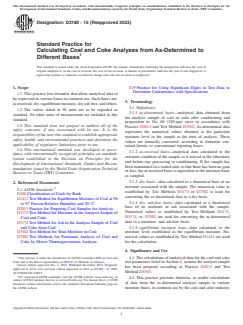
1.1 This practice lists formulas that allow analytical data to be expressed in various bases in common use. Such bases are: as received, dry, equilibrium moisture, dry ash free, and others.
1.2 The values stated in SI units are to be regarded as standard. No other units of measurement are included in this standard.
1.3 This standard does not purport to address all of the safety concerns, if any, associated with its use. It is the responsibility of the user this standard to establish appropriate safety, health, and environmental practices and determine the applicability of regulatory limitations prior to use.
1.4 This international standard was developed in accordance with internationally recognized principles on standardization established in the Decision on Principles for the Development of International Standards, Guides and Recommendations issued by the World Trade Organization Technical Barriers to Trade (TBT) Committee.
- Status
- Published
- Publication Date
- 30-Nov-2023
- Technical Committee
- D05 - Coal and Coke
- Drafting Committee
- D05.21 - Methods of Analysis
Overview
ASTM D3180-15(2023) is an international standard developed by ASTM International, providing a systematic practice for calculating coal and coke analyses from the as-determined basis to various reporting bases. This standard is essential for laboratories, analysts, and organizations involved in coal and coke testing, quality control, and trade. It ensures the consistency, accuracy, and comparability of analytical data by standardizing the formulas used for expressing test results on different moisture and ash bases commonly required in the coal and coke industries.
Key Topics
Analytical Bases: The standard defines and enables conversion of analytical results to multiple bases, including:
- As-Determined (ad)
- As-Received (ar)
- Dry basis (d)
- Dry Ash-Free basis (daf)
- Equilibrium Moisture basis
Sample Preparation: Calculations assume samples are prepared in accordance with ASTM Practice D2013 and Test Method D3302, which are referenced to ensure uniformity in sample conditioning.
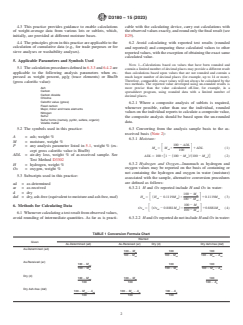
Formulas for Conversion: Provides specific formulas for recalculating values such as ash, moisture, carbon, hydrogen, oxygen, nitrogen, and sulfur between different reporting bases.
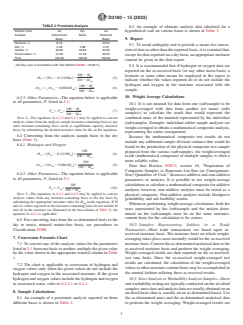
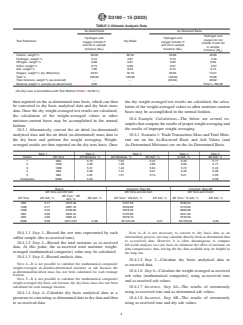
Weight-Averaging Guidance: Offers instructions for calculating weight-average analytical values from multiple lots or sublots, especially when initial data is reported on different moisture bases.
Reporting and Data Precision: Addresses best practices for reporting analytical data, emphasizing the importance of recording moisture content and properly handling significant digits and rounding.
Applications
ASTM D3180-15(2023) is widely used in the coal and coke sectors for:
Trade and Compliance: Standardizing analytical results for contracts, quality assurance, and trade negotiations, minimizing disputes through consistent reporting formats.
Laboratory Reporting: Laboratories use this standard to convert as-determined results into other required bases (such as dry or dry ash-free), ensuring results meet client and industry specification requirements.
Cumulative and Composite Data: Applied in the calculation of mathematical composite values for batches, shipments, or raw materials, supporting inventory management and regulatory reporting.
Sieve and Washability Analyses: Used in deriving weight-averaged or cumulative data for specific analyses (e.g., sieve analysis, washability analysis) applied in beneficiation processes or quality grading.
Data Comparison: Facilitates accurate comparison of results between laboratories or across different methods by ensuring a common basis for analytical values.
Related Standards
Several related standards are frequently referenced or used in conjunction with ASTM D3180-15(2023), including:
- ASTM D2013: Standard Practice for Preparing Coal Samples for Analysis
- ASTM D3302: Standard Test Method for Total Moisture in Coal
- ASTM D3173: Standard Test Method for Moisture in the Analysis Sample of Coal and Coke
- ASTM D3174: Standard Test Method for Ash in the Analysis Sample of Coal and Coke from Coal
- ASTM D1412: Standard Test Method for Equilibrium Moisture of Coal
- ASTM D388: Classification of Coals by Rank
- ASTM D7582: Test Methods for Proximate Analysis of Coal and Coke by Macro Thermogravimetric Analysis
- ASTM E29: Practice for Using Significant Digits in Test Data to Determine Conformance with Specifications
Practical Value
Using ASTM D3180-15(2023) provides consistent protocols for recalculating and reporting coal and coke analyses, reducing errors in conversions and improving the reliability of technical and commercial decision-making. Implementing this standard supports regulatory compliance, enhances data accuracy in coal industry operations, and promotes international standardization in reporting analytical results for coal and coke.
Keywords: coal analysis, coke analysis, moisture basis, dry basis, as-received basis, as-determined basis, ASTM D3180, analytical data conversion, standard practice, composite analysis, trade reporting.
Relations
- Effective Date
- 01-Dec-2023
- Effective Date
- 01-Apr-2024
- Effective Date
- 15-May-2015
- Effective Date
- 01-Dec-2023
- Effective Date
- 01-Dec-2023
- Effective Date
- 01-Dec-2023
- Effective Date
- 01-Dec-2023
- Effective Date
- 01-Dec-2023
- Referred By
ASTM D3175-20 - Standard Test Method for Volatile Matter in the Analysis Sample of Coal and Coke - Effective Date
- 01-Dec-2023
- Effective Date
- 01-Dec-2023
- Referred By
ASTM D3173/D3173M-17a - Standard Test Method for Moisture in the Analysis Sample of Coal and Coke - Effective Date
- 01-Dec-2023
- Effective Date
- 01-Dec-2023
- Effective Date
- 01-Dec-2023
- Effective Date
- 01-Dec-2023
- Effective Date
- 01-Dec-2023
Get Certified
Connect with accredited certification bodies for this standard

Element Materials Technology
Materials testing and product certification.

ABS Group Brazil
ABS Group certification services in Brazil.

ABS Quality Evaluations Inc.
American Bureau of Shipping quality certification.
Sponsored listings
Frequently Asked Questions
ASTM D3180-15(2023) is a standard published by ASTM International. Its full title is "Standard Practice for Calculating Coal and Coke Analyses from As-Determined to Different Bases". This standard covers: SIGNIFICANCE AND USE 4.1 The calculations of analytical data for the coal and coke test parameters listed in Section 6, assume the analysis sample has been prepared according to Practice D2013 and Test Method D3302. 4.2 This practice provides formulas, to enable calculations of data from the as-determined analysis sample to various moisture bases, in common use by the coal and coke industry. 4.3 This practice provides guidance to enable calculations of weight-average data from various lots or sublots, which, initially, are provided at different moisture bases. 4.4 The principles given in this practice are applicable to the calculation of cumulative data (e.g., for trade purposes or for sieve analyses or washability analyses). SCOPE 1.1 This practice lists formulas that allow analytical data to be expressed in various bases in common use. Such bases are: as received, dry, equilibrium moisture, dry ash free, and others. 1.2 The values stated in SI units are to be regarded as standard. No other units of measurement are included in this standard. 1.3 This standard does not purport to address all of the safety concerns, if any, associated with its use. It is the responsibility of the user this standard to establish appropriate safety, health, and environmental practices and determine the applicability of regulatory limitations prior to use. 1.4 This international standard was developed in accordance with internationally recognized principles on standardization established in the Decision on Principles for the Development of International Standards, Guides and Recommendations issued by the World Trade Organization Technical Barriers to Trade (TBT) Committee.
SIGNIFICANCE AND USE 4.1 The calculations of analytical data for the coal and coke test parameters listed in Section 6, assume the analysis sample has been prepared according to Practice D2013 and Test Method D3302. 4.2 This practice provides formulas, to enable calculations of data from the as-determined analysis sample to various moisture bases, in common use by the coal and coke industry. 4.3 This practice provides guidance to enable calculations of weight-average data from various lots or sublots, which, initially, are provided at different moisture bases. 4.4 The principles given in this practice are applicable to the calculation of cumulative data (e.g., for trade purposes or for sieve analyses or washability analyses). SCOPE 1.1 This practice lists formulas that allow analytical data to be expressed in various bases in common use. Such bases are: as received, dry, equilibrium moisture, dry ash free, and others. 1.2 The values stated in SI units are to be regarded as standard. No other units of measurement are included in this standard. 1.3 This standard does not purport to address all of the safety concerns, if any, associated with its use. It is the responsibility of the user this standard to establish appropriate safety, health, and environmental practices and determine the applicability of regulatory limitations prior to use. 1.4 This international standard was developed in accordance with internationally recognized principles on standardization established in the Decision on Principles for the Development of International Standards, Guides and Recommendations issued by the World Trade Organization Technical Barriers to Trade (TBT) Committee.
ASTM D3180-15(2023) is classified under the following ICS (International Classification for Standards) categories: 75.160.10 - Solid fuels. The ICS classification helps identify the subject area and facilitates finding related standards.
ASTM D3180-15(2023) has the following relationships with other standards: It is inter standard links to ASTM D3180-15, ASTM D7582-24, ASTM D7582-15, ASTM D4606-21, ASTM D3174-12(2018)e1, ASTM D6357-21b, ASTM D8247-19, ASTM E1534-93(2019), ASTM D3175-20, ASTM D6414-23, ASTM D3173/D3173M-17a, ASTM D6721-01(2015), ASTM D1857/D1857M-18, ASTM D7569/D7569M-10(2023), ASTM D7582-15(2023). Understanding these relationships helps ensure you are using the most current and applicable version of the standard.
ASTM D3180-15(2023) is available in PDF format for immediate download after purchase. The document can be added to your cart and obtained through the secure checkout process. Digital delivery ensures instant access to the complete standard document.
Standards Content (Sample)
This international standard was developed in accordance with internationally recognized principles on standardization established in the Decision on Principles for the
Development of International Standards, Guides and Recommendations issued by the World Trade Organization Technical Barriers to Trade (TBT) Committee.
Designation: D3180 − 15 (Reapproved 2023)
Standard Practice for
Calculating Coal and Coke Analyses from As-Determined to
Different Bases
This standard is issued under the fixed designation D3180; the number immediately following the designation indicates the year of
original adoption or, in the case of revision, the year of last revision. A number in parentheses indicates the year of last reapproval. A
superscript epsilon (´) indicates an editorial change since the last revision or reapproval.
1. Scope E29 Practice for Using Significant Digits in Test Data to
Determine Conformance with Specifications
1.1 This practice lists formulas that allow analytical data to
be expressed in various bases in common use. Such bases are:
3. Terminology
as received, dry, equilibrium moisture, dry ash free, and others.
3.1 Definitions:
1.2 The values stated in SI units are to be regarded as
3.1.1 as-determined basis—analytical data obtained from
standard. No other units of measurement are included in this
the analysis sample of coal or coke after conditioning and
standard.
preparation to No. 60 (250-μm) sieve in accordance with
1.3 This standard does not purport to address all of the
Practice D2013 and Test Method D3302. As-determined data
safety concerns, if any, associated with its use. It is the
represents the numerical values obtained at the particular
responsibility of the user this standard to establish appropriate
moisture level in the sample at the time of analysis. These
safety, health, and environmental practices and determine the
values are normally converted, according to formulae con-
applicability of regulatory limitations prior to use.
tained herein, to conventional reporting bases.
1.4 This international standard was developed in accor-
3.1.2 as-received basis—analytical data calculated to the
dance with internationally recognized principles on standard-
moisture condition of the sample as it arrived at the laboratory
ization established in the Decision on Principles for the
and before any processing or conditioning. If the sample has
Development of International Standards, Guides and Recom-
been maintained in a sealed state so that there has been no gain
mendations issued by the World Trade Organization Technical
or loss, the as-received basis is equivalent to the moisture basis
Barriers to Trade (TBT) Committee.
as sampled.
3.1.3 dry basis—data calculated to a theoretical base of no
2. Referenced Documents
moisture associated with the sample. The numerical value as
2.1 ASTM Standards:
established by Test Methods D3173 or D7582 is used for
D388 Classification of Coals by Rank
converting the as-determined data to a dry basis.
D1412 Test Method for Equilibrium Moisture of Coal at 96
3.1.4 dry, ash-free basis—data calculated to a theoretical
to 97 Percent Relative Humidity and 30 °C
base of no moisture or ash associated with the sample.
D2013 Practice for Preparing Coal Samples for Analysis
Numerical values as established by Test Methods D3173,
D3173 Test Method for Moisture in the Analysis Sample of
D3174, or, D7582 are used for converting the as-determined
Coal and Coke
data to a moisture- and ash-free basis.
D3174 Test Method for Ash in the Analysis Sample of Coal
3.1.5 equilibrium moisture base—data calculated to the
and Coke from Coal
D3302 Test Method for Total Moisture in Coal moisture level established as the equilibrium moisture. Nu-
D7582 Test Methods for Proximate Analysis of Coal and merical values as established by Test Method D1412 are used
Coke by Macro Thermogravimetric Analysis for the calculation.
4. Significance and Use
4.1 The calculations of analytical data for the coal and coke
This practice is under the jurisdiction of ASTM Committee D05 on Coal and
Coke and is the direct responsibility of D05.21 on Methods of Analysis.
test parameters listed in Section 6, assume the analysis sample
Current edition approved Dec. 1, 2023. Published December 2023. Originally
has been prepared according to Practice D2013 and Test
approved in 1974. Last previous edition approved in 2015 as D3180 – 15. DOI:
Method D3302.
10.1520/D3180-15R23.
For referenced ASTM standards, visit the ASTM website, www.astm.org, or
4.2 This practice provides formulas, to enable calculations
contact ASTM Customer Service at service@astm.org. For Annual Book of ASTM
of data from the as-determined analysis sample to various
Standards volume information, refer to the standard’s Document Summary page on
the ASTM website. moisture bases, in common use by the coal and coke industry.
Copyright © ASTM International, 100 Barr Harbor Drive, PO Box C700, West Conshohocken, PA 19428-2959. United States
D3180 − 15 (2023)
4.3 This practice provides guidance to enable calculations cable with the calculating device, carry out calculations with
of weight-average data from various lots or sublots, which, the observed values exactly, and round only the final result (see
initially, are provided at different moisture bases. E29).
4.4 The principles given in this practice are applicable to the
6.2 Avoid calculating with reported test results (rounded
calculation of cumulative data (e.g., for trade purposes or for
and reported) and comparing these calculated values to other
sieve analyses or washability analyses).
reported values, with the exception of obtaining the exact same
calculated value.
5. Applicable Parameters and Symbols Used
NOTE 1—Calculations based on values that have been rounded and
5.1 The calculation procedures defined in 6.3.3 and 6.4.2 are
contain a limited number of decimal places may provide a different result
applicable to the following analysis parameters when ex- than calculations based upon values that are not rounded and contain a
much larger number of decimal places (for example, up to 14 or more).
pressed as weight percent, μg/g (trace elements) or Btu/lb
Therefore, comparable, exact values will not always be calculated by the
(gross calorific value):
two methods. The reported value developed using un-rounded results is
Ash
more precise than the value calculated off-line, for example, in a
Carbon
spreadsheet program, using rounded data with a limited number of
Carbon dioxide
decimal places.
Chlorine
Calorific value (gross)
6.2.1 Where a composite analysis of sublots is required,
Fixed carbon
whenever possible, rather than use the individual, rounded
Major, minor and trace elements
values on the individual reports to calculate a composite value,
Nitrogen
Sulfur
the composite analysis should be based upon the un-rounded
Sulfur forms (namely, pyritic, sulfate, organic)
data.
Volatile matter
6.3 Converting from the analysis sample basis to the as-
5.2 The symbols used in this practice:
received basis (Note 2):
A = ash; weight %
6.3.1 Moisture:
M = moisture, weight %
100 2 ADL
P = any analysis parameter listed in 5.1, weight % (ex-
M 5 M × 1ADL (1)
F G
ar ad
cept gross calorific value is Btu/lb)
ADL = air-dry loss, weight % of as-received sample. See
ADL 5 100 × 1 2 100 2 M / 100 2 M (2)
@ ~ ! ~ !#
ar ad
Test Method D3302
6.3.2 Hydrogen and Oxygen—Inasmuch as hydrogen and
H = hydrogen, weight %
oxygen values may be reported on the basis of containing or
Ox = oxygen, weight %
not containing the hydrogen and oxygen in water (moisture)
5.3 Subscripts used in this practice:
associated with the sample, alternative conversion procedures
are defined as follows:
ad = as-determined
ar = as-received 6.3.2.1 H and Ox reported include H and Ox in water:
d = dry
100 2 M
ar
daf = dry, ash-free (equivalent to moisture and ash free, maf) H 5 ~H 2 0.1119M ! × 10.1119M (3)
F G
ar ad ad ar
100 2 M
ad
100 2 M
6. Methods for Calculating Data ar
Ox 5 Ox 2 0.8881M × 10.8881M (4)
F ~ ! G
ar ad ad ar
100 2 M
ad
6.1 Whenever calculating a test result from observed values,
avoid rounding of intermediate quantities. As far as is practi- 6.3.2.2 H and Ox reported do not include H and Ox in water:
TABLE 1 Conversion Formula Chart
Wanted
Given
As-Determined (ad) As-Received (ar) Dry (d) Dry Ash-free (daf)
As-Determined (ad)
100 2 M 100 100
ar
100 2 M 100 2 M 100 2 M 2 A
ad ad ad ad
As-Received (ar)
100 2 M 100 100
ad
100 2 M 100 2 M 100 2 M 2 A
ar ar ar ar
Dry (d)
100 2 M 100 2 M 100
ad ar
100 100 100 2 A
d
Dry Ash-free (daf)
100 2 M 2 A 100 2 M 2 A 100 2 A
ad ad ar ar d
100 100 100
D3180 − 15 (2023)
TABLE 2 Proximate Analysis
8.2 An example of ultimate analysis data tabulated for a
Sample Coal As Dry As hypothetical coal on various bases is shown in Table 3.
Analysis Determined Basis Received
Basis Basis
9. Report
Moisture, % 8.23 . 23.24
9.1 To avoid ambiguity and to provide a means for conver-
Ash, % 4.46 4.86 3.73
Volatile, % 40.05 43.64 33.50 sion of data to other than the reported basis, it is essential that,
Fixed carbon, % 47.26 51.50 39.53
except for data reported on a dry basis, an appropriate moisture
Total 100.00 100.00 100.00
content be given in the data report.
(Air-Dry Loss in accordance with Test Method D3302 = 16.36 %)
9.2 It is recommended that if hydrogen or oxygen data are
reported on the as-received basis (or any other moist basis) a
100 2 M
ar footnote or some other means be employed in the report to
H 5 ~H 2 0.1119M ! × (5)
ar ad ad
100 2 M
indicate whether the values reported do or do not include the
ad
hydrogen and oxygen in the moisture associated with the
100 2 M
ar
Ox 5 ~ Ox 2 0.8881M ! × (6)
ar ad ad
sample.
100 2 M
ad
10. Weight Average Calculations
6.3.3 Other Parameters—The equation below is applicable
to all parameters, P, listed in 5.1:
10.1 It is not unusual for data from one (sub)sample to be
100 2 M weight-averaged with data from another (or more) (sub)
ar
P 5 P × (7)
ar ad
100 2 M sample(s) to calculate the result that would represent the
ad
NOTE 2—The equations in 6.3.2 and 6.3.3 may be applied to convert
combined mass of the material represented by the individual
analysis values from the analysis sample moisture-containing basis to any
(sub)samples. Example: individual sublot sample analyses are
other moisture-containing basis (such as equilibrium capacity moisture
weight-averaged to obtain a mathematical composite analysis,
basis) by substituting the desired moisture value for M in the equations.
ar
representing the entire consignment.
6.4 Converting from the analysis sample basis to the dry
Because the mathematical composite test results do not
basis (Note 3):
include any additional sample division variance that would be
6.4.1 Hydrogen and Oxygen:
found in the production of the physical composite test sample
100 prepared from the various (sub)samples, the weight-averaged
H 5 ~H 2 0.1119M ! × (8)
d ad ad
100 2 M result (mathematical composite) of multiple samples is often a
ad
more reliable value.
Ox 5 Ox 2 0.8881M × (9)
~ !
d ad ad Note that Practice D2013, section 10, “Preparation of
100 2 M
ad
Composite Samples to Represent Lot-Size (or Consignment-
6.4.2 Other Parameters—The equation below is applicable
Size) Quantities of Coal,” discusses additive and non-additive
to all parameters, P, listed in 5.1:
parameters or analytes. It is possible to use weight-average
calculations to calculate a mathematical composite for additive
P 5 P × (10)
d ad
analytes; however, non-additive analytes must be tested as a
100 2 M
ad
NOTE 3—The equations in 6.4.1 and 6.4.2 may be applied to convert
physical composite. Non-additive analytes include Hardgrove
analysis values from any moisture-containing basis to the dry basis by
grindability and ash fusibility results.
substituting the appropriate moisture value for M in the equations. If H
ad
Whenever performing weight-average calculations, both the
and Ox values reported on the moisture-containing basis do not include H
mass represented by the (sub)sample and the analyte deter-
and Ox in the moisture (as illustrated in the last column of Table 3), the
mined on the (sub)sample must be on the same moisture-
equation in 6.4.2 is applicable.
content basis for the calculation to be correct.
6.5 For converting data from the as-determined basis to the
dry or moist, mineral matter-free basis, see procedures in 10.2 Samples Representi
...