


ASTM F841-19
(Specification)Standard Specification for Thrusters, Tunnel, Permanently Installed in Marine Vessels
Standard Specification for Thrusters, Tunnel, Permanently Installed in Marine Vessels
ABSTRACT
This specification supplies the general characteristics and requirements, and interface details of propeller-type, fixed-tunnel thruster units that are permanently installed in marine vessels or structures. Thrusters manufactured in accordance with this specification shall be identified by the following types and grades: Type I—fixed pitch; and Type II—controllable pitch; Grade 1—intermittent duty for docking and navigation; and Grade 2—continuous duty for stationkeeping or dynamic positioning. The thrusters shall meet the design, manufacturing, dimensional, and workmanship requirements specified herein.
SCOPE
1.1 This specification supplies general characteristics and interface details of propeller type, fixed-tunnel thruster units permanently installed in marine vessels or structures.
1.2 The values stated in inch-pound units are to be regarded as standard. The values given in parentheses are mathematical conversions to SI units that are provided for information only and are not considered standard.
Note 1: This specification supplies only general design, interface, and purchase information and does not include requirements for use, thruster controls, or associated equipment. The purchaser of the thruster equipment specified herein is cautioned that he must properly correlate the operating requirements with the thruster specified.
1.3 This standard does not purport to address all of the safety concerns, if any, associated with its use. It is the responsibility of the user of this standard to establish appropriate safety, health, and environmental practices and determine the applicability of regulatory limitations prior to use.
1.4 This international standard was developed in accordance with internationally recognized principles on standardization established in the Decision on Principles for the Development of International Standards, Guides and Recommendations issued by the World Trade Organization Technical Barriers to Trade (TBT) Committee.
General Information
- Status
- Published
- Publication Date
- 30-Nov-2019
- Technical Committee
- F25 - Ships and Marine Technology
- Drafting Committee
- F25.11 - Machinery and Piping Systems
Relations
- Effective Date
- 01-Dec-2019
- Effective Date
- 01-Nov-2017
- Effective Date
- 15-May-2013
- Effective Date
- 01-May-2013
- Effective Date
- 01-Nov-2012
- Effective Date
- 01-Oct-2010
- Effective Date
- 01-Mar-2006
- Effective Date
- 10-May-2003
- Effective Date
- 27-Apr-1999
Overview
ASTM F841-19: Standard Specification for Thrusters, Tunnel, Permanently Installed in Marine Vessels provides comprehensive criteria for the design, construction, and selection of fixed-tunnel, propeller-type thrusters that are permanently installed within marine vessels and offshore structures. This international standard addresses the general characteristics, key interface details, and essential manufacturing considerations for both fixed pitch (FP) and controllable pitch (CP) tunnel thruster units.
By establishing uniform specifications and definitions for materials, design parameters, functional requirements, and testing protocols, ASTM F841-19 ensures the compatibility, safety, and performance of marine thrusters across diverse vessel applications.
Key Topics
Thruster Types and Grades
- Type I: Fixed pitch thrusters
- Type II: Controllable pitch thrusters
- Grade 1: Intermittent duty for docking and navigation
- Grade 2: Continuous duty for stationkeeping or dynamic positioning
Design and Manufacturing Requirements
- Mandatory use of quality materials such as ABS-certified steel, Ni-Al bronze, stainless steel, and manganese bronze
- Strict guidelines on welding, material thickness, and surface treatment for marine durability
- Guidelines for structural details such as propeller shaft supports, landing bars, and grid bars to enhance installation and operation
Performance and Duty Ratings
- Defined thrust capacities for continuous and intermittent operations
- Clear operational metrics for thrust-to-power ratios, propeller tip speed, and operational durations
Inspection and Testing
- Detailed shop testing requirements, including spin tests, oil pressure and temperature checks, and inspection protocols for both fixed pitch and controllable pitch units
- Requirements for marking thruster assemblies with manufacturer and model details for traceability
Ordering and Documentation
- Essential ordering information to be specified for quotations and purchases
- Documentation requirements, including installation drawings, operation manuals, and spare parts recommendations
Applications
ASTM F841-19 is integral to ensuring the reliable operation and structural integrity of tunnel thrusters in a wide range of marine vessels and offshore structures. Applications include:
- Commercial Ships: Enhancing docking, navigation, and stationkeeping capability for cargo vessels, ferries, and cruise ships
- Offshore Platforms: Providing precise dynamic positioning and maneuverability for drilling rigs and floaters
- Special Purpose Vessels: Supporting operational control for research ships, tugs, and service boats
- Naval and Defense Vessels: Complying with performance and safety requirements as mandated by military and regulatory agencies
The standard ensures that thruster systems are robust, dependable, and suitable for demanding marine environments, contributing to vessel safety, maneuverability, and energy efficiency.
Related Standards
ASTM F841-19 references several key standards and guidelines relevant to marine thrusters, including:
- ASTM A743/A743M: Specification for corrosion-resistant castings used in thruster hubs and blades
- ABS Rules for Building and Classing Steel Vessels: Foundational requirements for vessel construction and materials
- ISO/DIS 484-2: Shipbuilding - Manufacturing tolerances for ship screw propellers
- ASTM F25: Test methods for contamination control in cleanroom environments relevant to manufacturing
- International Regulatory Guidelines: Alignment with the World Trade Organization Technical Barriers to Trade (WTO TBT) principles
By referencing these related marine and materials standards, ASTM F841-19 ensures harmonization and promotes best practices in marine thruster technology, supporting safe and efficient vessel operation worldwide.
Keywords: ASTM F841-19, tunnel thrusters, marine thruster standard, fixed pitch, controllable pitch, propeller thrusters, marine vessel propulsion, dynamic positioning, marine equipment standards
Buy Documents
ASTM F841-19 - Standard Specification for Thrusters, Tunnel, Permanently Installed in Marine Vessels
REDLINE ASTM F841-19 - Standard Specification for Thrusters, Tunnel, Permanently Installed in Marine Vessels
Get Certified
Connect with accredited certification bodies for this standard

DNV
DNV is an independent assurance and risk management provider.

Lloyd's Register
Lloyd's Register is a global professional services organisation specialising in engineering and technology.

ABS Quality Evaluations Inc.
American Bureau of Shipping quality certification.
Sponsored listings
Frequently Asked Questions
ASTM F841-19 is a technical specification published by ASTM International. Its full title is "Standard Specification for Thrusters, Tunnel, Permanently Installed in Marine Vessels". This standard covers: ABSTRACT This specification supplies the general characteristics and requirements, and interface details of propeller-type, fixed-tunnel thruster units that are permanently installed in marine vessels or structures. Thrusters manufactured in accordance with this specification shall be identified by the following types and grades: Type I—fixed pitch; and Type II—controllable pitch; Grade 1—intermittent duty for docking and navigation; and Grade 2—continuous duty for stationkeeping or dynamic positioning. The thrusters shall meet the design, manufacturing, dimensional, and workmanship requirements specified herein. SCOPE 1.1 This specification supplies general characteristics and interface details of propeller type, fixed-tunnel thruster units permanently installed in marine vessels or structures. 1.2 The values stated in inch-pound units are to be regarded as standard. The values given in parentheses are mathematical conversions to SI units that are provided for information only and are not considered standard. Note 1: This specification supplies only general design, interface, and purchase information and does not include requirements for use, thruster controls, or associated equipment. The purchaser of the thruster equipment specified herein is cautioned that he must properly correlate the operating requirements with the thruster specified. 1.3 This standard does not purport to address all of the safety concerns, if any, associated with its use. It is the responsibility of the user of this standard to establish appropriate safety, health, and environmental practices and determine the applicability of regulatory limitations prior to use. 1.4 This international standard was developed in accordance with internationally recognized principles on standardization established in the Decision on Principles for the Development of International Standards, Guides and Recommendations issued by the World Trade Organization Technical Barriers to Trade (TBT) Committee.
ABSTRACT This specification supplies the general characteristics and requirements, and interface details of propeller-type, fixed-tunnel thruster units that are permanently installed in marine vessels or structures. Thrusters manufactured in accordance with this specification shall be identified by the following types and grades: Type I—fixed pitch; and Type II—controllable pitch; Grade 1—intermittent duty for docking and navigation; and Grade 2—continuous duty for stationkeeping or dynamic positioning. The thrusters shall meet the design, manufacturing, dimensional, and workmanship requirements specified herein. SCOPE 1.1 This specification supplies general characteristics and interface details of propeller type, fixed-tunnel thruster units permanently installed in marine vessels or structures. 1.2 The values stated in inch-pound units are to be regarded as standard. The values given in parentheses are mathematical conversions to SI units that are provided for information only and are not considered standard. Note 1: This specification supplies only general design, interface, and purchase information and does not include requirements for use, thruster controls, or associated equipment. The purchaser of the thruster equipment specified herein is cautioned that he must properly correlate the operating requirements with the thruster specified. 1.3 This standard does not purport to address all of the safety concerns, if any, associated with its use. It is the responsibility of the user of this standard to establish appropriate safety, health, and environmental practices and determine the applicability of regulatory limitations prior to use. 1.4 This international standard was developed in accordance with internationally recognized principles on standardization established in the Decision on Principles for the Development of International Standards, Guides and Recommendations issued by the World Trade Organization Technical Barriers to Trade (TBT) Committee.
ASTM F841-19 is classified under the following ICS (International Classification for Standards) categories: 47.020.70 - Navigation and control equipment. The ICS classification helps identify the subject area and facilitates finding related standards.
ASTM F841-19 has the following relationships with other standards: It is inter standard links to ASTM F841-84(2011), ASTM A743/A743M-17, ASTM A743/A743M-13a, ASTM A743/A743M-13, ASTM A743/A743M-12, ASTM A743/A743M-06(2010), ASTM A743/A743M-06, ASTM A743/A743M-03, ASTM A743/A743M-98ae1. Understanding these relationships helps ensure you are using the most current and applicable version of the standard.
ASTM F841-19 is available in PDF format for immediate download after purchase. The document can be added to your cart and obtained through the secure checkout process. Digital delivery ensures instant access to the complete standard document.
Standards Content (Sample)
This international standard was developed in accordance with internationally recognized principles on standardization established in the Decision on Principles for the
Development of International Standards, Guides and Recommendations issued by the World Trade Organization Technical Barriers to Trade (TBT) Committee.
Designation: F841 −19 An American National Standard
Standard Specification for
Thrusters, Tunnel, Permanently Installed in Marine Vessels
ThisstandardisissuedunderthefixeddesignationF841;thenumberimmediatelyfollowingthedesignationindicatestheyearoforiginal
adoption or, in the case of revision, the year of last revision.Anumber in parentheses indicates the year of last reapproval.Asuperscript
epsilon (´) indicates an editorial change since the last revision or reapproval.
This standard has been approved for use by agencies of the U.S. Department of Defense.
1. Scope 2.3 ISO Document:
ISO 484-2 Shipbuilding — Ship Screw Propellers — Manu-
1.1 This specification supplies general characteristics and
facturing Tolerances — Part 2: Propellers of Diameter
interface details of propeller type, fixed-tunnel thruster units
Between 0,80 and 2,50 m Inclusive
permanently installed in marine vessels or structures.
1.2 The values stated in inch-pound units are to be regarded
3. Terminology
as standard. The values given in parentheses are mathematical
3.1 Definitions of Terms Specific to This Standard:
conversions to SI units that are provided for information only
3.1.1 continuous duty, n—operation of the thruster continu-
and are not considered standard.
ously at any power range, up to manufacturer’s rating, for
NOTE 1—This specification supplies only general design, interface, and
extended periods, but not to overlap into recommended main-
purchase information and does not include requirements for use, thruster
tenance intervals.
controls,orassociatedequipment.Thepurchaserofthethrusterequipment
specified herein is cautioned that he must properly correlate the operating 3.1.2 controllable pitch (CP), n—a propeller in which the
requirements with the thruster specified.
blades are attached to a mechanism within the hub by means of
1.3 This standard does not purport to address all of the bolts or fasteners, so that controlled movement of the mecha-
nism causes the blades to change pitch in unison.
safety concerns, if any, associated with its use. It is the
responsibility of the user of this standard to establish appro-
3.1.3 fixed pitch (FP), n—apropellerinwhichthebladesare
priate safety, health, and environmental practices and deter-
part of, or are rigidly attached to, the hub such that the
mine the applicability of regulatory limitations prior to use.
propeller pitch is constant for a given radius.
1.4 This international standard was developed in accor-
3.1.4 grid bars, n—bars installed at the tunnel entrances in
dance with internationally recognized principles on standard-
the form of a mesh to prevent large objects from passing
ization established in the Decision on Principles for the
through the thruster tunnel. The area occupied by the grid bars
Development of International Standards, Guides and Recom-
shall not exceed 6 % of the tunnel cross-sectional area.
mendations issued by the World Trade Organization Technical
3.1.5 intermittent duty, n—operation of the thruster at peak
Barriers to Trade (TBT) Committee.
power or RPM levels, or both, for periods not exceeding 1 h
2. Referenced Documents
followed by periods of1hatthe continuous rating or less, with
total running time not exceeding8hin24h.
2.1 ASTM Standards:
A743/A743M Specification for Castings, Iron-Chromium,
3.1.6 landing bars, n—permanent attachments, usually in
Iron-Chromium-Nickel, Corrosion Resistant, for General
the form of plates welded to the tunnel during manufacture,
Application
intended to provide joining facilities for deck plates or
2.2 American Bureau of Shipping:
bulkheads, or both, at installation. Landing bars are neither
ABS Rules for Building and Classing Steel Vessels
intended to be part of the support structure for the thruster, nor
provide support or transmit forces from the vessel structure to
This specification is under the jurisdiction of ASTM Committee F25 on Ships
the thruster.
and Marine Technology and is the direct responsibility of Subcommittee F25.11 on
3.1.7 peak power, n—highest horsepower developed by the
Machinery and Piping Systems.
Current edition approved Dec. 1, 2019. Published January 2020. Originally
prime mover, or as limited by the thruster manufacturer.
approved in 1984. Last previous edition approved in 2011 as F841 – 84 (2011).
3.1.8 prime mover, n—the motor(s) or engine(s) providing
DOI: 10.1520/F0841-19.
For referenced ASTM standards, visit the ASTM website, www.astm.org, or the power to drive the thruster.
contact ASTM Customer Service at service@astm.org. For Annual Book of ASTM
Standards volume information, refer to the standard’s Document Summary page on
the ASTM website.
Available from American Bureau of Shipping (ABS), ABS Plaza, 1701 City Available from American National Standards Institute (ANSI), 25 W. 43rd St.,
Plaza Drive, Spring TX 77389, http://www.eagle.org. 4th Floor, New York, NY 10036, http://www.ansi.org.
Copyright © ASTM International, 100 Barr Harbor Drive, PO Box C700, West Conshohocken, PA 19428-2959. United States
F841 − 19
3.1.9 thruster, n—a device constructed such as to provide a 5.2.3 Length at waterline.
force or thrust of controlled variable magnitude and direction 5.2.4 Width at waterline.
to a marine vessel or structure, usually, but not limited to, a 5.2.5 Draft, loaded forward after or draft, ballast forward
propeller mounted within a tunnel located below water level. after.
5.2.6 Dimension of keel to thruster centerline.
3.1.10 tunnel, n—a part of thruster assembly of circular
5.2.7 Dimension of bow at waterline to thruster centerline.
crosssectionwhichhousesstructuresupportingapropellerand
5.2.8 Beam at the thruster centerline.
drive mechanism.
5.2.9 Vessel displacement.
5.2.10 Vessel service and operating environment.
4. Classification
5.2.11 Whether grid bars are to be installed.
4.1 Thrusters manufactured in accordance with this specifi-
cation shall be identified as follows:
6. Materials and Manufacture
4.1.1 Type I—Fixed pitch.
6.1 General Requirements—The tunnel shall be made of
4.1.2 Type II—Controllable pitch.
tested steel ofABS quality or equal, fabricated, cast or forged,
4.2 Each type of thruster may be manufactured to the
or a combination thereof. All structural welding shall be in
following grade:
accordance with the applicable regulatory agency or the
4.2.1 Grade 1—Intermittent duty for docking and naviga-
thruster manufacturer’s recommendations or both. All welds
tion.
exposed to (sea) water shall be overlaid with weld metal
4.2.2 Grade 2—Continuous duty for stationkeeping or dy-
containing 2 ⁄2 % nickel, minimum. The minimum tunnel
namic positioning.
material thickness shall meet applicable classification society
requirements. A replaceable insert may be provided in the
5. Ordering Information
tunnel in way of the propeller tips to prevent erosion of the
tunnel wall (Fig. 3). The minimum width of the insert shall be
5.1 Requests for quotation and purchase orders shall specify
10 % of the propeller diameter. If an insert is not used, the
the following (in absence of specific requirements in ordering
tunnel thickness in way of the blades, and for a minimum
data, the unit will be provided only as specified herein):
length of 10 % of the tunnel diameter, shall be increased by at
5.1.1 Description of thruster.
least 10 % of the required thickness. Reinforcement rings/
5.1.2 ASTM designation and date of issue.
stiffeners may be applied at each end of the tunnel by the
5.1.3 Type.
manufacturer. The rings may or may not become part of the
5.1.4 Grade.
joint detail to the tunnel extension.
5.1.5 Input Shaft Angle—Refer to Fig. 1.
6.2 Propeller blades and hub may be one of the following
5.1.6 Tunnel Extensions—Refer to Fig. 2.
materials or other material approved by the applicable classi-
5.1.7 Landing bars or other weldments to the thruster to be
fication society and shall be specified in the ordering data.
shown in a sketch or drawing provided by the purchaser.
6.2.1 Ni-Al Bronze ABS Type 4.
5.1.8 Type of prime mover.
6.2.2 Stainless Steel Specification A743/A743M GR CF-3
5.1.9 Input HP and RPM to thruster.
or CF-8C.
5.1.10 Material Options for Hub and Blades:
6.2.3 Manganese Bronze ABS Type 2.
5.1.10.1 Ni-Al Bronze ABS Type 4.
5.1.10.2 Stainless steel Specification A743/A743M GR 6.3 All fasteners exposed to (sea) water shall be of monel,
CF-3 or CF-8C or other ABS approved material. stainless-steel, or bronze alloy, unless otherwise specified in
the ordering data.
5.1.10.3 Manganese bronze ABS Type 2.
5.1.11 Blade hatch.
6.4 All materials shall be free of imperfections and defects
5.1.12 Instruction books (unless otherwise specified, six
that adversely affect serviceability.
copies in English).
6.5 All steel surfaces exposed to (sea) water shall be
5.1.13 Tunnel insert (erosion liner).
cleaned, painted, or coated in accordance with manufacturer’s
5.1.14 Paintingorcoating,external(watercontactsurfaces).
commercial practice or as otherwise specified in ordering data.
5.1.15 Painting or coatin
...
This document is not an ASTM standard and is intended only to provide the user of an ASTM standard an indication of what changes have been made to the previous version. Because
it may not be technically possible to adequately depict all changes accurately, ASTM recommends that users consult prior editions as appropriate. In all cases only the current version
of the standard as published by ASTM is to be considered the official document.
Designation: F841 − 84 (Reapproved 2011) F841 − 19 An American National Standard
Standard Specification for
Thrusters, Tunnel, Permanently Installed in Marine Vessels
This standard is issued under the fixed designation F841; the number immediately following the designation indicates the year of original
adoption or, in the case of revision, the year of last revision. A number in parentheses indicates the year of last reapproval. A superscript
epsilon (´) indicates an editorial change since the last revision or reapproval.
This standard has been approved for use by agencies of the U.S. Department of Defense.
1. Scope
1.1 This specification supplies general characteristics and interface details of propeller type, fixed-tunnel thruster units
permanently installed in marine vessels or structures.
1.2 The values stated in either SI units or inch-pound units are to be regarded separately as standard. The values stated in each
system may not be exact equivalents; therefore, each system shall be used independently of the other. Combining values from the
two systems may result in non-conformance with the given in parentheses are mathematical conversions to SI units that are
provided for information only and are not considered standard.
NOTE 1—This specification supplies only general design, interface, and purchase information and does not include requirements for use, thruster
controls, or associated equipment. The purchaser of the thruster equipment specified herein is cautioned that he must properly correlate the operating
requirements with the thruster specified.
1.3 This standard does not purport to address all of the safety concerns, if any, associated with its use. It is the responsibility
of the user of this standard to establish appropriate safety safety, health, and healthenvironmental practices and determine the
applicability of regulatory limitations prior to use.
1.4 This international standard was developed in accordance with internationally recognized principles on standardization
established in the Decision on Principles for the Development of International Standards, Guides and Recommendations issued
by the World Trade Organization Technical Barriers to Trade (TBT) Committee.
2. Referenced Documents
2.1 ASTM Standards:
A296A743/A743M Specification for Corrosion-Resistant Iron-Chromium and Iron-Chromium Nickel and Nickel-B Alloy
Castings; Replaced by A 743, A 744Castings, Iron-Chromium, Iron-Chromium-Nickel, Corrosion Resistant, for General
Application (Withdrawn 1980)
F25 Test Method for Sizing and Counting Airborne Particulate Contamination in Cleanrooms and Other Dust-Controlled Areas
2.2 American Bureau of Shipping:
ABS Rules for Building and Classing Steel Vessels
2.3 ISO Document:
ISO Recommendation ISO/DIS 484484-2⁄11 (Draft) Shipbuilding — Ship Screw Propellers — Manufacturing Tolerances —
Part 2: Propellers of Diameter Between 0,80 and 2,50 m Inclusive
3. Definitions of Terms Specific to This Standard
3.1 thruster—a device constructed such as to provide a force or thrust of controlled variable magnitude and direction to a marine
vessel or structure, usually, but not limited to, a propeller mounted within a tunnel located below water level.
3.2 fixed pitch—(FP) a propeller in which the blades are part of, or are rigidly attached to, the hub such that the propeller pitch
is constant for a given radius.
This specification is under the jurisdiction of ASTM Committee F25 on Ships and Marine Technology and is the direct responsibility of Subcommittee F25.11 on
Machinery and Piping Systems.
Current edition approved April 1, 2011Dec. 1, 2019. Published April 2011January 2020. Originally approved in 1984. Last previous edition approved in 20062011 as
F841 – 84 (2011). (2006). DOI: 10.1520/F0841-84R11.10.1520/F0841-19.
For referenced ASTM standards, visit the ASTM website, www.astm.org, or contact ASTM Customer Service at service@astm.org. For Annual Book of ASTM Standards
volume information, refer to the standard’sstandard’s Document Summary page on the ASTM website.
Available from American Bureau of Shipping (ABS), ABS Plaza, 16855 Northchase Dr., Houston, TX 77060,1701 City Plaza Drive, Spring TX 77389,
http://www.eagle.org.
Available from American National Standards Institute (ANSI), 25 W. 43rd St., 4th Floor, New York, NY 10036, http://www.ansi.org.
Copyright © ASTM International, 100 Barr Harbor Drive, PO Box C700, West Conshohocken, PA 19428-2959. United States
F841 − 19
3.3 controllable pitch—(CP) a propeller in which the blades are attached to a mechanism within the hub by means of bolts or
fasteners, so that controlled movement of the mechanism causes the blades to change pitch in unison.
3.4 tunnel—a part of thruster assembly of circular cross section which houses structure supporting a propeller and drive
mechanism.
3.5 peak power—highest horsepower developed by the prime mover, or as limited by the thruster manufacturer.
3.6 continuous duty—operation of the thruster continuously at any power range, up to manufacturer’s rating, for extended
periods, but not to overlap into recommended maintenance intervals.
3.7 intermittent duty—operation of the thruster at peak power or RPM levels, or both, for periods not exceeding 1 h followed
by periods of 1 h at the continuous rating or less, with total running time not exceeding 8 h in 24 h.
3.8 landing bars—permanent attachments, usually in the form of plates welded to the tunnel during manufacture, intended to
provide joining facilities for deck plates or bulkheads, or both, at installation. Landing bars are neither intended to be part of the
support structure for the thruster, nor provide support or transmit forces from the vessel structure to the thruster.
3.9 prime mover—the motor(s) or engine(s) providing the power to drive the thruster.
3.10 grid bars—bars installed at the tunnel entrances in the form of a mesh to prevent large objects from passing through the
thruster tunnel. The area occupied by the grid bars shall not exceed 6 % of the tunnel cross-sectional area.
3. Terminology
3.1 Definitions of Terms Specific to This Standard:
3.1.1 continuous duty, n—operation of the thruster continuously at any power range, up to manufacturer’s rating, for extended
periods, but not to overlap into recommended maintenance intervals.
3.1.2 controllable pitch (CP), n—a propeller in which the blades are attached to a mechanism within the hub by means of bolts
or fasteners, so that controlled movement of the mechanism causes the blades to change pitch in unison.
3.1.3 fixed pitch (FP), n—a propeller in which the blades are part of, or are rigidly attached to, the hub such that the propeller
pitch is constant for a given radius.
3.1.4 grid bars, n—bars installed at the tunnel entrances in the form of a mesh to prevent large objects from passing through
the thruster tunnel. The area occupied by the grid bars shall not exceed 6 % of the tunnel cross-sectional area.
3.1.5 intermittent duty, n—operation of the thruster at peak power or RPM levels, or both, for periods not exceeding 1 h followed
by periods of 1 h at the continuous rating or less, with total running time not exceeding 8 h in 24 h.
3.1.6 landing bars, n—permanent attachments, usually in the form of plates welded to the tunnel during manufacture, intended
to provide joining facilities for deck plates or bulkheads, or both, at installation. Landing bars are neither intended to be part of
the support structure for the thruster, nor provide support or transmit forces from the vessel structure to the thruster.
3.1.7 peak power, n—highest horsepower developed by the prime mover, or as limited by the thruster manufacturer.
3.1.8 prime mover, n—the motor(s) or engine(s) providing the power to drive the thruster.
3.1.9 thruster, n—a device constructed such as to provide a force or thrust of controlled variable magnitude and direction to a
marine vessel or structure, usually, but not limited to, a propeller mounted within a tunnel located below water level.
3.1.10 tunnel, n—a part of thruster assembly of circular cross section which houses structure supporting a propeller and drive
mechanism.
4. Classification
4.1 Thrusters manufactured in accordance with this specification shall be identified as follows:
4.1.1 Type I—Fixed pitch.
4.1.2 Type II—Controllable pitch.
4.2 Each type of thruster may be manufactured to the following grade:
4.2.1 Grade 1—Intermittent duty for docking and navigation.
4.2.2 Grade 2—Continuous duty for stationkeeping or dynamic positioning.
5. Ordering Information
5.1 Requests for quotation and purchase orders shall specify the following (in absence of specific requirements in ordering data,
the unit will be provided only as specified herein):
5.1.1 Description of thruster.
5.1.2 ASTM designation and date of issue.
5.1.3 Type.
5.1.4 Grade.
F841 − 19
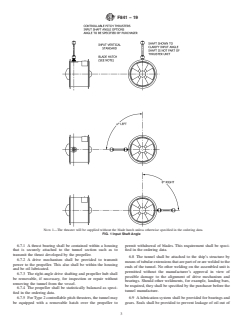
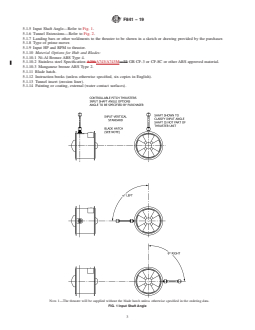
5.1.5 Input Shaft Angle—Refer to Fig. 1.
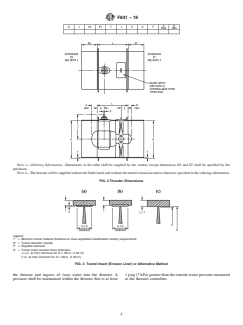
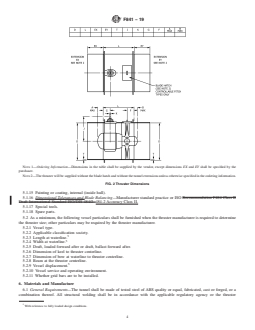
5.1.6 Tunnel Extensions—Refer to Fig. 2.
5.1.7 Landing bars or other weldments to the thruster to be shown in a sketch or drawing provided by the purchaser.
5.1.8 Type of prime mover.
5.1.9 Input HP and RPM to thruster.
5.1.10 Material Options for Hub and Blades:
5.1.10.1 Ni-Al Bronze ABS Type 4.
5.1.10.2 Stainless steel Specification A296A743/A743M – 72 GR CF-3 or CF-8C or other ABS approved material.
5.1.10.3 Manganese bronze ABS Type 2.
5.1.11 Blade hatch.
5.1.12 Instruction books (unless otherwise specified, six copies in English).
5.1.13 Tunnel insert (erosion liner).
5.1.14 Painting or coating, external (water contact surfaces).
NOTE 1—The thruster will be supplied without the blade hatch unless otherwise specified in the ordering data.
FIG. 1 Input Shaft Angle
F841 − 19
NOTE 1—Ordering Information—Dimensions in the table shall be supplied by the vendor, except dimensions EX and EY shall be specified by the
purchaser.
NOTE 2—The thruster will be supplied without the blade hatch and without the tunnel extensions unless otherwise specified in the ordering information.
FIG. 2 Thruster Dimensions
5.1.15 Painting or coating, internal (inside hull).
5.1.16 Dimensional Tolerances and Blade Balancing—Manufacturer standard practice or ISO Recommendation F484 Class II
Draft International Standard ISO/DIS 484/2. 484-2 Accuracy Class II.
5.1.17 Special tools.
5.1.18 Spare parts.
5.2 As a minimum, the following vessel particulars shall be furnished when the thruster manufacturer is required to determine
t
...
Questions, Comments and Discussion
Ask us and Technical Secretary will try to provide an answer. You can facilitate discussion about the standard in here.
Loading comments...