

ASTM C170/C170M-24a
(Test Method)Standard Test Method for Compressive Strength of Dimension Stone
General Information
- Abstract
SIGNIFICANCE AND USE
4.1 This test method is useful in indicating the differences in compressive strength between the various dimension stones. This test method also provides one element in comparing stones of the same type.
SCOPE
1.1 This test method covers the sampling, preparation of specimens, and determination of the compressive strength of dimension stone.
1.2 The values stated in either SI units or inch-pound units are to be regarded separately as standard. The values stated in each system are not necessarily exact equivalents; therefore, to ensure conformance with the standard, each system shall be used independently of the other, and values from the two systems shall not be combined.
1.3 This standard does not purport to address all of the safety concerns, if any, associated with its use. It is the responsibility of the user of this standard to establish appropriate safety, health, and environmental practices and determine the applicability of regulatory limitations prior to use.
1.4 This international standard was developed in accordance with internationally recognized principles on standardization established in the Decision on Principles for the Development of International Standards, Guides and Recommendations issued by the World Trade Organization Technical Barriers to Trade (TBT) Committee.
- Status
- Published
- Publication Date
- 31-Mar-2024
- Technical Committee
- C18 - Dimension Stone
- Drafting Committee
- C18.01 - Test Methods

Overview
ASTM C170/C170M-24a: Standard Test Method for Compressive Strength of Dimension Stone is an internationally recognized standard developed by ASTM International. This standard specifies the method for sampling, specimen preparation, and testing to determine the compressive strength of dimension stone. The method provides clear guidance to identify performance differences between stone types and supports accurate comparison within the same category of stone, which is essential for quality assurance, materials selection, and regulatory compliance in the construction and natural stone industries.
ASTM C170/C170M-24a is applicable in both SI and inch-pound units, with requirements that each system be used independently. This test method plays a critical role in verifying that stone products meet structural and safety demands in architectural, structural, and engineering projects.
Key Topics
- Purpose and Scope: Measures and compares the compressive strength of various dimension stones, supporting consistent evaluation for construction and engineering use.
- Sample Selection: Ensures representative sampling of stone types or grades, allowing for assessment of product variances from natural ledges or quarried sources.
- Specimen Preparation: Specifies the size, shape, and finish of specimens-for example, cube or right cylinder shape, minimum dimensions, and surface quality requirements.
- Test Conditions: Guides conditioning of specimens for wet or dry testing, replicating environmental factors that may affect compressive strength.
- Testing Procedures: Details use of calibrated testing machines, specimen alignment, load application rates, and failure definitions.
- Data Reporting: Requires comprehensive documentation, including average and individual test results, specimen orientation, conditioning details, equipment used, and statistical measures like standard deviation.
- Safety and Compliance: Emphasizes the user's responsibility for compliance with relevant safety, health, and environmental regulations.
Applications
ASTM C170/C170M-24a is essential for various stakeholders in the stone and construction industries:
- Stone Producers and Processors utilize this standard to demonstrate product performance, ensuring compliance with project specifications and regulatory requirements.
- Architects and Engineers refer to compressive strength data for selecting appropriate dimension stone for structural or aesthetic applications, particularly in load-bearing or high-traffic installations (such as flooring, cladding, columns, and facades).
- Quality Control Laboratories rely on this test method to standardize their testing protocols and provide consistent, comparable results across different projects and stone types.
- Construction Companies use certified test results to assess the suitability of stone material for specific projects, mitigating risk and ensuring long-term durability.
- Regulatory Agencies and Inspectors reference this standard when evaluating building materials for public safety and code compliance.
Related Standards
For comprehensive evaluation and quality control of dimension stone and related materials, ASTM C170/C170M-24a is frequently used alongside these related standards:
- ASTM C39/C39M: Test Method for Compressive Strength of Cylindrical Concrete Specimens
- ASTM C119: Terminology Relating to Dimension Stone
- ASTM C1799/C1799M: Guide to Dimension Stone Test Specimen Sampling and Preparation
- ASTM D4543: Practices for Preparing Rock Core as Cylindrical Test Specimens and Verifying Conformance to Dimensional and Shape Tolerances
- ASTM D7012: Test Methods for Compressive Strength and Elastic Moduli of Intact Rock Core Specimens
- ASTM E4: Practices for Force Calibration and Verification of Testing Machines
- ASTM E2586: Practice for Calculating and Using Basic Statistics
Keywords: ASTM C170, compressive strength, dimension stone, stone testing, construction materials, material testing standards, quality control, stone performance, laboratory methods, building codes.
Relations
- Effective Date
- 01-Apr-2024
- Effective Date
- 01-Apr-2024
- Effective Date
- 01-Apr-2024
- Effective Date
- 01-Apr-2024
- Effective Date
- 01-Apr-2024
- Effective Date
- 01-Apr-2024
- Effective Date
- 01-Apr-2024
- Effective Date
- 01-Apr-2024
- Effective Date
- 01-Apr-2024
- Effective Date
- 01-Apr-2024
- Effective Date
- 01-Apr-2024
Get Certified
Connect with accredited certification bodies for this standard

DIBt (Deutsches Institut für Bautechnik)
German Institute for Building Technology.
DIN CERTCO
DIN Group product certification.

Aboma Certification B.V.
Specialized in construction, metal, and transport sectors.
Sponsored listings
Frequently Asked Questions
ASTM C170/C170M-24a is a standard published by ASTM International. Its full title is "Standard Test Method for Compressive Strength of Dimension Stone". This standard covers: SIGNIFICANCE AND USE 4.1 This test method is useful in indicating the differences in compressive strength between the various dimension stones. This test method also provides one element in comparing stones of the same type. SCOPE 1.1 This test method covers the sampling, preparation of specimens, and determination of the compressive strength of dimension stone. 1.2 The values stated in either SI units or inch-pound units are to be regarded separately as standard. The values stated in each system are not necessarily exact equivalents; therefore, to ensure conformance with the standard, each system shall be used independently of the other, and values from the two systems shall not be combined. 1.3 This standard does not purport to address all of the safety concerns, if any, associated with its use. It is the responsibility of the user of this standard to establish appropriate safety, health, and environmental practices and determine the applicability of regulatory limitations prior to use. 1.4 This international standard was developed in accordance with internationally recognized principles on standardization established in the Decision on Principles for the Development of International Standards, Guides and Recommendations issued by the World Trade Organization Technical Barriers to Trade (TBT) Committee.
SIGNIFICANCE AND USE 4.1 This test method is useful in indicating the differences in compressive strength between the various dimension stones. This test method also provides one element in comparing stones of the same type. SCOPE 1.1 This test method covers the sampling, preparation of specimens, and determination of the compressive strength of dimension stone. 1.2 The values stated in either SI units or inch-pound units are to be regarded separately as standard. The values stated in each system are not necessarily exact equivalents; therefore, to ensure conformance with the standard, each system shall be used independently of the other, and values from the two systems shall not be combined. 1.3 This standard does not purport to address all of the safety concerns, if any, associated with its use. It is the responsibility of the user of this standard to establish appropriate safety, health, and environmental practices and determine the applicability of regulatory limitations prior to use. 1.4 This international standard was developed in accordance with internationally recognized principles on standardization established in the Decision on Principles for the Development of International Standards, Guides and Recommendations issued by the World Trade Organization Technical Barriers to Trade (TBT) Committee.
ASTM C170/C170M-24a is classified under the following ICS (International Classification for Standards) categories: 91.100.15 - Mineral materials and products. The ICS classification helps identify the subject area and facilitates finding related standards.
ASTM C170/C170M-24a has the following relationships with other standards: It is inter standard links to ASTM C170/C170M-24, ASTM E2260-21a, ASTM C616/C616M-22, ASTM C1682-21, ASTM C1526-19(2023)e1, ASTM C568/C568M-22, ASTM C615/C615M-23, ASTM C1242-23c, ASTM C1283-15(2021), ASTM C1527/C1527M-23, ASTM C503/C503M-23. Understanding these relationships helps ensure you are using the most current and applicable version of the standard.
ASTM C170/C170M-24a is available in PDF format for immediate download after purchase. The document can be added to your cart and obtained through the secure checkout process. Digital delivery ensures instant access to the complete standard document.
Standards Content (Sample)
This international standard was developed in accordance with internationally recognized principles on standardization established in the Decision on Principles for the
Development of International Standards, Guides and Recommendations issued by the World Trade Organization Technical Barriers to Trade (TBT) Committee.
Designation: C170/C170M − 24a
Standard Test Method for
Compressive Strength of Dimension Stone
This standard is issued under the fixed designation C170/C170M; the number immediately following the designation indicates the year
of original adoption or, in the case of revision, the year of last revision. A number in parentheses indicates the year of last reapproval.
A superscript epsilon (´) indicates an editorial change since the last revision or reapproval.
This standard has been approved for use by agencies of the U.S. Department of Defense.
1. Scope D7012 Test Methods for Compressive Strength and Elastic
Moduli of Intact Rock Core Specimens under Varying
1.1 This test method covers the sampling, preparation of
States of Stress and Temperatures
specimens, and determination of the compressive strength of
E4 Practices for Force Calibration and Verification of Test-
dimension stone.
ing Machines
1.2 The values stated in either SI units or inch-pound units
E2586 Practice for Calculating and Using Basic Statistics
are to be regarded separately as standard. The values stated in
each system are not necessarily exact equivalents; therefore, to
3. Terminology
ensure conformance with the standard, each system shall be
3.1 Definitions—All definitions are in accordance with Ter-
used independently of the other, and values from the two
minology C119.
systems shall not be combined.
1.3 This standard does not purport to address all of the
4. Significance and Use
safety concerns, if any, associated with its use. It is the
4.1 This test method is useful in indicating the differences in
responsibility of the user of this standard to establish appro-
compressive strength between the various dimension stones.
priate safety, health, and environmental practices and deter-
This test method also provides one element in comparing
mine the applicability of regulatory limitations prior to use.
stones of the same type.
1.4 This international standard was developed in accor-
dance with internationally recognized principles on standard-
5. Apparatus
ization established in the Decision on Principles for the
5.1 The testing machine used shall conform to the require-
Development of International Standards, Guides and Recom-
ments of Test Method C39/C39M, Section 5, including the
mendations issued by the World Trade Organization Technical
calibration requirements of Practices E4.
Barriers to Trade (TBT) Committee.
5.2 The testing machine used shall be capable of applying
2. Referenced Documents
the required load at a uniform rate as prescribed in Section 9
and applying load in a steady manner as to avoid sudden or
2.1 ASTM Standards:
rapid load changes.
C39/C39M Test Method for Compressive Strength of Cylin-
drical Concrete Specimens
5.3 The spherical bearing block of the testing machine shall
C119 Terminology Relating to Dimension Stone
be suspended from the upper head so that the contact plate
C1799/C1799M Guide to Dimension Stone Test Specimen
remains in a central position (spherical surfaces in full contact)
Sampling and Preparation
when not loaded. The spherical surfaces shall be well
D4543 Practices for Preparing Rock Core as Cylindrical Test
lubricated, and the center of curvature shall be aligned within
Specimens and Verifying Conformance to Dimensional
the surface of contact with the specimen.
and Shape Tolerances
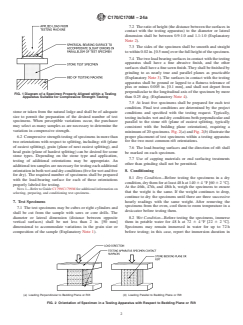
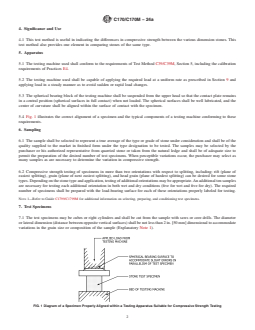
5.4 Fig. 1 illustrates the correct alignment of a specimen and
the typical components of a testing machine conforming to
1 these requirements.
This test method is under the jurisdiction of ASTM Committee C18 on
Dimension Stone and is the direct responsibility of Subcommittee C18.01 on Test
Methods.
6. Sampling
Current edition approved April 1, 2024. Published April 2024. Originally
6.1 The sample shall be selected to represent a true average
approved in 1941. Last previous edition approved in 2024 as C170/C170M – 24.
DOI: 10.1520/C0170_C0170M-24A.
of the type or grade of stone under consideration and shall be
For referenced ASTM standards, visit the ASTM website, www.astm.org, or
of the quality supplied to the market in finished form under the
contact ASTM Customer Service at service@astm.org. For Annual Book of ASTM
type designation to be tested. The samples may be selected by
Standards volume information, refer to the standard’s Document Summary page on
the ASTM website. the purchaser or his authorized representative from quarried
Copyright © ASTM International, 100 Barr Harbor Drive, PO Box C700, West Conshohocken, PA 19428-2959. United States
C170/C170M − 24a
7.2 The ratio of height (the distance between the surfaces in
contact with the testing apparatus) to the diameter or lateral
dimension shall be between 0.9:1.0 and 1.1:1.0 (Explanatory
Note 2).
7.3 The sides of the specimen shall be smooth and straight
to within 0.02 in. [0.5 mm] over the full height of the specimen.
7.4 The two load bearing surfaces in contact with the testing
apparatus shall have a fine abrasive finish, and the other
surfaces shall have a fine sawn finish. They shall be finished by
grinding to as nearly true and parallel planes as practicable
(Explanatory Note 3). The surfaces in contact with the testing
apparatus shall be ground or lapped to a flatness tolerance of
plus or minus 0.005 in. [0.1 mm], and shall not depart from
perpendicular to the longitudinal axis of the specimen by more
FIG. 1 Diagram of a Specimen Properly Aligned within a Testing
than 0.25 deg. (Explanatory Note 4).
Apparatus Suitable for Compressive Strength Testing
7.5 At least five specimens shall be prepared for each test
condition. Final test conditions are determined by the project
stone or taken from the natural ledge and shall be of adequate
conditions and specified with the testing request. Typically,
size to permit the preparation of the desired number of test
testing includes wet and dry conditions both perpendicular and
specimens. When perceptible variations occur, the purchaser
parallel to the stone rift (plane of easiest splitting, typically
may select as many samples as are necessary to determine the
consistent with the bedding plane orientation), requiring a
variation in compressive strength.
minimum of 20 specimens. Fig. 2(a) and Fig. 2(b) illustrate the
proper placement of test specimens within a testing apparatus
6.2 Compressive strength testing of specimens in more than
for the two most common rift orientations.
two orientations with respect to splitting, including: rift (plane
of easiest splitting), grain (plane of next easiest splitting), and
7.6 The load-bearing surfaces and the direction of rift shall
head grain (plane of hardest splitting) can be desired for some
be marked on each specimen.
stone types. Depending on the stone type and application,
7.7 Use of capping materials or end surfacing treatments
testing of additional orientations may be appropriate. An
other than grinding shall not be permitted.
additional ten samples are necessary for testing each additional
orientation in both wet and dry conditions (five for wet and five
8. Conditioning
for dry). The required number of specimens shall be prepared
8.1 Dry Condition—Before testing the specimens in a dry
with the load-bearing surface for each of these orientations
condition, dry them for at least 48 h at 140 6 4 °F [60 6 2 °C].
properly labeled for testing.
At the 46th, 47th, and 48th h, weigh the specimens to ensure
NOTE 1—Refer to Guide C1799/C1799M for additional information on
that the weight is the same. If the weight continues to drop,
selecting, preparing, and conditioning test specimens.
continue to dry the specimens until there are three successive
7. Test Specimens hourly readings with the same weight. After removing the
specimens from the oven, cool them to room temperature in a
7.1 The test specimens may be cubes or right cylinders and
desiccator before testing them.
shall be cut from the sample with saws or core drills. The
diameter or lateral dimension (distance between opposite 8.2 Wet Condition—Before testing the specimens, immerse
vertical surfaces) shall be not less than 2 in. [50 mm] them in potable water for 48 h at 72 6 4 °F [22 6 2 °C].
dimensional to accommodate var
...
This document is not an ASTM standard and is intended only to provide the user of an ASTM standard an indication of what changes have been made to the previous version. Because
it may not be technically possible to adequately depict all changes accurately, ASTM recommends that users consult prior editions as appropriate. In all cases only the current version
of the standard as published by ASTM is to be considered the official document.
Designation: C170/C170M − 24 C170/C170M − 24a
Standard Test Method for
Compressive Strength of Dimension Stone
This standard is issued under the fixed designation C170/C170M; the number immediately following the designation indicates the year
of original adoption or, in the case of revision, the year of last revision. A number in parentheses indicates the year of last reapproval.
A superscript epsilon (´) indicates an editorial change since the last revision or reapproval.
This standard has been approved for use by agencies of the U.S. Department of Defense.
1. Scope
1.1 This test method covers the sampling, preparation of specimens, and determination of the compressive strength of dimension
stone.
1.2 The values stated in either SI units or inch-pound units are to be regarded separately as standard. The values stated in each
system are not necessarily exact equivalents; therefore, to ensure conformance with the standard, each system shall be used
independently of the other, and values from the two systems shall not be combined.
1.3 This standard does not purport to address all of the safety concerns, if any, associated with its use. It is the responsibility
of the user of this standard to establish appropriate safety, health, and environmental practices and determine the applicability of
regulatory limitations prior to use.
1.4 This international standard was developed in accordance with internationally recognized principles on standardization
established in the Decision on Principles for the Development of International Standards, Guides and Recommendations issued
by the World Trade Organization Technical Barriers to Trade (TBT) Committee.
2. Referenced Documents
2.1 ASTM Standards:
C39/C39M Test Method for Compressive Strength of Cylindrical Concrete Specimens
C119 Terminology Relating to Dimension Stone
C1799/C1799M Guide to Dimension Stone Test Specimen Sampling and Preparation
D4543 Practices for Preparing Rock Core as Cylindrical Test Specimens and Verifying Conformance to Dimensional and Shape
Tolerances
D7012 Test Methods for Compressive Strength and Elastic Moduli of Intact Rock Core Specimens under Varying States of
Stress and Temperatures
E4 Practices for Force Calibration and Verification of Testing Machines
E2586 Practice for Calculating and Using Basic Statistics
3. Terminology
3.1 Definitions—All definitions are in accordance with Terminology C119.
This test method is under the jurisdiction of ASTM Committee C18 on Dimension Stone and is the direct responsibility of Subcommittee C18.01 on Test Methods.
Current edition approved March 1, 2024April 1, 2024. Published April 2024. Originally approved in 1941. Last previous edition approved in 20232024 as
C170/C170M – 23.C170/C170M – 24. DOI: 10.1520/C0170_C0170M-24.10.1520/C0170_C0170M-24A.
For referenced ASTM standards, visit the ASTM website, www.astm.org, or contact ASTM Customer Service at service@astm.org. For Annual Book of ASTM Standards
volume information, refer to the standard’s Document Summary page on the ASTM website.
Copyright © ASTM International, 100 Barr Harbor Drive, PO Box C700, West Conshohocken, PA 19428-2959. United States
C170/C170M − 24a
4. Significance and Use
4.1 This test method is useful in indicating the differences in compressive strength between the various dimension stones. This
test method also provides one element in comparing stones of the same type.
5. Apparatus
5.1 The testing machine used shall conform to the requirements of Test Method C39/C39M, Section 5, including the calibration
requirements of Practices E4.
5.2 The testing machine used shall be capable of applying the required load at a uniform rate as prescribed in Section 9 and
applying load in a steady manner as to avoid sudden or rapid load changes.
5.3 The spherical bearing block of the testing machine shall be suspended from the upper head so that the contact plate remains
in a central position (spherical surfaces in full contact) when not loaded. The spherical surfaces shall be well lubricated, and the
center of curvature shall be aligned within the surface of contact with the specimen.
5.4 Fig. 1 illustrates the correct alignment of a specimen and the typical components of a testing machine conforming to these
requirements.
6. Sampling
6.1 The sample shall be selected to represent a true average of the type or grade of stone under consideration and shall be of the
quality supplied to the market in finished form under the type designation to be tested. The samples may be selected by the
purchaser or his authorized representative from quarried stone or taken from the natural ledge and shall be of adequate size to
permit the preparation of the desired number of test specimens. When perceptible variations occur, the purchaser may select as
many samples as are necessary to determine the variation in compressive strength.
6.2 Compressive strength testing of specimens in more than two orientations with respect to splitting, including: rift (plane of
easiest splitting), grain (plane of next easiest splitting), and head grain (plane of hardest splitting) can be desired for some stone
types. Depending on the stone type and application, testing of additional orientations may be appropriate. An additional ten samples
are necessary for testing each additional orientation in both wet and dry conditions (five for wet and five for dry). The required
number of specimens shall be prepared with the load-bearing surface for each of these orientations properly labeled for testing.
NOTE 1—Refer to Guide C1799/C1799M for additional information on selecting, preparing, and conditioning test specimens.
7. Test Specimens
7.1 The test specimens may be cubes or right cylinders and shall be cut from the sample with saws or core drills. The diameter
or lateral dimension (distance between opposite vertical surfaces) shall be not less than 2 in. [50 mm] dimensional to accommodate
variations in the grain size or composition of the sample (Explanatory Note 1).
FIG. 1 Diagram of a Specimen Properly Aligned within a Testing Apparatus Suitable for Compressive Strength Testing
C170/C170M − 24a
7.2 The ratio of height (the distance between the surfaces in contact with the testing apparatus) to the diameter or lateral dimension
shall be between 0.9:1.0 and 1.1:1.0 (Explanatory Note 2).
7.3 The sides of the specimen shall be smooth and straight to within 0.02 in. [0.5 mm] over the full height of the specimen.
7.4 The two load bearing surfaces in contact with the testing apparatus shall have a fine abrasive finish, and the other surfaces shall
have a fine sawn finish. They shall be finished by grinding to as nearly true and parallel planes as practicable (Explanatory Note
3). The surfaces in contact with the testing apparatus shall be ground or lapped to a flatness tolerance of plus or minus 0.005 in.
[0.1 mm], and shall not depart from perpendicular to the longitudinal axis of the specimen by more than 0.25 deg. (Explanatory
Note 4).
7.5 At least five specimens shall be prepared for each test condition. Final test conditions are determined by the project conditions
and specified with the testing request. Typically, testing includes wet and dry conditions both perpendicular and parallel to the stone
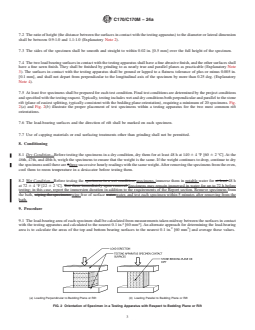
rift (plane of easiest splitting, typically consistent with the bedding plane orientation), requiring a minimum of 20 specimens. Fig.
2(a) and Fig. 2(b) illustrate the proper placement of test specimens within a testing apparatus for the two most common rift
orientations.
7.6 The load-bearing surfaces and the direction of rift shall be marked on each specimen.
7.7 Use of capping materials or end surfacing treatments other than grinding shall not be permitted.
8. Conditioning
8.1 Dry Condition—Before testing the specimens in a dry condition, dry them for at least 48 h at 140 6 4 °F [60 6 2 °C]. At the
46th, 47th, and 48th h, weigh the specimens to ensure that the weight is the same. If the weight continues to drop, continue to dry
the specimens until there are 3three successive hourly readings with the same weight. After removing the specimens from the oven,
cool them to room temperature in a desiccator before testin
...