

ASTM C1242-23c
(Guide)Standard Guide for Selection, Design, and Installation of Dimension Stone Attachment Systems
General Information
- Abstract
SIGNIFICANCE AND USE
4.1 This guide is intended to be used by architects, engineers, and contractors who either design or install exterior stone cladding for architectural structures.
4.2 This guide is an industry standard for engineering design considerations, documentation, material considerations, anchor type applications, and installation workmanship to assist designers and installers to achieve a proper and durable stone cladding.
4.3 Stone and its support systems are part of a building's skin and shall be compatible with the behavior and performance of other interfacing systems, such as the curtainwall and superstructure frame.
4.3.1 Every stone work application shall comply with applicable building codes.
4.3.2 It is not the intent of this guide to supersede published recommendations for specific stone types. Provisions of other dimension stone industry publications should be reviewed and considered in addition to this guide's recommendations. All industry information should be considered with respect to project specifications and requirements. If provisions of such publications differ from those in this guide, it is acceptable practice to follow the publication's provisions if recommended by the stone specialist defined in 4.4 for the specific conditions of the individual project.
4.3.3 Because stone properties vary, the range and variability of pertinent properties of the stone proposed for use should be determined by testing and statistical methods that are evaluated using sound engineering principles. Use recent test data where applicable. Always reference proven performance of relevant existing structures.
4.3.4 Changes in properties over time shall be considered.
4.3.5 Overall behaviors of all building systems and components including the stone shall be interactively compatible.
4.4 Stone Specialist—Some conditions require professional expertise to select and plan a proper anchoring system, establish appropriate testing requirements, interpret tests,...
SCOPE
1.1 This guide covers the categories of anchors and anchoring systems and discusses the design principles to be considered in selecting anchors or systems that will resist gravity loads and applied loads.
1.2 This guide sets forth basic requirements for the design of stone anchorage and provides a practical checklist of those design considerations.
1.3 This guide pertains to:
1.3.1 The anchoring of stone panels directly to the building structure for support,
1.3.2 The anchoring of stone panels to subframes or to curtainwall components after these support systems are attached to the building structure,
1.3.3 The anchoring of stone panels to subframes or to curtainwall components with stone cladding preassembled before these support systems are attached to the building structure, and
1.3.4 The supervision and inspection of fabrication and installation of the above.
1.4 Observe all applicable regulations, specific recommendations of the manufacturers, and standards governing interfacing work.
1.5 The values stated in inch-pound units are to be regarded as standard. The values given in parentheses are mathematical conversions to SI units that are provided for information only and are not considered standard.
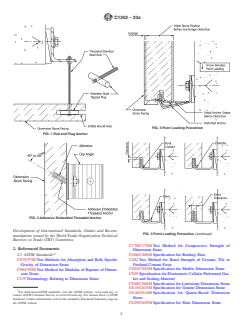
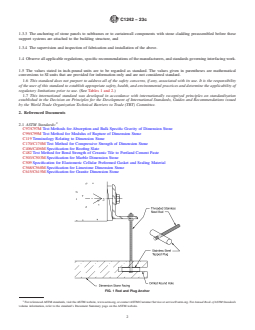
FIG. 1 Rod and Plug Anchor
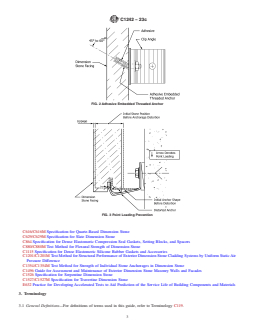
FIG. 2 Adhesive Embedded Threaded Anchor
FIG. 3 Point Loading Prevention
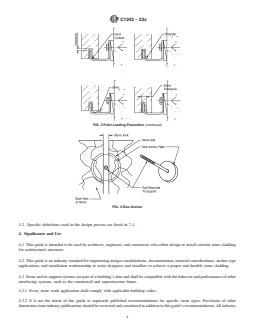
FIG. 3 Point Loading Prevention (continued)
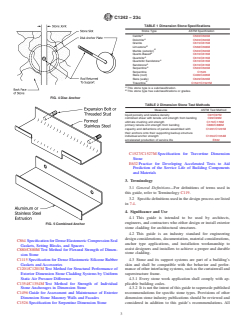
FIG. 4 Disc Anchor
FIG. 5 Combined Anchor
1.6 This standard does not purport to address all of the safety concerns, if any, associated with its use. It is the responsibility of the user of this standard to establish appropriate safety, health, and environmental practices and determine the applicability of regulatory limitations prior to use. (See Tables 1 and 2.)
1.7 This international standard was developed in accordance with internationally recognized principles on standardization established in the Decision on Principles for th...
- Status
- Published
- Publication Date
- 14-Nov-2023
- Technical Committee
- C18 - Dimension Stone
- Drafting Committee
- C18.06 - Attachment Components and Systems
Buy Documents
ASTM C1242-23c - Standard Guide for Selection, Design, and Installation of Dimension Stone Attachment Systems
REDLINE ASTM C1242-23c - Standard Guide for Selection, Design, and Installation of Dimension Stone Attachment Systems
Overview
ASTM C1242-23c – Standard Guide for Selection, Design, and Installation of Dimension Stone Attachment Systems provides comprehensive guidance for architects, engineers, and contractors involved in designing and installing exterior stone cladding systems. This industry-standard reference outlines key engineering design considerations, proper documentation, material selection, anchor type applications, and installation practices to ensure the performance, durability, and safety of dimension stone cladding in architectural structures. The guide is essential for aligning stone attachment systems with building codes, proven engineering principles, and the overall compatibility with other building envelope systems like curtainwalls and structural frames.
Key Topics
ASTM C1242-23c addresses critical aspects of dimension stone attachment systems, including:
- Design Principles: Considerations for selecting anchor systems that effectively resist gravity and applied loads, tailored to the specific stone type and building requirements.
- Anchor Types: Guidance on anchoring stone panels directly to building structures, subframes, or curtainwall systems, as well as the use of rod and plug anchors, adhesive-embedded threaded anchors, disc anchors, combined anchors, and undercut anchors.
- Material Considerations: Emphasis on selecting appropriate materials for anchors, subframes, and stone types, considering factors like corrosion resistance, compatibility, and durability.
- Testing and Documentation: Recommendations to assess the variability of stone properties through standardized testing methods. This supports appropriate safety factors and ensures selections are based on reliable, current test data.
- Installation Workmanship: Best practices for fabricating, supervising, and inspecting installation processes to achieve robust and long-lasting stone cladding.
- System Compatibility: Ensuring the stone cladding system interacts appropriately with adjoining facade components, accounting for differential movements, structural tolerances, and environmental impacts.
- Building Code Compliance: Emphasizes the need to adhere to all relevant model building codes, manufacturers' recommendations, and related technical standards.
- Role of Specialists: Recognizing when the expertise of a stone specialist is needed for complex conditions or engineering challenges.
Applications
ASTM C1242-23c is applicable to various construction scenarios, including:
- Commercial and Institutional Buildings: For exterior stone cladding on high-rise or mid-rise office buildings, universities, hospitals, and public spaces.
- Facade Renovation and Restoration: Assists professionals in upgrading existing stone facades or conducting repairs while ensuring anchor system integrity.
- Curtainwall and Hybrid Systems: Guidance for integrating stone panels with curtainwalls and subframe systems, supporting both new construction and retrofits.
- Custom Architectural Features: Useful for unique facade elements such as stone columns, arches, or soffits that require tailored anchorage solutions.
- Quality Assurance and Inspection: QA/QC teams, project managers, and inspectors use the standard as a reference to ensure installation adheres to best practices and documented requirements.
By following ASTM C1242-23c, project teams ensure their dimension stone attachment systems are structurally sound, aesthetically durable, and compliant with international standards and codes.
Related Standards
To achieve comprehensive project success with dimension stone attachment systems, consider the following related ASTM standards:
- ASTM C97/C97M: Absorption and Bulk Specific Gravity of Dimension Stone
- ASTM C99/C99M: Modulus of Rupture of Dimension Stone
- ASTM C170/C170M: Compressive Strength of Dimension Stone
- ASTM C1201/C1201M: Structural Performance of Exterior Dimension Stone Cladding Systems
- ASTM C1354/C1354M: Strength of Individual Stone Anchorages in Dimension Stone
- ASTM C615/C615M, C568/C568M, C503/C503M: Material specifications for granite, limestone, and marble dimension stones
Reviewing and applying these related standards alongside ASTM C1242-23c ensures robust engineering decisions, reliable anchorage selection, durable installation, and consistent compliance with the best practices for dimension stone cladding systems.
Relations
- Effective Date
- 15-Nov-2023
- Effective Date
- 01-Apr-2024
- Effective Date
- 01-Mar-2024
- Effective Date
- 01-Sep-2023
- Effective Date
- 15-Nov-2023
- Effective Date
- 15-Nov-2023
- Effective Date
- 15-Nov-2023
- Referred By
ASTM C1780-23a - Standard Practice for Installation Methods for Cement-based Adhered Masonry Veneer - Effective Date
- 15-Nov-2023
- Effective Date
- 15-Nov-2023
- Effective Date
- 15-Nov-2023
- Effective Date
- 15-Nov-2023
- Effective Date
- 15-Nov-2023
- Effective Date
- 15-Nov-2023
- Effective Date
- 15-Nov-2023
- Effective Date
- 15-Nov-2023
Buy Documents
ASTM C1242-23c - Standard Guide for Selection, Design, and Installation of Dimension Stone Attachment Systems
REDLINE ASTM C1242-23c - Standard Guide for Selection, Design, and Installation of Dimension Stone Attachment Systems
Get Certified
Connect with accredited certification bodies for this standard

Zavod za gradbeništvo Slovenije (ZAG) - Inšpekcija
ZAG inspection body for construction products, structures, and materials.
Sponsored listings
Frequently Asked Questions
ASTM C1242-23c is a guide published by ASTM International. Its full title is "Standard Guide for Selection, Design, and Installation of Dimension Stone Attachment Systems". This standard covers: SIGNIFICANCE AND USE 4.1 This guide is intended to be used by architects, engineers, and contractors who either design or install exterior stone cladding for architectural structures. 4.2 This guide is an industry standard for engineering design considerations, documentation, material considerations, anchor type applications, and installation workmanship to assist designers and installers to achieve a proper and durable stone cladding. 4.3 Stone and its support systems are part of a building's skin and shall be compatible with the behavior and performance of other interfacing systems, such as the curtainwall and superstructure frame. 4.3.1 Every stone work application shall comply with applicable building codes. 4.3.2 It is not the intent of this guide to supersede published recommendations for specific stone types. Provisions of other dimension stone industry publications should be reviewed and considered in addition to this guide's recommendations. All industry information should be considered with respect to project specifications and requirements. If provisions of such publications differ from those in this guide, it is acceptable practice to follow the publication's provisions if recommended by the stone specialist defined in 4.4 for the specific conditions of the individual project. 4.3.3 Because stone properties vary, the range and variability of pertinent properties of the stone proposed for use should be determined by testing and statistical methods that are evaluated using sound engineering principles. Use recent test data where applicable. Always reference proven performance of relevant existing structures. 4.3.4 Changes in properties over time shall be considered. 4.3.5 Overall behaviors of all building systems and components including the stone shall be interactively compatible. 4.4 Stone Specialist—Some conditions require professional expertise to select and plan a proper anchoring system, establish appropriate testing requirements, interpret tests,... SCOPE 1.1 This guide covers the categories of anchors and anchoring systems and discusses the design principles to be considered in selecting anchors or systems that will resist gravity loads and applied loads. 1.2 This guide sets forth basic requirements for the design of stone anchorage and provides a practical checklist of those design considerations. 1.3 This guide pertains to: 1.3.1 The anchoring of stone panels directly to the building structure for support, 1.3.2 The anchoring of stone panels to subframes or to curtainwall components after these support systems are attached to the building structure, 1.3.3 The anchoring of stone panels to subframes or to curtainwall components with stone cladding preassembled before these support systems are attached to the building structure, and 1.3.4 The supervision and inspection of fabrication and installation of the above. 1.4 Observe all applicable regulations, specific recommendations of the manufacturers, and standards governing interfacing work. 1.5 The values stated in inch-pound units are to be regarded as standard. The values given in parentheses are mathematical conversions to SI units that are provided for information only and are not considered standard. FIG. 1 Rod and Plug Anchor FIG. 2 Adhesive Embedded Threaded Anchor FIG. 3 Point Loading Prevention FIG. 3 Point Loading Prevention (continued) FIG. 4 Disc Anchor FIG. 5 Combined Anchor 1.6 This standard does not purport to address all of the safety concerns, if any, associated with its use. It is the responsibility of the user of this standard to establish appropriate safety, health, and environmental practices and determine the applicability of regulatory limitations prior to use. (See Tables 1 and 2.) 1.7 This international standard was developed in accordance with internationally recognized principles on standardization established in the Decision on Principles for th...
SIGNIFICANCE AND USE 4.1 This guide is intended to be used by architects, engineers, and contractors who either design or install exterior stone cladding for architectural structures. 4.2 This guide is an industry standard for engineering design considerations, documentation, material considerations, anchor type applications, and installation workmanship to assist designers and installers to achieve a proper and durable stone cladding. 4.3 Stone and its support systems are part of a building's skin and shall be compatible with the behavior and performance of other interfacing systems, such as the curtainwall and superstructure frame. 4.3.1 Every stone work application shall comply with applicable building codes. 4.3.2 It is not the intent of this guide to supersede published recommendations for specific stone types. Provisions of other dimension stone industry publications should be reviewed and considered in addition to this guide's recommendations. All industry information should be considered with respect to project specifications and requirements. If provisions of such publications differ from those in this guide, it is acceptable practice to follow the publication's provisions if recommended by the stone specialist defined in 4.4 for the specific conditions of the individual project. 4.3.3 Because stone properties vary, the range and variability of pertinent properties of the stone proposed for use should be determined by testing and statistical methods that are evaluated using sound engineering principles. Use recent test data where applicable. Always reference proven performance of relevant existing structures. 4.3.4 Changes in properties over time shall be considered. 4.3.5 Overall behaviors of all building systems and components including the stone shall be interactively compatible. 4.4 Stone Specialist—Some conditions require professional expertise to select and plan a proper anchoring system, establish appropriate testing requirements, interpret tests,... SCOPE 1.1 This guide covers the categories of anchors and anchoring systems and discusses the design principles to be considered in selecting anchors or systems that will resist gravity loads and applied loads. 1.2 This guide sets forth basic requirements for the design of stone anchorage and provides a practical checklist of those design considerations. 1.3 This guide pertains to: 1.3.1 The anchoring of stone panels directly to the building structure for support, 1.3.2 The anchoring of stone panels to subframes or to curtainwall components after these support systems are attached to the building structure, 1.3.3 The anchoring of stone panels to subframes or to curtainwall components with stone cladding preassembled before these support systems are attached to the building structure, and 1.3.4 The supervision and inspection of fabrication and installation of the above. 1.4 Observe all applicable regulations, specific recommendations of the manufacturers, and standards governing interfacing work. 1.5 The values stated in inch-pound units are to be regarded as standard. The values given in parentheses are mathematical conversions to SI units that are provided for information only and are not considered standard. FIG. 1 Rod and Plug Anchor FIG. 2 Adhesive Embedded Threaded Anchor FIG. 3 Point Loading Prevention FIG. 3 Point Loading Prevention (continued) FIG. 4 Disc Anchor FIG. 5 Combined Anchor 1.6 This standard does not purport to address all of the safety concerns, if any, associated with its use. It is the responsibility of the user of this standard to establish appropriate safety, health, and environmental practices and determine the applicability of regulatory limitations prior to use. (See Tables 1 and 2.) 1.7 This international standard was developed in accordance with internationally recognized principles on standardization established in the Decision on Principles for th...
ASTM C1242-23c is classified under the following ICS (International Classification for Standards) categories: 93.020 - Earthworks. Excavations. Foundation construction. Underground works. The ICS classification helps identify the subject area and facilitates finding related standards.
ASTM C1242-23c has the following relationships with other standards: It is inter standard links to ASTM C1242-23b, ASTM C170/C170M-24a, ASTM C170/C170M-24, ASTM C170/C170M-23, ASTM C1526-19(2023)e1, ASTM C1722-23, ASTM C503/C503M-23, ASTM C1780-23a, ASTM C1528/C1528M-20, ASTM C616/C616M-22, ASTM C1527/C1527M-23, ASTM C629/C629M-22, ASTM C615/C615M-23, ASTM C568/C568M-22, ASTM C1354/C1354M-22. Understanding these relationships helps ensure you are using the most current and applicable version of the standard.
ASTM C1242-23c is available in PDF format for immediate download after purchase. The document can be added to your cart and obtained through the secure checkout process. Digital delivery ensures instant access to the complete standard document.
Standards Content (Sample)
This international standard was developed in accordance with internationally recognized principles on standardization established in the Decision on Principles for the
Development of International Standards, Guides and Recommendations issued by the World Trade Organization Technical Barriers to Trade (TBT) Committee.
Designation: C1242 − 23c
Standard Guide for
Selection, Design, and Installation of Dimension Stone
Attachment Systems
This standard is issued under the fixed designation C1242; the number immediately following the designation indicates the year of
original adoption or, in the case of revision, the year of last revision. A number in parentheses indicates the year of last reapproval. A
superscript epsilon (´) indicates an editorial change since the last revision or reapproval.
INTRODUCTION
Natural building stone is chosen as a building’s cladding for its beauty which endures with minimal
maintenance. Stone is durable when used properly. Exercising good judgment when selecting the
particular stone, determining the quarrying and fabrication techniques, designing the method of
attachment, and installing all components correctly maximizes these benefits. A properly executed
stone cladding is designed and installed within the capabilities and limitations of the stone and support
system to resist all forces that work on them.
This guide presents design principles that require consideration when designing anchorages and
evaluating exterior stone to be compatible with its proposed use. It is an overview of current
techniques and a review of minimum requirements for sound stone engineering and construction. The
guide does not list all possible methods of attachment nor does it provide a step-by-step procedure for
stone anchor engineering. Knowledge gained from new engineering designs, testing of applications,
and the investigation of existing problems are continually reviewed to update this guide. Comment
from users is encouraged.
Good judgment by architects, engineers, and contractors when specifying, designing, engineering,
and constructing stone and other work that interfaces stone is necessary to use this guide. Users of this
guide should combine known performance characteristics of the stone, the building’s structural
behavior, and knowledge of materials and construction methods with proven engineering practice.
1. Scope 1.3.3 The anchoring of stone panels to subframes or to
curtainwall components with stone cladding preassembled
1.1 This guide covers the categories of anchors and anchor-
before these support systems are attached to the building
ing systems and discusses the design principles to be consid-
structure, and
ered in selecting anchors or systems that will resist gravity
1.3.4 The supervision and inspection of fabrication and
loads and applied loads.
installation of the above.
1.2 This guide sets forth basic requirements for the design
1.4 Observe all applicable regulations, specific recommen-
of stone anchorage and provides a practical checklist of those
dations of the manufacturers, and standards governing inter-
design considerations.
facing work.
1.3 This guide pertains to:
1.5 The values stated in inch-pound units are to be regarded
1.3.1 The anchoring of stone panels directly to the building
as standard. The values given in parentheses are mathematical
structure for support,
conversions to SI units that are provided for information only
1.3.2 The anchoring of stone panels to subframes or to
and are not considered standard.
curtainwall components after these support systems are at-
1.6 This standard does not purport to address all of the
tached to the building structure,
safety concerns, if any, associated with its use. It is the
responsibility of the user of this standard to establish appro-
priate safety, health, and environmental practices and deter-
mine the applicability of regulatory limitations prior to use.
This guide is under the jurisdiction of ASTM Committee C18 on Dimension
Stone and is the direct responsibility of Subcommittee C18.06 on Attachment
(See Tables 1 and 2.)
Components and Systems.
1.7 This international standard was developed in accor-
Current edition approved Nov. 15, 2023. Published February 2024. Originally
dance with internationally recognized principles on standard-
approved in 1993. Last previous edition approved in 2023 as C1242 – 23b. DOI:
10.1520/C1242-23C. ization established in the Decision on Principles for the
Copyright © ASTM International, 100 Barr Harbor Drive, PO Box C700, West Conshohocken, PA 19428-2959. United States
C1242 − 23c
FIG. 3 Point Loading Prevention
FIG. 1 Rod and Plug Anchor
FIG. 2 Adhesive Embedded Threaded Anchor
Development of International Standards, Guides and Recom-
FIG. 3 Point Loading Prevention (continued)
mendations issued by the World Trade Organization Technical
Barriers to Trade (TBT) Committee.
C170/C170M Test Method for Compressive Strength of
2. Referenced Documents
Dimension Stone
C406/C406M Specification for Roofing Slate
2.1 ASTM Standards:
C482 Test Method for Bond Strength of Ceramic Tile to
C97/C97M Test Methods for Absorption and Bulk Specific
Portland Cement Paste
Gravity of Dimension Stone
C99/C99M Test Method for Modulus of Rupture of Dimen- C503/C503M Specification for Marble Dimension Stone
C509 Specification for Elastomeric Cellular Preformed Gas-
sion Stone
C119 Terminology Relating to Dimension Stone ket and Sealing Material
C568/C568M Specification for Limestone Dimension Stone
C615/C615M Specification for Granite Dimension Stone
For referenced ASTM standards, visit the ASTM website, www.astm.org, or
C616/C616M Specification for Quartz-Based Dimension
contact ASTM Customer Service at service@astm.org. For Annual Book of ASTM
Stone
Standards volume information, refer to the standard’s Document Summary page on
the ASTM website. C629/C629M Specification for Slate Dimension Stone
C1242 − 23c
TABLE 1 Dimension Stone Specifications
Stone Type ASTM Specification
A
Calcite C503/C503M
A
Dolomite C503/C503M
Granite C615/C615M
B
Limestone C568/C568M
B
Marble (exterior) C503/C503M
B
Quartz-Based C616/C616M
A
Quartzite C616/C616M
A
Quartzitic Sandstone C616/C616M
A
Sandstone C616/C616M
A
Serpentine C503/C503M
Serpentine C1526
Slate (roof) C406/C406M
Slate (walls) C629/C629M
A
Travertine C1527/C1527M
A
This stone type is a subclassification.
B
This stone type has subclassifications or grades.
FIG. 4 Disc Anchor
TABLE 2 Dimension Stone Test Methods
Measures ASTM Test Method
liquid porosity and relative density C97/C97M
combined shear with tensile unit strength from bending C99/C99M
ultimate crushing unit strength C170/C170M
primary tensile unit strength from bending C880/C880M
capacity and deflections of panels assembled with C1201/C1201M
their anchors onto their supporting backup structure
individual anchor strength C1354/C1354M
accelerated production of service life E632
C1527/C1527M Specification for Travertine Dimension
Stone
E632 Practice for Developing Accelerated Tests to Aid
Prediction of the Service Life of Building Components
and Materials
3. Terminology
3.1 General Definitions—For definitions of terms used in
this guide, refer to Terminology C119.
3.2 Specific definitions used in the design process are listed
in 7.4.
4. Significance and Use
4.1 This guide is intended to be used by architects,
engineers, and contractors who either design or install exterior
FIG. 5 Combined Anchor
stone cladding for architectural structures.
4.2 This guide is an industry standard for engineering
design considerations, documentation, material considerations,
C864 Specification for Dense Elastomeric Compression Seal
anchor type applications, and installation workmanship to
Gaskets, Setting Blocks, and Spacers
assist designers and installers to achieve a proper and durable
C880/C880M Test Method for Flexural Strength of Dimen-
stone cladding.
sion Stone
C1115 Specification for Dense Elastomeric Silicone Rubber 4.3 Stone and its support systems are part of a building’s
Gaskets and Accessories skin and shall be compatible with the behavior and perfor-
C1201/C1201M Test Method for Structural Performance of mance of other interfacing systems, such as the curtainwall and
Exterior Dimension Stone Cladding Systems by Uniform superstructure frame.
Static Air Pressure Difference 4.3.1 Every stone work application shall comply with ap-
C1354/C1354M Test Method for Strength of Individual plicable building codes.
Stone Anchorages in Dimension Stone 4.3.2 It is not the intent of this guide to supersede published
C1496 Guide for Assessment and Maintenance of Exterior recommendations for specific stone types. Provisions of other
Dimension Stone Masonry Walls and Facades dimension stone industry publications should be reviewed and
C1526 Specification for Serpentine Dimension Stone considered in addition to this guide’s recommendations. All
C1242 − 23c
industry information should be considered with respect to Which physical properties are important to the application, and
project specifications and requirements. If provisions of such which test methods measure those properties and their vari-
publications differ from those in this guide, it is acceptable ability? Refer to Table 2 for standard test methods and
practice to follow the publication’s provisions if recommended properties they measure.
by the stone specialist defined in 4.4 for the specific conditions
5.1.6 Do the physical characteristics of the stone not mea-
of the individual project. sured by standard tests suggest the material may have long-
4.3.3 Because stone properties vary, the range and variabil- term durability concerns? Other properties, including (but not
ity of pertinent properties of the stone proposed for use should limited to) resistance to chemical attack, weather-related
be determined by testing and statistical methods that are strength reduction, and dimensional changes, might be evalu-
evaluated using sound engineering principles. Use recent test ated by special laboratory tests designed to obtain data under
data where applicable. Always reference proven performance simulated conditions.
of relevant existing structures. 5.1.7 Does the project location or shape develop exceptional
4.3.4 Changes in properties over time shall be considered.
design wind, or seismic loads, or does the stone material
4.3.5 Overall behaviors of all building systems and compo- require higher safety factors than other stones not anticipated
nents including the stone shall be interactively compatible.
by statutory codes?
5.1.8 Do the anchor and subframe system accommodate
4.4 Stone Specialist—Some conditions require professional
building dimensional changes caused by wind and seismic
expertise to select and plan a proper anchoring system,
sway, thermal and elastic deformation, creep and shrinkage,
establish appropriate testing requirements, interpret tests, de-
and their combined effects?
sign and engineer the anchoring system, or monitor its fabri-
5.1.9 Will contiguous facade elements such as windows,
cation and installation. A specialist is a person that comple-
other claddings, window supports, or window-washing and
ments the capabilities of the project team by contributing
wall maintenance provisions influence the stone cladding, its
specific expert experience with the use, selection, design, and
anchoring or subframe system?
installation of dimension stone.
5.1.10 Do the anchor or subframe systems penetrate
4.4.1 Particular conditions where special expertise is sug-
waterproofing, facilitate internal moisture collection, or pen-
gested to achieve a reliable installation:
etrate wall insulation and cavity ventilation?
4.4.1.1 Where complex connections or anchoring methods
5.1.11 Do the materials used resist corrosion, galvanic and
of unknown or questionable performance records are likely to
chemical reactions?
be considered or specified;
4.4.1.2 Where the performance record of the specified
5.2 The following general rules are helpful in the design of
systems and materials is not known or questionable;
stone attachments:
4.4.1.3 When multiple cladding materials occur on the same
5.2.1 The simplest connections are usually the best.
facade;
5.2.2 Make anchorages with the fewest components.
4.4.1.4 If the supporting structure or backup is more flexible
5.2.3 Use the fewest feasible anchor types in any particular
than L/600 in any direction;
project.
4.4.1.5 If extreme loading could be caused by seismic,
5.2.4 Provide for adjustability in anchorages to accommo-
hurricane, tornado, or installation and handling methods;
date tolerances in stone and anchor materials, backup
4.4.1.6 When special building code requirements prevail;
conditions, and methods of installation.
4.4.1.7 If provisions of stone industry publications or proj-
5.2.5 Support the stone’s weight by direct bearing on the
ect specifications differ from this guide.
anchorage or by the adhesive mortar’s voidless mechanical
interlock into expanded lath. Connect the anchorage or lath
5. Selection Considerations
directly to backup without allowing vertical downward move-
ment that could induce distress.
5.1 Review the following factors before selecting a stone
5.2.6 Minimize eccentricity from backup to bearing or lath
material, an anchoring system and subframe system from those
to eliminate vertical movement that could induce distress.
options being considered:
5.2.7 When bearing stone on anchors, distribute the stone
5.1.1 Have the stone materials under consideration per-
weight on no more than two locations where possible onto
formed well on existing buildings in similar exposures?
appropriately-sized shims.
5.1.2 Have the different anchoring and subframe systems
5.2.8 Make anchor locations accessible to the craftsman.
under consideration performed well on existing buildings in
similar exposures? 5.2.9 Design anchorage components and kerfs, holes, and
undercuts in the stone to avoid entrapping moisture.
5.1.3 How is the performance of the anchor and its engage-
5.2.10 At friction connections with slotted holes parallel to
ment into the stone affected by installation and handling
procedures? the direction of load, specify proper fasteners, washers, slot
size, and bolt installation procedure. Properly torque fasteners
5.1.4 How are the performance and appearance of the
subframe, the anchor’s connection to the subframe, and the or use other means to negate slip.
subframe’s connections to the building structure affected by 5.2.11 Where feasible and advantageous to cladding
differential movements? integrity, anchor each stone panel individually to permit its
5.1.5 Do the physical characteristics of the stone measured differential movement independent of its surrounding panels or
by standard tests show the material has structural limitations? other work.
C1242 − 23c
5.2.12 Where not feasible and advantageous to anchor each 6.1.1 Connect all anchors to a stable backup. A stable
stone panel individually, stack courses by vertically aligning backup provides sufficient strength and stiffness to resist
bearing shims or placing a continuous mortar bed in horizontal forces, rotations and displacements induced by the anchor as it
joints and provide sufficient provisions to accommodate differ- transfers reactions from the stone panel to the backup to sustain
ential movement between stacked areas that will move to- the structural integrity of the stone cladding. Strength and
gether. stiffness must also be sufficient to prevent stress concentrations
that could compromise capacity, so the stone cladding system
5.3 Safety Factors—In order to design an anchoring system,
can perform as engineered.
the variabilities of the materials being considered should be
6.1.2 Place structural shims between the anchor and backup
known and compensated. This is accomplished through the use
to accommodate variances in position between the finished
of an appropriate safety factor to be applied to the stone, the
stone panel’s position and actual location of the backup. Shims
anchorage, and the backup structure.
must possess permanent structural properties sufficient to
5.3.1 Table 3 shows generally accepted Safety Factors for
transfer forces while resisting rotations and displacements
stone cladding by stone type. Past successful practice, industry
between the anchor and backup that could compromise the
specialists, and association publications establish and recog-
anchor or fastener capacity, or its intended position. Insulation,
nize these recommended factors. These factors are based on a
waterproofing, compressible or elastomeric layers not possess-
maximum coefficient of variation of 20 % when samples
ing sufficient structural properties should not be used as shims,
produced from material representative of that to be provided to
and should not be sandwiched between anchors and backup at
a specific project are tested in accordance with Test Method
bearing surfaces. Unintended slip at adjustment slot, whether in
C880/C880M or Test Method C99/C99M for sedimentary
the vertical, horizontal, or diagonal direction, should be pre-
stones in thicknesses of 2 in. (50 mm) or greater. Safety factors
vented by use of a weld washer, interlocking serrated faces, or
could be changed when conditions listed under 5.3.2 or 5.3.3
other mechanical means.
exist in the project.
6.1.3 Where required to adjust the stone panel’s height
5.3.2 Exemplar Availability: A safety factor could be modi-
during setting, place structural shims between the stone and
fied if the long-term performance of the stone material, anchor
anchor to accommodate variances in position between the
and backup system cannot be verified by well-performing
finished stone panel’s position and actual location of the
exemplars. Consult a stone specialist as defined in 4.4 for the
anchor. Shims must possess permanent structural properties
appropriate change in safety factor.
sufficient to transfer forces while allowing rotations and slight
5.3.3 Structural Variables: A safety factor could be modi-
displacements between the anchor and stone panel that, if
fied if specific conditions exist on the project different from
restricted, could induce prying and compromise the anchor or
those upon which Table 3 values are based. Consult a stone
stone’s capacity where it is engaged by the anchor.
specialist as defined in 4.4 for the appropriate change in safety
factor. Some specific conditions are:
6.2 Cast-in Anchorage (refer to Fig. 6 and Fig. 7):
5.3.3.1 Critical material strength tests show increased vari-
6.2.1 Engage panel with anchor comprised of a spring-clip
ability;
hairpin (Fig. 6) or pairs of dowels, threaded rods, or bolts (Fig.
5.3.3.2 Life expectancy of project exceeds forty years;
7) made of materials following 8.1 “Metals” into holes bored
5.3.3.3 Stone material loses significant strength over time;
into the backside of stone panel. Avoid anchor misalignment in
5.3.3.4 When designing stone at anchors;
hole to reduce resulting prying on stone panel or unintended
5.3.3.5 Anchor capacity tests show increased variability;
load path.
5.3.3.6 Anchors will not be inspected in final position on
6.2.2 Transfer lateral and gravity reactions from stone to
building;
backup with anchor shown. Orient anchors in horizontal plane,
5.3.3.7 Anchors require varied installation techniques or
perpendicular to gravity load whenever possible, without
varied positions;
pointing downward in its final installed position. Slant and
5.3.3.8 Panel is used in higher-risk position such as a soffit,
oppose direction of holes to mechanically lock stone panel onto
overhang, liner block, assembled on backup before being
backup. When anchoring downward-facing stones, ensure that
erected or other similar position.
anchor arrangement will effectively resist vertical and lateral
reactions.
6. Anchor Types
6.2.3 Size diameter and depth of anchor that engages stone
6.1 The following descriptions apply to components poten-
to be capable of resisting intended reactions without allowing
tially common to all anchor types:
deformations that induce prying or reduce anchorage capacity.
In general, number and location of anchors should be a
TABLE 3 Generally Accepted Safety Factors for Stone Cladding
minimum of two anchors per individual panel as anchor and
by Stone Type
panel engineering require and follow factors in Section 5,
Stone Type Specification Safety Factor
“Selection Considerations”.
granite C615/C615M 3
6.2.4 Anchor hole depth and diameter, with the anchor’s
limestone C568/C568M 6
group A marble C503/C503M 5 embedment depth into the hole, are the critical elements
travertine C1527/C1527M 8
determining the anchorage assembly’s capacity for transferring
sandstone C616/C616M 6
forces from the panel to its support. Embed anchors ⁄8 in.
slate C629/C629M 5
(10 mm) minimum and no more than approximately two-thirds
C1242 − 23c
FIG. 6 Spring-Clip Cast-in Anchorage – anchor in horizontal or vertical plane can support gravity and lateral loads (prefer horizontal
clip orientation to support combined loads)
FIG. 7 Separated Pins Cast-in Anchorage – anchor in horizontal or vertical plane can support gravity and lateral loads (prefer horizon-
tal dowel or bolt orientation to support combined loads)
C1242 − 23c
the panel thickness in panels up to 3 in. (75 mm) thick. For 6.2.13 Do not allow floor-to-floor building movements to be
panels thicker than 3 in. (75 mm), embed anchors no more than accommodated as movement within the holes.
approximately one-half the panel thickness. Test specific con-
6.2.14 Size joint between panels to allow for tolerances,
figurations by Test Method C1354/C1354M to confirm capac- clearances, designed movement, and capability of the joint
ity and optimize configuration. filler. Do not accommodate movement occurring in joints in the
3 backup with this type of anchor. Unless the project’s design
6.2.5 Provide minimum ⁄8 in. (10 mm) stone cover over
requires open joints, seal joints between panels with
hole to help avoid rupturing the exposed face during boring or
compressible, compatible sealant with proper profile over
spalling or staining from absorbed moisture.
backer rod to prevent three-sided sealant bond that could cause
6.2.6 Bore hole for anchor with non-percussive tool using
premature sealant failure.
an apparatus to maintain consistent angularity to guide the bore
accurately. Slant holes to an angle of 45° to 60° to the face. 6.3 Dowel Anchorage (refer to Fig. 8 and Fig. 9):
Size hole diameter for minimum clearance around anchor, 6.3.1 Engage panel with a fixed or loose dowel made of
commonly ⁄32 in. (1 mm) larger than the anchor diameter.
materials following 8.1 “Metals”. Avoid dowel misalignment
However, hole size and alignment must allow anchor to be in hole and maintain clearances where shown to reduce
installed to its required embedment. resulting prying on stone panel or unintended load path.
6.3.2 Transfer lateral and gravity reactions (Fig. 8) or only
6.2.7 If required to reduce risk of water entry that might
lateral reactions (Fig. 9) from stone to backup with anchor
stain stone, or freeze and expand to possibly damage stone, fill
shown as a brake-formed shape. Anchor can also be other
the gap between the hole in the stone and anchor with
shapes. If a slot must be used instead of a hole, prevent
non-staining and non-migrating material such as compressible
unintended slip at slot according to 6.1.2.
low-modulus sealant. Polyester or epoxy resins may be used if
6.3.3 Size thickness and height of anchor that engages stone
their thermal and moisture expansion properties,
to be capable of resisting intended reactions without allowing
compressibility, annular volume, and other factors do not risk
deformations that induce prying or reduce anchorage capacity.
damaging the stone in its exposure. The fill also distributes
Size portion of anchor carrying weight of stone to support
bearing of anchor on sides of hole to reduce point bearing and
weight without allowing deformations that induce prying or
stress concentrations. Do not rely solely on adhesives to
reduce anchorage capacity.
support stone.
6.3.4 Place bearing shim to transfer weight of stone to
6.2.8 To prevent adhesion between the stone panel and
anchor and adjust its height to maintain clearances where
backup and minimize water absorption into backup, place a
shown to avoid unintended stress or load path.
continuous polyethylene separator sheet between the back face
6.3.5 Minimize hole depth to improve anchor capacity. Do
of stone and backup. To accommodate some movement,
not allow floor-to-floor building movements to be accommo-
prevent adhesion, and reduce risk of attachment rupture if
dated as movement within the holes. Provide minimum ⁄8 in.
moisture collects and freezes between the stone and backup,
(10 mm) engagement or depth determined to be appropriate by
place an expanded-type, closed-cell foam sheet between the
testing in accordance with Test Method C1354/C1354M.
back face of stone and backup. Protect plane from water entry
Increased engagement may increase anchorage capacity, and
and allow drainage.
could reduce capacity.
6.2.9 Place compressible grommet collar on anchor to allow
6.3.6 Size joint to allow for anchor, tolerances, clearances,
anchor to flex slightly to accommodate differential in-plane
designed movement, and capability of the joint filler. Do not
movements. Grommet to fit snugly onto anchor. Grommet
accommodate movement occurring in joints in the backup with
outside diameter is nominally two times the anchor diameter.
this type of anchor. Unless stone cladding system is intention-
Grommet length is nominally four times the anchor diameter.
ally designed with open joints, fill joints between panels with
6.2.10 Before inserting anchor into hole, remove loose dust
compressible gasket or compatible sealant with proper profile
and debris from holes with compressed desiccated air and wire
over backer rod. If anchor is not recessed enough to allow the
brush. Use minimum ⁄16 in. (5 mm) diameter spring-clip, or
backer rod to be continuous across the face-of-anchor, place
minimum ⁄4 in. (6 mm) diameter dowel, bolt or rod. When
bond breaker at anchor and place backer rod between anchors
holes are to be filled, verify holes around anchors are filled
to prevent three-sided sealant bond that could cause premature
before placing separator sheet and setting grommets. Also
sealant failure.
verify anchors are embedded to full hole depth and proper
6.3.7 Provide clearance between top-of-stone and bottom-
alignment before casting backup.
of-anchor to avoid contact and weight transfer unless cladding
6.2.11 Embed anchor into backup the greater of 2 ⁄2 in.
system is designed to stack. Clearance must allow for differ-
(60 mm), twice the anchor embedment into the stone panel, or
ential movement including thermal volume change, creep,
to 1 in. (25 mm) behind and within the backup’s reinforcing.
seismic and lateral drift, fabrication and installation tolerances.
6.2.12 Engineer the backup to be stiffer than the stone panel
6.3.8 Provide interior edge distance, the thickness of stone
so deformations of the backup do not induce stress into the from hole to back-face-of-stone, capable of resisting negative,
panel or its anchors. Engineer the anchors to accommodate or outward reactions, and also stone weight unless the anchor
shrinkage, creep, fabrication and erection, handling and other only supports lateral reactions. Maintain distance even when
in-service deformations to avoid development of secondary stone panel is at minimum overall thickness. Also provide
stresses that could compromise anchorage integrity. sufficient exterior edge distance, the thickness of stone from
C1242 − 23c
FIG. 8 Dowel Anchorage (brake-formed version) to support combined gravity plus lateral reactions
hole to front-face-of-stone, capable of resisting positive or 6.4.3 Size thickness and height of anchor that engages stone
inward reactions. Keeping this dimension constant could en- to be capable of resisting intended reactions without allowing
able installers to align the panels’ finished faces during setting. deformations that induce prying or reduce anchorage capacity.
6.3.9 Bore hole for dowel with non-percussive means. Size portion of anchor carrying weight of stone to support
Locate hole in center third of panel thickness. Minimize hole weight without allowing deformations that induce prying or
diameter to maximize anchor capacity and proportion interior reduce anchorage capacity.
and exterior edge distances to reactions being resisted while
6.4.4 Place bearing shim to transfer weight of stone to
satisfying 6.3.8. Size hole diameter for minimum clearance
anchor and adjust its height to maintain clearances where
around dowel.
shown and to avoid unintended stress or load path.
6.3.10 Fill holes with compressible and non-absorbing ma-
6.4.5 Minimize kerf depth to improve anchor capacity. Do
terial such as low-modulus sealant or closed-cell foam to
not allow floor-to-floor building movements to be accommo-
prevent moisture accumulation. The fill also cushions bearing 3
dated as movement within the kerfs. Provide minimum ⁄8 in.
of dowel on sides of hole to minimize point bearing and stress
(10 mm) engagement or depth determined to be appropriate by
concentrations. Wax or wrap tape on dowel to allow sliding
testing in accordance with Test Method C1354/C1354M.
where adhesion is not desired, and only small slip is needed.
Increased engagement may not increase anchorage capacity,
and could reduce capacity.
6.4 Kerf Anchorage—(refer to Fig. 10 and Fig. 11).
6.4.1 Engage panel with anchor made of materials follow- 6.4.6 Size joint to allow for anchor, tolerances, clearances,
ing 8.1 “Metals”. Avoid misalignment of leg in kerf and designed movement, and capability of the joint filler. Do not
maintain clearances where shown to reduce resulting prying on accommodate movement occurring in joints in the backup with
stone panel or unintended load path. this type of anchor. Unless stone cladding system is intention-
6.4.2 Transfer lateral and gravity reactions (Fig. 10) or only ally designed with open joints, fill joints between panels with
lateral reactions (Fig. 11) from stone to backup with anchor compressible gasket or compatible sealant with proper profile
shown as a brake-formed shape. Anchor can also be other over backer rod. If anchor is not recessed enough to allow for
shapes. If a slot is used instead of a hole, prevent unintended the backer rod to be continuous across the face-of-anchor,
slip at slot according to 6.1.2. place bond breaker at anchor and place backer rod between
C1242 − 23c
FIG. 9 Dowel Anchorage (brake-formed version) to support only lateral reactions; gravity reactions supported elsewhere
anchors to prevent three-sided sealant bond that could cause 6.5 Undercut Anchorage—(refer to Fig. 12):
premature sealant failure.
6.5.1 Engage panel with an anchor having a sleeve and an
6.4.7 Provide clearance between top-of-stone and bottom-
expanding collar or head into a wider-bottomed bell-shaped
of-anchor to avoid contact and weight transfer unless cladding
hole or milled into backside of panel (Fig. 12). Avoid misalign-
system is designed to stack. Clearance must allow for differ-
ment in collar undercut. Confirm proper fit of collar or head in
ential movement including thermal volume change, creep,
undercut and maintain clearances where shown so the anchor
seismic and lateral drift, fabrication and installation tolerances.
fit does not create secondary stresses or an unintended load
6.4.8 Provide interior edge distance, the thickness of stone
path, and also to reduce prying or expansive forces on stone
from kerf to back-face-of-stone, capable of resisting negative,
panel.
or outward, reactions, and also stone weight unless the anchor
6.5.2 Transfer lateral and gravity reactions from stone to
only supports lateral reactions. Maintain distance even when
backup with anchor shown as sleeve with collar, fastened to
stone panel is minimum overall thickness. Also provide suffi-
hardware connected to backup.
cient exterior edge distance, the thickness of stone from kerf to
6.5.3 Size diameter and depth of anchor that engages stone
front-face-of-stone, capable of resisting positive, or inward,
to be capable of resisting intended reactions without allowing
reactions. Keeping this dimension constant could enable in-
deformations that induce prying or reduce anchorage capacity.
stallers to align the panels’ finished faces during setting.
Nor should arrangement of anchors induce stress or reduce
6.4.9 Sawcut kerf for anchor with non-percussive means.
panel capacity. In general, number and location of anchors
Locate kerf in center third of panel thickness. Minimize kerf
should follow factors in Section 5, “Selection Considerations”.
width to maximize anchor capacity and proportion interior and
6.5.4 Anchor hole depth and diameter, along with the
exterior edge distances to reactions being resisted while
anchor’s embedment depth into the hole, are the critical
satisfying 6.4.8. Size kerf width for minimum clearance around
elements determining the anchorage assembly’s capacity for
anchor leg.
transferring forces from the panel to its support. Prepare
6.4.10 Fill kerfs with compressible and non-absorbing ma-
undercut holes, insert anchor into hole, and engage anchor into
terial such as low-modulus sealant or closed-cell foam to
undercut in strict accordance with the instructions from the
prevent moisture accumulation. The fill also cushions bearing
manufacturer of that particular anchor.
of anchor leg on sides of kerf to minimize point bearing and
stress concentrations. Wax or wrap tape on anchor leg to allow 6.5.4.1 For panels up to 2 in. (50 mm) thick, embed anchors
sliding where adhesion is not desired, and only small slip is between a minimum of ⁄8 in. (10 mm) and a maximum of
needed. two-thirds the panel thickness, unless consideration of specific
C1242 − 23c
FIG. 10 Kerf Anchorage (brake-formed split tail version) to support combined gravity plus lateral reactions
panel configurations, manufacturer’s directions, or project mum clearance around anchor sleeve and around anchor’s
requirements dictate otherwise. expanding collar or head to achieve fit and function defined in
6.5.4.2 For panels greater than 2 in. (50 mm) thick, embed
6.5.1.
anchors between a minimum of ⁄4 in. (20 mm) and a maximum
6.5.6 Do not fill holes or annular gap between anchor and
of one-half the panel thickness, unless consideration of specific
hole.
panel configurations, manufacturer’s directions, or project
6.5.7 Before inserting anchor into hole with collar undercut,
requirements dictate otherwise.
remove loose dust and debris from hole with compressed
6.5.4.3 Panel thickness should only consider the plane of
desiccated air and wire brush, and verify hole and collar
structural integrity and omit projections and incised or carved
undercut are fabricated to proper size, depth, and diameters to
reliefs and false joints.
achieve fit and function defined in 6.5.1. Use tool or device
6.5.4.4 Test specific configurations by Test Method C1354/
provided by manufacturer of anchor to verify hole and under-
C1354M to confirm capacity and optimize configuration.
cut are fabricated properly.
6.5.4.5 To potentially increase anchor capacity, increase
6.5.8 Insert un-expanded collar-end of anchor into properly
hole depth and anchor embedment to a project-specific depth
fabricated hole with collar undercut after verifying all debris is
that achieves capacity required by engineering or testing.
removed and collar undercut is clean. Use minimum ⁄4 in.
Increased quantity of anchors in a panel may not increase
(6 mm) diameter bolt or threaded rod matched to fit into the
anchorage or panel capacity, and could reduce capacity by
sleeve part of the anchor. Verify anchor is inserted to full hole
creating a weak plane across holes, or by transferring deflec-
depth and is properly aligned before fastening connection
tions from the backup that induce flexure.
hardware. Verify anchor sleeve extends behind back-of-stone
6.5.5 Mill hole and undercut for anchor with non-percussive
to prevent pulling the collar or head against the undercut when
tool. Keep holes and undercuts at an angle of 90° to the face of
stone. Size hole and undercut diameters, and embedment connecting the support hardware, and thus developing unin-
tended secondary stresses that can reduce anchor capacity or
depth, to conform with that anchor manufacturer’s require-
ments to attain required anchorage capacity. Maintain mini- damage stone.
C1242 − 23c
FIG. 11 Kerf Anchorage (brake-formed split tail version) to support only lateral reactions; gravity reactions supported elsewhere
FIG. 12 Undercut Anchorage – to support combined gravity plus lateral reactions
C1242 − 23c
6.5.9 If required to reduce risk of water entry that might requires open joints, seal joints between panels with
stain stone or freeze and expand, cover the gap between the compressible, compatible sealant with proper profile over
hole in the stone and anchor’s sleeve with non-staining and backer rod to prevent three-sided sealant bond that could cause
non-migrating, compressible low-modulus sealant to prevent premature sealant failure.
moisture from entering or accumulating around anchor. Sealant
6.6 Wire Ties (see Fig. 13):
must be compatible with and adhere to stone material.
6.6.1 Wire ties used on vertical panels are intended to resist
6.5.10 Attach undercut anchor to support hardware so that
only lateral loads. Weight of vertical panels should be sup-
stresses are not induced into stone at anchor or panel. The
ported by bearing on a ledge, corbel, slot, shelf, or liner
connection to the hardware must be isolated from the anchor
separate from the ties.
engagement into the stone. This isolation can be achieved by
6.6.2 Wire ties with portland-cement based mortar spots can
placing a bearing shim or threaded stress-less disc to bear
be used to attach stone cladding to cast-in-place concrete or
directly against the end-of-sleeve protruding from the back-of-
masonry backup on exteriors. Wire ties with gypsum or
stone, between stone and connecting hardware. Thickness of
molding plaster spots can be used to attach interior stone panels
bearing shim to be equal to or greater than the protrusion of
to backup.
sleeve from back-of-stone. Install the connecting hardware
6.6.3 Some stones are stained by mortar or plaster spots.
parallel to the back-of-panel to prevent torque and prying.
Verify compatibility of spot, tie and stone materials before
6.5.11 Engineer the backup to be stiffer than the stone panel
installing to avoid staining. Also verify that wire ties can be
so deformations of the backup do not induce stress into the
used in the intended application.
panel or its anchors. Engineer the anchors to accommodate
assembly, handling and in-service deformations to not develop 6.6.4 Wire ties can hook into the edge of a panel or wrap
secondary stresses that compromise anchorage integrity. through intersecting holes drilled into the side, or back of the
6.5.12 Do not allow floor-to-floor building movements to be stone, or both. Looping wire ties through intersecting holes in
accommodated as movement within the holes. the back of the stone allows anchors to remain hidden. Wire
6.5.13 Size joint between panels to allow for tolerances, ties should hook into or mechanically fasten into the backup to
clearances, designed movement, and capability of the joint act as a tensile tie to the stone. The spot needs to be tight
filler. Do not accommodate movement occurring in joints in the between the backup and the stone to provide for compression
backup with this type of anchor. Unless the project’s design transfer. Fill anchor holes with portland-cement based mortar
FIG. 13 Wire Ties
C1242 − 23c
or epoxy. Plaster may be used on interior applications to hold dowel, or wire anchor to the panel when an anchor is not able
wire firmly in stone. Set stone and clamp in place until spots to engage the panel’s edge, where edge of panel is exposed in
cure. the finished work or not accessible by anchor. A liner is a
6.6.5 Number of wires should be minimum of two and a section of stone specifically-fabricated of the same material as
maximum of four per individual panel and should follow the the face panel that is adhesively attached and mechanically
general rules of 5.2. If Test Method C1354/C1354M anchor locked onto the back face of a stone panel to transfer loads
testing or panel bending showed more than four anchors were from the panel to its anchorage. Liners should be shop-installed
required, then the backup must be made stiffer than the stone by experienced mechanics with controlled inspection.
panel.
6.9.1 Use anchor placed beneath liner with kerf (Fig. 14a) to
6.6.6 Drill holes following guidelines of 6.2.6. Tie embed-
support stone weight and lateral loads. Orient these anchors in
ment into stone, depth of holes and edge distances should
vertical plane, parallel to gravity and stone weight.
follow the guidelines of 6.2.6.
6.9.1.1 Use anchor with kerf (Fig. 14a) placed on side or top
6.6.7 Minimum recommended wire diameter is 0.148 in.
of liner only to support lateral loads.
(4 mm) for exterior, 0.0808 in. (2 mm) for interior.
6.9.2 Use anchor placed beneath liner without kerf (Fig.
6.7 Face Anchors—Face anchors are basically through-
14b) to support only stone weight. Orient these anchors in
bolted fasteners. Their main use currently is corrective in
vertical plane, parallel to gravity and stone weight.
nature, as a reinforcement for stone experiencing anchor
6.9.2.1 Anchors with liner without kerf (Fig. 14b) requires
failure, although it has some potential as a decorative feature.
additional anchors to resist lateral loads on the panel.
In this use, a decorative plate or washer is exposed at the
6.9.3 When anchoring downward-facing stones, ensure that
exterior face of the stone with a bolt either passing through this
anchor arrangement will effectively resist vertical and lateral
washer or welded to it. A backup plate or washer should also be
reactions.
used at the back of stone to transfer lateral loads to the
6.9.4 Panel thickness should only consider the plane of
through-bolt. The bolt is then passed through the backup wall
structural integrity and omit projections and incised reliefs.
and secured with a nut at the opposite face of the wall. The load
6.9.5 Size the diameter and depth of anchor that engages the
is adequately distributed by a plate or the bolt is anchored into
liner to be capable of resisting intended reactions without
the backup structure.
allowing deformations that induce prying or reduce anchor or
6.8 Blind Anchors—Blind anchors are those not available
liner capacity. In general, number and location of anchors in
for visual examination during and after anchorage installation
liners should be a minimum of three per individual panel as
and should not be used unless no other options exist.
engineering requires, and evaluate conditions in Section 5,
6.9 Stone Liners—(See Fig. 14a-c.) Use to connect a kerf, “Selection Considerations.”
FIG. 14 a: Stone Liner Block with Kerf
C1242 − 23c
FIG. 14 b: Stone Liner Block without Kerf (continued)
FIG. 14 c: Plan View Showing Horizontal Toenailing of Primary Dowels (continued)
6.9.6 The adhesive surface between the liner and panel is stone panel. Slant and oppose direction of holes to mechani-
the critical element determining the liner anchorage’s capacity cally lock liner onto panel. Assure holes align to avoid
for transferring forces from the panel to the liner to its anchor. resulting prying on liner or panel that could create an unin-
Locking dowel depth, diameter, and embedment into the panel tended load path or stress concentration.
should sustain the same capacity as redundant support. 6.9.6.2 For panels up to 2 in. (50 mm) thick, embed locking
6.9.6.1 Accurately position and adhesively bond and lami- dowels between a minimum of ⁄8 in. (10 mm) and a maximum
nate the liner onto the back-of-panel to secure it before boring of two-thirds panel thickness, unless consideration of specific
holes for locking do
...
This document is not an ASTM standard and is intended only to provide the user of an ASTM standard an indication of what changes have been made to the previous version. Because
it may not be technically possible to adequately depict all changes accurately, ASTM recommends that users consult prior editions as appropriate. In all cases only the current version
of the standard as published by ASTM is to be considered the official document.
Designation: C1242 − 23b C1242 − 23c
Standard Guide for
Selection, Design, and Installation of Dimension Stone
Attachment Systems
This standard is issued under the fixed designation C1242; the number immediately following the designation indicates the year of
original adoption or, in the case of revision, the year of last revision. A number in parentheses indicates the year of last reapproval. A
superscript epsilon (´) indicates an editorial change since the last revision or reapproval.
INTRODUCTION
Natural building stone is chosen as a building’s cladding for its beauty which endures with minimal
maintenance. Stone is durable when used properly. Exercising good judgment when selecting the
particular stone, determining the quarrying and fabrication techniques, designing the method of
attachment, and installing all components correctly maximizes these benefits. A properly executed
stone cladding is designed and installed within the capabilities and limitations of the stone and support
system to resist all forces that work on them.
This guide presents design principles that require consideration when designing anchorages and
evaluating exterior stone to be compatible with its proposed use. It is an overview of current
techniques and a review of minimum requirements for sound stone engineering and construction. The
guide does not list all possible methods of attachment nor does it provide a step-by-step procedure for
stone anchor engineering. Knowledge gained from new engineering designs, testing of applications,
and the investigation of existing problems are continually reviewed to update this guide. Comment
from users is encouraged.
Good judgment by architects, engineers, and contractors when specifying, designing, engineering,
and constructing stone and other work that interfaces stone is necessary to use this guide. Users of this
guide should combine known performance characteristics of the stone, the building’s structural
behavior, and knowledge of materials and construction methods with proven engineering practice.
1. Scope
1.1 This guide covers the categories of anchors and anchoring systems and discusses the design principles to be considered in
selecting anchors or systems that will resist gravity loads and applied loads.
1.2 This guide sets forth basic requirements for the design of stone anchorage and provides a practical checklist of those design
considerations.
1.3 This guide pertains to:
1.3.1 The anchoring of stone panels directly to the building structure for support,
1.3.2 The anchoring of stone panels to subframes or to curtainwall components after these support systems are attached to the
building structure,
This guide is under the jurisdiction of ASTM Committee C18 on Dimension Stone and is the direct responsibility of Subcommittee C18.06 on Attachment Components
and Systems.
Current edition approved Nov. 1, 2023Nov. 15, 2023. Published December 2023February 2024. Originally approved in 1993. Last previous edition approved in 2023 as
C1242 – 23a.C1242 – 23b. DOI: 10.1520/C1242-23B.10.1520/C1242-23C.
Copyright © ASTM International, 100 Barr Harbor Drive, PO Box C700, West Conshohocken, PA 19428-2959. United States
C1242 − 23c
1.3.3 The anchoring of stone panels to subframes or to curtainwall components with stone cladding preassembled before these
support systems are attached to the building structure, and
1.3.4 The supervision and inspection of fabrication and installation of the above.
1.4 Observe all applicable regulations, specific recommendations of the manufacturers, and standards governing interfacing work.
1.5 The values stated in inch-pound units are to be regarded as standard. The values given in parentheses are mathematical
conversions to SI units that are provided for information only and are not considered standard.
1.6 This standard does not purport to address all of the safety concerns, if any, associated with its use. It is the responsibility
of the user of this standard to establish appropriate safety, health, and environmental practices and determine the applicability of
regulatory limitations prior to use. (See Tables 1 and 2.)
1.7 This international standard was developed in accordance with internationally recognized principles on standardization
established in the Decision on Principles for the Development of International Standards, Guides and Recommendations issued
by the World Trade Organization Technical Barriers to Trade (TBT) Committee.
2. Referenced Documents
2.1 ASTM Standards:
C97/C97M Test Methods for Absorption and Bulk Specific Gravity of Dimension Stone
C99/C99M Test Method for Modulus of Rupture of Dimension Stone
C119 Terminology Relating to Dimension Stone
C170/C170M Test Method for Compressive Strength of Dimension Stone
C406/C406M Specification for Roofing Slate
C482 Test Method for Bond Strength of Ceramic Tile to Portland Cement Paste
C503/C503M Specification for Marble Dimension Stone
C509 Specification for Elastomeric Cellular Preformed Gasket and Sealing Material
C568/C568M Specification for Limestone Dimension Stone
C615/C615M Specification for Granite Dimension Stone
FIG. 1 Rod and Plug Anchor
For referenced ASTM standards, visit the ASTM website, www.astm.org, or contact ASTM Customer Service at service@astm.org. For Annual Book of ASTM Standards
volume information, refer to the standard’s Document Summary page on the ASTM website.
C1242 − 23c
FIG. 2 Adhesive Embedded Threaded Anchor
FIG. 3 Point Loading Prevention
C616/C616M Specification for Quartz-Based Dimension Stone
C629/C629M Specification for Slate Dimension Stone
C864 Specification for Dense Elastomeric Compression Seal Gaskets, Setting Blocks, and Spacers
C880/C880M Test Method for Flexural Strength of Dimension Stone
C1115 Specification for Dense Elastomeric Silicone Rubber Gaskets and Accessories
C1201/C1201M Test Method for Structural Performance of Exterior Dimension Stone Cladding Systems by Uniform Static Air
Pressure Difference
C1354/C1354M Test Method for Strength of Individual Stone Anchorages in Dimension Stone
C1496 Guide for Assessment and Maintenance of Exterior Dimension Stone Masonry Walls and Facades
C1526 Specification for Serpentine Dimension Stone
C1527/C1527M Specification for Travertine Dimension Stone
E632 Practice for Developing Accelerated Tests to Aid Prediction of the Service Life of Building Components and Materials
3. Terminology
3.1 General Definitions—For definitions of terms used in this guide, refer to Terminology C119.
C1242 − 23c
FIG. 3 Point Loading Prevention (continued)
FIG. 4 Disc Anchor
3.2 Specific definitions used in the design process are listed in 7.4.
4. Significance and Use
4.1 This guide is intended to be used by architects, engineers, and contractors who either design or install exterior stone cladding
for architectural structures.
4.2 This guide is an industry standard for engineering design considerations, documentation, material considerations, anchor type
applications, and installation workmanship to assist designers and installers to achieve a proper and durable stone cladding.
4.3 Stone and its support systems are part of a building’s skin and shall be compatible with the behavior and performance of other
interfacing systems, such as the curtainwall and superstructure frame.
4.3.1 Every stone work application shall comply with applicable building codes.
4.3.2 It is not the intent of this guide to supersede published recommendations for specific stone types. Provisions of other
dimension stone industry publications should be reviewed and considered in addition to this guide’s recommendations. All industry
C1242 − 23c
FIG. 5 Combined Anchor
TABLE 1 Dimension Stone Specifications
Stone Type ASTM Specification
A
Calcite C503/C503M
A
Dolomite C503/C503M
Granite C615/C615M
B
Limestone C568/C568M
B
Marble (exterior) C503/C503M
B
Quartz-Based C616/C616M
A
Quartzite C616/C616M
A
Quartzitic Sandstone C616/C616M
A
Sandstone C616/C616M
A
Serpentine C503/C503M
Serpentine C1526
Slate (roof) C406/C406M
Slate (walls) C629/C629M
A
Travertine C1527/C1527M
A
This stone type is a subclassification.
B
This stone type has subclassifications or grades.
TABLE 2 Dimension Stone Test Methods
Measures ASTM Test Method
liquid porosity and relative density C97/C97M
combined shear with tensile unit strength from bending C99/C99M
ultimate crushing unit strength C170/C170M
primary tensile unit strength from bending C880/C880M
capacity and deflections of panels assembled with C1201/C1201M
their anchors onto their supporting backup structure
individual anchor strength C1354/C1354M
accelerated production of service life E632
information should be considered with respect to project specifications and requirements. If provisions of such publications differ
from those in this guide, it is acceptable practice to follow the publication’s provisions if recommended by the stone specialist
defined in 4.4 for the specific conditions of the individual project.
4.3.3 Because stone properties vary, the range and variability of pertinent properties of the stone proposed for use should be
C1242 − 23c
determined by testing and statistical methods that are evaluated using sound engineering principles. Use recent test data where
applicable. Always reference proven performance of relevant existing structures.
4.3.4 Changes in properties over time shall be considered.
4.3.5 Overall behaviors of all building systems and components including the stone shall be interactively compatible.
4.4 Stone Specialist—Some conditions require professional expertise to select and plan a proper anchoring system, establish
appropriate testing requirements, interpret tests, design and engineer the anchoring system, or monitor its fabrication and
installation. A specialist is a person that complements the capabilities of the project team by contributing specific expert experience
with the use, selection, design, and installation of dimension stone.
4.4.1 Particular conditions where special expertise is suggested to achieve a reliable installation:
4.4.1.1 Where complex connections or anchoring methods of unknown or questionable performance records are likely to be
considered or specified;
4.4.1.2 Where the performance record of the specified systems and materials is not known or questionable;
4.4.1.3 When multiple cladding materials occur on the same facade;
4.4.1.4 If the supporting structure or backup is more flexible than L/600 in any direction;
4.4.1.5 If extreme loading could be caused by seismic, hurricane, tornado, or installation and handling methods;
4.4.1.6 When special building code requirements prevail;
4.4.1.7 If provisions of stone industry publications or project specifications differ from this guide.
5. Selection Considerations
5.1 Review the following factors before selecting a stone material, an anchoring system and subframe system from those options
being considered:
5.1.1 Have the stone materials under consideration performed well on existing buildings in similar exposures?
5.1.2 Have the different anchoring and subframe systems under consideration performed well on existing buildings in similar
exposures?
5.1.3 How is the performance of the anchor and its engagement into the stone affected by installation and handling procedures?
5.1.4 How are the performance and appearance of the subframe, the anchor’s connection to the subframe, and the subframe’s
connections to the building structure affected by differential movements?
5.1.5 Do the physical characteristics of the stone measured by standard tests show the material has structural limitations? Which
physical properties are important to the application, and which test methods measure those properties and their variability? Refer
to Table 2 for standard test methods and properties they measure.
5.1.6 Do the physical characteristics of the stone not measured by standard tests suggest the material may have long-term
durability concerns? Other properties, including (but not limited to) resistance to chemical attack, weather-related strength
reduction, and dimensional changes, might be evaluated by special laboratory tests designed to obtain data under simulated
conditions.
5.1.7 Does the project location or shape develop exceptional design wind, or seismic loads, or does the stone material require
higher safety factors than other stones not anticipated by statutory codes?
5.1.8 Do the anchor and subframe system accommodate building dimensional changes caused by wind and seismic sway, thermal
and elastic deformation, creep and shrinkage, and their combined effects?
C1242 − 23c
5.1.9 Will contiguous facade elements such as windows, other claddings, window supports, or window-washing and wall
maintenance provisions influence the stone cladding, its anchoring or subframe system?
5.1.10 Do the anchor or subframe systems penetrate waterproofing, facilitate internal moisture collection, or penetrate wall
insulation and cavity ventilation?
5.1.11 Do the materials used resist corrosion, galvanic and chemical reactions?
5.2 The following general rules are helpful in the design of stone attachments:
5.2.1 The simplest connections are usually the best.
5.2.2 Make anchorages with the fewest components.
5.2.3 Use the fewest feasible anchor types in any particular project.
5.2.4 Provide for adjustability in anchorages to accommodate tolerances in stone and anchor materials, backup conditions, and
methods of installation.
5.2.5 Support the stone’s weight by direct bearing on the anchorage or by the adhesive mortar’s voidless mechanical interlock into
expanded lath. Connect the anchorage or lath directly to backup without allowing vertical downward movement that could induce
distress.
5.2.6 Minimize eccentricity from backup to bearing or lath to eliminate vertical movement that could induce distress.
5.2.7 When bearing stone on anchors, distribute the stone weight on no more than two locations where possible onto
appropriately-sized shims.
5.2.8 Make anchor locations accessible to the craftsman.
5.2.9 Design anchorage components and kerfs, holes, and undercuts in the stone to avoid entrapping moisture.
5.2.10 At friction connections with slotted holes parallel to the direction of load, specify proper fasteners, washers, slot size, and
bolt installation procedure. Properly torque fasteners or use other means to negate slip.
5.2.11 Where feasible and advantageous to cladding integrity, anchor each stone panel individually to permit its differential
movement independent of its surrounding panels or other work.
5.2.12 Where not feasible and advantageous to anchor each stone panel individually, stack courses by vertically aligning bearing
shims or placing a continuous mortar bed in horizontal joints and provide sufficient provisions to accommodate differential
movement between stacked areas that will move together.
5.3 Safety Factors—In order to design an anchoring system, the variabilities of the materials being considered should be known
and compensated. This is accomplished through the use of an appropriate safety factor to be applied to the stone, the anchorage,
and the backup structure.
5.3.1 Table 3 shows generally accepted Safety Factors for stone cladding by stone type. Past successful practice, industry
TABLE 3 Generally Accepted Safety Factors for Stone Cladding
by Stone Type
Stone Type Specification Safety Factor
granite C615/C615M 3
limestone C568/C568M 6
group A marble C503/C503M 5
travertine C1527/C1527M 8
sandstone C616/C616M 6
slate C629/C629M 5
C1242 − 23c
specialists, and association publications establish and recognize these recommended factors. These factors are based on a
maximum coefficient of variation of 20 % when samples produced from material representative of that to be provided to a specific
project are tested in accordance with Test Method C880/C880M or Test Method C99/C99M for sedimentary stones in thicknesses
of 2 in. (50 mm) or greater. Safety factors could be changed when conditions listed under 5.3.2 or 5.3.3 exist in the project.
5.3.2 Exemplar Availability: A safety factor could be modified if the long-term performance of the stone material, anchor and
backup system cannot be verified by well-performing exemplars. Consult a stone specialist as defined in 4.4 for the appropriate
change in safety factor.
5.3.3 Structural Variables: A safety factor could be modified if specific conditions exist on the project different from those upon
which Table 3 values are based. Consult a stone specialist as defined in 4.4 for the appropriate change in safety factor. Some
specific conditions are:
5.3.3.1 Critical material strength tests show increased variability;
5.3.3.2 Life expectancy of project exceeds forty years;
5.3.3.3 Stone material loses significant strength over time;
5.3.3.4 When designing stone at anchors;
5.3.3.5 Anchor capacity tests show increased variability;
5.3.3.6 Anchors will not be inspected in final position on building;
5.3.3.7 Anchors require varied installation techniques or varied positions;
5.3.3.8 Panel is used in higher-risk position such as a soffit, overhang, liner block, assembled on backup before being erected or
other similar position.
6. Anchor Types
6.1 The following descriptions apply to components potentially common to all anchor types:
6.1.1 Connect all anchors to a stable backup. A stable backup provides sufficient strength and stiffness to resist forces, rotations
and displacements induced by the anchor as it transfers reactions from the stone panel to the backup to sustain the structural
integrity of the stone cladding. Strength and stiffness must also be sufficient to prevent stress concentrations that could compromise
capacity, so the stone cladding system can perform as engineered.
6.1.2 Place structural shims between the anchor and backup to accommodate variances in position between the finished stone
panel’s position and actual location of the backup. Shims must possess permanent structural properties sufficient to transfer forces
while resisting rotations and displacements between the anchor and backup that could compromise the anchor or fastener capacity,
or its intended position. Insulation, waterproofing, compressible or elastomeric layers not possessing sufficient structural properties
should not be used as shims, and should not be sandwiched between anchors and backup at bearing surfaces. Unintended slip at
adjustment slot, whether in the vertical, horizontal, or diagonal direction, should be prevented by use of a weld washer, interlocking
serrated faces, or other mechanical means.
6.1.3 Where required to adjust the stone panel’s height during setting, place structural shims between the stone and anchor to
accommodate variances in position between the finished stone panel’s position and actual location of the anchor. Shims must
possess permanent structural properties sufficient to transfer forces while allowing rotations and slight displacements between the
anchor and stone panel that, if restricted, could induce prying and compromise the anchor or stone’s capacity where it is engaged
by the anchor.
6.2 Cast-in Anchorage (refer to Fig. 6 and Fig. 7):
6.2.1 Engage panel with anchor comprised of a spring-clip hairpin (Fig. 6) or pairs of dowels, threaded rods, or bolts (Fig. 7) made
of materials following 8.1 “Metals” into holes bored into the backside of stone panel. Avoid anchor misalignment in hole to reduce
resulting prying on stone panel or unintended load path.
C1242 − 23c
FIG. 6 Spring-Clip Cast-in Anchorage – anchor in horizontal or vertical plane can support gravity and lateral loads (prefer horizontal
clip orientation to support combined loads)
FIG. 7 Separated Pins Cast-in Anchorage – anchor in horizontal or vertical plane can support gravity and lateral loads (prefer horizon-
tal dowel or bolt orientation to support combined loads)
C1242 − 23c
6.2.2 Transfer lateral and gravity reactions from stone to backup with anchor shown. Orient anchors in horizontal plane,
perpendicular to gravity load whenever possible, without pointing downward in its final installed position. Slant and oppose
direction of holes to mechanically lock stone panel onto backup. When anchoring downward-facing stones, ensure that anchor
arrangement will effectively resist vertical and lateral reactions.
6.2.3 Size diameter and depth of anchor that engages stone to be capable of resisting intended reactions without allowing
deformations that induce prying or reduce anchorage capacity. In general, number and location of anchors should be a minimum
of two anchors per individual panel as anchor and panel engineering require and follow factors in Section 5, “Selection
Considerations”.
6.2.4 Anchor hole depth and diameter, with the anchor’s embedment depth into the hole, are the critical elements determining the
anchorage assembly’s capacity for transferring forces from the panel to its support. Embed anchors ⁄8 in. (10 mm) minimum and
no more than approximately two-thirds the panel thickness in panels up to 3 in. (75 mm) thick. For panels thicker than 3 in. (75
mm), embed anchors no more than approximately one-half the panel thickness. Test specific configurations by Test Method
C1354/C1354M to confirm capacity and optimize configuration.
6.2.5 Provide minimum ⁄8 in. (10 mm) stone cover over hole to help avoid rupturing the exposed face during boring or spalling
or staining from absorbed moisture.
6.2.6 Bore hole for anchor with non-percussive tool using an apparatus to maintain consistent angularity to guide the bore
accurately. Slant holes to an angle of 45° to 60° to the face. Size hole diameter for minimum clearance around anchor, commonly
⁄32 in. (1 mm) larger than the anchor diameter. However, hole size and alignment must allow anchor to be installed to its required
embedment.
6.2.7 If required to reduce risk of water entry that might stain stone, or freeze and expand to possibly damage stone, fill the gap
between the hole in the stone and anchor with non-staining and non-migrating material such as compressible low-modulus sealant.
Polyester or epoxy resins may be used if their thermal and moisture expansion properties, compressibility, annular volume, and
other factors do not risk damaging the stone in its exposure. The fill also distributes bearing of anchor on sides of hole to reduce
point bearing and stress concentrations. Do not rely solely on adhesives to support stone.
6.2.8 To prevent adhesion between the stone panel and backup and minimize water absorption into backup, place a continuous
polyethylene separator sheet between the back face of stone and backup. To accommodate some movement, prevent adhesion, and
reduce risk of attachment rupture if moisture collects and freezes between the stone and backup, place an expanded-type,
closed-cell foam sheet between the back face of stone and backup. Protect plane from water entry and allow drainage.
6.2.9 Place compressible grommet collar on anchor to allow anchor to flex slightly to accommodate differential in-plane
movements. Grommet to fit snugly onto anchor. Grommet outside diameter is nominally two times the anchor diameter. Grommet
length is nominally four times the anchor diameter.
6.2.10 Before inserting anchor into hole, remove loose dust and debris from holes with compressed desiccated air and wire brush.
3 1
Use minimum ⁄16 in. (5 mm) diameter spring-clip, or minimum ⁄4 in. (6 mm) diameter dowel, bolt or rod. When holes are to be
filled, verify holes around anchors are filled before placing separator sheet and setting grommets. Also verify anchors are embedded
to full hole depth and proper alignment before casting backup.
6.2.11 Embed anchor into backup the greater of 2 ⁄2 in. (60 mm), twice the anchor embedment into the stone panel, or to 1 in.
(25 mm) behind and within the backup’s reinforcing.
6.2.12 Engineer the backup to be stiffer than the stone panel so deformations of the backup do not induce stress into the panel or
its anchors. Engineer the anchors to accommodate shrinkage, creep, fabrication and erection, handling and other in-service
deformations to avoid development of secondary stresses that could compromise anchorage integrity.
6.2.13 Do not allow floor-to-floor building movements to be accommodated as movement within the holes.
6.2.14 Size joint between panels to allow for tolerances, clearances, designed movement, and capability of the joint filler. Do not
accommodate movement occurring in joints in the backup with this type of anchor. Unless the project’s design requires open joints,
seal joints between panels with compressible, compatible sealant with proper profile over backer rod to prevent three-sided sealant
bond that could cause premature sealant failure.
C1242 − 23c
6.3 Dowel Anchorage (refer to Fig. 8 and Fig. 9):
6.3.1 Engage panel with a fixed or loose dowel made of materials following 8.1 “Metals”. Avoid dowel misalignment in hole and
maintain clearances where shown to reduce resulting prying on stone panel or unintended load path.
6.3.2 Transfer lateral and gravity reactions (Fig. 8) or only lateral reactions (Fig. 9) from stone to backup with anchor shown as
a brake-formed shape. Anchor can also be other shapes. If a slot must be used instead of a hole, prevent unintended slip at slot
according to 6.1.2.
6.3.3 Size thickness and height of anchor that engages stone to be capable of resisting intended reactions without allowing
deformations that induce prying or reduce anchorage capacity. Size portion of anchor carrying weight of stone to support weight
without allowing deformations that induce prying or reduce anchorage capacity.
6.3.4 Place bearing shim to transfer weight of stone to anchor and adjust its height to maintain clearances where shown to avoid
unintended stress or load path.
6.3.5 Minimize hole depth to improve anchor capacity. Do not allow floor-to-floor building movements to be accommodated as
movement within the holes. Provide minimum ⁄8 in. (10 mm) engagement or depth determined to be appropriate by testing in
accordance with Test Method C1354/C1354M. Increased engagement may increase anchorage capacity, and could reduce capacity.
6.3.6 Size joint to allow for anchor, tolerances, clearances, designed movement, and capability of the joint filler. Do not
accommodate movement occurring in joints in the backup with this type of anchor. Unless stone cladding system is intentionally
designed with open joints, fill joints between panels with compressible gasket or compatible sealant with proper profile over backer
rod. If anchor is not recessed enough to allow the backer rod to be continuous across the face-of-anchor, place bond breaker at
anchor and place backer rod between anchors to prevent three-sided sealant bond that could cause premature sealant failure.
FIG. 8 Dowel Anchorage (brake-formed version) to support combined gravity plus lateral reactions
C1242 − 23c
FIG. 9 Dowel Anchorage (brake-formed version) to support only lateral reactions; gravity reactions supported elsewhere
6.3.7 Provide clearance between top-of-stone and bottom-of-anchor to avoid contact and weight transfer unless cladding system
is designed to stack. Clearance must allow for differential movement including thermal volume change, creep, seismic and lateral
drift, fabrication and installation tolerances.
6.3.8 Provide interior edge distance, the thickness of stone from hole to back-face-of-stone, capable of resisting negative, or
outward reactions, and also stone weight unless the anchor only supports lateral reactions. Maintain distance even when stone panel
is at minimum overall thickness. Also provide sufficient exterior edge distance, the thickness of stone from hole to
front-face-of-stone, capable of resisting positive or inward reactions. Keeping this dimension constant could enable installers to
align the panels’ finished faces during setting.
6.3.9 Bore hole for dowel with non-percussive means. Locate hole in center third of panel thickness. Minimize hole diameter to
maximize anchor capacity and proportion interior and exterior edge distances to reactions being resisted while satisfying 6.3.8. Size
hole diameter for minimum clearance around dowel.
6.3.10 Fill holes with compressible and non-absorbing material such as low-modulus sealant or closed-cell foam to prevent
moisture accumulation. The fill also cushions bearing of dowel on sides of hole to minimize point bearing and stress
concentrations. Wax or wrap tape on dowel to allow sliding where adhesion is not desired, and only small slip is needed.
6.4 Kerf Anchorage—(refer to Fig. 10 and Fig. 11).
6.4.1 Engage panel with anchor made of materials following 8.1 “Metals”. Avoid misalignment of leg in kerf and maintain
clearances where shown to reduce resulting prying on stone panel or unintended load path.
6.4.2 Transfer lateral and gravity reactions (Fig. 10) or only lateral reactions (Fig. 11) from stone to backup with anchor shown
as a brake-formed shape. Anchor can also be other shapes. If a slot is used instead of a hole, prevent unintended slip at slot
according to 6.1.2.
C1242 − 23c
FIG. 10 Kerf Anchorage (brake-formed split tail version) to support combined gravity plus lateral reactions
6.4.3 Size thickness and height of anchor that engages stone to be capable of resisting intended reactions without allowing
deformations that induce prying or reduce anchorage capacity. Size portion of anchor carrying weight of stone to support weight
without allowing deformations that induce prying or reduce anchorage capacity.
6.4.4 Place bearing shim to transfer weight of stone to anchor and adjust its height to maintain clearances where shown and to
avoid unintended stress or load path.
6.4.5 Minimize kerf depth to improve anchor capacity. Do not allow floor-to-floor building movements to be accommodated as
movement within the kerfs. Provide minimum ⁄8 in. (10 mm) engagement or depth determined to be appropriate by testing in
accordance with Test Method C1354/C1354M. Increased engagement may not increase anchorage capacity, and could reduce
capacity.
6.4.6 Size joint to allow for anchor, tolerances, clearances, designed movement, and capability of the joint filler. Do not
accommodate movement occurring in joints in the backup with this type of anchor. Unless stone cladding system is intentionally
designed with open joints, fill joints between panels with compressible gasket or compatible sealant with proper profile over backer
rod. If anchor is not recessed enough to allow for the backer rod to be continuous across the face-of-anchor, place bond breaker
at anchor and place backer rod between anchors to prevent three-sided sealant bond that could cause premature sealant failure.
6.4.7 Provide clearance between top-of-stone and bottom-of-anchor to avoid contact and weight transfer unless cladding system
is designed to stack. Clearance must allow for differential movement including thermal volume change, creep, seismic and lateral
drift, fabrication and installation tolerances.
6.4.8 Provide interior edge distance, the thickness of stone from kerf to back-face-of-stone, capable of resisting negative, or
outward, reactions, and also stone weight unless the anchor only supports lateral reactions. Maintain distance even when stone
C1242 − 23c
FIG. 11 Kerf Anchorage (brake-formed split tail version) to support only lateral reactions; gravity reactions supported elsewhere
panel is minimum overall thickness. Also provide sufficient exterior edge distance, the thickness of stone from kerf to
front-face-of-stone, capable of resisting positive, or inward, reactions. Keeping this dimension constant could enable installers to
align the panels’ finished faces during setting.
6.4.9 Sawcut kerf for anchor with non-percussive means. Locate kerf in center third of panel thickness. Minimize kerf width to
maximize anchor capacity and proportion interior and exterior edge distances to reactions being resisted while satisfying 6.4.8. Size
kerf width for minimum clearance around anchor leg.
6.4.10 Fill kerfs with compressible and non-absorbing material such as low-modulus sealant or closed-cell foam to prevent
moisture accumulation. The fill also cushions bearing of anchor leg on sides of kerf to minimize point bearing and stress
concentrations. Wax or wrap tape on anchor leg to allow sliding where adhesion is not desired, and only small slip is needed.
6.5 Undercut Anchorage—(refer to Fig. 12):
6.5.1 Engage panel with an anchor having a sleeve and an expanding collar or head into a wider-bottomed bell-shaped hole or
milled into backside of panel (Fig. 12). Avoid misalignment in collar undercut. Confirm proper fit of collar or head in undercut
and maintain clearances where shown so the anchor fit does not create secondary stresses or an unintended load path, and also to
reduce prying or expansive forces on stone panel.
6.5.2 Transfer lateral and gravity reactions from stone to backup with anchor shown as sleeve with collar, fastened to hardware
connected to backup.
6.5.3 Size diameter and depth of anchor that engages stone to be capable of resisting intended reactions without allowing
deformations that induce prying or reduce anchorage capacity. Nor should arrangement of anchors induce stress or reduce panel
capacity. In general, number and location of anchors should follow factors in Section 5, “Selection Considerations”.
6.5.4 Anchor hole depth and diameter, along with the anchor’s embedment depth into the hole, are the critical elements
C1242 − 23c
FIG. 12 Undercut Anchorage – to support combined gravity plus lateral reactions
determining the anchorage assembly’s capacity for transferring forces from the panel to its support. Prepare undercut holes, insert
anchor into hole, and engage anchor into undercut in strict accordance with the instructions from the manufacturer of that particular
anchor.
6.5.4.1 For panels up to 2 in. (50 mm) thick, embed anchors between a minimum of ⁄8 in. (10 mm) and a maximum of two-thirds
the panel thickness, unless consideration of specific panel configurations, manufacturer’s directions, or project requirements dictate
otherwise.
6.5.4.2 For panels greater than 2 in. (50 mm) thick, embed anchors between a minimum of ⁄4 in. (20 mm) and a maximum of
one-half the panel thickness, unless consideration of specific panel configurations, manufacturer’s directions, or project
requirements dictate otherwise.
6.5.4.3 Panel thickness should only consider the plane of structural integrity and omit projections and incised or carved reliefs and
false joints.
6.5.4.4 Test specific configurations by Test Method C1354/C1354M to confirm capacity and optimize configuration.
6.5.4.5 To potentially increase anchor capacity, increase hole depth and anchor embedment to a project-specific depth that achieves
capacity required by engineering or testing. Increased quantity of anchors in a panel may not increase anchorage or panel capacity,
and could reduce capacity by creating a weak plane across holes, or by transferring deflections from the backup that induce flexure.
6.5.5 Mill hole and undercut for anchor with non-percussive tool. Keep holes and undercuts at an angle of 90° to the face of stone.
Size hole and undercut diameters, and embedment depth, to conform with that anchor manufacturer’s requirements to attain
required anchorage capacity. Maintain minimum clearance around anchor sleeve and around anchor’s expanding collar or head to
achieve fit and function defined in 6.5.1.
6.5.6 Do not fill holes or annular gap between anchor and hole.
6.5.7 Before inserting anchor into hole with collar undercut, remove loose dust and debris from hole with compressed desiccated
C1242 − 23c
air and wire brush, and verify hole and collar undercut are fabricated to proper size, depth, and diameters to achieve fit and function
defined in 6.5.1. Use tool or device provided by manufacturer of anchor to verify hole and undercut are fabricated properly.
6.5.8 Insert un-expanded collar-end of anchor into properly fabricated hole with collar undercut after verifying all debris is
removed and collar undercut is clean. Use minimum ⁄4 in. (6 mm) diameter bolt or threaded rod matched to fit into the sleeve part
of the anchor. Verify anchor is inserted to full hole depth and is properly aligned before fastening connection hardware. Verify
anchor sleeve extends behind back-of-stone to prevent pulling the collar or head against the undercut when connecting the support
hardware, and thus developing unintended secondary stresses that can reduce anchor capacity or damage stone.
6.5.9 If required to reduce risk of water entry that might stain stone or freeze and expand, cover the gap between the hole in the
stone and anchor’s sleeve with non-staining and non-migrating, compressible low-modulus sealant to prevent moisture from
entering or accumulating around anchor. Sealant must be compatible with and adhere to stone material.
6.5.10 Attach undercut anchor to support hardware so that stresses are not induced into stone at anchor or panel. The connection
to the hardware must be isolated from the anchor engagement into the stone. This isolation can be achieved by placing a bearing
shim or threaded stress-less disc to bear directly against the end-of-sleeve protruding from the back-of-stone, between stone and
connecting hardware. Thickness of bearing shim to be equal to or greater than the protrusion of sleeve from back-of-stone. Install
the connecting hardware parallel to the back-of-panel to prevent torque and prying.
6.5.11 Engineer the backup to be stiffer than the stone panel so deformations of the backup do not induce stress into the panel or
its anchors. Engineer the anchors to accommodate assembly, handling and in-service deformations to not develop secondary
stresses that compromise anchorage integrity.
6.5.12 Do not allow floor-to-floor building movements to be accommodated as movement within the holes.
6.5.13 Size joint between panels to allow for tolerances, clearances, designed movement, and capability of the joint filler. Do not
accommodate movement occurring in joints in the backup with this type of anchor. Unless the project’s design requires open joints,
seal joints between panels with compressible, compatible sealant with proper profile over backer rod to prevent three-sided sealant
bond that could cause premature sealant failure.
6.6 Wire Ties (see Fig. 13):
6.6.1 Wire ties used on vertical panels are intended to resist only lateral loads. Weight of vertical panels should be supported by
bearing on a ledge, corbel, slot, shelf, or liner separate from the ties.
6.6.2 Wire ties with portland-cement based mortar spots can be used to attach stone cladding to cast-in-place concrete or masonry
backup on exteriors. Wire ties with gypsum or molding plaster spots can be used to attach interior stone panels to backup.
6.6.3 Some stones are stained by mortar or plaster spots. Verify compatibility of spot, tie and stone materials before installing to
avoid staining. Also verify that wire ties can be used in the intended application.
6.6.4 Wire ties can hook into the edge of a panel or wrap through intersecting holes drilled into the side, or back of the stone, or
both. Looping wire ties through intersecting holes in the back of the stone allows anchors to remain hidden. Wire ties should hook
into or mechanically fasten into the backup to act as a tensile tie to the stone. The spot needs to be tight between the backup and
the stone to provide for compression transfer. Fill anchor holes with portland-cement based mortar or epoxy. Plaster may be used
on interior applications to hold wire firmly in stone. Set stone and clamp in place until spots cure.
6.6.5 Number of wires should be minimum of two and a maximum of four per individual panel and should follow the general rules
of 5.2. If Test Method C1354/C1354M anchor testing or panel bending showed more than four anchors were required, then the
backup must be made stiffer than the stone panel.
6.6.6 Drill holes following guidelines of 6.2.6. Tie embedment into stone, depth of holes and edge distances should follow the
guidelines of 6.2.6.
6.6.7 Minimum recommended wire diameter is 0.148 in. (4 mm) for exterior, 0.0808 in. (2 mm) for interior.
6.7 Face Anchors—Face anchors are basically through-bolted fasteners. Their main use currently is corrective in nature, as a
reinforcement for stone experiencing anchor failure, although it has some potential as a decorative feature. In this use, a decorative
C1242 − 23c
FIG. 13 Wire Ties
plate or washer is exposed at the exterior face of the stone with a bolt either passing through this washer or welded to it. A backup
plate or washer should also be used at the back of stone to transfer lateral loads to the through-bolt. The bolt is then passed through
the backup wall and secured with a nut at the opposite face of the wall. The load is adequately distributed by a plate or the bolt
is anchored into the backup structure.
6.8 Blind Anchors—Blind anchors are those not available for visual examination during and after anchorage installation and
should not be used unless no other options exist.
6.9 Stone Liners—(See Fig. 14a-c.) Use to connect a kerf, dowel, or wire anchor to the panel when an anchor is not able to engage
the panel’s edge, where edge of panel is exposed in the finished work or not accessible by anchor. A liner is a section of stone
specifically-fabricated of the same material as the face panel that is adhesively attached and mechanically locked onto the back
face of a stone panel to transfer loads from the panel to its anchorage. Liners should be shop-installed by experienced mechanics
with controlled inspection.
6.9.1 Use anchor placed beneath liner with kerf (Fig. 14a) to support stone weight and lateral loads. Orient these anchors in
vertical plane, parallel to gravity and stone weight.
6.9.1.1 Use anchor with kerf (Fig. 14a) placed on side or top of liner only to support lateral loads.
6.9.2 Use anchor placed beneath liner without kerf (Fig. 14b) to support only stone weight. Orient these anchors in vertical plane,
parallel to gravity and stone weight.
6.9.2.1 Anchors with liner without kerf (Fig. 14b) requires additional anchors to resist lateral loads on the panel.
6.9.3 When anchoring downward-facing stones, ensure that anchor arrangement will effectively resist vertical and lateral
reactions.
C1242 − 23c
FIG. 14 a: Stone Liner Block with Kerf
FIG. 14 b: Stone Liner Block without Kerf (continued)
6.9.4 Panel thickness should only consider the plane of structural integrity and omit projections and incised reliefs.
6.9.5 Size the diameter and depth of anchor that engages the liner to be capable of resisting intended reactions without allowing
C1242 − 23c
FIG. 14 c: Plan View Showing Horizontal Toenailing of Primary Dowels (continued)
deformations that induce prying or reduce anchor or liner capacity. In general, number and location of anchors in liners should be
a minimum of three per individual panel as engineering requires, and evaluate conditions in Section 5, “Selection Considerations.”
6.9.6 The adhesive surface between the liner and panel is the critical element determining the liner anchorage’s capacity for
transferring forces from the panel to the liner to its anchor. Locking dowel depth, diameter, and embedment into the panel should
sustain the same capacity as redundant support.
6.9.6.1 Accurately position and adhesively bond and laminate the liner onto the back-of-panel to secure it before bo
...