

EN 14879-5:2007
(Main)Organic coating systems and linings for protection of industrial apparatus and plants against corrosion caused by aggressive media - Part 5: Linings on concrete components
- Abstract
This document describes the requirements for and methods of testing of organic linings which are applied to concrete process engineering equipment that will come in contact with aggressive chemical substances (liquids, solids and gases). The requirements specified here may be used for the purposes of quality control (e.g. as agreed between the contract partners).
The standard applies to linings which serve one or more of the following purposes:
to protect the component from damaging effects of aggressive substances;
to protect waters (e.g. ground water) from harmful substances;
to protect the charge from becoming contaminated by components released from the substrate material;
to achieve a particular surface quality.
The different lining systems are:
a) bonded linings;
b) mechanically fixed linings;
c) loose linings of sheeting material;
d) loose linings of pre-formed pieces or lining units.
Handling of aggressive or water pollutant materials is understood to include
e) storage;
f) filling;
g) loading and unloading;
h) manufacture;
i) treatment;
j) use.
- Status
- Withdrawn
- Publication Date
- 31-Jul-2007
- Withdrawal Date
- 20-Oct-2026
- Current Stage
- 9960 - Withdrawal effective - Withdrawal
- Start Date
- 25-Mar-2026
- Completion Date
- 21-Oct-2026

Overview - EN 14879-5:2007 (CEN)
EN 14879-5:2007 is a CEN European standard that specifies requirements and test methods for organic linings on concrete components used in process engineering equipment exposed to aggressive media (liquids, solids and gases). The standard supports quality control and contractual specification of linings intended to:
- protect concrete components from chemical attack;
- prevent contamination of waters (e.g., groundwater);
- avoid contamination of product by substrate constituents;
- achieve a specified surface quality.
The document covers the full range of lining types for concrete: bonded linings, mechanically fixed linings, loose sheeting, and loose pre-formed lining units, and applies to handling activities such as storage, filling, loading/unloading, manufacture, treatment and use.
Key topics and technical requirements
- Scope and selection criteria: Guidance on selecting appropriate lining systems according to load profiles and exposure conditions.
- Lining concepts and materials: Requirements for lining material types, manufacturers’ responsibilities, and applicator qualifications.
- Application methods: Rules for installation of bonded, mechanically fixed and loose linings on concrete substrates.
- Testing and verification:
- Suitability testing for material/media combinations.
- Substrate inspections and acceptance criteria.
- Receiving inspections of lining materials.
- In-process tests during application and final checks of completed linings.
- Mandatory inspection reports for acceptance.
- Documentation and designations: Labelling and designation practices to ensure traceability and contractual clarity.
- Annexes: Informative and normative annexes cover selection matrices, verification overviews, test fluid groups and sample inspection forms.
Practical applications
EN 14879-5 is intended for specification and verification of linings in industrial settings such as:
- chemical process plants, storage tanks and sumps;
- secondary containment (collecting basins, gutters, trenches);
- wastewater and effluent treatment facilities;
- floors, walls and other concrete components in corrosive service.
Using the standard helps ensure durable corrosion protection, environmental protection (preventing pollutant release), and product integrity.
Who should use this standard
- Asset owners and engineers specifying linings for chemical resistance.
- Coating and lining manufacturers and material suppliers.
- Applicators and contractors performing installation and welding/welding qualification.
- Quality control inspectors and testing laboratories.
- Procurement and contract managers requiring clear acceptance criteria.
Related standards
Relevant references in EN 14879-5 include other parts of the EN 14879 series (e.g., EN 14879‑1, EN 14879‑4, and prEN 14879‑6) and various EN/ISO test standards cited for material and performance testing (as listed in the normative references).
Relations
- Effective Date
- 15-Apr-2026
- Effective Date
- 15-Apr-2026
- Effective Date
- 15-Apr-2026
- Effective Date
- 01-Apr-2026
- Effective Date
- 28-Jan-2026
- Effective Date
- 28-Jan-2026
- Effective Date
- 28-Jan-2026
- Effective Date
- 28-Jan-2026
- Effective Date
- 28-Jan-2026
- Effective Date
- 28-Jan-2026
- Effective Date
- 28-Jan-2026
- Effective Date
- 28-Jan-2026
- Effective Date
- 28-Jan-2026
- Effective Date
- 28-Jan-2026
- Effective Date
- 28-Jan-2026
Get Certified
Connect with accredited certification bodies for this standard

DVS-ZERT GmbH
German welding certification society.
CARES (UK Certification Authority for Reinforcing Steels)
UK certification for reinforcing steels and construction.
EWF/IIW (European/International Welding Federation)
International welding personnel certification.
Sponsored listings
Frequently Asked Questions
EN 14879-5:2007 is a standard published by the European Committee for Standardization (CEN). Its full title is "Organic coating systems and linings for protection of industrial apparatus and plants against corrosion caused by aggressive media - Part 5: Linings on concrete components". This standard covers: This document describes the requirements for and methods of testing of organic linings which are applied to concrete process engineering equipment that will come in contact with aggressive chemical substances (liquids, solids and gases). The requirements specified here may be used for the purposes of quality control (e.g. as agreed between the contract partners). The standard applies to linings which serve one or more of the following purposes: to protect the component from damaging effects of aggressive substances; to protect waters (e.g. ground water) from harmful substances; to protect the charge from becoming contaminated by components released from the substrate material; to achieve a particular surface quality. The different lining systems are: a) bonded linings; b) mechanically fixed linings; c) loose linings of sheeting material; d) loose linings of pre-formed pieces or lining units. Handling of aggressive or water pollutant materials is understood to include e) storage; f) filling; g) loading and unloading; h) manufacture; i) treatment; j) use.
This document describes the requirements for and methods of testing of organic linings which are applied to concrete process engineering equipment that will come in contact with aggressive chemical substances (liquids, solids and gases). The requirements specified here may be used for the purposes of quality control (e.g. as agreed between the contract partners). The standard applies to linings which serve one or more of the following purposes: to protect the component from damaging effects of aggressive substances; to protect waters (e.g. ground water) from harmful substances; to protect the charge from becoming contaminated by components released from the substrate material; to achieve a particular surface quality. The different lining systems are: a) bonded linings; b) mechanically fixed linings; c) loose linings of sheeting material; d) loose linings of pre-formed pieces or lining units. Handling of aggressive or water pollutant materials is understood to include e) storage; f) filling; g) loading and unloading; h) manufacture; i) treatment; j) use.
EN 14879-5:2007 is classified under the following ICS (International Classification for Standards) categories: 25.220.60 - Organic coatings. The ICS classification helps identify the subject area and facilitates finding related standards.
EN 14879-5:2007 has the following relationships with other standards: It is inter standard links to ISO 554:1976, ISO 37:2005, ISO 813:1997, EN ISO 179-1:2026, EN ISO 2286-2:2016, EN ISO 14632:2021, EN ISO 846:1997, EN ISO 178:2019, EN ISO 2286-3:2016, EN ISO 868:2003, EN ISO 179-1:2023, EN 10204:2004, EN ISO 179-2:2020, EN ISO 1183-1:2025, EN 915:1996. Understanding these relationships helps ensure you are using the most current and applicable version of the standard.
EN 14879-5:2007 is available in PDF format for immediate download after purchase. The document can be added to your cart and obtained through the secure checkout process. Digital delivery ensures instant access to the complete standard document.
Standards Content (Sample)
2003-01.Slovenski inštitut za standardizacijo. Razmnoževanje celote ali delov tega standarda ni dovoljeno.LQGXVWULMVNLKGHOLKBeschichtungen und Auskleidungen aus organischen Werkstoffen zum Schutz von industriellen Anlagen gegen Korrosion durch aggressive Medien - Teil 5: Auskleidungen für Bauteile aus BetonSystemes de revetements organiques de peinture et autres revetements rapportés pour la protection des appareils et installations industriels contre la corrosion par des milieux agressifs - Partie 5: Revetements rapportés pour bétonOrganic coating systems and linings for protection of industrial apparatus and plants against corrosion caused by aggressive media -
Part 5: Linings on concrete components25.220.60Organske prevlekeOrganic coatingsICS:Ta slovenski standard je istoveten z:EN 14879-5:2007SIST EN 14879-5:2009en,fr,de01-januar-2009SIST EN 14879-5:2009SLOVENSKI
STANDARD
EUROPEAN STANDARDNORME EUROPÉENNEEUROPÄISCHE NORMEN 14879-5August 2007ICS 25.220.60 English VersionOrganic coating systems and linings for protection of industrialapparatus and plants against corrosion caused by aggressivemedia -
Part 5: Linings on concrete componentsSystèmes de revêtements organiques de peinture et autresrevêtements rapportés pour la protection des appareils etinstallations industriels contre la corrosion par des milieuxagressifs - Partie 5: Revêtements rapportés pour bétonBeschichtungen und Auskleidungen aus organischenWerkstoffen zum Schutz von industriellen Anlagen gegenKorrosion durch aggressive Medien - Teil 5: Auskleidungenfür Bauteile aus BetonThis European Standard was approved by CEN on 24 June 2007.CEN members are bound to comply with the CEN/CENELEC Internal Regulations which stipulate the conditions for giving this EuropeanStandard the status of a national standard without any alteration. Up-to-date lists and bibliographical references concerning such nationalstandards may be obtained on application to the CEN Management Centre or to any CEN member.This European Standard exists in three official versions (English, French, German). A version in any other language made by translationunder the responsibility of a CEN member into its own language and notified to the CEN Management Centre has the same status as theofficial versions.CEN members are the national standards bodies of Austria, Belgium, Bulgaria, Cyprus, Czech Republic, Denmark, Estonia, Finland,France, Germany, Greece, Hungary, Iceland, Ireland, Italy, Latvia, Lithuania, Luxembourg, Malta, Netherlands, Norway, Poland, Portugal,Romania, Slovakia, Slovenia, Spain, Sweden, Switzerland and United Kingdom.EUROPEAN COMMITTEE FOR STANDARDIZATIONCOMITÉ EUROPÉEN DE NORMALISATIONEUROPÄISCHES KOMITEE FÜR NORMUNGManagement Centre: rue de Stassart, 36
B-1050 Brussels© 2007 CENAll rights of exploitation in any form and by any means reservedworldwide for CEN national Members.Ref. No. EN 14879-5:2007: ESIST EN 14879-5:2009
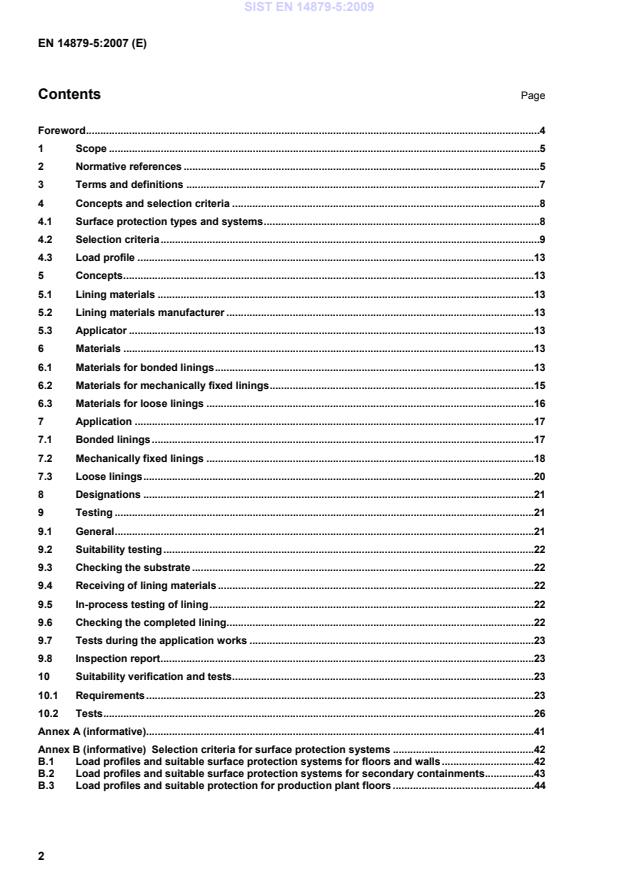
Contents Page Foreword.4 1 Scope.5 2 Normative references.5 3 Terms and definitions.7 4 Concepts and selection criteria.8 4.1 Surface protection types and systems.8 4.2 Selection criteria.9 4.3 Load profile.13 5 Concepts.13 5.1 Lining materials.13 5.2 Lining materials manufacturer.13 5.3 Applicator.13 6 Materials.13 6.1 Materials for bonded linings.13 6.2 Materials for mechanically fixed linings.15 6.3 Materials for loose linings.16 7 Application.17 7.1 Bonded linings.17 7.2 Mechanically fixed linings.18 7.3 Loose linings.20 8 Designations.21 9 Testing.21 9.1 General.21 9.2 Suitability testing.22 9.3 Checking the substrate.22 9.4 Receiving of lining materials.22 9.5 In-process testing of lining.22 9.6 Checking the completed lining.22 9.7 Tests during the application works.23 9.8 Inspection report.23 10 Suitability verification and tests.23 10.1 Requirements.23 10.2 Tests.26 Annex A (informative).41 Annex B (informative)
Selection criteria for surface protection systems.42 B.1 Load profiles and suitable surface protection systems for floors and walls.42 B.2 Load profiles and suitable surface protection systems for secondary containments.43 B.3 Load profiles and suitable protection for production plant floors.44 SIST EN 14879-5:2009
Sample form for acceptance inspection report.47 Annex D (normative)
Overview of verification of suitability for linings.48 Annex E (normative)
Test fluid groups for verification of suitability for material/media combinations.49 Annex F (normative)
Media lists for elastomer linings.52 Annex G (normative)
Testing the dissipation capability.54 G.1 General.54 G.1.1 Dissipation resistance.54 G.1.2 Ground dissipating resistance.54 G.2 Testing the dissipation resistance of test samples.54 G.2.1 Instruments.54 G.2.2 Test procedure.54 G.2.3 Test report.54 G.3 Measuring the ground dissipation resistance on the laid surface protection system.55 G.3.1 Instruments.55 G.3.2 Preparation.55 G.3.3 Test procedure.55 G.3.4 Test report.56 Annex H (informative)
Check list and sample form for inspection schedule.57 Annex I (informative)
A–deviations.60 Bibliography.61
Foreword This document (EN 14879-5:2007) has been prepared by Working Group CEN/BT/Task Force 130 “Organic coating systems and linings for protection of industrial apparatus and plants against corrosion caused by aggressive media”, the secretariat of which is held by DIN. This European Standard shall be given the status of a national standard, either by publication of an identical text or by endorsement, at the latest by February 2008, and conflicting national standards shall be withdrawn at the latest by February 2008. EN 14879 "Organic coating systems and linings for protection of industrial apparatus and plants against corrosion caused by aggressive media" consists of the following parts: Part 1: Terminology, design and preparation of substrate Part 2: Coatings on metallic components Part 3: Coatings on concrete components Part 4: Linings on metallic components Part 5: Linings on concrete components Part 6: Combined linings with tile and brick layers According to the CEN/CENELEC Internal Regulations, the national standards organizations of the following countries are bound to implement this European Standard: Austria, Belgium, Bulgaria, Cyprus, Czech Republic, Denmark, Estonia, Finland, France, Germany, Greece, Hungary, Iceland, Ireland, Italy, Latvia, Lithuania, Luxembourg, Malta, Netherlands, Norway, Poland, Portugal, Romania, Slovakia, Slovenia, Spain, Sweden, Switzerland and United Kingdom. SIST EN 14879-5:2009
EN 13067, Plastics welding personnel — Qualification testing of welders — Thermoplastic welded assemblies EN 13501-1, Fire classification of construction products and building elements — Part 1: Classification using data from reaction to fire tests EN 13813, Screed material and floor screeds — Screed material — Properties and requirements EN 14879-1:2005, Organic coating systems and linings for protection of industrial apparatus and plants against corrosion caused by aggressive media — Part 1: Terminology, design and preparation of substrate EN 14879-4, Organic coating systems and linings for protection of industrial apparatus and plants against corrosion caused by aggressive media — Part 4: Linings on metallic components EN ISO 75-1, Plastics — Determination of temperature of deflection under load — Part 1: General test method (ISO 75-1:2004) EN ISO 175, Plastics — Methods of test for the determination of the effects of immersion in liquid chemicals (ISO 175:1999) EN ISO 178, Plastics — Determination of flexural properties (ISO 178:2001) EN ISO 179 (all parts), Plastics — Determination of Charpy impact properties EN ISO 527-3, Plastics — Determination of tensile properties — Part 3: Test conditions for films and sheets (ISO 527-3:1995) EN ISO 846:1997, Plastics — Evaluation of the action of microorganisms (ISO 846:1997) EN ISO 868, Plastics and ebonite — Determination of indentation hardness by means of a durometer (Shore hardness) (ISO 868:2003) EN ISO 1133, Plastics - Determination of the melt mass-flow rate (MFR) and the melt volume-flow rate (MVR) of thermoplastics (ISO 1133:2005) EN ISO 1183-1, Plastics — Methods for determining the density of non-cellular plastics — Part 1: Immersion method, liquid pyknometer method and titration method (ISO 1183- 1:2004) EN ISO 2286 (all parts), Rubber- or plastics-coated fabrics — Determination of roll characteristics EN ISO 6721-2, Plastics — Determination of dynamic mechanical properties — Part 2: Torsion-pendulum method (ISO 6721-2:1994, including Technical Corrigendum 1:1995) EN ISO 14632, Extruded sheets of polyethylene (PE-HD) — Requirements and test methods (ISO 14632:1998) EN ISO 15013, Extruded sheets of polypropylene (PP) — Requirements and test methods (ISO 15013:1998) EN ISO 22088-4, Plastics — Determination of resistance to environmental stress cracking (ESC) - Part 4: Ball or pin impression method (ISO 22088-4:2006) IEC 60093:1980, Methods of test for volume resistivity and surface resistivity of solid electrical insulating materials IEC 60167, Methods of test for the determination of the insulation resistance of solid insulating materials ISO 37, Rubber, vulcanized or thermoplastic — Determination of tensile stress-strain properties ISO 554, Standard atmospheres for conditioning and/or testing — Specifications SIST EN 14879-5:2009
3.8 collecting basin tight basin or area designed to collect any water pollutants leaking in an emergency 3.9 tank open or closed facility of any shape or size designed to contain permanently fluids, solids, gases and vapours NOTE Typical designations for containers are basin, cistern, vessel and tank 4 Concepts and selection criteria 4.1 Surface protection types and systems 4.1.1 General Surface protection is usually applied as a lining as in 4.1.2 and Clause 5, as a coating as in EN 14879-3 or as a composite coating or lining system as in prEN 14879-6. The last of these combines a chemically resistant sealing coat with a wearing layer. 4.1.2 Protective linings Linings based on organic binders, such as a) Bonded linings Bonded linings comprise pre-fabricated sheets that are fixed to the substrate by means of an adhesive applied over the entire surface area. The sheets are then jointed using an adhesive or by welding. b) Mechanically fixed linings Linings made of thermoplastic units (e.g. sheets, slabs or pre-formed pieces) that are fixed to the concrete substrate by means of fasteners systematically arranged on the units' underside. The lining units are then jointed by welding. These linings may be applied either during the construction of the concrete member or after construction has been completed, in which case the lining is attached to a layer of facing concrete. c) Loose linings of sheeting material Pre-fabricated linings that are laid loosely on the substrate, jointed and then fixed to the walls by means of metal beads, for example. The sheets are usually surfaced with gravel or screed, or protected against exposure to sunlight, warping and mechanical damage by means of a masonry facing. d) Loose linings of pre-formed pieces or linings units Linings made of pre-formed pieces laid in the concrete member and then fixed or welded at the top edge, if necessary. SIST EN 14879-5:2009
1) International Union of Pure and Applied Chemistry. 2) Chemical Abstract Service. SIST EN 14879-5:2009
Table 1 — Classification of frequently (commonly) used chemicals Type of chemical Examples I. Inorganic chemicals Inorganic, non-oxidizing acids HCl H2SO4 H3PO4 Hydrochloric acid Sulphuric acid, up to 70 %
Phosphoric acid Inorganic, oxidizing acids HNO3 H2SO4 CrO3, H2CrO4 HClO3 Nitric acid Sulphuric acid, over 70 %
Chromic acid Chloric acid Inorganic acids, dissolving SiO2 HF H2SiF6 HBF4 Hydrofluoric acid Hexafluorosilicic acid (containing HF) Tetrafluoroboric acid (containing HF) Salts NaCl FeSO4 Na2CO3 Sodium chloride Iron (II) sulphate Sodium carbonate Bases NaOH KOH CaO, Ca(OH)2 NH4OH Sodium hydroxide Potassium hydroxide Calcium oxide Calcium hydroxide
Ammonia solution (Ammonium hydroxide solution) Oxidizing bases NaOCl Sodium hypochlorite II. Organic chemicals Organic acids HCOOH CH3COOH CH2ClCOOH (COOH)2 CH3CHOHCOOH Formic acid Acetic acid Chloroacetic acid Oxalic acid Lactic acid Aliphatic hydrocarbons C6H14 C8H18 Hexane Octane Aromatic hydrocarbons C6H6 C6H5CH3 C6H4(CH3)2 Benzene Toluene Xylene Alcohols CH3OH C2H5OH C4H9OH CH2OHCH2OH Methanol Ethanol Butanol Ethanediol Aldehydes, Ketones, esters CH2O CH3COCH3 C2H5COCH3 CH3COOC2H5 Formaldehyde Acetone Methyl ethyl ketone (2.butanone) Ethyl acetate Aliphatic halogenated hydrocarbons CH2Cl2 C2HCl3 C2Cl3F3 Dichloromethane Trichloroethylene Trichlorotrifluoroethane Aromatic Halogenated hydrocarbons C6H5Cl ClC6H4CF3 Chlorobenzene Chlorobenzotrifluoride Aliphatic amines CH3NH2 (C2H5)3N NH2C2H4NH2 Methylamine Triethylamine Ethylene diamine Aromatic amines C6H5NH2
C6H5N Aniline
Pyridine Phenols C6H5OH CH3C6H4OH Phenol Cresol Fats, oils
Vegetable and animal fats and oils NOTE The grades 0 to 2 and 4 are normally not applicable for linings according to this standard. SIST EN 14879-5:2009
no exposure to fluids. Grade 1:
sporadic exposure to droplets of fluid (e.g. laboratory floors, floors in small units, walls). Grade 2: frequent, short-term exposure to splashes of fluid, where the surfaces are regularly flushed (e.g. floors of closed production plants). Grade 3: exceptional and limited exposure to fluids during operations (e.g. due to plant failure) in, for example, collecting basins. Grade 4: constant or frequent exposure to a film of fluid, due to wetness, condensation, puddles, trickles and the like (e.g. floors in production plants, electroplating plants or pumping stations). Grade 5: operational exposure to a constant flow of fluid involving no significant hydrostatic pressure (e.g. open gutters, trenches and their pump sumps, closed trenches and pipes). Grade 6: constant exposure of containers to fluid contents for unlimited periods (e.g. vessels, pits). 4.2.4 Thermal loading Temperature influences the effectiveness of a surface protection system in the following ways. a) Aggressiveness of medium Elevated temperatures increase the aggressiveness of the medium by raising the levels of its chemical reactions and diffusion, and also through the accumulation of volatile substances in the headspace. b) Thermal stress Temperatures which deviate from the installation temperature cause thermal stress between the substrate and the surface protection system and may cause peeling, cracks, etc. This may result from the direct action of hot or cold media, or from radiant heat and extreme ambient temperature. The maximum thermal load shall be stated in °C. 4.2.5 Changes in temperature Changes in temperature include a) temperature changes at the protective surface during exposure to fluid loads of grades 3 to 5 as in 4.2.3 involving changed medium temperatures; b) temperature changes as otherwise constantly heated or cooled surfaces, resulting from operational contingencies, such as start-up and shutdown; c) temperature changes, possibly involving thermal shock, which occur during cleaning operations; d) process-related changes in the temperature of the medium under loading conditions corresponding to grade 6 (as in 4.2.3). Temperature changes due to climatic influences are dealt with in 4.2.7. SIST EN 14879-5:2009
The source, degree, speed and frequency of temperature changes shall be taken into consideration when assessing their effect. The following grades serve in assessing the effects of temperature changes, whereby details of the frequency and the duration of temperature changes are to be given for grades 1 to 4. Grade 0:
no temperature changes; Grade 1:
infrequent temperature changes of not more than 50 K; Grade 2:
infrequent temperature changes of more than 50 K; Grade 3:
frequent temperature changes of not more than 50 K; Grade 4:
frequent temperature changes of more than 50 K; Grade 5:
temperature changes involving thermal shock (assessment not possible with this standard). 4.2.6 Mechanical loading The effectiveness of a surface protection system may be impaired through exposure to mechanical loads or hydrostatic pressure during operation or assembly. The following grades shall be used to assess such loads. Grade 0:
no loads, or hydrostatic pressure up to 0,05 bar; Grade 1:
loads up to 0,2 N/mm2 (e.g. pedestrian traffic, light transport, static loading); Grade 2:
loads up to 1 N/mm2 (e.g. vehicles with pneumatic tires, static loading); Grade 3:
loads over 1 N/mm2, for example
a) loads of 1 N/mm2 to 7 N/mm2 (e.g. vehicles with Vulkollan wheels, static loading) and
b) loads over 7 N/mm2 (e.g. vehicles with polyamide wheels, static loading); Grade 4:
impact loads, such as those resulting from setting down sharp-edged objects (e.g. barrels), and from scraping (e.g. shovel loaders); Grade 5:
hydrostatic pressure from 0,05 bar to 0,5 bar; Grade 6:
hydrostatic pressure greater than 0,5 bar. NOTE The grades 2 to 4 are normally not applicable for linings without additional protection according to this standard. 4.2.7 Climate Influences Climatic influences may affect the durability of a surface protection system, and shall be graded as follows. Grade 0:
no climatic influences: the component is located inside a building and is not exposed to climatic
influences. Grade 1:
limited climatic influences: a roof protects the component, which is exposed to limited climatic
influences. Grade 2:
full climatic influences: the component is located outside, and is fully exposed to climatic
influences. SIST EN 14879-5:2009
Table 2 — Recommended maximum operating temperatures
for soft rubbers Symbol Rubber type Maximum temperature in °C NR Isoprene rubber (Natural rubber) +
80 CR Chloroprene rubber +
80 IIR Isobutene-isoprene rubber (Butyl rubber) + 100 BIIR Bromo-isobutene-isoprene rubber (Bromobutyl rubber) + 100 CIIR Chloro-isobutene-isoprene rubber (Chlorobutyl rubber) + 100 CSM Chlorosulfonylpolyethylene +
80 NBR Acrylonitrile-butadiene rubber (nitrile rubber) +
The operating temperatures for which the rubbers are suitable will depend on the type and duration of loading.
Table 3 specifies requirements for soft rubber sheeting. Table 3 — Requirements for soft rubber sheeting Nominal thickness, in mm Density in g/cm3 Shore A hardness Tear strength in N/mm2 Elongation at break, as a percentage Sheeting type Rubber type (testing as inEN ISO 2286)(testing as inEN ISO 1183-1)(testing as inEN ISO 868) (testing as in ISO 37) Vulcanised single-ply sheets IIR, BIIR, CIIR CSM 2 to 5 2 to 5 1,10 to 1,301,20 to 1,70 50 to 65 55 to 70 ≥ 4 ≥ 3 ≥ 300 ≥ 300 Vulcanised double-ply sheets IIR, BIIR, CIIR, CSM NBR 2 to 5 2 to 5 1,10 to 1,301,20 to 1,40 50 to 65 60 to 80 ≥ 3 ≥ 4 ≥ 300 ≥ 300 Partially vulcanised single-ply sheetsa CIIR and BIIR 2 to 5 1,10 to 1,30 50 to 65 ≥ 3 ≥ 300 Self-vulcanising single-ply sheetsa CIIR, BIIR NR CSM CR 2 to 5 2 to 5 2 to 5 2 to 5 1,10 to 1,301,10 to 1,401,20 to 1,501,40 to 1,70 50 to 65 50 to 65 55 to 70 55 to 70 ≥ 4 ≥ 4 ≥ 4 ≥ 5 ≥ 300 ≥ 400 ≥ 300 ≥ 300 a Values refer to the rubber in its completely vulcanised state.
6.1.2 Thermoplastics Thermoplastics sheets shall be of polyisobutylene (PIB) or plasticised poly(vinyl chloride) (PVC-P). The operating temperatures for which these thermoplastics are suitable are given in Table 4. SIST EN 14879-5:2009
Table 5 contains general requirements for thermoplastic sheeting. Table 5 — Requirements for thermoplastics sheeting used in process plant Tear strength, in N/mm2 Elongation at break,as a percentage Type of thermoplastic Nominal thickness,in mm (testing as in EN ISO 2286) (testing as in EN ISO 6721-2) PIB 1,5 to 3 >
3 > 350 PVC-P-BV (compatible with bitumen) 1,5 to 3 > 15 > 200 PVC-P-NB (incompatible with bitumen) 1,5 to 3 > 15 > 200
6.2 Materials for mechanically fixed linings Table 6 lists thermoplastics commonly used for mechanically fixed linings and the temperature ranges for which they are suitable. Table 6 — Recommended operating temperature ranges
for thermoplastics used in mechanically fixed linings Symbol Type of thermoplastic Temperature range, in °C PVC-U Non-plasticised poly(vinyl chloride) –
5 to +
60 PE-HD High density polyethylene – 30 to +
80 PP Polypropylene –
5 to + 100 PVDF Poly(vinylidene fluoride) – 30 to + 140
The operating temperature ranges for which the thermoplastics are suitable will depend on the type and duration of loading. SIST EN 14879-5:2009
Table 7 specifies requirements for materials used in mechanically fixed linings. Table 7 — Requirements for thermoplastics used in mechanically fixed linings Requirements for Property Unit Testing as in PVC-U PE-HD (see EN ISO 14632)PP (see EN ISO 15013) PVDF Nominal thickness mm EN ISO 2286 ≥ 3 3 to 10 3 to 10 ≥ 3 Density g/cm3 EN ISO 1183-1 Formulation-dependent As specified for sheet groups 1 and 2in EN ISO 146320,90 to 0,91 1,76 to 1,80 Melt-flow rate g/(10 min) EN ISO 1133 — 190/5: 0,3 to 1,5 190/5: 0,4 to 0,8 230/5: 1,6 to 6,2 Tensile strength at break (for PVC-U, tear strength) N/mm2 EN ISO 6721-2 ≥ 55 ≥ 50 Modulus of elasticity (tensile test) N/mm2 EN ISO 178 ≥ 3 000 ≥ 2 400 Notched bar impact strength kJ/m2 EN ISO 179 ≥ 2 20 Deflection temperature °C EN ISO 75-1
142 Dimensional change after exposure to heat % - Less than 5 As in EN ISO 14632 As in EN ISO 15013 Less than 2(testing for 1 h at 150 °C) As regards the fixing of the lining, the following requirements shall be met: a) The attachment of the fastener to the lining shall be sufficiently strong and free of residual stresses. b) The arrangement of attachments to the concrete substrate shall ensure that the lining is securely fixed without stress. 6.3 Materials for loose linings 6.3.1 Sheets The materials described in 6.1 to 6.2 may be used for loose linings, depending on the load profile and application. Polyethylene copolymers and multi-layered sheeting may also be used. Requirements shall be taken from Table 3, 5, 7 or 8, depending on the material selected. Table 8 — Requirements for polyethylene sheeting used as loose lining Nominal thickness,in mm Tear strength, in N/mm2 Elongation at break,as a percentage Type of material Relevant standard (testing as in EN ISO 2286) (testing as in EN ISO 6721-2) PE-LD ≥ 2 > 10 > 600 PE copolymer EN ISO 14632 (by analogy) ≥ 2 > 20 > 725 SIST EN 14879-5:2009
7.1.2.2 Ambient conditions See 7.1.1.2. 7.1.2.3 Lining process Normally, a suitable primer is to be applied to the substrate to improve adhesion. The primer shall be fully dried before the adhesive is applied. To ensure adhesion over the entire surface, a solvent-based contact adhesive shall be applied to the substrate and the underside of the thermoplastics sheet simultaneously. The adhesive selected shall be suitable for the thermoplastic material used. After the required drying time (which will vary depending on the adhesive used), apply the thermoplastic sheet to the substrate using a special roller or other appropriate tool, ensuring that adhesion occurs over the entire area. A hot-melt bitumen adhesive may be used where thermoplastics that are compatible with bitumen are laid on floor surfaces. Under certain circumstances, some types of thermoplastic sheeting may be laid on a special emulsion adhesive. 7.1.2.4 Jointing Depending on the type of sheeting used for the lining, the following welding methods may be used for jointing (the manufacturer's instructions shall be observed): Hot gas welding (as in DVS 2225-1); Heated wedge welding (as in DVS 2225-1); Diffusion bonding (a solvent welding procedure; as in DVS 2225-1). The first two methods listed shall be performed by persons qualified in accordance with EN 13067 and carried out according to national guidelines, e. g. DVS 2225-1. 7.2 Mechanically fixed linings 7.2.1 Substrate preparation It may be necessary to bridge cracks in the substrate that are wider than those described in EN 14879-1. In this case, any permanent deformation shall be no more than 3 % of the spacing of the anchor elements to prevent stress cracking of the lining. If, within the area concerned, there are any weld seams, the maximal permissible deformation reduces to 2 % of the spacing of the anchors from which the width of the weld seam has to be deducted. For mechanically fixed linings moisture affecting from the rear side is admissible. However, if the lining is subjected to hydrostatic pressure on its rear side, e.g. in the event of ground water diffusing through the concrete, evidence of long-term anchoring strength and resistance to bulging between the anchors is to be recorded by performing a test according to 10.2.6.2.2, taking the operating conditions into account. SIST EN 14879-5:2009
Under no circumstances shall condensation be allowed in the welding area. Welding shall be carried out by qualified welders approved in accordance with national guidelines, e. g. DVS 2212-1 or DVS 2212-2. 7.3 Loose linings 7.3.1 Special requirements regarding operating conditions To minimise stresses in the lining, the following operating conditions shall be taken into consideration: fluctuations in the operating temperature; hydraulic loads (e.g. changes in the filling level); abrasion caused by the charge (e.g. in mixing vessels); other mechanical loads (e.g. vehicle loads). 7.3.2 Substrate preparation If the lining will be subjected to hydrostatic pressure on the reverse side, it shall be proven that no risk of uplifting or buckling exists. It may be necessary to bridge cracks in the substrate that are wider than those described in EN 14879-1. The linings specified in this standard are capable of bridging cracks up to 1,5 mm in width. To prevent damage to the lining, the substrate should be smooth and free of burrs or offsets. It may be necessary to apply a screed or protective mat to the substrate. The back of the lining may be exposed to moisture. 7.3.3 Ambient conditions See 7.2.2. 7.3.4 Lining proces
...