


EN 13624:2013
(Main)Chemical disinfectants and antiseptics - Quantitative suspension test for the evaluation of fungicidal or yeasticidal activity in the medical area - Test method and requirements (phase 2, step 1)
Chemical disinfectants and antiseptics - Quantitative suspension test for the evaluation of fungicidal or yeasticidal activity in the medical area - Test method and requirements (phase 2, step 1)
This European Standard specifies a test method and the minimum requirements for fungicidal or yeasticidal activity of chemical disinfectant and antiseptic products that form a homogeneous, physically stable preparation when diluted with hard water, or - in the case of ready-to-use products - with water. Products can only be tested at a concentration of 80 % or less (97 % with a modified method for special cases) as some dilution is always produced by adding the test organisms and interfering substance.
This European Standard applies to products that are used in the medical area in the fields of hygienic handrub, hygienic handwash, surgical handrub, surgical handwash, instrument disinfection by immersion, and surface disinfection by wiping, spraying, flooding or other means.
This European Standard applies to areas and situations where disinfection or antisepsis is medically indicated. Such indications occur in patient care, for example:
- in hospitals, in community medical facilities and in dental institutions;
- in clinics of schools, of kindergartens and of nursing homes;
and may occur in the workplace and in the home. It may also include services such as laundries and kitchens supplying products directly for the patients.
NOTE 1 The method described is intended to determine the activity of commercial formulations or active substances under the conditions in which they are used.
NOTE 2 This method corresponds to a phase 2 step 1 test.
EN 14885 specifies in detail the relationship of the various tests to one another and to "use recommendations".
Chemische Desinfektionsmittel und Antiseptika - Quantitativer Suspensionsversuch zur Bestimmung der fungiziden oder levuroziden Wirkung im humanmedizinischen Bereich - Prüfverfahren und Anforderungen (Phase 2, Stufe 1)
Diese Europäische Norm legt ein Prüfverfahren und Mindestanforderungen für die fungizide oder levurozide (Hefen abtötende) Wirkung von chemischen Desinfektionsmitteln und Antiseptika fest, die bei Verdünnung mit Wasser standardisierter Härte bzw. – im Fall von gebrauchsfertigen Produkten – mit Wasser als homogenes physikalisch stabiles Präparat vorliegen. Die Produkte können nur in einer Konzentration bis zu 80 % (97 % bei einem modifizierten Verfahren in Sonderfällen) geprüft werden, da durch Zu¬gabe der Prüforganismen und der Belastungssubstanz stets eine gewisse Verdünnung bewirkt wird.
Diese Europäische Norm gilt für Produkte, die im humanmedizinischen Bereich für hygienische Hände-desinfektion und Händewaschung, chirurgische Händedesinfektion und Händewaschung, für die Instrumentendesinfektion durch Eintauchen sowie für die Oberflächendesinfektion mittels Wischen, Sprühen, Spülen o. ä. verwendet werden.
Diese Europäische Norm gilt für Bereiche und Bedingungen, wo eine Desinfektion oder Antisepsis aus medizinischen Gründen angezeigt ist. Derartige Gründe treten bei der Patientenbetreuung z. B. in
Krankenhäusern, kommunalen medizinischen Einrichtungen und im Dentalbereich;
medizinischen Einrichtungen in Schulen, Kindergärten und Heimen;
auf und können auch am Arbeitsplatz oder im privaten Bereich gegeben sein. Eingeschlossen sein können auch Einrichtungen wie Wäschereien und Küchen, die der direkten Versorgung der Patienten dienen.
ANMERKUNG 1 Das beschriebene Verfahren dient zur Bestimmung der Wirksamkeit kommerziell erhältlicher Zubereitungen oder Wirkstoffe unter den jeweiligen Anwendungsbedingungen.
ANMERKUNG 2 Dieses Verfahren entspricht einer Prüfung der Phase 2, Stufe 1.
EN 14885 legt detailliert die Beziehungen der unterschiedlichen Prüfungen untereinander und zu „Anwen¬dungs-empfehlungen“ fest.
Désinfectants chimiques et antiseptiques - Essai quantitatif de suspension pour l'évaluation de l'activité fongicide ou levuricide en médecine - Méthode d'essai et prescriptions (phase 2, étape 1)
La présente Norme européenne spécifie une méthode d’essai et les exigences minimales relatives à l’activité fongicide et levuricide des désinfectants chimiques et des produits antiseptiques qui forment une préparation homogène, physiquement stable, lorsqu’ils sont dilués dans de l'eau dure ou — dans le cas de produits prêts à l’emploi — dans de l’eau. Les produits ne peuvent être soumis à l’essai qu’à une concentration inférieure ou égale à 80 % (97 % avec une méthode modifiée dans certains cas particuliers), car l’ajout des souches d’essai et de la substance interférente entraîne toujours une dilution.
La présente Norme européenne s’applique aux produits employés en médecine pour la friction et le lavage hygiéniques des mains, pour la friction et le lavage chirurgicaux des mains, pour la désinfection des instruments par immersion et pour la désinfection de surface par essuyage, pulvérisation, rinçage ou autre.
Le présent document s’applique dans les zones et situations où la désinfection ou l’antisepsie est médicalement préconisée. De telles indications se rencontrent dans le cadre des soins apportés aux patients, par exemple :
dans des hôpitaux, centres de soins médicaux et cabinets dentaires ;
dans des infirmeries d’écoles, de jardins d'enfants et de maisons de retraite ;
et peuvent aussi se rencontrer sur les lieux de travail ou à domicile. Elles peuvent également concerner des services tels que des blanchisseries et cuisines qui fournissent des produits directement aux patients.
NOTE 1 La méthode décrite est destinée à déterminer l’activité des formulations commerciales ou des substances actives dans leurs conditions d’utilisation.
NOTE 2 La présente méthode correspond à un essai de type phase 2, étape 1.
L’EN 14885 précise de manière détaillée la relation entre les différents essais et les « recommandations d’utilisation.
Kemična razkužila in antiseptiki - Kvantitativni suspenzijski preskus za vrednotenje fungicidnega delovanja ali delovanja na kvasovke v medicini - Preskusna metoda in zahteve (faza 2, stopnja 1)
Ta evropski standard določa preskusno metodo in minimalne zahteve za fungicidno delovanje ali delovanje na kvasovke kemičnih razkužil in antiseptikov, ki tvorijo homogen, fizikalno stabilen pripravek, če so razredčeni s trdo vodo ali, pri proizvodih, ki so pripravljeni za uporabo, z vodo. Proizvode je mogoče preskušati samo pri 80-odstotni ali nižji koncentraciji (s prilagojeno metodo v posebnih primerih 97-odstotni), ker dodajanje preskusnih organizmov in moteče snovi vedno povzroči razredčenje. Ta evropski standard velja za proizvode, ki se uporabljajo na področju zdravstva pri higienskem drgnjenju rok, higienskem umivanju rok, kirurškem drgnjenju rok, kirurškem umivanju rok, dezinfekciji instrumentov s potapljanjem in površinski dezinfekciji z brisanjem, pršenjem, zalivanjem ali na druge načine. Ta evropski standard se uporablja za področja in primere, ko obstajajo zdravniške indikacije za dezinfekcijo ali antisepso. Te indikacije se pojavljajo pri negi bolnikov, na primer: – v bolnišnicah, skupnih zdravstvenih in zobozdravstvenih ustanovah; – v klinikah šol, vrtcev in domov za starejše; in lahko nastanejo na delovnem mestu ali doma. Vključujejo lahko tudi storitve, kot so pralnice in kuhinje, ki proizvode neposredno dostavljajo bolnikom.
General Information
- Status
- Withdrawn
- Publication Date
- 24-Sep-2013
- Withdrawal Date
- 13-Apr-2025
- Technical Committee
- CEN/TC 216 - Chemical disinfectants and antiseptics
- Drafting Committee
- CEN/TC 216/WG 1 - Human medicine
- Current Stage
- 9960 - Withdrawal effective - Withdrawal
- Start Date
- 10-Nov-2021
- Completion Date
- 14-Apr-2025
Relations
- Effective Date
- 02-Oct-2013
- Effective Date
- 17-Nov-2021

Frequently Asked Questions
EN 13624:2013 is a standard published by the European Committee for Standardization (CEN). Its full title is "Chemical disinfectants and antiseptics - Quantitative suspension test for the evaluation of fungicidal or yeasticidal activity in the medical area - Test method and requirements (phase 2, step 1)". This standard covers: This European Standard specifies a test method and the minimum requirements for fungicidal or yeasticidal activity of chemical disinfectant and antiseptic products that form a homogeneous, physically stable preparation when diluted with hard water, or - in the case of ready-to-use products - with water. Products can only be tested at a concentration of 80 % or less (97 % with a modified method for special cases) as some dilution is always produced by adding the test organisms and interfering substance. This European Standard applies to products that are used in the medical area in the fields of hygienic handrub, hygienic handwash, surgical handrub, surgical handwash, instrument disinfection by immersion, and surface disinfection by wiping, spraying, flooding or other means. This European Standard applies to areas and situations where disinfection or antisepsis is medically indicated. Such indications occur in patient care, for example: - in hospitals, in community medical facilities and in dental institutions; - in clinics of schools, of kindergartens and of nursing homes; and may occur in the workplace and in the home. It may also include services such as laundries and kitchens supplying products directly for the patients. NOTE 1 The method described is intended to determine the activity of commercial formulations or active substances under the conditions in which they are used. NOTE 2 This method corresponds to a phase 2 step 1 test. EN 14885 specifies in detail the relationship of the various tests to one another and to "use recommendations".
This European Standard specifies a test method and the minimum requirements for fungicidal or yeasticidal activity of chemical disinfectant and antiseptic products that form a homogeneous, physically stable preparation when diluted with hard water, or - in the case of ready-to-use products - with water. Products can only be tested at a concentration of 80 % or less (97 % with a modified method for special cases) as some dilution is always produced by adding the test organisms and interfering substance. This European Standard applies to products that are used in the medical area in the fields of hygienic handrub, hygienic handwash, surgical handrub, surgical handwash, instrument disinfection by immersion, and surface disinfection by wiping, spraying, flooding or other means. This European Standard applies to areas and situations where disinfection or antisepsis is medically indicated. Such indications occur in patient care, for example: - in hospitals, in community medical facilities and in dental institutions; - in clinics of schools, of kindergartens and of nursing homes; and may occur in the workplace and in the home. It may also include services such as laundries and kitchens supplying products directly for the patients. NOTE 1 The method described is intended to determine the activity of commercial formulations or active substances under the conditions in which they are used. NOTE 2 This method corresponds to a phase 2 step 1 test. EN 14885 specifies in detail the relationship of the various tests to one another and to "use recommendations".
EN 13624:2013 is classified under the following ICS (International Classification for Standards) categories: 11.080.20 - Disinfectants and antiseptics. The ICS classification helps identify the subject area and facilitates finding related standards.
EN 13624:2013 has the following relationships with other standards: It is inter standard links to EN 13624:2003, EN 13624:2021. Understanding these relationships helps ensure you are using the most current and applicable version of the standard.
EN 13624:2013 is associated with the following European legislation: EU Directives/Regulations: 93/42/EEC; Standardization Mandates: M/023, M/BC/CEN/89/9. When a standard is cited in the Official Journal of the European Union, products manufactured in conformity with it benefit from a presumption of conformity with the essential requirements of the corresponding EU directive or regulation.
You can purchase EN 13624:2013 directly from iTeh Standards. The document is available in PDF format and is delivered instantly after payment. Add the standard to your cart and complete the secure checkout process. iTeh Standards is an authorized distributor of CEN standards.
Standards Content (Sample)
2003-01.Slovenski inštitut za standardizacijo. Razmnoževanje celote ali delov tega standarda ni dovoljeno.Chemische Desinfektionsmittel und Antiseptika - Quantitativer Suspensionsversuch zur Bestimmung der fungiziden oder levuroziden Wirkung im humanmedizinischen Bereich - Prüfverfahren und Anforderungen (Phase 2, Stufe 1)Désinfectants chimiques et antiseptiques - Essai quantitatif de suspension pour l'évaluation de l'activité fongicide ou levuricide en médecine - Méthode d'essai et prescriptions (phase 2, étape 1)Chemical disinfectants and antiseptics - Quantitative suspension test for the evaluation of fungicidal or yeasticidal activity in the medical area - Test method and requirements (phase 2, step 1)11.080.20Dezinfektanti in antiseptikiDisinfectants and antisepticsICS:Ta slovenski standard je istoveten z:EN 13624:2013SIST EN 13624:2013en,fr,de01-november-2013SIST EN 13624:2013SLOVENSKI
STANDARDSIST EN 13624:20041DGRPHãþD
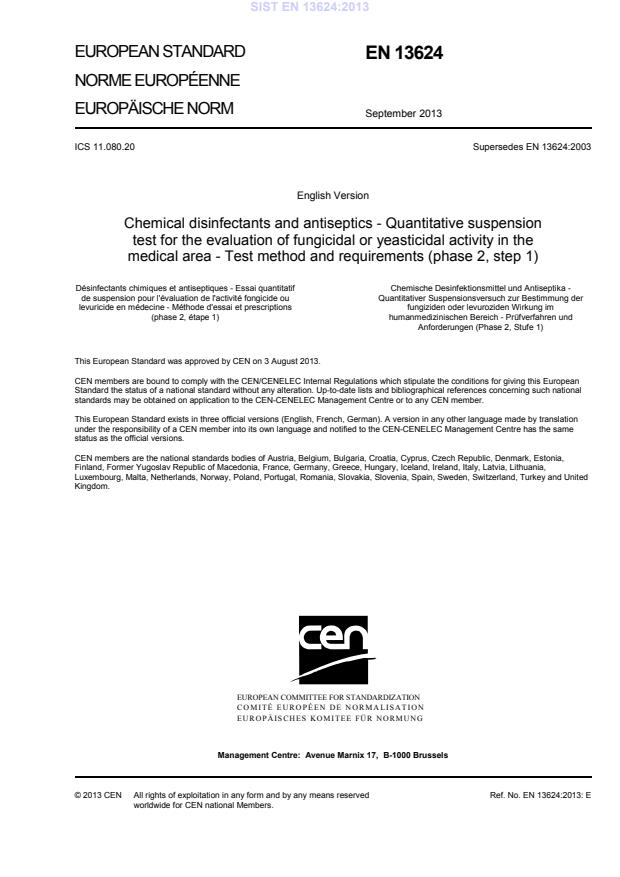
EUROPEAN STANDARD NORME EUROPÉENNE EUROPÄISCHE NORM
EN 13624
September 2013 ICS 11.080.20 Supersedes EN 13624:2003English Version
Chemical disinfectants and antiseptics - Quantitative suspension test for the evaluation of fungicidal or yeasticidal activity in the medical area - Test method and requirements (phase 2, step 1) Désinfectants chimiques et antiseptiques - Essai quantitatif de suspension pour l'évaluation de l'activité fongicide ou levuricide en médecine - Méthode d'essai et prescriptions (phase 2, étape 1)
Chemische Desinfektionsmittel und Antiseptika - Quantitativer Suspensionsversuch zur Bestimmung der fungiziden oder levuroziden Wirkung im humanmedizinischen Bereich - Prüfverfahren und Anforderungen (Phase 2, Stufe 1) This European Standard was approved by CEN on 3 August 2013.
CEN members are bound to comply with the CEN/CENELEC Internal Regulations which stipulate the conditions for giving this European Standard the status of a national standard without any alteration. Up-to-date lists and bibliographical references concerning such national standards may be obtained on application to the CEN-CENELEC Management Centre or to any CEN member.
This European Standard exists in three official versions (English, French, German). A version in any other language made by translation under the responsibility of a CEN member into its own language and notified to the CEN-CENELEC Management Centre has the same status as the official versions.
CEN members are the national standards bodies of Austria, Belgium, Bulgaria, Croatia, Cyprus, Czech Republic, Denmark, Estonia, Finland, Former Yugoslav Republic of Macedonia, France, Germany, Greece, Hungary, Iceland, Ireland, Italy, Latvia, Lithuania, Luxembourg, Malta, Netherlands, Norway, Poland, Portugal, Romania, Slovakia, Slovenia, Spain, Sweden, Switzerland, Turkey and United Kingdom.
EUROPEAN COMMITTEE FOR STANDARDIZATION
COMITÉ EUROPÉEN DE NORMALISATION EUROPÄISCHES KOMITEE FÜR NORMUNG
Management Centre:
Avenue Marnix 17,
B-1000 Brussels © 2013 CEN All rights of exploitation in any form and by any means reserved worldwide for CEN national Members. Ref. No. EN 13624:2013: ESIST EN 13624:2013
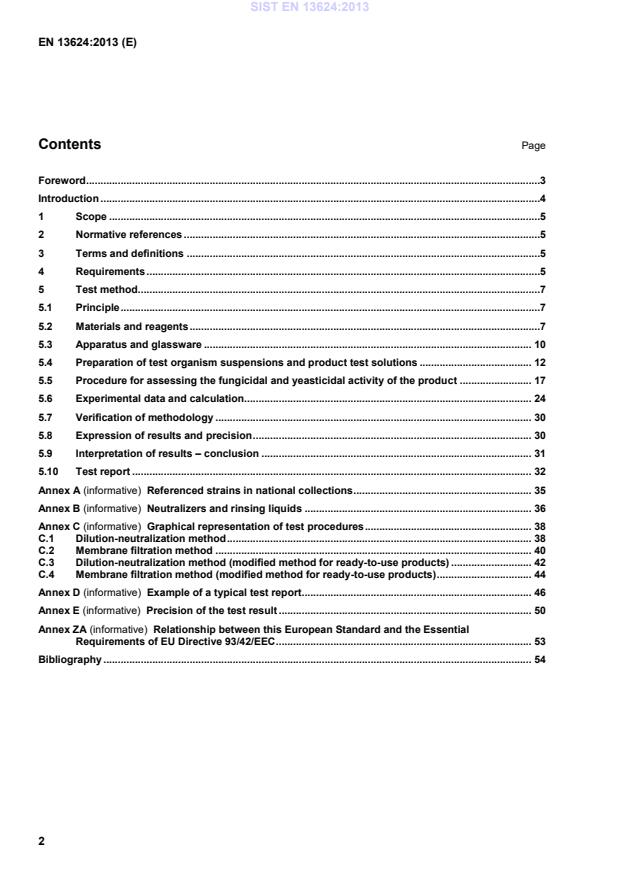
Referenced strains in national collections . 35 Annex B (informative)
Neutralizers and rinsing liquids . 36 Annex C (informative)
Graphical representation of test procedures . 38 C.1 Dilution-neutralization method . 38 C.2 Membrane filtration method . 40 C.3 Dilution-neutralization method (modified method for ready-to-use products) . 42 C.4 Membrane filtration method (modified method for ready-to-use products) . 44 Annex D (informative)
Example of a typical test report . 46 Annex E (informative)
Precision of the test result . 50 Annex ZA (informative)
Relationship between this European Standard and the Essential Requirements of EU Directive 93/42/EEC . 53 Bibliography . 54
Introduction This European Standard specifies a suspension test for establishing whether a chemical disinfectant or an antiseptic has a fungicidal or yeasticidal activity in the area and fields described in the scope. This laboratory test takes into account practical conditions of application of the product including contact time, temperature, test organisms and interfering substances, i.e. conditions which may influence its action in practical situations. Each utilisation concentration of the chemical disinfectant or antiseptic found by this test corresponds to the chosen experimental conditions. SIST EN 13624:2013
This European Standard applies to products that are used in the medical area in the fields of hygienic handrub, hygienic handwash, surgical handrub, surgical handwash, instrument disinfection by immersion, and surface disinfection by wiping, spraying, flooding or other means. This European Standard applies to areas and situations where disinfection or antisepsis is medically indicated. Such indications occur in patient care, for example: in hospitals, in community medical facilities and in dental institutions; in clinics of schools, of kindergartens and of nursing homes; and may occur in the workplace and in the home. It may also include services such as laundries and kitchens supplying products directly for the patients. NOTE 1 The method described is intended to determine the activity of commercial formulations or active substances under the conditions in which they are used. NOTE 2 This method corresponds to a phase 2 step 1 test. EN 14885 specifies in detail the relationship of the various tests to one another and to “use recommendations”. 2 Normative references The following documents, in whole or in part, are normatively referenced in this document and are indispensable for its application. For dated references, only the edition cited applies. For undated references, the latest edition of the referenced document (including any amendments) applies. EN 12353, Chemical disinfectants and antiseptics — Preservation of test organisms used for the determination of bactericidal (including Legionella), mycobactericidal, sporicidal, fungicidal and virucidal (including bacteriophages) activity EN 14885, Chemical disinfectants and antiseptics — Application of European Standards for chemical disinfectants and antiseptics ISO 4793:1980, Laboratory sintered (fritted) filters — Porosity grading, classification and designation 3 Terms and definitions For the purposes of this document, the terms and definitions given in EN 14885 apply. 4 Requirements The product shall demonstrate at least a 4 decimal log (lg) reduction (for hygienic handwash at least a 2 lg reduction), when tested in accordance with Table 1 and Clause 5. SIST EN 13624:2013
Candida albicans (vegetative cells) Candida albicans (vegetative cells) a) fungicidal activity: Aspergillus brasiliensis (conidiospores) Candida albicans (veg. cells) b) yeasticidal activity: Candida albicans (veg. cells) a) fungicidal activity: Aspergillus brasiliensis (conidiospores) Candida albicans (veg. cells) b) yeasticidal activity: Candida albicans (veg. cells)
additional Any relevant test organism Test temperature according to the manufacturer's recommendation, but at/ between 20 °C 20 °C 20 °C and 70 °C 4 °C and 30 °C Contact time according to the manufacturer's recommendation,
but between
but no longer than 30 s and 60 s 1 min and 5 min 60 min 5 min or 60 mina Interfering substance clean conditions 0,3 g/l bovine albumin solution (hygienic handrub)b 0,3 g/l bovine albumin solution (surgical handrub)b 0,3 g/l bovine albumin solution 0,3 g/l bovine albumin solution dirty conditions 3,0 g/l bovine albumin solution plus 3,0 ml/l erythrocytes (hygienic handwash)c 3,0 g/l bovine albumin solution plus 3,0 ml/l erythrocytes (surgical and handwash)c and/or 3,0 g/l bovine albumin solution plus 3,0 ml/l erythrocytes and/or 3,0 g/l bovine albumin solution plus 3,0 ml/l erythrocytes b) additional — — any relevant substance any relevant substance NOTE For the additional conditions, the concentration defined as a result can be lower than the one obtained under the minimum test conditions. a The contact times for surface disinfectants stated in this table are chosen on the basis of the practical conditions of the product. The recommended contact time for the use of the product is within the responsibility of the manufacturer. Products intended to disinfect surfaces that are likely to come into contact with the patient and/or the medical staff and surfaces, which are frequently touched by different people, leading to the transmission of microorganisms to the patient, shall be tested with a contact time of maximum 5 min. The same applies where the contact time of the product shall be limited for practical reasons. Products for other surfaces than stated above may be tested with a contact time of maximum 60 min.
b Hygienic and surgical handrub shall be tested as a minimum under clean conditions.
c Hygienic and surgical handwash shall be tested as a minimum under dirty conditions.
5 Test method 5.1 Principle 5.1.1 A sample of the product as delivered and/or diluted with hard water (or water for ready to use products) is added to a test suspension of fungi (yeast cells or mould spores) in a solution of an interfering substance. The mixture is maintained at the temperature and the contact time specified in Clause 4 and 5.5.1.1. At the end of this contact time, an aliquot is taken; the fungicidal and/or the fungistatic action in this portion is immediately neutralized or suppressed by a validated method. The method of choice is dilution-neutralization. If a suitable neutralizer cannot be found, membrane filtration is used. The numbers of surviving fungi in each sample are determined and the reduction is calculated. NOTE Handwash products are always prediluted with hard water (5.2.2.7). The resulting solution is regarded as a ready-to-use product (5.4.2). 5.1.2 The test is performed using the vegetative cells of Candida albicans and the conidiospores of Aspergillus brasiliensis (fungicidal activity) or only the vegetative cells of Candida albicans (yeasticidal activity) as test-organisms (Clause 4, Table 1). 5.1.3 Additional contact times and temperatures are specified (Clause 4, Table 1). Additional interfering substances and test organisms may be used. 5.2 Materials and reagents 5.2.1 Test organisms The fungicidal activity shall be evaluated using the following strains as test organisms selected according to Clause 4 (Table 1)1): Candida albicans ATCC 10231; Aspergillus brasiliensis (former “A.niger”) ATCC 16404. The yeasticidal activity shall be evaluated using only Candida albicans.
NOTE See Annex A for strain reference in some other culture collections. The required incubation temperature for these test organisms is (30 ± 1) °C (5.3.2.3). If additional test organisms are used, they shall be incubated under optimum growth conditions (temperature, time, atmosphere, media) noted in the test report. If the additional test organisms selected do not correspond to the specified strains, their suitability for supplying the required inocula shall be verified. If these additional test organisms are not classified at a reference centre, their identification characteristics shall be stated. In addition, they shall be held by the testing laboratory or national culture collection under a reference for five years.
1) The ATCC numbers are the collection numbers of strains supplied by these culture collections. This information is given for the convenience of users of this European Standard and does not constitute an endorsement by CEN of the product named. SIST EN 13624:2013
For each culture medium and reagent, a time limitation for use should be fixed.
All specified pH values are measured at (20 ± 1) °C. 5.2.2.2 Water The water shall be freshly glass-distilled water and not demineralised water. If distilled water of adequate quality is not available, water for injections (see bibliographic reference [1]) can be used. Sterilise in the autoclave [5.3.2.1 a)]. Sterilisation is not necessary if the water is used, e.g. for preparation of culture media and subsequently sterilised. See 5.2.2.7 for the procedure to prepare hard water. 5.2.2.3 Malt extract agar (MEA) Malt extract agar, consisting of:
Malt extract (food grade (e.g. Christomalt powder from Difal) or an equivalent extract that is not highly purified and not only based on maltose (e.g. Malt extract from OXOID))2) 30,0 g
Agar 15,0 g
Water (5.2.2.2) to 1 000,0 ml
Sterilise in the autoclave (5.3.1). After sterilisation, the pH (5.3.2.4) of the medium shall be equivalent to 5,6 ± 0,2. In case of an encountering (problems with neutralization (5.5.1.2 and 5.5.1.3), it may be necessary to add neutralizer to MEA. Annex B gives guidance on the neutralizers that may be used. It is recommended not to use neutralizer that causes opalescence in the agar. If there are problems with producing at least 75 % spiny conidiospores, see 5.4.1.4.2. 5.2.2.4 Diluent Tryptone sodium chloride solution, consisting of:
2) This Malt extract from OXOID is an example of a suitable product available commercially. This information is given for the convenience of users of this European Standard and does not constitute an endorsement by CEN of this product. SIST EN 13624:2013
Tryptone, pancreatic digest of casein 1,0 g
Sodium chloride (NaCl) 8,5 g
Water (5.2.2.2) to 1 000,0 ml Sterilise in the autoclave [5.3.2.1 a)]. After sterilisation, the pH (5.3.2.4) of the diluent shall be equivalent to 7,0 ± 0,2. 5.2.2.5 Neutralizer The neutralizer shall be validated for the product being tested in accordance with 5.5.1.2, 5.5.1.3 and 5.5.2. It shall be sterile. NOTE Information on neutralizers that have been found to be suitable for some categories of products is given in Annex B. 5.2.2.6 Rinsing liquid (for membrane filtration) The rinsing liquid shall be validated for the product being tested in accordance with 5.5.1.2, 5.5.1.3 and 5.5.3. It shall be sterile, compatible with the filter membrane and capable of filtration through the filter membrane under the test conditions described in 5.5.3. NOTE Information on rinsing liquids that have been found to be suitable for some categories of products is given in Annex B. 5.2.2.7 Hard water for dilution of products For the preparation of 1 l of hard water, the procedure is as follows: prepare solution A: dissolve 19,84 g magnesium chloride (MgCl2) and 46,24 g calcium chloride (CaCl2) in water (5.2.2.2) and dilute to 1 000 ml. Sterilise by membrane filtration (5.3.2.7) or in the autoclave [5.3.2.1 a)]. Autoclaving – if used – may cause a loss of liquid. In this case make up to 1 000 ml with water (5.2.2.2) under aseptic conditions. Store the solution in the refrigerator (5.3.2.8) for no longer than one month; prepare solution B: dissolve 35,02 g sodium bicarbonate (NaHCO3) in water (5.2.2.2) and dilute to 1 000 ml. Sterilise by membrane filtration (5.3.2.7). Store the solution in the refrigerator (5.3.2.8) for no longer than one week; place 600 ml to 700 ml of water (5.2.2.2) in a 1 000 ml volumetric flask (5.3.2.12) and add 6,0 ml (5.3.2.9) of solution A, then 8,0 ml of solution B. Mix and dilute to 1 000 ml with water (5.2.2.2). The pH (5.3.2.4) of the hard water shall be 7,0 ± 0,2. If necessary, adjust the pH by using a solution of approximately 40 g/l (about 1 mol/l) of sodium hydroxide (NaOH) or approximately 36,5 g/l (about 1 mol/l) of hydrochloric acid (HCl).
The hard water shall be freshly prepared under aseptic conditions and used within 12 h. NOTE When preparing the product test solutions (5.4.2), the addition of the product to the hard water produces different final water hardness in each test tube. In any case the final hardness expressed as calcium carbonate (CaCO3) is in the test tube lower than 375 mg/l. 5.2.2.8 Interfering substance 5.2.2.8.1 General The interfering substance shall be chosen according to the conditions of use laid down for the product. The interfering substance shall be sterile and prepared at 10 times its final concentration in the test (50 times in the case of the modified method, see 5.2.2.8.4). SIST EN 13624:2013
NOTE The term “interfering substance” is used even if it contains more than one substance. 5.2.2.8.2 Clean conditions (bovine albumin solution – low concentration) Dissolve 0,30 g of bovine albumin fraction V (suitable for microbiological purposes) in 100 ml of diluent (5.2.2.4). Sterilise by membrane filtration (5.3.2.7), keep in a refrigerator (5.3.2.8) and use within one month. The final concentration of the bovine albumin in the test procedure (5.5) shall be 0,3 g/l. 5.2.2.8.3 Dirty conditions (mixture of bovine albumin solutions – high concentration with sheep erythrocytes) Dissolve 3,00 g of bovine albumin fraction V (suitable for microbiological purposes) in 97 ml of diluent (5.2.2.4). Sterilise by membrane filtration (5.3.2.7). Prepare at least 8,0 ml fresh defibrinated sheep blood (5.2.2.9). Centrifuge the erythrocytes at 800 gN for 10 min (5.3.2.13). After discarding the supernatant, resuspend erythrocytes in diluent (5.2.2.4). Repeat this procedure at least 3 times, until the supernatant is colourless.
Resuspend 3 ml of the packed sheep erythrocytes in the 97 ml of sterilised bovine albumin solution (see above). To avoid later contamination this mixture should be split in portions probably needed per day and kept in separate containers for a maximum of 7 d in a refrigerator (5.3.2.8). The final concentration of bovine albumin and sheep erythrocytes in the test procedure (5.5) shall be 3 g/l and 3 ml/l respectively. 5.2.2.8.4 Clean and dirty conditions for the modified method for ready-to-use products (5.5.4) Follow the procedures for preparation according to 5.2.2.8.2 and 5.2.2.8.3, but prepare the interfering substance in fivefold higher concentrations. a) Clean conditions (5.2.2.8.2) – dissolve 1,50 g bovine albumin (instead of 0,3 g) in 100 ml of diluent; b) Dirty conditions (5.2.2.8.3) – dissolve 15,0 g bovine albumin (instead of 3,0 g) in 85 ml of diluent (instead of 97 ml). Prepare at least 40 ml (instead of 8,0 ml) sheep blood. Resuspend 15 ml (instead of 3,0 ml) of the packed sheep erythrocytes in 85 ml of sterilised bovine albumin solution (see above). 5.2.2.9 Defibrinated sheep blood The defibrinated sheep blood should be sterile (aseptic blood-letting and preparation), pooled from more than one sheep and can be acquired from a commercial supplier. 5.3 Apparatus and glassware 5.3.1 General Sterilise all glassware and parts of the apparatus that will come into contact with the culture media and reagents or the sample, except those which are supplied sterile, by one of the following methods: SIST EN 13624:2013
b) for dry heat sterilisation, a hot air oven capable of being maintained at (50180+) °C for a minimum holding time of 30 min, at (170 50+) °C for a minimum holding time of 1 h or at (50160+) °C for a minimum holding time of 2 h. 5.3.2.2 Water baths, capable of being controlled at (20 ± 1) °C, at (45 ± 1) °C (to maintain melted MEA in case of pour plate technique) and at additional test temperatures ± 1 °C (5.5.1). 5.3.2.3 Incubator, capable of being controlled at (30 ± 1) °C. 5.3.2.4 pH-meter, having an inaccuracy of calibration of no more than ± 0,1 pH units at (20 ± 1) °C. A puncture electrode or a flat membrane electrode should be used for measuring the pH of the agar media (5.2.2.3). 5.3.2.5 Stopwatch. 5.3.2.6 Shakers. a) Electromechanical agitator, e.g. Vortex® mixer4); b) Mechanical shaker. 5.3.2.7 Membrane filtration apparatus, constructed of a material compatible with the substances to be filtered, with a filter holder of at least 50 ml volume, and suitable for use of filters of diameter 47 mm to 50 mm and 0,45 µm pore size for sterilisation of hard water (5.2.2.7), bovine albumin (5.2.2.8.2, 5.2.2.8.3 and 5.2.2.8.4), and if the membrane filtration method is used (5.5.3). The vacuum source used shall give an even filtration flow rate. In order to obtain a uniform distribution of the micro-organisms over the membrane and to prevent overlong filtration, the device shall be set so as to obtain the filtration of 100 ml of rinsing liquid in 20 s to 40 s. 5.3.2.8 Refrigerator, capable of being controlled at 2 °C to 8 °C. 5.3.2.9 Graduated pipettes, of nominal capacities 10 ml and 1 ml and 0,1 ml, or calibrated automatic pipettes. 5.3.2.10 Petri dishes, (plates) of size 90 mm to 100 mm.
3) Disposable sterile equipment is an acceptable alternative to reusable glassware. 4) Vortex® is an example of a suitable product available commercially. This information is given for the convenience of users of this European Standard and does not constitute an endorsement by CEN of this product. SIST EN 13624:2013
5.3.2.14 Flasks with ventilated caps: Roux bottles or similar flasks. 5.3.2.15 Fritted filters: Porosity of 40 µm to 100 µm according to ISO 4793:1980, Clause 2. 5.4 Preparation of test organism suspensions and product test solutions 5.4.1 Test organism suspensions (test and validation suspension) 5.4.1.1 General For each test organism, two different suspensions have to be prepared: the “test suspension” to perform the test and the “validation suspension” to perform the controls and method validation. 5.4.1.2 Preservation and stock cultures of test organisms The test organisms and their stock cultures shall be prepared and kept in accordance with EN 12353. 5.4.1.3 Working culture of test organisms 5.4.1.3.1 Candida albicans (yeast) In order to prepare the working culture of Candida albicans (5.2.1), subculture from the stock culture (5.4.1.2) by streaking onto MEA (5.2.2.3) slopes or plates and incubate (5.3.2.3). After 42 h to 48 h prepare a second subculture from the first subculture in the same way and incubate for 42 h to 48 h. From this second subculture a third subculture may be produced in the same way. The second and (if produced) third subculture are the working cultures. If it is not possible to prepare the second subculture on a particular day, a 72 h subculture may be used for subsequent sub-culturing, provided that the subculture has been kept in the incubator (5.3.2.3) during the 72 h period. Never produce and use a fourth subculture. 5.4.1.3.2 Aspergillus brasiliensis (previously A. niger) (mould) For Aspergillus brasiliensis (5.2.1) use only the first subculture grown on MEA (5.2.2.3) in Petri dishes (5.3.2.10) or flasks with ventilated caps (5.3.2.14) and incubate for 7 d to 9 d. No further subculturing is needed. Stacking the Petri dishes during the incubation could result in inhomogeneous temperature.
At the end of incubation, all the cultures have to show a dark brown or black surface with only a few small white or grey spots. SIST EN 13624:2013
Figure 1 — Photos N°1: Examples of appropriate cultures of A.brasiliensis ATCC 16404 after 7 d of incubation at 30 °C
Figure 2 — Photo N°2: Example of inappropriate (not usable) culture of A.brasiliensis ATCC 16404 after 7 d of incubation at 30 °C 5.4.1.3.3 Other test organisms (yeasts or moulds) For additional test organisms, any departure from this method of culturing the yeast or the mould or of preparing the suspensions shall be noted, giving the reasons in the test report. 5.4.1.4 Test suspension (N) 5.4.1.4.1 Candida albicans a) Take 10 ml of diluent (5.2.2.4) and place in a 100 ml flask with 5 g of glass beads (5.3.2.11). Take the working culture (5.4.1.3.1) and transfer loopfuls of the cells into the diluent (5.2.2.4).The cells should be suspended in the diluent by rubbing the loop against the wet wall of the flask to dislodge the cells before immersing in the diluent. Shake the flask for 3 min using a mechanical shaker [5.3.2.6 b)]. Aspirate the suspension from the glass beads and transfer to a tube.
b) Adjust the number of cells in the suspension to 1,5 x 10⁷ cfu/ml5) to 5,0 x 10⁷ cfu/ml using diluent (5.2.2.4) (1,5 x 10⁸ cfu/ml to 5,0 x 10⁸ cfu/ml in the case of the modified method, 5.5.4), estimating the number of cfu by any suitable means. Maintain this test suspension in the water bath at 20 °C and use within 2 h. Adjust the temperature according to 5.5.1.1 a) and 5.5.1.4 only immediately before the start of the test. The use of a spectrophotometer for adjusting the number of cells is highly recommended (about 620 nm wavelength – cuvette 10 mm path length). Each laboratory should therefore produce calibration data knowing that suitable values of optical density are generally found between 0,200 and 0,350. To achieve reproducible results of this measurement it may be necessary to dilute the test suspension, e.g. 1+9.
5) cfu/ml = colony forming unit(s) per millilitre. SIST EN 13624:2013
NOTE A colorimeter is a suitable alternative. c) For counting, prepare 10-5 and 10-6 dilutions (10-6 and 10-7 dilutions in the case of the modified method – 5.5.4) of the test suspension using diluent (5.2.2.4). Mix [(5.3.2.6a)]. Take a sample of 1,0 ml of each dilution in duplicate and inoculate using the pour plate or the spread plate technique. 1) When using the pour plate technique, transfer each 1,0 ml sample into separate Petri dishes and add 15 ml to 20 ml melted MEA (5.2.2.3), cooled to (45 ± 1) °C. 2) When using the spread plate technique, spread each 1,0 ml sample – divided into portions of approximately equal size – on an appropriate number (at least two) of surface dried plates containing MEA (5.2.2.3). The technique used for counting of the test suspension has to be used for all other countings, 5.4.1.5 d), 5.5.2.2 c) and d), 5.5.2.3 b), 5.5.2.4 b) and 5.5.2.5 b). For incubation and counting, see 5.4.1.6. 5.4.1.4.2 Aspergillus brasiliensis The procedure for preparing the Aspergillus brasiliensis test suspension is as follows: a) Take the working culture (5.4.1.3.2) and suspend the conidiospores in 10 ml of sterile 0,05 % (w/v) polysorbate 80 solution in water (5.2.2.2). Using a glass rod or spatula, detach the conidiospores from the culture surface. Transfer the suspension into a flask and gently shake by hand for one minute together with 5 g of glass beads (5.3.2.11). Filter the suspension through a fritted filter (5.3.2.15); b) Carry out a microscopic examination under x 400 magnification immediately after the preparation to show:
1) the presence of a high concentration of characteristic mature conidiospores, i.e. spiny conidiospores (versus smooth spores). See Figure 3 and Figure 4.
Figure 3 — Photo N°3 Observation of conidiospores under light microscope: Presence of smooth (a) and spiny (b) spores [inappropriate (not usable) suspension] Figure 4 — Photo N°4 Observation of conidiospores under light microscope: High concentration of characteristic mature spores with spiny aspect (appropriate suspension)
If there are less than 75 % spiny conidiospores it may be due to the Aspergillus strain used or to the media. Therefore use another strain, preferably from another supplier, and/or try out another media; SIST EN 13624:2013
Each laboratory should therefore produce calibration data to establish the relationship between the counts obtained using the counting device and the counts (5.4.1.6) obtained by the pour plate or the spread plate technique [d)]. Experienced laboratories found a better fit to the required number of conidiospores when the conidiospore suspension count in the device was 10 % to 50 % higher than the number aimed at. e) For counting, prepare 10-5 and 10-6 dilutions (10-6 and 10-7 dilutions in the case of the modified method 5.5.4) of the test suspension using diluent (5.2.2.4). Mix [5.3.2.6 a)]. Take a sample of 1,0 ml of each dilution in duplicate and inoculate using the pour plate or the spread plate technique. 1) When using the pour plate technique, transfer about half of each 1,0 ml sample into separate Petri dishes (i.e. in duplicate = four plates) and add 15 ml to 20 ml of melted MEA (5.2.2.3), cooled to (45 ± 1) °C; 2) when using the spread plate technique, spread about one quarter of each 1,0 ml sample on an appropriate number (at least four) of surface dried plates containing MEA (5.2.2.3) (i.e. in duplicate – at least eight plates). The technique used for counting of the test suspension has to be used for all other countings, 5.4.1.5 d), 5.5.2.2 c) and d), 5.5.2.3 b), 5.5.2.4 b) and 5.5.2.5 b). For incubation and counting, see 5.4.1.6. 5.4.1.5 Validation suspension (NV and NVB) a) To prepare the validation suspension, dilute the test suspension N (see 5.4.1.4.1 and 5.4.1.4.2) with the diluent (5.2.2.4) to obtain 3,0 x 10² cfu/ml to 1,6 x 10³ cfu/ml (about one fourth (1 + 3) of the 10-4 dilution). NOTE In the case of the modified method (5.5.4) the procedure is the same, but one fourth (1+3) of the 10-4 dilution resulting in 3,0 x 10³ cfu/ml to 1,6 x 10⁴ cfu/ml. b) For the neutralizer control NVB (5.5.2.4) dilute the test suspension (5.4.1.4) with the diluent to obtain 3,0 x 10⁴ cfu/ml to 1,6 x 10⁵ cfu/ml [about one fourth (1+3) of the 10-2 dilution]. c) Maintain and use these validation suspensions (NV and NVB) the same way as the test suspension [5.4.1.4.1 b) and 5.4.1.4.2 c)]. d) For counting prepare with diluent (5.2.2.4) a 10-1 dilution, in the case of the modified method (5.5.4) a
For liquid products, dilutions of the product shall be prepared with hard water in volumetric flasks (5.3.2.12) on a volume/volume basis. The product test solutions shall be prepared freshly and used in the test within 2 h. They shall give a physically homogenous preparation, stable during the whole procedure. If during the procedure a visible inhomogeneity appears due to the formation of a precipitate or flocculate (for example, through the addition of the interfering substance), it shall be recorded in the test report. NOTE Counting micro-organisms embedded in a precipitate or flocculate is difficult and unreliable. The concentration of the product stated in the test report shall be the desired test concentration. Record the test concentration in terms of mass per volume or volume per volume and details of the product sample as received. SIST EN 13624:2013
The experimental conditions may be selected according to the practical use considered for the product (Clause 4): a) temperature θ (in °C): The temperatures to be tested are specified in Clause 4, Table 1. The allowed deviation for each chosen temperature is ± 1 °C. b) contact time t (in min): The contact times to be tested are specified in Clause 4, Table 1. The allowed deviation for each chosen contact time is ± 10 s, except for 1 min or less where it is 5 s. c) interfering substance: The interfering substance to be tested is 0,30 g/l bovine albumin (5.2.2.8.2) representing clean conditions or a mixture of 3 ml/l sheep erythrocytes and 3,0 g/l bovine albumin (5.2.2.8.3) representing dirty conditions – according to Clause 4, Table 1 and practical applications. Additional interfering substances may be tested according to specific fields of application. d) test organisms: 1) the test organisms for testing fungicidal activity are: Candida albicans and Aspergillus brasiliensis as specified in Clause 4, Table 1 and 5.2.1; 2) the test organism for testing yeasticidal activity is: Candida albicans as specified in Clause 4, Table 1 and 5.2.1. Additional test organisms may be tested. 5.5.1.2 Choice of test method The method of choice is the dilution-neutralization method. To determine a suitable neutralizer carry out the validation of the dilution neutralization method (5.5.2.2, 5.5.2.3 and 5.5.2.4 in connection with 5.5.2.5) using a neutralizer, chosen according to laboratory experience and published data. If this neutralizer is not valid, repeat the validation test using an alternative neutralizer taking into account the information given in Annex B. If both neutralizers are found to be invalid, the membrane filtration method (5.5.3) may be used.
In special circumstances it may be necessary to add neutralizer to MEA (5.2.2.3).
5.5.1.3 General instructions for validation and control procedures The neutralization and/or removal of the fungicidal and/or fungistatic activity of the product shall be controlled and validated - only for the highest product test concentration - for each of
...
SIST EN 13624:2013は、医療分野における化学消毒剤および殺菌剤の定量的懸濁試験を評価するための標準であり、その範囲は具体的である。この欧州標準は、硬水で希釈された際に均一で物理的に安定した調製物を形成する化学消毒剤および抗菌製品の真菌殺滅または酵母殺滅作用を評価するための試験方法および最低要件を指定している。製品は、試験微生物および妨害物質を添加する際に常に希釈が行われることから、80%以下の濃度でのみ試験されることが許可されており、特別なケースに対して修正手法を使用することで97%まで可能である。 この標準は、医療分野における衛生的手指消毒、手洗い、手術用手指消毒、器具の浸漬消毒、表面消毒など多岐にわたる用途に適用される。具体的な使用場所としては、病院、コミュニティ医療施設、歯科医療機関、学校や幼稚園、老人ホームのクリニックなどが含まれ、職場や家庭においても消毒または抗菌が医学的に示唆される状況において重要である。さらに、洗濯所や厨房といったサービスも対象となり、患者へ直接供給される製品を含む可能性がある。 SIST EN 13624:2013では、商業製品や活性物質の使用条件における活動を評価することに特化しており、EN 14885によって各種試験の関連性及び「使用推奨」の关系が詳細に規定されているため、非常に実用的な指針を提供している。このように、標準が定める具体的な試験方法と要件は、医療現場における感染制御の重要性を強調し、消毒効果を評価するための信頼できる基準を確立している。
The standard EN 13624:2013 provides a comprehensive framework for evaluating the fungicidal and yeasticidal activity of chemical disinfectants and antiseptics specifically suited for medical applications. The scope of this standard is notably extensive, as it establishes a quantitative suspension test method that ensures products demonstrate efficacy in a variety of conditions encountered within healthcare environments. One strength of this standard is its focus on the formulation conditions - ensuring that products must form stable, homogeneous preparations when diluted with hard water or used as ready-to-use applications. This is critical, as the standard requires testing at concentrations of 80% or less, reflecting real-world scenarios where dilutions occur due to the presence of test organisms and interfering substances. Furthermore, the relevance of EN 13624:2013 is underscored by its applicability across a broad spectrum of medical contexts, including hygienic and surgical hand rubs and washes, as well as instrument and surface disinfection methods. The clarity in defining applicable settings such as hospitals, clinics, and even home care environments ensures that the standard meets the diverse disinfection needs found across public health sectors. The alignment with EN 14885 further enhances the standard's robustness by detailing the relationships between various tests and their recommendations for use. This interconnectedness solidifies the standard's role as a pivotal document in shaping effective practices in infection control and prevention. Overall, EN 13624:2013 is an essential guideline that significantly contributes to ensuring the safety and efficacy of disinfectants and antiseptics in medical settings.
La norme EN 13624:2013 établit une méthodologie standardisée pour évaluer l'activité fongicide ou levuricide des désinfectants chimiques et des antiseptiques dans le domaine médical. Son champ d'application est clairement défini, se concentrant sur des produits qui forment une préparation homogène et physiquement stable lorsqu'ils sont dilués avec de l'eau dure ou, dans le cas de produits prêts à l'emploi, avec de l'eau simple. Cette précision est essentielle pour garantir l'efficacité des produits dans des situations où la désinfection est médicalement nécessaire. Parmi ses forces, la norme précise des exigences minimales pour l'activité fongicide, ce qui permet aux fabricants et aux utilisateurs de s'assurer que les produits répondent à des critères soutenus par des méthodes de test rigoureuses. L'exigence de ne tester les produits qu'à une concentration égale ou inférieure à 80 % (et jusqu'à 97 % dans des cas modifiés) est également significative. Cela garantit que les résultats des tests reflètent des conditions d'utilisation réelles, évitant ainsi une surestimation de l’efficacité des produits. La norme s'applique dans une variété de contextes médicaux, notamment dans les hôpitaux, les établissements médico-sociaux, et même dans la sphère domestique et professionnelle, élargissant son applicabilité. Cela en fait un outil indispensable pour toutes les entités engagées dans la désinfection, y compris les cliniques dentaires, les écoles, et les cuisines, assurant ainsi la sécurité des patients et du personnel. En outre, l'intégration de la méthode dans le cadre plus large défini par la norme EN 14885, qui explique les relations entre les différents tests et les recommandations d'utilisation, renforce encore la pertinence de cette norme. EN 13624:2013 sert donc non seulement de référence pour l'évaluation des produits, mais elle ancre également les pratiques de désinfection dans un système normatif cohérent et complet. Cette norme est synonyme d'une approche rigoureuse et systématique pour garantir que les désinfectants et antiseptiques utilisés dans les soins médicaux répondent aux attentes nécessaires en termes d'efficacité et de sécurité, ce qui en fait un instrument fondamental pour la santé publique.
Die EN 13624:2013 stellt einen wichtigen Standard für die Bewertung der fungiziden oder yeastiziden Aktivität von chemischen Desinfektionsmitteln und Antiseptika im medizinischen Bereich dar. Der Standard legt eine Testmethode und die Mindestanforderungen fest, die für Produkte gelten müssen, um deren Wirksamkeit zu gewährleisten. Besonders hervorzuheben ist, dass diese Norm nur für Produkte angewendet wird, die bei einer Konzentration von 80 % oder weniger getestet werden, was die Praxisrelevanz in realen Anwendungsszenarien unterstreicht. Die Relevanz dieses Standards ist evident, da er sich insbesondere auf die medizinische Nutzung konzentriert. Er erfasst verschiedene Anwendungen wie hygienische Handdesinfektion, chirurgische Handdesinfektion sowie die Desinfektion von Instrumenten und Oberflächen. Diese umfassende Anwendbarkeit in verschiedenen medizinischen Einrichtungen, von Krankenhäusern bis hin zu Zahnarztpraxen und weiteren Gesundheitseinrichtungen, macht die Norm unverzichtbar für die Sicherstellung von Hygiene und Infektionskontrolle. Ein weiterer starker Punkt der EN 13624:2013 ist die Berücksichtigung von harten Wasserbedingungen, wodurch die Testergebnisse in Einklang mit den realistischsten Bedingungen gebracht werden. Der Standard stellt auch sicher, dass die getesteten Produkte physikalisch stabile Zubereitungen darstellen, die für die Anwendung im Gesundheitswesen geeignet sind. Die Tatsache, dass der Standard die Testmethode als Phase 2 Schritt 1 beschreibt, zeigt zudem, dass er Teil eines strukturierten Evaluierungsprozesses ist, der durch EN 14885 weiter definiert wird. Dies garantiert eine konsistente und nachvollziehbare Prüfung der Desinfektions- und Antiseptikawirkung von Produkten, die für die Patientenversorgung unerlässlich sind. Zusammengefasst bietet die EN 13624:2013 ein robustes Rahmenwerk für die Bewertung von Desinfektionsmitteln, das den heutigen Anforderungen im medizinischen Bereich gerecht wird und hohe Sicherheits- und Wirksamkeitsstandards gewährleistet.
SIST EN 13624:2013 표준은 화학 소독제와 항균제의 곰팡이 및 효모에 대한 살균 또는 항효모 활성을 평가하기 위한 정량적 정지 시험 방법 및 요구사항을 명시하고 있습니다. 이 표준의 적용 범위는 의료 분야의 다양한 상황에서 소독 또는 항균이 의료적으로 필요한 경우에 해당하며, 병원, 지역 의료 시설 및 치과 기관, 학교 및 유치원, 요양원 등에서 이루어집니다. EN 13624:2013의 강점은 체계적이고 신뢰할 수 있는 시험 방법을 제공함으로써, 화학 소독제와 항균제가 실제 사용 조건에서 얼마나 효과적인지를 평가할 수 있게 한다는 것입니다. 특히, 이 표준은 80% 미만의 농도로 제품을 시험하도록 요구하며, 이는 테스트 유기체 및 방해 물질이 추가됨에 따라 반드시 발생하는 희석을 고려한 것입니다. 이는 실제 현장에서의 사용을 반영하기 위한 중요한 요소입니다. 또한 이 표준은 소독제와 항균제를 검사할 때 사용될 수 있는 다양한 적용 분야를 포함하여, 의료와 위생 분야에서의 실용성을 높이고 있습니다. 이로 인해, 특정 의료 환경에서 요구되는 높은 수준의 위생 기준을 충족할 수 있는 제품 개발에 도움을 줍니다. 게다가 EN 14885와의 연계성을 통해 다양한 시험과 "사용 권장 사항" 간의 관계를 명확히 하고 있어, 표준의 유용성을 더욱 강화합니다. 결론적으로, SIST EN 13624:2013 표준은 의료 분야의 소독제와 항균제의 효과를 평가하기 위한 중요한 기준을 제공하여, 안전하고 효과적인 제품 사용을 보장하는 데 기여하고 있습니다. 이러한 점에서 이 표준은 매우 적절하고 필요하며, 해당 분야의 전문가와 기업들에게 큰 가치를 제공합니다.
Questions, Comments and Discussion
Ask us and Technical Secretary will try to provide an answer. You can facilitate discussion about the standard in here.
Loading comments...