

prEN 3037
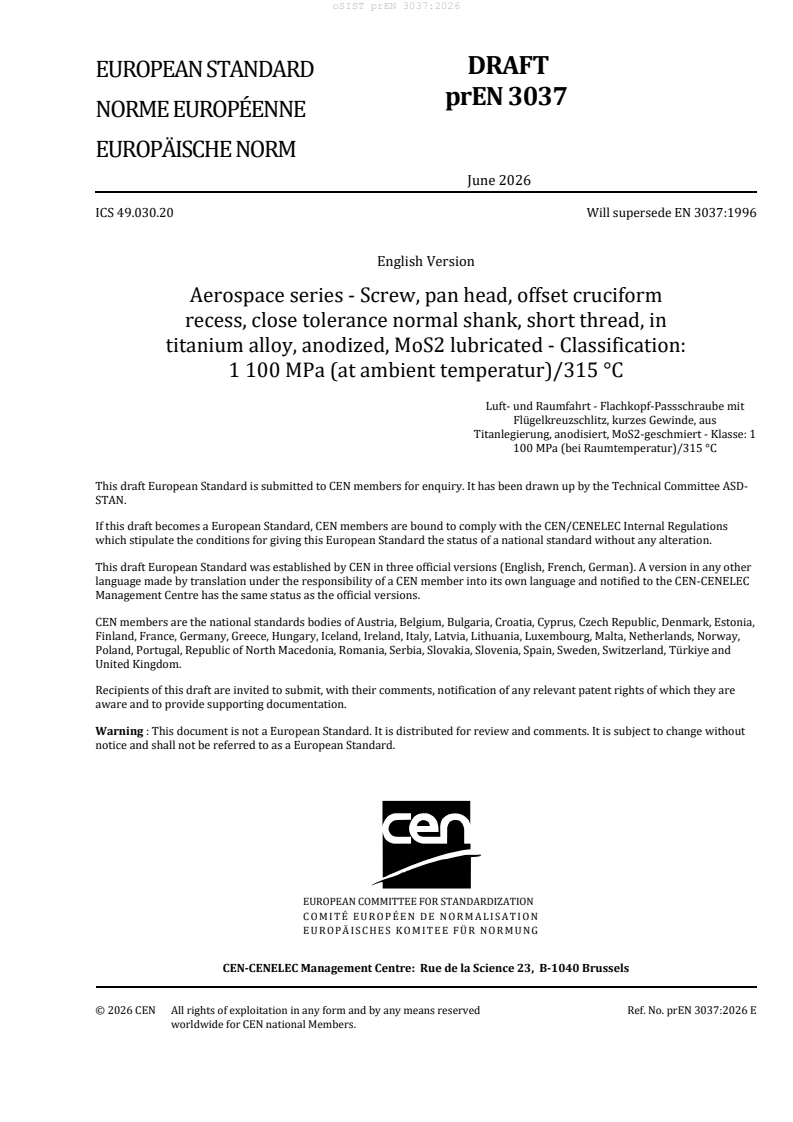
(Main)Aerospace series - Screw, pan head, offset cruciform recess, close tolerance normal shank, short thread, in titanium alloy, anodized, MoS2 lubricated - Classification: 1 100 MPa (at ambient temperatur)/315 °C
- Abstract
This document specifies the characteristics of screws, pan head, offset cruciform recess, close tolerance normal shank, short thread, in titanium alloy, anodized, MoS2 lubricated.
Classification: 1 100 MPa1/315 °C2.
- Status
- Not Published
- Publication Date
- 15-Nov-2027
- Technical Committee
- ASD-STAN - Aerospace
- Drafting Committee
- ASD-STAN/D 3/WG 2 - Fasteners
- Current Stage
- 4060 - Closure of enquiry - Enquiry
- Start Date
- 17-Sep-2026
- Due Date
- 17-Sep-2026
- Completion Date
- 17-Sep-2026

prEN 3037 is a CEN draft European Standard for aerospace pan head screws with an offset cruciform recess, a close tolerance normal shank, a short thread, and titanium alloy material with anodizing and MoS2 lubrication. It specifies the product characteristics, designation, marking, and technical specification for screws classified as 1 100 MPa at ambient temperature/315 °C.
What does prEN 3037 specify?
prEN 3037 specifies the characteristics of one aerospace screw type and the way it is identified and controlled. In practice, it gives the rules a designer, purchaser, manufacturer, or inspector needs to select the screw, describe it on a drawing or purchase order, and verify that supplied parts match the standard.
The document is organized into clauses 1 to 8. Clause 4 covers the required characteristics, clause 5 covers designation, clause 6 covers marking, clause 7 covers the technical specification, and clause 8 covers oversized bolts.
What are the key requirements of prEN 3037?
- Configuration, dimensions, tolerances, and mass are given in Figure 1 and Table 1, with dimensions and tolerances expressed in millimetres and applied after anodizing but before lubricating. This matters because the part must be checked at the right manufacturing stage.
- Form and position tolerances follow ISO 7913. For users, that means the geometry is controlled by a referenced aerospace tolerance standard rather than by free interpretation.
- Materials shall comply with TR 3775 and use titanium alloy in strength class 1 100 MPa. In practice, this ties the screw to a defined material family and strength level.
- Surface treatment and lubrication are controlled by TR 4070 and EN 2491, with lubricant application of 5 µm to 10 µm. The figure also notes edge breaking limits and that micrometre values apply before surface treatment, which affects inspection and process planning.
- Designation in clause 5 combines hole code, diameter code, length code, drive code, and lubricant code. This is useful for procurement because one designation string identifies the ordered variant.
- Marking in clause 6 follows EN 2424 style, with different marking patterns for diameter code groups 030 and 040 versus 050 to 120. This helps traceability on the finished product.
- Technical specification in clause 7 follows ISO 9152 with modifications. The manufacturer must be an approved production organization for aerospace products and show a quality management system such as EN 9100 or an equivalent aerospace accepted and established system. Product qualification is to be carried out and documented using a qualification procedure such as EN 9133 or an equivalent procedure.
- Oversized bolts are handled by EN 4016. This gives a separate route when the standard size is not sufficient.
What terms does prEN 3037 define?
prEN 3037 does not list formal terms and definitions in clause 3, but it uses several key terms that matter in practice.
- Offset cruciform recess - the screw drive shape used for the tool engagement.
- Close tolerance normal shank - a shank with tighter dimensional control for fit and alignment.
- Short thread - the threaded portion is limited in length compared with a full-thread screw.
- MoS2 - molybdenum disulphide, used here as the lubricant specification.
- Strength class 1 100 MPa - the material strength level associated with this screw classification.
- Approved production organization - a manufacturer organization approved to make aerospace products.
- Qualification of products - the documented procedure used to demonstrate the product meets the specified tests.
Who uses prEN 3037?
prEN 3037 is used by aerospace designers, procurement teams, quality managers, and fastener manufacturers. Designers use it to specify a controlled screw type on aircraft or aerospace assemblies. Buyers and suppliers use it to order, make, inspect, mark, and qualify the fastener consistently. Quality and conformity teams use it to check manufacturer approval, product qualification, dimensions, surface treatment, and traceability.
What changed in prEN 3037 from the previous edition?
prEN 3037 will supersede EN 3037:1996. The foreword states these significant changes:
- Clause 3, Terms and definitions, was added.
- Figure 1 was updated.
- Table 3 drive code references were changed to ISO 14275 and ISO 14276.
- Clause 7, Technical specification, was editorially revised.
Which standards are used with prEN 3037?
The document refers to these standards and technical reports:
- EN 2424 - marking of aerospace products.
- EN 2491 - coating methods for molybdenum disulphide dry lubricants.
- EN 4016 - oversized bolts.
- ISO 3353-1 - lead and runout threads for rolled external threads.
- ISO 5855-2 - MJ thread limit dimensions for bolts and nuts.
- ISO 7913 - tolerances of form and position for bolts and screws.
- ISO 9152 - procurement specification for titanium alloy MJ bolts and screws in strength class 1 100 MPa.
- TR 3775 - materials for bolts and pins.
- TR 4070 - list of commercial molybdenum disulphide coating products.
Clause 7 also cites EN 9100 and EN 9133 as examples for quality management and qualification procedures, and the bibliography lists ISO 14275 and ISO 14276 for offset cruciform drive forms.
What does the prEN 3037 document contain?
prEN 3037 contains one configuration figure and four main tables that support identification and control of the screw. Figure 1 shows the screw configuration, while Table 1 gives dimensions and mass for the size range. Table 2 gives hole codes, Table 3 gives drive codes, and Table 4 gives marking rules. The document also includes a worked designation example, which shows how the order code is built for procurement and traceability.
Relations
- Effective Date
- 20-Jan-2026
Get Certified
Connect with accredited certification bodies for this standard

BUREAU VERITAS Certification Germany
Bureau Veritas certification in Germany.

Element Materials Technology
Materials testing and product certification.

AQMS Ltd.
AQMS provides ISO certification to SMEs across the UK.
Sponsored listings
Frequently Asked Questions
prEN 3037 is a draft published by the European Committee for Standardization (CEN). Its full title is "Aerospace series - Screw, pan head, offset cruciform recess, close tolerance normal shank, short thread, in titanium alloy, anodized, MoS2 lubricated - Classification: 1 100 MPa (at ambient temperatur)/315 °C". This standard covers: This document specifies the characteristics of screws, pan head, offset cruciform recess, close tolerance normal shank, short thread, in titanium alloy, anodized, MoS2 lubricated. Classification: 1 100 MPa1/315 °C2.
This document specifies the characteristics of screws, pan head, offset cruciform recess, close tolerance normal shank, short thread, in titanium alloy, anodized, MoS2 lubricated. Classification: 1 100 MPa1/315 °C2.
prEN 3037 is classified under the following ICS (International Classification for Standards) categories: 49.030.20 - Bolts, screws, studs. The ICS classification helps identify the subject area and facilitates finding related standards.
prEN 3037 has the following relationships with other standards: It is inter standard links to EN 3037:1996. Understanding these relationships helps ensure you are using the most current and applicable version of the standard.
prEN 3037 is available in PDF format for immediate download after purchase. The document can be added to your cart and obtained through the secure checkout process. Digital delivery ensures instant access to the complete standard document.
Standards Content (Sample)
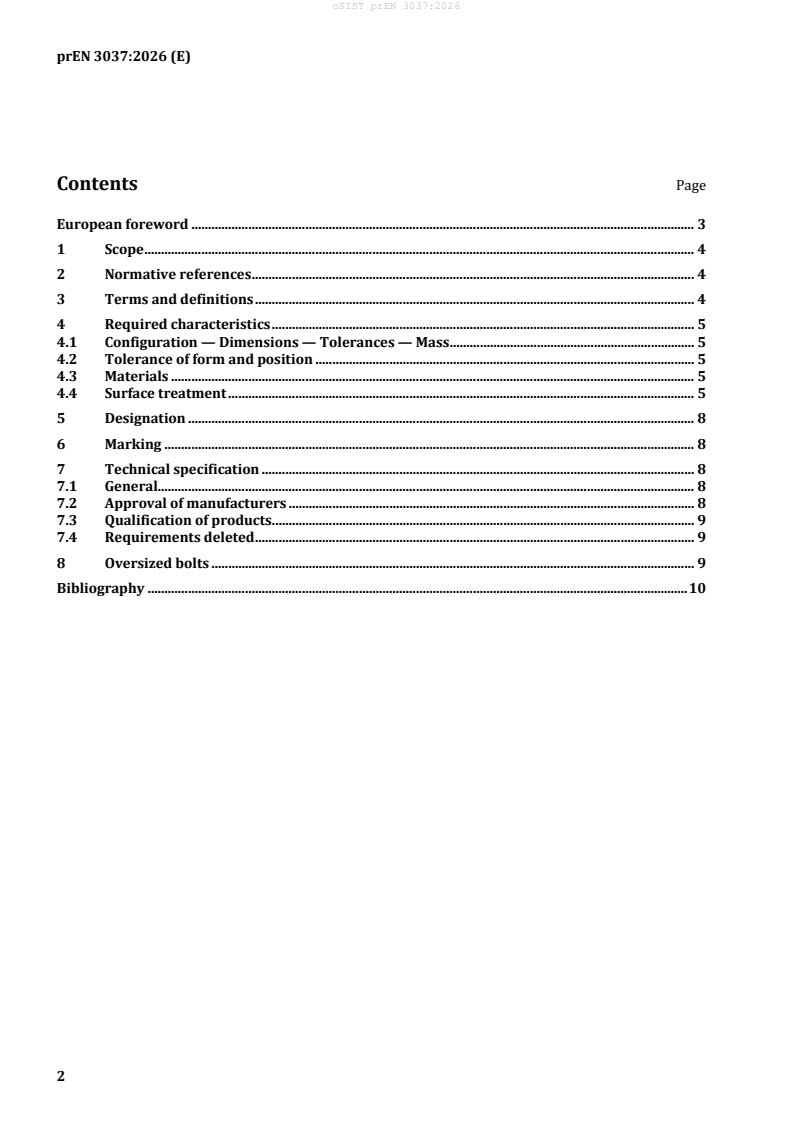
Contents
- 1 Scope
- 2 Normative references
- 3 Terms and definitions
- 4 Required characteristics
- 4.1 Configuration — Dimensions — Tolerances — Mass
- 4.2 Tolerance of form and position
- 4.3 Materials
- 4.4 Surface treatment
- 1 Shape optional
- 5 Designation
- 6 Marking
- 7 Technical specification
- 7.1 General
- 7.2 Approval of manufacturers
- 7.3 Qualification of products
- 7.4 Requirements deleted
- 8 Oversized bolts
- Bibliography
1 Scope
This document specifies the characteristics of screws, pan head, offset cruciform recess, close tolerance normal shank, short thread, in titanium alloy, anodized, MoS lubricated.
1 2 Classification: 1 100 MPa /315 °C .
2 Normative references
The following documents are referred to in the text in such a way that some or all of their content constitutes requirements of this document. For dated references, only the edition cited applies. For undated references, the latest edition of the referenced document (including any amendments) applies. EN 2424, Aerospace series — Marking of aerospace products EN 2491, Aerospace series — Molybdenum disulphide dry lubricants — Coating methods
EN 4016, Aerospace series — Oversized bolts ISO 3353-1, Aerospace — Lead and runout threads — Part 1: Rolled external threads ISO 5855-2, Aerospace — MJ threads — Part 2: Limit dimensions for bolts and nuts ISO 7913, Aerospace — Bolts and screws, metric — Tolerances of form and position ISO 9152, Aerospace — Bolts, with MJ threads, in titanium alloys, strength class 1 100 MPa — Procurement specification
TR 3775, Aerospace series — Bolts and pins —Materials
TR 4070, Aerospace series — Molybdenum disulphide coatings — List of commercial products
3 Terms and definitions
No terms and definitions are listed in this document.
ISO and IEC maintain terminology databases for use in standardization at the following addresses:
- ISO Online browsing platform: available at https://www.iso.org/obp/
- IEC Electropedia: available at https://www.electropedia.org/
Minimum tensile strength of the material at ambient temperature.
Maximum temperature that the screw can withstand without continuous change in its original characteristics, after return to ambient temperature. The maximum temperature is determined by the surface treatment.
Published as ASD-STAN prEN at the date of publication of this document, available at: https://www.asdstan.org/.
Published as ASD-STAN TR, available at: https://www.asd-stan.org/.
oSIST prEN 3037:2026 prEN 3037:2026 (E)
...