

EN 4162:2026
(Main)Aerospace series - Screw, 100° countersunk normal head, offset cruciform recess, coarse tolerance normal shank, medium length thread, in alloy steel, cadmium plated - Classification: 1 100 MPa (at ambient temperature)/235 °C
- Abstract
This document specifies the characteristics of bolts, 100° countersunk normal head, offset cruciform recess, coarse tolerance normal shank, medium length thread, in alloy steel, cadmium plated.
Classification: 1 100 MPa /235 °C .
- Status
- Published
- Publication Date
- 01-Sep-2026
- Technical Committee
- ASD-STAN - Aerospace
- Drafting Committee
- ASD-STAN/D 3/S 2 - Fasteners
- Current Stage
- 6060 - Definitive text made available (DAV) - Publishing
- Start Date
- 02-Sep-2026
- Completion Date
- 02-Sep-2026
EN 4162:2026 is a CEN European Standard for aerospace screws with a 100° countersunk normal head, offset cruciform recess, coarse tolerance normal shank, medium length thread, in alloy steel and cadmium plated. It specifies the screw characteristics, designation, marking and technical specification for parts classified as 1 100 MPa at ambient temperature/235 °C, so it is used when the same fastener definition must be designed, made, marked and qualified consistently.
What does EN 4162:2026 specify?
EN 4162:2026 specifies the characteristics of the aerospace screw described in the title and classifies it by strength and temperature capability. The document is organized into clauses 1 to 7 and a bibliography, covering scope, normative references, terms and definitions, required characteristics, designation, marking, and technical specification.
- Clause 4 defines the product configuration, dimensions, mass, tolerances, materials and surface treatment.
- Clause 5 defines how to build the designation code.
- Clause 6 defines the marking requirement.
- Clause 7 ties the screw to procurement and qualification rules for aerospace use.
What are the key requirements of EN 4162:2026?
EN 4162:2026 is mainly a dimensional and manufacturing standard. It tells you how the screw must be built, finished, coded and qualified, so procurement, inspection and supplier approval can all refer to the same definition.
Configuration, dimensions and mass
Clause 4.1 requires the configuration, dimensions and mass to follow Figure 1 and Table 1. The dimensions and tolerances are expressed in millimetres and apply after surface treatment, which matters because inspection has to check the finished coated part, not an unfinished blank.
Form and position
Clause 4.2 requires tolerances of form and position to follow ISO 7913. In practice, this links the screw to the aerospace tolerance system for shape and alignment, so drawing checks and acceptance inspections use a common rule set.
Materials
Clause 4.3 requires materials in accordance with EN 2137 and EN 3514, or TR 3775, for alloy steel in classification 1 100 MPa. This is the material basis for meeting the strength class, so buyers and manufacturers need evidence that the selected steel matches the permitted aerospace material routes.
Surface treatment
Clause 4.4 requires surface treatment to follow EN 2133. It specifies cadmium plating thickness of 8 µm to 14 µm on all surfaces that can be contacted by a 20 mm diameter ball, and a continuous cadmium plating on all other surfaces. The designation can also carry a code letter for the post-treatment process, including the preferred Type 3, Code C option for chromium(VI)-free passivation, which is important when a customer wants a specific coating route documented.
Designation
Clause 5 defines the order of the designation elements, including the hole code, diameter code, length code, drive code and post-treatment code. The example designation shows how a buyer or engineer specifies the exact variant, so ordering and traceability use one unambiguous string instead of a written description.
Marking
Clause 6 requires marking in accordance with EN 2424 and Figure 1, with the marking style depending on the diameter code range in Table 4. This helps production and receiving inspection identify the part family directly on the product.
Technical specification, approval and qualification
Clause 7 says the technical specification follows ISO 7689, with additional requirements for manufacturer approval and screw qualification. The manufacturer must be an approved production organization for aerospace products and maintain a quality management system such as EN 9100 or an equivalent system, and qualification should use a procedure such as EN 9133 or an equivalent aerospace-accepted method unless customer and supplier agree otherwise.
What terms does EN 4162:2026 define?
EN 4162:2026 uses these key terms and codes in its requirements:
- Offset cruciform recess - the internal drive shape used for tool engagement in the screw head.
- 100° countersunk normal head - the head form that sits flush in a 100° countersunk seat.
- Coarse tolerance normal shank - the shank form and tolerance category required for this screw type.
- Medium length thread - the thread-length category used to identify the screw geometry in Table 1.
- Classification 1 100 MPa (at ambient temperature)/235 °C - the performance class linked to minimum tensile strength and the maximum temperature after which the screw must retain its original characteristics.
- Hole code - the designation element that shows whether the screw is with or without a hole.
- Drive code - the designation element that identifies the internal drive standard.
- Post treatment process code - the designation element that identifies the cadmium surface post-treatment.
Who uses EN 4162:2026?
EN 4162:2026 is used by aerospace designers, fastener buyers, suppliers, production organizations and quality teams. Designers use it to select the correct screw form and performance class, purchasers use it to order the right coded variant, and manufacturers use it to build, coat, mark and qualify the screw to the same aerospace definition. It is also relevant to inspection and supplier approval because it links product geometry, material, plating and qualification to named aerospace standards.
Which standards are used with EN 4162:2026?
| Standard | What it contributes |
|---|---|
| EN 2133 | Cadmium plating and related post-treatment requirements |
| EN 2137 | Steel material requirements for one permitted alloy steel route |
| EN 2424 | Marking of aerospace products |
| EN 3514 | Another permitted alloy steel material route |
| ISO 3353-1 | Lead and runout threads for rolled external threads |
| ISO 4520 | Chromate conversion coatings on electroplated zinc and cadmium coatings |
| ISO 5855-2 | MJ thread limit dimensions for bolts and nuts |
| ISO 5856 | Dimensions for 100° normal countersunk head screws |
| ISO 7689 | Baseline procurement specification for aerospace alloy steel bolts with MJ threads |
| ISO 7913 | Tolerances of form and position |
| ISO 14275 | Internal offset cruciform ribbed drive standard |
| ISO 14276 | Internal offset cruciform drive standard |
| TR 3775 | Materials guidance for bolts and pins |
| EN 9100 | Example quality management system for manufacturer approval |
| EN 9133 | Example qualification procedure for aerospace standard products |
What does the EN 4162:2026 document contain?
EN 4162:2026 contains Figure 1 for the screw configuration, Table 1 for dimensions and mass, Table 2 for hole code, Table 3 for drive code, and Table 4 for marking style. It also includes a designation example that shows how the code elements are combined in practice. Clause 7 gives the production-organization approval and screw qualification framework used for aerospace procurement and conformity control.
Relations
- Effective Date
- 14-Oct-2026
- Effective Date
- 30-Sep-2026
- Effective Date
- 30-Sep-2026
- Refers
EN 2137:2017 - Aerospace series - Steel FE-PL75 - 1 100 MPa ≤ Rm ≤ 1 250 MPa - Bars - De ≤ 100 mm - Effective Date
- 30-Sep-2026
- Effective Date
- 30-Sep-2026
- Effective Date
- 30-Sep-2026
- Effective Date
- 30-Sep-2026
- Effective Date
- 30-Sep-2026
- Effective Date
- 30-Sep-2026
- Effective Date
- 30-Sep-2026
- Effective Date
- 30-Sep-2026
- Effective Date
- 30-Sep-2026
- Effective Date
- 05-Jun-2024
- Effective Date
- 05-Jun-2024
Get Certified
Connect with accredited certification bodies for this standard

BUREAU VERITAS Certification Germany
Bureau Veritas certification in Germany.

Element Materials Technology
Materials testing and product certification.

AQMS Ltd.
AQMS provides ISO certification to SMEs across the UK.
Sponsored listings
Frequently Asked Questions
EN 4162:2026 is a standard published by the European Committee for Standardization (CEN). Its full title is "Aerospace series - Screw, 100° countersunk normal head, offset cruciform recess, coarse tolerance normal shank, medium length thread, in alloy steel, cadmium plated - Classification: 1 100 MPa (at ambient temperature)/235 °C". This standard covers: This document specifies the characteristics of bolts, 100° countersunk normal head, offset cruciform recess, coarse tolerance normal shank, medium length thread, in alloy steel, cadmium plated. Classification: 1 100 MPa /235 °C .
This document specifies the characteristics of bolts, 100° countersunk normal head, offset cruciform recess, coarse tolerance normal shank, medium length thread, in alloy steel, cadmium plated. Classification: 1 100 MPa /235 °C .
EN 4162:2026 is classified under the following ICS (International Classification for Standards) categories: 49.030.20 - Bolts, screws, studs. The ICS classification helps identify the subject area and facilitates finding related standards.
EN 4162:2026 has the following relationships with other standards: It is inter standard links to EN 2133:2026, ISO 14275:2002, ISO 14276:2002, EN 2137:2017, ISO 7689:2025, EN 2133:2020, ISO 5856:2008, ISO 5855-2:1999, EN 2424:2008, ISO 4520:1981, ISO 3353-1:2020, ISO 7913:1994, EN 4162:2016/AC:2017, EN 4162:2016. Understanding these relationships helps ensure you are using the most current and applicable version of the standard.
EN 4162:2026 is available in PDF format for immediate download after purchase. The document can be added to your cart and obtained through the secure checkout process. Digital delivery ensures instant access to the complete standard document.
Standards Content (Sample)
SLOVENSKI STANDARD
01-november-2026
Aeronavtika - Vijak, 100° ugrezna glava, križna zareza, polno steblo, ozka
toleranca, srednja navojna dolžina, iz legiranega jekla, prevlečen s kadmijem -
Klasifikacija: 1100 MPa (pri temperaturi okolice)/235 °C
Aerospace series - Screw, 100° countersunk normal head, offset cruciform recess,
coarse tolerance normal shank, medium length thread, in alloy steel, cadmium plated -
Classification: 1 100 MPa (at ambient temperature)/235 °C
Luft- und Raumfahrt - 100°-Senkschraube mit Flügelkreuzschlitz, mittlere Gewindelänge,
aus legiertem Stahl, verkadmet - Klasse: 1 100 MPa (bei Raumtemperatur)/235 °C
Série aérospatiale - Vis à tête fraisée 100° normale, à empreinte cruciforme déportée,
tige normale à tolérance large, filetage moyen, en acier allié, cadmiée - Classification: 1
100 MPa (à température ambiante)/235 °C
Ta slovenski standard je istoveten z: EN 4162:2026
ICS:
49.025.10 Jekla Steels
49.030.20 Sorniki, vijaki, stebelni vijaki Bolts, screws, studs
2003-01.Slovenski inštitut za standardizacijo. Razmnoževanje celote ali delov tega standarda ni dovoljeno.
EN 4162
EUROPEAN STANDARD
NORME EUROPÉENNE
September 2026
EUROPÄISCHE NORM
ICS 49.030.20
English Version
Aerospace series - Screw, 100° countersunk normal head,
offset cruciform recess, coarse tolerance normal shank,
medium length thread, in alloy steel, cadmium plated -
Classification: 1 100 MPa (at ambient temperature)/235
°C
Série aérospatiale - Vis à tête fraisée 100° normale, à Luft- und Raumfahrt - 100°-Senkschraube mit
empreinte cruciforme déportée, tige normale à Flügelkreuzschlitz, mittlere Gewindelänge, aus
tolérance large, filetage moyen, en acier allié, cadmiée - legiertem Stahl, verkadmet - Klasse: 1 100 MPa (bei
Classification : 1 100 MPa (à température Raumtemperatur)/235 °C
ambiante)/235 °C
This European Standard was approved by CEN on 3 August 2026.
CEN members are bound to comply with the CEN/CENELEC Internal Regulations which stipulate the conditions for giving this
European Standard the status of a national standard without any alteration. Up-to-date lists and bibliographical references
concerning such national standards may be obtained on application to the CEN-CENELEC Management Centre or to any CEN
member.
This European Standard exists in three official versions (English, French, German). A version in any other language made by
translation under the responsibility of a CEN member into its own language and notified to the CEN-CENELEC Management
Centre has the same status as the official versions.
CEN members are the national standards bodies of Austria, Belgium, Bulgaria, Croatia, Cyprus, Czech Republic, Denmark, Estonia,
Finland, France, Germany, Greece, Hungary, Iceland, Ireland, Italy, Latvia, Lithuania, Luxembourg, Malta, Netherlands, Norway,
Poland, Portugal, Republic of North Macedonia, Romania, Serbia, Slovakia, Slovenia, Spain, Sweden, Switzerland, Türkiye and
United Kingdom.
EUROPEAN COMMITTEE FOR STANDARDIZATION
COMITÉ EUROPÉEN DE NORMALISATION
EUROPÄISCHES KOMITEE FÜR NORMUNG
CEN-CENELEC Management Centre: Rue de la Science 23, B-1040 Brussels
© 2026 CEN All rights of exploitation in any form and by any means reserved Ref. No. EN 4162:2026 E
worldwide for CEN national Members.
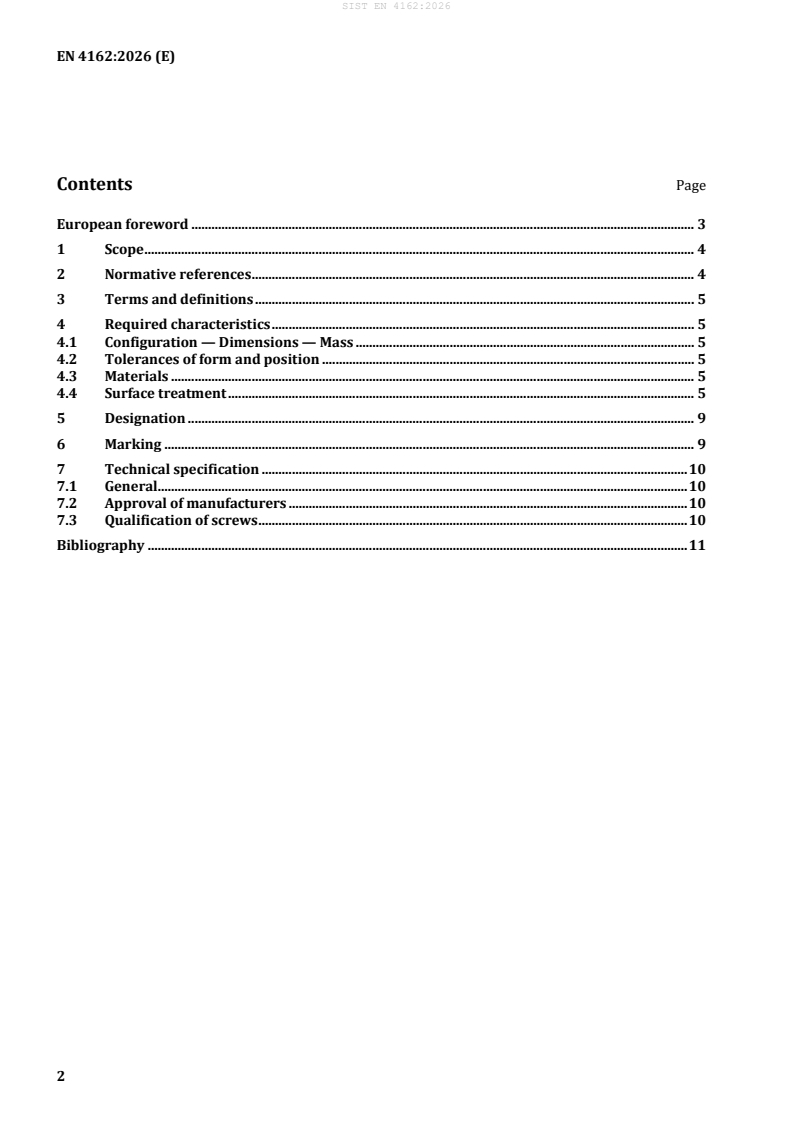
Contents Page
European foreword . 3
1 Scope . 4
2 Normative references . 4
3 Terms and definitions . 5
4 Required characteristics . 5
4.1 Configuration — Dimensions — Mass . 5
4.2 Tolerances of form and position . 5
4.3 Materials . 5
4.4 Surface treatment . 5
5 Designation . 9
6 Marking . 9
7 Technical specification . 10
7.1 General. 10
7.2 Approval of manufacturers . 10
7.3 Qualification of screws . 10
Bibliography . 11
European foreword
This document (EN 4162:2026) has been prepared by ASD-STAN.
After enquiries and votes carried out in accordance with the rules of this Association, this document has
received the approval of the National Associations and the Official Services of the member countries of
ASD-STAN, prior to its presentation to CEN.
This European Standard shall be given the status of a national standard, either by publication of an
identical text or by endorsement, at the latest by March 2027, and conflicting national standards shall
be withdrawn at the latest by March 2027.
Attention is drawn to the possibility that some of the elements of this document may be the subject of
patent rights. CEN shall not be held responsible for identifying any or all such patent rights.
Any feedback and questions on this document should be directed to the users’ national standards body.
A complete listing of these bodies can be found on the CEN website.
According to the CEN-CENELEC Internal Regulations, the national standards organizations of the
following countries are bound to implement this European Standard: Austria, Belgium, Bulgaria,
Croatia, Cyprus, Czech Republic, Denmark, Estonia, Finland, France, Germany, Greece, Hungary, Iceland,
Ireland, Italy, Latvia, Lithuania, Luxembourg, Malta, Netherlands, Norway, Poland, Portugal, Republic of
North Macedonia, Romania, Serbia, Slovakia, Slovenia, Spain, Sweden, Switzerland, Türkiye and the
United Kingdom.
1 Scope
This document specifies the characteristics of screws, 100° countersunk normal head, offset cruciform
recess, coarse tolerance normal shank, medium length thread, in alloy steel, cadmium plated.
1 2
Classification: 1 100 MPa /235 °C .
2 Normative references
The following documents are referred to in the text in such a way that some or all of their content
constitutes requirements of this document. For dated references, only the edition cited applies. For
undated references
...