

prEN 1888-1
(Main)Child care articles - Wheeled child conveyances - Part 1: Pushchairs and prams
- Abstract
This document specifies the safety requirements and test methods for pushchairs and prams, designed for the carriage of one or more children, up to 22 kg each and up to 20 kg for any integrated platform on which a child can stand.
This document does not cover toys, baby carriers fitted with wheels; pushchairs and prams propelled by a motor and pushchairs and prams designed for children with special needs.
Where a pushchair or pram or any part of the pushchair or pram has several functions or can be converted into another function it is due to comply with relevant standard(s).
- Status
- Not Published
- Publication Date
- 05-Jun-2028
- Technical Committee
- CEN/TC 252 - Child use and care articles
- Drafting Committee
- CEN/TC 252/WG 3 - Wheeled transportation
- Current Stage
- 4020 - Submission to enquiry - Enquiry
- Start Date
- 27-Aug-2026
- Due Date
- 23-Feb-2027
- Completion Date
- 27-Aug-2026

prEN 1888-1 is a draft CEN European Standard for child care articles - wheeled child conveyances. It specifies safety requirements and test methods for pushchairs and prams intended to carry one or more children, up to 22 kg each, and up to 20 kg for any integrated platform used for standing. It is written for manufacturers, test laboratories, importers, quality managers, and buyers who need to check design safety, strength, stability, markings, and user information.
What does prEN 1888-1 specify?
prEN 1888-1 specifies safety requirements and test methods for pushchairs and prams. It applies to wheeled child conveyances for one or more children and sets the framework for design checks, type testing, marking, and instructions for use.
The scope excludes toys, baby carriers fitted with wheels, motor-propelled pushchairs and prams, and products designed for children with special needs. Where a pushchair or pram, or one of its parts, has several functions or can be converted to another function, it has to comply with the relevant standard(s) for those functions.
The document is organized into these main clauses:
- Clause 1 - Scope
- Clause 2 - Normative references
- Clause 3 - Terms and definitions
- Clause 4 - General requirements and test conditions
- Clause 5 - Test equipment
- Clause 6 - Chemical hazards
- Clause 7 - Thermal hazards
- Clause 8 - Mechanical hazards
- Clause 9 - Durability of marking
- Clause 10 - Product information
| Annex | What it covers |
|---|---|
| Annex A | Rationales for the requirements in Clauses 6 to 10 |
| Annex B | Examples of articulated arms for the irregular surface test |
| Annex C | Guidance for applying the locking mechanism release requirement |
| Annex D | Canopy overlap cases and probe access examples |
| Annex E | Material suitability and the effects of ageing and climate |
| Annex ZA | Relationship with Regulation 2023/988/EU |
What are the key requirements of prEN 1888-1?
prEN 1888-1 combines worst-case test set-up rules, hazard-specific checks, and product-information requirements. In practice, a product has to pass the relevant tests in the configurations and conditions that are most demanding for safety, not only in the easiest arrangement.
General test conditions and configuration
Clause 4 requires tests to be performed in the order given, using one vehicle unless a clause says otherwise. The vehicle must be assessed in the most onerous condition, including the number and type of seat units, pram bodies, carry cots, car seats, accessories, added loads, and adjustable positions allowed by the manufacturer.
That matters because convertible and multi-seat products can behave very differently depending on how they are built and loaded. A compliant design has to stay safe in the arrangements that users can actually choose.
Clause 4 also sets test conditions and equipment tolerances. The vehicle is conditioned before testing, tests are carried out at a specified ambient temperature, and inflatable tyres have to be set according to the instructions for use. For a test program, that means the laboratory has to control set-up details as carefully as the product itself.
Protected volumes and geometric checks
Clause 4 defines the protected volume, the junction line, and the occupant space for seat units, pram bodies, and car seats. These definitions are the basis for many later checks on openings, surfaces, and access to hazardous parts.
For engineers, this is the geometry that decides where the child can reach, where a finger probe or head probe is used, and which surfaces are treated as safety-critical. If the protected volume is wrong, the hazard assessment can be wrong as well.
Chemical and thermal hazards
Clause 6 requires materials in the protected volume to meet the migration-of-elements requirements of EN 17826:2025, with special attention to surfaces and parts the child can mouth. Textile components in the protected volume also have to meet the relevant textile requirements from EN 17826.
Clause 7 requires textiles, coated textile supports, and plastic coverings to resist surface flash and to meet flame-spread limits when tested to EN 71-2:2020+A1:2025. In practice, this is the part that controls how easily soft materials can ignite and how quickly flame can spread across the product.
Mechanical safety
Clause 8 is the largest safety section. It covers the protective function of the vehicle, minimum internal height of pram bodies, restraint systems and fasteners, entrapment hazards, moving parts, entanglement, choking and ingestion hazards, suffocation hazards, hazardous edges and protrusions, parking and braking devices, stability, structural integrity, and visibility.
A few points are especially important in use:
- The vehicle has to resist a child falling out or sliding into unsafe positions.
- Folding systems, locking mechanisms, rotating seats, and handle movement are checked so they do not release or create crushing and shearing hazards.
- Small parts, loops, free lengths, and detachable items are checked to reduce choking, ingestion, and entanglement risks.
- Edges and protrusions within the protected volume have to be rounded or chamfered, and other surfaces must be free from burrs and sharp edges.
- Parking and braking devices have to hold the vehicle safely on a slope and be usable by the carer.
- Stability and structural integrity tests check tipping resistance, wheel strength, handle strength, attachment devices, and irregular-surface performance.
Clause 8.11 adds a visibility requirement: the vehicle has to be permanently fitted with reflectors or retroreflective material on both left and right sides. In practice, that improves visibility to road users in poor light.
Marking and user information
Clause 9 requires durable marking. Permanent labels are rubbed with a moist cotton cloth, and the marking still has to be legible after the test.
Clause 10 requires product marking, purchase information, and instructions for use. The product and point-of-sale information have to give the user the key warnings, the product identity, the child weight limits, and other safety information in the language of sale. For buyers and retailers, this is the part that supports correct selection and correct use.
What terms does prEN 1888-1 define?
- Wheeled child conveyance - a vehicle designed to carry one or more children and to be manually steered while being pushed or pulled.
- Pushchair - a vehicle made up of a chassis and one or more seat units or car seats.
- Pram - a vehicle made up of a chassis and one or more pram bodies.
- Integrated platform - an integral part of the vehicle designed to support a child in a standing position.
- Protected volume - the volume accessible to the child while sitting or lying, where specific safety requirements apply.
- Junction line - the intersection of the seat and the backrest.
- Restraint system - the system used to hold the child within the vehicle.
- Child Restraint System (CRS) - the child restraint used in a type A car seat or type B car seat.
Who uses prEN 1888-1?
prEN 1888-1 is used by manufacturers of pushchairs, prams, seat units, pram bodies, carry cots, and related accessories. It is also used by test laboratories and certification teams that need repeatable methods for safety verification.
Quality managers, buyers, importers, and retailers use it to specify acceptance criteria, check warnings and instructions, and confirm that a product matches its intended child weight and age range. Safety engineers and compliance staff use it when assessing hazards such as folding, tipping, entrapment, flammability, and material safety.
What changed in prEN 1888-1 from the previous edition?
prEN 1888-1 is the draft intended to supersede EN 1888-1:2018+A1:2022 and EN 1888-2:2018+A1:2022.
Which standards are used with prEN 1888-1?
| Standard | What it contributes |
|---|---|
| EN 71-2:2020+A1:2025 | Flammability test methods for textiles, coated textile supports, and plastic coverings in Clause 7 |
| EN 1466:2023 | Safety requirements and test methods for carry cots and stands for domestic use |
| EN 17826:2025 | Chemical hazards requirements used in Clause 6 |
| EN 71-1:2026 | Mechanical and physical properties of toys, cited in the bibliography as background |
| CEN/TS 13387-1 | Safety philosophy and safety assessment background |
| CEN/TS 13387-2 | Chemical hazards guidance background |
| CEN/TS 13387-3 | Mechanical hazards guidance and examples of suitable clamps for the bite test |
| CEN/TS 13387-4 | Thermal hazards guidance background |
| CEN/TS 13387-5 | Product information guidance background |
What does the prEN 1888-1 document contain?
prEN 1888-1 contains defined test equipment such as test masses, finger probes, head probes, conical probes, the angle measuring device, the bite tester, the test surface, rectangular stops, and irregular-surface test equipment. It also gives illustrated set-ups for protected volume, junction line, occupant space, ball retention, head support, stability, and irregular-surface testing.
The mechanical test section includes procedures for folding and locking mechanisms, entrapment and entanglement checks, small parts, choking and ingestion, suffocation, braking, stability, and structural integrity. Annex C adds guidance for judging unintentional release of locking mechanisms, and Annex D shows canopy cases where probe access is or is not considered hazardous.
Annex E explains why material choice matters in real use, especially with ageing, sunlight, humidity, temperature changes, and cold-weather brittleness. Annex ZA maps the document’s clauses to Regulation 2023/988/EU safety requirements for products in scope.
Relations
- Effective Date
- 28-Jan-2026
- Effective Date
- 28-Jan-2026
- Effective Date
- 15-Oct-2025
- Effective Date
- 15-Oct-2025
Frequently Asked Questions
prEN 1888-1 is a draft published by the European Committee for Standardization (CEN). Its full title is "Child care articles - Wheeled child conveyances - Part 1: Pushchairs and prams". This standard covers: This document specifies the safety requirements and test methods for pushchairs and prams, designed for the carriage of one or more children, up to 22 kg each and up to 20 kg for any integrated platform on which a child can stand. This document does not cover toys, baby carriers fitted with wheels; pushchairs and prams propelled by a motor and pushchairs and prams designed for children with special needs. Where a pushchair or pram or any part of the pushchair or pram has several functions or can be converted into another function it is due to comply with relevant standard(s).
This document specifies the safety requirements and test methods for pushchairs and prams, designed for the carriage of one or more children, up to 22 kg each and up to 20 kg for any integrated platform on which a child can stand. This document does not cover toys, baby carriers fitted with wheels; pushchairs and prams propelled by a motor and pushchairs and prams designed for children with special needs. Where a pushchair or pram or any part of the pushchair or pram has several functions or can be converted into another function it is due to comply with relevant standard(s).
prEN 1888-1 is classified under the following ICS (International Classification for Standards) categories: 97.190 - Equipment for children. The ICS classification helps identify the subject area and facilitates finding related standards.
prEN 1888-1 has the following relationships with other standards: It is inter standard links to CEN ISO/TS 5387:2024, CEN ISO/TS 23359:2025, EN 1888-1:2018+A1:2022, EN 1888-2:2018+A1:2022. Understanding these relationships helps ensure you are using the most current and applicable version of the standard.
prEN 1888-1 is associated with the following European legislation: EU Directives/Regulations: 2023/988/EU; Standardization Mandates: M/264. When a standard is cited in the Official Journal of the European Union, products manufactured in conformity with it benefit from a presumption of conformity with the essential requirements of the corresponding EU directive or regulation.
prEN 1888-1 is available in PDF format for immediate download after purchase. The document can be added to your cart and obtained through the secure checkout process. Digital delivery ensures instant access to the complete standard document.
Standards Content (Sample)
SLOVENSKI STANDARD
01-oktober-2026
Izdelki za otroke - Otroški vozički - 1. del: Otroški vozički s sedežem in otroški
vozički s košaro
Child care articles - Wheeled child conveyances - Part 1: Pushchairs and prams
Artikel für Säuglinge und Kleinkinder - Kinderfahrzeuge auf Rädern - Teil 1: Kinderstühle
und Kinderwagen
Articles de puériculture - Voitures d'enfant - Partie 1 : Poussettes et landaus
Ta slovenski standard je istoveten z: prEN 1888-1
ICS:
97.190 Otroška oprema Equipment for children
2003-01.Slovenski inštitut za standardizacijo. Razmnoževanje celote ali delov tega standarda ni dovoljeno.
DRAFT
EUROPEAN STANDARD
NORME EUROPÉENNE
EUROPÄISCHE NORM
August 2026
ICS 97.190 Will supersede EN 1888-1:2018+A1:2022, EN 1888-
2:2018+A1:2022
English Version
Child care articles - Wheeled child conveyances - Part 1:
Pushchairs and prams
Articles de puériculture - Voitures d'enfant - Partie 1: Artikel für Säuglinge und Kleinkinder - Transportmittel
Poussettes et landaus auf Rädern für Kinder - Teil 1: Kinderwagen und
Kindersportwagen
This draft European Standard is submitted to CEN members for enquiry. It has been drawn up by the Technical Committee
CEN/TC 252.
If this draft becomes a European Standard, CEN members are bound to comply with the CEN/CENELEC Internal Regulations
which stipulate the conditions for giving this European Standard the status of a national standard without any alteration.
This draft European Standard was established by CEN in three official versions (English, French, German). A version in any other
language made by translation under the responsibility of a CEN member into its own language and notified to the CEN-CENELEC
Management Centre has the same status as the official versions.
CEN members are the national standards bodies of Austria, Belgium, Bulgaria, Croatia, Cyprus, Czech Republic, Denmark, Estonia,
Finland, France, Germany, Greece, Hungary, Iceland, Ireland, Italy, Latvia, Lithuania, Luxembourg, Malta, Netherlands, Norway,
Poland, Portugal, Republic of North Macedonia, Romania, Serbia, Slovakia, Slovenia, Spain, Sweden, Switzerland, Türkiye and
United Kingdom.
Recipients of this draft are invited to submit, with their comments, notification of any relevant patent rights of which they are
aware and to provide supporting documentation.
Warning : This document is not a European Standard. It is distributed for review and comments. It is subject to change without
notice and shall not be referred to as a European Standard.
EUROPEAN COMMITTEE FOR STANDARDIZATION
COMITÉ EUROPÉEN DE NORMALISATION
EUROPÄISCHES KOMITEE FÜR NORMUNG
CEN-CENELEC Management Centre: Rue de la Science 23, B-1040 Brussels
© 2026 CEN All rights of exploitation in any form and by any means reserved Ref. No. prEN 1888-1:2026 E
worldwide for CEN national Members.
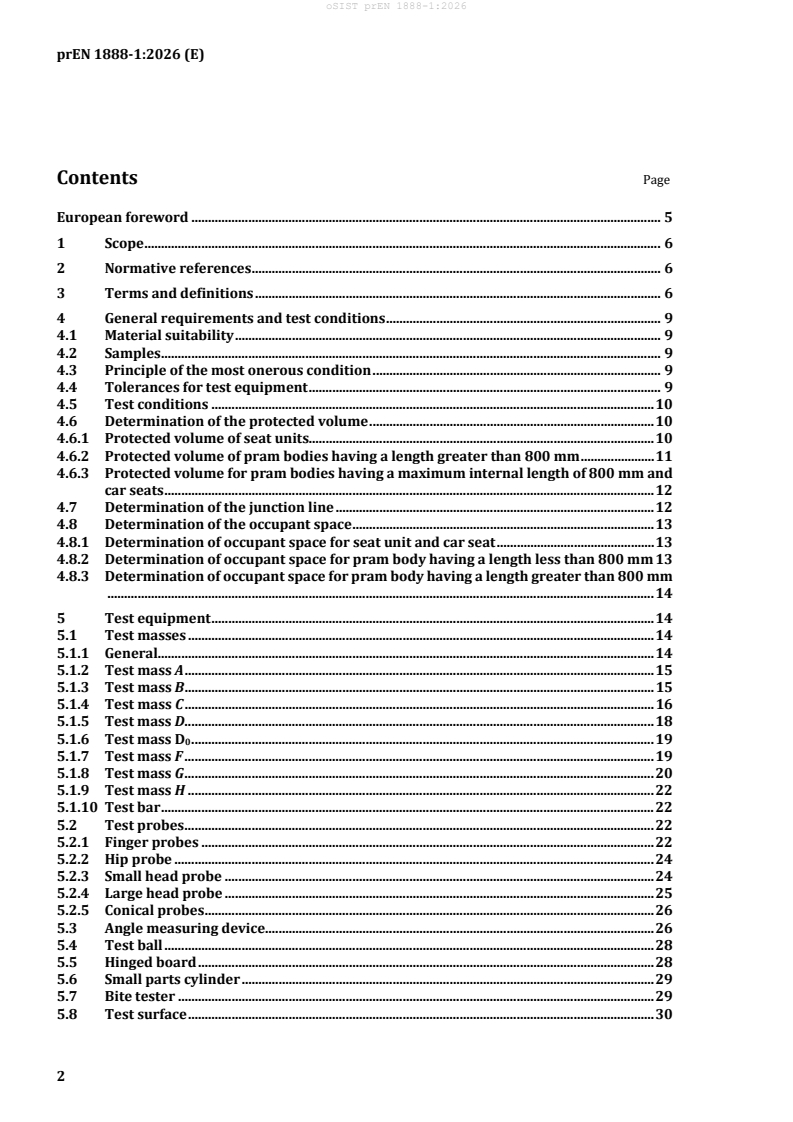
Contents Page
European foreword . 5
1 Scope . 6
2 Normative references . 6
3 Terms and definitions . 6
4 General requirements and test conditions . 9
4.1 Material suitability . 9
4.2 Samples . 9
4.3 Principle of the most onerous condition . 9
4.4 Tolerances for test equipment . 9
4.5 Test conditions . 10
4.6 Determination of the protected volume . 10
4.6.1 Protected volume of seat units. 10
4.6.2 Protected volume of pram bodies having a length greater than 800 mm . 11
4.6.3 Protected volume for pram bodies having a maximum internal length of 800 mm and
car seats . 12
4.7 Determination of the junction line . 12
4.8 Determination of the occupant space . 13
4.8.1 Determination of occupant space for seat unit and car seat . 13
4.8.2 Determination of occupant space for pram body having a length less than 800 mm 13
4.8.3 Determination of occupant space for pram body having a length greater than 800 mm
................................................................................................................................................................... 14
5 Test equipment . 14
5.1 Test masses . 14
5.1.1 General. 14
5.1.2 Test mass A . 15
5.1.3 Test mass B . 15
5.1.4 Test mass C . 16
5.1.5 Test mass D. 18
5.1.6 Test mass D . 19
5.1.7 Test mass F . 19
5.1.8 Test mass G . 20
5.1.9 Test mass H . 22
5.1.10 Test bar . 22
5.2 Test probes . 22
5.2.1 Finger probes . 22
5.2.2 Hip probe . 24
5.2.3 Small head probe . 24
5.2.4 Large head probe . 25
5.2.5 Conical probes . 26
5.3 Angle measuring device . 26
5.4 Test ball . 28
5.5 Hinged board . 28
5.6 Small parts cylinder . 29
5.7 Bite tester . 29
5.8 Test surface . 30
5.9 Rectangular stops . 31
5.10 Irregular surface test equipment . 31
5.10.1 Obstacles . 31
5.10.2 Articulating arms (see Annex B) . 33
6 Chemical hazards (see A.2) . 33
7 Thermal hazards (see A.3) . 34
8 Mechanical hazards (see A.4) . 34
8.1 Protective function (see A.4.2) . 34
8.1.1 Suitability of vehicle . 34
8.1.2 Minimum internal height of pram body . 38
8.1.3 Restraint system and fasteners . 41
8.2 Entrapment hazards (see A.4.3) . 44
8.2.1 Holes and openings . 44
8.2.2 Entrapment between the handle and the pram body . 44
8.3 Hazards from moving parts (see A.4.4) . 45
8.3.1 General . 45
8.3.2 Shearing hazards (see A.4.4) . 45
8.3.3 Crushing hazards, requirement (see A.4.4) . 46
8.3.4 Wheels . 46
8.3.5 Locking mechanism(s) . 46
8.4 Entanglement hazards (see A.5). 50
8.4.1 Requirements . 50
8.4.2 Test methods . 51
8.5 Choking and ingestion hazards (see A.6) . 52
8.5.1 Requirements . 52
8.5.2 Test methods . 52
8.6 Suffocation hazards (see A.7) . 55
8.6.1 Internal lining of the pram body and seat unit . 55
8.6.2 Plastic packaging . 55
8.7 Hazardous edges and protrusions (see A.8) . 55
8.8 Parking and braking devices (see A.9) . 55
8.8.1 Requirements . 55
8.8.2 Test methods . 56
8.9 Stability (see A.10) . 59
8.9.1 Stability of vehicle . 59
8.9.2 Longitudinal stability of a pram body with carrying handles . 64
8.10 Structural integrity (see A.11) . 65
8.10.1 Carrying handles and handle anchorage points of pram bodies, car seats, and
detachable seat units . 65
8.10.2 Strength and durability of attachment devices for pram bodies, or carry cots or seat
units or car seats . 65
8.10.3 Irregular surface test . 66
8.10.4 Dynamic strength . 67
8.10.5 Wheel strength . 69
8.10.6 Handle strength . 69
8.11 Visibility of the vehicle (see A.13) . 73
9 Durability of marking . 73
10 Product information . 73
10.1 General . 73
10.2 Marking of product . 74
10.3 Purchase information (A.12) . 75
10.4 Instructions for use . 77
Annex A (informative) Rationales . 79
A.1 General. 79
A.2 Chemical hazards (see Clause 6) . 79
A.3 Thermal hazards (see Clause 7) . 79
A.4 Mechanical hazards (see Clause 8) . 79
A.4.1 General. 79
A.4.2 Protective function (see 8.1) . 79
A.4.3 Entrapment hazards (see 8.2) . 79
A.4.4 Hazards from moving parts (see 8.3) . 80
A.5 Entanglement hazards (see 8.4) . 82
A.6 Choking and ingestion hazards (see 8.5) . 82
A.7 Suffocation hazards (see 8.6) . 82
A.8 Hazardous edges and protrusions (see 8.7) . 82
A.9 Parking and braking devices (see 8.8) . 82
A.10 Stability (see 8.9) . 82
A.11 Structural integrity (see 8.10) . 83
A.12 Purchase information (see 10.3) . 83
A.13 Visibility of the vehicle (see 8.11) . 83
Annex B (informative) Examples of articulated arms to maintain the vehicle on the rig for
the irregular surface test . 84
Annex C (informative) Guideline for the application of 8.3.5.1.1.3 “Unintentional release of
locking mechanism(s)” . 86
C.1 Relevant definitions . 86
C.2 Guidelines for the application of 8.3.5.1.1.3 “Unintentional release of locking
mechanism(s)” . 86
C.2.1 General. 86
C.2.2 Products fitted with one single operating device (products that may be fold using only
one hand) . 86
C.2.3 Products fitted with two operating devices . 87
C.2.4 Products having three or more operating devices . 88
C.2.5 Products covered by different requirements . 89
Annex D (informative) Examples of moving parts of the canopies inside 100 mm from the
pivot point . 90
D.1 Case A . 90
D.2 Case B . 91
D.3 Case C . 92
Annex E (informative) Material suitability . 94
Annex ZA (informative) Relationship between this European Standard and the safety
requirements of Regulation 2023/988/EU aimed to be covered . 95
Bibliography . 98
European foreword
This document (prEN 1888-1:2026) has been prepared by Technical Committee CEN/TC 252 “Child care
articles”, the secretariat of which is held by AFNOR.
This document is currently submitted to the CEN Enquiry.
This document will supersede EN 1888-1:2018+A1:2022 and EN 1888-2:2018+A1:2022.
In comparison with the previous edition, the significant technical changes have been made:
To be completed.
EN 1888 is currently composed with the following parts:
— EN 1888-1, Child care articles — Wheeled child conveyances — Part 1: Pushchairs and prams;
— EN 1888-3, Child care articles — Wheeled child conveyances — Part 3: Pushchairs intended for leisure
sport activities.
This document has been prepared under a standardisation request addressed to CEN by the European
Commission. The Standing Committee of the EFTA States subsequently approves these requests for its
Member States.
For the relationship with EU Legislation, see informative Annex ZA, which is an integral part of this
document.
1 Scope
This document specifies the safety requirements and test methods for pushchairs and prams, designed
for the carriage of one or more children, up to 22 kg each and up to 20 kg for any integrated platform on
which a child can stand.
This document does not cover toys, baby carriers fitted with wheels; pushchairs and prams propelled by
a motor and pushchairs and prams designed for children with special needs.
Where a pushchair or pram or any part of the pushchair or pram has several functions or can be converted
into another function it is due to comply with relevant standard(s).
2 Normative references
The following documents are referred to in the text in such a way that some or all of their content
constitutes requirements of this document. For dated references, only the edition cited applies. For
undated references, the latest edition of the referenced document (including any amendments) applies.
EN 71-2:2020+A1:2025, Safety of toys - Part 2: Flammability
EN 1466:2023, Child care articles - Carry cots and stands for domestic use - Safety requirements and test
methods
EN 17826:2025, Child care articles - Chemical hazards - Requirements
3 Terms and definitions
For the purposes of this document, the following terms and definitions apply.
ISO and IEC maintain terminological databases for use in standardization at the following addresses:
• IEC Electropedia: available at https://www.electropedia.org/
• ISO Online browsing platform: available at https://www.iso.org/obp
3.1
wheeled child conveyance
vehicle designed for the carriage of one or more children which can be manually steered while being
pushed or pulled
3.2
pushchair
vehicle comprising a chassis and one or more seat units or car seats
Note 1 to entry: Referred to as the “vehicle” for the purpose of this standard.
3.3
pram
vehicle comprising a chassis and one or more pram bodies
Note 1 to entry: Referred to as the “vehicle” for the purpose of this standard.
3.4
integrated platform
integral part of the vehicle designed to support a child in a standing position
3.5
chassis
wheeled framework with extended handle(s) for pushing, pulling and steering, designed to accommodate
and transport a pram body (bodies) or car seat(s) or seat unit(s) or a combination of these items
3.6
seat unit
structure which may or may not be adjustable to achieve a reclining or recumbent position designed to
support one or more children
3.7
type A car seat
Child Restraint System (CRS) used for children up to 9 kg
Note 1 to entry: Child Restraint Systems are covered by UNECE regulations.
3.8
type B car seat
Child Restraint System (CRS) used for children up to 13 kg
Note 1 to entry: Child Restraint Systems are covered by UNECE regulations.
3.9
pram body
structure with essentially vertical and continuous sides and ends with an internal base designed to
transport one or more children in a primarily horizontal position
3.10
carry cot
product consisting of a base, sides, ends and carrying handle(s), within which a child can be laid down
and transported by hand
Note 1 to entry: Carry cot is the generic term generally used.
3.11
protected volume
volume accessible by the child (occupant) when sitting or lying in the pushchair or pram, where specific
safety requirements are necessary
3.12
junction line
intersection of the seat and the backrest
3.13
restraint system
system to restrain the child within the vehicle
3.14
crotch restraint
device positioned between the child’s legs to prevent the child from sliding forwards
3.15
harness anchorage point
device suitable for the attachment of an additional child’s harness
3.16
footrest
support for the feet or a foot, used when sitting
3.17
shearing hazard
hazard due to the movement of components relatively one to another resulting in a scissoring action
3.18
crushing hazard
hazard due to the movement of components relatively one to another resulting in a compression action
3.19
folding system
assembly of moving parts which enables the vehicle to be changed from an erected position to a folded
position and vice versa under the control of the carer
3.20
locking mechanism
assembly of components consisting of one or more locking device(s) and one or more operating device(s)
3.21
locking device
mechanical component that maintains part(s) of the vehicle erected in the position of use (e.g. latch(es),
hooks, over centre lock.) which could be deactivated or activated by action(s) on the operating device
3.22
operating device
part of the locking mechanism(s) designed to be activated by the carer through one or several positive
action(s)
3.23
automatic locking device
device that engages with no additional voluntary action by the carer, when the vehicle is erected to its
position of use
3.24
reversible handle
handle that can be rotated on the chassis to change the direction of pushing or pulling
3.25
occupant space
space enclosed by the surfaces, for example, side and ends or the base, or both, of a pram body, seat unit
or car seat that contains the child (occupant) within a pram or pushchair
3.26
parking device
device to maintain the vehicle in a stationary position
3.27
braking device
device to reduce the speed of the vehicle
4 General requirements and test conditions
NOTE Words in italics are defined in Clause 3 (Terms and definitions). Additional information on the
background and rationale for various requirements is given in Annex A.
4.1 Material suitability
Different weather conditions during the usage of the product can influence the material performances.
Annex E provides general guidance on the choice of materials.
4.2 Samples
Tests should be carried out in the order of the clauses given in this European standard, unless otherwise
stated. Each test shall be carried out only using one vehicle, unless otherwise stated.
Vehicles with multiple places for pram bodies and/or carry cots and/or seat units shall comply with all
applicable requirements in any possible arrangement in accordance with the manufacturer's
instructions. If a vehicle can be equipped with an additional seat unit or pram body or type A/B car seat
supplied or recommended, the combination shall comply with this European Standard.
4.3 Principle of the most onerous condition
Unless the test method gives specific indications for any of the following topics, each test shall be
conducted with the vehicle in the most onerous condition for that test in terms of:
— the choice and number of seat units and/or pram bodies and/or carry cots and/or car seats attached
to the chassis stated in the manufacturer's instructions;
— the addition of any additional seat unit(s) approved by the manufacturer;
— the use of test masses: for vehicles transporting more than one child, at least one place that a child
can occupy shall be loaded with a test mass; the loading placement of the test masses on the seat
units and/or pram bodies and/or carry cots and/or car seats shall be carried out in the most onerous
condition, regardless of the manufacturer’s instructions;
— the loading (or not) of any receptacle designed for carrying additional load(s) allowed for in the
instructions or otherwise approved by the manufacturer and the placing (or not) of load(s) in any
such facility, up to the maximum mass allowed in the manufacturer's instructions, or 2 kg if nothing
is indicated; such loads shall be evenly distributed on the loading support surface in the receptacle
(e.g. sandbags, etc.); small pockets fitted onto textile parts are not concerned by this condition;
— the addition (or not) of any other accessories supplied or recommended by the manufacturer for use
with the vehicle and with accessories loaded according to the manufacturer’s instructions;
— the adjustment of seat units, pram bodies, handles, car seats, and any other adjustable features or
accessories (with exception of the backrest inclination), or any other optional arrangement of the
vehicle allowed in the manufacturer's instructions or otherwise approved by the manufacturer.
NOTE The heaviest loads do not always produce the most onerous conditions.
4.4 Tolerances for test equipment
Unless otherwise stated, the accuracy of the test equipment shall be:
— forces ± 5 %;
— masses ± 0,5 %;
— dimensions ± 0,5 mm;
— timing ± 1 s;
— angles ± 0,5°.
4.5 Test conditions
The vehicle shall be conditioned at a temperature of (23 ± 5) °C for at least 2 h prior to tests. All tests shall
be carried out at a temperature of (21 ± 6) °C unless otherwise specified. For vehicles fitted with
inflatable tyres, the tyre pressure shall be adjusted according to manufacturer’s instructions for use
before conducting the entire test procedure. If a tyre is punctured during the test procedure, the tyre shall
be replaced and the test procedure continued.
4.6 Determination of the protected volume
4.6.1 Protected volume of seat units
The protected volume of seat units shall be determined in accordance with Figure 1 below.
Dimensions in millimetres
Key
1 origin from which the protected volume has been defined (mid-point of the junction line, on the
uncompressed upper surface of the seat unit)
2 seat
3 back rest
4 leg rest
Figure 1 — Protected volume for seat units
The space located behind the backrest is excluded from the protected volume.
Where a vehicle is suitable for two or more children the space located behind the backrest shall be
considered if it enters another protected volume.
The space underneath the seat and underneath the leg rest is excluded from the protected volume, except
for a 50 mm wide band measured from the outermost edge of the seat/leg rest sides where the seat/leg
rest is not fitted with lateral protections of a height greater than 50 mm (textile or any rigid component)
(see Figure 2).
Dimensions in millimetres
Key
1 space to be checked
2 space not to be checked
3 leg rest
4 seat
5 backrest
Figure 2 — Effect of lateral protection on the determination of the protected volume
4.6.2 Protected volume of pram bodies having a length greater than 800 mm
The protected volume of pram bodies having a length greater than 800 mm shall be determined in
accordance with Figure 3.
The 550 mm height shall be measured in accordance with 8.1.2.2.
The surface underneath the pram body is excluded from the protected volume.
Dimensions in millimetres
Figure 3 — Protected volume for pram bodies having a length greater than 800 mm
4.6.3 Protected volume for pram bodies having a maximum internal length of 800 mm and car
seats
For vehicles designed only for children under 6 months of age, pram bodies with a maximum internal
length of 800 mm and for car seats, the protected volume is considered to be the inner upper surface that
supports the child and the inner surface of the sides and ends of the pram body.
4.7 Determination of the junction line
The junction line shall be determined as the intersection between the seat and the backrest as shown on
Figure 4.
Key
LL junction line
1 backrest
2 seat
Figure 4 — Junction line
When the seat unit is in the form of a hammock, then a theoretical junction line, “LL”, is determined as
shown in Figure 5.
Key
LL junction line
L vertical projection of C on the hammock
Figure 5 — Junction line for seat unit in form of a hammock
NOTE The junction line can vary when the backrest is adjusted to different positions.
4.8 Determination of the occupant space
4.8.1 Determination of occupant space for seat unit and car seat
The occupant space is defined 550 mm from the mid-point of the junction line, on the uncompressed
upper surface of the seat unit or car seat and the sides of the inner upper surface that support the child.
The volume stops at the vertical projection of the front edge of the seat. See Figure 6.
Dimensions in millimetres
Figure 6 — Occupant space for seat unit and car seat
4.8.2 Determination of occupant space for pram body having a length less than 800 mm
For vehicles designed only for children under 6 months of age, pram bodies with a maximum internal
length of 800 mm, the occupant space is considered to be the volume of the inner upper surface that
supports the child and the inner surface of the sides and ends of the pram body. See Figure 7.
Key
1 occupant space
Figure 7 — Occupant space for pram body having a length less than 800 mm
4.8.3 Determination of occupant space for pram body having a length greater than 800 mm
For pram bodies with a internal length greater than 800 mm, the occupant space is considered to be the
volume of the inner upper surface that supports the child and the inner surface of the sides and ends of
the pram body up to 550 mm above. See Figure 8.
Dimensions in millimetres
Key
1 occupant space
Figure 8 — Occupant space for pram body having a length greater than 800 mm
5 Test equipment
5.1 Test masses
5.1.1 General
Unless otherwise specified, the test masses shall be those given in 5.1.2 to 5.1.9.
Any damage to fabric which may occur as a result of abrasion by the test masses during tests shall be
ignored. Damage can be minimized by using a convenient means of protection of negligible mass. Where
damage is not caused by abrasion by the test masses it constitutes a structural failure.
Test masses may be fitted with additional handles for carrying purposes or hooks for specific test
methods, as long as the centre of gravity is not changed and mass remains within tolerances and the test
procedure is not affected.
5.1.2 Test mass A
Test mass A is a rigid cylinder (160 ± 5) mm in diameter and (300 ± 5) mm in height, having a mass
of (9 + 0, 1/0) kg and with its centre of gravity in the centre of the cylinder. All edges shall have a radius
of (5 ± 1) mm. Two anchorage points shall be provided, positioned (150 ± 2,5) mm from the base and
at 180° to each other around the circumference as shown in Figure 9.
Dimensions in millimetres
Key
1 radius: (5 ± 1) mm
2 two anchorage points
Figure 9 — Test mass A
5.1.3 Test mass B
Test mass B is a rigid cylinder (200 ± 5) mm in diameter and (300 ± 5) mm in height, having a mass
of (15 + 0, 1/0) kg and with its centre of gravity in the centre of the cylinder. All edges shall have a radius
of (5 ± 1) mm. Two anchorage points shall be provided, positioned (150 ± 2,5) mm from the base and
at 180° to each other around the circumference (see Figure 10).
Dimensions in millimetres
Key
1 radius: (5 ± 1) mm
2 two anchorage points
Figure 10 — Test mass B
5.1.4 Test mass C
Test mass C is a rigid plate (600 ± 5) mm long and (180 ± 5) mm wide, having a minimum thickness
of 5 mm and a mass of (9 + 0, 1/0) kg hinged along the centre line (see Figure 11).
Dimensions in millimetres
Key
1 hinge line
Figure 11 — Test mass C
5.1.5 Test mass D
Test mass D is made of a rigid material with a smooth finish and a total mass of (9 ± 0,1) kg
(see Figure 12).
Dimensions in millimetres
Tolerances:
— dimensions ± 2 mm;
— angles ± 2°;
— where shown, corner radii shall be (10 ± 1) mm.
Figure 12 — Test mass D
5.1.6 Test mass D
Test mass D is made of a rigid material with a smooth finish and a total mass of (3,7 ± 0,1) kg
(see Figure 13).
Dimensions in millimetres
Tolerances:
— dimensions ± 2 mm;
— angles ± 2 °;
— where shown, corner radii shall be (10 ± 1) mm.
Figure 13 — Test mass D
5.1.7 Test mass F
Test mass F is a rigid cylinder (180 ± 5) mm in diameter and (300 ± 5) mm in height, having a mass of
(13 + 0, 1/0) kg and with its centre of gravity in the centre of the cylinder. All edges shall have a radius of
(5 ± 1) mm. Two anchorage points shall be provided. These shall be positioned (150 ± 2,5) mm from the
base and at 180° to each other around the circumference (see Figure 14).
Dimensions in millimetres
Key
1 radius (5 ± 1) mm
2 anchorage points
Figure 14 — Test mass F
5.1.8 Test mass G
Test mass G comprises two identical parts made of steel and with the dimensions given in Figure 15. Each
part shall have a mass of (10 + 0,1 −0) kg.
Dimensions in millimetres
Key
1 Side view
2 Front view
Figure 15 — Test mass G
The distance between the two identical parts of test mass G shall be adjusted in accordance with the shape
and dimensions of the integrated platform that is tested.
A rigid bar of negligible mass shall be used to maintain the test mass along the integrated platform and
both parts shall be maintained apart from each other by any connecting means of negligible mass.
5.1.9 Test mass H
Test mass H is a rigid cylinder (220 ± 5) mm in diameter and (320 ± 5) mm in height, having a mass of
(22 + 0,1/0) kg and with its centre of gravity in the centre of the cylinder. All edges shall have a radius of
(5 ± 1) mm. Two anchorage points shall be provided, positioned (160 ± 2,5) mm from the base and at
180° to each other around the circumference (see Figure 16).
The test mass may be fitted with additional handle for carrying purposes, as long as the centre of gravity
is not changed and mass remains within tolerances and the test procedure is not affected.
Dimensions in millimetres
Figure 16 — Test mass H
5.1.10 Test bar
Rigid square bar with a cross section of (25 × 25) mm, having a length greater than the length of the pram
body and a mass of 0,75 kg.
5.2 Test probes
5.2.1 Finger probes
5.2.1.1 Finger probe with hemispherical end
0 0
Probes made from plastics or other hard, smooth material of diameters 5 mm, 7 mm and
−01, −01,
+01,
12 mm, with a full hemispherical end (see Figure 17).
Dimensions in millimetres
Key
1 hemispherical end
2 scribed line around circumference
3 Ø 5 mm 7 mm and 12 mm
Figure 17 — Probes with hemispherical end
5.2.1.2 Shape assessment probe
Probe made from plastics or other hard, smooth material with the dimensions shown in Figure 18.
Dimensions in millimetres
Key
A lateral view
B top view
C front view
Figure 18 — Shape assessment probe
5.2.1.3 Conical probe for mesh
Probe for assessing mesh made from plastics or other hard, smooth material as shown in Figure 19 which
shall be capable of being mounted on a force measuring device, so that the conical end can be presented
to the opening being assessed.
Dimensions in millimetres
Figure 19 — conical probe for mesh
The tolerance on the radius is ± 0,2 mm.
5.2.2 Hip probe
The hip probe shall be made from plastics or other hard, smooth material with the dimensions given in
Figure 20
...