

EN 15651-4:2017
(Main)Sealants for non-structural use in joints in buildings and pedestrian walkways - Part 4: Sealants for pedestrian walkways
- Abstract
This European Standard specifies definitions and requirements for cold applied non-structural elastic sealants used for movement joints in floors in building construction for interior and exterior use.
Areas of application are: floor joints designed for pedestrian walkways, public areas, movement joints between concrete slabs, areas with pedestrian load, areas used with trolleys, walkable floors, balconies, terraces, warehouses.
NOTE Provisions on assessment and verification of constancy of performance - AVCP (i.e. Product type determination and Factory Production Control) and marking of these products are given in EN 15651-5.
Chemical containment, cold applied joint sealants for concrete pavements to be used in roads, airfields and sewage treatment plants, perimeter seals and seals in wood floors are excluded.
This European Standard does not apply to non-structural sealants in any of non-paste form, to those used in pedestrian walkways.
- Status
- Published
- Publication Date
- 14-Feb-2017
- Withdrawal Date
- 29-Nov-2018
- Technical Committee
- CEN/TC 349 - Sealants for joints in building construction
- Drafting Committee
- CEN/TC 349/WG 4 - Sealants for pedestrian walkways
- Current Stage
- 9093 - Decision to confirm - Review Enquiry
- Start Date
- 05-Jul-2023
- Completion Date
- 21-Oct-2026


Overview
EN 15651-4:2017 is the CEN European standard for cold-applied, non‑structural elastic sealants used in movement joints in floors for interior and exterior building applications - specifically sealants for pedestrian walkways. It defines terminology, performance requirements and test methods for sealants used in floor joints subject to pedestrian loads (including trolleys), balconies, terraces, warehouses and movement joints between concrete slabs. AVCP (assessment and verification of constancy of performance) and marking requirements are covered in EN 15651-5.
Key topics and technical requirements
- Scope and exclusions
- Applies to cold‑applied, paste-form, non‑structural elastic sealants for pedestrian walkways.
- Excludes chemical containment, sealants for roads/airfields/sewage treatment plants, perimeter seals, seals in wood floors and non‑paste forms.
- Identification and product information
- Short description (brand, type, one/multi‑component, primer where relevant).
- Laboratory tests and properties
- Thermogravimetric analysis on uncured sealant (EN ISO 11358).
- Density determination by pyknometer (EN ISO 2811‑1:2016).
- Indentation (Shore) hardness on cured sealant (EN ISO 868).
- Tests for resistance to flow, self‑levelling properties (EN 14187‑3), tear resistance, elastic recovery, tensile properties, and adhesion/cohesion under variable conditions (referenced ISO/EN test methods).
- Artificial weathering (UV) and additional exterior performance checks.
- Reaction to fire and ignitability testing referenced (EN 13501‑1, EN ISO 11925‑2).
- Change in mass/volume for self‑levelling sealants (EN ISO 10563).
- Quality & conformity
- Durability, sampling, factory production control and AVCP procedures (see EN 15651‑5).
- Marking and labelling requirements; relationship to Regulation (EU) No 305/2011 (Annex ZA).
Practical applications
- Use EN 15651‑4:2017 to:
- Specify and select appropriate sealants for pedestrian walkways, balconies and terraces.
- Define testing regimes for product development and third‑party laboratory verification.
- Set quality control and factory production control criteria for manufacturers.
- Support procurement and compliance documentation for construction projects where pedestrian traffic and weather exposure are factors.
Who will use this standard
- Sealant and adhesive manufacturers
- Product test laboratories and QA teams
- Architects, specifiers and façade/flooring designers
- Building contractors and installers (floor joints, balconies, terraces)
- Regulatory bodies and conformity assessors involved with CE marking and AVCP
Related standards
- EN 15651 series (Parts 1–5), EN 15651‑5 (AVCP/marking), EN ISO test methods (EN ISO 11358, EN ISO 2811‑1, EN ISO 868, EN 14187‑3, EN ISO 10563), EN 13501‑1.
Keywords: EN 15651-4:2017, sealants for pedestrian walkways, non-structural sealants, cold applied sealants, movement joints, self-levelling sealant, resistance to flow, AVCP, sealant testing.
Relations
- Effective Date
- 22-Feb-2017
- Refers
ISO 13640:1999 - Building construction — Jointing products — Specifications for test substrates - Effective Date
- 25-Aug-2026
- Effective Date
- 05-Aug-2026
- Effective Date
- 04-Feb-2026
- Effective Date
- 28-Jan-2026
- Effective Date
- 28-Jan-2026
- Effective Date
- 28-Jan-2026
- Effective Date
- 28-Jan-2026
- Effective Date
- 28-Jan-2026
- Effective Date
- 28-Jan-2026
- Effective Date
- 28-Jan-2026
- Effective Date
- 28-Jan-2026
- Effective Date
- 28-Jan-2026
- Effective Date
- 28-Jan-2026
- Effective Date
- 28-Jan-2026
Get Certified
Connect with accredited certification bodies for this standard

DIBt (Deutsches Institut für Bautechnik)
German Institute for Building Technology.
DIN CERTCO
DIN Group product certification.

Aboma Certification B.V.
Specialized in construction, metal, and transport sectors.
Sponsored listings
Frequently Asked Questions
EN 15651-4:2017 is a standard published by the European Committee for Standardization (CEN). Its full title is "Sealants for non-structural use in joints in buildings and pedestrian walkways - Part 4: Sealants for pedestrian walkways". This standard covers: This European Standard specifies definitions and requirements for cold applied non-structural elastic sealants used for movement joints in floors in building construction for interior and exterior use. Areas of application are: floor joints designed for pedestrian walkways, public areas, movement joints between concrete slabs, areas with pedestrian load, areas used with trolleys, walkable floors, balconies, terraces, warehouses. NOTE Provisions on assessment and verification of constancy of performance - AVCP (i.e. Product type determination and Factory Production Control) and marking of these products are given in EN 15651-5. Chemical containment, cold applied joint sealants for concrete pavements to be used in roads, airfields and sewage treatment plants, perimeter seals and seals in wood floors are excluded. This European Standard does not apply to non-structural sealants in any of non-paste form, to those used in pedestrian walkways.
This European Standard specifies definitions and requirements for cold applied non-structural elastic sealants used for movement joints in floors in building construction for interior and exterior use. Areas of application are: floor joints designed for pedestrian walkways, public areas, movement joints between concrete slabs, areas with pedestrian load, areas used with trolleys, walkable floors, balconies, terraces, warehouses. NOTE Provisions on assessment and verification of constancy of performance - AVCP (i.e. Product type determination and Factory Production Control) and marking of these products are given in EN 15651-5. Chemical containment, cold applied joint sealants for concrete pavements to be used in roads, airfields and sewage treatment plants, perimeter seals and seals in wood floors are excluded. This European Standard does not apply to non-structural sealants in any of non-paste form, to those used in pedestrian walkways.
EN 15651-4:2017 is classified under the following ICS (International Classification for Standards) categories: 91.100.50 - Binders. Sealing materials. The ICS classification helps identify the subject area and facilitates finding related standards.
EN 15651-4:2017 has the following relationships with other standards: It is inter standard links to EN 15651-4:2012, ISO 13640:1999, EN 13238:2026, EN ISO 11925-2:2026, EN ISO 10590:2005, EN ISO 10563:2023, EN ISO 11600:2003, EN ISO 868:2003, EN ISO 8339:2005, CEN/TR 15172-2:2005, EN ISO 8340:2005, EN 13501-1:2018, EN ISO 9047:2003, EN ISO 11431:2025, EN ISO 11925-2:2020. Understanding these relationships helps ensure you are using the most current and applicable version of the standard.
EN 15651-4:2017 is associated with the following European legislation: EU Directives/Regulations: 305/2011; Standardization Mandates: M/474. When a standard is cited in the Official Journal of the European Union, products manufactured in conformity with it benefit from a presumption of conformity with the essential requirements of the corresponding EU directive or regulation.
EN 15651-4:2017 is available in PDF format for immediate download after purchase. The document can be added to your cart and obtained through the secure checkout process. Digital delivery ensures instant access to the complete standard document.
Standards Content (Sample)
2003-01.Slovenski inštitut za standardizacijo. Razmnoževanje celote ali delov tega standarda ni dovoljeno.Tesnilne mase za nekonstrukcijske stike v stavbah in na površinah za pešce - 4. del: Tesnilne mase za površine za pešceFugendichtstoffe für nicht tragende Anwendungen in Gebäuden und Fußgängerwegen - Teil 4: Fugendichtstoffe für FußgängerwegeMastics pour joints pour des usages non structuraux dans les constructions immobilières et pour chemins piétonniers - Partie 4 : Mastics pour chemins piétonniersSealants for non-structural use in joints in buildings and pedestrian walkways - Part 4: Sealants for pedestrian walkways91.100.50Veziva. Tesnilni materialiBinders. Sealing materialsICS:Ta slovenski standard je istoveten z:EN 15651-4:2017SIST EN 15651-4:2017en,fr,de01-april-2017SIST EN 15651-4:2017SLOVENSKI
STANDARDSIST EN 15651-4:20131DGRPHãþD
EUROPEAN STANDARD NORME EUROPÉENNE EUROPÄISCHE NORM
EN 15651-4
February
t r s y ICS
{ sä s r rä w r Supersedes EN
s w x w sæ vã t r s tEnglish Version
Sealants for nonæstructural use in joints in buildings and pedestrian walkways æ Part
vã Sealants for pedestrian walkways Mastics pour joints pour des usages non structuraux dans les constructions immobilières et pour chemins piétonniers æ Partie
v ã Mastics pour chemins piétonniers
Fugendichtstoffe für nicht tragende Anwendungen in Gebäuden und Fußgängerwegen æ Teil
vã Fugendichtstoffe für Fußgängerwege This European Standard was approved by CEN on
t w December
t r s xä
egulations which stipulate the conditions for giving this European Standard the status of a national standard without any alterationä Upætoædate lists and bibliographical references concerning such national standards may be obtained on application to the CENæCENELEC Management Centre or to any CEN memberä
translation under the responsibility of a CEN member into its own language and notified to the CENæCENELEC Management Centre has the same status as the official versionsä
CEN members are the national standards bodies of Austriaá Belgiumá Bulgariaá Croatiaá Cyprusá Czech Republicá Denmarká Estoniaá Finlandá Former Yugoslav Republic of Macedoniaá Franceá Germanyá Greeceá Hungaryá Icelandá Irelandá Italyá Latviaá Lithuaniaá Luxembourgá Maltaá Netherlandsá Norwayá Polandá Portugalá Romaniaá Serbiaá Slovakiaá Sloveniaá Spainá Swedená Switzerlandá Turkey and United Kingdomä
EUROPEAN COMMITTEE FOR STANDARDIZATION COMITÉ EUROPÉEN DE NORMALISATION EUROPÄISCHES KOMITEE FÜR NORMUNG
CEN-CENELEC Management Centre:
Avenue Marnix 17,
B-1000 Brussels
t r s y CEN All rights of exploitation in any form and by any means reserved worldwide for CEN national Membersä Refä Noä EN
s w x w sæ vã t r s y ESIST EN 15651-4:2017
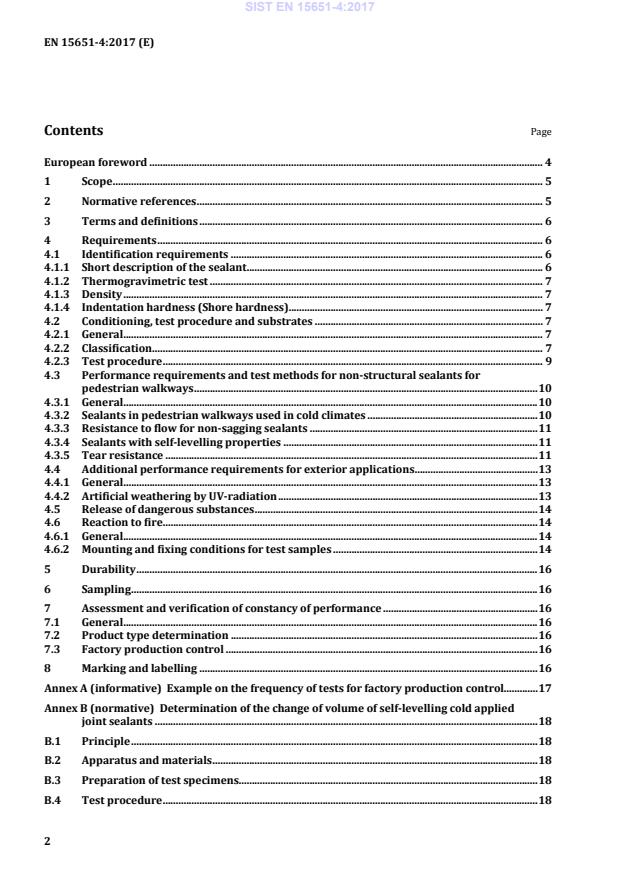
Example on the frequency of tests for factory production control. 17 Annex B (normative)
Determination of the change of volume of self-levelling cold applied joint sealants . 18 B.1 Principle . 18 B.2 Apparatus and materials . 18 B.3 Preparation of test specimens. 18 B.4 Test procedure . 18 SIST EN 15651-4:2017
Relationship of this European Standard with Regulation (EU) No.305/2011 . 20 ZA.1 Scope and relevant characteristics . 20 ZA.2 System of Assessment and Verification of Constancy of Performance (AVCP) . 21 ZA.3 Assignment of AVCP tasks . 21 Bibliography . 24
100 ±25 25,0 20 60 ±20 20,0 12,5 60 ±12,5 12,5 a For the correct interpretation and application of movement capability to the design of joints, relevant national standards and advisory documents should be considered. 4.2.2.3 Classification according to the secant tensile modulus Sealants of class 25 and class 20 are additionally sub-classified according to their secant tensile modulus (see EN ISO 6927 and EN ISO 11600): — low modulus: code LM; — high modulus: code HM. If the evaluated secant tensile modulus value exceeds the values specified below for either or both temperatures, the sealant shall be classified as high modulus. Specified values (see Tables 2 and 3, second column) are as follows: — 0,4 N/mm2 at + 23 °C; — 0,6 N/mm2 at - 20 °C. The secant modulus shall be the mean value of the three measured values. Round the mean value to one decimal place. EXAMPLE: Measured values 0,43 N/mm2 0,40 N/mm2 0,46 N/mm2 and mean value 0,43 N/mm2. Reported value0,4 N/mm2 . Substrates to be used in all mechanical tests concerned are; mortar M1 or M2 according to ISO 13640 and/or other substrates. SIST EN 15651-4:2017
Test method Classes of non-structural sealants for pedestrian walkways elements 25LM 25HM 20LM 20HM 12,5E Elongation a EN ISO 7389 EN ISO 8339 EN ISO 8340 EN ISO 10590 EN ISO 11431 100 % 100 % 60 % 60 % 60 % Amplitude EN ISO 9047 ±25 % ±25 % ±20 % ±20 % ±12,5 % a The value of elongation is given as a percentage of the original width:
elongation % = [(final width – original width) / (original width)] x 100 % Substrates to be used in all mechanical tests concerned shall be mortar M1 or M2 and/or anodised aluminium and/or glass, according to ISO 13640. SIST EN 15651-4:2017
· 70
· 70
· 60
· 60
· 40 EN ISO 7389 Tensile properties secant modulus at (23 ± 2) °C (MPa) at (- 20 ± 2) °C (MPa)
¶ 0,4 and
¶ 0,6 > 0,4 or > 0,6
¶ 0,4 and
¶ 0,6 > 0,4 or > 0,6
EN ISO 8339
Tensile properties at maintained extension a NF NF NF NF NF EN ISO 8340 Adhesion/cohesion properties at variable temperatures NF NF NF NF NF EN ISO 9047 Adhesion/cohesion properties at maintained extension after water immersion NF NF NF NF NF EN ISO 10590 Loss of volume non sagging sealant (%)
¶ 10 %
¶ 10 %
¶ 10 %
¶ 10 %
¶ 15 % EN ISO 10563
Loss of volume self-levelling sealants (%)
¶ 10 %
¶ 10 %
¶ 10 %
¶ 10 %
¶ 15 % Adapted EN ISO 10563 See Annex B Resistance to flow for non-sagging sealants (mm)
¶ 3
¶ 3
¶ 3
¶ 3
¶ 5 EN ISO 7390 Sealants with self-levelling properties declared value declared value declared value declared value declared value EN 14187–3 Tear resistance NF NF NF NF NF EN ISO 8340 Modified, see 4.3.5 NF = No Failure a .For exterior use, secant modulus has to be recorded during the EN ISO 8340 test. 4.3.2 Sealants in pedestrian walkways used in cold climates 4.3.2.1 General This test has been developed to demonstrate that elastic sealants for exterior use perform well at lower temperatures than those currently tested at in EN ISO 11600 (e.g. common winter temperatures in Northern Europe). The specific intention is to ensure that the sealant continues to perform at - 30 °C, which is a common winter temperature in cold climate areas. In addition to the requirements given in Table 3, elastic non-structural for sealants in pedes
...