


EN 15651-3:2017
(Main)Sealants for non-structural use in joints in buildings and pedestrian walkways - Part 3: Sealants for sanitary joints
Sealants for non-structural use in joints in buildings and pedestrian walkways - Part 3: Sealants for sanitary joints
This European Standard specifies definitions and requirements for sealants used for sealing of joints applied in sanitary areas in the interior of buildings exposed to non-pressurized water.
It covers joints in:
- bathrooms;
- toilets;
- showers;
- domestic kitchens;
- prefabricated elements in sanitary areas (e.g. shower cubicles).
Industrial, drinking water, underwater (swimming pools, sewage systems, etc.), food contact applications and sealing of glass-ceramic cooktop panels (stove tops, ceramic hobs) are excluded from the scope.
This European Standard does not provide criteria or recommendations for the design of joints and installation of sealants in sanitary applications.
NOTE Provisions on assessment and verification of constancy of performance - AVCP (i.e. Product type determination and Factory Production Control) and marking of these products are given in EN 15651-5.
This European Standard does not apply to non-structural sealants in any of non-paste form, to those used in sanitary joints and to oil-based mastics.
Fugendichtstoffe für nicht tragende Anwendungen in Gebäuden und Fußgängerwegen - Teil 3: Dichtstoffe für Fugen im Sanitärbereich
Diese Europäische Norm legt Definitionen für und Anforderungen an Dichtstoffe zum Abdichten von Fugen im Sanitärbereich im Innern von Gebäuden fest, die keinem Druckwasser ausgesetzt sind.
Erfasst werden Fugen in:
- Badezimmern;
- Toiletten;
- Duschen;
- Küchen in Haushalte;
- vorgefertigen Elementen in Sanitärbereichen (z. B. Duschkabinen).
Anwendungen für Brauch- und Trinkwasser, Unterwasser-Anwendungen (Schwimmbäder, Abwassersysteme usw.), Anwendungen mit Nahrungsmittelkontakt und Fugen in Glaskeramikkochfeldern fallen nicht in den Anwendungsbereich dieser Norm.
Diese Europäische Norm legt keine Kriterien oder Empfehlungen für die Ausführung der Fugen und den Einbau der Fugendichtstoffe für Anwendungen im Sanitärbereich fest.
ANMERKUNG Festlegungen zur Bewertung und Überprüfung der Leistungsbeständigkeit - AVCP (d. h. zur Bestimmung des Produkttyps sowie zur werkseigenen Produktionskontrolle) und zur Kennzeichnung dieser Produkte werden in EN 15651-5 angegeben.
Diese Europäische Norm gilt weder für nicht plastische (nicht in pastöser Form vorliegende) Fugendichtstoffe für nicht tragende Anwendungen, noch für Fugendichtstoffe, die im Sanitärbereich angewendet werden, noch für Mastixharze auf Ölbasis.
Mastics pour joints pour des usages non structuraux dans les constructions immobilières et pour chemins piétonniers - Partie 3 : Mastics sanitaires
La présente Norme européenne spécifie les définitions et les exigences relatives aux mastics utilisés pour calfeutrer des joints exposés à une eau n'étant pas sous pression dans les zones sanitaires à l'intérieur des bâtiments.
Elle traite des joints dans :
— les salles de bain ;
— les toilettes ;
— les douches ;
— les cuisines domestiques ;
— les éléments préfabriqués dans les zones sanitaires (par exemple, cabines de douche).
Les applications industrielles liées à l'eau potable, sous l'eau (piscines, systèmes d'égout, etc.) ou impliquant un contact avec les aliments et le calfeutrement de surfaces de cuisson en vitrocéramique (tables de cuisson, plaque vitrocéramique) sont exclus du domaine d'application.
Cette Norme européenne ne fournit pas de critères ou de recommandations pour la conception des joints et la mise en œuvre des mastics dans les applications sanitaires.
NOTE Les dispositions concernant l'évaluation et la vérification de la constance des performances, ou EVCP, (à savoir la détermination du type de produit et le contrôle de la production en usine) et le marquage de ces produits sont données dans l'EN 15651-5.
La présente Norme européenne ne s'applique pas aux produits pour joints non structuraux sous une autre forme que pâteuse utilisés dans les joints sanitaires, ni aux mastics à base d'huile.
Tesnilne mase za nekonstrukcijske stike v stavbah in na površinah za pešce - 3. del: Tesnilne mase za stike v sanitarijah
Ta evropski standard določa definicije in zahteve za tesnilne mase, ki se uporabljajo za tesnjenje stikov na sanitarnih območjih znotraj stavb, ki so izpostavljena vodi, ki ni pod tlakom.
Zajema stike v:
– kopalnicah;
– straniščih;
– tuš kabinah;
– domačih kuhinjah;
– montažnih elementih na sanitarnih površinah (npr. tuš kabine).
Industrijska uporaba, uporaba s pitno vodo, podvodna uporaba (bazeni, kanalizacija itd.), uporaba s hrano in tesnjenje steklo-keramičnih kuhalnih plošč (štedilniki, keramične kuhalne plošče) ne spadajo na področje uporabe tega standarda.
Ta evropski standard ne podaja meril ali priporočil za projektiranje stikov in nameščanje tesnilnih mas pri sanitarni uporabi.
OPOMBA Določila o ocenjevanju in preverjanju stalnosti delovanja – AVCP (tj. določevanje tipa izdelka in kontrola proizvodnje v obratu) ter označevanju teh izdelkov so podana v standardu EN 15651-5.
Ta evropski standard se ne uporablja za nekonstrukcijske tesnilne mase, ki niso v obliki paste, tesnilne mase, ki se uporabljajo v sanitarnih stikih, ter kite na osnovi olja.
General Information
- Status
- Published
- Publication Date
- 14-Feb-2017
- Withdrawal Date
- 29-Nov-2018
- Technical Committee
- CEN/TC 349 - Sealants for joints in building construction
- Drafting Committee
- CEN/TC 349/WG 3 - Sealants for sanitary joints
- Current Stage
- 9093 - Decision to confirm - Review Enquiry
- Start Date
- 05-Jul-2023
- Completion Date
- 14-Apr-2025
Relations
- Effective Date
- 07-Oct-2015
Overview
EN 15651-3:2017 - published by CEN - is the European standard for sealants for sanitary joints used in interior sanitary areas exposed to non-pressurized water. It defines terminology, identification, test methods and performance requirements for non‑structural sealants applied in bathrooms, toilets, showers, domestic kitchens and prefabricated sanitary elements (e.g., shower cubicles). The standard excludes industrial/drinking-water, underwater (pools, sewage), food-contact uses and sealing of glass‑ceramic cooktops. It does not cover joint design or installation practice.
Key topics and technical requirements
- Scope and classification: Sealants for sanitary joints are covered as type “S” with performance classes (e.g., S1–S3 and XS1–XS3).
- Required tests and properties (referenced test methods are normative):
- Thermogravimetric analysis (EN ISO 11358) on uncured product - 35 °C to 900 °C at 10 °C/min in non‑oxidative conditions.
- Density determination by pycnometer (EN ISO 2811-1) at (23.0 ± 0.5) °C (50 cm3 pyknometer is typical).
- Indentation hardness (Shore) on cured sealant (EN ISO 868); at least three samples and five measurements per sample.
- Mechanical performance: tensile properties at maintained extension (EN ISO 8340), adhesion/cohesion at variable temperatures (EN ISO 9047), and after water immersion (EN ISO 10590 / EN ISO 10591). For S‑classes a minimum elongation after water immersion of 25 % is required.
- Change in mass and volume (EN ISO 10563).
- Resistance to flow (EN ISO 7390) measured with a vertical anodised‑aluminium profile; required limits differ by class (resistance to flow values are specified in the standard). Tests are performed at (50 ± 2) °C (50 % RH) and at (5 ± 2) °C.
- Evaluation of resistance to microorganisms (EN ISO 846) - growth intensity classification for sanitary environments.
- Conditioning and substrates: Method A or B conditioning must be used consistently across tests; substrates include glass and/or anodised aluminium (ISO 13640) or other sanitary materials.
- Conformity and marking: Provisions for AVCP (assessment and verification of constancy of performance), factory production control and marking are given in EN 15651-5.
Applications
- Specification and testing of bathroom and kitchen sealants: sanitary perimeter joints, shower edges, fittings interfaces, and prefabricated sanitary units.
- Material selection for interior, non‑pressurized wet areas where hygiene and resistance to microbial growth are important.
Who uses this standard
- Sealant manufacturers and R&D labs (product development and type testing)
- Architects, specifiers and purchasing professionals (product selection and procurement)
- Testing laboratories and certification bodies (performance verification)
- Building inspectors and quality managers (compliance checks)
Related standards
- EN 15651-5 (AVCP & marking)
- EN ISO 11358, EN ISO 2811-1, EN ISO 868, EN ISO 7390, EN ISO 8340, EN ISO 9047, EN ISO 10563, EN ISO 10590, EN ISO 10591, EN ISO 846
Keywords: EN 15651-3:2017, sealants for sanitary joints, non-structural sealants, bathroom sealant standards, CEN, resistance to flow, microbiological resistance, AVCP, factory production control.

Frequently Asked Questions
EN 15651-3:2017 is a standard published by the European Committee for Standardization (CEN). Its full title is "Sealants for non-structural use in joints in buildings and pedestrian walkways - Part 3: Sealants for sanitary joints". This standard covers: This European Standard specifies definitions and requirements for sealants used for sealing of joints applied in sanitary areas in the interior of buildings exposed to non-pressurized water. It covers joints in: - bathrooms; - toilets; - showers; - domestic kitchens; - prefabricated elements in sanitary areas (e.g. shower cubicles). Industrial, drinking water, underwater (swimming pools, sewage systems, etc.), food contact applications and sealing of glass-ceramic cooktop panels (stove tops, ceramic hobs) are excluded from the scope. This European Standard does not provide criteria or recommendations for the design of joints and installation of sealants in sanitary applications. NOTE Provisions on assessment and verification of constancy of performance - AVCP (i.e. Product type determination and Factory Production Control) and marking of these products are given in EN 15651-5. This European Standard does not apply to non-structural sealants in any of non-paste form, to those used in sanitary joints and to oil-based mastics.
This European Standard specifies definitions and requirements for sealants used for sealing of joints applied in sanitary areas in the interior of buildings exposed to non-pressurized water. It covers joints in: - bathrooms; - toilets; - showers; - domestic kitchens; - prefabricated elements in sanitary areas (e.g. shower cubicles). Industrial, drinking water, underwater (swimming pools, sewage systems, etc.), food contact applications and sealing of glass-ceramic cooktop panels (stove tops, ceramic hobs) are excluded from the scope. This European Standard does not provide criteria or recommendations for the design of joints and installation of sealants in sanitary applications. NOTE Provisions on assessment and verification of constancy of performance - AVCP (i.e. Product type determination and Factory Production Control) and marking of these products are given in EN 15651-5. This European Standard does not apply to non-structural sealants in any of non-paste form, to those used in sanitary joints and to oil-based mastics.
EN 15651-3:2017 is classified under the following ICS (International Classification for Standards) categories: 91.100.50 - Binders. Sealing materials. The ICS classification helps identify the subject area and facilitates finding related standards.
EN 15651-3:2017 has the following relationships with other standards: It is inter standard links to EN 15651-3:2012. Understanding these relationships helps ensure you are using the most current and applicable version of the standard.
EN 15651-3:2017 is associated with the following European legislation: EU Directives/Regulations: 305/2011; Standardization Mandates: M/474. When a standard is cited in the Official Journal of the European Union, products manufactured in conformity with it benefit from a presumption of conformity with the essential requirements of the corresponding EU directive or regulation.
You can purchase EN 15651-3:2017 directly from iTeh Standards. The document is available in PDF format and is delivered instantly after payment. Add the standard to your cart and complete the secure checkout process. iTeh Standards is an authorized distributor of CEN standards.
Standards Content (Sample)
2003-01.Slovenski inštitut za standardizacijo. Razmnoževanje celote ali delov tega standarda ni dovoljeno.Tesnilne mase za nekonstrukcijske stike v stavbah in na površinah za pešce - 3. del: Tesnilne mase za stike v sanitarijahFugendichtstoffe für nicht tragende Anwendungen in Gebäuden und Fußgängerwegen - Teil 3: Dichtstoffe für Fugen im SanitärbereichMastics pour joints pour des usages non structuraux dans les constructions immobilières et pour chemins piétonniers - Partie 3 : Mastics sanitairesSealants for non-structural use in joints in buildings and pedestrian walkways - Part 3: Sealants for sanitary joints91.140.70Sanitarne napraveSanitary installations91.100.50Veziva. Tesnilni materialiBinders. Sealing materialsICS:Ta slovenski standard je istoveten z:EN 15651-3:2017SIST EN 15651-3:2017en,fr,de01-april-2017SIST EN 15651-3:2017SLOVENSKI
STANDARDSIST EN 15651-3:20131DGRPHãþD
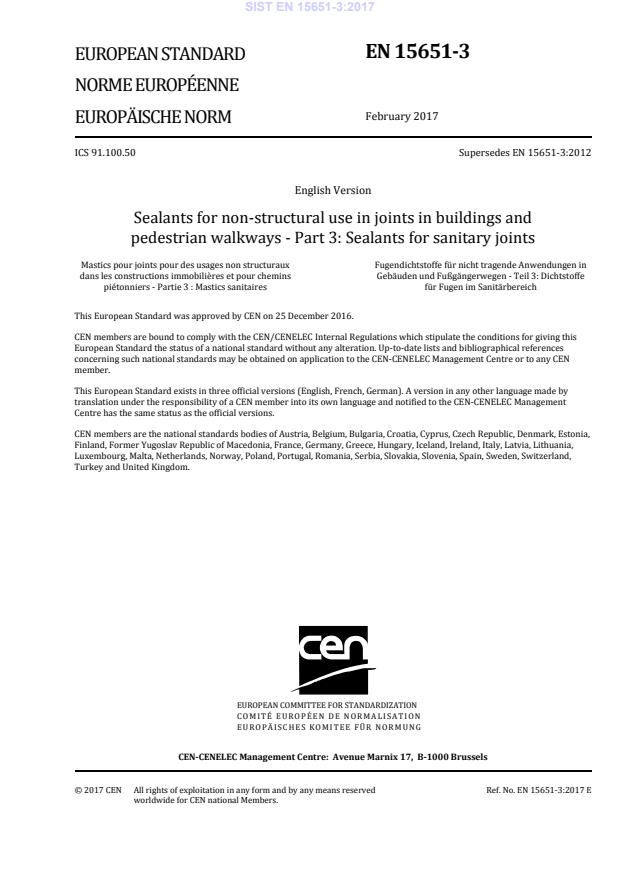
EUROPEAN STANDARD NORME EUROPÉENNE EUROPÄISCHE NORM
EN 15651-3
February
t r s y ICS
{ sä s r rä w r Supersedes EN
s w x w sæ uã t r s tEnglish Version
Sealants for nonæstructural use in joints in buildings and pedestrian walkways æ Part
uã Sealants for sanitary jointsMastics pour joints pour des usages non structuraux dans les constructions immobilières et pour chemins piétonniers æ Partie
u ã Mastics sanitaires
Fugendichtstoffe für nicht tragende Anwendungen in Gebäuden und Fußgängerwegen æ Teil
uã Dichtstoffe für Fugen im Sanitärbereich This European Standard was approved by CEN on
t w December
t r s xä
egulations which stipulate the conditions for giving this European Standard the status of a national standard without any alterationä Upætoædate lists and bibliographical references concerning such national standards may be obtained on application to the CENæCENELEC Management Centre or to any CEN memberä
translation under the responsibility of a CEN member into its own language and notified to the CENæCENELEC Management Centre has the same status as the official versionsä
CEN members are the national standards bodies of Austriaá Belgiumá Bulgariaá Croatiaá Cyprusá Czech Republicá Denmarká Estoniaá Finlandá Former Yugoslav Republic of Macedoniaá Franceá Germanyá Greeceá Hungaryá Icelandá Irelandá Italyá Latviaá Lithuaniaá Luxembourgá Maltaá Netherlandsá Norwayá Polandá Portugalá Romaniaá Serbiaá Slovakiaá Sloveniaá Spainá Swedená Switzerlandá Turkey and United Kingdomä
EUROPEAN COMMITTEE FOR STANDARDIZATION COMITÉ EUROPÉEN DE NORMALISATION EUROPÄISCHES KOMITEE FÜR NORMUNG
CEN-CENELEC Management Centre:
Avenue Marnix 17,
B-1000 Brussels
t r s y CEN All rights of exploitation in any form and by any means reserved worldwide for CEN national Membersä Refä Noä EN
s w x w sæ uã t r s y ESIST EN 15651-3:2017
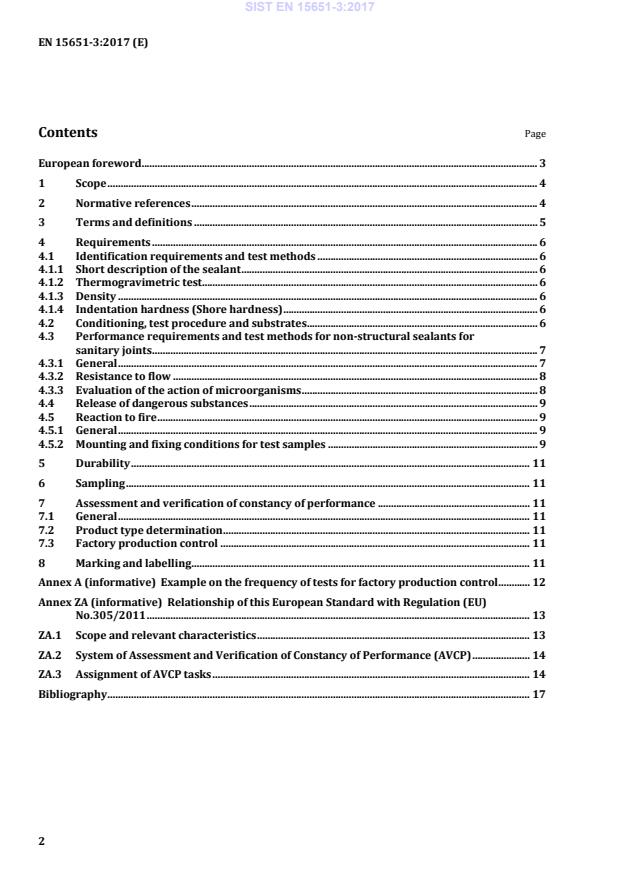
Example on the frequency of tests for factory production control . 12 Annex ZA (informative)
Relationship of this European Standard with Regulation (EU) No.305/2011 . 13 ZA.1 Scope and relevant characteristics . 13 ZA.2 System of Assessment and Verification of Constancy of Performance (AVCP) . 14 ZA.3 Assignment of AVCP tasks . 14 Bibliography . 17
EN 15651-3
...
SIST EN 15651-3:2017 표준은 비구조적 사용을 위한 실란트에 대한 명확한 정의와 요구사항을 제시하고 있습니다. 이 표준의 범위는 비압력 수에 노출되는 건물 내부의 위생 영역에서 적용되는 조인트 밀봉에 사용되는 실란트로 한정됩니다. 구체적으로, 이 표준은 욕실, 화장실, 샤워, 가정용 주방 및 위생 영역의 조립식 요소와 같은 다양한 환경에서의 사용을 다룹니다. 이 표준의 강점 중 하나는 구체적이고 포괄적인 요구사항을 통해 Sanitary Joint의 설계 및 설치 시 고려해야 할 사항들을 명확히 제시하지 않지만, 대신 실란트 사용의 안전성과 신뢰성을 보장하기 위한 기초 자료를 제공합니다. 다만, 산업용, 식수용, 수중 사용(수영장, 하수 시스템 등), 그리고 유리세라믹 조리버너판 밀봉과 같은 용도는 이 표준의 범위에서 제외됩니다. SIST EN 15651-3:2017은 비구조적 실란트에 대한 원칙을 이해하는데 필수적인 지침을 제공하며, 특정 제품의 성능 일관성을 평가하고 검증하는 조항(예: 제품 유형 결정 및 공장 생산 관리를 포괄하는 AVCP)은 EN 15651-5에서 제공됩니다. 또한, 비페이스트 형태의 비구조적 실란트와 오일 기반 마스틱에 대해서도 이 표준은 적용되지 않습니다. 이와 같은 특성은 이 표준이 위생 조인트에서 실란트를 사용할 때 필수적인 기준을 제공함으로써, 품질 높은 건축물과 인프라의 유지에 기여하는 중요한 역할을 함을 보여줍니다.
The standard EN 15651-3:2017 presents a comprehensive framework for sealants used in non-structural applications in sanitary areas within buildings. Its primary scope focuses on the definitions and performance requirements for sealants applied in environments such as bathrooms, toilets, showers, and domestic kitchens, specifically where exposure to non-pressurized water is a consideration. This inclusivity covers critical sanitary joints found in various building components, including prefabricated elements like shower cubicles. One of the notable strengths of this standard is its specificity in delineating the applicable environments for the sealants, thereby ensuring that users are aware of the contexts in which these materials can be effectively employed. By clearly excluding applications involving industrial uses, drinking water, and food contact, the standard provides clarity that enhances safety and compliance for users adhering to it. Moreover, while the standard delineates requirements, it notably does not prescribe the design or installation criteria for the joints, allowing for flexibility in approaches to meet unique project specifications without compromising on safety. This can be seen as both a strength and a limitation, as it promotes innovation while necessitating that users exercise their professional judgment in application. Additionally, it refers to the related standard EN 15651-5 regarding product type determination, factory production control, and marking requirements, thereby offering a complete guideline for manufacturers and users interested in comprehensively understanding the performance consistency and quality assurance of sealants used in sanitary conditions. In summary, EN 15651-3:2017 stands as a relevant and practical standard for the assessment and use of sealants in non-structural joints in sanitary applications within buildings. Its emphasis on specified applications, exclusion of non-relevant contexts, and guidance on performance assurance highlights its significance in both construction and maintenance of sanitary facilities in residential and similar environments.
Die EN 15651-3:2017 ist eine bedeutende europäische Norm, die sich auf Dichtstoffe für den nicht strukturellen Einsatz in Fugen in Gebäuden und Fußgängerbereichen konzentriert, insbesondere für sanitäre Fugen. Der Geltungsbereich der Norm ist klar definiert und umfasst die spezifischen Anforderungen und Definitionen für Dichtstoffe, die in sanitären Bereichen innerhalb von Gebäuden verwendet werden, die nicht unter Druck stehen und mit Wasser in Kontakt kommen. Ein herausragendes Merkmal dieser Norm ist ihre präzise Fokussierung auf spezifische Anwendungen wie Badezimmer, Toiletten, Duschen und Küchen. Auch vorgefertigte Elemente in sanitären Bereichen, wie z.B. Duschkabinen, sind in den Geltungsbereich eingeschlossen. Dadurch bietet die Norm eine wertvolle Grundlage für Hersteller und Anwender, um sicherzustellen, dass die verwendeten Dichtstoffe den notwendigen Anforderungen für sanitäre Anwendungen gerecht werden. Die Stärken der EN 15651-3:2017 liegen in ihrer Klarheit und Relevanz für die Bauindustrie. Sie bietet eine zentrale Anlaufstelle für die Standardisierung von Dichtstoffen in sanitären Bereichen, wodurch die Qualität und Sicherheit in der Anwendung gefördert wird. Es ist wichtig zu beachten, dass die Norm ausdrücklich industrielle Anwendungen, Trinkwasser, Unterwasseranwendungen sowie Lebensmittelkontaktanwendungen von ihrem Geltungsbereich ausschließt, was zur Klarheit und zur spezifischen Ausrichtung auf die relevanten Anwendungsgebiete beiträgt. Die Norm legt hingegen keine Kriterien oder Empfehlungen für die Gestaltung und Installation von Fugen und Dichtstoffen in sanitären Anwendungen fest. Dies könnte für einige Anwender eine Einschränkung darstellen, da sie keine umfassenden Anleitungen zur praktischen Umsetzung bietet. Dennoch ist die Norm von grundlegender Bedeutung, da sie den Rahmen für die Leistungsbewertung und -verifizierung von Dichtstoffen in diesen speziellen Anwendungen absteckt. Insgesamt stellt die EN 15651-3:2017 eine zentrale Europäische Norm dar, die die Qualität und Verwendbarkeit von Dichtstoffen für sanitäre Fugen sicherstellt. Ihre klare Abgrenzung und Definition von Anwendungsbereichen macht sie zu einem unverzichtbaren Referenzdokument für alle Beteiligten in der Bau- und Sanitärindustrie.
標準EN 15651-3:2017は、建物の内部における非構造用接合部および歩行者用通路で使用されるシーラントに関する重要な基準です。この文書は、特に衛生関連のエリアで使用されるシーラントの定義と要件を具体的に示しています。例えば、浴室、トイレ、シャワー、家庭用キッチン、プレハブ要素などの衛生エリアに適用される接合部に焦点を当てています。 この標準の強みは、規定された使用範囲の明確さと、非加圧水にさらされる内部の衛生エリアにおけるシーラントの特性を強調している点にあります。特に、標準は衛生的な用途において安全で効果的なシーラントを選ぶための指針を提供することで、品質や耐久性の観点からも重要です。 また、EN 15651-3:2017は、シーリング用途のデザインやシーラントの取り付けに関する具体的な基準を設けていないことにも言及されていますが、これは使用者が必要に応じて他の基準や専門家の意見を考慮することを促すものと解釈できます。さらに、工業用、飲料水、さらにはグラスセラミック調理パネルのシーリングには適用されないため、特定の用途に特化した基準を提供している点も評価に値します。 このように、EN 15651-3:2017は、衛生エリアにおけるシーラントの基準としての重要性があり、それに伴うさまざまな使用条件に対する具体的な情報を示しています。この標準を遵守することで、シーラントが持つべき性能を確保できるだけでなく、建築物の衛生条件を維持し、最適な環境を提供する手助けとなります。
La norme EN 15651-3:2017 est un document essentiel qui définit les exigences et les spécifications pour les mastics destinés à l’étanchéité des joints dans les zones sanitaires à l'intérieur des bâtiments. Son champ d'application est clairement défini, se concentrant sur des applications non-pressurisées, incluant les joints dans les salles de bains, les toilettes, les douches, les cuisines domestiques et les éléments préfabriqués dans ces espaces. Une des forces notables de cette norme est sa capacité à standardiser l'utilisation de mastics spécifiques, garantissant ainsi une meilleure performance et durabilité des joints exposés à l’eau, ce qui est crucial dans un environnement sanitaire. Cependant, la norme exclut les applications industrielles, la contact avec l'eau potable, les systèmes sous-marins tels que les piscines et les systèmes d'égouts, ainsi que l'utilisation avec des panneaux de cuisson en céramique vitrocéramique. Ceci souligne son aspect ciblé et pertinent pour des usages domestiques, tout en précisant les limites et le contexte dans lequel elle doit être appliquée. Ce cadre de référence permet aux professionnels du secteur de mieux comprendre la pertinence des choix de produits d'étanchéité en fonction de leurs besoins spécifiques. Il est aussi à noter que la norme ne fournit pas de critères pour la conception des joints ni pour l'installation des mastics dans les applications sanitaires, ce qui peut nécessiter une consultation complémentaire pour les praticiens cherchant à optimiser leurs produits. En outre, des indications sur l’évaluation et la vérification de la constance de performance sont référencées sous EN 15651-5, ce qui complète la compréhension de l'approbation et de l’utilisation de ces produits. Dans l'ensemble, la norme SIST EN 15651-3:2017 s'affirme comme un document clé pour garantir la qualité et la sécurité des joints sanitaires, tout en en délimitant clairement l'utilisation pour des applications spécifiques, répondant ainsi aux exigences du marché et aux attentes des utilisateurs dans le domaine de la construction.
Questions, Comments and Discussion
Ask us and Technical Secretary will try to provide an answer. You can facilitate discussion about the standard in here.
Loading comments...