

prEN 197-1
(Main)Cement - Part 1: Common cement - Performance assessment and declaration
- Abstract
This document covers calcium silicate cement (common cement) intended to be used:
- for the preparation of concrete, mortar, grout, and other mixes for construction and for the manufacture of construction products including structural and non-structural products, including white cement;
- for the preparation of mortar for bricklaying, blocklaying, rendering and plastering, including white cement;
- for the preparation of adhesives for other construction products;
- for soil stabilization or improvement, road bases and sub-bases, and capping layers.
Calcium aluminate cement, supersulfated cement, very low heat cement and alkali activated binder as well as masonry cement exclusively manufactured for the preparation of mortar for bricklaying, rendering and plastering are excluded from this product definition.
NOTE 1 Calcium silicate cements with an intended use as defined in this document belong to the product category "common cement".
The product definition of common cement covers the following combination of constituents expressed in percentage as mass, any other combination is outside the product definition:
a) primary cement (minimum of 95 % clinker);
NOTE 2 This refers to the designation code CEM I.
b) binary cements with clinker and a maximum of 95 % of blast furnace slag;
NOTE 3 This refers to the designation codes CEM II/A-S, CEM II/B-S, CEM III/A, CEM III/B, CEM III/C.
c) binary cements with clinker and a maximum of 10 % of silica fume;
NOTE 4 This refers to the designation code CEM II/A-D.
d) binary cements with clinker and a maximum of 35 % of one of the following constituents: natural pozzolana, natural activated pozzolana, fly ash, coal bottom ash, burnt shale, limestone or recycled concrete fines;
NOTE 5 This refers to the designation codes CEM II/A-P, CEM II/B-P, CEM II/A-Q, CEM II/B-Q, CEM II/A-V, CEM II/B-V, CEM II/A-W, CEM II/B-W, CEM II/A-Z, CEM II/B-Z, CEM II/A-T, CEM II/B-T, CEM II/A-F, CEM II/B-F, CEM II/A-L, CEM II/B-L, CEM II/A-LL, CEM II/B-LL.
e) pozzolanic cements with clinker and a maximum of 55 % of a combination of silica fume, natural pozzolana, natural activated pozzolana, fly ash and coal bottom ash with a maximum of 10 % silica fume;
NOTE 6 This refers to the designation codes CEM IV/A, CEM IV/B.
f) composite cement with a minimum of 50 % of clinker, a maximum of 29 % of recycled concrete fines and a maximum of 44 % of any combination of blast furnace slag, silica fume, natural pozzolana, natural activated pozzolana, fly ash, coal bottom ash, burn shale and limestone with a maximum of 10 % silica fume and a maximum of 35 % of the aggregation of limestone and recycled concrete fines;
NOTE 7 This refers to the designation codes CEM II/A-M, CEM II/B-M, CEM II/C-M (containing recycled concrete fines and other allowed constituents).
g) composite cement with a minimum of 50% of clinker and a maximum of 50% of any combination of blast furnace slag, silica fume, natural pozzolana, natural activated pozzolana, fly ash, coal bottom ash, burnt shale, limestone and recycled concrete fines with a maximum of 10% of silica fume, a maximum of 20% of recycled concrete fines, and a maximum of 35% of any combination of limestone and recycled concrete fines;
NOTE 8 This refers to the designation codes CEM II/A-M, CEM II/B-M, CEM II/C-M (containing allowed constituents).
h) composite cements with a minimum of 20 % of clinker, a maximum of 49 % of blast furnace slag and a maximum of 49 % of a combination of natural pozzolana, natural activated pozzolana, siliceous fly ash and coal bottom ash;
NOTE 9 This refers to the designation codes CEM V/A, CEM V/B.
i) composite cements with a minimum of 35 % clinker, a maximum of 59% of blast furnace slag and a maximum of 20 % of natural pozzolana, natural activated pozzolana, siliceous fly ash, coal bottom ash, limestone or recycled concrete fines;
...
- Status
- Not Published
- Publication Date
- 07-Sep-2027
- Technical Committee
- CEN/TC 51 - Cement and building limes
- Drafting Committee
- CEN/TC 51/WG 6 - Definitions and terminology of cement
- Current Stage
- 4060 - Closure of enquiry - Enquiry
- Start Date
- 01-Oct-2026
- Due Date
- 19-Aug-2026
- Completion Date
- 01-Oct-2026

prEN 197-1 is the CEN draft European Standard for common cement. It sets the product definition, the performance characteristics to be declared, and the assessment and verification process used to show constancy of performance and conformity. The standard is aimed at cement used for concrete, mortar, grout, adhesives, and soil stabilization or road layers.
What does prEN 197-1 specify?
prEN 197-1 specifies calcium silicate cement, called common cement, and the way its performance is assessed and declared. In practice, it tells a manufacturer what combinations of constituents belong to the product family, which characteristics must be tested, and how the cement is identified and documented.
The scope covers common cement intended for concrete, mortar, grout, other construction mixes, construction products, masonry mortar, adhesives for other construction products, and soil stabilization, road bases and sub-bases, and capping layers. It excludes calcium aluminate cement, supersulfated cement, very low heat cement, alkali activated binder, and masonry cement made only for bricklaying, rendering and plastering mortar.
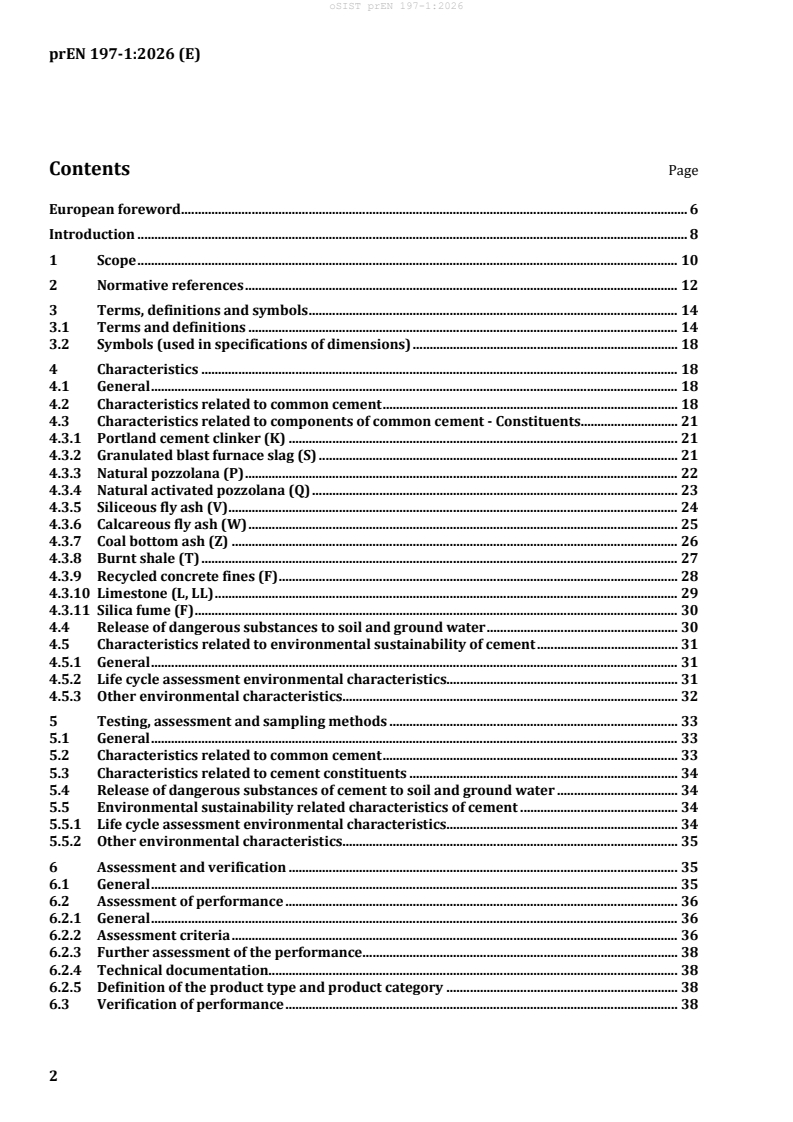
The document is organized into clauses on scope, normative references, terms and definitions, characteristics, testing and sampling methods, assessment and verification, guidance for product information and safety information, and marking, labelling and packaging. It is followed by normative Annexes A to D, Annex E on specimen preparation for release of dangerous substances, informative Annex F with designation examples, and informative Annex ZA linking the standard to Regulation (EU) 2024/3110.
| Annex | What it covers |
|---|---|
| Annex A | Minor additional constituents, calcium sulfate and additives |
| Annex B | Implementation of assessment and verification, including FPC, autocontrol testing, inspections, surveillance and non-conformity actions |
| Annex C | Statistical criteria and assessment procedure |
| Annex D | Representativeness and accuracy of standard compressive strength - 28 days test results |
| Annex E | Test specimen format, size and preparation for release of dangerous substances |
| Annex F | Examples of cement designation |
| Annex ZA | Relationship with Regulation (EU) 2024/3110, DoPC, CE marking and AVS tasks |
What are the key requirements of prEN 197-1?
prEN 197-1 requires common cement to fit a defined product family and to meet declared performance values that are checked by specified methods. The practical effect is that producers must control composition, test results, and factory production control together, not as separate activities.
Product definition and permitted constituents
prEN 197-1 defines common cement as a calcium silicate cement family and lists the permitted combinations of clinker and other constituents. The scope includes primary cement, binary cements, pozzolanic cements, composite cements, and cements with recycled concrete fines in the allowed combinations.
The document also allows minor additional constituents up to 5% by mass, calcium sulfate to control setting, and additives up to 1.0% by mass. Annex A adds that organic additives are limited on a dry basis and that the added materials must not harm workability, durability, or reinforcement protection. For a buyer or quality manager, this means the designation alone is not enough - the composition behind it must still stay inside the permitted family.
Performance characteristics to be declared
Clause 4.2 and Table 2 specify the main characteristics for common cement. These include compressive strength at different ages, setting time, loss on ignition, soundness, heat of hydration, pozzolanicity, insoluble residue, sulfate and chloride content, total and effective alkali content, clinker phase contents, magnesium oxide, aluminium oxide, sulfur as sulfide ions, calcium oxide, and sulfate resistance.
The standard also uses performance classes for compressive strength, including minimum and maximum 28-day classes and minimum early-strength classes. In practice, the manufacturer must declare the class that matches the tested performance and use the corresponding strength designation in the product identification.
Testing and sampling
Clause 5 requires spot samples to be taken in accordance with EN 196-7. The reference method for each characteristic is given in the standard, and only results from the reference method are declared. Alternative methods may be used only if they are calibrated against the reference method or recognized reference materials and are at least as conservative.
For common cement, inspection by variables applies to minimum strength at 2, 7 and 28 days and maximum strength at 28 days. Inspection by attributes applies to the other characteristics. That matters because the statistical treatment is different: strength is assessed as a distribution, while most other properties are checked against pass-fail limits.
Dangerous substances and environmental sustainability
Clause 4.4 and 5.4 cover release of dangerous substances to soil and ground water. The standard requires leaching tests using EN 16637-2, with specimen preparation in Annex E, analysis of leachates by EN 17195 and EN 17332, and asbestos determination by CEN/TS 18020. The result is expressed as cumulative release, which is the form needed for product declaration and environmental assessment.
Clause 4.5 and 6.4 cover environmental sustainability characteristics. Where these are declared, the assessment must be validated against EN 15804 and EN 16908 together with the standard’s own provisions. For a manufacturer, this means the environmental declaration is not just a calculation - it needs documented inputs, modelling choices, and validation of the process.
Assessment, verification, and factory production control
Clause 6 and Annex B set out the assessment and verification system (AVS), factory production control (FPC), autocontrol testing, inspection, surveillance, and audit-testing. Annex B requires documented FPC, regular calibration of equipment, traceable sampling and testing, initial inspection of new plants, and continuing surveillance at least once per year.
The initial period starts after the first certificate or the first dispatch, lasts three months, and doubles the minimum sampling and control frequency. Annex B also requires random audit samples, separate handling of non-conformity, and a certificate of constancy of performance and conformity when the criteria are met. In practice, this is the backbone of market surveillance and certification.
Product information and marking
Clause 7 gives guidance for general product information, instructions for use and safety information. Clause 8 requires the cement to be accompanied by documentation and to be marked with the designation codes. Annex ZA adds the DoPC, CE marking and the tasks assigned to manufacturers, notified bodies and product certification bodies under Regulation (EU) 2024/3110.
What terms does prEN 197-1 define?
- Assessment and verification system (AVS) - The system used to check performance, factory control and conformity for common cement.
- Reactive calcium oxide (CaO) - The fraction of calcium oxide that can take part in normal hardening reactions.
- Reactive silicon dioxide (SiO) - The fraction of silicon dioxide that becomes soluble after the specified acid and alkali treatment.
- Autocontrol testing - Further testing of spot samples taken at the manufacturing plant or depot under the prescribed test plan.
- Control period - The production and dispatch period used to evaluate autocontrol test results.
- Initial period - The immediate period after the first certificate or first dispatch of a cement.
- Product group - A set of products from the same manufacturer for which one assessment result can apply to the others for the relevant characteristics.
Who uses prEN 197-1?
prEN 197-1 is used by cement manufacturers, plant quality managers, laboratory staff, product certification bodies and notified bodies. They use it to define a cement type, choose the correct test methods, run factory production control, and support certification and market declarations.
It is also relevant to distributors and importers who handle autocontrol testing in Annex B, and to buyers, engineers and specifiers who need to select a cement suitable for concrete, mortar, grout, adhesives, or soil stabilization work. In practice, it is the standard that links cement composition, test evidence, and product declaration.
What changed in prEN 197-1 from the previous edition?
prEN 197-1 supersedes EN 197-1:2011. The introduction states that the previous strength classes will no longer be used because they were partly overlapping.
Instead, the standard defines new classes for minimum standard compressive strength at 28 days, maximum standard compressive strength at 28 days, minimum early compressive strength at 2 days, and minimum early compressive strength at 7 days. The previous strength designations remain part of the common cement designation code so that familiar product names can still be used.
Which standards are used with prEN 197-1?
| Reference | What it contributes |
|---|---|
| EN 196-1 | Strength testing of cement |
| EN 196-2 | Chemical analysis of cement |
| EN 196-3 | Setting time and soundness |
| EN 196-5 | Pozzolanicity test |
| EN 196-6 | Fineness |
| EN 196-7 | Sampling and preparation of cement samples |
| EN 196-9 | Heat of hydration, semi-adiabatic method |
| EN 196-12 | Reactivity of cement constituents, including heat of hydration and bound water content methods |
| EN 196-13 | Effective alkali content |
| EN 196-14 | Clinker and cement phase determination |
| EN 196-15 / EN 196-16 | Sulfate resistance by flat prism and square prism methods |
| EN 196-17 | Glass content of granulated blast furnace slag |
| EN 196-18 | Whiteness or colour of cement and clinker |
| EN 206-1 | Concrete performance requirements and conformity criteria |
| EN 450-1 / EN 451-1 | Fly ash definition and free calcium oxide test |
| EN 933-9 | Clay content of fines by methylene blue test |
| EN 934-1 to EN 934-7 | Admixture requirements, conformity and sampling rules |
| EN 12390-2 | Preparation and curing of concrete specimens |
| EN 13639 | Total organic carbon in limestone |
| EN 15804 | Core rules for environmental product declarations |
| EN 16637-2 | Leaching test for construction products |
| EN 16908 | Cement and building lime product category rules for environmental declarations |
| EN 17195 / EN 17332 | Analysis of inorganic and organic substances in eluates |
| ISO 2854 | Statistical interpretation of data |
| ISO 9277 | Specific surface area by gas adsorption |
| ISO 9286 | Chemical analysis of silicon carbide |
| ISO 10694 | Organic and total carbon in soil by dry combustion |
| CEN/TS 18020 | Sampling and quantitative determination of asbestos in construction products |
What does the prEN 197-1 document contain?
prEN 197-1 contains the tables and procedures that support product declaration and verification. These include the characteristic tables for common cement and its constituents, the leaching characteristics, the environmental sustainability characteristics, the performance class table, and the audit-testing table.
It also contains the statistical formulas and criteria in Annex C, the comparison procedure for 28-day compressive strength data in Annex D, the specimen preparation rules in Annex E, and designation examples in Annex F. Annex B adds the practical certification flow, inspection rules, FPC checks, non-conformity actions and the procedure for issuing a certificate of constancy of performance and conformity.
Relations
- Effective Date
- 09-Jul-2025
Get Certified
Connect with accredited certification bodies for this standard

DIBt (Deutsches Institut für Bautechnik)
German Institute for Building Technology.
DIN CERTCO
DIN Group product certification.

Aboma Certification B.V.
Specialized in construction, metal, and transport sectors.
Sponsored listings
Frequently Asked Questions
prEN 197-1 is a draft published by the European Committee for Standardization (CEN). Its full title is "Cement - Part 1: Common cement - Performance assessment and declaration". This standard covers: This document covers calcium silicate cement (common cement) intended to be used: - for the preparation of concrete, mortar, grout, and other mixes for construction and for the manufacture of construction products including structural and non-structural products, including white cement; - for the preparation of mortar for bricklaying, blocklaying, rendering and plastering, including white cement; - for the preparation of adhesives for other construction products; - for soil stabilization or improvement, road bases and sub-bases, and capping layers. Calcium aluminate cement, supersulfated cement, very low heat cement and alkali activated binder as well as masonry cement exclusively manufactured for the preparation of mortar for bricklaying, rendering and plastering are excluded from this product definition. NOTE 1 Calcium silicate cements with an intended use as defined in this document belong to the product category "common cement". The product definition of common cement covers the following combination of constituents expressed in percentage as mass, any other combination is outside the product definition: a) primary cement (minimum of 95 % clinker); NOTE 2 This refers to the designation code CEM I. b) binary cements with clinker and a maximum of 95 % of blast furnace slag; NOTE 3 This refers to the designation codes CEM II/A-S, CEM II/B-S, CEM III/A, CEM III/B, CEM III/C. c) binary cements with clinker and a maximum of 10 % of silica fume; NOTE 4 This refers to the designation code CEM II/A-D. d) binary cements with clinker and a maximum of 35 % of one of the following constituents: natural pozzolana, natural activated pozzolana, fly ash, coal bottom ash, burnt shale, limestone or recycled concrete fines; NOTE 5 This refers to the designation codes CEM II/A-P, CEM II/B-P, CEM II/A-Q, CEM II/B-Q, CEM II/A-V, CEM II/B-V, CEM II/A-W, CEM II/B-W, CEM II/A-Z, CEM II/B-Z, CEM II/A-T, CEM II/B-T, CEM II/A-F, CEM II/B-F, CEM II/A-L, CEM II/B-L, CEM II/A-LL, CEM II/B-LL. e) pozzolanic cements with clinker and a maximum of 55 % of a combination of silica fume, natural pozzolana, natural activated pozzolana, fly ash and coal bottom ash with a maximum of 10 % silica fume; NOTE 6 This refers to the designation codes CEM IV/A, CEM IV/B. f) composite cement with a minimum of 50 % of clinker, a maximum of 29 % of recycled concrete fines and a maximum of 44 % of any combination of blast furnace slag, silica fume, natural pozzolana, natural activated pozzolana, fly ash, coal bottom ash, burn shale and limestone with a maximum of 10 % silica fume and a maximum of 35 % of the aggregation of limestone and recycled concrete fines; NOTE 7 This refers to the designation codes CEM II/A-M, CEM II/B-M, CEM II/C-M (containing recycled concrete fines and other allowed constituents). g) composite cement with a minimum of 50% of clinker and a maximum of 50% of any combination of blast furnace slag, silica fume, natural pozzolana, natural activated pozzolana, fly ash, coal bottom ash, burnt shale, limestone and recycled concrete fines with a maximum of 10% of silica fume, a maximum of 20% of recycled concrete fines, and a maximum of 35% of any combination of limestone and recycled concrete fines; NOTE 8 This refers to the designation codes CEM II/A-M, CEM II/B-M, CEM II/C-M (containing allowed constituents). h) composite cements with a minimum of 20 % of clinker, a maximum of 49 % of blast furnace slag and a maximum of 49 % of a combination of natural pozzolana, natural activated pozzolana, siliceous fly ash and coal bottom ash; NOTE 9 This refers to the designation codes CEM V/A, CEM V/B. i) composite cements with a minimum of 35 % clinker, a maximum of 59% of blast furnace slag and a maximum of 20 % of natural pozzolana, natural activated pozzolana, siliceous fly ash, coal bottom ash, limestone or recycled concrete fines; ...
This document covers calcium silicate cement (common cement) intended to be used: - for the preparation of concrete, mortar, grout, and other mixes for construction and for the manufacture of construction products including structural and non-structural products, including white cement; - for the preparation of mortar for bricklaying, blocklaying, rendering and plastering, including white cement; - for the preparation of adhesives for other construction products; - for soil stabilization or improvement, road bases and sub-bases, and capping layers. Calcium aluminate cement, supersulfated cement, very low heat cement and alkali activated binder as well as masonry cement exclusively manufactured for the preparation of mortar for bricklaying, rendering and plastering are excluded from this product definition. NOTE 1 Calcium silicate cements with an intended use as defined in this document belong to the product category "common cement". The product definition of common cement covers the following combination of constituents expressed in percentage as mass, any other combination is outside the product definition: a) primary cement (minimum of 95 % clinker); NOTE 2 This refers to the designation code CEM I. b) binary cements with clinker and a maximum of 95 % of blast furnace slag; NOTE 3 This refers to the designation codes CEM II/A-S, CEM II/B-S, CEM III/A, CEM III/B, CEM III/C. c) binary cements with clinker and a maximum of 10 % of silica fume; NOTE 4 This refers to the designation code CEM II/A-D. d) binary cements with clinker and a maximum of 35 % of one of the following constituents: natural pozzolana, natural activated pozzolana, fly ash, coal bottom ash, burnt shale, limestone or recycled concrete fines; NOTE 5 This refers to the designation codes CEM II/A-P, CEM II/B-P, CEM II/A-Q, CEM II/B-Q, CEM II/A-V, CEM II/B-V, CEM II/A-W, CEM II/B-W, CEM II/A-Z, CEM II/B-Z, CEM II/A-T, CEM II/B-T, CEM II/A-F, CEM II/B-F, CEM II/A-L, CEM II/B-L, CEM II/A-LL, CEM II/B-LL. e) pozzolanic cements with clinker and a maximum of 55 % of a combination of silica fume, natural pozzolana, natural activated pozzolana, fly ash and coal bottom ash with a maximum of 10 % silica fume; NOTE 6 This refers to the designation codes CEM IV/A, CEM IV/B. f) composite cement with a minimum of 50 % of clinker, a maximum of 29 % of recycled concrete fines and a maximum of 44 % of any combination of blast furnace slag, silica fume, natural pozzolana, natural activated pozzolana, fly ash, coal bottom ash, burn shale and limestone with a maximum of 10 % silica fume and a maximum of 35 % of the aggregation of limestone and recycled concrete fines; NOTE 7 This refers to the designation codes CEM II/A-M, CEM II/B-M, CEM II/C-M (containing recycled concrete fines and other allowed constituents). g) composite cement with a minimum of 50% of clinker and a maximum of 50% of any combination of blast furnace slag, silica fume, natural pozzolana, natural activated pozzolana, fly ash, coal bottom ash, burnt shale, limestone and recycled concrete fines with a maximum of 10% of silica fume, a maximum of 20% of recycled concrete fines, and a maximum of 35% of any combination of limestone and recycled concrete fines; NOTE 8 This refers to the designation codes CEM II/A-M, CEM II/B-M, CEM II/C-M (containing allowed constituents). h) composite cements with a minimum of 20 % of clinker, a maximum of 49 % of blast furnace slag and a maximum of 49 % of a combination of natural pozzolana, natural activated pozzolana, siliceous fly ash and coal bottom ash; NOTE 9 This refers to the designation codes CEM V/A, CEM V/B. i) composite cements with a minimum of 35 % clinker, a maximum of 59% of blast furnace slag and a maximum of 20 % of natural pozzolana, natural activated pozzolana, siliceous fly ash, coal bottom ash, limestone or recycled concrete fines; ...
prEN 197-1 is classified under the following ICS (International Classification for Standards) categories: 91.100.10 - Cement. Gypsum. Lime. Mortar. The ICS classification helps identify the subject area and facilitates finding related standards.
prEN 197-1 has the following relationships with other standards: It is inter standard links to EN 197-1:2011. Understanding these relationships helps ensure you are using the most current and applicable version of the standard.
prEN 197-1 is associated with the following European legislation: EU Directives/Regulations: 2024/3110, 305/2011; Standardization Mandates: M/114, M/128, M/615. When a standard is cited in the Official Journal of the European Union, products manufactured in conformity with it benefit from a presumption of conformity with the essential requirements of the corresponding EU directive or regulation.
prEN 197-1 is available in PDF format for immediate download after purchase. The document can be added to your cart and obtained through the secure checkout process. Digital delivery ensures instant access to the complete standard document.
Standards Content (Sample)
SLOVENSKI STANDARD
01-september-2026
Cement - 1. del: Običajni cement - Ocena in deklaracija lastnosti
Cement - Part 1: Common cement - Performance assessment and declaration
Zement - Teil 1: Zusammensetzung, Anforderungen und Konformitätskriterien von
Normalzement
Ciment - Partie 1: Ciment courant - Évaluation et déclaration des performances
Ta slovenski standard je istoveten z: prEN 197-1
ICS:
91.100.10 Cement. Mavec. Apno. Malta Cement. Gypsum. Lime.
Mortar
2003-01.Slovenski inštitut za standardizacijo. Razmnoževanje celote ali delov tega standarda ni dovoljeno.
DRAFT
EUROPEAN STANDARD
NORME EUROPÉENNE
EUROPÄISCHE NORM
July 2026
ICS 91.100.10 Will supersede EN 197-1:2011
English Version
Cement - Part 1: Common cement - Performance
assessment and declaration
Ciment - Partie 1: Ciment courant - Évaluation et Zement - Teil 1: Zusammensetzung, Anforderungen
déclaration des performances und Konformitätskriterien von Normalzement
This draft European Standard is submitted to CEN members for enquiry. It has been drawn up by the Technical Committee
CEN/TC 51.
If this draft becomes a European Standard, CEN members are bound to comply with the CEN/CENELEC Internal Regulations
which stipulate the conditions for giving this European Standard the status of a national standard without any alteration.
This draft European Standard was established by CEN in three official versions (English, French, German). A version in any other
language made by translation under the responsibility of a CEN member into its own language and notified to the CEN-CENELEC
Management Centre has the same status as the official versions.
CEN members are the national standards bodies of Austria, Belgium, Bulgaria, Croatia, Cyprus, Czech Republic, Denmark, Estonia,
Finland, France, Germany, Greece, Hungary, Iceland, Ireland, Italy, Latvia, Lithuania, Luxembourg, Malta, Netherlands, Norway,
Poland, Portugal, Republic of North Macedonia, Romania, Serbia, Slovakia, Slovenia, Spain, Sweden, Switzerland, Türkiye and
United Kingdom.
Recipients of this draft are invited to submit, with their comments, notification of any relevant patent rights of which they are
aware and to provide supporting documentation.
Warning : This document is not a European Standard. It is distributed for review and comments. It is subject to change without
notice and shall not be referred to as a European Standard.
EUROPEAN COMMITTEE FOR STANDARDIZATION
COMITÉ EUROPÉEN DE NORMALISATION
EUROPÄISCHES KOMITEE FÜR NORMUNG
CEN-CENELEC Management Centre: Rue de la Science 23, B-1040 Brussels
© 2026 CEN All rights of exploitation in any form and by any means reserved Ref. No. prEN 197-1:2026 E
worldwide for CEN national Members.
Contents Page
European foreword . 6
Introduction . 8
1 Scope . 10
2 Normative references . 12
3 Terms, definitions and symbols . 14
3.1 Terms and definitions . 14
3.2 Symbols (used in specifications of dimensions) . 18
4 Characteristics . 18
4.1 General . 18
4.2 Characteristics related to common cement . 18
4.3 Characteristics related to components of common cement - Constituents. 21
4.3.1 Portland cement clinker (K) . 21
4.3.2 Granulated blast furnace slag (S) . 21
4.3.3 Natural pozzolana (P) . 22
4.3.4 Natural activated pozzolana (Q) . 23
4.3.5 Siliceous fly ash (V) . 24
4.3.6 Calcareous fly ash (W) . 25
4.3.7 Coal bottom ash (Z) . 26
4.3.8 Burnt shale (T) . 27
4.3.9 Recycled concrete fines (F) . 28
4.3.10 Limestone (L, LL) . 29
4.3.11 Silica fume (F) . 30
4.4 Release of dangerous substances to soil and ground water . 30
4.5 Characteristics related to environmental sustainability of cement . 31
4.5.1 General . 31
4.5.2 Life cycle assessment environmental characteristics. 31
4.5.3 Other environmental characteristics. 32
5 Testing, assessment and sampling methods . 33
5.1 General . 33
5.2 Characteristics related to common cement . 33
5.3 Characteristics related to cement constituents . 34
5.4 Release of dangerous substances of cement to soil and ground water . 34
5.5 Environmental sustainability related characteristics of cement . 34
5.5.1 Life cycle assessment environmental characteristics. 34
5.5.2 Other environmental characteristics. 35
6 Assessment and verification . 35
6.1 General . 35
6.2 Assessment of performance . 36
6.2.1 General . 36
6.2.2 Assessment criteria . 36
6.2.3 Further assessment of the performance . 38
6.2.4 Technical documentation . 38
6.2.5 Definition of the product type and product category . 38
6.3 Verification of performance . 38
6.3.1 Factory production control (FPC) system . 38
6.3.2 Factory production control (FPC) system checks . 39
6.4 Environmental sustainability assessment validation . 42
6.5 Confirmation of product type and product category determination . 42
6.6 Initial inspection of the manufacturing plant to validate environmental
sustainability company specific data . 42
6.7 Initial inspection of manufacturing plant and FPC . 43
6.7.1 General . 43
6.8 Continuous surveillance of FPC . 43
6.9 Verification of the technical documentation . 43
6.10 Audit-testing of samples. 44
7 Guidelines for the drawing up of general product information, instructions for use
and safety information . 45
7.1 General . 45
7.2 General product information . 45
7.2.1 Unique identification code of the product type . 45
7.2.2 Product description . 45
7.3 Instruction for use and safety information . 49
7.3.1 Safety during transport, installation, deinstallation, maintenance, deconstruction
and demolition. 49
7.3.2 Compatibility and integration in systems or kits . 49
7.3.3 Recommendations for a product . 50
7.3.4 Environmental performance . 50
8 Marking, labelling and packaging . 50
8.1 Documentation . 50
8.2 Marking . 50
Annex A (normative) Minor additional constituents, calcium sulfate and additives . 51
A.1 Minor additional constituents . 51
A.2 Calcium sulfate . 51
A.3 Additives . 51
Annex B (normative) Implementation of assessment and verification . 52
B.1 General . 52
B.2 Factory production control (FPC) . 52
B.2.1 Documentation . 52
B.2.2 Autocontrol testing . 53
B.2.2.1 General . 53
B.2.2.2 Autocontrol testing in the case of distributors or importers . 53
B.3 Initial inspection of the manufacturing plant and of FPC . 54
B.4 Initial period . 54
B.5 Inspection of the manufacturing plant and FPC . 54
B.6 Evaluation of the results of autocontrol testing of samples . 55
B.7 Audit-testing of samples taken at the manufacturing plant/depot . 56
B.7.1 Sampling . 56
B.7.2 Testing . 56
B.7.3 Evaluation of test results . 57
B.8 Reports . 57
B.9 Actions to be taken in the event of non-conformity . 57
B.9.1 General . 57
B.9.2 Non-conformity to single result assessment criteria . 57
B.9.3 Following inspection of the FPC and evaluation of the results of autocontrol testing . 57
B.9.4 Following evaluation of the results of the audit-testing . 58
B.10 Procedure for certification of constancy of performance and conformity of the
product . 58
Annex C (normative) Statistical criteria and assessment procedure . 61
C.1 General . 61
C.2 Values P and CR . 61
k
C.3 Inspection by variables . 61
C.4 Inspection by attributes . 63
C.5 Single result assessment criteria. 63
Annex D (normative) Evaluation of the representativeness and the accuracy of the
standard compressive strength – 28 days test results . 65
D.1 General . 65
D.2 Sets of results considered . 65
D.3 Evaluation procedure . 65
D.3.1 General . 65
D.3.2 Symbols . 65
D.3.3 Evaluation of whether set A and set B belong to the same population (sampling error
check) . 66
D.3.4 Comparison between set B and set C in order to check the accuracy of the
autocontrol testing (testing error check) . 66
Annex E (normative) Test specimens for testing the release of dangerous substances to soil
and ground water . 67
E.1 General . 67
E.2 Type and size of test specimens . 67
E.3 Preparation of test specimens . 67
Annex F (informative) Examples of cement designation . 68
Annex ZA (informative) Relationship of this European Standard with Regulation (EU)
2024/3110 . 69
ZA.1 Scope and relevant characteristics . 69
ZA.2 Assessment and verification systems . 86
ZA.3 Guidelines to ensure interoperability of the human- and machine-readable formats. 86
ZA.3.1 General . 86
ZA.3.2 Declaration of performance and conformity . 87
Data template header . 87
Product description . 87
Permalinks or data carriers . 88
Manufacturer . 89
Authorized representative . 89
Notified body . 89
Reference to certificates or validation reports issued by notified bodies and TABs . 90
Technical reference documents . 90
Declared performance and sustainability characteristics . 90
Applicable product requirements . 90
Declarations . 91
ZA.3.3 General product information, instructions for use and safety information . 92
Bibliography . 93
European foreword
This document (prEN 197-1:2026) has been prepared by Technical Committee CEN/TC 51 “Cement and
building limes”, the secretariat of which is held by NBN.
This document is currently submitted to the CEN Enquiry.
This document will supersede EN 197-1:2011.
This document has been prepared under a standardization request addressed to CEN by the European
Commission. The Standing Committee of the EFTA States subsequently approves these requests for its
Member States.
For the relationship with EU Legislation, see informative Annex ZA, which is an integral part of this
document.
The main changes with respect to the previous edition of EN 197-1 are listed below:
— the title of the document has been amended;
— the scope of common cement has been extended to include white cement;
— the scope of common cement has been extended to include specific composite cements (with
designations CEM II/C-M, CEM VI/A, CEM VI/B);
— new cement constituents coal bottom ash and recycled concrete fines have been introduced;
— the requirements for some existing cement constituents (calcareous fly ash, limestone and natural
activated pozzolana) have been amended;
— the content of the former Clause 4 “Cement” has been deleted;
— the Clauses 4, 5, 6 and Annex ZA have been completely revised;
— the strength classes have been defined in a new way;
— the designation code of common cement contains the formerly used notations of cement types and
strength classes;
— the total alkali content and the effective alkali content have been included as new characteristics;
— the method specified in EN 196-9:2010 has been introduced as reference test method for the
determination of heat of hydration;
— information on minor additional constituents, calcium sulphate and additives has been included in a
new Annex A;
— cement-specific information on the implementation of assessment and verification has been included
in a new Annex B;
— the statistical criteria for mechanical, physical and chemical characteristics and evaluation procedure
have been incorporated in a new Annex C;
— the evaluation of the representativeness and the accuracy of the 28 days standard compressive
strength test results is described in Annex D;
— information on the specimens for testing the release of dangerous substances to soil and ground
water is given in Annex E;
— examples of cement designation are given in Annex F;
— all references to other European Standards have been dated.
Introduction
The first European harmonized standard for common cement was published in 2000. The notation used
for cement since then provides information about the type and quantity of cement constituents. This
enables users to select the appropriate cements for their respective applications, based on practical
construction experience, particularly with regard to durability. Application standards therefore use the
cement notations.
To ensure that the systematics, which has proven itself over decades, can continue to be used, common
cement will continue to be designated in a way that allows conclusions to be drawn about their
composition. Table 1 gives an overview of the systematics of the designation code of common cement.
Table 1 — Composition of cements with different designation codes
Clinker Minor
(main Other main constituents additional
Main Type
constituent) constituents
Type name
type notation
Content
Content [%] Type Content [%]
[%]
Portland
CEM I CEM I 95-100 – 0-5
cement
CEM Blast furnace slag, silica fume (up to
80-94 6-20 0-5
a
II/A-X 10 %), natural pozzolana, natural
activated pozzolana, siliceous fly ash,
calcareous fly ash, coal bottom ash,
CEM
65-79 21-35 0-5
a burnt shale, recycled concrete fines,
II/B-X
limestone
Portland-
CEM II composite
CEM
80-88 12-20 Combination of blast furnace slag, 0-5
cement
II/A-M
silica fume (up to 10 %), natural
CEM pozzolana, natural activated pozzolana,
65-79 21-35 0-5
II/B-M siliceous fly ash, calcareous fly ash, coal
bottom ash, burnt shale, recycled
CEM
50-64 36-50 concrete fines (up to 29 %), limestone 0-5
II/C-M
CEM
35-64 36-65 0-5
III/A
Blast
CEM
CEM III furnace 20-34 66-80 Blast furnace slag 0-5
III/B
cement
CEM
5-19 81-95 0-5
III/C
CEM
Natural pozzolana, natural activated
65-89 11-35 0-5
IV/A
Pozzolanic pozzolana, siliceous fly ash, calcareous
CEM IV
cement fly ash, coal bottom ash, silica fume (up
CEM
45-64 36-55 0-5
to 10 %)
IV/B
18 % to 30 % blast furnace slag and
18 to 30 % natural pozzolana, natural
CEM V/A 40-64 36-60 0-5
activated pozzolana, siliceous fly ash or
Slag-
coal bottom ash
CEM V pozzolanic
31 % to 49 % blast furnace slag and
cement
31 % to 49 % natural pozzolana,
CEM V/B 20-38 62-80 0-5
natural activated pozzolana, siliceous
fly ash or coal bottom ash
Clinker Minor
(main Other main constituents additional
Main Type
constituent) constituents
Type name
type notation
Content
Content [%] Type Content [%]
[%]
CEM
VI/A
31 % to 59 % blast furnace slag and
(S-P),
6 % to 20 % natural pozzolana, natural
(S-Q),
activated pozzolana, siliceous fly ash,
35-49 51-65 0-5
(S-V),
coal bottom ash, recycled concrete
(S-Z),
Composite
fines, or limestone
(S-F),
CEM VI
cement
(S-L),
(S-LL)
CEM
VI/B
21 % to 49 % blast furnace slag and
21-49 51-79 0-5
21 % to 49 % limestone
(S-L),
(S-LL)
a
X stands for blast furnace slag, silica fume (up to 10 %), natural pozzolana, natural activated pozzolana, siliceous fly ash, calcareous fly ash,
coal bottom ash, burnt shale, recycled concrete fines, limestone.
The previously used strength classes will no longer be used in the future, as they were partially
overlapping. Instead, the following new classes have been defined in this document:
— Classes of performance minimum standard compressive strength - 28 days
— Classes of performance maximum standard compressive strength - 28 days
— Classes of performance minimum early compressive strength - 2 days
— Classes of performance minimum early compressive strength - 7 days
However, the previous strength designations are now part of the designation code for common cement.
This will ensure that there is continued clarity for all stakeholders and that application rules can continue
to refer to the well-known designations.
It is recognized that different common cements have different properties and performance. Those
performance tests available (i.e. setting time, strength, soundness, heat of hydration) have been included
in this standard. In addition, work is being carried out by CEN/TC 51 to identify any additional tests which
are needed to specify further performance characteristics of common cement.
Until further performance tests are available, it is necessary that the choice of common cement (especially
the type and/or strength, in relation to the requirements for durability depending on the exposure class
and the type of construction in which it is incorporated) follows the appropriate standards and/or
regulations for concrete, mortar, grout, etc.
1 Scope
This document covers calcium silicate cement (common cement) intended to be used:
— for the preparation of concrete, mortar, grout, and other mixes for construction and for the
manufacture of construction products including structural and non-structural products, including
white cement;
— for the preparation of mortar for bricklaying, blocklaying, rendering and plastering, including white
cement;
— for the preparation of adhesives for other construction products;
— for soil stabilization or improvement, road bases and sub-bases, and capping layers.
Calcium aluminate cement, supersulfated cement, very low heat cement and alkali activated binder as
well as masonry cement exclusively manufactured for the preparation of mortar for bricklaying,
rendering and plastering are excluded from this product definition.
NOTE 1 Calcium silicate cements with an intended use as defined in this document belong to the product
category “common cement”.
The product definition of common cement covers the following combination of constituents expressed in
percentage as mass, any other combination is outside the product definition:
a) primary cement (minimum of 95 % clinker);
NOTE 2 This refers to the designation code CEM I.
b) binary cements with clinker and a maximum of 95 % of blast furnace slag;
NOTE 3 This refers to the designation codes CEM II/A-S, CEM II/B-S, CEM III/A, CEM III/B, CEM III/C.
c) binary cements with clinker and a maximum of 10 % of silica fume;
NOTE 4 This refers to the designation code CEM II/A-D.
d) binary cements with clinker and a maximum of 35 % of one of the following constituents: natural
pozzolana, natural activated pozzolana, fly ash, coal bottom ash, burnt shale, limestone or recycled
concrete fines;
NOTE 5 This refers to the designation codes CEM II/A-P, CEM II/B-P, CEM II/A-Q, CEM II/B-Q, CEM II/A-V,
CEM II/B-V, CEM II/A-W, CEM II/B-W, CEM II/A-Z, CEM II/B-Z, CEM II/A-T, CEM II/B-T, CEM II/A-F, CEM II/B-
F, CEM II/A-L, CEM II/B-L, CEM II/A-LL, CEM II/B-LL.
e) pozzolanic cements with clinker and a maximum of 55 % of a combination of silica fume, natural
pozzolana, natural activated pozzolana, fly ash and coal bottom ash with a maximum of 10 % silica
fume;
NOTE 6 This refers to the designation codes CEM IV/A, CEM IV/B.
f) composite cement with a minimum of 50 % of clinker, a maximum of 29 % of recycled concrete fines
and a maximum of 44 % of any combination of blast furnace slag, silica fume, natural pozzolana,
natural activated pozzolana, fly ash, coal bottom ash, burn shale and limestone with a maximum of
10 % silica fume and a maximum of 35 % of the aggregation of limestone and recycled concrete fines;
NOTE 7 This refers to the designation codes CEM II/A-M, CEM II/B-M, CEM II/C-M (containing recycled
concrete fines and other allowed constituents).
g) composite cement with a minimum of 50% of clinker and a maximum of 50% of any combination of
blast furnace slag, silica fume, natural pozzolana, natural activated pozzolana, fly ash, coal bottom
ash, burnt shale, limestone and recycled concrete fines with a maximum of 10% of silica fume, a
maximum of 20% of recycled concrete fines, and a maximum of 35% of any combination of limestone
and recycled concrete fines;
NOTE 8 This refers to the designation codes CEM II/A-M, CEM II/B-M, CEM II/C-M (containing allowed
constituents).
h) composite cements with a minimum of 20 % of clinker, a maximum of 49 % of blast furnace slag and
a maximum of 49 % of a combination of natural pozzolana, natural activated pozzolana, siliceous fly
ash and coal bottom ash;
NOTE 9 This refers to the designation codes CEM V/A, CEM V/B.
i) composite cements with a minimum of 35 % clinker, a maximum of 59% of blast furnace slag and a
maximum of 20 % of natural pozzolana, natural activated pozzolana, siliceous fly ash, coal bottom
ash, limestone or recycled concrete fines;
NOTE 10 This refers to the designation codes CEM VI/A (S-P), CEM VI/A (S-Q), CEM VI/A (S-V), CEM VI/A (S-
Z), CEM VI/A (S-F), CEM VI/A (S-L), CEM VI/A (S-LL).
j) composite cements with a minimum of 21% clinker, a maximum of 49% of blast furnace slag and a
maximum of 49% of limestone.
NOTE 11 This refers to the designation codes CEM VI/B (S-L), CEM VI/B (S-LL).
All the above combinations can contain
— up to 5 % of a minor additional constituent (A.1) as long as the same constituent is not used as a main
constituent; minor constituents are specially selected, inorganic natural mineral materials and
inorganic mineral materials derived from the clinker production process;
— calcium sulfate (A.2) to control setting;
— additives (A.3) up to 1,0% to improve the manufacture or the properties of the cement.
NOTE 12 The proportions indicated take into account the constituents of cement, both main and minor, and not
the other permitted components. In the common cement, the other components authorized in addition to a
combination of constituents are calcium sulphate to control setting and additives to improve the manufacture or
the properties of the cement.
2 Normative references
The following documents are referred to in the text in such a way that some or all of their content
constitutes requirements of this document. For dated references, only the edition cited applies. For
undated references, the latest edition of the referenced document (including any amendments) applies.
EN 196-1:2026, Methods of testing cement — Part 1: Determination of strength
EN 196-2:2025, Methods of testing cement — Part 2: Chemical analysis of cement
EN 196-3:2016, Methods of testing cement — Part 3: Determination of setting times and soundness
EN 196-5:2011, Methods of testing cement — Part 5: Pozzolanicity test for pozzolanic cement
EN 196-6:2018, Methods of testing cement — Part 6: Determination of fineness
EN 196-7:2007, Methods of testing cement — Part 7: Methods of taking and preparing samples of cement
EN 196-9:2010, Methods of testing cement — Part 9: Heat of hydration — Semi-adiabatic method
EN 196-12:2024, Methods of testing cement — Part 12: Reactivity of cement constituents — Heat of
hydration and bound water content methods
EN 196-13:2027, Methods of testing cement — Part 13: Effective alkali content
EN 196-14:2027, Methods of testing cement — Part 14: Determination of tricalcium silicate (C S),
dicalcium silicate (C S), tricalcium aluminate (C A) and tetracalcium aluminoferrite (C AF) of common
2 3 4
cement and clinker
EN 196-15:2027, Methods of testing cement — Part 15: Sulfate resistance — Flat prism method
EN 196-16:2027, Methods of testing cement — Part 16: Sulfate resistance — Square prism method
EN 196-17:2027, Methods of testing cement — Part 17: Determination glass content of granulated blast
furnace slag as constituent for common cement
EN 196-18:2027, Methods of testing cement — Part 18: Determination of whiteness or colour of cement
and clinker
Under preparation. Current stage: prEN 196-1:2026.
Under preparation. Current stage: prEN 196-13:2026.
Under preparation. Current stage: prEN 196-14:2026.
Under preparation. Current stage: prEN 196-15:2026.
Under preparation. Current stage: prEN 196-16:2026.
Under preparation. Current stage: prEN 196-17:2026.
Under preparation. Current stage: prEN 196-18:2026.
EN 206-1:2026, Concrete — Specification, performance, production and conformity — Part 1: Performance,
requirements, factory production control and assessment criteria for individual values
EN 450-1:2012, Fly ash for concrete — Part 1: Definition, specifications and conformity criteria
EN 451-1:2017, Method of testing fly ash — Part 1: Determination of free calcium oxide content
EN 933-9:2022, Tests for geometrical properties of aggregates — Part 9: Assessment of fines — Methylene
blue test
EN 934-1:2008, Admixtures for concrete, mortar and grout — Part 1: Common requirements
EN 934-2:2009+A1:2012, Admixtures for concrete, mortar and grout — Part 2: Concrete admixtures —
Definitions, requirements, conformity, marking and labelling
EN 934-3:2009+A1:2012, Admixtures for concrete, mortar and grout — Part 3: Admixtures for masonry
mortar — Definitions, requirements, conformity and marking and labelling
EN 934-4:2009, Admixtures for concrete, mortar and grout — Part 4: Admixtures for grout for prestressing
tendons — Definitions, requirements, conformity, marking and labelling
EN 934-5:2007, Admixtures for concrete, mortar and grout — Part 5: Admixtures for sprayed concrete —
Definitions, requirements, conformity, marking and labelling
EN 934-6:2019, Admixtures for concrete, mortar and grout — Part 6: Sampling, assessment and verification
of the constancy of performance
EN 934-7:2024, Admixtures for concrete, mortar and grout — Part 7: Shrinkage reducing admixtures —
Definitions, requirements, conformity, marking and labelling
EN 12390-2:2019, Testing hardened concrete — Part 2: Making and curing specimens for strength tests
EN 13639:2017, Determination of total organic carbon in limestone
EN 15804:2012+A2:2019, Sustainability of construction works — Environmental product declarations —
Core rules for the product category of construction products
EN 16637-2:2023, Construction products — Assessment of release of dangerous substances — Part 2:
Horizontal dynamic surface leaching test
EN 16908:2027, Cement and building lime — Environmental product declarations — Product category
rules complementary to EN 15804
EN 17195:2023, Construction products: Assessment of release of dangerous substances — Analysis of
inorganic substances in eluates
EN 17332:2023, Construction products: Assessment of release of dangerous substances — Analysis of
organic substances in eluates
As impacted by EN 15804:2012+A2:2019/AC:2021.
Under preparation. Current stage: prEN 16908:2026.
ISO 2854:1976, Statistical interpretation of data; Techniques of estimation and tests relating to means and
variances
ISO 9277:2022, Determination of the specific surface area of solids by gas adsorption — BET method
ISO 9286:2021, Abrasive grains and crude — Chemical analysis of silicon carbide
ISO 10694:1995, Soil quality — Determination of organic and total carbon after dry combustion
(elementary analysis)
CEN/TS 18020:2024, Construction products: Assessment of release of dangerous substances — Sampling
and quantitative determination of asbestos in construction products
3 Terms, definitions and symbols
For the purposes of this document, the following terms, definitions and symbols apply.
ISO and IEC maintain terminology databases for use in standardization at the following addresses:
— ISO Online browsing platform: available at https://www.iso.org/obp/
— IEC Electropedia: available at https://www.electropedia.org/
3.1 Terms and definitions
3.1.1
AVS
assessment and verification system (abbreviation)
3.1.2
reactive calcium oxide
CaO
fraction of the calcium oxide which, under normal hardening conditions, can form calcium silicate
hydrates or calcium aluminate hydrates
Note 1 to entry: To evaluate this fraction, the total calcium oxide content (see EN 196-2:2025) is reduced by the
fraction corresponding to calcium carbonate (CaCO ), based on the measured carbon dioxide (CO ) content emitted
3 2
after phosphoric acid decomposition of carbonates (see EN 196-2:2025), and the fraction corresponding to calcium
sulfate (CaSO4), based on the measured sulfate (SO3) content (see EN 196-2:2025) after subtraction of the SO3 taken
up by alkalis.
3.1.3
reactive silicon dioxide
SiO
fraction of the silicon dioxide which is soluble after treatment with hydrochloric acid (HCl) and with
boiling potassium hydroxide (KOH) solution
Note 1 to entry: The quantity of reactive silicon dioxide is determined by subtracting from the total silicon
dioxide content (see EN 196-2:2025) the fraction contained in the residue insoluble in hydrochloric acid and
potassium hydroxide (see EN 196-2:2025), both on a dry basis.
3.1.4
constituent
specially selected material used as main constituent (3.1.4) or minor additional constituent (3.1.5) of
common cement
Note 1 to entry: For each specific constituent, during the production process, constituents supplied by different
suppliers or from different sources may be used. For the purposes of the factory production control (FPC), the
definition refers to the combination of the constituents actually in use.
3.1.5
main constituent
specially selected inorganic material in a proportion exceeding 5 % by mass related to the sum of all main
and minor additional constituents
3.1.6
minor additional constituent
specially selected inorganic material used in a proportion not exceeding a total of
...