

prEN ISO 8502-9
(Main)Preparation of steel substrates before application of paints and related products - Tests for the assessment of surface cleanliness - Part 9: Field method for the conductometric determination of water-soluble salts (ISO/DIS 8502‑9:2026)
- Abstract
This document specifies a field method for the assessment of the surface density of various water-soluble salts on steel surfaces, before and/or after surface preparation, by conductometric determination. The individual surface densities of the salt composition like chlorides, sulphates, sodium, etc, cannot be determined by this method.
This method assesses only contaminants that forms an electrolyte (ions) when in contact with water. These represent the greater part of the contaminants.
- Status
- Not Published
- Publication Date
- 20-Feb-2028
- Technical Committee
- CEN/TC 139 - Paints and varnishes
- Current Stage
- 4020 - Submission to enquiry - Enquiry
- Start Date
- 03-Sep-2026
- Completion Date
- 03-Sep-2026

prEN ISO 8502-9 is a draft standard from the European Committee for Standardization (CEN) and the International Organization for Standardization (ISO) for checking water-soluble salts on steel surfaces. It specifies a field conductometric method that reports the total surface density of soluble salts as one value, so paint specifiers, inspectors, and coating contractors can judge surface cleanliness before and/or after surface preparation.
What does prEN ISO 8502-9 specify?
prEN ISO 8502-9 specifies how to assess water-soluble salts on steel surfaces by measuring the conductivity of an extract taken from a defined area. The method is for field use and is aimed at the salts that form ions in water, rather than at identifying each salt separately.
The document is organized into scope, principle, apparatus and materials, procedure, calculations, accuracy, and test report. It also adds an annex on evaluating results.
| Clause / annex | What it covers |
|---|---|
| 1 Scope | Field conductometric assessment of water-soluble salts on steel surfaces |
| 4 Principle | Dissolving salts from a defined area and measuring conductivity |
| 5 Apparatus and materials | Conductometer, beaker, sampling equipment, syringe, solvent |
| 6 Procedure | Calibration, blank test, sampling, and measurement |
| 7 Calculations | Corrected volume, total salt load, and worked examples |
| 8 Accuracy | Factors that influence the result and its uncertainty |
| 9 Test report | Information to record with the result |
| Annex A | Evaluation of results |
What are the key requirements of prEN ISO 8502-9?
Measurement setup and instrument control
prEN ISO 8502-9 requires a conductometer with temperature compensation and suitable range and resolution for low-conductivity extracts. The instrument is calibrated before each test sequence, or at least daily, in the range used for the measurements.
In practice, this matters because the method is often used on lightly contaminated surfaces where small conductivity changes are important. If the meter is not stable or is outside its useful range, the salt result is not reliable.
Blank test and sampling
prEN ISO 8502-9 requires a blank test with the water, beaker, syringe, and conductometer to check for contamination before measuring the sample. Sampling is carried out with the adhesive cell method referenced in ISO 8502-6, using water as the solvent.
In practice, the blank test helps separate true surface contamination from contamination introduced by the tools or water. The sampling area and extraction water volume must be recorded because they are needed for the calculation.
Conductometric measurement
prEN ISO 8502-9 measures the conductivity of the extracted solution after the salts have been dissolved from the steel surface. The solution is measured with the same type of handling used in the blank test, and the sensor, beaker, and related items are rinsed between readings.
In practice, this keeps carry-over from previous tests from inflating the reading. The method gives one total value for soluble salts, not a separate result for chloride, sulphate, sodium, or other individual ions.
Calculation of surface salt load
prEN ISO 8502-9 converts the conductivity change into total surface density of soluble salts, with a correction if the sample was diluted. The calculation uses the extraction volume, the measured conductivity difference, and the area of the surface tested.
In practice, this means the test is not just a meter reading - the user must also document the exact test area and any dilution step. The document includes worked examples for the standard patch A-1250 and flexible sleeve S-1000 from ISO 8502-6.
Accuracy and interpretation
prEN ISO 8502-9 states that accuracy depends on the salt mixture, temperature, surface condition, agitation, and extraction time. It also notes that the conductivity-to-salt conversion is based on an empirical constant for representative salt mixtures.
In practice, two tests taken on different surfaces or under different conditions may not be directly comparable unless the sampling and extraction conditions are similar. Borderline results should be interpreted with the test conditions in mind.
Test reporting
prEN ISO 8502-9 requires the report to include the conductometer range, measured conductivities, type and size of adhesive cell or sleeve, batch number, surface temperature, solvent type, extraction volume, contact time, dilution volumes if used, calculated salt density, measurement temperature, deviations, anomalies, and date.
In practice, this gives traceability for quality records, customer acceptance, and later dispute resolution.
What terms does prEN ISO 8502-9 define?
- Conductometer - The instrument used to measure the conductivity of the extract, with temperature compensation for the test conditions.
- Adhesive cell - The sampling device that seals to the steel surface and holds the water used to dissolve the salts.
- Water-soluble salts - Salts that dissolve in water and form ions, which is why conductivity can be used to assess them.
- Total soluble salts - The single reported value for the salt load on the surface, rather than separate results for each ion.
- Surface density - The amount of salt per unit area of steel surface, which is the result the method calculates.
- Blank test - A check of the water and equipment before sampling to confirm they are not adding contamination.
Who uses prEN ISO 8502-9?
prEN ISO 8502-9 is used by coating inspectors, corrosion protection specialists, paint manufacturers, surface preparation contractors, and quality managers. It is relevant in industries that apply paints and related products to steel, especially where pre-paint cleanliness affects performance.
It is used when a team needs to check whether washing, blast cleaning, or other surface preparation has reduced soluble salt contamination enough for coating work. Buyers and specifiers also use it when they want a documented field method for acceptance testing.
What changed in prEN ISO 8502-9 from the previous edition?
prEN ISO 8502-9 cancels and replaces ISO 8502-9:2020. The foreword states that the introduction has been revised and that a new Annex A, Evaluation of results, has been added.
Which standards are used with prEN ISO 8502-9?
- ISO 8502-6 - Provides the adhesive cell sampling method and related extraction details used by this test.
- ISO 3696 - Provides the water purity grade for the solvent used in the conductometric measurement.
- ISO 8501-1 and ISO 8501-2 - Give the rust grades and preparation grades referred to in the introduction when discussing contaminated steel surfaces.
What does the prEN ISO 8502-9 document contain?
prEN ISO 8502-9 contains the conductometer specification, the blank-test check, the field extraction procedure, the conductivity measurement step, and the calculation method that turns conductivity into a surface salt value. It also includes accuracy notes that explain the main sources of variation, such as temperature and salt composition.
Clause 7 provides calculation formulas and worked examples, including guidance for the standard patch A-1250 and flexible sleeve S-1000. The document also defines the information that has to appear in the test report, which is important for audits, customer acceptance, and repeat testing.
The revised edition adds Annex A, which supports interpretation of the measured results without changing the field measurement principle.
Relations
- Effective Date
- 09-Jul-2025
Get Certified
Connect with accredited certification bodies for this standard

DVS-ZERT GmbH
German welding certification society.
CARES (UK Certification Authority for Reinforcing Steels)
UK certification for reinforcing steels and construction.
EWF/IIW (European/International Welding Federation)
International welding personnel certification.
Sponsored listings
Frequently Asked Questions
prEN ISO 8502-9 is a draft published by the European Committee for Standardization (CEN). Its full title is "Preparation of steel substrates before application of paints and related products - Tests for the assessment of surface cleanliness - Part 9: Field method for the conductometric determination of water-soluble salts (ISO/DIS 8502‑9:2026)". This standard covers: This document specifies a field method for the assessment of the surface density of various water-soluble salts on steel surfaces, before and/or after surface preparation, by conductometric determination. The individual surface densities of the salt composition like chlorides, sulphates, sodium, etc, cannot be determined by this method. This method assesses only contaminants that forms an electrolyte (ions) when in contact with water. These represent the greater part of the contaminants.
This document specifies a field method for the assessment of the surface density of various water-soluble salts on steel surfaces, before and/or after surface preparation, by conductometric determination. The individual surface densities of the salt composition like chlorides, sulphates, sodium, etc, cannot be determined by this method. This method assesses only contaminants that forms an electrolyte (ions) when in contact with water. These represent the greater part of the contaminants.
prEN ISO 8502-9 is classified under the following ICS (International Classification for Standards) categories: 25.220.10 - Surface preparation. The ICS classification helps identify the subject area and facilitates finding related standards.
prEN ISO 8502-9 has the following relationships with other standards: It is inter standard links to EN ISO 8502-9:2020. Understanding these relationships helps ensure you are using the most current and applicable version of the standard.
prEN ISO 8502-9 is available in PDF format for immediate download after purchase. The document can be added to your cart and obtained through the secure checkout process. Digital delivery ensures instant access to the complete standard document.
Standards Content (Sample)
SLOVENSKI STANDARD
01-oktober-2026
Priprava jeklenih podlag pred nanašanjem barv in sorodnih premazov - Preskusi
za ocenjevanje čistosti površine - 9. del: Terenska metoda za konduktometrijsko
določanje soli, topnih v vodi (ISO/DIS 8502-9:2026)
Preparation of steel substrates before application of paints and related products - Tests
for the assessment of surface cleanliness - Part 9: Field method for the conductometric
determination of water-soluble salts (ISO/DIS 8502-9:2026)
Vorbereitung von Stahloberflächen vor dem Auftragen von Beschichtungsstoffen und
verwandten Produkten - Prüfungen zur Beurteilung der Oberflächenreinheit - Teil 9:
Feldverfahren zur konduktometrischen Bestimmung von wasserlöslichen Salzen
(ISO/DIS 8502-9:2026)
Préparation des subjectiles d'acier avant application de peintures et de produits
assimilés - Essais pour apprécier la propreté d'une surface - Partie 9: Méthode in situ
pour la détermination des sels solubles dans l'eau par conductimétrie (ISO/DIS 8502-
9:2026)
Ta slovenski standard je istoveten z: prEN ISO 8502-9
ICS:
25.220.10 Priprava površine Surface preparation
87.020 Postopki za nanašanje Paint coating processes
barvnih premazov
2003-01.Slovenski inštitut za standardizacijo. Razmnoževanje celote ali delov tega standarda ni dovoljeno.
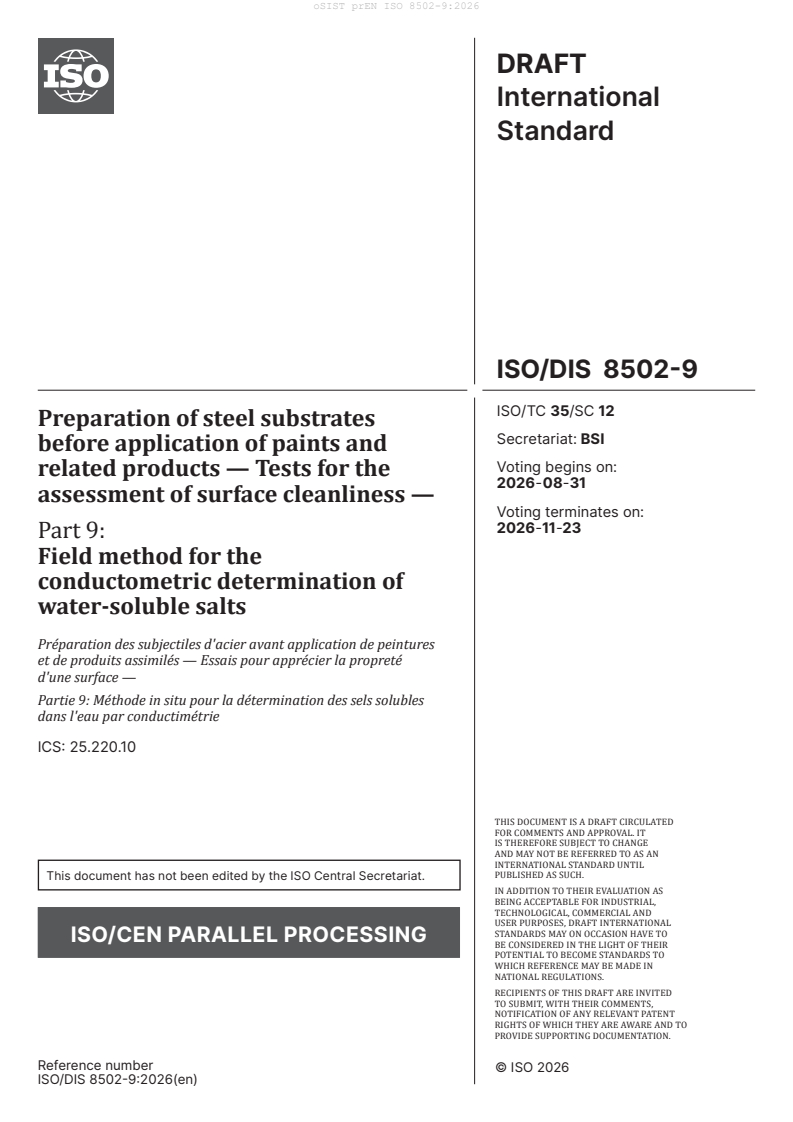
DRAFT
International
Standard
ISO/DIS 8502-9
ISO/TC 35/SC 12
Preparation of steel substrates
Secretariat: BSI
before application of paints and
Voting begins on:
related products — Tests for the
2026-08-31
assessment of surface cleanliness —
Voting terminates on:
2026-11-23
Part 9:
Field method for the
conductometric determination of
water-soluble salts
Préparation des subjectiles d'acier avant application de peintures
et de produits assimilés — Essais pour apprécier la propreté
d'une surface —
Partie 9: Méthode in situ pour la détermination des sels solubles
dans l'eau par conductimétrie
ICS: 25.220.10
THIS DOCUMENT IS A DRAFT CIRCULATED
FOR COMMENTS AND APPROVAL. IT
IS THEREFORE SUBJECT TO CHANGE
AND MAY NOT BE REFERRED TO AS AN
INTERNATIONAL STANDARD UNTIL
PUBLISHED AS SUCH.
This document has not been edited by the ISO Central Secretariat.
IN ADDITION TO THEIR EVALUATION AS
BEING ACCEPTABLE FOR INDUSTRIAL,
TECHNOLOGICAL, COMMERCIAL AND
USER PURPOSES, DRAFT INTERNATIONAL
STANDARDS MAY ON OCCASION HAVE TO
ISO/CEN PARALLEL PROCESSING
BE CONSIDERED IN THE LIGHT OF THEIR
POTENTIAL TO BECOME STANDARDS TO
WHICH REFERENCE MAY BE MADE IN
NATIONAL REGULATIONS.
RECIPIENTS OF THIS DRAFT ARE INVITED
TO SUBMIT, WITH THEIR COMMENTS,
NOTIFICATION OF ANY RELEVANT PATENT
RIGHTS OF WHICH THEY ARE AWARE AND TO
PROVIDE SUPPORTING DOCUMENTATION.
Reference number
ISO/DIS 8502-9:2026(en)
DRAFT
ISO/DIS 8502-9:2026(en)
International
Standard
ISO/DIS 8502-9
ISO/TC 35/SC 12
Preparation of steel substrates
Secretariat: BSI
before application of paints and
Voting begins on:
related products — Tests for the
2026-08-31
assessment of surface cleanliness —
Voting terminates on:
2026-11-23
Part 9:
Field method for the
conductometric determination of
water-soluble salts
Préparation des subjectiles d'acier avant application de peintures
et de produits assimilés — Essais pour apprécier la propreté
d'une surface —
Partie 9: Méthode in situ pour la détermination des sels solubles
dans l'eau par conductimétrie
ICS: 25.220.10
THIS DOCUMENT IS A DRAFT CIRCULATED
FOR COMMENTS AND APPROVAL. IT
IS THEREFORE SUBJECT TO CHANGE
AND MAY NOT BE REFERRED TO AS AN
INTERNATIONAL STANDARD UNTIL
PUBLISHED AS SUCH.
This document has not been edited by the ISO Central Secretariat.
IN ADDITION TO THEIR EVALUATION AS
BEING ACCEPTABLE FOR INDUSTRIAL,
© ISO 2026
TECHNOLOGICAL, COMMERCIAL AND
USER PURPOSES, DRAFT INTERNATIONAL
All rights reserved. Unless otherwise specified, or required in the context of its implementation, no part of this publication may
STANDARDS MAY ON OCCASION HAVE TO
ISO/CEN PARALLEL PROCESSING
be reproduced or utilized otherwise in any form or by any means, electronic or mechanical, including photocopying, or posting on
BE CONSIDERED IN THE LIGHT OF THEIR
the internet or an intranet, without prior written permission. Permission can be requested from either ISO at the address below
POTENTIAL TO BECOME STANDARDS TO
WHICH REFERENCE MAY BE MADE IN
or ISO’s member body in the country of the requester.
NATIONAL REGULATIONS.
ISO copyright office
RECIPIENTS OF THIS DRAFT ARE INVITED
CP 401 • Ch. de Blandonnet 8
TO SUBMIT, WITH THEIR COMMENTS,
CH-1214 Vernier, Geneva
NOTIFICATION OF ANY RELEVANT PATENT
Phone: +41 22 749 01 11
RIGHTS OF WHICH THEY ARE AWARE AND TO
PROVIDE SUPPORTING DOCUMENTATION.
Email: copyright@iso.org
Website: www.iso.org
Published in Switzerland Reference number
ISO/DIS 8502-9:2026(en)
ii
ISO/DIS 8502-9:2026(en)
Contents Page
Foreword .iv
Introduction .v
1 Scope . 1
2 Normative references . 1
3 Terms and definitions . 1
4 Principle . 1
5 Apparatus and materials . 1
5.1 Conductometer .1
5.2 Beaker.2
5.3 Equipment for sampling .2
5.4 Syringe .2
5.5 Solvent .2
6 Procedure . 2
6.1 Calibration .2
6.2 Preparation of water and equipment blank test .2
6.3 Sampling of salts from the steel surface .3
6.4 Conductometric measurement .3
7 Calculations . 3
7.1 Calculation of corrected volume .3
7.2 Calculation of total amount of salt on the surface .3
7.3 Examples: Standard patch A-1250 and flexible sleeve S-1000 acc. to ISO 8502-6 .4
8 Accuracy . 5
9 Test report . 6
Bibliography . 7
iii
ISO/DIS 8502-9:2026(en)
Foreword
ISO (the International Organization for Standardization) is a worldwide federation of national standards
bodies (ISO member bodies). The work of preparing International Standards is normally carried out through
ISO technical committees. Each member body interested in a subject for which a technical committee
has been established has the right to be represented on that committee. International organizations,
governmental and non-governmental, in liaison with ISO, also take part in the work. ISO collaborates closely
with the International Electrotechnical Commission (IEC) on all matters of electrotechnical standardization.
The procedures used to develop this document and those intended for its further maintenance are described
in the ISO/IEC Directives, Part 1. In particular, the different approval criteria needed for the different types
of ISO documents should be noted. This document was drafted in accordance with the editorial rules of the
ISO/IEC Directives, Part 2 (see www.iso.org/directives).
Attention is drawn to the possibility that some of the elements of this document may be the subject of patent
rights. ISO shall not be held responsible for identifying any or all such patent rights. Details of any patent
rights identified during the development of the document will be in the Introduction and/or on the ISO list of
patent declarations received (see www.iso.org/patents).
Any trade name used in this document is information given for the convenience of users and does not
constitute an endorsement.
For an explanation of the voluntary nature of standards, the meaning of ISO specific terms and expressions
related to conformity assessment, as well as information about ISO's adherence to the World Trade
Organization (WTO) principles in the Technical Barriers to Trade (TBT) see www.iso.org/iso/foreword.html.
This document was prepared by Technical Committee ISO/TC 35, Paints and varnishes, Subcommittee SC 12,
Preparation of steel substrates before application of paints and related products, in collaboration with the
European Committee for Standardization (CEN) Technical Committee CEN/TC 139, Paints and varnishes, in
accordance with the Agreement on technical cooperation between ISO and CEN (Vienna Agreement).
This thirdedition cancels and replaces the second edition (ISO 8502-9:2020), which has been technically
revised.
The main changes compared to the previous edition are as follows:
— the introduction has been revised;
— addition of new Annex A, Evaluation of results.
A list of all parts in the ISO 8502 series can be found on the ISO website.
Any feedback or questions on this document should be directed to the user’s national standards body. A
complete listing of these bodies can be found at www.iso.org/members.html.
iv
ISO/DIS 8502-9:2026(en)
Introduction
The performance of protective coatings of paint and related products applied to steel is significantly
affected by the state of the steel surface immediately prior to painting. The principal factors that are known
to influence this performance are:
a) the presence of rust and mill scale;
b) the presence of surface contaminants, including salts, dust, oils and greases;
c) the surface profiles.
ISO 8501, ISO 8502 and ISO 8503 have been prepared to provide methods of assessing these factors, while
ISO 8504 provides guidance on the preparation methods that are available for cleaning steel substrates,
indicating the capabilities of each in attaining specified levels of cleanliness.
These International Standards do not contain recommendations for the protective coating systems to be
applied to the steel surface. Neither do they contain recommendations for the surface quality requirements
for specific situations even though surface quality can have a direct influence on the choice of protective
coating to be applied and on its performance. Such recommendations are found in other documents such as
national standards and codes of practice. It is be necessary for the users of these International Standards to
ensure that the qualities specified are:
— compatible and appropriate both for the environmental conditions to which the steel is exposed and for
the protective coating system to be used, and
— within the capability of the cleaning procedure specified.
The four International Standards referred to above deal with the following aspects of preparation of steel
substrates before application of paints and related products:
— ISO 8501, Visual assessment of surface cleanliness;
— ISO 8502, Tests for the assessment of surface cleanliness;
— ISO 8503, Surface roughness characteristics of blast-cleaned steel substrates;
— ISO 8504, Surface preparation methods.
Each of these International Standards is in turn divided into separate parts.
This document describes a field method for the assessment of the total amount of water-soluble salts by
conductometric determination, the salts being reported as one value. Conductivity can be caused by multiple
salts. These can include both corrosion-promoting salts such as chlorides
...